Chapter 29
A Few Sample Bricks
WE passed through the Plum Point region, turned Craighead's Point, and glided unchallenged by what was once the formidable Fort Pillow, memorable because of the massacre perpetrated there during the war. Massacres are sprinkled with some frequency through the histories of several Christian nations, but this is almost the only one that can be found in American history; perhaps it is the only one which rises to a size correspondent to that huge and somber title. We have the 'Boston Massacre,' where two or three people were killed; but we must bunch Anglo-Saxon history together to find the fellow to the Fort Pillow tragedy; and doubtless even then we must travel back to the days and the performances of Coeur de Lion, that fine 'hero,' before we accomplish it.
We passed through the Plum Point region, rounded Craighead's Point, and glided unchallenged past what was once the formidable Fort Pillow. The fort is remembered for the massacre carried out there during the war. Massacres occur fairly often in the histories of several Christian nations, but this is almost the only one found in American history. Perhaps it is the only one large enough to deserve that huge and somber title. We have the 'Boston Massacre,' where two or three people were killed. But we must look across all of Anglo-Saxon history to find a match for the Fort Pillow tragedy. Even then, we must doubtless go back to the days and deeds of Coeur de Lion, that fine 'hero,' before we find one.
More of the river's freaks. In times past, the channel used to strike above Island 37, by Brandywine Bar, and down towards Island 39. Afterward, changed its course and went from Brandywine down through Vogelman's chute in the Devil's Elbow, to Island 39—part of this course reversing the old order; the river running up four or five miles, instead of down, and cutting off, throughout, some fifteen miles of distance. This in 1876. All that region is now called Centennial Island.
More of the river's odd tricks. In the past, the channel used to run above Island 37, by Brandywine Bar, and down toward Island 39. Later, the river changed course, running from Brandywine through Vogelman's chute in the Devil's Elbow to Island 39. Part of this course reversed the old route. The river ran up four or five miles instead of down, shortening the total distance by some fifteen miles. This was in 1876. All that region is now called Centennial Island.
There is a tradition that Island 37 was one of the principal abiding places of the once celebrated 'Murel's Gang.' This was a colossal combination of robbers, horse-thieves, negro-stealers, and counterfeiters, engaged in business along the river some fifty or sixty years ago. While our journey across the country towards St. Louis was in progress we had had no end of Jesse James and his stirring history; for he had just been assassinated by an agent of the Governor of Missouri, and was in consequence occupying a good deal of space in the newspapers. Cheap histories of him were for sale by train boys. According to these, he was the most marvelous creature of his kind that had ever existed. It was a mistake. Murel was his equal in boldness; in pluck; in rapacity; in cruelty, brutality, heartlessness, treachery, and in general and comprehensive vileness and shamelessness; and very much his superior in some larger aspects. James was a retail rascal; Murel, wholesale. James's modest genius dreamed of no loftier flight than the planning of raids upon cars, coaches, and country banks; Murel projected negro insurrections and the capture of New Orleans; and furthermore, on occasion, this Murel could go into a pulpit and edify the congregation. What are James and his half-dozen vulgar rascals compared with this stately old-time criminal, with his sermons, his meditated insurrections and city-captures, and his majestic following of ten hundred men, sworn to do his evil will!
According to tradition, Island 37 was one of the main hideouts of the once famous 'Murel's Gang.' This was a huge organization of robbers, horse thieves, kidnappers of Black people, and counterfeiters. They operated along the river some fifty or sixty years ago. During our journey across the country toward St. Louis, we heard endless accounts of Jesse James and his thrilling history. An agent of the Governor of Missouri had just assassinated him, so the newspapers were giving him a lot of space. Boys on the train sold cheap histories of him. According to these, he was the most extraordinary criminal of his kind who had ever lived. That was a mistake. Murel was James's equal in boldness, courage, greed, cruelty, brutality, heartlessness, treachery, and all kinds of wickedness and shamelessness. In some broader respects, he was far superior. James was a small-time rascal. Murel operated on a grand scale. James's modest genius never dreamed of anything bigger than planning raids on trains, coaches, and country banks. Murel planned uprisings among enslaved Black people and the capture of New Orleans. On occasion, Murel could also step into a pulpit and deliver an uplifting sermon to the congregation. What are James and his half-dozen common rascals compared with this grand criminal of the old days? Murel had his sermons, his planned uprisings and captures of cities, and his magnificent following of a thousand men, sworn to do his evil bidding!
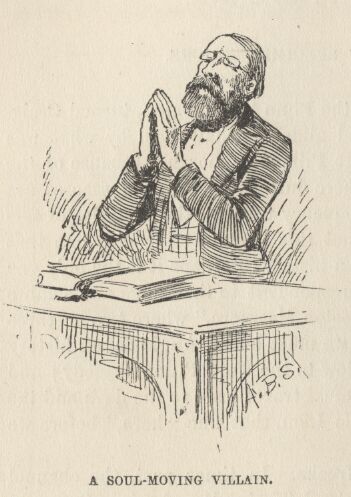
Here is a paragraph or two concerning this big operator, from a now forgotten book which was published half a century ago—
Here are a paragraph or two about this big operator, from a now-forgotten book published half a century ago:
He appears to have been a most dexterous as well as consummate villain. When he traveled, his usual disguise was that of an itinerant preacher; and it is said that his discourses were very 'soul-moving'—interesting the hearers so much that they forgot to look after their horses, which were carried away by his confederates while he was preaching. But the stealing of horses in one State, and selling them in another, was but a small portion of their business; the most lucrative was the enticing slaves to run away from their masters, that they might sell them in another quarter. This was arranged as follows; they would tell a negro that if he would run away from his master, and allow them to sell him, he should receive a portion of the money paid for him, and that upon his return to them a second time they would send him to a free State, where he would be safe.
He seems to have been an extremely skilled and accomplished villain. When he traveled, he usually disguised himself as a traveling preacher. His sermons were said to be very 'soul-moving'. They interested his listeners so much that they forgot to watch their horses. While he preached, his accomplices stole the horses. But stealing horses in one state and selling them in another was only a small part of their business. Their most profitable business was persuading enslaved people to run away from their masters so they could sell them elsewhere. They arranged it like this: they would tell an enslaved person to run away from his master and let them sell him. If he did, they would give him a share of the money paid for him. They also promised that if he returned to them a second time, they would send him to a free state, where he would be safe.
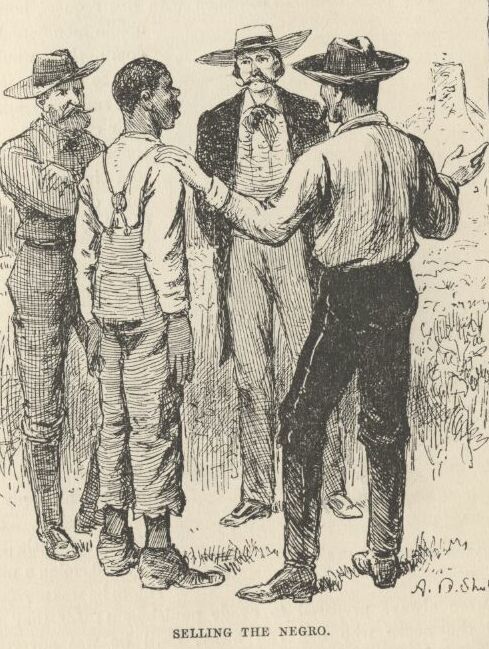
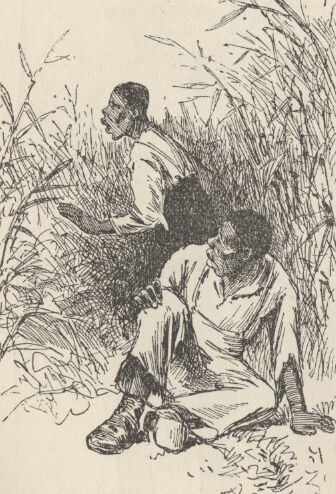
The poor wretches complied with this request, hoping to obtain money and freedom; they would be sold to another master, and run away again, to their employers; sometimes they would be sold in this manner three or four times, until they had realized three or four thousand dollars by them; but as, after this, there was fear of detection, the usual custom was to get rid of the only witness that could be produced against them, which was the negro himself, by murdering him, and throwing his body into the Mississippi. Even if it was established that they had stolen a negro, before he was murdered, they were always prepared to evade punishment; for they concealed the negro who had run away, until he was advertised, and a reward offered to any man who would catch him. An advertisement of this kind warrants the person to take the property, if found. And then the negro becomes a property in trust, when, therefore, they sold the negro, it only became a breach of trust, not stealing; and for a breach of trust, the owner of the property can only have redress by a civil action, which was useless, as the damages were never paid. It may be inquired, how it was that Murel escaped Lynch law under such circumstances This will be easily understood when it is stated that he had more than a thousand sworn confederates, all ready at a moment's notice to support any of the gang who might be in trouble. The names of all the principal confederates of Murel were obtained from himself, in a manner which I shall presently explain. The gang was composed of two classes: the Heads or Council, as they were called, who planned and concerted, but seldom acted; they amounted to about four hundred. The other class were the active agents, and were termed strikers, and amounted to about six hundred and fifty. These were the tools in the hands of the others; they ran all the risk, and received but a small portion of the money; they were in the power of the leaders of the gang, who would sacrifice them at any time by handing them over to justice, or sinking their bodies in the Mississippi. The general rendezvous of this gang of miscreants was on the Arkansas side of the river, where they concealed their negroes in the morasses and cane-brakes.
The poor wretches did as they were asked, hoping to gain money and freedom. They would be sold to another master, then run away again to their employers. Sometimes they were sold this way three or four times, until their employers had made three or four thousand dollars from them. After that, however, the employers feared being caught. So they usually got rid of the only witness who could testify against them, the enslaved person himself. They murdered him and threw his body into the Mississippi. Even if it was established that they had stolen an enslaved person before he was murdered, they were always prepared to escape punishment. They hid the person who had run away until his owner placed an advertisement offering a reward to anyone who caught him. Such an advertisement authorized the person who found him to take possession of him as property. The enslaved person then became property held in trust. So when they sold him, it was only a breach of trust, not theft. For a breach of trust, the owner could seek redress only through a civil action. That was useless, because the damages were never paid. One might ask how Murel escaped Lynch law under such circumstances. The answer is easy to understand once you know that he had more than a thousand sworn confederates. They were all ready at a moment's notice to support any gang member who got into trouble. The names of all Murel's principal confederates were obtained from Murel himself, in a way I shall explain shortly. The gang was made up of two classes. The Heads, or Council, as they were called, planned and coordinated, but seldom took action. They numbered about four hundred. The other class consisted of the active agents, who were called strikers and numbered about six hundred and fifty. They were tools in the hands of the others. They took all the risks and received only a small share of the money. They were at the mercy of the gang's leaders, who would sacrifice them at any time. The leaders would either hand them over to justice or sink their bodies in the Mississippi. The gang of villains generally met on the Arkansas side of the river, where they hid the enslaved people in the swamps and cane thickets.
The depredations of this extensive combination were severely felt; but so well were their plans arranged, that although Murel, who was always active, was everywhere suspected, there was no proof to be obtained. It so happened, however, that a young man of the name of Stewart, who was looking after two slaves which Murel had decoyed away, fell in with him and obtained his confidence, took the oath, and was admitted into the gang as one of the General Council. By this means all was discovered; for Stewart turned traitor, although he had taken the oath, and having obtained every information, exposed the whole concern, the names of all the parties, and finally succeeded in bringing home sufficient evidence against Murel, to procure his conviction and sentence to the Penitentiary (Murel was sentenced to fourteen years' imprisonment); so many people who were supposed to be honest, and bore a respectable name in the different States, were found to be among the list of the Grand Council as published by Stewart, that every attempt was made to throw discredit upon his assertions—his character was vilified, and more than one attempt was made to assassinate him. He was obliged to quit the Southern States in consequence. It is, however, now well ascertained to have been all true; and although some blame Mr. Stewart for having violated his oath, they no longer attempt to deny that his revelations were correct. I will quote one or two portions of Murel's confessions to Mr. Stewart, made to him when they were journeying together. I ought to have observed, that the ultimate intentions of Murel and his associates were, by his own account, on a very extended scale; having no less an object in view than raising the blacks against the whites, taking possession of, and plundering new orleans, and making themselves possessors of the territory. The following are a few extracts:—
The crimes of this extensive organization were felt severely. But its plans were so well arranged that no proof could be obtained, although Murel was always active and suspected everywhere. A young man named Stewart happened to be searching for two enslaved people whom Murel had lured away. Stewart met Murel and gained his confidence. He took the oath and was admitted to the gang as a member of the General Council. In this way, everything was discovered. Although Stewart had taken the oath, he betrayed the gang. After gathering all the information he could, he exposed the whole operation and named everyone involved. He finally obtained enough evidence against Murel to secure his conviction and sentence to the Penitentiary. (Murel was sentenced to fourteen years in prison.) Stewart published a list of the Grand Council. It included so many people who were thought honest and had respectable names in different States that every effort was made to discredit his claims. His character was attacked, and more than one attempt was made to assassinate him. As a result, he was forced to leave the Southern States. It is now well established, however, that it was all true. Although some blame Mr. Stewart for breaking his oath, they no longer try to deny that his revelations were correct. I will quote one or two passages from Murel's confessions to Mr. Stewart, made while they were traveling together. I should have mentioned that, by Murel's own account, the ultimate plans of Murel and his associates were very ambitious. Their aim was nothing less than raising the blacks against the whites, taking possession of and plundering new orleans, and making themselves owners of the territory. Here are a few extracts:
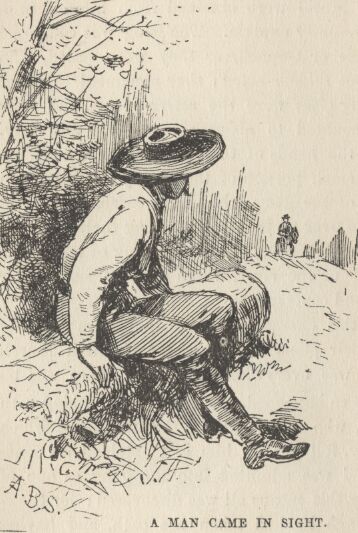
'I collected all my friends about New Orleans at one of our friends' houses in that place, and we sat in council three days before we got all our plans to our notion; we then determined to undertake the rebellion at every hazard, and make as many friends as we could for that purpose. Every man's business being assigned him, I started to Natchez on foot, having sold my horse in New Orleans,—with the intention of stealing another after I started. I walked four days, and no opportunity offered for me to get a horse. The fifth day, about twelve, I had become tired, and stopped at a creek to get some water and rest a little. While I was sitting on a log, looking down the road the way that I had come, a man came in sight riding on a good-looking horse. The very moment I saw him, I was determined to have his horse, if he was in the garb of a traveler. He rode up, and I saw from his equipage that he was a traveler. I arose and drew an elegant rifle pistol on him and ordered him to dismount. He did so, and I took his horse by the bridle and pointed down the creek, and ordered him to walk before me. He went a few hundred yards and stopped. I hitched his horse, and then made him undress himself, all to his shirt and drawers, and ordered him to turn his back to me. He said, 'If you are determined to kill me, let me have time to pray before I die,' I told him I had no time to hear him pray. He turned around and dropped on his knees, and I shot him through the back of the head.
'I gathered all my friends around New Orleans at one of our friends' houses there. We spent three days discussing our plans before we had them just as we wanted. We then decided to undertake the rebellion at every risk and make as many friends as we could for that purpose. Once each man had been assigned his task, I set out on foot for Natchez. I had sold my horse in New Orleans, intending to steal another after I set out. I walked for four days without a chance to get a horse. On the fifth day, around noon, I was tired and stopped at a creek to drink and rest. I sat on a log, looking back down the road I had traveled. A man came into view, riding a good-looking horse. The moment I saw him, I decided to take his horse if he was dressed as a traveler. He rode closer, and I could see from his gear that he was a traveler. I stood up, pointed a fine rifle pistol at him, and ordered him to dismount. He did, and I took his horse by the bridle. I pointed down the creek and ordered him to walk ahead of me. He went a few hundred yards and stopped. I tied up his horse, then made him strip down to his shirt and drawers. I ordered him to turn his back to me. He said, 'If you are determined to kill me, let me have time to pray before I die,' I told him I had no time to hear him pray. He turned around and dropped to his knees, and I shot him through the back of the head.
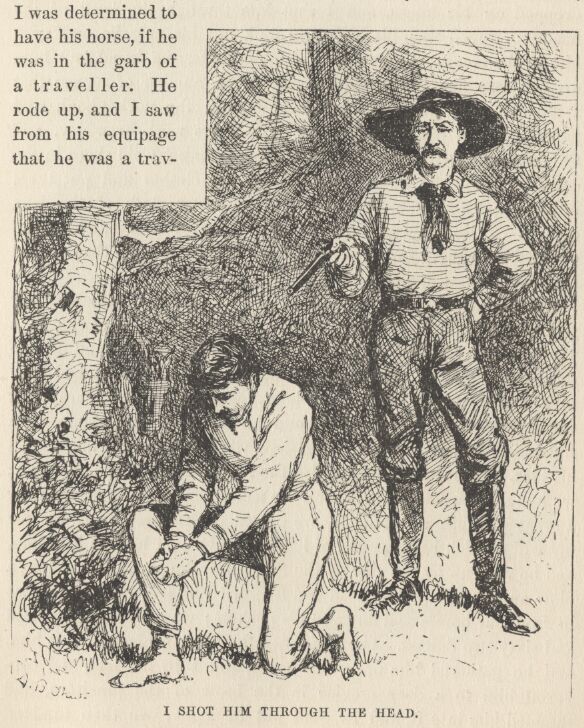
I ripped open his belly and took out his entrails, and sunk him in the creek. I then searched his pockets, and found four hundred dollars and thirty-seven cents, and a number of papers that I did not take time to examine. I sunk the pocket-book and papers and his hat, in the creek. His boots were brand-new, and fitted me genteelly; and I put them on and sunk my old shoes in the creek, to atone for them. I rolled up his clothes and put them into his portmanteau, as they were brand-new cloth of the best quality. I mounted as fine a horse as ever I straddled, and directed my course for Natchez in much better style than I had been for the last five days.
I ripped open his belly, took out his guts, and sank him in the creek. Then I searched his pockets. I found four hundred dollars and thirty-seven cents, along with several papers I did not take time to examine. I sank his wallet, the papers, and his hat in the creek. His boots were brand-new and fit me nicely. I put them on and sank my old shoes in the creek to make up for taking them. I rolled up his clothes and put them in his suitcase because they were brand-new and made of the best cloth. I mounted as fine a horse as I had ever ridden and headed for Natchez in much better style than I had traveled for the past five days.
'Myself and a fellow by the name of Crenshaw gathered four good horses and started for Georgia. We got in company with a young South Carolinian just before we got to Cumberland Mountain, and Crenshaw soon knew all about his business. He had been to Tennessee to buy a drove of hogs, but when he got there pork was dearer than he calculated, and he declined purchasing. We concluded he was a prize. Crenshaw winked at me; I understood his idea. Crenshaw had traveled the road before, but I never had; we had traveled several miles on the mountain, when he passed near a great precipice; just before we passed it Crenshaw asked me for my whip, which had a pound of lead in the butt; I handed it to him, and he rode up by the side of the South Carolinian, and gave him a blow on the side of the head and tumbled him from his horse; we lit from our horses and fingered his pockets; we got twelve hundred and sixty-two dollars. Crenshaw said he knew a place to hide him, and he gathered him under his arms, and I by his feet, and conveyed him to a deep crevice in the brow of the precipice, and tumbled him into it, and he went out of sight; we then tumbled in his saddle, and took his horse with us, which was worth two hundred dollars.
'Crenshaw and I gathered four good horses and set out for Georgia. Just before reaching Cumberland Mountain, we joined a young man from South Carolina. Crenshaw soon learned all about his business. The young man had gone to Tennessee to buy a drove of hogs. But pork cost more than he had expected, so he decided not to buy any. We decided he was a prize. Crenshaw winked at me, and I understood his idea. Crenshaw had traveled that road before, but I had never been on it. We had ridden several miles along the mountain when the road passed near a great precipice. Just before we reached it, Crenshaw asked for my whip, which had a pound of lead in the handle. I handed it to him. He rode up beside the South Carolinian and struck him on the side of the head, knocking him from his horse. We got off our horses and searched his pockets. We found twelve hundred and sixty-two dollars. Crenshaw said he knew a place to hide him. He grabbed the man under the arms, and I took him by the feet. We carried him to a deep crevice at the edge of the precipice and threw him in. He disappeared from sight. Then we threw in his saddle and took his horse with us. The horse was worth two hundred dollars.
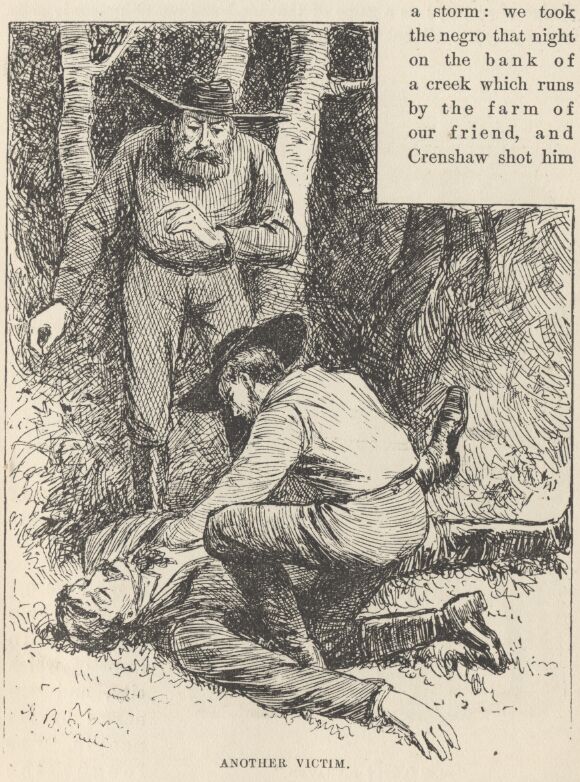
'We were detained a few days, and during that time our friend went to a little village in the neighborhood and saw the negro advertised (a negro in our possession), and a description of the two men of whom he had been purchased, and giving his suspicions of the men. It was rather squally times, but any port in a storm: we took the negro that night on the bank of a creek which runs by the farm of our friend, and Crenshaw shot him through the head. We took out his entrails and sunk him in the creek.
'We were held up for a few days. During that time, our friend went to a nearby village. There he saw a notice about the Black man in our possession. It described the two men from whom he had been bought and expressed suspicions about them. Things were getting rough, but any port in a storm. That night, we took the man to the bank of a creek that ran past our friend's farm. Crenshaw shot him through the head. We removed his entrails and sank him in the creek.
'He had sold the other negro the third time on Arkansaw River for upwards of five hundred dollars; and then stole him and delivered him into the hand of his friend, who conducted him to a swamp, and veiled the tragic scene, and got the last gleanings and sacred pledge of secrecy; as a game of that kind will not do unless it ends in a mystery to all but the fraternity. He sold the negro, first and last, for nearly two thousand dollars, and then put him for ever out of the reach of all pursuers; and they can never graze him unless they can find the negro; and that they cannot do, for his carcass has fed many a tortoise and catfish before this time, and the frogs have sung this many a long day to the silent repose of his skeleton.'
'He had sold the other Black man for the third time on the Arkansaw River, for more than five hundred dollars. Then he stole him and handed him over to his friend. His friend took him to a swamp, concealed the tragic scene, and got the last scraps of money and a solemn pledge of secrecy. A scheme like that will not work unless it ends in a mystery to everyone outside the fraternity. In all, he sold the man for nearly two thousand dollars. Then he put him forever beyond the reach of all pursuers. They can never touch him unless they can find the Black man. And they cannot do that, for his body has fed many a tortoise and catfish by now. For many a long day, the frogs have sung over his skeleton as it rests in silence.'
We were approaching Memphis, in front of which city, and witnessed by its people, was fought the most famous of the river battles of the Civil War. Two men whom I had served under, in my river days, took part in that fight: Mr. Bixby, head pilot of the Union fleet, and Montgomery, Commodore of the Confederate fleet. Both saw a great deal of active service during the war, and achieved high reputations for pluck and capacity.
We were approaching Memphis, where the most famous river battle of the Civil War was fought. The battle took place in front of the city, and its people watched it. Two men I had served under during my river days took part in the battle: Mr. Bixby, head pilot of the Union fleet, and Montgomery, Commodore of the Confederate fleet. Both saw a great deal of active service during the war. Both earned strong reputations for courage and ability.
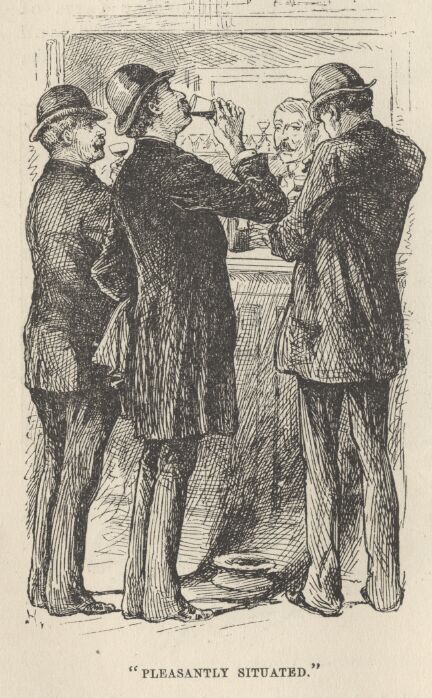
As we neared Memphis, we began to cast about for an excuse to stay with the 'Gold Dust' to the end of her course—Vicksburg. We were so pleasantly situated, that we did not wish to make a change. I had an errand of considerable importance to do at Napoleon, Arkansas, but perhaps I could manage it without quitting the 'Gold Dust.' I said as much; so we decided to stick to present quarters.
As we neared Memphis, we began looking for an excuse to stay aboard the 'Gold Dust' all the way to Vicksburg, the end of her route. We were so comfortable that we did not want to change boats. I had a very important errand in Napoleon, Arkansas, but perhaps I could take care of it without leaving the 'Gold Dust.' I said so, and we decided to stay aboard.
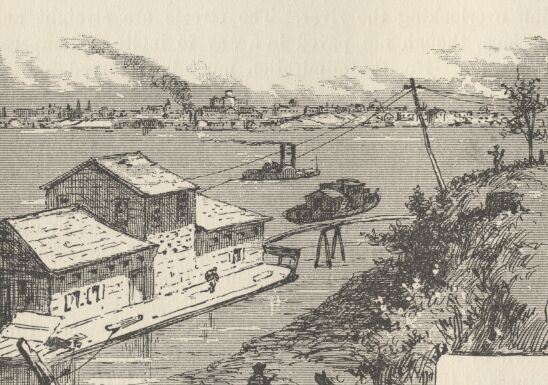
The boat was to tarry at Memphis till ten the next morning. It is a beautiful city, nobly situated on a commanding bluff overlooking the river. The streets are straight and spacious, though not paved in a way to incite distempered admiration. No, the admiration must be reserved for the town's sewerage system, which is called perfect; a recent reform, however, for it was just the other way, up to a few years ago—a reform resulting from the lesson taught by a desolating visitation of the yellow-fever. In those awful days the people were swept off by hundreds, by thousands; and so great was the reduction caused by flight and by death together, that the population was diminished three-fourths, and so remained for a time. Business stood nearly still, and the streets bore an empty Sunday aspect.
The boat was to stay at Memphis until ten the next morning. Memphis is a beautiful city, splendidly situated on a high bluff overlooking the river. The streets are straight and spacious, though their paving is hardly enough to stir up wild admiration. No, that admiration must be saved for the city's sewer system, which is said to be perfect. The sewer system was reformed only recently, however. Until a few years ago, it was just the opposite of perfect. The reform followed the lesson taught by a devastating outbreak of yellow fever. In those awful days, people died by the hundreds, by the thousands. So many people fled or died that the population fell by three-fourths and stayed that low for a time. Business nearly stopped, and the streets had the empty look of a Sunday.
Here is a picture of Memphis, at that disastrous time, drawn by a German tourist who seems to have been an eye-witness of the scenes which he describes. It is from Chapter VII, of his book, just published, in Leipzig, 'Mississippi-Fahrten, von Ernst von Hesse-Wartegg.'—
Here is a picture of Memphis at that disastrous time, drawn by a German tourist. He seems to have witnessed the scenes he describes. The account comes from Chapter VII of his book, just published in Leipzig, 'Mississippi-Fahrten, von Ernst von Hesse-Wartegg':
'In August the yellow-fever had reached its extremest height. Daily, hundreds fell a sacrifice to the terrible epidemic. The city was become a mighty graveyard, two-thirds of the population had deserted the place, and only the poor, the aged and the sick, remained behind, a sure prey for the insidious enemy. The houses were closed: little lamps burned in front of many—a sign that here death had entered. Often, several lay dead in a single house; from the windows hung black crape. The stores were shut up, for their owners were gone away or dead.
'In August, yellow fever reached its peak. Every day, hundreds died from the terrible epidemic. The city had become a vast graveyard. Two-thirds of the population had fled, leaving only the poor, the elderly, and the sick behind. They were sure prey for the insidious enemy. The houses were closed. Small lamps burned in front of many houses, a sign that death had entered. Often, several people lay dead in a single house. Black crape hung from the windows. The stores were closed because their owners had gone away or died.
'Fearful evil! In the briefest space it struck down and swept away even the most vigorous victim. A slight indisposition, then an hour of fever, then the hideous delirium, then—the Yellow Death! On the street corners, and in the squares, lay sick men, suddenly overtaken by the disease; and even corpses, distorted and rigid. Food failed. Meat spoiled in a few hours in the fetid and pestiferous air, and turned black.
'What a terrible evil! In no time, it struck down and swept away even the strongest victims. First came a slight illness, then an hour of fever, then the terrible delirium, then the Yellow Death! Sick men lay on street corners and in public squares, suddenly struck down by the disease. Corpses lay there too, twisted and stiff. Food ran out. Meat spoiled within hours in the foul, disease-ridden air and turned black.
'Fearful clamors issue from many houses; then after a season they cease, and all is still: noble, self-sacrificing men come with the coffin, nail it up, and carry it away, to the graveyard. In the night stillness reigns. Only the physicians and the hearses hurry through the streets; and out of the distance, at intervals, comes the muffled thunder of the railway train, which with the speed of the wind, and as if hunted by furies, flies by the pest-ridden city without halting.'
'Terrible cries come from many houses. After a while, they stop, and all is quiet. Noble, self-sacrificing men come with a coffin, nail it shut, and carry it to the graveyard. At night, all is still. Only the doctors and hearses hurry through the streets. From time to time, the muffled thunder of a train comes from the distance. It races past the plague-stricken city without stopping, as fast as the wind and as if hunted by furies.'
But there is life enough there now. The population exceeds forty thousand and is augmenting, and trade is in a flourishing condition. We drove about the city; visited the park and the sociable horde of squirrels there; saw the fine residences, rose-clad and in other ways enticing to the eye; and got a good breakfast at the hotel.
But there is plenty of life there now. The population is over forty thousand and growing, and trade is thriving. We drove around the city and visited the park and its friendly horde of squirrels. We saw fine homes, covered in roses and pleasing to the eye in other ways. We also had a good breakfast at the hotel.
A thriving place is the Good Samaritan City of the Mississippi: has a great wholesale jobbing trade; foundries, machine shops; and manufactories of wagons, carriages, and cotton-seed oil; and is shortly to have cotton mills and elevators.
The Good Samaritan City of the Mississippi is a thriving place. It has a large wholesale trade, foundries, and machine shops. It also has factories that make wagons, carriages, and cottonseed oil. Cotton mills and grain elevators will soon follow.
Her cotton receipts reached five hundred thousand bales last year—an increase of sixty thousand over the year before. Out from her healthy commercial heart issue five trunk lines of railway; and a sixth is being added.
Her cotton receipts reached five hundred thousand bales last year, an increase of sixty thousand over the year before. Five main railway lines run out from her thriving commercial heart, and a sixth is being added.
This is a very different Memphis from the one which the vanished and unremembered procession of foreign tourists used to put into their books long time ago. In the days of the now forgotten but once renowned and vigorously hated Mrs. Trollope, Memphis seems to have consisted mainly of one long street of log-houses, with some outlying cabins sprinkled around rearward toward the woods; and now and then a pig, and no end of mud. That was fifty-five years ago. She stopped at the hotel. Plainly it was not the one which gave us our breakfast. She says—
This Memphis is very different from the one described long ago by a procession of foreign tourists, now gone and forgotten. In the days of Mrs. Trollope, Memphis seems to have consisted mainly of one long street of log houses. Mrs. Trollope was once famous and intensely hated, but is now forgotten. A few cabins stood farther back, scattered toward the woods. There was an occasional pig and endless mud. That was fifty-five years ago. She stayed at the hotel. Clearly, it was not the one that served us breakfast. She says:
'The table was laid for fifty persons, and was nearly full. They ate in perfect silence, and with such astonishing rapidity that their dinner was over literally before ours was begun; the only sounds heard were those produced by the knives and forks, with the unceasing chorus of coughing, etc.'
'The table was set for fifty people and was nearly full. They ate in complete silence and so astonishingly fast that they had literally finished dinner before we had begun ours. The only sounds were the clatter of knives and forks and the constant chorus of coughing, etc.'
'Coughing, etc.' The 'etc.' stands for an unpleasant word there, a word which she does not always charitably cover up, but sometimes prints. You will find it in the following description of a steamboat dinner which she ate in company with a lot of aristocratic planters; wealthy, well-born, ignorant swells they were, tinselled with the usual harmless military and judicial titles of that old day of cheap shams and windy pretense—
'Coughing, etc.' The 'etc.' stands for an unpleasant word. She does not always charitably cover up the word, but sometimes prints it. You will find it in her description of a steamboat dinner she ate with a group of aristocratic planters. They were wealthy, well-born, ignorant snobs, decked out with the usual harmless military and judicial titles. Those were the old days of cheap shams and empty pretension:
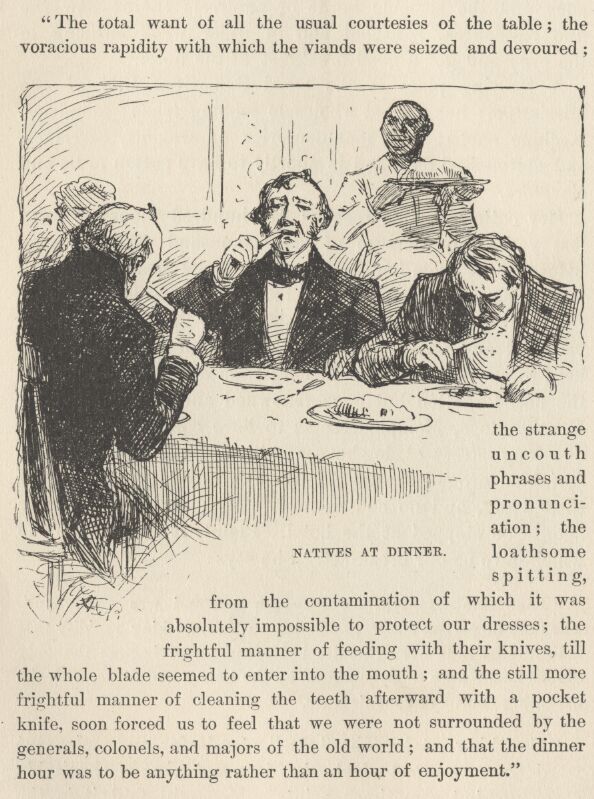
'The total want of all the usual courtesies of the table; the voracious rapidity with which the viands were seized and devoured; the strange uncouth phrases and pronunciation; the loathsome spitting, from the contamination of which it was absolutely impossible to protect our dresses; the frightful manner of feeding with their knives, till the whole blade seemed to enter into the mouth; and the still more frightful manner of cleaning the teeth afterward with a pocket knife, soon forced us to feel that we were not surrounded by the generals, colonels, and majors of the old world; and that the dinner hour was to be anything rather than an hour of enjoyment.'
'There was a total lack of the usual table manners. The food was grabbed and devoured with ravenous speed. The phrases and pronunciation were strange and crude. The disgusting spitting made it absolutely impossible to keep our dresses clean. It was frightening to see them eat with their knives, until the whole blade seemed to enter their mouths. It was even more frightening to see them clean their teeth afterward with a pocketknife. All this soon made us feel that we were not surrounded by the generals, colonels, and majors of the old world. It also made us feel that the dinner hour would be anything but enjoyable.'