Chapter 28
Uncle Mumford Unloads
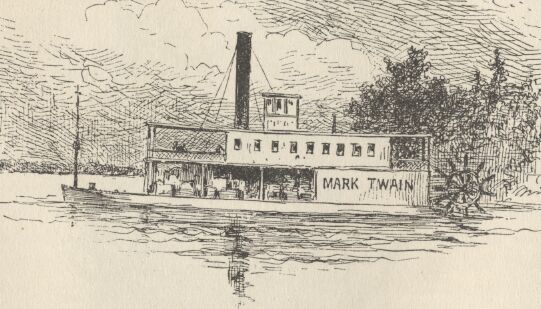
ALL day we swung along down the river, and had the stream almost wholly to ourselves. Formerly, at such a stage of the water, we should have passed acres of lumber rafts, and dozens of big coal barges; also occasional little trading-scows, peddling along from farm to farm, with the peddler's family on board; possibly, a random scow, bearing a humble Hamlet and Co. on an itinerant dramatic trip. But these were all absent. Far along in the day, we saw one steamboat; just one, and no more. She was lying at rest in the shade, within the wooded mouth of the Obion River. The spy-glass revealed the fact that she was named for me—or he was named for me, whichever you prefer. As this was the first time I had ever encountered this species of honor, it seems excusable to mention it, and at the same time call the attention of the authorities to the tardiness of my recognition of it.
All day we traveled down the river and had it almost entirely to ourselves. In the past, at that water level, we would have passed acres of lumber rafts and dozens of big coal barges. We would also have seen an occasional little trading scow, selling goods from farm to farm with the peddler's family aboard. Perhaps we would even have seen a scow carrying a humble Hamlet and company on a traveling theatrical tour. But all of these were absent. Late in the day, we saw one steamboat. Just one, and no more. She was resting in the shade at the wooded mouth of the Obion River. Through the spyglass, I saw that she was named after me. Or he was named after me, whichever you prefer. This was the first time I had ever received this kind of honor, so I hope I may be excused for mentioning it. At the same time, I would like to call the authorities' attention to how late my recognition of the honor has been.
Noted a big change in the river, at Island 21. It was a very large island, and used to be out toward mid-stream; but it is joined fast to the main shore now, and has retired from business as an island.
I noticed a big change in the river at Island 21. It was a very large island and used to lie near the middle of the river. But now it is firmly attached to the mainland and has retired from the island business.
As we approached famous and formidable Plum Point, darkness fell, but that was nothing to shudder about—in these modern times. For now the national government has turned the Mississippi into a sort of two-thousand-mile torchlight procession. In the head of every crossing, and in the foot of every crossing, the government has set up a clear-burning lamp. You are never entirely in the dark, now; there is always a beacon in sight, either before you, or behind you, or abreast. One might almost say that lamps have been squandered there. Dozens of crossings are lighted which were not shoal when they were created, and have never been shoal since; crossings so plain, too, and also so straight, that a steamboat can take herself through them without any help, after she has been through once. Lamps in such places are of course not wasted; it is much more convenient and comfortable for a pilot to hold on them than on a spread of formless blackness that won't stay still; and money is saved to the boat, at the same time, for she can of course make more miles with her rudder amidships than she can with it squared across her stern and holding her back.
As we approached the famous and formidable Plum Point, darkness fell. But these days, that was nothing to fear. The national government has turned the Mississippi into a kind of two-thousand-mile torchlight procession. It has placed a bright lamp at each end of every crossing. You are never completely in the dark now. There is always a beacon in sight, either ahead, behind, or alongside you. You might almost say lamps have been scattered there extravagantly. Dozens of crossings are lit even though they were not shallow when they were created and have never been shallow since. They are also so clear and straight that a steamboat can take herself through them unaided after one trip. Of course, lamps in such places are not wasted. It is much more convenient and comfortable for a pilot to steer by them than by a shapeless expanse of darkness that never stays still. The lamps save the boat money, too. With her rudder centered, she can travel farther than she can with it turned across her stern, slowing her down.

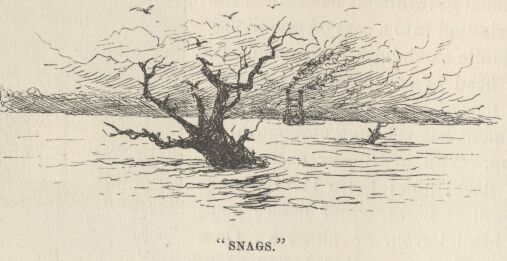
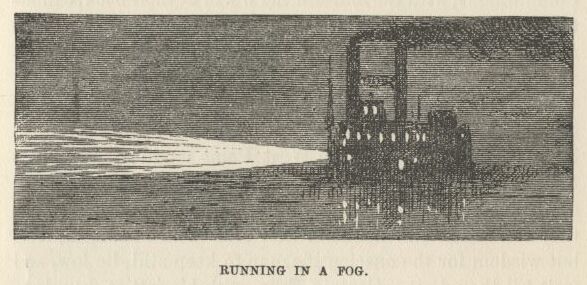
But this thing has knocked the romance out of piloting, to a large extent. It, and some other things together, have knocked all the romance out of it. For instance, the peril from snags is not now what it once was. The government's snag-boats go patrolling up and down, in these matter-of-fact days, pulling the river's teeth; they have rooted out all the old clusters which made many localities so formidable; and they allow no new ones to collect. Formerly, if your boat got away from you, on a black night, and broke for the woods, it was an anxious time with you; so was it also, when you were groping your way through solidified darkness in a narrow chute; but all that is changed now—you flash out your electric light, transform night into day in the twinkling of an eye, and your perils and anxieties are at an end. Horace Bixby and George Ritchie have charted the crossings and laid out the courses by compass; they have invented a lamp to go with the chart, and have patented the whole. With these helps, one may run in the fog now, with considerable security, and with a confidence unknown in the old days.
But this thing has taken much of the romance out of piloting. Together with some other things, it has taken all the romance out of piloting. For instance, snags are not as dangerous now as they once were. In these practical days, government snag-boats patrol up and down the river, pulling its teeth. They have cleared out the old clusters of snags that made many places so dangerous. And they let no new clusters form. In the past, if your boat got away from you on a pitch-black night and headed for the woods, you had an anxious time. So did you when you were feeling your way through solid darkness in a narrow channel. But all that has changed now. You switch on your electric light and turn night into day in an instant. Then your dangers and worries are over. Horace Bixby and George Ritchie have mapped the crossings and plotted the courses by compass. They have invented a lamp to use with the chart and patented the whole thing. With these aids, a pilot can now travel in fog with considerable safety and a confidence unknown in the old days.
With these abundant beacons, the banishment of snags, plenty of daylight in a box and ready to be turned on whenever needed, and a chart and compass to fight the fog with, piloting, at a good stage of water, is now nearly as safe and simple as driving stage, and is hardly more than three times as romantic.
Now there are plenty of beacons, the snags have been removed, and daylight comes in a box, ready to switch on whenever needed. Pilots also have a chart and compass to help them fight the fog. With all these aids, piloting when the water is at a good level is nearly as safe and simple as driving a stagecoach. And it is hardly more than three times as romantic.
And now in these new days, these days of infinite change, the Anchor Line have raised the captain above the pilot by giving him the bigger wages of the two. This was going far, but they have not stopped there. They have decreed that the pilot shall remain at his post, and stand his watch clear through, whether the boat be under way or tied up to the shore. We, that were once the aristocrats of the river, can't go to bed now, as we used to do, and sleep while a hundred tons of freight are lugged aboard; no, we must sit in the pilot-house; and keep awake, too. Verily we are being treated like a parcel of mates and engineers. The Government has taken away the romance of our calling; the Company has taken away its state and dignity.
Now, in these new days of endless change, the Anchor Line has raised the captain above the pilot. It pays the captain more than the pilot. That was going far, but the company has not stopped there. It has ordered pilots to stay at their posts for their entire watches, whether the boat is moving or tied up at shore. We were once the aristocrats of the river. Now we can't go to bed and sleep while a hundred tons of freight are hauled aboard, as we used to. No, we must sit in the pilothouse and stay awake, too. We are being treated like a bunch of mates and engineers. The Government has taken away the romance of our calling. The Company has taken away its prestige and dignity.
Plum Point looked as it had always looked by night, with the exception that now there were beacons to mark the crossings, and also a lot of other lights on the Point and along its shore; these latter glinting from the fleet of the United States River Commission, and from a village which the officials have built on the land for offices and for the employees of the service. The military engineers of the Commission have taken upon their shoulders the job of making the Mississippi over again—a job transcended in size by only the original job of creating it. They are building wing-dams here and there, to deflect the current; and dikes to confine it in narrower bounds; and other dikes to make it stay there; and for unnumbered miles along the Mississippi, they are felling the timber-front for fifty yards back, with the purpose of shaving the bank down to low-water mark with the slant of a house roof, and ballasting it with stones; and in many places they have protected the wasting shores with rows of piles. One who knows the Mississippi will promptly aver—not aloud, but to himself—that ten thousand River Commissions, with the mines of the world at their back, cannot tame that lawless stream, cannot curb it or confine it, cannot say to it, Go here, or Go there, and make it obey; cannot save a shore which it has sentenced; cannot bar its path with an obstruction which it will not tear down, dance over, and laugh at. But a discreet man will not put these things into spoken words; for the West Point engineers have not their superiors anywhere; they know all that can be known of their abstruse science; and so, since they conceive that they can fetter and handcuff that river and boss him, it is but wisdom for the unscientific man to keep still, lie low, and wait till they do it. Captain Eads, with his jetties, has done a work at the mouth of the Mississippi which seemed clearly impossible; so we do not feel full confidence now to prophesy against like impossibilities. Otherwise one would pipe out and say the Commission might as well bully the comets in their courses and undertake to make them behave, as try to bully the Mississippi into right and reasonable conduct.
Plum Point looked as it always had at night, except that beacons now marked the crossings. Many other lights shone on the Point and along its shore. These came from the United States River Commission’s fleet and from a village the officials had built on land. The village housed offices and employees of the service. The Commission’s military engineers have taken on the job of remaking the Mississippi. Only the original job of creating the river was bigger. They are building wing-dams here and there to redirect the current. They are also building dikes to confine it within narrower bounds, and other dikes to keep it there. Along countless miles of the Mississippi, they are clearing the trees for fifty yards back from the bank. They plan to shave the bank down to the low-water mark at the slope of a house roof. Then they will weight it down with stones. In many places, they have protected the eroding shores with rows of piles. Anyone who knows the Mississippi will promptly declare, though only to himself, that ten thousand River Commissions could not tame it. Even with the world’s mines behind them, they could not curb or confine that lawless stream. They could not tell it to go here or there and make it obey. They could not save a shore the river had sentenced. They could not block its path with anything it would not tear down, dance over, and laugh at. But a discreet man will not say these things aloud. The West Point engineers have no superiors anywhere. They know all that can be known of their difficult science. And since they believe they can chain and handcuff the river and boss him, the unscientific man would be wise to keep quiet. He should lie low and wait until they do it. Captain Eads, with his jetties, has done work at the mouth of the Mississippi that seemed clearly impossible. So we no longer feel entirely confident predicting that similar impossibilities will not happen. Otherwise, one would speak up and say the Commission might as well bully the comets in their courses and make them behave. That would be as sensible as trying to bully the Mississippi into right and reasonable conduct.
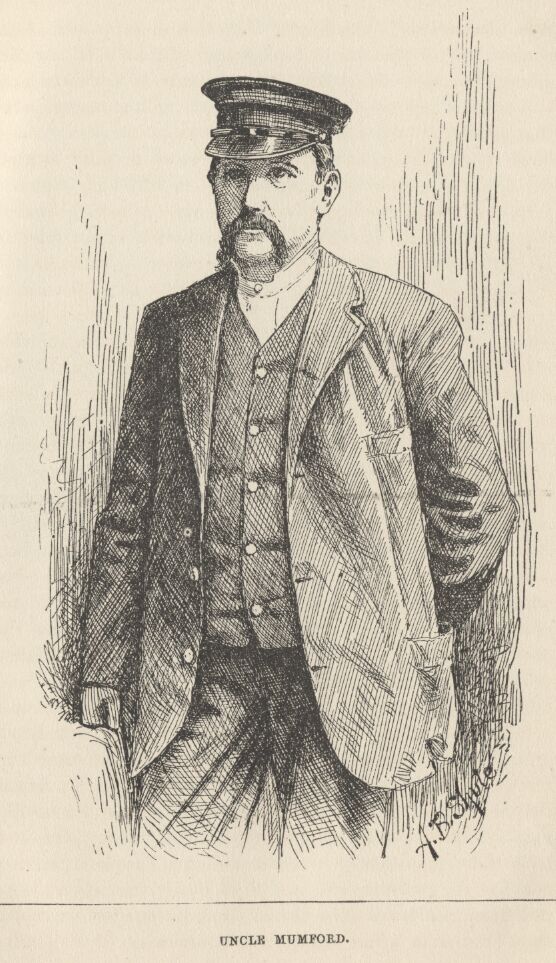
I consulted Uncle Mumford concerning this and cognate matters; and I give here the result, stenographically reported, and therefore to be relied on as being full and correct; except that I have here and there left out remarks which were addressed to the men, such as 'where in blazes are you going with that barrel now?' and which seemed to me to break the flow of the written statement, without compensating by adding to its information or its clearness. Not that I have ventured to strike out all such interjections; I have removed only those which were obviously irrelevant; wherever one occurred which I felt any question about, I have judged it safest to let it remain.
I consulted Uncle Mumford about this and related matters. I give the results here, recorded in shorthand, so they can be trusted to be complete and accurate. I have, however, left out some remarks addressed to the men, such as 'where in blazes are you going with that barrel now?' These seemed to interrupt the flow of the written account without making it more informative or clear. Not that I dared remove all such interjections. I removed only those that were obviously irrelevant. Whenever I had any doubt about one, I thought it safest to leave it in.
UNCLE MUMFORD'S IMPRESSIONS
UNCLE MUMFORD'S IMPRESSIONS
Uncle Mumford said—
Uncle Mumford said:
'As long as I have been mate of a steamboat—thirty years—I have watched this river and studied it. Maybe I could have learnt more about it at West Point, but if I believe it I wish I may be what are you sucking your fingers there for ?—collar that kag of nails! Four years at West Point, and plenty of books and schooling, will learn a man a good deal, I reckon, but it won't learn him the river. You turn one of those little European rivers over to this Commission, with its hard bottom and clear water, and it would just be a holiday job for them to wall it, and pile it, and dike it, and tame it down, and boss it around, and make it go wherever they wanted it to, and stay where they put it, and do just as they said, every time. But this ain't that kind of a river. They have started in here with big confidence, and the best intentions in the world; but they are going to get left. What does Ecclesiastes vii. 13 say? Says enough to knock their little game galley-west, don't it? Now you look at their methods once. There at Devil's Island, in the Upper River, they wanted the water to go one way, the water wanted to go another. So they put up a stone wall. But what does the river care for a stone wall? When it got ready, it just bulged through it. Maybe they can build another that will stay; that is, up there—but not down here they can't. Down here in the Lower River, they drive some pegs to turn the water away from the shore and stop it from slicing off the bank; very well, don't it go straight over and cut somebody else's bank? Certainly. Are they going to peg all the banks? Why, they could buy ground and build a new Mississippi cheaper. They are pegging Bulletin Tow-head now. It won't do any good. If the river has got a mortgage on that island, it will foreclose, sure, pegs or no pegs. Away down yonder, they have driven two rows of piles straight through the middle of a dry bar half a mile long, which is forty foot out of the water when the river is low. What do you reckon that is for? If I know, I wish I may land in—hump yourself, you son of an undertaker!—out with that coal-oil, now, lively, lively! And just look at what they are trying to do down there at Milliken's Bend. There's been a cut-off in that section, and Vicksburg is left out in the cold. It's a country town now. The river strikes in below it; and a boat can't go up to the town except in high water. Well, they are going to build wing-dams in the bend opposite the foot of 103, and throw the water over and cut off the foot of the island and plow down into an old ditch where the river used to be in ancient times; and they think they can persuade the water around that way, and get it to strike in above Vicksburg, as it used to do, and fetch the town back into the world again. That is, they are going to take this whole Mississippi, and twist it around and make it run several miles up stream. Well you've got to admire men that deal in ideas of that size and can tote them around without crutches; but you haven't got to believe they can do such miracles, have you! And yet you ain't absolutely obliged to believe they can't. I reckon the safe way, where a man can afford it, is to copper the operation, and at the same time buy enough property in Vicksburg to square you up in case they win. Government is doing a deal for the Mississippi, now—spending loads of money on her. When there used to be four thousand steamboats and ten thousand acres of coal-barges, and rafts and trading scows, there wasn't a lantern from St. Paul to New Orleans, and the snags were thicker than bristles on a hog's back; and now when there's three dozen steamboats and nary barge or raft, Government has snatched out all the snags, and lit up the shores like Broadway, and a boat's as safe on the river as she'd be in heaven. And I reckon that by the time there ain't any boats left at all, the Commission will have the old thing all reorganized, and dredged out, and fenced in, and tidied up, to a degree that will make navigation just simply perfect, and absolutely safe and profitable; and all the days will be Sundays, and all the mates will be Sunday-school su——what-in-the-nation-you-fooling-around-there-for, you sons of unrighteousness, heirs of perdition! going to be a year getting that hogshead ashore?'
'For as long as I've been a steamboat mate, thirty years, I've watched and studied this river. Maybe I could have learned more about it at West Point, but if I believe that, I wish I may be. What are you standing there sucking your fingers for? Grab that keg of nails! Four years at West Point, with plenty of books and schooling, will teach a man a lot, I reckon. But it won't teach him the river. Give this Commission one of those little European rivers, with its hard bottom and clear water. It would be a holiday job for them to wall it, drive piles into it, dike it, and tame it. They could boss it around, make it go wherever they wanted, and stay wherever they put it. It would do just as they said, every time. But this isn't that kind of river. They've started here with great confidence and the best intentions in the world, but they're going to be left behind. What does Ecclesiastes vii. 13 say? It says enough to knock their little scheme to pieces, doesn't it? Now take a look at their methods. At Devil's Island, on the Upper River, they wanted the water to go one way. The water wanted to go another. So they put up a stone wall. But what does the river care about a stone wall? When it was ready, it just bulged through. Maybe they can build another wall that will hold up there, but they can't do it down here. Down here on the Lower River, they drive in stakes to turn the water away from the shore. They want to stop it from slicing away the bank. But doesn't it go straight over and cut away somebody else's bank? Of course it does. Are they going to stake all the banks? Why, they could buy land and build a new Mississippi for less. They're putting stakes around Bulletin Tow-head now. It won't do any good. If the river has a mortgage on that island, it will foreclose, sure enough, stakes or no stakes. Farther downriver, they've driven two rows of piles straight through the middle of a dry sandbar half a mile long. The bar stands forty feet above the water when the river is low. What do you suppose that's for? If I know, I wish I may land in. Get moving, you son of an undertaker! Get that coal oil out now, lively, lively! And just look at what they're trying to do down at Milliken's Bend. The river has cut a new channel through that section, leaving Vicksburg out in the cold. It's a country town now. The river joins its old course below the town. A boat can't go upstream to town except in high water. Well, they're going to build wing dams in the bend opposite the foot of 103. They mean to push the water over, cut off the foot of the island, and plow into an old channel. The river used to run there in ancient times. They think they can persuade the water to go that way and join its old course above Vicksburg, as it used to. That would bring the town back into the world again. In other words, they're going to take the whole Mississippi, twist it around, and make it run several miles upstream. Well, you have to admire men who deal in ideas that big and can carry them around without crutches. But you don't have to believe they can perform such miracles, do you? And yet you aren't absolutely obliged to believe they can't. I reckon the safe course, if you can afford it, is to bet against the operation. At the same time, buy enough property in Vicksburg to cover your losses if they win. The government is doing a lot for the Mississippi now, spending loads of money on her. There used to be four thousand steamboats and ten thousand acres of coal barges, rafts, and trading scows. Back then, there wasn't a lantern from St. Paul to New Orleans. The snags were thicker than bristles on a hog's back. Now there are three dozen steamboats and not one barge or raft. The government has pulled out all the snags and lit up the shores like Broadway. A boat is as safe on the river as she'd be in heaven. And I reckon that by the time there aren't any boats left at all, the Commission will have finished the job. They'll have the old river reorganized, dredged, fenced in, and tidied up. Navigation will be simply perfect, absolutely safe and profitable. All the days will be Sundays, and all the mates will be Sunday-school su. What in the world are you fooling around there for, you sons of unrighteousness, heirs of perdition! Are you going to take a year to get that hogshead ashore?'
During our trip to New Orleans and back, we had many conversations with river men, planters, journalists, and officers of the River Commission—with conflicting and confusing results. To wit:—
On our trip to New Orleans and back, we talked with many river workers, planters, journalists, and River Commission officers. Their accounts were conflicting and confusing. Here is what we heard:
1. Some believed in the Commission's scheme to arbitrarily and permanently confine (and thus deepen) the channel, preserve threatened shores, etc.
1. Some believed in the Commission's plan to restrict the channel permanently and at will, making it deeper. The plan also aimed to protect threatened shores, and so on.
2. Some believed that the Commission's money ought to be spent only on building and repairing the great system of levees.
2. Some believed the Commission's money should be spent only on building and repairing the great system of levees.
3. Some believed that the higher you build your levee, the higher the river's bottom will rise; and that consequently the levee system is a mistake.
3. Some believed that the higher you build your levee, the higher the riverbed will rise. They therefore believed that the levee system is a mistake.
4. Some believed in the scheme to relieve the river, in flood-time, by turning its surplus waters off into Lake Borgne, etc.
4. Some believed in the plan to relieve the river during floods by diverting its excess water into Lake Borgne, etc.
5. Some believed in the scheme of northern lake-reservoirs to replenish the Mississippi in low-water seasons.
5. Some believed in a plan to use northern lake reservoirs to replenish the Mississippi during low-water seasons.
Wherever you find a man down there who believes in one of these theories you may turn to the next man and frame your talk upon the hypothesis that he does not believe in that theory; and after you have had experience, you do not take this course doubtfully, or hesitatingly, but with the confidence of a dying murderer—converted one, I mean. For you will have come to know, with a deep and restful certainty, that you are not going to meet two people sick of the same theory, one right after the other. No, there will always be one or two with the other diseases along between. And as you proceed, you will find out one or two other things. You will find out that there is no distemper of the lot but is contagious; and you cannot go where it is without catching it. You may vaccinate yourself with deterrent facts as much as you please—it will do no good; it will seem to 'take,' but it doesn't; the moment you rub against any one of those theorists, make up your mind that it is time to hang out your yellow flag.
Whenever you meet a man down there who believes in one of these theories, you can assume the next man doesn't. After some experience, you make that assumption without doubt or hesitation. You make it with the confidence of a dying murderer. A converted murderer, I mean. For you will have learned, with a deep and restful certainty, that you won't meet two people in a row who are sick with the same theory. No, there will always be one or two people with the other diseases in between. As you go on, you will discover one or two other things. You will find that every one of these diseases is contagious. You cannot go where a disease is without catching it. You may vaccinate yourself with discouraging facts as much as you please, but it will do no good. The vaccination will seem to 'take,' but it doesn't. The moment you rub against any one of those theorists, make up your mind that it's time to hang out your yellow flag.
Yes, you are his sure victim: yet his work is not all to your hurt—only part of it; for he is like your family physician, who comes and cures the mumps, and leaves the scarlet-fever behind. If your man is a Lake-Borgne-relief theorist, for instance, he will exhale a cloud of deadly facts and statistics which will lay you out with that disease, sure; but at the same time he will cure you of any other of the five theories that may have previously got into your system.
Yes, you are sure to be his victim. Yet only part of his work will harm you. He is like your family doctor, who comes and cures your mumps, then leaves you with scarlet fever. Suppose, for instance, that your man is a Lake-Borgne-relief theorist. He will breathe out a cloud of deadly facts and statistics that will surely lay you out with that disease. But at the same time, he will cure you of any of the other five theories you may have already caught.
I have had all the five; and had them 'bad;' but ask me not, in mournful numbers, which one racked me hardest, or which one numbered the biggest sick list, for I do not know. In truth, no one can answer the latter question. Mississippi Improvement is a mighty topic, down yonder. Every man on the river banks, south of Cairo, talks about it every day, during such moments as he is able to spare from talking about the war; and each of the several chief theories has its host of zealous partisans; but, as I have said, it is not possible to determine which cause numbers the most recruits.
I have had all five, and had them 'bad.' But don't ask me, in mournful verse, which one tormented me most. And don't ask which one had the longest sick list, for I don't know. In truth, no one can answer that last question. Mississippi Improvement is a big topic down there. Every man on the riverbanks south of Cairo talks about it every day. He does so whenever he can spare a moment from talking about the war. Each of the main theories has many devoted supporters. But, as I have said, it is impossible to tell which cause has the most recruits.
All were agreed upon one point, however: if Congress would make a sufficient appropriation, a colossal benefit would result. Very well; since then the appropriation has been made—possibly a sufficient one, certainly not too large a one. Let us hope that the prophecy will be amply fulfilled.
Everyone agreed on one point, however: if Congress provided enough funding, the benefit would be enormous. Well, Congress has since provided the funding. It may be enough, and it is certainly not too much. Let us hope the prediction comes fully true.
One thing will be easily granted by the reader; that an opinion from Mr. Edward Atkinson, upon any vast national commercial matter, comes as near ranking as authority, as can the opinion of any individual in the Union. What he has to say about Mississippi River Improvement will be found in the Appendix.{footnote [See Appendix B.]}
The reader will readily agree on one point. On any major national commercial matter, Mr. Edward Atkinson’s opinion is as close to authoritative as any individual’s in the Union. What he has to say about Mississippi River Improvement can be found in the Appendix.{footnote [See Appendix B.]}
Sometimes, half a dozen figures will reveal, as with a lightning-flash, the importance of a subject which ten thousand labored words, with the same purpose in view, had left at last but dim and uncertain. Here is a case of the sort—paragraph from the 'Cincinnati Commercial'—
Sometimes, just half a dozen figures can reveal the importance of a subject like a flash of lightning. Ten thousand painstaking words, meant to do the same, may leave its importance dim and uncertain. Here is an example, a paragraph from the 'Cincinnati Commercial':
'The towboat “Jos. B. Williams” is on her way to New Orleans with a tow of thirty-two barges, containing six hundred thousand bushels (seventy-six pounds to the bushel) of coal exclusive of her own fuel, being the largest tow ever taken to New Orleans or anywhere else in the world. Her freight bill, at 3 cents a bushel, amounts to $18,000. It would take eighteen hundred cars, of three hundred and thirty-three bushels to the car, to transport this amount of coal. At $10 per ton, or $100 per car, which would be a fair price for the distance by rail, the freight bill would amount to $180,000, or $162,000 more by rail than by river. The tow will be taken from Pittsburg to New Orleans in fourteen or fifteen days. It would take one hundred trains of eighteen cars to the train to transport this one tow of six hundred thousand bushels of coal, and even if it made the usual speed of fast freight lines, it would take one whole summer to put it through by rail.'
'The towboat “Jos. B. Williams” is on her way to New Orleans, towing thirty-two barges. The barges carry six hundred thousand bushels of coal, weighing seventy-six pounds per bushel. That does not include the boat’s own fuel. This is the largest tow ever taken to New Orleans or anywhere else in the world. At 3 cents a bushel, the freight charge comes to $18,000. It would take eighteen hundred railcars, each carrying three hundred and thirty-three bushels, to transport that much coal. A fair rail price for the distance would be $10 per ton, or $100 per car. At that rate, the freight charge would be $180,000, or $162,000 more than by river. The tow will travel from Pittsburg to New Orleans in fourteen or fifteen days. It would take one hundred trains of eighteen cars each to carry this single tow of six hundred thousand bushels of coal. Even if the trains traveled at the usual speed of fast freight lines, it would take a whole summer to ship the coal by rail.'
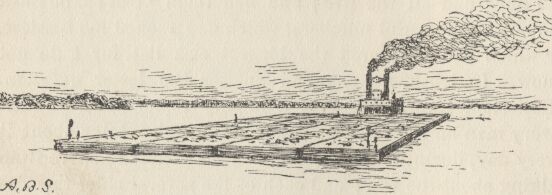
When a river in good condition can enable one to save $162,000 and a whole summer's time, on a single cargo, the wisdom of taking measures to keep the river in good condition is made plain to even the uncommercial mind.
When a river in good condition can save someone $162,000 and a whole summer on a single cargo, even someone with no business sense can see the wisdom of keeping the river in good condition.