Chapter 27
Some Imported Articles
WE met two steamboats at New Madrid. Two steamboats in sight at once! an infrequent spectacle now in the lonesome Mississippi. The loneliness of this solemn, stupendous flood is impressive—and depressing. League after league, and still league after league, it pours its chocolate tide along, between its solid forest walls, its almost untenanted shores, with seldom a sail or a moving object of any kind to disturb the surface and break the monotony of the blank, watery solitude; and so the day goes, the night comes, and again the day—and still the same, night after night and day after day—majestic, unchanging sameness of serenity, repose, tranquillity, lethargy, vacancy—symbol of eternity, realization of the heaven pictured by priest and prophet, and longed for by the good and thoughtless!
We met two steamboats at New Madrid. Two steamboats in sight at once! That is a rare sight now on the lonely Mississippi. The loneliness of this solemn, immense river is impressive and depressing. For mile after mile, it pours its chocolate-colored waters between solid walls of forest and almost empty shores. Seldom does a sail or anything else moving disturb the surface and break the monotony of the empty, watery solitude. The day passes, night comes, and then another day. Still the river remains the same, night after night and day after day. Its majestic sameness is serene, restful, peaceful, sluggish, and empty. It is a symbol of eternity, the heaven imagined by priests and prophets, and longed for by the good and thoughtless!
Immediately after the war of 1812, tourists began to come to America, from England; scattering ones at first, then a sort of procession of them—a procession which kept up its plodding, patient march through the land during many, many years. Each tourist took notes, and went home and published a book—a book which was usually calm, truthful, reasonable, kind; but which seemed just the reverse to our tender-footed progenitors. A glance at these tourist-books shows us that in certain of its aspects the Mississippi has undergone no change since those strangers visited it, but remains to-day about as it was then. The emotions produced in those foreign breasts by these aspects were not all formed on one pattern, of course; they had to be various, along at first, because the earlier tourists were obliged to originate their emotions, whereas in older countries one can always borrow emotions from one's predecessors. And, mind you, emotions are among the toughest things in the world to manufacture out of whole cloth; it is easier to manufacture seven facts than one emotion. Captain Basil Hall. R.N., writing fifty-five years ago, says—
Immediately after the War of 1812, English tourists began coming to America. At first only a few came, then a sort of procession. The procession kept up its slow, patient march through the country for many, many years. Each tourist took notes, went home, and published a book. The books were usually calm, truthful, reasonable, and kind. But to our sensitive ancestors, they seemed just the opposite. A glance at these tourist books shows that the Mississippi has not changed in certain respects since those strangers visited. In those respects, it remains today much as it was then. Of course, those sights did not stir the same emotions in all the foreign visitors. The emotions had to vary at first, because the early tourists had to invent their own. In older countries, people can always borrow emotions from those who came before them. And mind you, emotions are among the hardest things in the world to invent from nothing. It is easier to invent seven facts than one emotion. Captain Basil Hall, R.N., writing fifty-five years ago, says:
'Here I caught the first glimpse of the object I had so long wished to behold, and felt myself amply repaid at that moment for all the trouble I had experienced in coming so far; and stood looking at the river flowing past till it was too dark to distinguish anything. But it was not till I had visited the same spot a dozen times, that I came to a right comprehension of the grandeur of the scene.'
'Here I caught my first glimpse of what I had wanted to see for so long. At that moment, I felt fully rewarded for all the trouble of coming so far. I stood watching the river flow past until it was too dark to see anything. But only after I had visited the same spot a dozen times did I truly understand the grandeur of the scene.'
Following are Mrs. Trollope's emotions. She is writing a few months later in the same year, 1827, and is coming in at the mouth of the Mississippi—
Here are Mrs. Trollope's impressions. She is writing a few months later in the same year, 1827, as she enters the mouth of the Mississippi:
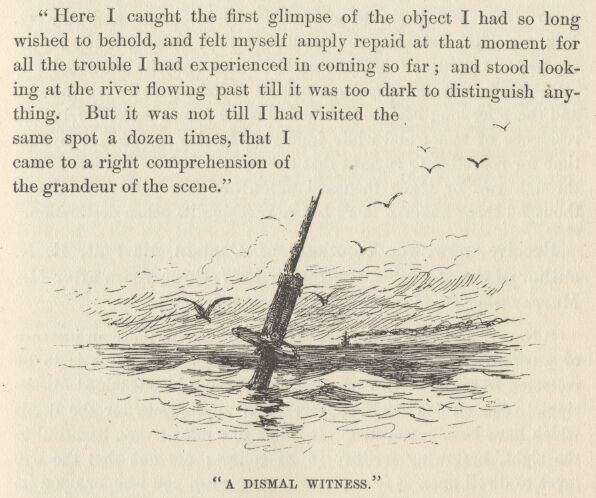
'The first indication of our approach to land was the appearance of this mighty river pouring forth its muddy mass of waters, and mingling with the deep blue of the Mexican Gulf. I never beheld a scene so utterly desolate as this entrance of the Mississippi. Had Dante seen it, he might have drawn images of another Borgia from its horrors. One only object rears itself above the eddying waters; this is the mast of a vessel long since wrecked in attempting to cross the bar, and it still stands, a dismal witness of the destruction that has been, and a boding prophet of that which is to come.'
'The first sign that we were approaching land was this mighty river. Its muddy waters poured out and mingled with the deep blue waters of the Mexican Gulf. I have never seen a place as utterly desolate as this entrance to the Mississippi. If Dante had seen it, its horrors might have inspired him to imagine another Borgia. Only one object rises above the swirling waters: the mast of a vessel wrecked long ago while trying to cross the sandbar. It still stands as a grim witness to the destruction of the past and an ominous sign of destruction to come.'
Emotions of Hon. Charles Augustus Murray (near St. Louis), seven years later—
The feelings of the Honorable Charles Augustus Murray (near St. Louis), seven years later:
'It is only when you ascend the mighty current for fifty or a hundred miles, and use the eye of imagination as well as that of nature, that you begin to understand all his might and majesty. You see him fertilizing a boundless valley, bearing along in his course the trophies of his thousand victories over the shattered forest—here carrying away large masses of soil with all their growth, and there forming islands, destined at some future period to be the residence of man; and while indulging in this prospect, it is then time for reflection to suggest that the current before you has flowed through two or three thousand miles, and has yet to travel one thousand three hundred more before reaching its ocean destination.'
'Only when you travel fifty or a hundred miles upstream do you begin to understand all the river's power and majesty. You must use your imagination as well as your eyes. You see the river enriching a boundless valley and carrying the trophies of its thousand victories over the shattered forest. In one place, it carries away great masses of soil and everything growing on them. In another, it forms islands where people will someday live. As you take in this view, you have time to reflect on the current before you. It has flowed two or three thousand miles and must travel another one thousand three hundred before it reaches the ocean.'
Receive, now, the emotions of Captain Marryat, R.N. author of the sea tales, writing in 1837, three years after Mr. Murray—
Now consider the feelings of Captain Marryat, R.N., author of sea tales, writing in 1837, three years after Mr. Murray:
'Never, perhaps, in the records of nations, was there an instance of a century of such unvarying and unmitigated crime as is to be collected from the history of the turbulent and blood-stained Mississippi. The stream itself appears as if appropriate for the deeds which have been committed. It is not like most rivers, beautiful to the sight, bestowing fertility in its course; not one that the eye loves to dwell upon as it sweeps along, nor can you wander upon its banks, or trust yourself without danger to its stream. It is a furious, rapid, desolating torrent, loaded with alluvial soil; and few of those who are received into its waters ever rise again, {footnote [There was a foolish superstition of some little prevalence in that day, that the Mississippi would neither buoy up a swimmer, nor permit a drowned person's body to rise to the surface.]} or can support themselves long upon its surface without assistance from some friendly log. It contains the coarsest and most uneatable of fish, such as the cat-fish and such genus, and as you descend, its banks are occupied with the fetid alligator, while the panther basks at its edge in the cane-brakes, almost impervious to man. Pouring its impetuous waters through wild tracks covered with trees of little value except for firewood, it sweeps down whole forests in its course, which disappear in tumultuous confusion, whirled away by the stream now loaded with the masses of soil which nourished their roots, often blocking up and changing for a time the channel of the river, which, as if in anger at its being opposed, inundates and devastates the whole country round; and as soon as it forces its way through its former channel, plants in every direction the uprooted monarchs of the forest (upon whose branches the bird will never again perch, or the raccoon, the opossum, or the squirrel climb) as traps to the adventurous navigators of its waters by steam, who, borne down upon these concealed dangers which pierce through the planks, very often have not time to steer for and gain the shore before they sink to the bottom. There are no pleasing associations connected with the great common sewer of the Western America, which pours out its mud into the Mexican Gulf, polluting the clear blue sea for many miles beyond its mouth. It is a river of desolation; and instead of reminding you, like other beautiful rivers, of an angel which has descended for the benefit of man, you imagine it a devil, whose energies have been only overcome by the wonderful power of steam.'
'Perhaps the records of nations contain no other century of such constant, unrelieved crime as the history of the turbulent, bloodstained Mississippi. The river itself seems suited to the deeds committed there. Unlike most rivers, it is not beautiful to look at or a source of fertility along its course. It is not a river the eye loves to follow as it flows. Nor can you wander along its banks or trust yourself to its waters without danger. It is a furious, swift, destructive torrent, loaded with sediment. Few who enter its waters ever rise again, {footnote [In those days, a foolish superstition had some currency. People believed the Mississippi would neither keep a swimmer afloat nor allow a drowned body to rise to the surface.]} and few can stay afloat long without help from a friendly log. It contains the coarsest and most inedible fish, such as catfish and similar kinds. As you travel downstream, foul-smelling alligators inhabit its banks. Panthers bask at the water's edge in canebrakes that people can hardly enter. The river pours its rushing waters through wild lands covered with trees of little value except as firewood. Along the way, it sweeps away entire forests. The trees disappear in churning confusion, carried off by water now loaded with the soil that fed their roots. They often block the river's channel and change its course for a time. The river then floods and devastates the surrounding country, as if angry at being obstructed. As soon as the river forces its way back through its former channel, it plants the uprooted monarchs of the forest in every direction. Birds will never again perch on their branches, nor will raccoons, opossums, or squirrels climb them. These trees become traps for the adventurous people who navigate the river by steam. The current carries them down on these hidden dangers, which pierce their boats' planks. Very often, they do not have time to steer for shore and reach it before sinking to the bottom. No pleasant associations are connected with this great common sewer of Western America. It pours its mud into the Mexican Gulf, polluting the clear blue sea for many miles beyond its mouth. It is a river of desolation. Unlike other beautiful rivers, it does not remind you of an angel who has descended to benefit humanity. Instead, you imagine it as a devil whose powers have been overcome only by the wonderful power of steam.'
It is pretty crude literature for a man accustomed to handling a pen; still, as a panorama of the emotions sent weltering through this noted visitor's breast by the aspect and traditions of the 'great common sewer,' it has a value. A value, though marred in the matter of statistics by inaccuracies; for the catfish is a plenty good enough fish for anybody, and there are no panthers that are 'impervious to man.'
For a man used to writing, this is pretty crude literature. Still, it has value as a picture of the emotions stirred in this famous visitor by the sight and traditions of the 'great common sewer.' That value is marred by factual inaccuracies, though. The catfish is a good enough fish for anyone, and there are no panthers that are 'impervious to man.'
Later still comes Alexander Mackay, of the Middle Temple, Barrister at Law, with a better digestion, and no catfish dinner aboard, and feels as follows—
Later comes Alexander Mackay, a barrister of the Middle Temple. His digestion is better, and he has not eaten a catfish dinner. He feels as follows:
'The Mississippi! It was with indescribable emotions that I first felt myself afloat upon its waters. How often in my schoolboy dreams, and in my waking visions afterwards, had my imagination pictured to itself the lordly stream, rolling with tumultuous current through the boundless region to which it has given its name, and gathering into itself, in its course to the ocean, the tributary waters of almost every latitude in the temperate zone! Here it was then in its reality, and I, at length, steaming against its tide. I looked upon it with that reverence with which everyone must regard a great feature of external nature.'
'The Mississippi! I cannot describe the emotions I felt when I first found myself afloat on its waters. How often had I imagined that majestic river in my schoolboy dreams and in my waking visions afterward! I pictured its turbulent current rolling through the vast region named for it. On its way to the ocean, it gathered the waters of tributaries from almost every latitude in the temperate zone. Now here was the real river, and at last I was steaming against its current. I looked at it with the reverence everyone must feel for a great feature of the natural world.'
So much for the emotions. The tourists, one and all, remark upon the deep, brooding loneliness and desolation of the vast river. Captain Basil Hall, who saw it at flood-stage, says—
So much for the emotions. Every tourist comments on the deep, brooding loneliness and desolation of the vast river. Captain Basil Hall, who saw the river at flood level, says:
'Sometimes we passed along distances of twenty or thirty miles without seeing a single habitation. An artist, in search of hints for a painting of the deluge, would here have found them in abundance.'
'Sometimes we traveled twenty or thirty miles without seeing a single home. An artist looking for ideas for a painting of the great flood would have found plenty here.'
The first shall be last, etc. just two hundred years ago, the old original first and gallantest of all the foreign tourists, pioneer, head of the procession, ended his weary and tedious discovery-voyage down the solemn stretches of the great river—La Salle, whose name will last as long as the river itself shall last. We quote from Mr. Parkman—
The first shall be last, and so on. Just two hundred years ago, the original foreign tourist finished his weary, tedious voyage of discovery down the great river's solemn stretches. He was the first and most gallant of all the foreign tourists, the pioneer at the head of the procession. He was La Salle, whose name will last as long as the river itself. We quote Mr. Parkman:
'And now they neared their journey's end. On the sixth of April, the river divided itself into three broad channels. La Salle followed that of the west, and D'Autray that of the east; while Tonty took the middle passage. As he drifted down the turbid current, between the low and marshy shores, the brackish water changed to brine, and the breeze grew fresh with the salt breath of the sea. Then the broad bosom of the great Gulf opened on his sight, tossing its restless billows, limitless, voiceless, lonely as when born of chaos, without a sail, without a sign of life.'
'And now they were nearing the end of their journey. On April 6, the river divided into three broad channels. La Salle followed the western channel, and D'Autray the eastern one, while Tonty took the middle passage. As Tonty drifted down the muddy current between low, marshy shores, the brackish water turned salty. The breeze grew fresh with the salt air of the sea. Then the broad expanse of the great Gulf came into view, its restless waves tossing. It was boundless, silent, and lonely, as it had been when born from chaos, without a sail or a sign of life.'
Then, on a spot of solid ground, La Salle reared a column 'bearing the arms of France; the Frenchmen were mustered under arms; and while the New England Indians and their squaws looked on in wondering silence, they chanted the Te Deum, The Exaudiat, and the Domine Salvum Fac Regem.'
Then, on a patch of solid ground, La Salle raised a column 'bearing the arms of France. The Frenchmen assembled with their weapons. As the New England Indians and their women looked on in silent wonder, the Frenchmen sang the Te Deum, The Exaudiat, and the Domine Salvum Fac Regem.'
Then, whilst the musketry volleyed and rejoicing shouts burst forth, the victorious discoverer planted the column, and made proclamation in a loud voice, taking formal possession of the river and the vast countries watered by it, in the name of the King. The column bore this inscription—
Then, as muskets fired in volleys and joyful shouts rang out, the victorious discoverer planted the column. In a loud voice, he formally claimed the river and the vast countries it watered in the name of the King. The column bore this inscription:
LOUIS LE GRAND, ROY DE FRANCE ET DE NAVARRE, REGNE; LE NEUVIEME AVRIL, 1682.
LOUIS THE GREAT, KING OF FRANCE AND NAVARRE, REIGNS. APRIL 9, 1682.
New Orleans intended to fittingly celebrate, this present year, the bicentennial anniversary of this illustrious event; but when the time came, all her energies and surplus money were required in other directions, for the flood was upon the land then, making havoc and devastation everywhere.
New Orleans planned a fitting celebration this year for the 200th anniversary of this illustrious event. But when the time came, the city needed all its energy and spare money for other purposes. Floodwaters had covered the land, causing havoc and devastation everywhere.