Chapter 24
My Disguise Is Exposed
AFTER a close study of the face of the pilot on watch, I was satisfied that I had never seen him before; so I went up there. The pilot inspected me; I re-inspected the pilot. These customary preliminaries over, I sat down on the high bench, and he faced about and went on with his work. Every detail of the pilot-house was familiar to me, with one exception,—a large-mouthed tube under the breast-board. I puzzled over that thing a considerable time; then gave up and asked what it was for.
I studied the face of the pilot on watch and was sure I had never seen him before. So I went up to the pilothouse. The pilot inspected me, and I inspected him in return. After these customary preliminaries, I sat down on the high bench. He turned around and went back to work. Every detail of the pilothouse was familiar to me, except for one: a wide-mouthed tube under the breastboard. I puzzled over the tube for quite a while. Then I gave up and asked what it was for.
'To hear the engine-bells through.'
'To hear the engine bells through.'
It was another good contrivance which ought to have been invented half a century sooner. So I was thinking, when the pilot asked—
It was another good invention that should have been invented half a century earlier. I was thinking this when the pilot asked:
'Do you know what this rope is for?'
'Do you know what this rope is for?'
I managed to get around this question, without committing myself.
I managed to avoid the question without committing myself.
'Is this the first time you were ever in a pilot-house?'
'Is this your first time in a pilothouse?'
I crept under that one.
I crept under that one.
'Where are you from?'
'Where are you from?'
'New England.'
'New England.'
'First time you have ever been West?'
'Is this your first time in the West?'
I climbed over this one.
I climbed over this one.
'If you take an interest in such things, I can tell you what all these things are for.'
'If you're interested in such things, I can tell you what all these things are for.'
I said I should like it.
I said I would like it.
'This,' putting his hand on a backing-bell rope, 'is to sound the fire-alarm; this,' putting his hand on a go-ahead bell, 'is to call the texas-tender; this one,' indicating the whistle-lever, 'is to call the captain'—and so he went on, touching one object after another, and reeling off his tranquil spool of lies.
'This is for sounding the fire alarm,' he said, putting his hand on a backing-bell rope. 'This is for calling the texas-tender,' he said, putting his hand on a go-ahead bell. 'This one is for calling the captain,' he said, pointing to the whistle lever. He went on like that, touching one object after another and calmly spinning out his lies.
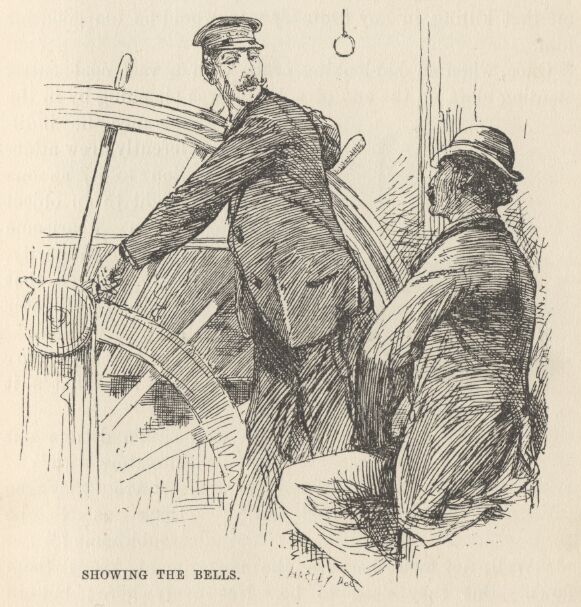
I had never felt so like a passenger before. I thanked him, with emotion, for each new fact, and wrote it down in my note-book. The pilot warmed to his opportunity, and proceeded to load me up in the good old-fashioned way. At times I was afraid he was going to rupture his invention; but it always stood the strain, and he pulled through all right. He drifted, by easy stages, into revealments of the river's marvelous eccentricities of one sort and another, and backed them up with some pretty gigantic illustrations. For instance—
I had never felt so much like a passenger before. I thanked him warmly for each new fact and wrote it down in my notebook. The pilot seized the opportunity and began feeding me tall tales in the good old-fashioned way. At times, I feared he would strain his imagination to the breaking point. But his imagination always held up, and he came through all right. Gradually, he began revealing the river’s marvelous quirks of one kind and another. He backed them up with some pretty enormous examples. For instance:
'Do you see that little boulder sticking out of the water yonder? well, when I first came on the river, that was a solid ridge of rock, over sixty feet high and two miles long. All washed away but that.' [This with a sigh.]
'Do you see that little boulder sticking out of the water over there? Well, when I first came to the river, it was part of a solid ridge of rock. The ridge was over sixty feet high and two miles long. All of it washed away except that boulder.' [He sighed as he said this.]
I had a mighty impulse to destroy him, but it seemed to me that killing, in any ordinary way, would be too good for him.
I had a powerful urge to destroy him. But I thought killing him in any ordinary way would be too good for him.
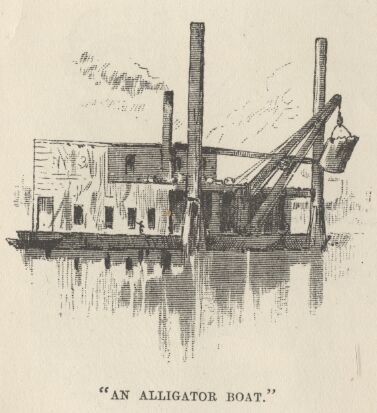
Once, when an odd-looking craft, with a vast coal-scuttle slanting aloft on the end of a beam, was steaming by in the distance, he indifferently drew attention to it, as one might to an object grown wearisome through familiarity, and observed that it was an 'alligator boat.'
Once, a strange-looking boat was steaming by in the distance. It had a huge coal scuttle tilted upward on the end of a beam. He casually pointed it out, as if he had seen it so often that it had become boring. He remarked that it was an 'alligator boat.'
'An alligator boat? What's it for?'
'An alligator boat? What's it for?'
'To dredge out alligators with.'
'For dredging out alligators.'
'Are they so thick as to be troublesome?'
'Are there so many of them that they cause trouble?'
'Well, not now, because the Government keeps them down. But they used to be. Not everywhere; but in favorite places, here and there, where the river is wide and shoal-like Plum Point, and Stack Island, and so on—places they call alligator beds.'
'Well, not now, because the Government keeps their numbers down. But they used to be. Not everywhere, but in favorite spots here and there, where the river is wide and shallow. Places like Plum Point, Stack Island, and so on. They call these places alligator beds.'
'Did they actually impede navigation?'
'Did they actually make it harder to navigate?'
'Years ago, yes, in very low water; there was hardly a trip, then, that we didn't get aground on alligators.'
'Years ago, yes, when the water was very low. Back then, we hardly made a trip without running aground on alligators.'
It seemed to me that I should certainly have to get out my tomahawk. However, I restrained myself and said—
I felt sure I would have to get out my tomahawk. But I held back and said:
'It must have been dreadful.'
'It must have been terrible.'
'Yes, it was one of the main difficulties about piloting. It was so hard to tell anything about the water; the damned things shift around so—never lie still five minutes at a time. You can tell a wind-reef, straight off, by the look of it; you can tell a break; you can tell a sand-reef—that's all easy; but an alligator reef doesn't show up, worth anything. Nine times in ten you can't tell where the water is; and when you do see where it is, like as not it ain't there when you get there, the devils have swapped around so, meantime. Of course there were some few pilots that could judge of alligator water nearly as well as they could of any other kind, but they had to have natural talent for it; it wasn't a thing a body could learn, you had to be born with it. Let me see: there was Ben Thornburg, and Beck Jolly, and Squire Bell, and Horace Bixby, and Major Downing, and John Stevenson, and Billy Gordon, and Jim Brady, and George Ealer, and Billy Youngblood—all A-1 alligator pilots. They could tell alligator water as far as another Christian could tell whiskey. Read it?—Ah, couldn't they, though! I only wish I had as many dollars as they could read alligator water a mile and a half off. Yes, and it paid them to do it, too. A good alligator pilot could always get fifteen hundred dollars a month. Nights, other people had to lay up for alligators, but those fellows never laid up for alligators; they never laid up for anything but fog. They could smell the best alligator water it was said; I don't know whether it was so or not, and I think a body's got his hands full enough if he sticks to just what he knows himself, without going around backing up other people's say-so's, though there's a plenty that ain't backward about doing it, as long as they can roust out something wonderful to tell. Which is not the style of Robert Styles, by as much as three fathom—maybe quarter-less.'
'Yes, it was one of the main difficulties of piloting. It was so hard to tell anything about the water. The damned things shift around so much. They never stay still for five minutes. You can tell a wind-reef right away by how it looks. You can tell a break, and you can tell a sand-reef. That's all easy. But an alligator reef hardly shows up at all. Nine times out of ten, you can't tell where the water is. And even when you can see where it is, it may well be gone by the time you get there. The devils have swapped around in the meantime. Of course, a few pilots could judge alligator water almost as well as any other kind. But they had to have a natural talent for it. It wasn't something a person could learn. You had to be born with it. Let me see: there was Ben Thornburg, and Beck Jolly, and Squire Bell, and Horace Bixby, and Major Downing, and John Stevenson, and Billy Gordon, and Jim Brady, and George Ealer, and Billy Youngblood. All of them were first-rate alligator pilots. They could spot alligator water as far away as another Christian could spot whiskey. Could they read it? Ah, couldn't they, though! I only wish I had as many dollars as they could read alligator water a mile and a half away. Yes, and it paid them to do it, too. A good alligator pilot could always get fifteen hundred dollars a month. At night, other people had to stop for alligators. But those fellows never stopped for alligators. They never stopped for anything but fog. People said they could smell the best alligator water. I don't know whether that was true or not. I think a person has enough to do just sticking to what he knows himself. There's no need to go around backing up what other people say. Though plenty of people aren't shy about doing that, as long as they can dig up something wonderful to tell. That's not Robert Styles's way, not by three fathoms, maybe a quarter less.'
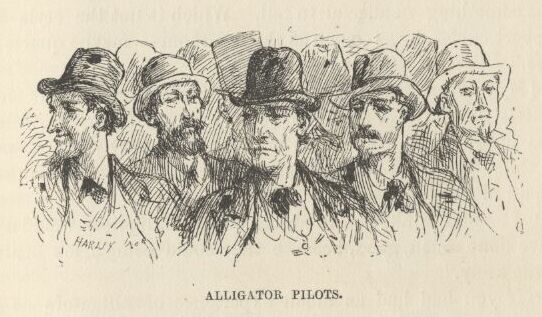
[My! Was this Rob Styles?—This mustached and stately figure?-A slim enough cub, in my time. How he has improved in comeliness in five-and-twenty year and in the noble art of inflating his facts.] After these musings, I said aloud—
[My! Was this Rob Styles? This stately man with a mustache? He was a rather skinny youngster in my day. How much more handsome he has become in twenty-five years, and how much better at the noble art of exaggerating his facts.] After these thoughts, I said aloud:
'I should think that dredging out the alligators wouldn't have done much good, because they could come back again right away.'
'I don't think dredging out the alligators would have helped much, because they could come right back.'
'If you had had as much experience of alligators as I have, you wouldn't talk like that. You dredge an alligator once and he's convinced. It's the last you hear of him. He wouldn't come back for pie. If there's one thing that an alligator is more down on than another, it's being dredged. Besides, they were not simply shoved out of the way; the most of the scoopful were scooped aboard; they emptied them into the hold; and when they had got a trip, they took them to Orleans to the Government works.'
'If you had as much experience with alligators as I do, you wouldn't talk like that. Dredge an alligator once and he's convinced. That's the last you hear of him. He wouldn't come back for pie. If there's one thing an alligator hates more than anything else, it's being dredged. Besides, they weren't just pushed out of the way. Most of the alligators in each scoop were brought aboard and emptied into the hold. When they had a full load, they took the alligators to Orleans to the Government works.'
'What for?'
'Why?'
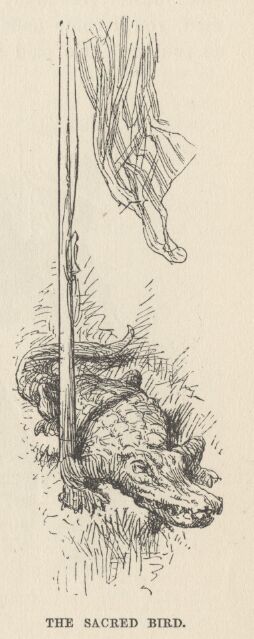
'Why, to make soldier-shoes out of their hides. All the Government shoes are made of alligator hide. It makes the best shoes in the world. They last five years, and they won't absorb water. The alligator fishery is a Government monopoly. All the alligators are Government property—just like the live-oaks. You cut down a live-oak, and Government fines you fifty dollars; you kill an alligator, and up you go for misprision of treason—lucky duck if they don't hang you, too. And they will, if you're a Democrat. The buzzard is the sacred bird of the South, and you can't touch him; the alligator is the sacred bird of the Government, and you've got to let him alone.'
'Why, to make soldiers' shoes out of their hides. All Government shoes are made of alligator hide. It makes the best shoes in the world. The shoes last five years and won't soak up water. The Government has a monopoly on alligator fishing. All alligators belong to the Government, just like the live oaks. If you cut down a live oak, the Government fines you fifty dollars. If you kill an alligator, you go to jail for misprision of treason. You're lucky if they don't hang you too. And they will hang you if you're a Democrat. The buzzard is the sacred bird of the South, and you can't touch it. The alligator is the sacred bird of the Government, and you've got to leave it alone.'
'Do you ever get aground on the alligators now?'
'Do you ever get stuck on the alligators now?'
'Oh, no! it hasn't happened for years.'
'Oh, no! It hasn't happened for years.'
'Well, then, why do they still keep the alligator boats in service?'
'Well, then, why do they still use the alligator boats?'
'Just for police duty—nothing more. They merely go up and down now and then. The present generation of alligators know them as easy as a burglar knows a roundsman; when they see one coming, they break camp and go for the woods.'
'Just for police duty, nothing more. They only go up and down now and then. Today's alligators recognize them as easily as a burglar recognizes a patrolling policeman. When they see one coming, they pack up and head for the woods.'
After rounding-out and finishing-up and polishing-off the alligator business, he dropped easily and comfortably into the historical vein, and told of some tremendous feats of half-a-dozen old-time steamboats of his acquaintance, dwelling at special length upon a certain extraordinary performance of his chief favorite among this distinguished fleet—and then adding—
After wrapping up and polishing off the alligator business, he easily and comfortably turned to history. He told of some tremendous feats by half a dozen old-time steamboats he knew. He spent particular time on an extraordinary performance by his favorite among this distinguished fleet. Then he added:
'That boat was the “Cyclone,”—last trip she ever made—she sunk, that very trip—captain was Tom Ballou, the most immortal liar that ever I struck. He couldn't ever seem to tell the truth, in any kind of weather. Why, he would make you fairly shudder. He was the most scandalous liar! I left him, finally; I couldn't stand it. The proverb says, “like master, like man;” and if you stay with that kind of a man, you'll come under suspicion by and by, just as sure as you live. He paid first-class wages; but said I, What's wages when your reputation's in danger? So I let the wages go, and froze to my reputation. And I've never regretted it. Reputation's worth everything, ain't it? That's the way I look at it. He had more selfish organs than any seven men in the world—all packed in the stern-sheets of his skull, of course, where they belonged. They weighed down the back of his head so that it made his nose tilt up in the air. People thought it was vanity, but it wasn't, it was malice. If you only saw his foot, you'd take him to be nineteen feet high, but he wasn't; it was because his foot was out of drawing. He was intended to be nineteen feet high, no doubt, if his foot was made first, but he didn't get there; he was only five feet ten. That's what he was, and that's what he is. You take the lies out of him, and he'll shrink to the size of your hat; you take the malice out of him, and he'll disappear. That “Cyclone” was a rattler to go, and the sweetest thing to steer that ever walked the waters. Set her amidships, in a big river, and just let her go; it was all you had to do. She would hold herself on a star all night, if you let her alone. You couldn't ever feel her rudder. It wasn't any more labor to steer her than it is to count the Republican vote in a South Carolina election. One morning, just at daybreak, the last trip she ever made, they took her rudder aboard to mend it; I didn't know anything about it; I backed her out from the wood-yard and went a-weaving down the river all serene. When I had gone about twenty-three miles, and made four horribly crooked crossings—'
'That boat was the “Cyclone.” It was her last trip. She sank on that very trip. Her captain was Tom Ballou, the most immortal liar I ever met. He never seemed able to tell the truth, in any kind of weather. Why, he'd make you shudder. He was the most scandalous liar! I finally left him. I couldn't stand it. The proverb says, “like master, like man.” If you stay with that kind of man, you'll come under suspicion sooner or later, just as sure as you live. He paid first-class wages, but I said, What's wages when your reputation is in danger? So I gave up the wages and held tight to my reputation. I've never regretted it. Reputation is worth everything, isn't it? That's how I see it. He had more selfish organs than any seven men in the world. They were all packed in the back of his skull, of course, where they belonged. They weighed down the back of his head, so his nose tilted up in the air. People thought it was vanity, but it wasn't. It was malice. If you saw only his foot, you'd think he was nineteen feet tall. But he wasn't. It was because his foot was out of proportion. If his foot was made first, he was no doubt intended to be nineteen feet tall. But he didn't get there. He was only five feet ten. That's what he was, and that's what he is. Take the lies out of him, and he'll shrink to the size of your hat. Take the malice out of him, and he'll disappear. That “Cyclone” was a real speedster and the sweetest thing to steer that ever walked the waters. Point her straight ahead in a big river and just let her go. That was all you had to do. She would hold herself on course toward a star all night, if you left her alone. You could never feel her rudder. Steering her was no more work than counting the Republican vote in a South Carolina election. One morning, at daybreak, on her last trip, they took her rudder aboard to mend it. I didn't know anything about it. I backed her out from the wood-yard and went weaving down the river, perfectly calm. After I'd gone about twenty-three miles and made four horribly crooked crossings, '
'Without any rudder?'
'Without any rudder?'
'Yes—old Capt. Tom appeared on the roof and began to find fault with me for running such a dark night—'
'Yes, old Capt. Tom appeared on the roof and began criticizing me for running the boat on such a dark night.'
'Such a dark night?—Why, you said—'
'Such a dark night? But you said...'
'Never mind what I said,—'twas as dark as Egypt now, though pretty soon the moon began to rise, and—'
'Never mind what I said. It was as dark as Egypt now, though pretty soon the moon began to rise, and...'
'You mean the sun—because you started out just at break of—look here! Was this before you quitted the captain on account of his lying, or—'
'You mean the sun, because you set out just at daybreak. Wait! Was this before you left the captain because he lied, or...'
'It was before—oh, a long time before. And as I was saying, he—'
'It was before, oh, a long time before. And as I was saying, he...'
'But was this the trip she sunk, or was—'
'But was this the trip when she sank, or was...'
'Oh, no!—months afterward. And so the old man, he—'
'Oh, no! Months later. And so the old man, he...'
'Then she made two last trips, because you said—'
'Then she made two last trips, because you said...'
He stepped back from the wheel, swabbing away his perspiration, and said—
He stepped back from the wheel, wiped away his sweat, and said:
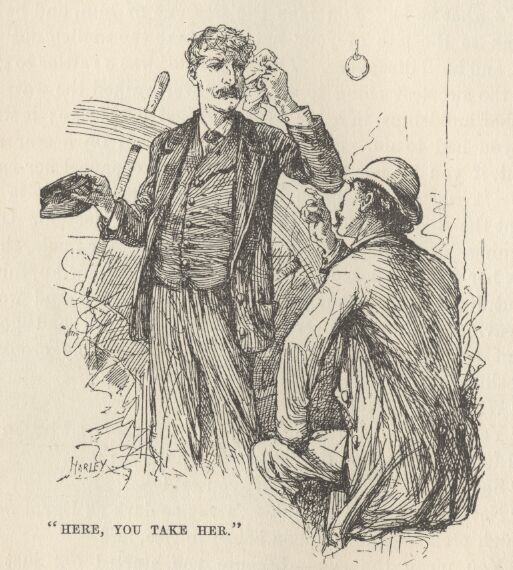
'Here!' (calling me by name), 'you take her and lie a while—you're handier at it than I am. Trying to play yourself for a stranger and an innocent!—why, I knew you before you had spoken seven words; and I made up my mind to find out what was your little game. It was to draw me out. Well, I let you, didn't I? Now take the wheel and finish the watch; and next time play fair, and you won't have to work your passage.'
'Here!' (calling me by name), 'you take the wheel and lie for a while. You're better at it than I am. Trying to pass yourself off as a stranger and an innocent! Why, I recognized you before you'd said seven words. I decided to find out what your little game was. You were trying to draw me out. Well, I let you, didn't I? Now take the wheel and finish the watch. Next time, play fair, and you won't have to work your passage.'
Thus ended the fictitious-name business. And not six hours out from St. Louis! but I had gained a privilege, any way, for I had been itching to get my hands on the wheel, from the beginning. I seemed to have forgotten the river, but I hadn't forgotten how to steer a steamboat, nor how to enjoy it, either.
That was the end of the made-up name business. And we were not even six hours out of St. Louis! But I had gained a privilege anyway. I had been itching to get my hands on the wheel from the start. I seemed to have forgotten the river, but I hadn't forgotten how to steer a steamboat. I hadn't forgotten how to enjoy it, either.