Chapter 22
Back to My Subject
AFTER twenty-one years' absence, I felt a very strong desire to see the river again, and the steamboats, and such of the boys as might be left; so I resolved to go out there. I enlisted a poet for company, and a stenographer to 'take him down,' and started westward about the middle of April.
After twenty-one years away, I wanted very much to see the river and the steamboats again. I also wanted to see any of the boys who might still be around. So I decided to go out there. I recruited a poet for company and a stenographer to 'take him down.' We headed west around the middle of April.
As I proposed to make notes, with a view to printing, I took some thought as to methods of procedure. I reflected that if I were recognized, on the river, I should not be as free to go and come, talk, inquire, and spy around, as I should be if unknown; I remembered that it was the custom of steamboatmen in the old times to load up the confiding stranger with the most picturesque and admirable lies, and put the sophisticated friend off with dull and ineffectual facts: so I concluded, that, from a business point of view, it would be an advantage to disguise our party with fictitious names. The idea was certainly good, but it bred infinite bother; for although Smith, Jones, and Johnson are easy names to remember when there is no occasion to remember them, it is next to impossible to recollect them when they are wanted. How do criminals manage to keep a brand-new alias in mind? This is a great mystery. I was innocent; and yet was seldom able to lay my hand on my new name when it was needed; and it seemed to me that if I had had a crime on my conscience to further confuse me, I could never have kept the name by me at all.
I planned to take notes for publication, so I gave some thought to how I should proceed. If people recognized me on the river, I would not be as free to come and go, talk, ask questions, and snoop around as I would be if they did not know me. I also remembered an old custom among steamboatmen. They would feed a trusting stranger the most colorful and admirable lies, but offer a worldly friend dull and useless facts. So I decided that, from a business point of view, our party would benefit from using false names. The idea was certainly good, but it caused endless trouble. Smith, Jones, and Johnson are easy names to remember when you don't need to remember them. But when you do need them, they are almost impossible to recall. How do criminals manage to remember a brand-new alias? This is a great mystery. I was innocent, yet I could seldom remember my new name when I needed it. And it seemed to me that if I had had a crime on my conscience to confuse me further, I could never have kept the name in mind at all.
We left per Pennsylvania Railroad, at 8 A.M. April 18.
We left on the Pennsylvania Railroad at 8 a.m. on April 18.
'EVENING. Speaking of dress. Grace and picturesqueness drop gradually out of it as one travels away from New York.'
'EVENING. Speaking of clothing. As you travel away from New York, clothing gradually becomes less graceful and picturesque.'
I find that among my notes. It makes no difference which direction you take, the fact remains the same. Whether you move north, south, east, or west, no matter: you can get up in the morning and guess how far you have come, by noting what degree of grace and picturesqueness is by that time lacking in the costumes of the new passengers,—I do not mean of the women alone, but of both sexes. It may be that carriage is at the bottom of this thing; and I think it is; for there are plenty of ladies and gentlemen in the provincial cities whose garments are all made by the best tailors and dressmakers of New York; yet this has no perceptible effect upon the grand fact: the educated eye never mistakes those people for New-Yorkers. No, there is a godless grace, and snap, and style about a born and bred New-Yorker which mere clothing cannot effect.
I find that in my notes. It makes no difference which direction you take. The fact remains the same. Whether you travel north, south, east, or west, you can wake up and guess how far you have come. Just notice how much grace and picturesqueness the new passengers' clothes have lost by then. I mean the clothes of both sexes, not just the women's. Maybe carriage is at the root of this, and I think it is. Many ladies and gentlemen in provincial cities have all their clothes made by the best tailors and dressmakers in New York. Yet that makes no perceptible difference to the central fact: the trained eye never mistakes those people for New-Yorkers. No, a born and bred New-Yorker has a godless grace, snap, and style that clothes alone cannot create.
'APRIL 19. This morning, struck into the region of full goatees—sometimes accompanied by a mustache, but only occasionally.'
'APRIL 19. This morning, we entered the region of full goatees. Occasionally, a mustache accompanied one.'
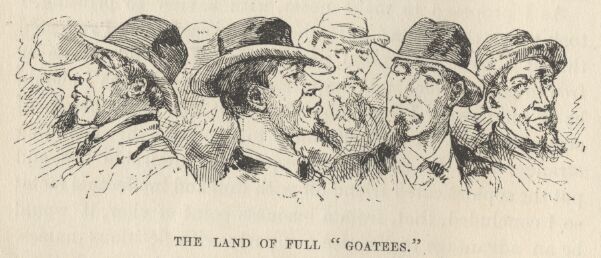
It was odd to come upon this thick crop of an obsolete and uncomely fashion; it was like running suddenly across a forgotten acquaintance whom you had supposed dead for a generation. The goatee extends over a wide extent of country; and is accompanied by an iron-clad belief in Adam and the biblical history of creation, which has not suffered from the assaults of the scientists.
It was strange to find so many examples of this outdated and unattractive style. It was like suddenly meeting a forgotten acquaintance you had thought dead for a generation. The goatee is common across a wide stretch of the country. It goes hand in hand with an unshakable belief in Adam and the biblical account of creation, untouched by scientists’ attacks.
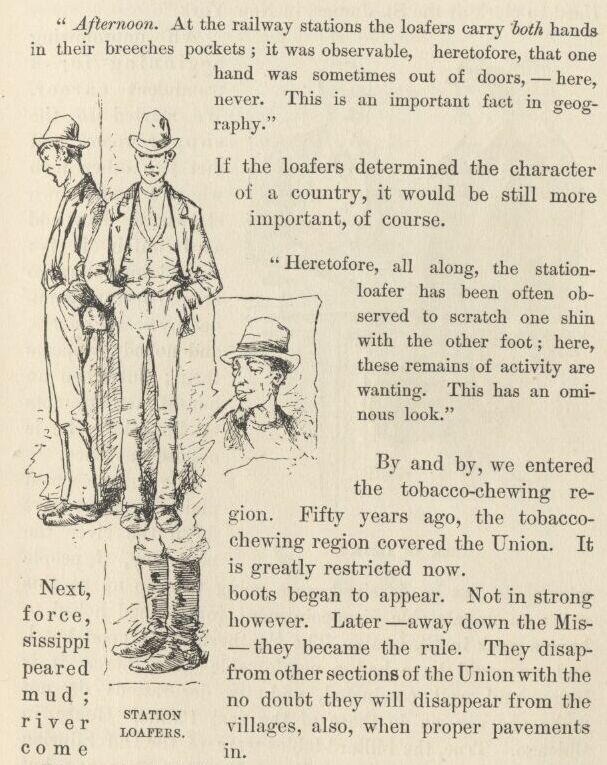
'AFTERNOON. At the railway stations the loafers carry both hands in their breeches pockets; it was observable, heretofore, that one hand was sometimes out of doors,—here, never. This is an important fact in geography.'
'AFTERNOON. At the train stations, the loafers keep both hands in their pants pockets. Earlier, I noticed that one hand was sometimes out of a pocket. Here, that never happens. This is an important fact of geography.'
If the loafers determined the character of a country, it would be still more important, of course.
Of course, if loafers determined a country’s character, it would be even more important.
'Heretofore, all along, the station-loafer has been often observed to scratch one shin with the other foot; here, these remains of activity are wanting. This has an ominous look.'
'Until now, the station-loafer has often been seen scratching one shin with the other foot. Here, even this last bit of activity is missing. That looks ominous.'
By and by, we entered the tobacco-chewing region. Fifty years ago, the tobacco-chewing region covered the Union. It is greatly restricted now.
Eventually, we entered the tobacco-chewing region. Fifty years ago, the tobacco-chewing region covered the whole Union. Now it is much smaller.
Next, boots began to appear. Not in strong force, however. Later—away down the Mississippi—they became the rule. They disappeared from other sections of the Union with the mud; no doubt they will disappear from the river villages, also, when proper pavements come in.
Next, boots began to appear, though not in great numbers. Later, farther down the Mississippi, boots became the norm. They disappeared from other parts of the Union along with the mud. No doubt they will also disappear from the river villages when proper pavements come in.
We reached St. Louis at ten o'clock at night. At the counter of the hotel I tendered a hurriedly-invented fictitious name, with a miserable attempt at careless ease. The clerk paused, and inspected me in the compassionate way in which one inspects a respectable person who is found in doubtful circumstances; then he said—
We reached St. Louis at ten o'clock at night. At the hotel desk, I gave a fake name I had made up in a hurry. I made a miserable attempt to act casual. The clerk paused and looked me over with compassion, as if I were a respectable person caught in suspicious circumstances. Then he said:
'It's all right; I know what sort of a room you want. Used to clerk at the St. James, in New York.'
'It's all right. I know what kind of room you want. I used to work as a clerk at the St. James in New York.'
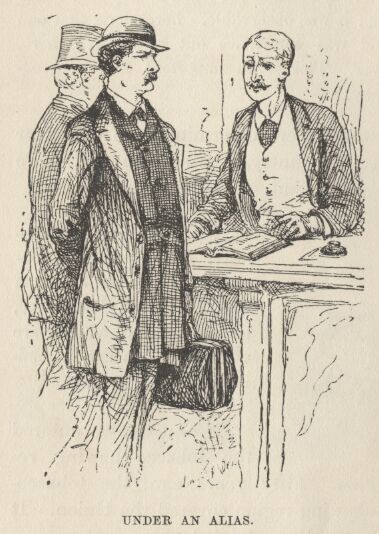
An unpromising beginning for a fraudulent career. We started to the supper room, and met two other men whom I had known elsewhere. How odd and unfair it is: wicked impostors go around lecturing under my Nom De Guerre and nobody suspects them; but when an honest man attempts an imposture, he is exposed at once.
A poor start to a life of fraud. We headed to the supper room and met two other men I knew from elsewhere. How strange and unfair! Wicked impostors go around giving lectures under my pen name, and nobody suspects them. But when an honest man tries to impersonate someone, he is exposed at once.
One thing seemed plain: we must start down the river the next day, if people who could not be deceived were going to crop up at this rate: an unpalatable disappointment, for we had hoped to have a week in St. Louis. The Southern was a good hotel, and we could have had a comfortable time there. It is large, and well conducted, and its decorations do not make one cry, as do those of the vast Palmer House, in Chicago. True, the billiard-tables were of the Old Silurian Period, and the cues and balls of the Post-Pliocene; but there was refreshment in this, not discomfort; for there is rest and healing in the contemplation of antiquities.
One thing seemed clear: we had to start down the river the next day if people we couldn’t fool kept turning up at this rate. That was a bitter disappointment, because we had hoped to spend a week in St. Louis. The Southern was a good hotel, and we could have been comfortable there. It was large and well run, and its decorations didn’t make you cry, as those of the vast Palmer House in Chicago did. True, the billiard tables dated from the Old Silurian Period, and the cues and balls from the Post-Pliocene. But their age was refreshing, not uncomfortable. There is rest and healing in the contemplation of antiques.
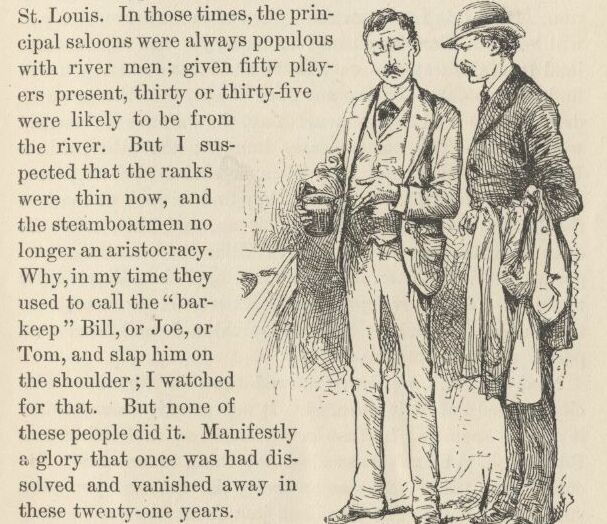
The most notable absence observable in the billiard-room, was the absence of the river man. If he was there he had taken in his sign, he was in disguise. I saw there none of the swell airs and graces, and ostentatious displays of money, and pompous squanderings of it, which used to distinguish the steamboat crowd from the dry-land crowd in the bygone days, in the thronged billiard-rooms of St. Louis. In those times, the principal saloons were always populous with river men; given fifty players present, thirty or thirty-five were likely to be from the river. But I suspected that the ranks were thin now, and the steamboatmen no longer an aristocracy. Why, in my time they used to call the 'barkeep' Bill, or Joe, or Tom, and slap him on the shoulder; I watched for that. But none of these people did it. Manifestly a glory that once was had dissolved and vanished away in these twenty-one years.
The most noticeable absence in the billiard room was the river man. If he was there, he had hidden his identity. In the old days, St. Louis billiard rooms were crowded. The steamboat crowd stood out from the land crowd with their fancy airs, flashy displays of money, and grand spending. I saw none of that now. Back then, the main saloons were always full of river men. Out of fifty players, thirty or thirty-five were likely to be from the river. But I suspected that there were fewer river men now and that steamboatmen were no longer an aristocracy. Why, in my day they used to call the 'barkeep' Bill, or Joe, or Tom, and slap him on the shoulder. I watched for that, but none of these people did it. Clearly, a glory that once existed had faded and vanished in those twenty-one years.
When I went up to my room, I found there the young man called Rogers, crying. Rogers was not his name; neither was Jones, Brown, Dexter, Ferguson, Bascom, nor Thompson; but he answered to either of these that a body found handy in an emergency; or to any other name, in fact, if he perceived that you meant him. He said—
When I went up to my room, I found the young man called Rogers crying. Rogers was not his real name. Neither was Jones, Brown, Dexter, Ferguson, Bascom, or Thompson. But he answered to any of those names that someone found handy in an emergency. In fact, he would answer to any name if he understood you meant him. He said:
'What is a person to do here when he wants a drink of water?—drink this slush?'
'What is a person supposed to do when they want a drink of water here? Drink this slush?'
'Can't you drink it?'
'Can't you drink it?'
'I could if I had some other water to wash it with.'
'I could if I had some other water to wash it with.'
Here was a thing which had not changed; a score of years had not affected this water's mulatto complexion in the least; a score of centuries would succeed no better, perhaps. It comes out of the turbulent, bank-caving Missouri, and every tumblerful of it holds nearly an acre of land in solution. I got this fact from the bishop of the diocese. If you will let your glass stand half an hour, you can separate the land from the water as easy as Genesis; and then you will find them both good: the one good to eat, the other good to drink. The land is very nourishing, the water is thoroughly wholesome. The one appeases hunger; the other, thirst. But the natives do not take them separately, but together, as nature mixed them. When they find an inch of mud in the bottom of a glass, they stir it up, and then take the draught as they would gruel. It is difficult for a stranger to get used to this batter, but once used to it he will prefer it to water. This is really the case. It is good for steamboating, and good to drink; but it is worthless for all other purposes, except baptizing.
Here was one thing that had not changed. Twenty years had not affected the water’s mixed-race complexion in the least. Perhaps twenty centuries would do no better. The water comes from the turbulent Missouri, which wears away its banks. Every glassful holds nearly an acre of land in solution. I got this fact from the bishop of the diocese. If you let your glass stand for half an hour, you can separate the land from the water as easily as Genesis did. Then you will find them both good: one good to eat, the other good to drink. The land is very nourishing, and the water is thoroughly wholesome. One satisfies hunger, the other thirst. But the locals do not take them separately. They take them together, as nature mixed them. When they find an inch of mud at the bottom of a glass, they stir it up. Then they drink it like a thin porridge. A stranger finds it hard to get used to this batter. But once used to it, he will prefer it to water. This is really true. The water is good for steamboating and good to drink. But it is worthless for every other purpose, except baptizing.
Next morning, we drove around town in the rain. The city seemed but little changed. It was greatly changed, but it did not seem so; because in St. Louis, as in London and Pittsburgh, you can't persuade a new thing to look new; the coal smoke turns it into an antiquity the moment you take your hand off it. The place had just about doubled its size, since I was a resident of it, and was now become a city of 400,000 inhabitants; still, in the solid business parts, it looked about as it had looked formerly. Yet I am sure there is not as much smoke in St. Louis now as there used to be. The smoke used to bank itself in a dense billowy black canopy over the town, and hide the sky from view. This shelter is very much thinner now; still, there is a sufficiency of smoke there, I think. I heard no complaint.
The next morning, we drove around town in the rain. The city seemed to have changed very little. It had changed greatly, but it didn’t seem that way. In St. Louis, as in London and Pittsburgh, you can’t persuade anything new to look new. Coal smoke turns it into an antique the moment you take your hand off it. The city had just about doubled in size since I had lived there. It now had 400,000 inhabitants. Still, the established business districts looked much as they had before. Yet I’m sure there isn’t as much smoke in St. Louis now as there used to be. The smoke used to form a dense, billowing black canopy over the town, hiding the sky from view. That cover is much thinner now. Still, I think there’s enough smoke there. I heard no complaints.
However, on the outskirts changes were apparent enough; notably in dwelling-house architecture. The fine new homes are noble and beautiful and modern. They stand by themselves, too, with green lawns around them; whereas the dwellings of a former day are packed together in blocks, and are all of one pattern, with windows all alike, set in an arched frame-work of twisted stone; a sort of house which was handsome enough when it was rarer.
However, the changes on the outskirts were easy to see, especially in the architecture of the houses. The fine new homes are grand, beautiful, and modern. They also stand apart, surrounded by green lawns. The older homes, by contrast, are packed together in blocks. They all follow the same design, with identical windows set in arched frames of twisted stone. This kind of house was handsome enough when it was less common.
There was another change—the Forest Park. This was new to me. It is beautiful and very extensive, and has the excellent merit of having been made mainly by nature. There are other parks, and fine ones, notably Tower Grove and the Botanical Gardens; for St. Louis interested herself in such improvements at an earlier day than did the most of our cities.
There was another change, Forest Park. It was new to me. The park is beautiful and very large, and it has the great advantage of being mostly nature's work. There are other fine parks, especially Tower Grove and the Botanical Gardens. St. Louis began investing in such improvements earlier than most American cities.
The first time I ever saw St. Louis, I could have bought it for six million dollars, and it was the mistake of my life that I did not do it. It was bitter now to look abroad over this domed and steepled metropolis, this solid expanse of bricks and mortar stretching away on every hand into dim, measure-defying distances, and remember that I had allowed that opportunity to go by. Why I should have allowed it to go by seems, of course, foolish and inexplicable to-day, at a first glance; yet there were reasons at the time to justify this course.
The first time I saw St. Louis, I could have bought it for six million dollars. Not buying it was the mistake of my life. Now it was bitter to look out over this city of domes and steeples. Its solid expanse of brick and mortar stretched in every direction into hazy distances too vast to measure. And I had to remember that I had let the opportunity pass. Today, at first glance, letting it pass seems foolish and inexplicable. Yet at the time, there were reasons that justified my decision.
A Scotchman, Hon. Charles Augustus Murray, writing some forty-five or fifty years ago, said—'The streets are narrow, ill paved and ill lighted.' Those streets are narrow still, of course; many of them are ill paved yet; but the reproach of ill lighting cannot be repeated, now. The 'Catholic New Church' was the only notable building then, and Mr. Murray was confidently called upon to admire it, with its 'species of Grecian portico, surmounted by a kind of steeple, much too diminutive in its proportions, and surmounted by sundry ornaments' which the unimaginative Scotchman found himself 'quite unable to describe;' and therefore was grateful when a German tourist helped him out with the exclamation—'By —, they look exactly like bed-posts!' St. Louis is well equipped with stately and noble public buildings now, and the little church, which the people used to be so proud of, lost its importance a long time ago. Still, this would not surprise Mr. Murray, if he could come back; for he prophesied the coming greatness of St. Louis with strong confidence.
A Scotsman, Hon. Charles Augustus Murray, wrote some forty-five or fifty years ago: “The streets are narrow, badly paved, and poorly lit.” The streets are still narrow, of course, and many are still badly paved. But no one can complain about poor lighting now. The “Catholic New Church” was the only notable building then, and people confidently expected Mr. Murray to admire it. It had a “sort of Greek portico, topped by a kind of steeple, much too small in proportion, and topped by various ornaments.” The unimaginative Scotsman found himself “quite unable to describe” the ornaments. So he was grateful when a German tourist helped him out by exclaiming, “By God, they look exactly like bedposts!” St. Louis now has plenty of stately and noble public buildings. The little church that people once took such pride in lost its importance long ago. Still, this would not surprise Mr. Murray if he could come back. He predicted with great confidence that St. Louis would become a great city.
The further we drove in our inspection-tour, the more sensibly I realized how the city had grown since I had seen it last; changes in detail became steadily more apparent and frequent than at first, too: changes uniformly evidencing progress, energy, prosperity.
The farther we drove on our tour, the more clearly I saw how much the city had grown since my last visit. Changes in its details also became more noticeable and frequent as we went on. Every change showed progress, energy, and prosperity.
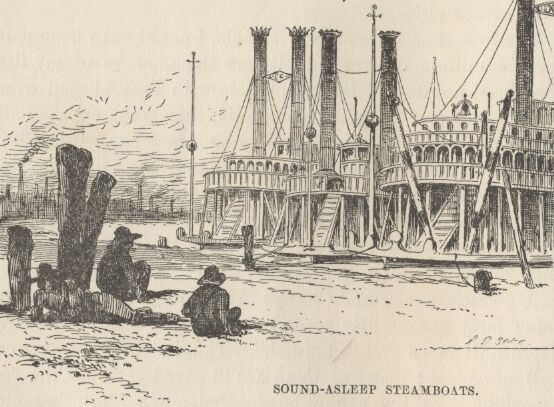
But the change of changes was on the 'levee.' This time, a departure from the rule. Half a dozen sound-asleep steamboats where I used to see a solid mile of wide-awake ones! This was melancholy, this was woeful. The absence of the pervading and jocund steamboatman from the billiard-saloon was explained. He was absent because he is no more. His occupation is gone, his power has passed away, he is absorbed into the common herd, he grinds at the mill, a shorn Samson and inconspicuous. Half a dozen lifeless steamboats, a mile of empty wharves, a negro fatigued with whiskey stretched asleep, in a wide and soundless vacancy, where the serried hosts of commerce used to contend!{footnote [Capt. Marryat, writing forty-five years ago says: 'St. Louis has 20,000 inhabitants. The river abreast of the town is crowded with steamboats, lying in two or three tiers.']} Here was desolation, indeed.
But the greatest change was on the 'levee.' This time, there was an exception to the rule. Half a dozen steamboats lay fast asleep where I used to see a solid mile of lively ones! It was sad, it was heartbreaking. Now I understood why the cheerful steamboatman, once a constant presence in the billiard-saloon, was missing. He was missing because he no longer exists. His occupation is gone, and his power has passed away. He has been absorbed into the common crowd. He works at the mill, an unnoticed Samson with his hair cut off. Half a dozen lifeless steamboats, a mile of empty wharves, and a Black man asleep, worn out by whiskey. All this lay in a vast, silent emptiness where the crowded forces of commerce used to compete!{footnote [Capt. Marryat, writing forty-five years ago, says: 'St. Louis has 20,000 inhabitants. The river alongside the town is crowded with steamboats, lying in two or three rows.']} This was desolation indeed.
'The old, old sea, as one in tears, Comes murmuring, with foamy lips, And knocking at the vacant piers, Calls for his long-lost multitude of ships.'
'The old, old sea comes murmuring like someone in tears, its lips covered in foam. It knocks at the empty piers and calls for its many long-lost ships.'
The towboat and the railroad had done their work, and done it well and completely. The mighty bridge, stretching along over our heads, had done its share in the slaughter and spoliation. Remains of former steamboatmen told me, with wan satisfaction, that the bridge doesn't pay. Still, it can be no sufficient compensation to a corpse, to know that the dynamite that laid him out was not of as good quality as it had been supposed to be.
The towboat and the railroad had done their work, and done it well and completely. The mighty bridge stretching overhead had done its share of the killing and destruction. The surviving steamboatmen told me, with a faint sense of satisfaction, that the bridge doesn't pay. Still, a corpse can hardly be comforted by knowing that the dynamite that killed him wasn't as good as people thought.
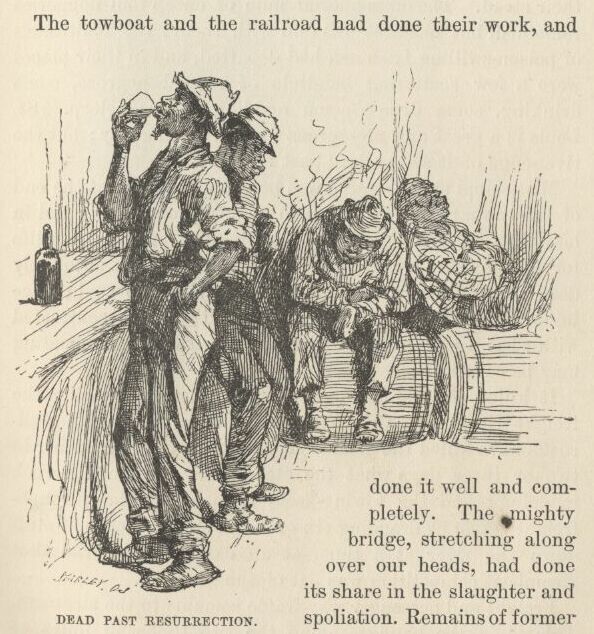
The pavements along the river front were bad: the sidewalks were rather out of repair; there was a rich abundance of mud. All this was familiar and satisfying; but the ancient armies of drays, and struggling throngs of men, and mountains of freight, were gone; and Sabbath reigned in their stead. The immemorial mile of cheap foul doggeries remained, but business was dull with them; the multitudes of poison-swilling Irishmen had departed, and in their places were a few scattering handfuls of ragged negroes, some drinking, some drunk, some nodding, others asleep. St. Louis is a great and prosperous and advancing city; but the river-edge of it seems dead past resurrection.
The riverfront pavement was bad, the sidewalks were somewhat run-down, and there was plenty of mud. All this was familiar and satisfying. But the old armies of drays, the struggling crowds of men, and the mountains of freight were gone. A Sunday stillness reigned in their place. The long-established mile of cheap, filthy saloons remained, but business was slow. The crowds of Irishmen who had swilled poison were gone. In their places were a few scattered groups of ragged Black people. Some were drinking, some were drunk, some were nodding off, and others were asleep. St. Louis is a great, prosperous, and growing city. But its riverfront seems dead beyond resurrection.
Mississippi steamboating was born about 1812; at the end of thirty years, it had grown to mighty proportions; and in less than thirty more, it was dead! A strangely short life for so majestic a creature. Of course it is not absolutely dead, neither is a crippled octogenarian who could once jump twenty-two feet on level ground; but as contrasted with what it was in its prime vigor, Mississippi steamboating may be called dead.
Mississippi steamboating began around 1812. Within thirty years, it had grown to enormous proportions. Less than thirty years after that, it was dead! A strangely short life for such a majestic creature. Of course, it is not completely dead. Neither is a crippled eighty-year-old who could once jump twenty-two feet on level ground. But compared with what it was in its prime, Mississippi steamboating may be called dead.
It killed the old-fashioned keel-boating, by reducing the freight-trip to New Orleans to less than a week. The railroads have killed the steamboat passenger traffic by doing in two or three days what the steamboats consumed a week in doing; and the towing-fleets have killed the through-freight traffic by dragging six or seven steamer-loads of stuff down the river at a time, at an expense so trivial that steamboat competition was out of the question.
It killed old-fashioned keel-boating by cutting the freight trip to New Orleans to less than a week. Railroads have killed steamboat passenger traffic by making the trip in two or three days instead of a week. Towing fleets have killed long-distance freight traffic by dragging six or seven steamboat loads downriver at once. Their costs are so low that steamboats cannot possibly compete.
Freight and passenger way-traffic remains to the steamers. This is in the hands—along the two thousand miles of river between St. Paul and New Orleans—-of two or three close corporations well fortified with capital; and by able and thoroughly business-like management and system, these make a sufficiency of money out of what is left of the once prodigious steamboating industry. I suppose that St. Louis and New Orleans have not suffered materially by the change, but alas for the wood-yard man!
Steamboats still carry freight and passengers to and from places along the river. On the two thousand miles between St. Paul and New Orleans, this traffic is controlled by two or three privately held corporations with plenty of capital. Through capable, businesslike management and organization, they make enough money from what remains of the once enormous steamboat industry. I suppose St. Louis and New Orleans have not suffered much from the change, but alas for the wood-yard man!
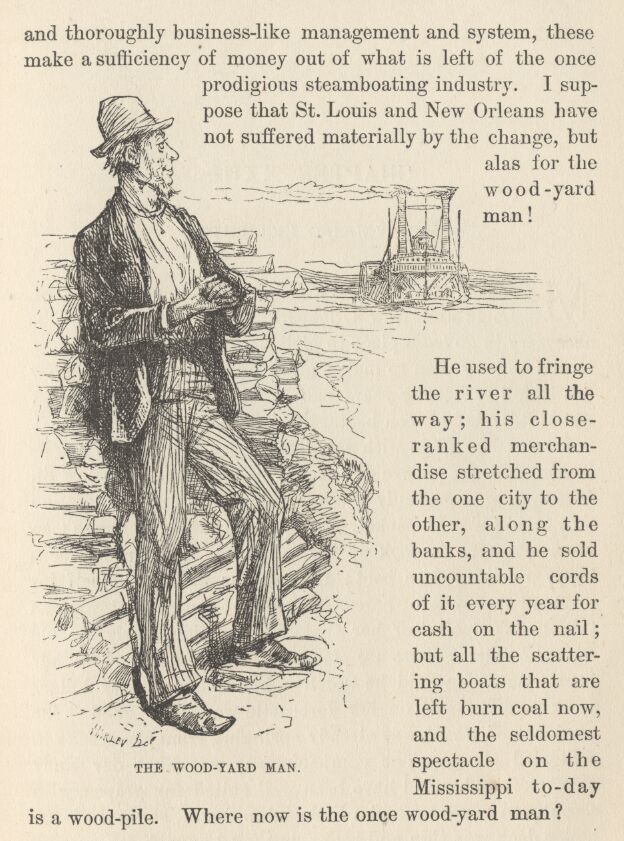
He used to fringe the river all the way; his close-ranked merchandise stretched from the one city to the other, along the banks, and he sold uncountable cords of it every year for cash on the nail; but all the scattering boats that are left burn coal now, and the seldomest spectacle on the Mississippi to-day is a wood-pile. Where now is the once wood-yard man?
The wood-yard man used to line the river all the way. His closely stacked wood stretched along the banks from one city to the other. Every year, he sold countless cords of it for cash on the spot. But all the few boats left now burn coal, and a woodpile is the rarest sight on the Mississippi today. Where is the wood-yard man of the past?