Chapter 19
Brown and I Exchange Compliments
Two trips later, I got into serious trouble. Brown was steering; I was 'pulling down.' My younger brother appeared on the hurricane deck, and shouted to Brown to stop at some landing or other a mile or so below. Brown gave no intimation that he had heard anything. But that was his way: he never condescended to take notice of an under clerk. The wind was blowing; Brown was deaf (although he always pretended he wasn't), and I very much doubted if he had heard the order. If I had two heads, I would have spoken; but as I had only one, it seemed judicious to take care of it; so I kept still.
Two trips later, I got into serious trouble. Brown was steering, and I was 'pulling down.' My younger brother appeared on the hurricane deck. He shouted to Brown to stop at some landing about a mile downstream. Brown gave no sign that he had heard him. But that was his way. He never bothered to acknowledge a junior clerk. The wind was blowing, and Brown was deaf, though he always pretended he wasn't. I very much doubted that he had heard the order. If I had two heads, I would have spoken. But since I had only one, it seemed wise to take care of it, so I kept quiet.
Presently, sure enough, we went sailing by that plantation. Captain Klinefelter appeared on the deck, and said—
Soon, sure enough, we sailed past that plantation. Captain Klinefelter appeared on deck and said:
'Let her come around, sir, let her come around. Didn't Henry tell you to land here?'
'Let her turn around, sir, let her turn around. Didn't Henry tell you to land here?'
'No, sir!'
'No, sir!'
'I sent him up to do, it.'
'I sent him up to do it.'
'He did come up; and that's all the good it done, the dod-derned fool. He never said anything.'
'He did come up, but that was all the good it did, the darned fool. He never said anything.'
'Didn't you hear him?' asked the captain of me.
'Didn't you hear him?' the captain asked me.
Of course I didn't want to be mixed up in this business, but there was no way to avoid it; so I said—
Of course, I didn't want to get involved in this business, but I couldn't avoid it. So I said:
'Yes, sir.'
'Yes, sir.'
I knew what Brown's next remark would be, before he uttered it; it was—
I knew what Brown would say next before he said it. It was:
'Shut your mouth! you never heard anything of the kind.'
'Shut your mouth! You never heard anything like that.'
I closed my mouth according to instructions. An hour later, Henry entered the pilot-house, unaware of what had been going on. He was a thoroughly inoffensive boy, and I was sorry to see him come, for I knew Brown would have no pity on him. Brown began, straightway—
I shut my mouth as instructed. An hour later, Henry entered the pilot-house, unaware of what had been going on. He was a completely harmless boy, and I was sorry to see him come in. I knew Brown would show him no pity. Brown began at once:
'Here! why didn't you tell me we'd got to land at that plantation?'
'Hey! Why didn't you tell me we had to stop at that plantation?'
'I did tell you, Mr. Brown.'
'I did tell you, Mr. Brown.'
'It's a lie!'
'It's a lie!'
I said—
I said:
'You lie, yourself. He did tell you.'
'You're lying yourself. He did tell you.'
Brown glared at me in unaffected surprise; and for as much as a moment he was entirely speechless; then he shouted to me—
Brown glared at me in genuine surprise. For a moment, he was completely speechless. Then he shouted to me:
'I'll attend to your case in half a minute!' then to Henry, 'And you leave the pilot-house; out with you!'
'I'll deal with you in half a minute!' Then he said to Henry, 'And you, leave the pilot-house. Get out!'
It was pilot law, and must be obeyed. The boy started out, and even had his foot on the upper step outside the door, when Brown, with a sudden access of fury, picked up a ten-pound lump of coal and sprang after him; but I was between, with a heavy stool, and I hit Brown a good honest blow which stretched-him out.
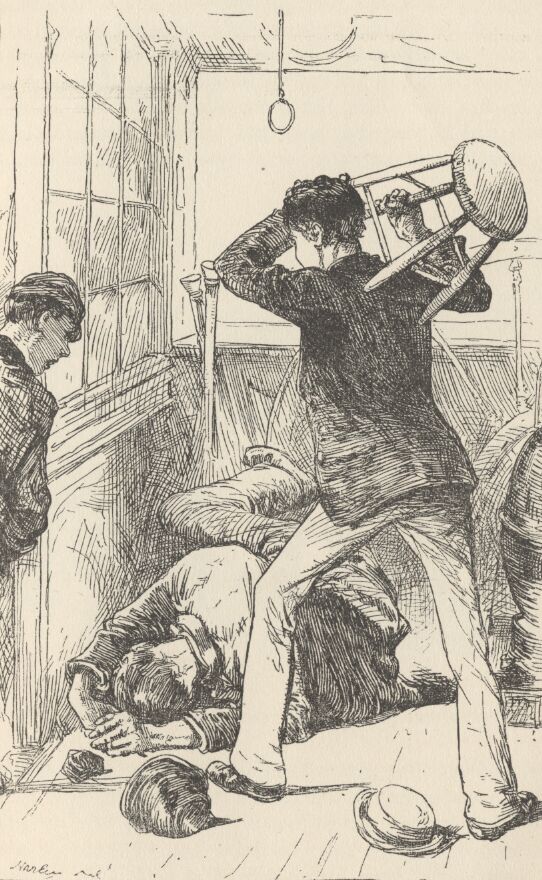
It was pilot law, and it had to be obeyed. The boy started out and had one foot on the top step outside the door. Then Brown suddenly flew into a rage, picked up a ten-pound lump of coal, and sprang after him. But I was between them with a heavy stool. I gave Brown a good, honest blow that knocked him flat.
I had committed the crime of crimes—I had lifted my hand against a pilot on duty! I supposed I was booked for the penitentiary sure, and couldn't be booked any surer if I went on and squared my long account with this person while I had the chance; consequently I stuck to him and pounded him with my fists a considerable time—I do not know how long, the pleasure of it probably made it seem longer than it really was;—but in the end he struggled free and jumped up and sprang to the wheel: a very natural solicitude, for, all this time, here was this steamboat tearing down the river at the rate of fifteen miles an hour and nobody at the helm! However, Eagle Bend was two miles wide at this bank-full stage, and correspondingly long and deep; and the boat was steering herself straight down the middle and taking no chances. Still, that was only luck—a body might have found her charging into the woods.
I had committed the worst crime of all. I had raised my hand against a pilot on duty! I figured I was sure to go to prison. I couldn’t be any more certain of that if I settled my long account with the man while I had the chance. So I held on to him and pounded him with my fists for quite a while. I don’t know how long. The pleasure of it probably made it seem longer than it really was. But at last he struggled free, jumped up, and sprang to the wheel. His concern was natural enough. All this time, the steamboat was tearing down the river at fifteen miles an hour with nobody at the wheel! Still, Eagle Bend was two miles wide with the river this full, and it was long and deep to match. The boat was steering itself straight down the middle and taking no chances. But that was only luck. A person might have found the boat charging into the woods.
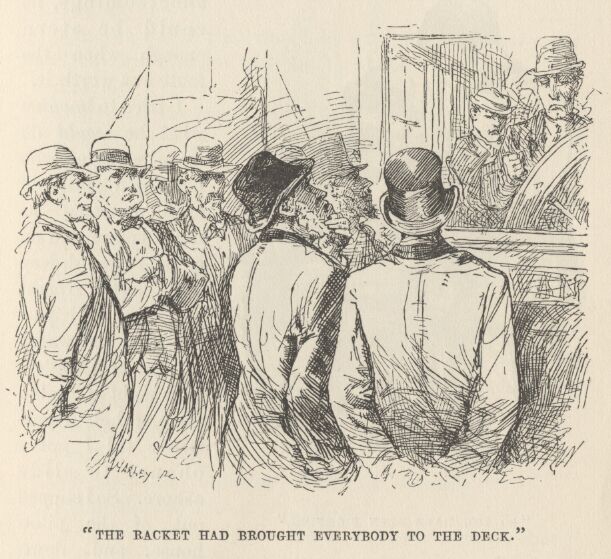
Perceiving, at a glance, that the 'Pennsylvania' was in no danger, Brown gathered up the big spy-glass, war-club fashion, and ordered me out of the pilot-house with more than Comanche bluster. But I was not afraid of him now; so, instead of going, I tarried, and criticized his grammar; I reformed his ferocious speeches for him, and put them into good English, calling his attention to the advantage of pure English over the bastard dialect of the Pennsylvanian collieries whence he was extracted. He could have done his part to admiration in a cross-fire of mere vituperation, of course; but he was not equipped for this species of controversy; so he presently laid aside his glass and took the wheel, muttering and shaking his head; and I retired to the bench. The racket had brought everybody to the hurricane deck, and I trembled when I saw the old captain looking up from the midst of the crowd. I said to myself, 'Now I am done for!'—For although, as a rule, he was so fatherly and indulgent toward the boat's family, and so patient of minor shortcomings, he could be stern enough when the fault was worth it.
Brown saw at a glance that the 'Pennsylvania' was in no danger. He picked up the big spyglass like a war club and ordered me out of the pilot-house, blustering more fiercely than a Comanche. But I was no longer afraid of him, so instead of leaving, I stayed and criticized his grammar. I corrected his ferocious speeches and put them into good English. I pointed out the advantages of pure English over the bastard dialect of the Pennsylvania coal mines he came from. Of course, he could have held his own admirably in a shouting match of insults. But he was not equipped for this kind of argument. So he soon put down his spyglass and took the wheel, muttering and shaking his head. I went back to the bench. The racket had brought everybody to the hurricane deck. I trembled when I saw the old captain looking up from the middle of the crowd. I said to myself, 'Now I am done for!' As a rule, he was fatherly and indulgent toward the boat's family and patient with minor faults. But he could be stern enough when the fault deserved it.
I tried to imagine what he would do to a cub pilot who had been guilty of such a crime as mine, committed on a boat guard-deep with costly freight and alive with passengers. Our watch was nearly ended. I thought I would go and hide somewhere till I got a chance to slide ashore. So I slipped out of the pilot-house, and down the steps, and around to the texas door—and was in the act of gliding within, when the captain confronted me! I dropped my head, and he stood over me in silence a moment or two, then said impressively—
I tried to imagine what he would do to a trainee pilot who had committed a crime like mine. The boat was loaded down to its guards with expensive freight and crowded with passengers. Our watch was almost over. I thought I would hide somewhere until I had a chance to slip ashore. So I slipped out of the pilot-house, down the steps, and around to the texas door. I was just slipping inside when the captain confronted me! I dropped my head. He stood over me in silence for a moment or two, then said in a solemn tone:
'Follow me.'
'Follow me.'
I dropped into his wake; he led the way to his parlor in the forward end of the texas. We were alone, now. He closed the after door; then moved slowly to the forward one and closed that. He sat down; I stood before him. He looked at me some little time, then said—
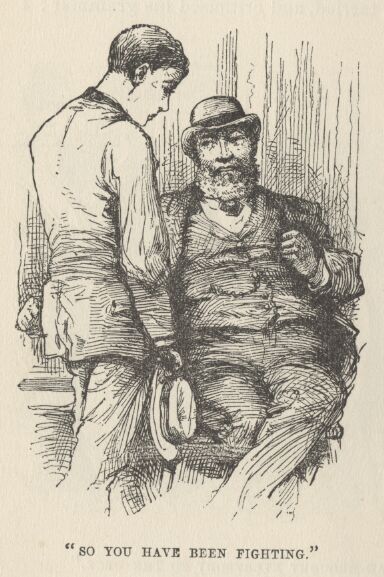
I followed him to his parlor at the front of the texas. We were alone now. He closed the rear door, then slowly walked to the front door and closed it. He sat down, and I stood in front of him. He looked at me for a little while, then said:
'So you have been fighting Mr. Brown?'
'So you've been fighting Mr. Brown?'
I answered meekly—
I answered meekly:
'Yes, sir.'
'Yes, sir.'
'Do you know that that is a very serious matter?'
'Do you know that this is a very serious matter?'
'Yes, sir.'
'Yes, sir.'
'Are you aware that this boat was plowing down the river fully five minutes with no one at the wheel?'
'Do you know this boat was heading downriver for a full five minutes with no one at the wheel?'
'Yes, sir.'
'Yes, sir.'
'Did you strike him first?'
'Did you hit him first?'
'Yes, sir.'
'Yes, sir.'
'What with?'
'With what?'
'A stool, sir.'
'A stool, sir.'
'Hard?'
'Hard?'
'Middling, sir.'
'Fairly well, sir.'
'Did it knock him down?'
'Did it knock him down?'
'He—he fell, sir.'
'He, he fell, sir.'
'Did you follow it up? Did you do anything further?'
'Did you follow it up? Did you do anything else?'
'Yes, sir.'
'Yes, sir.'
'What did you do?'
'What did you do?'
'Pounded him, sir.'
'Pounded him, sir.'
'Pounded him?'
'Pounded him?'
'Yes, sir.'
'Yes, sir.'
'Did you pound him much?—that is, severely?'
'Did you beat him much? I mean, did you beat him severely?'
'One might call it that, sir, maybe.'
'You might call it that, sir, maybe.'
'I'm deuced glad of it! Hark ye, never mention that I said that. You have been guilty of a great crime; and don't you ever be guilty of it again, on this boat. But—lay for him ashore! Give him a good sound thrashing, do you hear? I'll pay the expenses. Now go—and mind you, not a word of this to anybody. Clear out with you!—you've been guilty of a great crime, you whelp!'
'I'm damn glad of it! Listen, never tell anyone I said that. You've committed a serious crime. Don't ever do it again on this boat. But wait for him ashore! Give him a good beating, do you hear? I'll pay the expenses. Now go, and remember, not a word of this to anyone. Get out of here! You've committed a serious crime, you little brat!'
I slid out, happy with the sense of a close shave and a mighty deliverance; and I heard him laughing to himself and slapping his fat thighs after I had closed his door.
I slipped out, happy to have had such a narrow escape. After I closed his door, I heard him laughing to himself and slapping his fat thighs.
When Brown came off watch he went straight to the captain, who was talking with some passengers on the boiler deck, and demanded that I be put ashore in New Orleans—and added—
When Brown came off watch, he went straight to the captain, who was talking with some passengers on the boiler deck. Brown demanded that the captain put me ashore in New Orleans. He added:
'I'll never turn a wheel on this boat again while that cub stays.'
'I'll never steer this boat again as long as that trainee stays.'
The captain said—
The captain said:
'But he needn't come round when you are on watch, Mr. Brown.
'But he doesn't need to come around when you're on watch, Mr. Brown.
'I won't even stay on the same boat with him. One of us has got to go ashore.'
'I won't even stay on the same boat with him. One of us has to go ashore.'
'Very well,' said the captain, 'let it be yourself;' and resumed his talk with the passengers.
'All right,' said the captain, 'let it be you.' Then he went back to talking with the passengers.
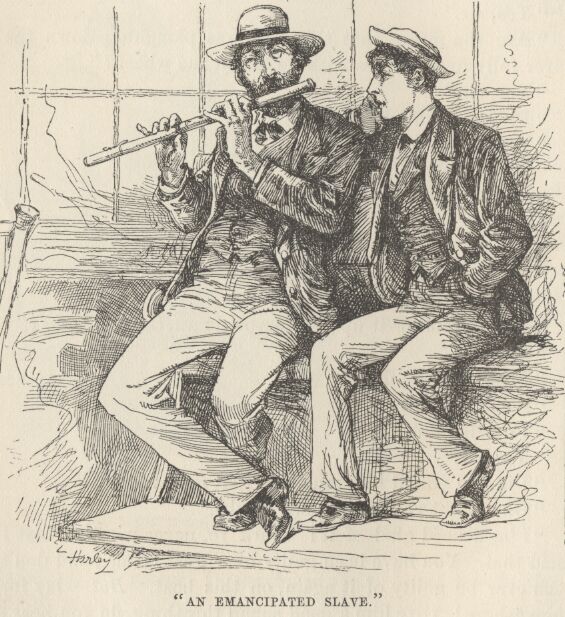
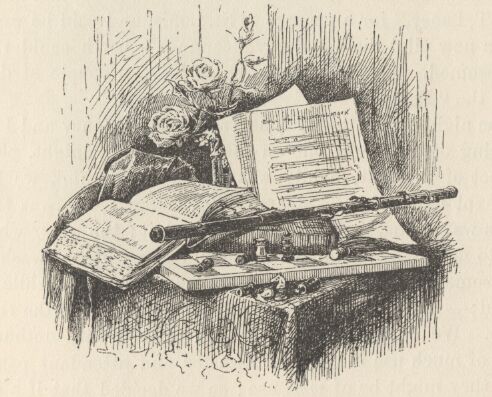
During the brief remainder of the trip, I knew how an emancipated slave feels; for I was an emancipated slave myself. While we lay at landings, I listened to George Ealer's flute; or to his readings from his two bibles, that is to say, Goldsmith and Shakespeare; or I played chess with him—and would have beaten him sometimes, only he always took back his last move and ran the game out differently.
For the short rest of the trip, I knew how a freed slave feels, because I was a freed slave myself. While we were docked, I listened to George Ealer play his flute. I also listened to him read from his two bibles, Goldsmith and Shakespeare. Or I played chess with him. I would have beaten him sometimes, but he always took back his last move and played the rest of the game differently.