Chapter 18
I Take a Few Extra Lessons
DURING the two or two and a half years of my apprenticeship, I served under many pilots, and had experience of many kinds of steamboatmen and many varieties of steamboats; for it was not always convenient for Mr. Bixby to have me with him, and in such cases he sent me with somebody else. I am to this day profiting somewhat by that experience; for in that brief, sharp schooling, I got personally and familiarly acquainted with about all the different types of human nature that are to be found in fiction, biography, or history. The fact is daily borne in upon me, that the average shore-employment requires as much as forty years to equip a man with this sort of an education. When I say I am still profiting by this thing, I do not mean that it has constituted me a judge of men—no, it has not done that; for judges of men are born, not made. My profit is various in kind and degree; but the feature of it which I value most is the zest which that early experience has given to my later reading. When I find a well-drawn character in fiction or biography, I generally take a warm personal interest in him, for the reason that I have known him before—met him on the river.
During the two or two and a half years of my apprenticeship, I served under many pilots. I also gained experience with many kinds of steamboatmen and steamboats. Mr. Bixby could not always have me with him, so he sent me with someone else at those times. I still benefit somewhat from that experience. In that brief, intense schooling, I got to know firsthand nearly every type of human nature found in fiction, biography, or history. Every day I am reminded that the average job on shore takes as much as forty years to give a man that kind of education. When I say I still benefit from it, I do not mean it made me a judge of men. No, it did not do that, for judges of men are born, not made. I have benefited in various ways and to various degrees. But what I value most is the zest that early experience has given my later reading. When I find a well-drawn character in fiction or biography, I generally take a warm personal interest in him. That is because I have known him before. I met him on the river.
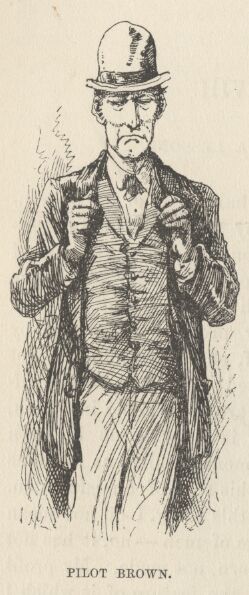
The figure that comes before me oftenest, out of the shadows of that vanished time, is that of Brown, of the steamer 'Pennsylvania'—the man referred to in a former chapter, whose memory was so good and tiresome. He was a middle-aged, long, slim, bony, smooth-shaven, horse-faced, ignorant, stingy, malicious, snarling, fault hunting, mote-magnifying tyrant. I early got the habit of coming on watch with dread at my heart. No matter how good a time I might have been having with the off-watch below, and no matter how high my spirits might be when I started aloft, my soul became lead in my body the moment I approached the pilot-house.
The figure I see most often from the shadows of that vanished time is Brown, of the steamer 'Pennsylvania'. I mentioned him in an earlier chapter. His memory was so good and so tiresome. He was middle-aged, tall, thin, bony, clean-shaven, and horse-faced. He was an ignorant, stingy, malicious, snarling tyrant who hunted for faults and made mountains out of specks. I soon got into the habit of coming on watch with dread in my heart. I might have been having a wonderful time with the off-watch crew below, and my spirits might have been high when I started upstairs. But the moment I approached the pilot-house, my soul turned to lead inside me.
I still remember the first time I ever entered the presence of that man. The boat had backed out from St. Louis and was 'straightening down;' I ascended to the pilot-house in high feather, and very proud to be semi-officially a member of the executive family of so fast and famous a boat. Brown was at the wheel. I paused in the middle of the room, all fixed to make my bow, but Brown did not look around. I thought he took a furtive glance at me out of the corner of his eye, but as not even this notice was repeated, I judged I had been mistaken. By this time he was picking his way among some dangerous 'breaks' abreast the woodyards; therefore it would not be proper to interrupt him; so I stepped softly to the high bench and took a seat.
I still remember the first time I ever met that man. The boat had backed out from St. Louis and was 'straightening down' into the river. I climbed to the pilot-house in high spirits. I was proud to be a semi-official member of the crew in charge of such a fast, famous boat. Brown was at the wheel. I stopped in the middle of the room, ready to bow, but Brown did not turn around. I thought he glanced at me out of the corner of his eye. But he did not even do that again, so I decided I had been mistaken. By then he was steering through some dangerous 'breaks' in the water beside the woodyards. It would not have been proper to interrupt him, so I walked quietly to the high bench and sat down.
There was silence for ten minutes; then my new boss turned and inspected me deliberately and painstakingly from head to heel for about—as it seemed to me—a quarter of an hour. After which he removed his countenance and I saw it no more for some seconds; then it came around once more, and this question greeted me—
There was silence for ten minutes. Then my new boss turned and examined me slowly and carefully from head to toe. It seemed to me that he spent fifteen minutes doing it. Then he turned his face away, and I did not see it for a few seconds. Then he turned back and asked me this question:
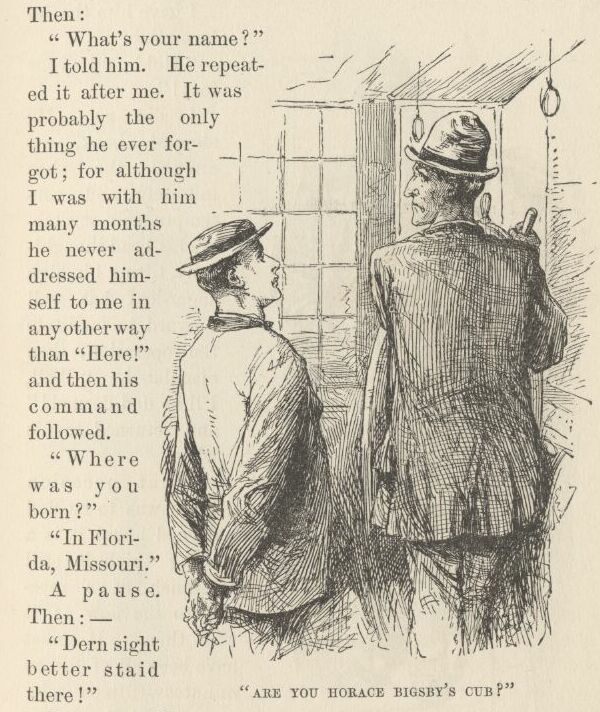
'Are you Horace Bigsby's cub?'
'Are you Horace Bigsby's apprentice?'
'Yes, sir.'
'Yes, sir.'
After this there was a pause and another inspection. Then—
After this, there was a pause and another inspection. Then...
'What's your name?'
'What's your name?'
I told him. He repeated it after me. It was probably the only thing he ever forgot; for although I was with him many months he never addressed himself to me in any other way than 'Here!' and then his command followed.
I told him. He repeated it after me. It was probably the only thing he ever forgot. Although I was with him for many months, he never addressed me any other way than 'Here!' Then he would give his command.
'Where was you born?'
'Where were you born?'
'In Florida, Missouri.'
'In Florida, Missouri.'
A pause. Then—
A pause. Then...
'Dern sight better staid there!'
'Would have been a damn sight better to stay there!'
By means of a dozen or so of pretty direct questions, he pumped my family history out of me.
He asked me about a dozen pretty direct questions and got my family history out of me.
The leads were going now, in the first crossing. This interrupted the inquest. When the leads had been laid in, he resumed—
The crew was now using the sounding leads on the first crossing. This interrupted the inquiry. When the leads were put away, he resumed:
'How long you been on the river?'
'How long have you been on the river?'
I told him. After a pause—
I told him. After a pause...
'Where'd you get them shoes?'
'Where did you get those shoes?'
I gave him the information.
I gave him the information.
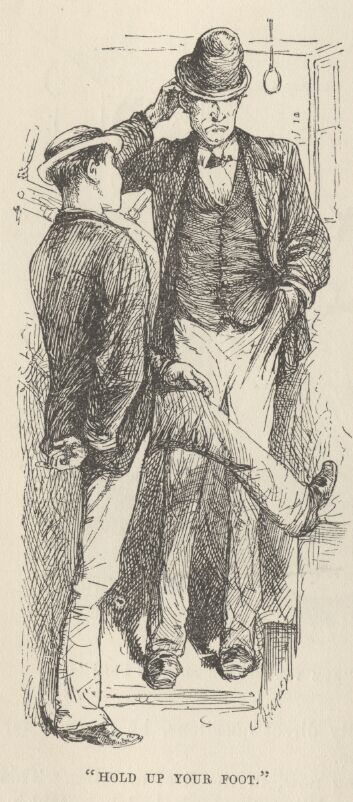
'Hold up your foot!'
'Hold up your foot!'
I did so. He stepped back, examined the shoe minutely and contemptuously, scratching his head thoughtfully, tilting his high sugar-loaf hat well forward to facilitate the operation, then ejaculated, 'Well, I'll be dod derned!' and returned to his wheel.
I did so. He stepped back and examined the shoe closely and scornfully. He scratched his head thoughtfully, tipping his tall, cone-shaped hat forward to make it easier. Then he exclaimed, 'Well, I'll be dod derned!' and returned to his wheel.
What occasion there was to be dod derned about it is a thing which is still as much of a mystery to me now as it was then. It must have been all of fifteen minutes—fifteen minutes of dull, homesick silence—before that long horse-face swung round upon me again—and then, what a change! It was as red as fire, and every muscle in it was working. Now came this shriek—
Why there was any reason to be so darned about it is still as much a mystery to me now as it was then. A full fifteen minutes must have passed in dull, homesick silence before that long horse-face swung around toward me again. And what a change! His face was red as fire, and every muscle in it was moving. Then came this shriek:
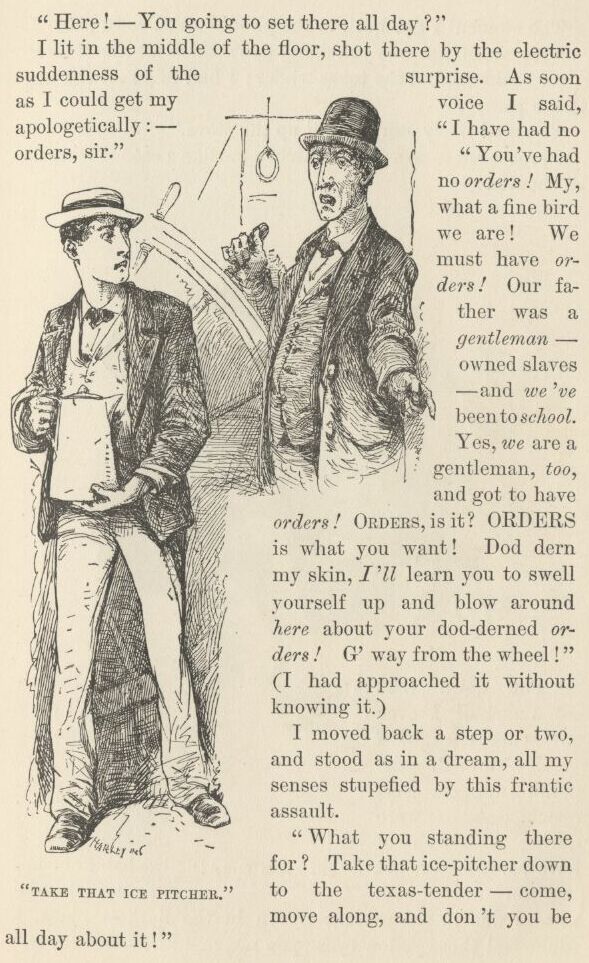
'Here!—You going to set there all day?'
'Hey! Are you going to sit there all day?'
I lit in the middle of the floor, shot there by the electric suddenness of the surprise. As soon as I could get my voice I said, apologetically:—'I have had no orders, sir.'
I landed in the middle of the floor, sent flying by the sudden shock of surprise. As soon as I could speak, I said apologetically: 'I haven't received any orders, sir.'
'You've had no orders! My, what a fine bird we are! We must have orders! Our father was a gentleman—owned slaves—and we've been to school. Yes, we are a gentleman, too, and got to have orders! orders, is it? Orders is what you want! Dod dern my skin, i'll learn you to swell yourself up and blow around here about your dod-derned orders! G'way from the wheel!' (I had approached it without knowing it.)
'You've had no orders! My, what a fine bird we are! We must have orders! Our father was a gentleman. He owned slaves, and we've been to school. Yes, we are a gentleman, too, and we have to have orders! Orders, is that it? Orders are what you want! Damn it, I'll teach you to act so important and make a fuss about your damn orders! Get away from the wheel!' (I had approached the wheel without realizing it.)
I moved back a step or two, and stood as in a dream, all my senses stupefied by this frantic assault.
I stepped back a step or two and stood as if in a dream. All my senses were stunned by this frantic attack.
'What you standing there for? Take that ice-pitcher down to the texas-tender-come, move along, and don't you be all day about it!'
'What are you standing there for? Take that ice pitcher down to the texas tender. Come on, move along, and don't take all day!'
The moment I got back to the pilot-house, Brown said—
As soon as I got back to the pilot house, Brown said:
'Here! What was you doing down there all this time?'
'Hey! What were you doing down there all this time?'
'I couldn't find the texas-tender; I had to go all the way to the pantry.'
'I couldn't find the texas-tender. I had to go all the way to the pantry.'
'Derned likely story! Fill up the stove.'
'What a likely story! Fill up the stove.'
I proceeded to do so. He watched me like a cat. Presently he shouted—
I did as he asked. He watched me like a cat. Soon he shouted:
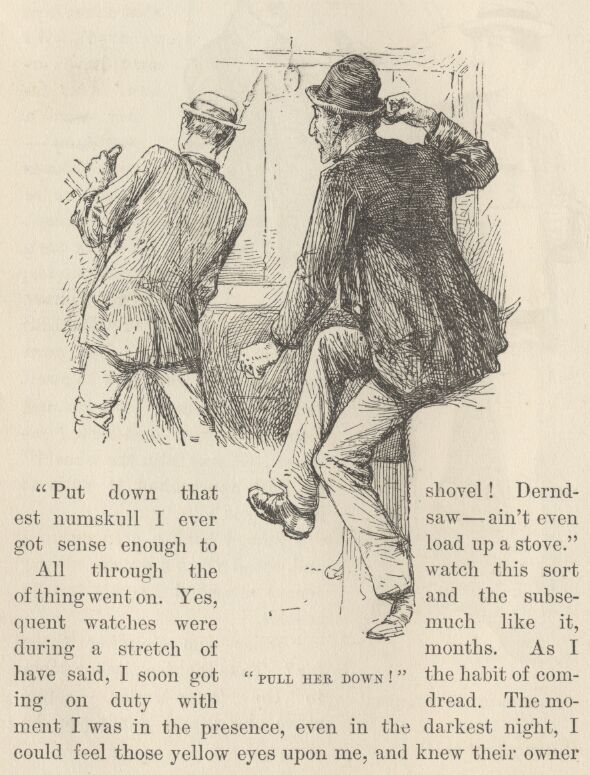
'Put down that shovel! Deadest numskull I ever saw—ain't even got sense enough to load up a stove.'
'Put down that shovel! You're the biggest idiot I ever saw. You don't even have enough sense to load a stove.'
All through the watch this sort of thing went on. Yes, and the subsequent watches were much like it, during a stretch of months. As I have said, I soon got the habit of coming on duty with dread. The moment I was in the presence, even in the darkest night, I could feel those yellow eyes upon me, and knew their owner was watching for a pretext to spit out some venom on me. Preliminarily he would say—
This sort of thing went on throughout the watch. Yes, and the watches that followed were much the same for months. As I have said, I soon got into the habit of dreading coming on duty. The moment I was in his presence, even on the darkest night, I could feel those yellow eyes on me. I knew their owner was watching for an excuse to spit some venom at me. He would begin by saying:
'Here! Take the wheel.'
'Here! Take the wheel.'
Two minutes later—
Two minutes later...
'Where in the nation you going to? Pull her down! pull her down!'
'Where on earth are you going? Pull her down! Pull her down!'
After another moment—
After another moment...
'Say! You going to hold her all day? Let her go—meet her! meet her!'
'Say! Are you going to hold her all day? Let her go, meet her! Meet her!'
Then he would jump from the bench, snatch the wheel from me, and meet her himself, pouring out wrath upon me all the time.
Then he would jump from the bench, snatch the wheel from me, and correct her course himself. All the while, he would rage at me.
George Ritchie was the other pilot's cub. He was having good times now; for his boss, George Ealer, was as kindhearted as Brown wasn't. Ritchie had steeled for Brown the season before; consequently he knew exactly how to entertain himself and plague me, all by the one operation. Whenever I took the wheel for a moment on Ealer's watch, Ritchie would sit back on the bench and play Brown, with continual ejaculations of 'Snatch her! snatch her! Derndest mud-cat I ever saw!' 'Here! Where you going now? Going to run over that snag?' 'Pull her down! Don't you hear me? Pull her down!' 'There she goes! Just as I expected! I told you not to cramp that reef. G'way from the wheel!'
George Ritchie was the other pilot's cub. He was having a good time now because his boss, George Ealer, was as kindhearted as Brown was not. Ritchie had steered for Brown the season before. So he knew exactly how to entertain himself and torment me at the same time. Whenever I took the wheel for a moment during Ealer's watch, Ritchie would sit back on the bench and imitate Brown. He would shout, 'Snatch her! Snatch her! Damnedest mud-cat I ever saw!' 'Here! Where are you going now? Are you going to run over that snag?' 'Pull her down! Don't you hear me? Pull her down!' 'There she goes! Just as I expected! I told you not to steer so close to that reef. Get away from the wheel!'
So I always had a rough time of it, no matter whose watch it was; and sometimes it seemed to me that Ritchie's good-natured badgering was pretty nearly as aggravating as Brown's dead-earnest nagging.
So I always had a rough time, no matter whose watch it was. Sometimes Ritchie's good-natured teasing seemed almost as annoying as Brown's deadly serious nagging.
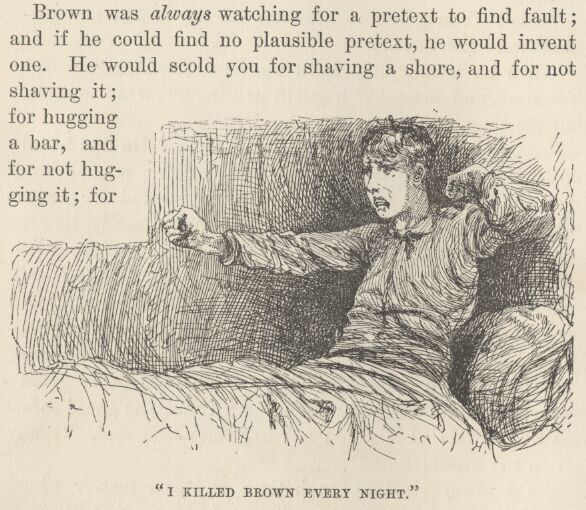
I often wanted to kill Brown, but this would not answer. A cub had to take everything his boss gave, in the way of vigorous comment and criticism; and we all believed that there was a United States law making it a penitentiary offense to strike or threaten a pilot who was on duty. However, I could imagine myself killing Brown; there was no law against that; and that was the thing I used always to do the moment I was abed. Instead of going over my river in my mind as was my duty, I threw business aside for pleasure, and killed Brown. I killed Brown every night for months; not in old, stale, commonplace ways, but in new and picturesque ones;—ways that were sometimes surprising for freshness of design and ghastliness of situation and environment.
I often wanted to kill Brown, but that would not do. A cub pilot had to put up with all the harsh comments and criticism his boss gave him. And we all believed that a United States law made it a prison offense to strike or threaten a pilot on duty. But I could imagine myself killing Brown. There was no law against that, and I always did it as soon as I got into bed. I was supposed to go over the river in my mind, but I set work aside for pleasure and killed Brown. I killed Brown every night for months, never in stale, ordinary ways, but in new and vivid ones. Sometimes the methods were surprisingly original, and the scenes and surroundings were gruesome.
Brown was always watching for a pretext to find fault; and if he could find no plausible pretext, he would invent one. He would scold you for shaving a shore, and for not shaving it; for hugging a bar, and for not hugging it; for 'pulling down' when not invited, and for not pulling down when not invited; for firing up without orders, and for waiting for orders. In a word, it was his invariable rule to find fault with everything you did; and another invariable rule of his was to throw all his remarks (to you) into the form of an insult.
Brown was always looking for an excuse to find fault. If he could not find a plausible excuse, he would invent one. He would scold you for steering too close to a shore, and for not steering close enough. He would scold you for hugging a sandbar, and for not hugging it. He would scold you for 'pulling down' when not invited, and for not pulling down when not invited. He would scold you for firing up without orders, and for waiting for orders. In short, he always found fault with everything you did. He also made every remark to you an insult.
One day we were approaching New Madrid, bound down and heavily laden. Brown was at one side of the wheel, steering; I was at the other, standing by to 'pull down' or 'shove up.' He cast a furtive glance at me every now and then. I had long ago learned what that meant; viz., he was trying to invent a trap for me. I wondered what shape it was going to take. By and by he stepped back from the wheel and said in his usual snarly way—
One day we were approaching New Madrid, heading downstream with a heavy load. Brown was steering on one side of the wheel. I stood on the other side, ready to 'pull down' or 'shove up.' He glanced at me furtively now and then. I had long ago learned what those glances meant. He was trying to think up a trap for me. I wondered what kind of trap it would be. After a while, he stepped back from the wheel and spoke in his usual snarly way:
'Here!—See if you've got gumption enough to round her to.'
'Here! See if you have enough sense to turn her around.'
This was simply bound to be a success; nothing could prevent it; for he had never allowed me to round the boat to before; consequently, no matter how I might do the thing, he could find free fault with it. He stood back there with his greedy eye on me, and the result was what might have been foreseen: I lost my head in a quarter of a minute, and didn't know what I was about; I started too early to bring the boat around, but detected a green gleam of joy in Brown's eye, and corrected my mistake; I started around once more while too high up, but corrected myself again in time; I made other false moves, and still managed to save myself; but at last I grew so confused and anxious that I tumbled into the very worst blunder of all—I got too far down before beginning to fetch the boat around. Brown's chance was come.
This was simply bound to be a success. Nothing could prevent it. Brown had never let me turn the boat around before. So, no matter how I did it, he could find plenty of fault. He stood back there watching me with a greedy eye. The result was predictable. Within fifteen seconds, I lost my head and didn't know what I was doing. I started to turn the boat too early, but I caught a green gleam of joy in Brown's eye. So I corrected my mistake. I started to turn again while I was still too far upstream, but corrected myself in time. I made other false moves, yet still managed to save myself. But at last I became so confused and anxious that I made the worst blunder of all. I went too far downstream before starting to turn the boat around. Brown's chance had come.
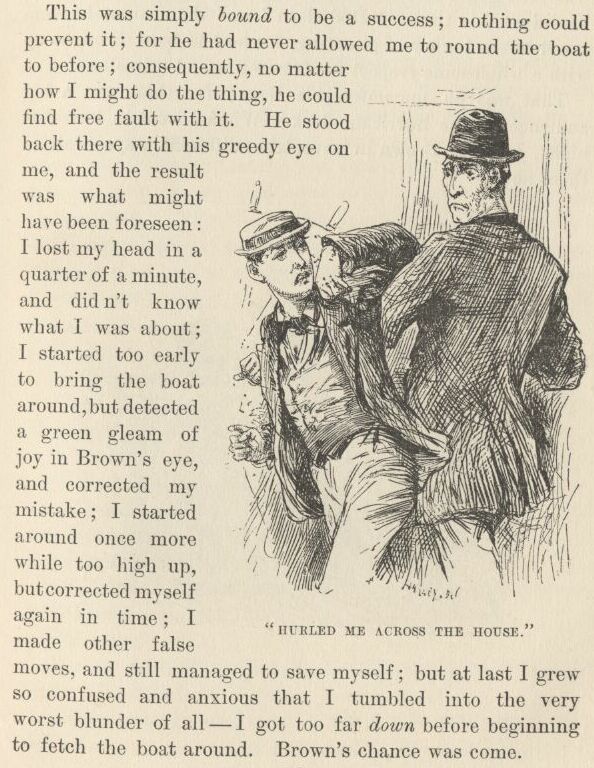
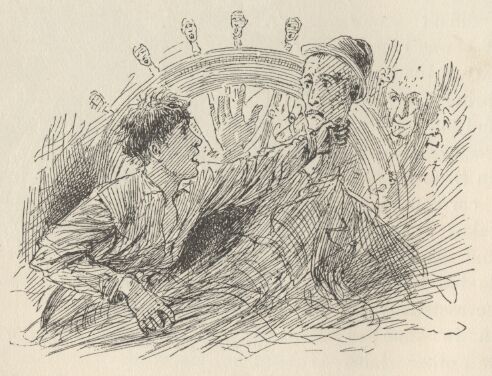
His face turned red with passion; he made one bound, hurled me across the house with a sweep of his arm, spun the wheel down, and began to pour out a stream of vituperation upon me which lasted till he was out of breath. In the course of this speech he called me all the different kinds of hard names he could think of, and once or twice I thought he was even going to swear—but he didn't this time. 'Dod dern' was the nearest he ventured to the luxury of swearing, for he had been brought up with a wholesome respect for future fire and brimstone.
His face turned red with rage. He leaped forward, swept me across the pilothouse with his arm, and spun the wheel down. Then he unleashed a torrent of insults at me until he ran out of breath. He called me every nasty name he could think of. Once or twice, I thought he was even going to swear, but he didn't this time. 'Dod dern' was the closest he dared come to the luxury of swearing. He had been brought up with a healthy respect for the fire and brimstone awaiting him in the next life.
That was an uncomfortable hour; for there was a big audience on the hurricane deck. When I went to bed that night, I killed Brown in seventeen different ways—all of them new.
That was an uncomfortable hour because a large crowd was watching from the hurricane deck. When I went to bed that night, I killed Brown in seventeen different ways. All of them were new.