Chapter 16
Racing Days
IT was always the custom for the boats to leave New Orleans between four and five o'clock in the afternoon. From three o'clock onward they would be burning rosin and pitch pine (the sign of preparation), and so one had the picturesque spectacle of a rank, some two or three miles long, of tall, ascending columns of coal-black smoke; a colonnade which supported a sable roof of the same smoke blended together and spreading abroad over the city. Every outward-bound boat had its flag flying at the jack-staff, and sometimes a duplicate on the verge staff astern. Two or three miles of mates were commanding and swearing with more than usual emphasis; countless processions of freight barrels and boxes were spinning athwart the levee and flying aboard the stage-planks, belated passengers were dodging and skipping among these frantic things, hoping to reach the forecastle companion way alive, but having their doubts about it; women with reticules and bandboxes were trying to keep up with husbands freighted with carpet-sacks and crying babies, and making a failure of it by losing their heads in the whirl and roar and general distraction; drays and baggage-vans were clattering hither and thither in a wild hurry, every now and then getting blocked and jammed together, and then during ten seconds one could not see them for the profanity, except vaguely and dimly; every windlass connected with every forehatch, from one end of that long array of steamboats to the other, was keeping up a deafening whiz and whir, lowering freight into the hold, and the half-naked crews of perspiring negroes that worked them were roaring such songs as 'De Las' Sack! De Las' Sack!'—inspired to unimaginable exaltation by the chaos of turmoil and racket that was driving everybody else mad.
Boats always left New Orleans between four and five in the afternoon. From three o'clock onward, they burned rosin and pitch pine as a sign that they were preparing to leave. The result was a picturesque sight: a row of tall, rising columns of coal-black smoke, stretching two or three miles. The columns supported a black roof of smoke that blended together and spread over the city. Every outgoing boat flew its flag at the jackstaff, and sometimes a duplicate flag at the stern. Two or three miles of mates were shouting orders and swearing more forcefully than usual. Countless lines of barrels and boxes spun across the levee and flew aboard over the gangplanks. Late passengers dodged and skipped among all this frantic movement, hoping to reach the forecastle entrance alive, though they had their doubts. Women carrying handbags and hatboxes tried to keep up with husbands loaded down with carpetbags and crying babies. The women failed, losing their heads in the whirl, roar, and general confusion. Drays and baggage vans clattered back and forth in a wild hurry, now and then becoming blocked and jammed together. Then, for ten seconds, you could see them only vaguely and dimly through the profanity. From one end of that long row of steamboats to the other, every winch at every forward cargo hatch kept up a deafening whiz and whir as it lowered freight into the hold. The half-naked crews of sweating Black men who worked the winches roared songs such as 'De Las' Sack! De Las' Sack!' The chaotic commotion and racket that drove everyone else mad lifted the crews to unimaginable heights of excitement.
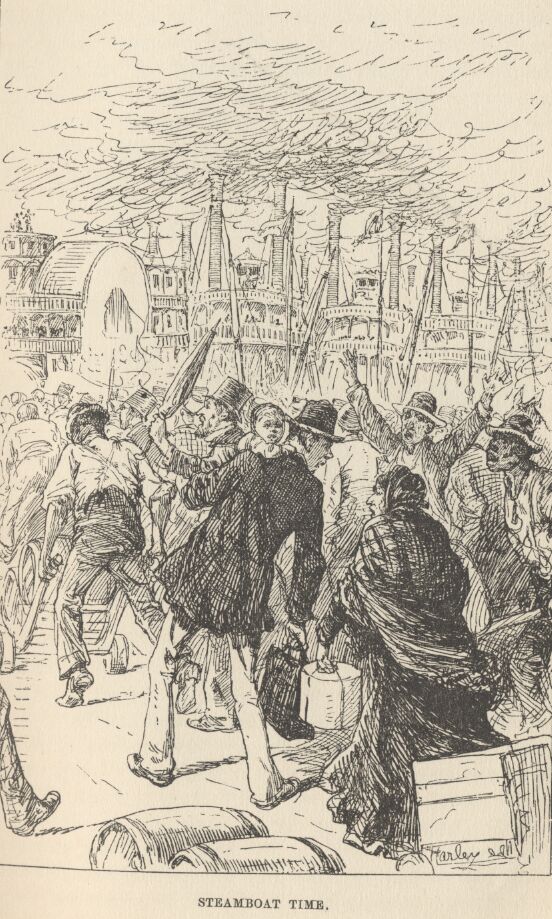
By this time the hurricane and boiler decks of the steamers would be packed and black with passengers. The 'last bells' would begin to clang, all down the line, and then the powwow seemed to double; in a moment or two the final warning came,—a simultaneous din of Chinese gongs, with the cry, 'All dat ain't goin', please to git asho'!'—and behold, the powwow quadrupled! People came swarming ashore, overturning excited stragglers that were trying to swarm aboard. One more moment later a long array of stage-planks was being hauled in, each with its customary latest passenger clinging to the end of it with teeth, nails, and everything else, and the customary latest procrastinator making a wild spring shoreward over his head.
By this time, the hurricane and boiler decks of the steamboats would be packed with a dark mass of passengers. The 'last bells' would begin to clang all down the line, and the commotion seemed to double. A moment or two later came the final warning. Chinese gongs clanged all at once, and someone cried, 'Everyone who isn't going, please get ashore!' And suddenly the commotion quadrupled! People swarmed ashore, knocking over excited stragglers who were trying to swarm aboard. Another moment later, a long row of boarding planks was being hauled in. Each plank had its usual last passenger clinging to the end with teeth, nails, and everything else. And the usual last procrastinator made a wild leap over the passenger's head toward shore.
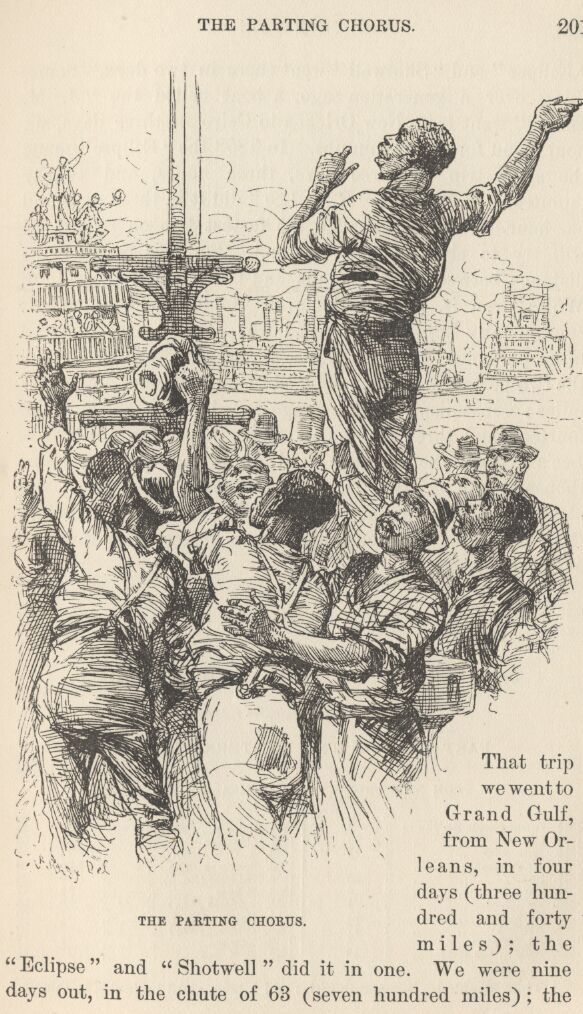
Now a number of the boats slide backward into the stream, leaving wide gaps in the serried rank of steamers. Citizens crowd the decks of boats that are not to go, in order to see the sight. Steamer after steamer straightens herself up, gathers all her strength, and presently comes swinging by, under a tremendous head of steam, with flag flying, black smoke rolling, and her entire crew of firemen and deck-hands (usually swarthy negroes) massed together on the forecastle, the best 'voice' in the lot towering from the midst (being mounted on the capstan), waving his hat or a flag, and all roaring a mighty chorus, while the parting cannons boom and the multitudinous spectators swing their hats and huzza! Steamer after steamer falls into line, and the stately procession goes winging its flight up the river.
Now several boats back into the river, leaving wide gaps in the tightly packed row of steamers. People crowd the decks of boats that are staying behind to watch the sight. One steamer after another straightens up and gathers all its strength. Soon each swings past under a tremendous head of steam, with its flag flying and black smoke rolling. The entire crew of firemen and deckhands, usually dark-skinned Black men, gather on the forecastle. The best 'voice' among them stands above the rest on the capstan, waving a hat or a flag. All roar out a mighty chorus as the parting cannons boom and the many spectators wave their hats and cheer. Steamer after steamer falls into line, and the stately procession sweeps up the river.
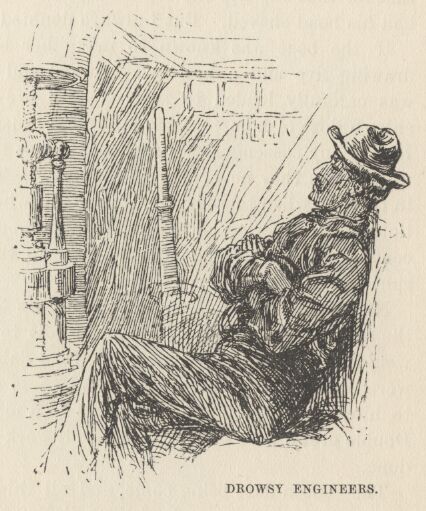
In the old times, whenever two fast boats started out on a race, with a big crowd of people looking on, it was inspiring to hear the crews sing, especially if the time were night-fall, and the forecastle lit up with the red glare of the torch-baskets. Racing was royal fun. The public always had an idea that racing was dangerous; whereas the opposite was the case—that is, after the laws were passed which restricted each boat to just so many pounds of steam to the square inch. No engineer was ever sleepy or careless when his heart was in a race. He was constantly on the alert, trying gauge-cocks and watching things. The dangerous place was on slow, plodding boats, where the engineers drowsed around and allowed chips to get into the 'doctor' and shut off the water supply from the boilers.
In the old days, two fast boats would sometimes race while a big crowd watched. It was thrilling to hear the crews sing, especially at nightfall, when torch-baskets lit the forecastle with a red glow. Racing was royal fun. The public always thought racing was dangerous, but the opposite was true. That was so after laws limited each boat’s steam pressure to a set number of pounds per square inch. No engineer was ever sleepy or careless when his heart was in a race. He was always alert, testing the gauge-cocks and watching everything. The dangerous place was on slow, plodding boats. There, engineers dozed and let chips get into the 'doctor', cutting off the water supply to the boilers.
In the 'flush times' of steamboating, a race between two notoriously fleet steamers was an event of vast importance. The date was set for it several weeks in advance, and from that time forward, the whole Mississippi Valley was in a state of consuming excitement. Politics and the weather were dropped, and people talked only of the coming race. As the time approached, the two steamers 'stripped' and got ready. Every encumbrance that added weight, or exposed a resisting surface to wind or water, was removed, if the boat could possibly do without it. The 'spars,' and sometimes even their supporting derricks, were sent ashore, and no means left to set the boat afloat in case she got aground. When the 'Eclipse' and the 'A. L. Shotwell' ran their great race many years ago, it was said that pains were taken to scrape the gilding off the fanciful device which hung between the 'Eclipse's' chimneys, and that for that one trip the captain left off his kid gloves and had his head shaved. But I always doubted these things.
In the 'boom years' of steamboating, a race between two famously fast steamers was a hugely important event. The date was set several weeks in advance. From then on, the whole Mississippi Valley was consumed with excitement. People stopped talking about politics and the weather and talked only about the coming race. As the race approached, the two steamers were 'stripped' and prepared. Anything the boat could possibly do without was removed if it added weight or caught the wind or water. The 'spars,' and sometimes even the derricks that supported them, were sent ashore. This left no way to get the boat afloat again if it ran aground. Many years ago, the 'Eclipse' and the 'A. L. Shotwell' ran their great race. People said that the crew took pains to scrape the gold coating off the fancy ornament between the 'Eclipse's' smokestacks. They also said that, for that one trip, the captain left off his kid gloves and shaved his head. But I always doubted these stories.
If the boat was known to make her best speed when drawing five and a half feet forward and five feet aft, she was carefully loaded to that exact figure—she wouldn't enter a dose of homoeopathic pills on her manifest after that. Hardly any passengers were taken, because they not only add weight but they never will 'trim boat.' They always run to the side when there is anything to see, whereas a conscientious and experienced steamboatman would stick to the center of the boat and part his hair in the middle with a spirit level.
If the boat was known to run fastest with five and a half feet of her hull underwater at the front and five feet at the back, she was loaded to exactly that depth. After that, she wouldn't add even a dose of homeopathic pills to her cargo list. Hardly any passengers were taken, because they added weight and never would 'trim boat.' Whenever there was anything to see, they all ran to one side. A conscientious, experienced steamboatman, on the other hand, would stay in the center of the boat and part his hair in the middle with a spirit level.
No way-freights and no way-passengers were allowed, for the racers would stop only at the largest towns, and then it would be only 'touch and go.' Coal flats and wood flats were contracted for beforehand, and these were kept ready to hitch on to the flying steamers at a moment's warning. Double crews were carried, so that all work could be quickly done.
No freight or passengers were allowed at stops along the way, because the racers stopped only at the largest towns. Even there, the stops were just 'touch and go.' Coal and wood barges were arranged for in advance. They were kept ready to hitch to the speeding steamers at a moment's notice. The steamers carried double crews so that all work could be done quickly.
The chosen date being come, and all things in readiness, the two great steamers back into the stream, and lie there jockeying a moment, and apparently watching each other's slightest movement, like sentient creatures; flags drooping, the pent steam shrieking through safety-valves, the black smoke rolling and tumbling from the chimneys and darkening all the air. People, people everywhere; the shores, the house-tops, the steamboats, the ships, are packed with them, and you know that the borders of the broad Mississippi are going to be fringed with humanity thence northward twelve hundred miles, to welcome these racers.
The chosen day arrives, and everything is ready. The two great steamers back into the current and jockey for position. They seem to watch each other's slightest movement, like living creatures. Flags droop, trapped steam shrieks through the safety valves, and black smoke rolls and tumbles from the chimneys, darkening the air. People, people everywhere. The shores, rooftops, steamboats, and ships are packed with them. You know that people will line the banks of the broad Mississippi for twelve hundred miles north from here, welcoming the racers.
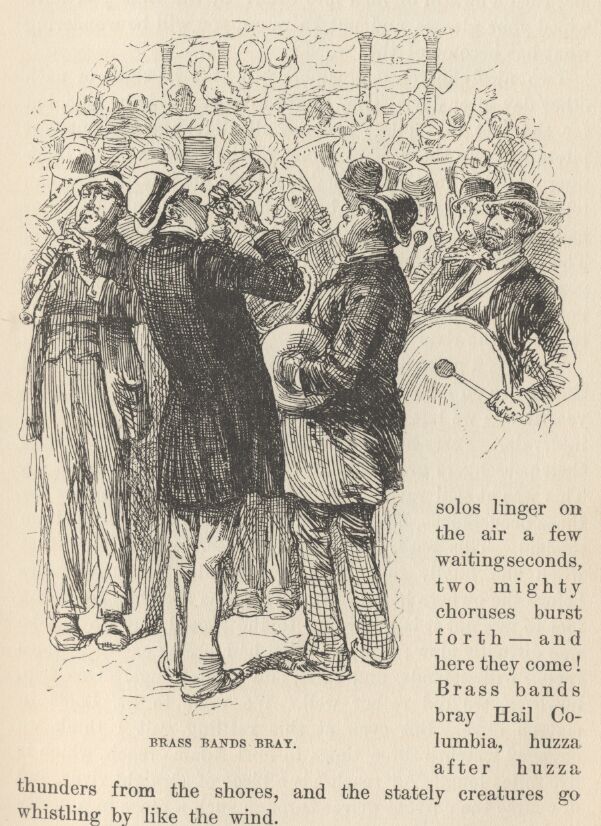
Presently tall columns of steam burst from the 'scape-pipes of both steamers, two guns boom a good-bye, two red-shirted heroes mounted on capstans wave their small flags above the massed crews on the forecastles, two plaintive solos linger on the air a few waiting seconds, two mighty choruses burst forth—and here they come! Brass bands bray Hail Columbia, huzza after huzza thunders from the shores, and the stately creatures go whistling by like the wind.
Soon, tall columns of steam burst from the escape pipes of both steamboats. Two guns boom a goodbye. Two red-shirted heroes stand on capstans, waving small flags above the crews gathered on the forward decks. Two plaintive solo voices linger in the air for a few seconds. Two mighty choruses burst out, and here come the steamboats! Brass bands blare Hail Columbia. Cheers thunder from the shores, and the stately vessels go whistling past like the wind.
Those boats will never halt a moment between New Orleans and St. Louis, except for a second or two at large towns, or to hitch thirty-cord wood-boats alongside. You should be on board when they take a couple of those wood-boats in tow and turn a swarm of men into each; by the time you have wiped your glasses and put them on, you will be wondering what has become of that wood.
Those boats will never stop between New Orleans and St. Louis, except for a second or two at large towns or to tie wood-boats carrying thirty cords alongside. You should be on board when they take a couple of those wood-boats in tow and send a swarm of men into each one. By the time you have wiped your glasses and put them on, you will be wondering what happened to the wood.
Two nicely matched steamers will stay in sight of each other day after day. They might even stay side by side, but for the fact that pilots are not all alike, and the smartest pilots will win the race. If one of the boats has a 'lightning' pilot, whose 'partner' is a trifle his inferior, you can tell which one is on watch by noting whether that boat has gained ground or lost some during each four-hour stretch. The shrewdest pilot can delay a boat if he has not a fine genius for steering. Steering is a very high art. One must not keep a rudder dragging across a boat's stem if he wants to get up the river fast.
Two evenly matched steamboats can stay in sight of each other day after day. They might even stay side by side, but pilots differ, and the most skilled pilots will win the race. Suppose one boat has a 'lightning' pilot whose 'partner' is slightly less skilled. You can tell which pilot is on duty by seeing whether that boat gains or loses ground during each four-hour shift. Even the shrewdest pilot can slow a boat down without a special talent for steering. Steering is a fine art. If a pilot wants to get up the river fast, the rudder must not drag across the boat's stern.
There is a great difference in boats, of course. For a long time I was on a boat that was so slow we used to forget what year it was we left port in. But of course this was at rare intervals. Ferryboats used to lose valuable trips because their passengers grew old and died, waiting for us to get by. This was at still rarer intervals. I had the documents for these occurrences, but through carelessness they have been mislaid. This boat, the 'John J. Roe,' was so slow that when she finally sunk in Madrid Bend, it was five years before the owners heard of it. That was always a confusing fact to me, but it is according to the record, any way. She was dismally slow; still, we often had pretty exciting times racing with islands, and rafts, and such things. One trip, however, we did rather well. We went to St. Louis in sixteen days. But even at this rattling gait I think we changed watches three times in Fort Adams reach, which is five miles long. A 'reach' is a piece of straight river, and of course the current drives through such a place in a pretty lively way.
There’s a big difference between boats, of course. For a long time, I was on a boat so slow we used to forget what year we left port. But of course, that only happened once in a great while. Ferryboats used to lose valuable trips because their passengers grew old and died waiting for us to pass. That happened even less often. I had the documents for these events, but I carelessly mislaid them. This boat, the 'John J. Roe,' was so slow that when she finally sank in Madrid Bend, her owners didn’t hear about it for five years. That always confused me, but it’s in the record, anyway. She was terribly slow, but we often had exciting races with islands, rafts, and things like that. On one trip, though, we did pretty well. We reached St. Louis in sixteen days. But even at that breakneck speed, I think we changed watches three times in Fort Adams reach. That reach is five miles long. A 'reach' is a straight stretch of river, and of course the current runs through it pretty fast.
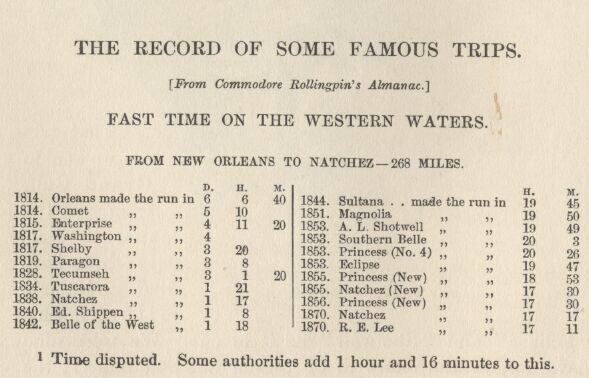
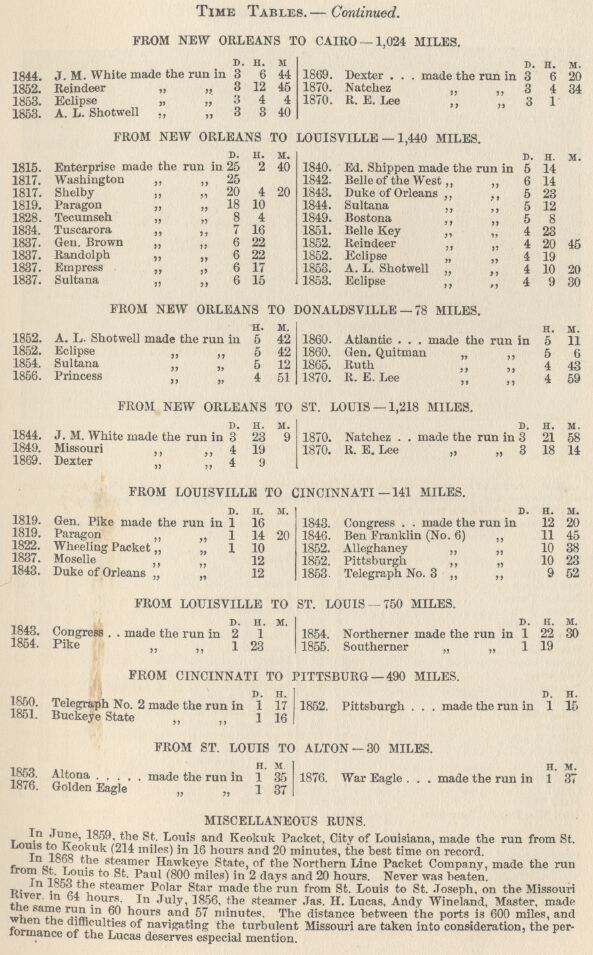
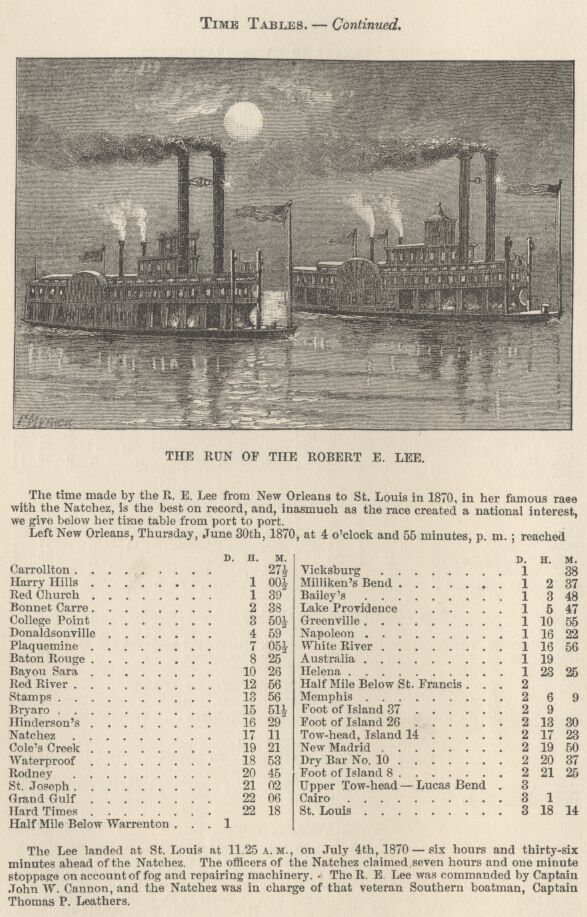
That trip we went to Grand Gulf, from New Orleans, in four days (three hundred and forty miles); the 'Eclipse' and 'Shotwell' did it in one. We were nine days out, in the chute of 63 (seven hundred miles); the 'Eclipse' and 'Shotwell' went there in two days. Something over a generation ago, a boat called the 'J. M. White' went from New Orleans to Cairo in three days, six hours, and forty-four minutes. In 1853 the 'Eclipse' made the same trip in three days, three hours, and twenty minutes.{footnote [Time disputed. Some authorities add 1 hour and 16 minutes to this.]} In 1870 the 'R. E. Lee' did it in three days and one hour. This last is called the fastest trip on record. I will try to show that it was not. For this reason: the distance between New Orleans and Cairo, when the 'J. M. White' ran it, was about eleven hundred and six miles; consequently her average speed was a trifle over fourteen miles per hour. In the 'Eclipse's' day the distance between the two ports had become reduced to one thousand and eighty miles; consequently her average speed was a shade under fourteen and three-eighths miles per hour. In the 'R. E. Lee's' time the distance had diminished to about one thousand and thirty miles; consequently her average was about fourteen and one-eighth miles per hour. Therefore the 'Eclipse's' was conspicuously the fastest time that has ever been made.
On that trip, we traveled from New Orleans to Grand Gulf in four days, covering 340 miles. The 'Eclipse' and 'Shotwell' made the trip in one day. After nine days, we had reached the chute of 63, 700 miles out. The 'Eclipse' and 'Shotwell' got there in two days. A little over a generation ago, a boat called the 'J. M. White' traveled from New Orleans to Cairo in three days, six hours, and forty-four minutes. In 1853, the 'Eclipse' made the same trip in three days, three hours, and twenty minutes.{footnote [Time disputed. Some authorities add 1 hour and 16 minutes to this.]} In 1870, the 'R. E. Lee' made it in three days and one hour. The 'R. E. Lee's' trip is considered the fastest on record. I will try to show that it was not. Here is why: When the 'J. M. White' made the trip, New Orleans and Cairo were about 1,106 miles apart. Her average speed was therefore a little over fourteen miles per hour. In the 'Eclipse's' day, the distance between the ports had shrunk to 1,080 miles. Her average speed was therefore just under fourteen and three-eighths miles per hour. By the 'R. E. Lee's' time, the distance had shrunk to about 1,030 miles. Her average was therefore about fourteen and one-eighth miles per hour. So the 'Eclipse's' time was clearly the fastest ever made.