Chapter 15
The Pilots' Monopoly
ONE day, on board the 'Aleck Scott,' my chief, Mr. Bixby, was crawling carefully through a close place at Cat Island, both leads going, and everybody holding his breath. The captain, a nervous, apprehensive man, kept still as long as he could, but finally broke down and shouted from the hurricane deck—
One day, aboard the 'Aleck Scott,' my chief, Mr. Bixby, was carefully guiding the boat through a tight spot at Cat Island. Both depth lines were in use, and everyone was holding their breath. The captain was a nervous, anxious man. He kept quiet as long as he could, but finally gave in and shouted from the hurricane deck:
'For gracious' sake, give her steam, Mr. Bixby! give her steam! She'll never raise the reef on this headway!'
'For goodness' sake, give her more steam, Mr. Bixby! Give her more steam! She'll never reach the reef at this speed!'
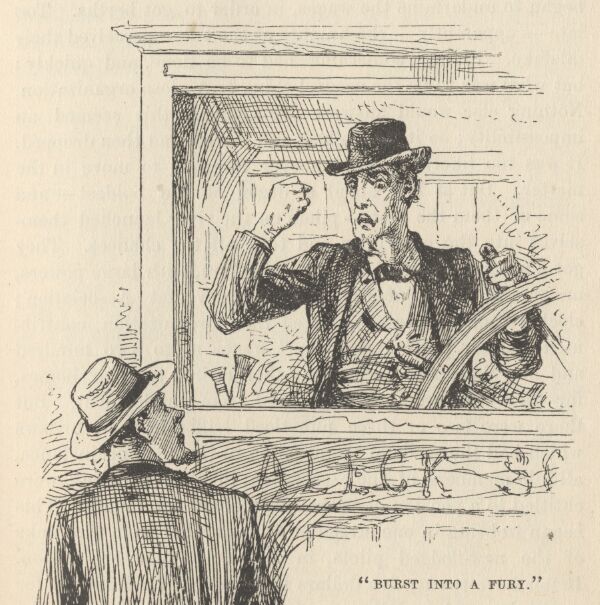
For all the effect that was produced upon Mr. Bixby, one would have supposed that no remark had been made. But five minutes later, when the danger was past and the leads laid in, he burst instantly into a consuming fury, and gave the captain the most admirable cursing I ever listened to. No bloodshed ensued; but that was because the captain's cause was weak; for ordinarily he was not a man to take correction quietly.
From Mr. Bixby's reaction, you would have thought no one had said a word. But five minutes later, the danger was past and the sounding leads had been put away. He suddenly flew into a towering rage and gave the captain the most admirable cursing I had ever heard. No blood was shed, but only because the captain had a weak case. Normally, he was not a man to accept a scolding quietly.
Having now set forth in detail the nature of the science of piloting, and likewise described the rank which the pilot held among the fraternity of steamboatmen, this seems a fitting place to say a few words about an organization which the pilots once formed for the protection of their guild. It was curious and noteworthy in this, that it was perhaps the compactest, the completest, and the strongest commercial organization ever formed among men.
I have now explained the science of piloting in detail and described the pilot’s rank among steamboatmen. This seems a fitting place to say a few words about an organization the pilots once formed to protect their guild. The organization was curious and noteworthy. It was perhaps the most tightly knit, complete, and powerful commercial organization ever formed among men.
For a long time wages had been two hundred and fifty dollars a month; but curiously enough, as steamboats multiplied and business increased, the wages began to fall little by little. It was easy to discover the reason of this. Too many pilots were being 'made.' It was nice to have a 'cub,' a steersman, to do all the hard work for a couple of years, gratis, while his master sat on a high bench and smoked; all pilots and captains had sons or nephews who wanted to be pilots. By and by it came to pass that nearly every pilot on the river had a steersman. When a steersman had made an amount of progress that was satisfactory to any two pilots in the trade, they could get a pilot's license for him by signing an application directed to the United States Inspector. Nothing further was needed; usually no questions were asked, no proofs of capacity required.
For a long time, wages had been two hundred and fifty dollars a month. But strangely enough, as steamboats multiplied and business grew, wages began to fall little by little. The reason was easy to find. Too many pilots were being 'made.' It was nice to have a 'cub,' a trainee steersman, doing all the hard work for free for a couple of years. Meanwhile, his master sat on a high bench and smoked. All pilots and captains had sons or nephews who wanted to be pilots. Before long, nearly every pilot on the river had a steersman. Once any two working pilots were satisfied with a steersman's progress, they could get him a pilot's license. All they had to do was sign an application to the United States Inspector. Nothing more was needed. Usually, no questions were asked, and no proof of ability was required.
Very well, this growing swarm of new pilots presently began to undermine the wages, in order to get berths. Too late—apparently—the knights of the tiller perceived their mistake. Plainly, something had to be done, and quickly; but what was to be the needful thing. A close organization. Nothing else would answer. To compass this seemed an impossibility; so it was talked, and talked, and then dropped. It was too likely to ruin whoever ventured to move in the matter. But at last about a dozen of the boldest—and some of them the best—pilots on the river launched themselves into the enterprise and took all the chances. They got a special charter from the legislature, with large powers, under the name of the Pilots' Benevolent Association; elected their officers, completed their organization, contributed capital, put 'association' wages up to two hundred and fifty dollars at once—and then retired to their homes, for they were promptly discharged from employment. But there were two or three unnoticed trifles in their by-laws which had the seeds of propagation in them. For instance, all idle members of the association, in good standing, were entitled to a pension of twenty-five dollars per month. This began to bring in one straggler after another from the ranks of the new-fledged pilots, in the dull (summer) season. Better have twenty-five dollars than starve; the initiation fee was only twelve dollars, and no dues required from the unemployed.
Very well, this growing swarm of new pilots soon began accepting lower wages to get jobs. Apparently too late, the knights of the tiller realized their mistake. Clearly, something had to be done, and quickly. But what? A tightly organized association. Nothing else would do. Forming one seemed impossible, so the pilots talked and talked about it, then dropped the idea. Anyone who dared take action was all too likely to ruin himself. But at last about a dozen of the boldest pilots on the river, some of them among the best, took on the task and risked everything. They obtained a special charter from the legislature, granting them broad powers under the name of the Pilots' Benevolent Association. They elected officers, completed their organization, and contributed capital. They immediately raised association wages to two hundred and fifty dollars. Then they went home, because they were promptly fired. But their bylaws contained two or three overlooked little details that could help the association grow. For instance, all unemployed members in good standing were entitled to a pension of twenty-five dollars a month. During the slow summer season, this began to draw in newly trained pilots, one straggler after another. Better to have twenty-five dollars than starve. The initiation fee was only twelve dollars, and unemployed members paid no dues.
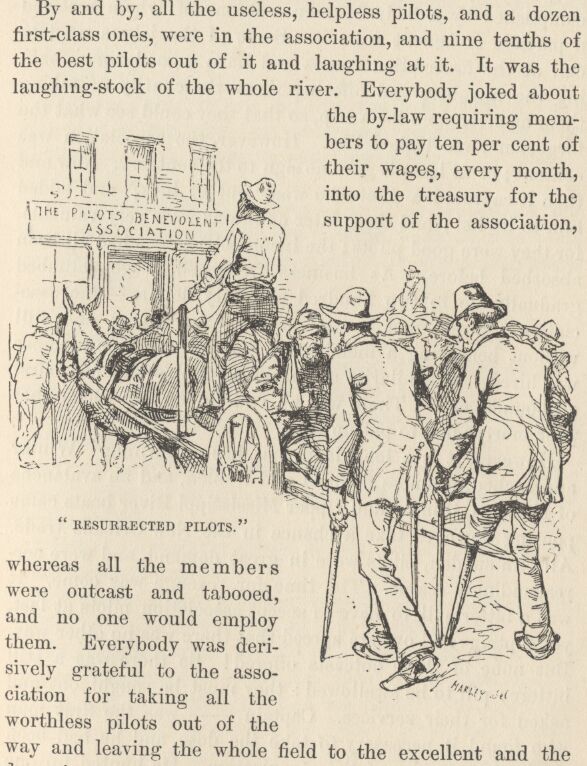
Also, the widows of deceased members in good standing could draw twenty-five dollars per month, and a certain sum for each of their children. Also, the said deceased would be buried at the association's expense. These things resurrected all the superannuated and forgotten pilots in the Mississippi Valley. They came from farms, they came from interior villages, they came from everywhere. They came on crutches, on drays, in ambulances,—any way, so they got there. They paid in their twelve dollars, and straightway began to draw out twenty-five dollars a month, and calculate their burial bills.
Also, widows of deceased members in good standing could receive twenty-five dollars a month, plus a certain amount for each child. The association would also pay for the deceased members’ burials. These benefits brought all the retired and forgotten pilots in the Mississippi Valley back to life. They came from farms, inland villages, and everywhere else. They came on crutches, on wagons, in ambulances, any way they could get there. They paid their twelve dollars and immediately began collecting twenty-five dollars a month and calculating their burial costs.
By and by, all the useless, helpless pilots, and a dozen first-class ones, were in the association, and nine-tenths of the best pilots out of it and laughing at it. It was the laughing-stock of the whole river. Everybody joked about the by-law requiring members to pay ten per cent. of their wages, every month, into the treasury for the support of the association, whereas all the members were outcast and tabooed, and no one would employ them. Everybody was derisively grateful to the association for taking all the worthless pilots out of the way and leaving the whole field to the excellent and the deserving; and everybody was not only jocularly grateful for that, but for a result which naturally followed, namely, the gradual advance of wages as the busy season approached. Wages had gone up from the low figure of one hundred dollars a month to one hundred and twenty-five, and in some cases to one hundred and fifty; and it was great fun to enlarge upon the fact that this charming thing had been accomplished by a body of men not one of whom received a particle of benefit from it. Some of the jokers used to call at the association rooms and have a good time chaffing the members and offering them the charity of taking them as steersmen for a trip, so that they could see what the forgotten river looked like. However, the association was content; or at least it gave no sign to the contrary. Now and then it captured a pilot who was 'out of luck,' and added him to its list; and these later additions were very valuable, for they were good pilots; the incompetent ones had all been absorbed before. As business freshened, wages climbed gradually up to two hundred and fifty dollars—the association figure—and became firmly fixed there; and still without benefiting a member of that body, for no member was hired. The hilarity at the association's expense burst all bounds, now. There was no end to the fun which that poor martyr had to put up with.
Before long, all the useless, helpless pilots had joined the association, along with a dozen first-class pilots. Nine-tenths of the best pilots stayed out and laughed at it. The association was the laughingstock of the whole river. Everyone joked about its bylaw requiring members to pay ten percent of their monthly wages into the treasury. The money was supposed to support the association, yet all its members were shunned and no one would employ them. Everyone mockingly thanked the association for taking all the worthless pilots out of the way. That left the whole field to the excellent and deserving pilots. Everyone also jokingly thanked the association for a natural result: wages gradually rose as the busy season approached. Wages had risen from the low figure of $100 a month to $125, and in some cases to $150. People had great fun pointing out that this delightful result had been achieved by men who received no benefit from it. Some jokers would visit the association’s rooms to tease the members. They would even offer, as an act of charity, to take them on a trip as steersmen. That way, the members could see what the river they had forgotten looked like. The association, however, was content, or at least gave no sign otherwise. Now and then it recruited a pilot who was 'out of luck' and added him to its list. These later additions were very valuable because they were good pilots. All the incompetent pilots had joined earlier. As business picked up, wages gradually climbed to $250, the amount the association wanted, and stayed firmly there. Still, no member benefited, because no member was hired. Now the laughter at the association’s expense knew no bounds. There was no end to the fun that poor martyr had to put up with.
However, it is a long lane that has no turning. Winter approached, business doubled and trebled, and an avalanche of Missouri, Illinois and Upper Mississippi River boats came pouring down to take a chance in the New Orleans trade. All of a sudden pilots were in great demand, and were correspondingly scarce. The time for revenge was come. It was a bitter pill to have to accept association pilots at last, yet captains and owners agreed that there was no other way. But none of these outcasts offered! So there was a still bitterer pill to be swallowed: they must be sought out and asked for their services. Captain —— was the first man who found it necessary to take the dose, and he had been the loudest derider of the organization. He hunted up one of the best of the association pilots and said—
But sooner or later, things turn around. Winter approached, and business doubled and tripled. An avalanche of boats from Missouri, Illinois, and the Upper Mississippi River poured down to try their luck in the New Orleans trade. Suddenly, pilots were in great demand and just as scarce. The time for revenge had come. Captains and owners found it a bitter pill to accept association pilots at last. Yet they agreed there was no other way. But none of these outcasts offered their services! So the captains and owners had to swallow an even more bitter pill. They had to seek out the pilots and ask for their services. Captain —— was the first man who had to take the dose. He had also been the loudest critic of the organization. He sought out one of the best association pilots and said:
'Well, you boys have rather got the best of us for a little while, so I'll give in with as good a grace as I can. I've come to hire you; get your trunk aboard right away. I want to leave at twelve o'clock.'
'Well, you boys have gotten the better of us for a little while, so I'll give in as gracefully as I can. I've come to hire you. Get your trunk aboard right away. I want to leave at twelve o'clock.'
'I don't know about that. Who is your other pilot?'
'I don't know about that. Who is your other pilot?'
'I've got I. S——. Why?'
'I've got I. S... Why?'
'I can't go with him. He don't belong to the association.'
'I can't go with him. He doesn't belong to the association.'
'What!'
'What!'
'It's so.'
'It's true.'
'Do you mean to tell me that you won't turn a wheel with one of the very best and oldest pilots on the river because he don't belong to your association?'
'Are you telling me you won't work with one of the best and oldest pilots on the river because he doesn't belong to your association?'
'Yes, I do.'
'Yes, I do.'
'Well, if this isn't putting on airs! I supposed I was doing you a benevolence; but I begin to think that I am the party that wants a favor done. Are you acting under a law of the concern?'
'Well, aren't you putting on airs! I thought I was doing you a favor. But I'm beginning to think I'm the one who needs a favor. Are you acting under a rule of the company?'
'Yes.'
'Yes.'
'Show it to me.'
'Show it to me.'
So they stepped into the association rooms, and the secretary soon satisfied the captain, who said—
So they went into the association rooms, and the secretary soon satisfied the captain. The captain said:
'Well, what am I to do? I have hired Mr. S—— for the entire season.'
'Well, what am I supposed to do? I hired Mr. S-- for the whole season.'
'I will provide for you,' said the secretary. 'I will detail a pilot to go with you, and he shall be on board at twelve o'clock.'
'I will make arrangements for you,' said the secretary. 'I will assign a pilot to go with you. He will be on board at twelve o'clock.'
'But if I discharge S——, he will come on me for the whole season's wages.'
'But if I fire S--, he will demand wages for the whole season.'
'Of course that is a matter between you and Mr. S——, captain. We cannot meddle in your private affairs.'
'Of course, that is between you and Mr. S, captain. We can't interfere in your private affairs.'
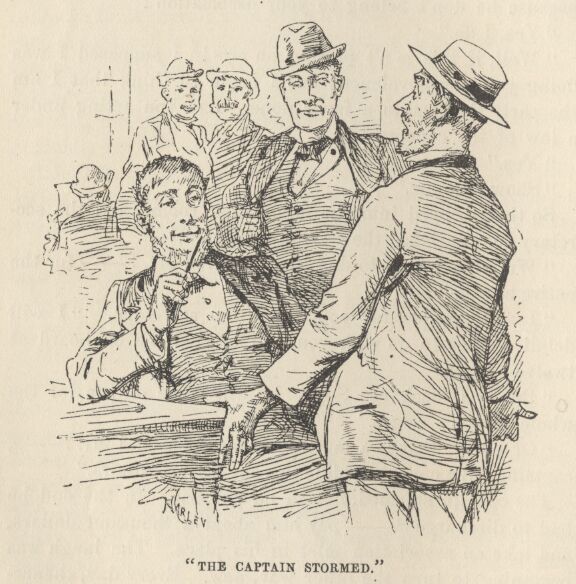
The captain stormed, but to no purpose. In the end he had to discharge S——, pay him about a thousand dollars, and take an association pilot in his place. The laugh was beginning to turn the other way now. Every day, thenceforward, a new victim fell; every day some outraged captain discharged a non-association pet, with tears and profanity, and installed a hated association man in his berth. In a very little while, idle non-associationists began to be pretty plenty, brisk as business was, and much as their services were desired. The laugh was shifting to the other side of their mouths most palpably. These victims, together with the captains and owners, presently ceased to laugh altogether, and began to rage about the revenge they would take when the passing business 'spurt' was over.
The captain raged, but it did no good. In the end, he had to fire S——, pay him about a thousand dollars, and replace him with an association pilot. Now the laughter was beginning to turn the other way. From then on, a new victim fell every day. Every day, some furious captain fired a favored non-association pilot, with tears and curses, and put a hated association man in his place. Before long, unemployed non-association pilots were fairly common, even though business was brisk and their services were much in demand. Very clearly, the laughter was shifting to the other side of their mouths. Soon these victims, along with the captains and owners, stopped laughing altogether. They began to rage about the revenge they would take when the temporary business 'spurt' was over.
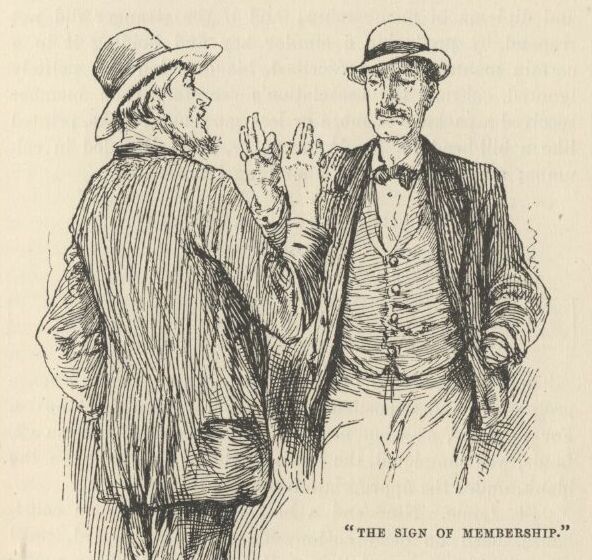
Soon all the laughers that were left were the owners and crews of boats that had two non-association pilots. But their triumph was not very long-lived. For this reason: It was a rigid rule of the association that its members should never, under any circumstances whatever, give information about the channel to any 'outsider.' By this time about half the boats had none but association pilots, and the other half had none but outsiders. At the first glance one would suppose that when it came to forbidding information about the river these two parties could play equally at that game; but this was not so. At every good-sized town from one end of the river to the other, there was a 'wharf-boat' to land at, instead of a wharf or a pier. Freight was stored in it for transportation; waiting passengers slept in its cabins. Upon each of these wharf-boats the association's officers placed a strong box fastened with a peculiar lock which was used in no other service but one—the United States mail service. It was the letter-bag lock, a sacred governmental thing. By dint of much beseeching the government had been persuaded to allow the association to use this lock. Every association man carried a key which would open these boxes. That key, or rather a peculiar way of holding it in the hand when its owner was asked for river information by a stranger—for the success of the St. Louis and New Orleans association had now bred tolerably thriving branches in a dozen neighboring steamboat trades—was the association man's sign and diploma of membership; and if the stranger did not respond by producing a similar key and holding it in a certain manner duly prescribed, his question was politely ignored.
Soon the only people still laughing were the owners and crews of boats with two non-association pilots. But their triumph did not last long. The reason was simple: the association had a strict rule. Its members could never, under any circumstances, give an 'outsider' information about the channel. By then, about half the boats had only association pilots, and the other half had only outsiders. At first, you might suppose that both sides could play the same game by withholding information about the river. But they could not. At every good-sized town along the river, boats landed at a 'wharf-boat' instead of a wharf or pier. Freight was stored there for transportation, and waiting passengers slept in its cabins. On each wharf-boat, the association’s officers placed a strongbox with a special lock. The lock had only one other use: the United States mail service. It was the letter-bag lock, a sacred government thing. After much pleading, the association had persuaded the government to let it use the lock. Every association member carried a key that could open these boxes. By now, the success of the St. Louis and New Orleans association had produced fairly thriving branches in a dozen neighboring steamboat trades. When a stranger asked an association member for river information, the member would hold his key in a particular way. This was his sign and diploma of membership. If the stranger did not respond by producing a similar key and holding it in the prescribed manner, his question was politely ignored.
From the association's secretary each member received a package of more or less gorgeous blanks, printed like a billhead, on handsome paper, properly ruled in columns; a bill-head worded something like this—
Each member received a package of more or less fancy blank forms from the association's secretary. They were printed on handsome paper, with columns, like billheads. The billhead was worded something like this:
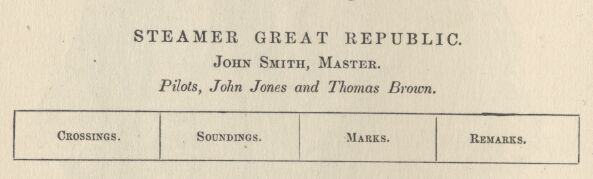
These blanks were filled up, day by day, as the voyage progressed, and deposited in the several wharf-boat boxes. For instance, as soon as the first crossing, out from St. Louis, was completed, the items would be entered upon the blank, under the appropriate headings, thus—
These forms were filled out each day as the voyage went on and placed in the boxes at the various wharf-boats. For example, as soon as the first crossing out of St. Louis was completed, the items would be entered on the form under the appropriate headings, like this:
'St. Louis. Nine and a half (feet). Stern on court-house, head on dead cottonwood above wood-yard, until you raise the first reef, then pull up square.' Then under head of Remarks: 'Go just outside the wrecks; this is important. New snag just where you straighten down; go above it.'
'St. Louis. Nine and a half feet. Keep the stern pointed at the courthouse and the bow at the dead cottonwood above the wood-yard. Do this until you bring the first reef into view, then pull up squarely.' Under Remarks: 'Go just outside the wrecks. This is important. There is a new snag just where you straighten out downstream. Go above it.'
The pilot who deposited that blank in the Cairo box (after adding to it the details of every crossing all the way down from St. Louis) took out and read half a dozen fresh reports (from upward-bound steamers) concerning the river between Cairo and Memphis, posted himself thoroughly, returned them to the box, and went back aboard his boat again so armed against accident that he could not possibly get his boat into trouble without bringing the most ingenious carelessness to his aid.
Before putting that form in the Cairo box, the pilot added details of every crossing all the way down from St. Louis. He then took out and read half a dozen fresh reports from upriver-bound steamboats about the river between Cairo and Memphis. He studied them thoroughly, returned them to the box, and went back aboard his boat. He was now so well prepared to avoid accidents that he could not possibly get his boat into trouble without being extraordinarily careless.
Imagine the benefits of so admirable a system in a piece of river twelve or thirteen hundred miles long, whose channel was shifting every day! The pilot who had formerly been obliged to put up with seeing a shoal place once or possibly twice a month, had a hundred sharp eyes to watch it for him, now, and bushels of intelligent brains to tell him how to run it. His information about it was seldom twenty-four hours old. If the reports in the last box chanced to leave any misgivings on his mind concerning a treacherous crossing, he had his remedy; he blew his steam-whistle in a peculiar way as soon as he saw a boat approaching; the signal was answered in a peculiar way if that boat's pilots were association men; and then the two steamers ranged alongside and all uncertainties were swept away by fresh information furnished to the inquirer by word of mouth and in minute detail.
Imagine the benefits of such an excellent system on a stretch of river twelve or thirteen hundred miles long, where the channel shifted every day! Before, a pilot had to make do with seeing a shallow spot once or perhaps twice a month. Now he had a hundred sharp eyes watching it for him, and bushels of intelligent brains telling him how to navigate it. His information about the spot was seldom more than twenty-four hours old. If reports in the last box left him uncertain about a treacherous crossing, he had a remedy. As soon as he saw a boat approaching, he blew his steam whistle in a distinctive way. If the other boat’s pilots were association members, they answered with their own distinctive signal. Then the two steamboats pulled alongside each other. The other pilots gave him fresh information by word of mouth, in minute detail, and all his uncertainties were swept away.
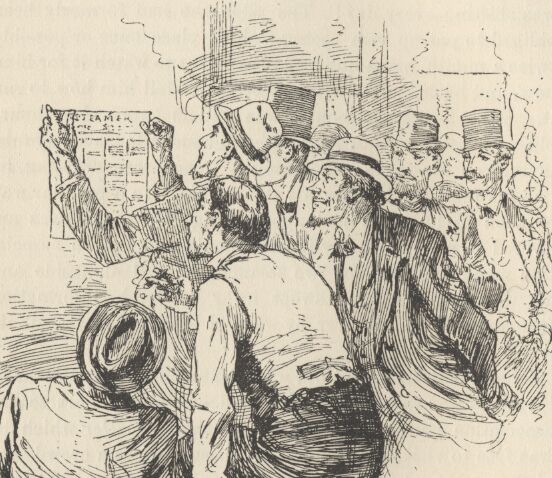
The first thing a pilot did when he reached New Orleans or St. Louis was to take his final and elaborate report to the association parlors and hang it up there,—after which he was free to visit his family. In these parlors a crowd was always gathered together, discussing changes in the channel, and the moment there was a fresh arrival, everybody stopped talking till this witness had told the newest news and settled the latest uncertainty. Other craftsmen can 'sink the shop,' sometimes, and interest themselves in other matters. Not so with a pilot; he must devote himself wholly to his profession and talk of nothing else; for it would be small gain to be perfect one day and imperfect the next. He has no time or words to waste if he would keep 'posted.'
When a pilot reached New Orleans or St. Louis, the first thing he did was take his final, detailed report to the association parlors and hang it up. Only then was he free to visit his family. A crowd was always gathered in the parlors, discussing changes in the channel. As soon as a pilot arrived, everyone stopped talking until he had given them the latest news and settled the latest uncertainty. Other workers can sometimes 'leave work behind' and take an interest in other things. Not a pilot. He must devote himself entirely to his profession and talk of nothing else. There would be little benefit in knowing the river perfectly one day and imperfectly the next. If he wants to stay 'up to date,' he has no time or words to waste.
But the outsiders had a hard time of it. No particular place to meet and exchange information, no wharf-boat reports, none but chance and unsatisfactory ways of getting news. The consequence was that a man sometimes had to run five hundred miles of river on information that was a week or ten days old. At a fair stage of the river that might have answered; but when the dead low water came it was destructive.
But the outsiders had a hard time. They had no regular place to meet and exchange information, and no wharf-boat reports. They had only unreliable, hit-or-miss ways of getting news. As a result, a man sometimes had to travel five hundred miles of river using information that was a week or ten days old. That might have been good enough when the river was at a reasonable level. But when the water became extremely low, it was disastrous.
Now came another perfectly logical result. The outsiders began to ground steamboats, sink them, and get into all sorts of trouble, whereas accidents seemed to keep entirely away from the association men. Wherefore even the owners and captains of boats furnished exclusively with outsiders, and previously considered to be wholly independent of the association and free to comfort themselves with brag and laughter, began to feel pretty uncomfortable. Still, they made a show of keeping up the brag, until one black day when every captain of the lot was formally ordered to immediately discharge his outsiders and take association pilots in their stead. And who was it that had the dashing presumption to do that? Alas, it came from a power behind the throne that was greater than the throne itself. It was the underwriters!
Then came another perfectly logical result. The outsiders began running steamboats aground, sinking them, and getting into all sorts of trouble. Meanwhile, accidents seemed to stay entirely away from the association men. Even owners and captains whose boats had only outsider pilots began to feel pretty uncomfortable. They had previously considered themselves wholly independent of the association, free to comfort themselves with bragging and laughter. Still, they pretended to keep bragging until one black day. Every captain in the group was formally ordered to fire his outsider pilots immediately and replace them with association pilots. And who had the bold nerve to give that order? Alas, it came from a power behind the throne that was greater than the throne itself. It was the underwriters!
It was no time to 'swap knives.' Every outsider had to take his trunk ashore at once. Of course it was supposed that there was collusion between the association and the underwriters, but this was not so. The latter had come to comprehend the excellence of the 'report' system of the association and the safety it secured, and so they had made their decision among themselves and upon plain business principles.
There was no time to 'swap knives.' Every outsider had to take his trunk ashore immediately. Of course, people assumed that the association and the underwriters had secretly worked together, but they had not. The underwriters had come to understand how good the association's 'report' system was and how much safety it provided. So they had made their decision on their own, based on straightforward business principles.
There was weeping and wailing and gnashing of teeth in the camp of the outsiders now. But no matter, there was but one course for them to pursue, and they pursued it. They came forward in couples and groups, and proffered their twelve dollars and asked for membership. They were surprised to learn that several new by-laws had been long ago added. For instance, the initiation fee had been raised to fifty dollars; that sum must be tendered, and also ten per cent. of the wages which the applicant had received each and every month since the founding of the association. In many cases this amounted to three or four hundred dollars. Still, the association would not entertain the application until the money was present. Even then a single adverse vote killed the application. Every member had to vote 'Yes' or 'No' in person and before witnesses; so it took weeks to decide a candidacy, because many pilots were so long absent on voyages. However, the repentant sinners scraped their savings together, and one by one, by our tedious voting process, they were added to the fold. A time came, at last, when only about ten remained outside. They said they would starve before they would apply. They remained idle a long while, because of course nobody could venture to employ them.
There was weeping, wailing, and gnashing of teeth among the outsiders now. But it didn't matter. They had only one course open to them, and they took it. They came forward in pairs and groups, offered their twelve dollars, and asked to join. They were surprised to learn that several new bylaws had been added long ago. For example, the initiation fee had been raised to fifty dollars. Applicants had to offer that amount, plus ten percent of the wages they had earned each month since the association was founded. In many cases, this came to three or four hundred dollars. Even so, the association would not consider an application until the money was on hand. And even then, a single vote against an applicant killed the application. Every member had to vote 'Yes' or 'No' in person and before witnesses. So it took weeks to decide on a candidate, because many pilots were away on voyages for so long. Still, the repentant sinners scraped their savings together. One by one, through our tedious voting process, they were welcomed into the fold. At last, only about ten remained outside. They said they would starve before they would apply. They remained out of work for a long time, because of course nobody dared employ them.
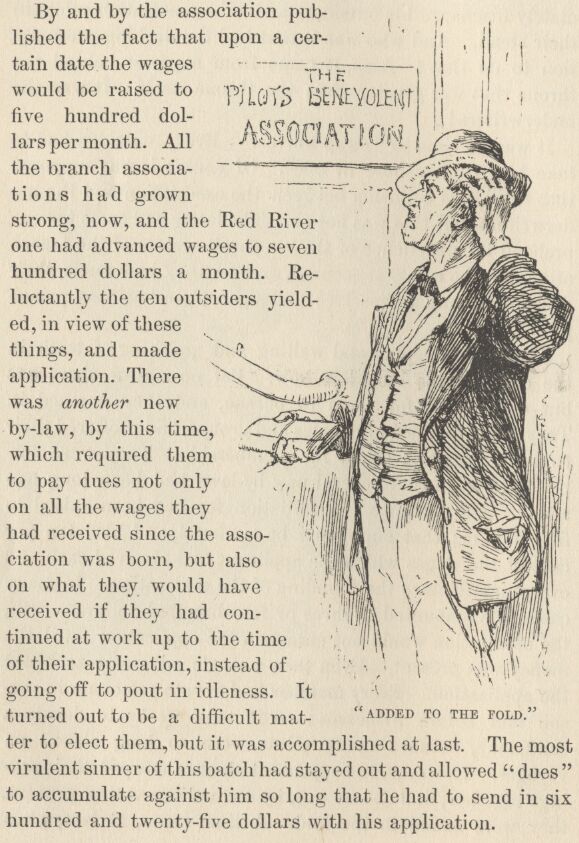
By and by the association published the fact that upon a certain date the wages would be raised to five hundred dollars per month. All the branch associations had grown strong, now, and the Red River one had advanced wages to seven hundred dollars a month. Reluctantly the ten outsiders yielded, in view of these things, and made application. There was another new by-law, by this time, which required them to pay dues not only on all the wages they had received since the association was born, but also on what they would have received if they had continued at work up to the time of their application, instead of going off to pout in idleness. It turned out to be a difficult matter to elect them, but it was accomplished at last. The most virulent sinner of this batch had stayed out and allowed 'dues' to accumulate against him so long that he had to send in six hundred and twenty-five dollars with his application.
Before long, the association announced that wages would rise to five hundred dollars a month on a certain date. By then, all the branch associations had grown strong. The Red River association had raised wages to seven hundred dollars a month. In view of these developments, the ten outsiders reluctantly gave in and applied to join. By then, another new by-law required them to pay dues on all their wages since the association began. They also had to pay dues on what they would have earned if they had kept working until they applied, instead of going off to pout in idleness. It proved difficult to elect them, but they were finally accepted. The most stubborn sinner of the group had stayed out so long that his 'dues' had piled up. He had to send six hundred and twenty-five dollars with his application.
The association had a good bank account now, and was very strong. There was no longer an outsider. A by-law was added forbidding the reception of any more cubs or apprentices for five years; after which time a limited number would be taken, not by individuals, but by the association, upon these terms: the applicant must not be less than eighteen years old, and of respectable family and good character; he must pass an examination as to education, pay a thousand dollars in advance for the privilege of becoming an apprentice, and must remain under the commands of the association until a great part of the membership (more than half, I think) should be willing to sign his application for a pilot's license.
The association now had a healthy bank account and was very strong. No one remained outside it. The association added a rule forbidding the admission of any more cubs or apprentices for five years. After that, a limited number would be accepted by the association, not by individual members. Applicants had to be at least eighteen, from respectable families, and of good character. They had to pass an education exam and pay a thousand dollars in advance for the privilege of becoming apprentices. They also had to remain under the association’s authority until a large part of the membership agreed to sign their applications for a pilot’s license. I think it had to be more than half.
All previously-articled apprentices were now taken away from their masters and adopted by the association. The president and secretary detailed them for service on one boat or another, as they chose, and changed them from boat to boat according to certain rules. If a pilot could show that he was in infirm health and needed assistance, one of the cubs would be ordered to go with him.
All apprentices who had previously signed contracts were now taken from their masters and placed under the association's care. The president and secretary assigned them to boats as they saw fit. They moved the apprentices from boat to boat according to certain rules. If a pilot could show that he was in poor health and needed help, a cub would be ordered to go with him.
The widow and orphan list grew, but so did the association's financial resources. The association attended its own funerals in state, and paid for them. When occasion demanded, it sent members down the river upon searches for the bodies of brethren lost by steamboat accidents; a search of this kind sometimes cost a thousand dollars.
The list of widows and orphans grew, but so did the association’s financial resources. The association attended its members’ funerals with ceremony and paid for them. When necessary, it sent members down the river to search for fellow members lost in steamboat accidents. Such a search sometimes cost a thousand dollars.
The association procured a charter and went into the insurance business, also. It not only insured the lives of its members, but took risks on steamboats.
The association obtained a charter and also went into the insurance business. It insured not only its members’ lives but also steamboats.
The organization seemed indestructible. It was the tightest monopoly in the world. By the United States law, no man could become a pilot unless two duly licensed pilots signed his application; and now there was nobody outside of the association competent to sign. Consequently the making of pilots was at an end. Every year some would die and others become incapacitated by age and infirmity; there would be no new ones to take their places. In time, the association could put wages up to any figure it chose; and as long as it should be wise enough not to carry the thing too far and provoke the national government into amending the licensing system, steamboat owners would have to submit, since there would be no help for it.
The organization seemed impossible to destroy. It was the tightest monopoly in the world. Under United States law, no man could become a pilot unless two licensed pilots signed his application. Now, no one outside the association was qualified to sign. As a result, no new pilots could be licensed. Every year, some pilots would die, and others would become unable to work because of age or illness. There would be no new pilots to replace them. In time, the association could raise wages as high as it chose. The association only had to be wise enough not to go too far and provoke the national government into changing the licensing system. As long as it did that, steamboat owners would have no choice but to submit.
The owners and captains were the only obstruction that lay between the association and absolute power; and at last this one was removed. Incredible as it may seem, the owners and captains deliberately did it themselves. When the pilots' association announced, months beforehand, that on the first day of September, 1861, wages would be advanced to five hundred dollars per month, the owners and captains instantly put freights up a few cents, and explained to the farmers along the river the necessity of it, by calling their attention to the burdensome rate of wages about to be established. It was a rather slender argument, but the farmers did not seem to detect it. It looked reasonable to them that to add five cents freight on a bushel of corn was justifiable under the circumstances, overlooking the fact that this advance on a cargo of forty thousand sacks was a good deal more than necessary to cover the new wages.
The owners and captains were the only obstacle between the association and absolute power. At last, that obstacle was removed. Incredible as it may seem, the owners and captains deliberately removed it themselves. Months beforehand, the pilots' association announced that wages would rise to five hundred dollars a month on September 1, 1861. The owners and captains immediately raised freight rates by a few cents. They explained the need for the increase to farmers along the river by pointing to the burdensome new wage rate. It was a rather weak argument, but the farmers did not seem to notice. They thought adding five cents to the freight charge on a bushel of corn was reasonable under the circumstances. They overlooked the fact that this increase on a cargo of forty thousand sacks was far more than enough to cover the new wages.
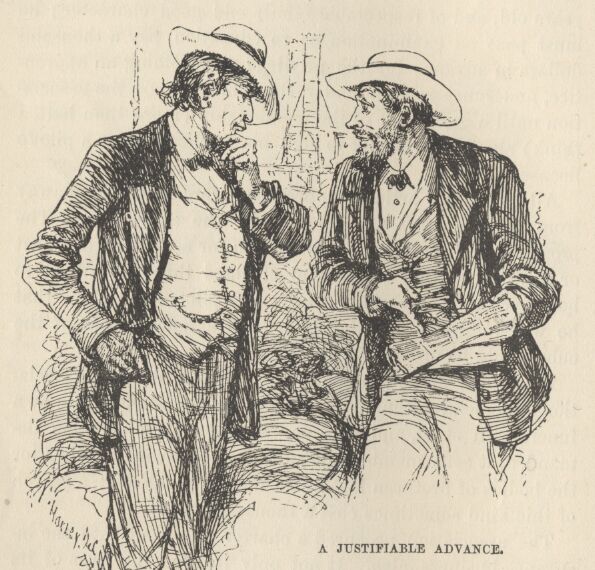
So, straightway the captains and owners got up an association of their own, and proposed to put captains' wages up to five hundred dollars, too, and move for another advance in freights. It was a novel idea, but of course an effect which had been produced once could be produced again. The new association decreed (for this was before all the outsiders had been taken into the pilots' association) that if any captain employed a non-association pilot, he should be forced to discharge him, and also pay a fine of five hundred dollars. Several of these heavy fines were paid before the captains' organization grew strong enough to exercise full authority over its membership; but that all ceased, presently. The captains tried to get the pilots to decree that no member of their corporation should serve under a non-association captain; but this proposition was declined. The pilots saw that they would be backed up by the captains and the underwriters anyhow, and so they wisely refrained from entering into entangling alliances.
So the captains and owners promptly formed an association of their own. They proposed raising captains' wages to five hundred dollars, too, and pushing for another increase in freight rates. It was a novel idea, but of course an effect produced once could be produced again. The new association made a rule. This was before all the outsiders had been admitted to the pilots' association. If a captain employed a pilot who did not belong to the pilots' association, the captain would have to fire the pilot and pay a five-hundred-dollar fine. Several captains paid these heavy fines before their organization grew strong enough to exercise full authority over its members. But before long, the fines stopped altogether. The captains tried to get the pilots to make a rule of their own. Under the proposed rule, no member of the pilots' association could serve under a captain outside the captains' association. But the pilots rejected the proposal. They saw that the captains and the underwriters would back them anyway, so they wisely avoided entangling alliances.
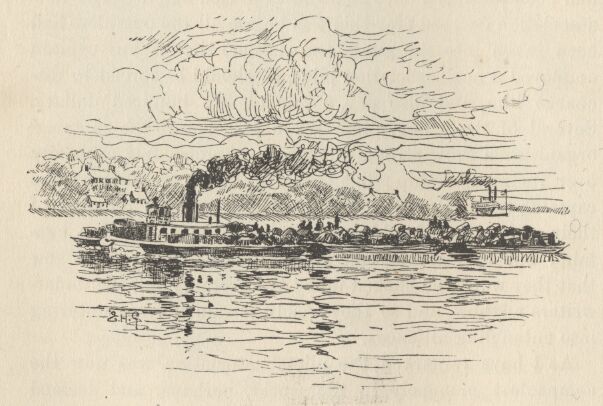
As I have remarked, the pilots' association was now the compactest monopoly in the world, perhaps, and seemed simply indestructible. And yet the days of its glory were numbered. First, the new railroad stretching up through Mississippi, Tennessee, and Kentucky, to Northern railway centers, began to divert the passenger travel from the steamers; next the war came and almost entirely annihilated the steamboating industry during several years, leaving most of the pilots idle, and the cost of living advancing all the time; then the treasurer of the St. Louis association put his hand into the till and walked off with every dollar of the ample fund; and finally, the railroads intruding everywhere, there was little for steamers to do, when the war was over, but carry freights; so straightway some genius from the Atlantic coast introduced the plan of towing a dozen steamer cargoes down to New Orleans at the tail of a vulgar little tug-boat; and behold, in the twinkling of an eye, as it were, the association and the noble science of piloting were things of the dead and pathetic past!
As I have mentioned, the pilots' association was now perhaps the tightest monopoly in the world. It seemed simply indestructible. And yet its days of glory were numbered. First, a new railroad stretched through Mississippi, Tennessee, and Kentucky to Northern railway centers. It began drawing passenger traffic away from the steamers. Next, the war came and almost entirely destroyed the steamboat industry for several years. Most pilots were left idle, while the cost of living kept rising. Then the treasurer of the St. Louis association dipped into the till and walked off with its entire substantial fund. Finally, with railroads spreading everywhere, steamers had little to do after the war but carry freight. So some genius from the Atlantic coast introduced a new plan. He would tow a dozen steamer cargoes down to New Orleans behind a vulgar little tugboat. And behold, in the blink of an eye, the association and the noble science of piloting belonged to the dead and pathetic past!