Chapter 14
The Status and Dignity of Piloting
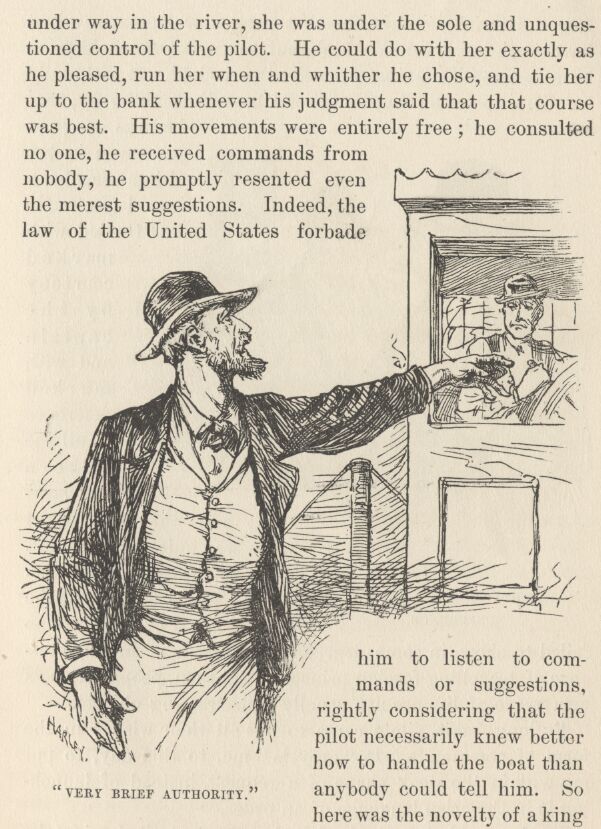
IN my preceding chapters I have tried, by going into the minutiae of the science of piloting, to carry the reader step by step to a comprehension of what the science consists of; and at the same time I have tried to show him that it is a very curious and wonderful science, too, and very worthy of his attention. If I have seemed to love my subject, it is no surprising thing, for I loved the profession far better than any I have followed since, and I took a measureless pride in it. The reason is plain: a pilot, in those days, was the only unfettered and entirely independent human being that lived in the earth. Kings are but the hampered servants of parliament and people; parliaments sit in chains forged by their constituency; the editor of a newspaper cannot be independent, but must work with one hand tied behind him by party and patrons, and be content to utter only half or two-thirds of his mind; no clergyman is a free man and may speak the whole truth, regardless of his parish's opinions; writers of all kinds are manacled servants of the public. We write frankly and fearlessly, but then we 'modify' before we print. In truth, every man and woman and child has a master, and worries and frets in servitude; but in the day I write of, the Mississippi pilot had none. The captain could stand upon the hurricane deck, in the pomp of a very brief authority, and give him five or six orders while the vessel backed into the stream, and then that skipper's reign was over.
In the preceding chapters, I have tried to explain the science of piloting step by step, down to its smallest details. I have also tried to show how curious and wonderful a science it is, and how worthy of your attention. If I have seemed to love my subject, that is no surprise. I loved piloting far more than any profession I have followed since, and I took immense pride in it. The reason is plain: in those days, a pilot was the only completely free and independent human being on earth. Kings are merely servants, restricted by parliament and the people. Parliaments sit in chains forged by their voters. A newspaper editor cannot be independent. Party and patrons tie one hand behind the editor's back, so the editor must settle for saying only half or two-thirds of what he thinks. No clergyman is free to speak the whole truth, regardless of his congregation's opinions. Writers of all kinds are servants chained to the public. We write frankly and fearlessly, but then we 'modify' what we have written before we print it. In truth, every man, woman, and child has a master and worries and frets in servitude. But in the days I write about, the Mississippi pilot had no master. The captain could stand on the hurricane deck, grandly exercising his very brief authority. He could give the pilot five or six orders while the vessel backed into the stream. Then the skipper's reign was over.
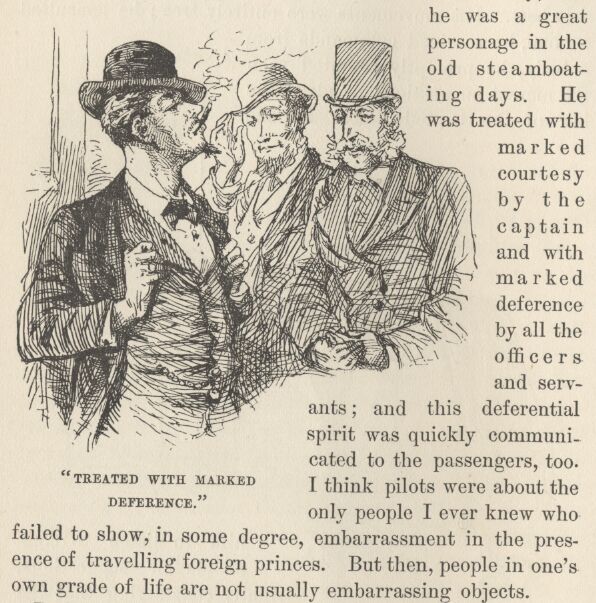
The moment that the boat was under way in the river, she was under the sole and unquestioned control of the pilot. He could do with her exactly as he pleased, run her when and whither he chose, and tie her up to the bank whenever his judgment said that that course was best. His movements were entirely free; he consulted no one, he received commands from nobody, he promptly resented even the merest suggestions. Indeed, the law of the United States forbade him to listen to commands or suggestions, rightly considering that the pilot necessarily knew better how to handle the boat than anybody could tell him. So here was the novelty of a king without a keeper, an absolute monarch who was absolute in sober truth and not by a fiction of words. I have seen a boy of eighteen taking a great steamer serenely into what seemed almost certain destruction, and the aged captain standing mutely by, filled with apprehension but powerless to interfere. His interference, in that particular instance, might have been an excellent thing, but to permit it would have been to establish a most pernicious precedent. It will easily be guessed, considering the pilot's boundless authority, that he was a great personage in the old steamboating days. He was treated with marked courtesy by the captain and with marked deference by all the officers and servants; and this deferential spirit was quickly communicated to the passengers, too. I think pilots were about the only people I ever knew who failed to show, in some degree, embarrassment in the presence of traveling foreign princes. But then, people in one's own grade of life are not usually embarrassing objects.
As soon as the boat was moving on the river, the pilot had sole and unquestioned control. He could do exactly as he pleased with her. He could run her when and where he chose, and tie her up at the bank whenever he thought best. He was completely free to act. He consulted no one, took orders from nobody, and immediately resented even the slightest suggestion. In fact, United States law forbade him to listen to orders or suggestions. The law rightly recognized that the pilot necessarily knew better than anyone else how to handle the boat. So here was something new: a king without a keeper, an absolute monarch who truly was absolute, not just in name. I have seen an eighteen-year-old boy calmly steer a great steamer toward what seemed almost certain destruction. The elderly captain stood silently by, filled with fear but powerless to interfere. In that particular case, his interference might have been an excellent thing. But allowing it would have set a very harmful precedent. Given the pilot's unlimited authority, it is easy to guess that he was an important figure in the old steamboat days. The captain treated him with special courtesy, and all the officers and servants treated him with great respect. The passengers quickly came to treat him with respect, too. I think pilots were about the only people I ever knew who showed no embarrassment at all around traveling foreign princes. But then, people of one's own social rank are not usually embarrassing to be around.
By long habit, pilots came to put all their wishes in the form of commands. It 'gravels' me, to this day, to put my will in the weak shape of a request, instead of launching it in the crisp language of an order. In those old days, to load a steamboat at St. Louis, take her to New Orleans and back, and discharge cargo, consumed about twenty-five days, on an average. Seven or eight of these days the boat spent at the wharves of St. Louis and New Orleans, and every soul on board was hard at work, except the two pilots; they did nothing but play gentleman up town, and receive the same wages for it as if they had been on duty. The moment the boat touched the wharf at either city, they were ashore; and they were not likely to be seen again till the last bell was ringing and everything in readiness for another voyage.
Through long habit, pilots came to express all their wishes as commands. To this day, it 'irritates' me to make a weak request instead of giving a crisp order. In those days, a steamboat trip took about twenty-five days on average. That included loading the boat at St. Louis, taking it to New Orleans and back, and unloading the cargo. The boat spent seven or eight of those days at the docks in St. Louis and New Orleans. Everyone on board worked hard, except the two pilots. They did nothing but play the gentleman in town, receiving the same wages as if they had been on duty. As soon as the boat reached the dock in either city, the pilots went ashore. They were unlikely to be seen again until the last bell was ringing and everything was ready for another voyage.
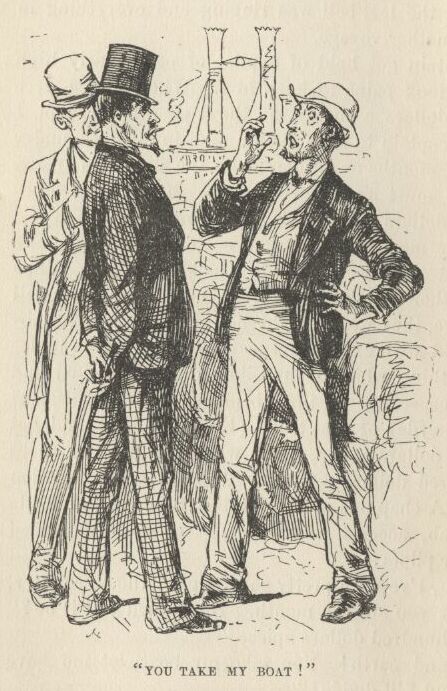
When a captain got hold of a pilot of particularly high reputation, he took pains to keep him. When wages were four hundred dollars a month on the Upper Mississippi, I have known a captain to keep such a pilot in idleness, under full pay, three months at a time, while the river was frozen up. And one must remember that in those cheap times four hundred dollars was a salary of almost inconceivable splendor. Few men on shore got such pay as that, and when they did they were mightily looked up to. When pilots from either end of the river wandered into our small Missouri village, they were sought by the best and the fairest, and treated with exalted respect. Lying in port under wages was a thing which many pilots greatly enjoyed and appreciated; especially if they belonged in the Missouri River in the heyday of that trade (Kansas times), and got nine hundred dollars a trip, which was equivalent to about eighteen hundred dollars a month. Here is a conversation of that day. A chap out of the Illinois River, with a little stern-wheel tub, accosts a couple of ornate and gilded Missouri River pilots—
When a captain got a pilot with an especially good reputation, he took care to keep him. On the Upper Mississippi, pilots earned four hundred dollars a month. I have known a captain to keep such a pilot idle on full pay for three months while the river was frozen. Remember, too, that in those inexpensive times, four hundred dollars was an almost unimaginably splendid salary. Few men on shore earned that much, and those who did were greatly admired. When pilots from either end of the river wandered into our small Missouri village, the best and the fairest sought them out. Everyone treated them with the highest respect. Many pilots greatly enjoyed and appreciated being paid while their boats lay in port. That was especially true of pilots who worked on the Missouri River during its heyday, the Kansas times. They earned nine hundred dollars a trip, or about eighteen hundred dollars a month. Here is a conversation from those days. A fellow from the Illinois River, with a little stern-wheel tub, speaks to a couple of ornate and gilded Missouri River pilots:
'Gentlemen, I've got a pretty good trip for the upcountry, and shall want you about a month. How much will it be?'
'Gentlemen, I've got a pretty good trip upriver, and I'll need you for about a month. How much will it cost?'
'Eighteen hundred dollars apiece.'
'Eighteen hundred dollars each.'
'Heavens and earth! You take my boat, let me have your wages, and I'll divide!'
'Good heavens! You take my boat, let me have your wages, and I'll split the difference!'
I will remark, in passing, that Mississippi steamboatmen were important in landsmen's eyes (and in their own, too, in a degree) according to the dignity of the boat they were on. For instance, it was a proud thing to be of the crew of such stately craft as the 'Aleck Scott' or the 'Grand Turk.' Negro firemen, deck hands, and barbers belonging to those boats were distinguished personages in their grade of life, and they were well aware of that fact too. A stalwart darkey once gave offense at a negro ball in New Orleans by putting on a good many airs. Finally one of the managers bustled up to him and said—
I should mention that people on land judged Mississippi steamboatmen’s importance by the prestige of their boat. To some extent, the steamboatmen judged themselves that way, too. For example, it was a source of pride to serve on a stately boat like the 'Aleck Scott' or the 'Grand Turk.' Black firemen, deckhands, and barbers from those boats were distinguished people in their station in life. They knew it, too. Once, a strong Black man offended people at a Black dance in New Orleans by putting on a lot of airs. Finally, one of the organizers hurried up to him and said:
'Who is you, any way? Who is you? dat's what I wants to know!'
'Who are you, anyway? Who are you? That's what I want to know!'
The offender was not disconcerted in the least, but swelled himself up and threw that into his voice which showed that he knew he was not putting on all those airs on a stinted capital.
The offender was not bothered in the least. Instead, he puffed himself up and spoke in a tone that showed he knew he had plenty to back up all his airs.
'Who is I? Who is I? I let you know mighty quick who I is! I want you niggers to understan' dat I fires de middle do'{footnote [Door]} on de “Aleck Scott!”'
'Who am I? Who am I? I'll let you know mighty quick who I am! I want you niggers to understand that I fire the middle door{footnote [Door]} on the “Aleck Scott!”'
That was sufficient.
That was enough.
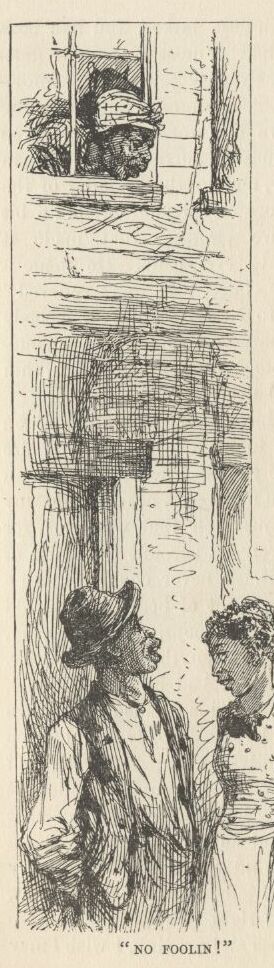
The barber of the 'Grand Turk' was a spruce young negro, who aired his importance with balmy complacency, and was greatly courted by the circle in which he moved. The young colored population of New Orleans were much given to flirting, at twilight, on the banquettes of the back streets. Somebody saw and heard something like the following, one evening, in one of those localities. A middle-aged negro woman projected her head through a broken pane and shouted (very willing that the neighbors should hear and envy), 'You Mary Ann, come in de house dis minute! Stannin' out dah foolin' 'long wid dat low trash, an' heah's de barber offn de “Gran' Turk” wants to conwerse wid you!'
The barber of the 'Grand Turk' was a neatly dressed young Black man. He displayed his importance with relaxed self-satisfaction, and people in his social circle eagerly sought his company. Young Black people in New Orleans often flirted at twilight on the sidewalks of the back streets. One evening, someone saw and heard something like the following on one of those streets. A middle-aged Black woman stuck her head through a broken windowpane and shouted. She was happy to have the neighbors hear and envy her: 'Mary Ann, come into the house this minute! You're standing out there fooling around with that low trash, and the barber from the “Grand Turk” wants to talk with you!'
My reference, a moment ago, to the fact that a pilot's peculiar official position placed him out of the reach of criticism or command, brings Stephen W—— naturally to my mind. He was a gifted pilot, a good fellow, a tireless talker, and had both wit and humor in him. He had a most irreverent independence, too, and was deliciously easy-going and comfortable in the presence of age, official dignity, and even the most august wealth. He always had work, he never saved a penny, he was a most persuasive borrower, he was in debt to every pilot on the river, and to the majority of the captains. He could throw a sort of splendor around a bit of harum-scarum, devil-may-care piloting, that made it almost fascinating—but not to everybody. He made a trip with good old Captain Y——once, and was 'relieved' from duty when the boat got to New Orleans. Somebody expressed surprise at the discharge. Captain Y—— shuddered at the mere mention of Stephen. Then his poor, thin old voice piped out something like this:—
A moment ago, I mentioned that a pilot’s unusual official position put him beyond criticism or command. That brings Stephen W. to mind. He was a gifted pilot, a good fellow, and a tireless talker, with both wit and humor. He was also boldly independent and irreverent. He was delightfully relaxed and comfortable around his elders, people in high office, and even the grandest wealthy people. He always had work, but never saved a penny. He was a very persuasive borrower and owed money to every pilot on the river and most of the captains. He could give his reckless, devil-may-care piloting a kind of splendor that made it almost fascinating, though not to everyone. He once made a trip with good old Captain Y. When the boat reached New Orleans, Stephen was 'relieved' of duty. Someone expressed surprise that he had been dismissed. Captain Y. shuddered at the mere mention of Stephen. Then his poor, thin old voice piped up with something like this:
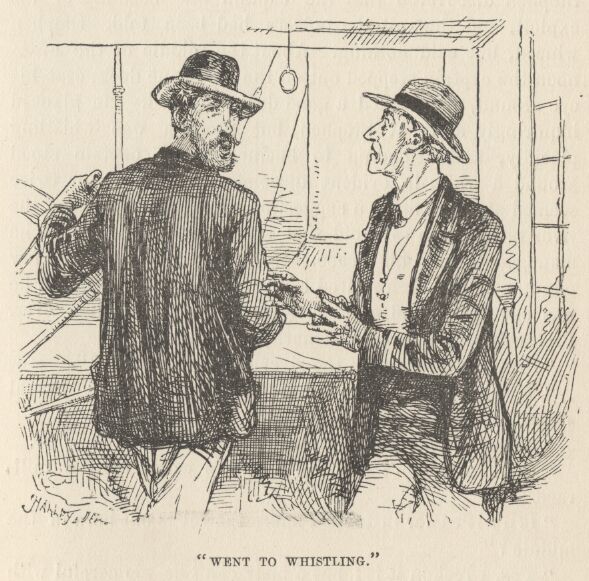
'Why, bless me! I wouldn't have such a wild creature on my boat for the world—not for the whole world! He swears, he sings, he whistles, he yells—I never saw such an Injun to yell. All times of the night—it never made any difference to him. He would just yell that way, not for anything in particular, but merely on account of a kind of devilish comfort he got out of it. I never could get into a sound sleep but he would fetch me out of bed, all in a cold sweat, with one of those dreadful war-whoops. A queer being—very queer being; no respect for anything or anybody. Sometimes he called me “Johnny.” And he kept a fiddle, and a cat. He played execrably. This seemed to distress the cat, and so the cat would howl. Nobody could sleep where that man—and his family—was. And reckless. There never was anything like it. Now you may believe it or not, but as sure as I am sitting here, he brought my boat a-tilting down through those awful snags at Chicot under a rattling head of steam, and the wind a-blowing like the very nation, at that! My officers will tell you so. They saw it. And, sir, while he was a-tearing right down through those snags, and I a-shaking in my shoes and praying, I wish I may never speak again if he didn't pucker up his mouth and go to whistling! Yes, sir; whistling “Buffalo gals, can't you come out tonight, can't you come out to-night, can't you come out to-night;” and doing it as calmly as if we were attending a funeral and weren't related to the corpse. And when I remonstrated with him about it, he smiled down on me as if I was his child, and told me to run in the house and try to be good, and not be meddling with my superiors!'
'Well, bless me! I wouldn't have such a wild creature on my boat for the world, not for the whole world! He swears, sings, whistles, and yells. I never saw an Indian who could yell like that. He yelled at all hours of the night. It made no difference to him. He would just yell, not for any particular reason, but simply for the devilish comfort it gave him. Whenever I fell sound asleep, one of those dreadful war whoops would bring me out of bed in a cold sweat. A strange creature, a very strange creature, with no respect for anything or anybody. Sometimes he called me “Johnny.” And he kept a fiddle and a cat. He played terribly. This seemed to distress the cat, so the cat would howl. Nobody could sleep wherever that man and his family were. And reckless! There was never anything like it. You may believe it or not, but as surely as I'm sitting here, he brought my boat tilting down through those awful snags at Chicot under a full head of steam. And the wind was blowing like the devil, too! My officers will tell you so. They saw it. And, sir, while he was tearing down through those snags, I was shaking in my shoes and praying. May I never speak again if he didn't pucker his lips and start whistling! Yes, sir, whistling “Buffalo gals, can't you come out tonight, can't you come out to-night, can't you come out to-night.” He was as calm as if we were attending a funeral and weren't related to the corpse. And when I protested, he smiled down at me as if I were his child. He told me to run in the house and try to be good, and not meddle with my superiors!'
Once a pretty mean captain caught Stephen in New Orleans out of work and as usual out of money. He laid steady siege to Stephen, who was in a very 'close place,' and finally persuaded him to hire with him at one hundred and twenty-five dollars per month, just half wages, the captain agreeing not to divulge the secret and so bring down the contempt of all the guild upon the poor fellow. But the boat was not more than a day out of New Orleans before Stephen discovered that the captain was boasting of his exploit, and that all the officers had been told. Stephen winced, but said nothing. About the middle of the afternoon the captain stepped out on the hurricane deck, cast his eye around, and looked a good deal surprised. He glanced inquiringly aloft at Stephen, but Stephen was whistling placidly, and attending to business. The captain stood around a while in evident discomfort, and once or twice seemed about to make a suggestion; but the etiquette of the river taught him to avoid that sort of rashness, and so he managed to hold his peace. He chafed and puzzled a few minutes longer, then retired to his apartments. But soon he was out again, and apparently more perplexed than ever. Presently he ventured to remark, with deference—
Once, a pretty mean captain found Stephen in New Orleans, out of work and, as usual, out of money. The captain kept after Stephen, who was in a very tight spot. Finally, he persuaded Stephen to work for him for one hundred and twenty-five dollars a month, just half the usual wages. The captain agreed to keep the deal secret so that the whole guild would not look down on the poor fellow. But the boat had been out of New Orleans for less than a day when Stephen discovered that the captain was boasting about his exploit. He had told all the officers. Stephen winced, but said nothing. In the middle of the afternoon, the captain stepped out onto the hurricane deck and looked around. He seemed quite surprised. He glanced up at Stephen with a questioning look, but Stephen was whistling calmly and attending to business. The captain stood around for a while, clearly uncomfortable. Once or twice he seemed about to make a suggestion, but river etiquette taught him to avoid anything so rash. So he managed to keep quiet. He fretted and puzzled over the matter for a few more minutes, then went back to his quarters. But he soon came out again, apparently more puzzled than ever. At last, he ventured to say respectfully:
'Pretty good stage of the river now, ain't it, sir?'
'The river's at a pretty good level now, isn't it, sir?'
'Well, I should say so! Bank-full is a pretty liberal stage.'
'Well, I should say so! A bank-full river is pretty high.'
'Seems to be a good deal of current here.'
'There seems to be a lot of current here.'
'Good deal don't describe it! It's worse than a mill-race.'
‘“A good deal” doesn’t begin to describe it! It’s worse than the current in a mill channel.’
'Isn't it easier in toward shore than it is out here in the middle?'
'Isn't it easier closer to shore than out here in the middle?'
'Yes, I reckon it is; but a body can't be too careful with a steamboat. It's pretty safe out here; can't strike any bottom here, you can depend on that.'
'Yes, I think it is, but you can't be too careful with a steamboat. It's pretty safe out here. You can be sure the boat won't hit bottom here.'
The captain departed, looking rueful enough. At this rate, he would probably die of old age before his boat got to St. Louis. Next day he appeared on deck and again found Stephen faithfully standing up the middle of the river, fighting the whole vast force of the Mississippi, and whistling the same placid tune. This thing was becoming serious. In by the shore was a slower boat clipping along in the easy water and gaining steadily; she began to make for an island chute; Stephen stuck to the middle of the river. Speech was wrung from the captain. He said—
The captain left, looking miserable. At this rate, he would probably die of old age before his boat reached St. Louis. The next day, he came on deck and found Stephen still faithfully steering up the middle of the river. He was fighting the full, tremendous force of the Mississippi and whistling the same calm tune. The situation was becoming serious. Near the shore, a slower boat was moving swiftly through the gentler water and steadily gaining on them. The slower boat began heading for a channel beside an island, but Stephen stayed in the middle of the river. The captain was forced to speak. He said:
'Mr. W——, don't that chute cut off a good deal of distance?'
'Mr. W, doesn't that chute save a lot of distance?'
'I think it does, but I don't know.'
'I think it does, but I don't know.'
'Don't know! Well, isn't there water enough in it now to go through?'
'You don't know! Well, isn't there enough water in it now to get through?'
'I expect there is, but I am not certain.'
'I think there is, but I am not sure.'
'Upon my word this is odd! Why, those pilots on that boat yonder are going to try it. Do you mean to say that you don't know as much as they do?'
'Well, this is strange! The pilots on that boat over there are going to try it. Are you saying you don't know as much as they do?'
'They! Why, they are two-hundred-and-fifty-dollar pilots! But don't you be uneasy; I know as much as any man can afford to know for a hundred and twenty-five!'
'They! Why, they are two-hundred-and-fifty-dollar pilots! But don't worry. I know as much as any man can afford to know for a hundred and twenty-five!'
The captain surrendered.
The captain surrendered.
Five minutes later Stephen was bowling through the chute and showing the rival boat a two-hundred-and-fifty-dollar pair of heels.
Five minutes later, Stephen was racing through the chute, leaving the rival boat $250 behind.