Chapter 11
The River Rises
DURING this big rise these small-fry craft were an intolerable nuisance. We were running chute after chute,—a new world to me,—and if there was a particularly cramped place in a chute, we would be pretty sure to meet a broad-horn there; and if he failed to be there, we would find him in a still worse locality, namely, the head of the chute, on the shoal water. And then there would be no end of profane cordialities exchanged.
During this big flood, these little boats were an unbearable nuisance. We were running through one chute after another, a whole new world to me. If a chute had a particularly tight spot, we were almost sure to meet a broad-horn there. If it wasn't there, we would find it in an even worse spot: the shallow water at the head of the chute. Then there would be no end of friendly curses exchanged.
Sometimes, in the big river, when we would be feeling our way cautiously along through a fog, the deep hush would suddenly be broken by yells and a clamor of tin pans, and all in instant a log raft would appear vaguely through the webby veil, close upon us; and then we did not wait to swap knives, but snatched our engine bells out by the roots and piled on all the steam we had, to scramble out of the way! One doesn't hit a rock or a solid log craft with a steamboat when he can get excused.
Sometimes, on the big river, we would be feeling our way cautiously through a fog. Suddenly, yells and the clamor of tin pans would break the deep silence. A log raft would appear dimly through the mist, right in front of us. Then we didn't stop to swap knives. We yanked at the engine bells and piled on all the steam we had to scramble out of the way! You don't hit a rock or a solid log raft with a steamboat if you can help it.
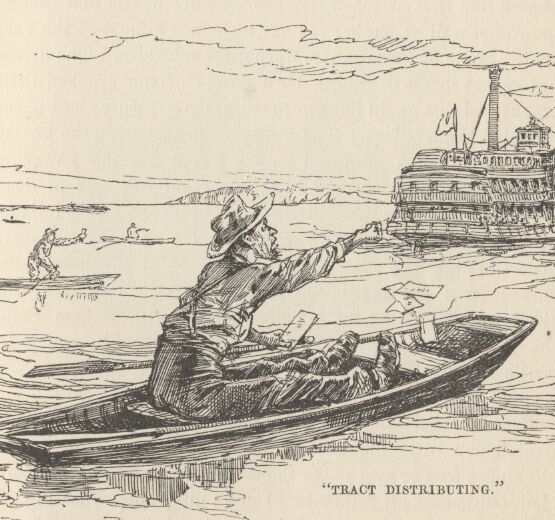
You will hardly believe it, but many steamboat clerks always carried a large assortment of religious tracts with them in those old departed steamboating days. Indeed they did. Twenty times a day we would be cramping up around a bar, while a string of these small-fry rascals were drifting down into the head of the bend away above and beyond us a couple of miles. Now a skiff would dart away from one of them, and come fighting its laborious way across the desert of water. It would 'ease all,' in the shadow of our forecastle, and the panting oarsmen would shout, 'Gimme a pa-a-per!' as the skiff drifted swiftly astern. The clerk would throw over a file of New Orleans journals. If these were picked up without comment, you might notice that now a dozen other skiffs had been drifting down upon us without saying anything. You understand, they had been waiting to see how No. 1 was going to fare. No. 1 making no comment, all the rest would bend to their oars and come on, now; and as fast as they came the clerk would heave over neat bundles of religious tracts, tied to shingles. The amount of hard swearing which twelve packages of religious literature will command when impartially divided up among twelve raftsmen's crews, who have pulled a heavy skiff two miles on a hot day to get them, is simply incredible.
You will hardly believe it, but in the old steamboat days, many clerks always carried a large assortment of religious tracts. They really did. Twenty times a day, we would be making a tight turn around a sandbar. Meanwhile, a string of these small-time rascals would be drifting down toward the head of the bend, a couple of miles upstream. Then a skiff would dart away from one of them and struggle across that desert of water. The skiff would stop rowing in the shadow of our forecastle and drift swiftly toward the stern. As it passed, the panting oarsmen would shout, “Gimme a pa-a-per!” The clerk would throw them a stack of New Orleans newspapers. If the men picked up the papers without comment, you might notice a dozen other skiffs drifting silently toward us. You see, they had been waiting to find out how the first skiff would fare. Since its crew made no comment, all the others would now start rowing toward us. As each skiff arrived, the clerk would throw over neat bundles of religious tracts tied to shingles. Those twelve packages of religious literature were divided fairly among twelve raftsmen’s crews. Each crew had rowed a heavy skiff two miles on a hot day to get them. The amount of hard swearing those packages could provoke is simply incredible.
As I have said, the big rise brought a new world under my vision. By the time the river was over its banks we had forsaken our old paths and were hourly climbing over bars that had stood ten feet out of water before; we were shaving stumpy shores, like that at the foot of Madrid Bend, which I had always seen avoided before; we were clattering through chutes like that of 82, where the opening at the foot was an unbroken wall of timber till our nose was almost at the very spot. Some of these chutes were utter solitudes. The dense, untouched forest overhung both banks of the crooked little crack, and one could believe that human creatures had never intruded there before. The swinging grape-vines, the grassy nooks and vistas glimpsed as we swept by, the flowering creepers waving their red blossoms from the tops of dead trunks, and all the spendthrift richness of the forest foliage, were wasted and thrown away there. The chutes were lovely places to steer in; they were deep, except at the head; the current was gentle; under the 'points' the water was absolutely dead, and the invisible banks so bluff that where the tender willow thickets projected you could bury your boat's broadside in them as you tore along, and then you seemed fairly to fly.
As I have said, the great rise in the river brought a new world into view. By the time the river overflowed its banks, we had abandoned our old routes. Every hour, we crossed sandbars that had stood ten feet above the water before. We skimmed past shores full of stumps, like the one at the foot of Madrid Bend. I had always seen boats avoid that shore before. We clattered through narrow channels like the one at 82. There, the opening at the lower end looked like an unbroken wall of trees until our bow was almost upon it. Some of these channels were utterly deserted. Dense, untouched forest hung over both banks of the crooked little passage. You could believe that no human being had ever ventured there before. As we swept past, we glimpsed swinging grapevines and grassy nooks and clearings. Flowering vines waved their red blossoms from the tops of dead trunks. All this lavish richness of forest foliage was wasted there. The channels were lovely places to steer through. They were deep, except at the entrance, and the current was gentle. Below the 'points', the water was absolutely still. The hidden banks were so steep that, where tender willow thickets stuck out, you could bury the boat's side in them as you raced along. Then you seemed almost to fly.
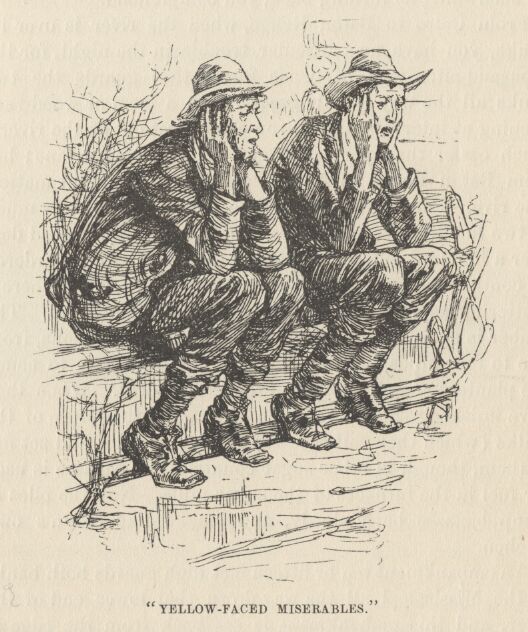
Behind other islands we found wretched little farms, and wretcheder little log-cabins; there were crazy rail fences sticking a foot or two above the water, with one or two jeans-clad, chills-racked, yellow-faced male miserables roosting on the top-rail, elbows on knees, jaws in hands, grinding tobacco and discharging the result at floating chips through crevices left by lost teeth; while the rest of the family and the few farm-animals were huddled together in an empty wood-flat riding at her moorings close at hand. In this flat-boat the family would have to cook and eat and sleep for a lesser or greater number of days (or possibly weeks), until the river should fall two or three feet and let them get back to their log-cabin and their chills again—chills being a merciful provision of an all-wise Providence to enable them to take exercise without exertion. And this sort of watery camping out was a thing which these people were rather liable to be treated to a couple of times a year: by the December rise out of the Ohio, and the June rise out of the Mississippi. And yet these were kindly dispensations, for they at least enabled the poor things to rise from the dead now and then, and look upon life when a steamboat went by. They appreciated the blessing, too, for they spread their mouths and eyes wide open and made the most of these occasions. Now what could these banished creatures find to do to keep from dying of the blues during the low-water season!
Behind other islands, we found miserable little farms and even more miserable little log cabins. Rickety rail fences stuck a foot or two above the water. One or two miserable men sat on the top rail, wearing jeans and shaking with chills. Their faces were yellow, their elbows rested on their knees, and their jaws rested in their hands. They chewed tobacco and spat through the gaps left by missing teeth, aiming at floating wood chips. The rest of the family and their few farm animals huddled together in an empty flatboat used for carrying wood. It was moored close by. The family would have to cook, eat, and sleep in the boat for days or possibly weeks. They had to wait until the river fell two or three feet. Then they could return to their log cabin and their chills. The chills were a merciful gift from an all-wise Providence, allowing them to exercise without exertion. These people were likely to be treated to this kind of watery camping a couple of times a year. The Ohio rose in December, and the Mississippi rose in June. And yet these floods were blessings, for they at least allowed the poor creatures to rise from the dead occasionally. They could get a look at life when a steamboat went by. They appreciated the blessing, too. They opened their mouths and eyes wide and made the most of these occasions. Now what could these banished creatures find to do to keep from dying of the blues during low water?
Once, in one of these lovely island chutes, we found our course completely bridged by a great fallen tree. This will serve to show how narrow some of the chutes were. The passengers had an hour's recreation in a virgin wilderness, while the boat-hands chopped the bridge away; for there was no such thing as turning back, you comprehend.
Once, in one of these lovely channels beside an island, a huge fallen tree stretched across our path. That shows how narrow some of the channels were. The passengers spent an hour enjoying the untouched wilderness while the boat crew chopped the tree away. You see, there was no way to turn back.
From Cairo to Baton Rouge, when the river is over its banks, you have no particular trouble in the night, for the thousand-mile wall of dense forest that guards the two banks all the way is only gapped with a farm or wood-yard opening at intervals, and so you can't 'get out of the river' much easier than you could get out of a fenced lane; but from Baton Rouge to New Orleans it is a different matter. The river is more than a mile wide, and very deep—as much as two hundred feet, in places. Both banks, for a good deal over a hundred miles, are shorn of their timber and bordered by continuous sugar plantations, with only here and there a scattering sapling or row of ornamental China-trees. The timber is shorn off clear to the rear of the plantations, from two to four miles. When the first frost threatens to come, the planters snatch off their crops in a hurry. When they have finished grinding the cane, they form the refuse of the stalks (which they call bagasse) into great piles and set fire to them, though in other sugar countries the bagasse is used for fuel in the furnaces of the sugar mills. Now the piles of damp bagasse burn slowly, and smoke like Satan's own kitchen.
From Cairo to Baton Rouge, you have little trouble at night when the river is over its banks. A thousand-mile wall of dense forest guards both banks all the way. Only occasional openings for farms or wood-yards break the forest. So you can't "get out of the river" much easier than you could get out of a fenced lane. But from Baton Rouge to New Orleans, it's a different matter. The river is more than a mile wide and very deep, reaching two hundred feet in places. For well over a hundred miles, both banks have been cleared of trees and are lined with continuous sugar plantations. Only here and there do you see a few scattered saplings or a row of ornamental China-trees. The trees have been cleared all the way to the back of the plantations, two to four miles from the river. When the first frost threatens, the planters rush to harvest their crops. After grinding the cane, they heap up the leftover stalks, which they call bagasse, and set the piles on fire. In other sugar-growing countries, though, bagasse is used as fuel for the sugar mill furnaces. These piles of damp bagasse burn slowly and smoke like Satan's own kitchen.
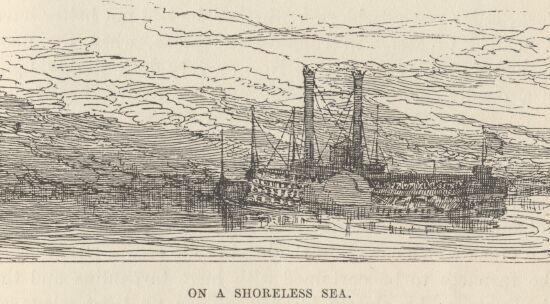
An embankment ten or fifteen feet high guards both banks of the Mississippi all the way down that lower end of the river, and this embankment is set back from the edge of the shore from ten to perhaps a hundred feet, according to circumstances; say thirty or forty feet, as a general thing. Fill that whole region with an impenetrable gloom of smoke from a hundred miles of burning bagasse piles, when the river is over the banks, and turn a steamboat loose along there at midnight and see how she will feel. And see how you will feel, too! You find yourself away out in the midst of a vague dim sea that is shoreless, that fades out and loses itself in the murky distances; for you cannot discern the thin rib of embankment, and you are always imagining you see a straggling tree when you don't. The plantations themselves are transformed by the smoke, and look like a part of the sea. All through your watch you are tortured with the exquisite misery of uncertainty. You hope you are keeping in the river, but you do not know. All that you are sure about is that you are likely to be within six feet of the bank and destruction, when you think you are a good half-mile from shore. And you are sure, also, that if you chance suddenly to fetch up against the embankment and topple your chimneys overboard, you will have the small comfort of knowing that it is about what you were expecting to do. One of the great Vicksburg packets darted out into a sugar plantation one night, at such a time, and had to stay there a week. But there was no novelty about it; it had often been done before.
An embankment ten or fifteen feet high protects both banks along that lower stretch of the Mississippi. It stands ten to perhaps a hundred feet back from the shore, depending on the conditions. Usually, it is about thirty or forty feet back. Now fill the whole region with impenetrable smoke from a hundred miles of burning bagasse piles. Let the river rise over its banks, then send a steamboat loose along there at midnight. See how she feels. And see how you feel, too! You find yourself far out in the middle of a vague, dim sea with no visible shore. It fades away into the murky distance. You cannot make out the thin ridge of the embankment, and you keep imagining trees where there are none. The smoke transforms the plantations themselves, making them look like part of the sea. Throughout your watch, you are tortured by the exquisite misery of uncertainty. You hope you are staying in the river, but you do not know. You know only that you could be within six feet of the bank and destruction. And you could be that close when you think you are a good half-mile from shore. You also know what will happen if you suddenly run into the embankment and knock your chimneys overboard. You will have the small comfort of knowing that it was about what you expected to do. One night, under such conditions, one of the great Vicksburg packet boats darted into a sugar plantation. It had to stay there for a week. But there was nothing new about that. It had often been done before.
I thought I had finished this chapter, but I wish to add a curious thing, while it is in my mind. It is only relevant in that it is connected with piloting. There used to be an excellent pilot on the river, a Mr. X., who was a somnambulist. It was said that if his mind was troubled about a bad piece of river, he was pretty sure to get up and walk in his sleep and do strange things. He was once fellow-pilot for a trip or two with George Ealer, on a great New Orleans passenger packet. During a considerable part of the first trip George was uneasy, but got over it by and by, as X. seemed content to stay in his bed when asleep. Late one night the boat was approaching Helena, Arkansas; the water was low, and the crossing above the town in a very blind and tangled condition. X. had seen the crossing since Ealer had, and as the night was particularly drizzly, sullen, and dark, Ealer was considering whether he had not better have X. called to assist in running the place, when the door opened and X. walked in. Now on very dark nights, light is a deadly enemy to piloting; you are aware that if you stand in a lighted room, on such a night, you cannot see things in the street to any purpose; but if you put out the lights and stand in the gloom you can make out objects in the street pretty well. So, on very dark nights, pilots do not smoke; they allow no fire in the pilot-house stove if there is a crack which can allow the least ray to escape; they order the furnaces to be curtained with huge tarpaulins and the sky-lights to be closely blinded. Then no light whatever issues from the boat. The undefinable shape that now entered the pilot-house had Mr. X.'s voice. This said—
I thought I had finished this chapter, but I want to add a curious thing while it is on my mind. It is relevant only because it has to do with piloting. There used to be an excellent pilot on the river, a Mr. X., who was a sleepwalker. People said that if he was worried about a bad stretch of river, he was almost certain to get up, walk in his sleep, and do strange things. He once served as fellow pilot with George Ealer for a trip or two on a large New Orleans passenger packet. For much of the first trip, George was uneasy. But he got over it after a while, since X. seemed content to stay in bed when he slept. Late one night, the boat was approaching Helena, Arkansas. The water was low, and the crossing above town was very difficult to read and navigate. X. had seen the crossing more recently than Ealer. The night was especially drizzly, gloomy, and dark. Ealer was considering whether he should have X. called to help navigate the crossing when the door opened and X. walked in. On very dark nights, light is a deadly enemy to piloting. If you stand in a lighted room on such a night, you cannot see much of anything in the street. But if you put out the lights and stand in the dark, you can make out objects in the street fairly well. So, on very dark nights, pilots do not smoke. They allow no fire in the pilothouse stove if there is a crack that could let even the slightest ray escape. They order the furnaces covered with huge tarpaulins and the skylights tightly covered. Then no light at all comes from the boat. The shapeless figure that now entered the pilothouse had Mr. X.'s voice. The figure said:
'Let me take her, George; I've seen this place since you have, and it is so crooked that I reckon I can run it myself easier than I could tell you how to do it.'
'Let me take her, George. I've seen this place more recently than you have. It's so crooked that I think I can steer through it more easily than I could tell you how.'
'It is kind of you, and I swear I am willing. I haven't got another drop of perspiration left in me. I have been spinning around and around the wheel like a squirrel. It is so dark I can't tell which way she is swinging till she is coming around like a whirligig.'
'That's kind of you, and I swear I am willing. I don't have another drop of sweat left in me. I've been spinning around and around the wheel like a squirrel. It's so dark I can't tell which way she's turning until she's spinning like a top.'
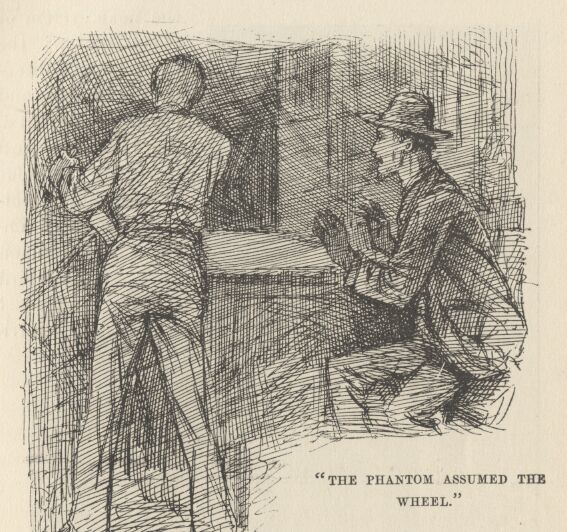
So Ealer took a seat on the bench, panting and breathless. The black phantom assumed the wheel without saying anything, steadied the waltzing steamer with a turn or two, and then stood at ease, coaxing her a little to this side and then to that, as gently and as sweetly as if the time had been noonday. When Ealer observed this marvel of steering, he wished he had not confessed! He stared, and wondered, and finally said—
So Ealer sat down on the bench, panting and out of breath. The black phantom took the wheel without a word and steadied the swaying steamer with a turn or two. Then he stood comfortably at the wheel, gently guiding her first one way and then the other, as calmly as if it were noon. When Ealer saw this amazing display of steering, he wished he had not confessed! He stared in wonder and finally said:
'Well, I thought I knew how to steer a steamboat, but that was another mistake of mine.'
'Well, I thought I knew how to steer a steamboat, but I was wrong about that too.'
X. said nothing, but went serenely on with his work. He rang for the leads; he rang to slow down the steam; he worked the boat carefully and neatly into invisible marks, then stood at the center of the wheel and peered blandly out into the blackness, fore and aft, to verify his position; as the leads shoaled more and more, he stopped the engines entirely, and the dead silence and suspense of 'drifting' followed when the shoalest water was struck, he cracked on the steam, carried her handsomely over, and then began to work her warily into the next system of shoal marks; the same patient, heedful use of leads and engines followed, the boat slipped through without touching bottom, and entered upon the third and last intricacy of the crossing; imperceptibly she moved through the gloom, crept by inches into her marks, drifted tediously till the shoalest water was cried, and then, under a tremendous head of steam, went swinging over the reef and away into deep water and safety!
X. said nothing, but calmly continued his work. He rang for the leads to sound the depth, then rang to slow the engines. He guided the boat carefully and neatly into position using marks he could not see. Then he stood at the center of the wheel and peered calmly into the darkness, forward and aft, to check his position. As the leads showed the water growing shallower, he stopped the engines completely. Then came the dead silence and suspense of 'drifting'. When the leads reached the shallowest water, he opened the steam, carried the boat smoothly over, and carefully guided her toward the next set of shallow-water marks. Again, he used the leads and engines patiently and carefully. The boat slipped through without touching bottom and entered the third and final tricky part of the crossing. She moved almost imperceptibly through the gloom, creeping inch by inch into position at the marks. She drifted for a long time until the shallowest depth was called out. Then, under a tremendous head of steam, she swung over the reef and out into deep water and safety!
Ealer let his long-pent breath pour out in a great, relieving sigh, and said—
Ealer let out the breath he had been holding in a great sigh of relief and said:
'That's the sweetest piece of piloting that was ever done on the Mississippi River! I wouldn't believed it could be done, if I hadn't seen it.'
'That’s the best piloting ever done on the Mississippi River! I wouldn’t have believed it was possible if I hadn’t seen it.'
There was no reply, and he added—
There was no reply, and he added:
'Just hold her five minutes longer, partner, and let me run down and get a cup of coffee.'
'Just hold her for five more minutes, partner, and let me run down and get a cup of coffee.'
A minute later Ealer was biting into a pie, down in the 'texas,' and comforting himself with coffee. Just then the night watchman happened in, and was about to happen out again, when he noticed Ealer and exclaimed—
A minute later, Ealer was down in the 'texas,' biting into a pie and taking comfort in his coffee. Just then, the night watchman happened to come in. He was about to leave again when he noticed Ealer and exclaimed:
'Who is at the wheel, sir?'
'Who is steering, sir?'
'X.'
'X.'
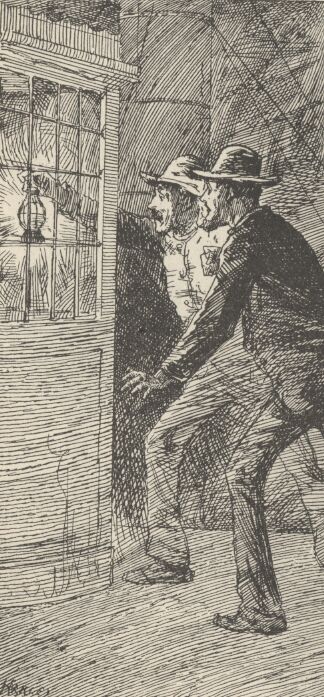
'Dart for the pilot-house, quicker than lightning!'
'Run to the pilot house, faster than lightning!'
The next moment both men were flying up the pilot-house companion way, three steps at a jump! Nobody there! The great steamer was whistling down the middle of the river at her own sweet will! The watchman shot out of the place again; Ealer seized the wheel, set an engine back with power, and held his breath while the boat reluctantly swung away from a 'towhead' which she was about to knock into the middle of the Gulf of Mexico!
The next moment, both men were racing up the stairs to the pilot house, three steps at a time! Nobody was there! The great steamboat was whistling down the middle of the river, going wherever it pleased! The watchman dashed out again. Ealer grabbed the wheel, put one engine hard in reverse, and held his breath. The boat slowly turned away from a 'towhead', a sandbar it had been about to knock clear into the middle of the Gulf of Mexico!
By and by the watchman came back and said—
After a while, the watchman came back and said:
'Didn't that lunatic tell you he was asleep, when he first came up here?'
'Didn't that lunatic tell you he was asleep when he first came up here?'
'No.'
'No.'
'Well, he was. I found him walking along on top of the railings just as unconcerned as another man would walk a pavement; and I put him to bed; now just this minute there he was again, away astern, going through that sort of tight-rope deviltry the same as before.'
'Well, he was. I found him walking on top of the railings as casually as another man would walk on a sidewalk. I put him to bed. But just a minute ago, there he was again, back at the stern, doing the same tightrope mischief as before.'
'Well, I think I'll stay by, next time he has one of those fits. But I hope he'll have them often. You just ought to have seen him take this boat through Helena crossing. I never saw anything so gaudy before. And if he can do such gold-leaf, kid-glove, diamond-breastpin piloting when he is sound asleep, what couldn't he do if he was dead!'
'Well, I think I'll stay and watch the next time he has one of those fits. But I hope he has them often. You should have seen him pilot this boat through Helena crossing. I've never seen anything so flashy. And if he can do such gold-leaf, kid-glove, diamond-breastpin piloting while he's sound asleep, what couldn't he do if he were dead!'