Section 2
Climate and Houses in Flatland
As with you, so also with us, there are four points of the compass North, South, East, and West.
Like you, we have four compass points: North, South, East, and West.
There being no sun nor other heavenly bodies, it is impossible for us to determine the North in the usual way; but we have a method of our own. By a Law of Nature with us, there is a constant attraction to the South; and, although in temperate climates this is very slight—so that even a Woman in reasonable health can journey several furlongs northward without much difficulty—yet the hampering effect of the southward attraction is quite sufficient to serve as a compass in most parts of our earth. Moreover, the rain (which falls at stated intervals) coming always from the North, is an additional assistance; and in the towns we have the guidance of the houses, which of course have their side-walls running for the most part North and South, so that the roofs may keep off the rain from the North. In the country, where there are no houses, the trunks of the trees serve as some sort of guide. Altogether, we have not so much difficulty as might be expected in determining our bearings.
We have no sun or other heavenly bodies, so we cannot find North in the usual way. But we have a method of our own. A Law of Nature in our world creates a constant pull toward the South. In temperate climates, the pull is very slight. Even a Woman in reasonable health can travel several furlongs northward without much difficulty. Although slight, the resistance from this southward pull is enough to act as a compass across most of our earth. Rain, which falls at regular intervals, always comes from the North and provides another guide. In towns, we can also find our way by the houses. Their side walls, of course, mostly run North and South so that their roofs can keep out the northern rain. In the countryside, where there are no houses, tree trunks provide some guidance. Altogether, we have less trouble finding our bearings than might be expected.
Yet in our more temperate regions, in which the southward attraction is hardly felt, walking sometimes in a perfectly desolate plain where there have been no houses nor trees to guide me, I have been occasionally compelled to remain stationary for hours together, waiting till the rain came before continuing my journey. On the weak and aged, and especially on delicate Females, the force of attraction tells much more heavily than on the robust of the Male Sex, so that it is a point of breeding, if you meet a Lady in the street, always to give her the North side of the way—by no means an easy thing to do always at short notice when you are in rude health and in a climate where it is difficult to tell your North from your South.
Yet in our more temperate regions, the southward pull is hardly felt. There, I have sometimes walked across a completely deserted plain, with no houses or trees to guide me. I have occasionally had to stand still for hours, waiting for rain before continuing my journey. The pull affects the weak and elderly, especially delicate Females, much more strongly than healthy, strong Males. So good manners require you always to give a Lady the North side of the street if you meet her. This is by no means always easy to do at short notice when you are in excellent health. It is especially difficult in a climate where you can hardly tell North from South.
Windows there are none in our houses: for the light comes to us alike in our homes and out of them, by day and by night, equally at all times and in all places, whence we know not. It was in old days, with our learned men, an interesting and oft-investigated question, "What is the origin of light?" and the solution of it has been repeatedly attempted, with no other result than to crowd our lunatic asylums with the would-be solvers. Hence, after fruitless attempts to suppress such investigations indirectly by making them liable to a heavy tax, the Legislature, in comparatively recent times, absolutely prohibited them. I—alas, I alone in Flatland—know now only too well the true solution of this mysterious problem; but my knowledge cannot be made intelligible to a single one of my countrymen; and I am mocked at—I, the sole possessor of the truths of Space and of the theory of the introduction of Light from the world of three Dimensions—as if I were the maddest of the mad! But a truce to these painful digressions: let me return to our houses.
Our houses have no windows, because light reaches us equally indoors and outdoors, by day and by night. The light is the same at all times and in all places, but we do not know its source. In the old days, our scholars found one question fascinating and investigated it often: "What is the origin of light?" They repeatedly tried to find the answer. Their attempts achieved nothing except to fill our lunatic asylums with those who hoped to solve the problem. So the Legislature tried to discourage these investigations indirectly by imposing a heavy tax on them. When the tax proved useless, the Legislature banned the investigations outright in comparatively recent times. I now know the true answer to this mysterious problem, only too well. Alas, I alone in Flatland know it. But I cannot make even one of my countrymen understand what I know. I alone possess the truths of Space and the theory explaining how Light enters from the world of three Dimensions. Yet people mock me as if I were the maddest of the mad! But enough of these painful digressions. Let me return to our houses.
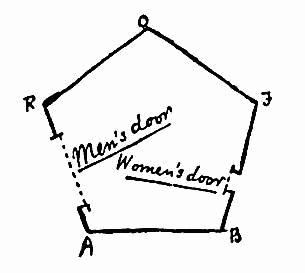
The most common form for the construction of a house is five-sided or pentagonal, as in the annexed figure. The two Northern sides RO, OF, constitute the roof, and for the most part have no doors; on the East is a small door for the Women; on the West a much larger one for the Men; the South side or floor is usually doorless.
The most common house shape is five-sided, or pentagonal, as shown in the accompanying figure. The two Northern sides, RO and OF, form the roof and usually have no doors. On the East is a small door for the Women. On the West is a much larger door for the Men. The South side, or floor, usually has no doors.
Square and triangular houses are not allowed, and for this reason. The angles of a Square (and still more those of an equilateral Triangle), being much more pointed than those of a Pentagon, and the lines of inanimate objects (such as houses) being dimmer than the lines of Men and Women, it follows that there is no little danger lest the points of a square or triangular house residence might do serious injury to an inconsiderate or perhaps absent-minded traveller suddenly therefore, running against them: and as early as the eleventh century of our era, triangular houses were universally forbidden by Law, the only exceptions being fortifications, powder-magazines, barracks, and other state buildings, which it is not desirable that the general public should approach without circumspection.
Square and triangular houses are not allowed, for the following reason. The corners of a Square are much sharper than those of a Pentagon. The corners of an equilateral Triangle are sharper still. Also, the outlines of lifeless objects (such as houses) are fainter than the outlines of Men and Women. So the corners of square or triangular houses pose a considerable danger. They might seriously injure a careless or perhaps absent-minded traveller who suddenly runs into them. For this reason, triangular houses were banned everywhere by law as early as the eleventh century of our era. The only exceptions were fortifications, gunpowder stores, barracks, and other state buildings. It is best that the general public approach such buildings with caution.
At this period, square houses were still everywhere permitted, though discouraged by a special tax. But, about three centuries afterwards, the Law decided that in all towns containing a population above ten thousand, the angle of a Pentagon was the smallest house-angle that could be allowed consistently with the public safety. The good sense of the community has seconded the efforts of the Legislature; and now, even in the country, the pentagonal construction has superseded every other. It is only now and then in some very remote and backward agricultural district that an antiquarian may still discover a square house.
At this time, square houses were still allowed everywhere, though a special tax discouraged their use. But about three centuries later, the Law set a new rule for all towns with more than ten thousand people. For public safety, no house could have a corner sharper than the angle of a Pentagon. The community’s good sense has supported the Legislature’s efforts. Now, even in the countryside, pentagonal houses have replaced every other kind. Only now and then, in some very remote and backward farming district, may a student of antiquities still discover a square house.