Chapter 12
Engaged to Be Married
Was the “poor Peter” of Cranford the Aga Jenkyns of Chunderabaddad, or was he not? As somebody says, that was the question.
Was Cranford’s “poor Peter” the same person as Aga Jenkyns of Chunderabaddad? As somebody says, that was the question.
In my own home, whenever people had nothing else to do, they blamed me for want of discretion. Indiscretion was my bug-bear fault. Everybody has a bug-bear fault, a sort of standing characteristic—a pièce de résistance for their friends to cut at; and in general they cut and come again. I was tired of being called indiscreet and incautious; and I determined for once to prove myself a model of prudence and wisdom. I would not even hint my suspicions respecting the Aga. I would collect evidence and carry it home to lay before my father, as the family friend of the two Miss Jenkynses.
At home, whenever people had nothing else to do, they blamed me for being indiscreet. Indiscretion was the fault they always picked on. Everybody has a fault like that, a defining trait that is a sort of pièce de résistance for their friends to carve up. And usually, the friends come back for more. I was tired of being called indiscreet and careless. So, for once, I decided to show how prudent and wise I could be. I would not even hint at my suspicions about the Aga. I would collect evidence and take it home to show my father, who was a family friend of the two Miss Jenkynses.
In my search after facts, I was often reminded of a description my father had once given of a ladies’ committee that he had had to preside over. He said he could not help thinking of a passage in Dickens, which spoke of a chorus in which every man took the tune he knew best, and sang it to his own satisfaction. So, at this charitable committee, every lady took the subject uppermost in her mind, and talked about it to her own great contentment, but not much to the advancement of the subject they had met to discuss. But even that committee could have been nothing to the Cranford ladies when I attempted to gain some clear and definite information as to poor Peter’s height, appearance, and when and where he was seen and heard of last. For instance, I remember asking Miss Pole (and I thought the question was very opportune, for I put it when I met her at a call at Mrs Forrester’s, and both the ladies had known Peter, and I imagined that they might refresh each other’s memories)—I asked Miss Pole what was the very last thing they had ever heard about him; and then she named the absurd report to which I have alluded, about his having been elected Great Lama of Thibet; and this was a signal for each lady to go off on her separate idea. Mrs Forrester’s start was made on the veiled prophet in Lalla Rookh—whether I thought he was meant for the Great Lama, though Peter was not so ugly, indeed rather handsome, if he had not been freckled. I was thankful to see her double upon Peter; but, in a moment, the delusive lady was off upon Rowland’s Kalydor, and the merits of cosmetics and hair oils in general, and holding forth so fluently that I turned to listen to Miss Pole, who (through the llamas, the beasts of burden) had got to Peruvian bonds, and the share market, and her poor opinion of joint-stock banks in general, and of that one in particular in which Miss Matty’s money was invested. In vain I put in “When was it—in what year was it that you heard that Mr Peter was the Great Lama?” They only joined issue to dispute whether llamas were carnivorous animals or not; in which dispute they were not quite on fair grounds, as Mrs Forrester (after they had grown warm and cool again) acknowledged that she always confused carnivorous and graminivorous together, just as she did horizontal and perpendicular; but then she apologised for it very prettily, by saying that in her day the only use people made of four-syllabled words was to teach how they should be spelt.
While searching for facts, I often remembered my father’s description of a ladies’ committee he had once chaired. He said it reminded him of a passage in Dickens. The passage described a chorus in which every man sang the tune he knew best, to his own satisfaction. At the charity committee, each lady talked about whatever was foremost in her mind. Each was greatly contented, but their talk did little to advance the matter they had met to discuss. But even that committee could have been nothing compared with the Cranford ladies. I tried to find clear, definite information about poor Peter’s height and appearance, and when and where he was last seen or heard of. For example, I remember asking Miss Pole what was the very last thing they had heard about him. I thought it was an excellent time to ask. I had met her while calling at Mrs Forrester’s, and both ladies had known Peter. I imagined they might help each other remember. Miss Pole mentioned the absurd report I have already referred to, that Peter had been elected Great Lama of Thibet. This was a signal for each lady to go off on her own train of thought. Mrs Forrester began with the veiled prophet in Lalla Rookh. She asked whether I thought he was meant to be the Great Lama. Peter, though, was not so ugly. Indeed, he would have been rather handsome if he had not been freckled. I was thankful to see her return to Peter. But in a moment, the unreliable lady was off again, talking about Rowland’s Kalydor and the merits of cosmetics and hair oils in general. She talked so fluently that I turned to listen to Miss Pole. By way of llamas, the beasts of burden, Miss Pole had reached Peruvian bonds and the share market. She was also talking about her poor opinion of joint-stock banks in general, and especially the one where Miss Matty’s money was invested. In vain I interrupted, “When was it, in what year was it that you heard that Mr Peter was the Great Lama?” The ladies only came together to dispute whether llamas were carnivorous animals. They were not quite on equal terms in the dispute. After they had grown heated and then cooled down again, Mrs Forrester admitted that she always confused carnivorous and graminivorous, or meat-eating and grass-eating. She confused them just as she did horizontal and perpendicular. But she apologized very prettily, saying that in her day, the only use people made of four-syllable words was to teach how they should be spelled.
The only fact I gained from this conversation was that certainly Peter had last been heard of in India, “or that neighbourhood”; and that this scanty intelligence of his whereabouts had reached Cranford in the year when Miss Pole had bought her Indian muslin gown, long since worn out (we washed it and mended it, and traced its decline and fall into a window-blind before we could go on); and in a year when Wombwell came to Cranford, because Miss Matty had wanted to see an elephant in order that she might the better imagine Peter riding on one; and had seen a boa-constrictor too, which was more than she wished to imagine in her fancy-pictures of Peter’s locality; and in a year when Miss Jenkyns had learnt some piece of poetry off by heart, and used to say, at all the Cranford parties, how Peter was “surveying mankind from China to Peru,” which everybody had thought very grand, and rather appropriate, because India was between China and Peru, if you took care to turn the globe to the left instead of the right.
The only fact I learned from this conversation was that Peter had certainly last been heard of in India, “or that neighbourhood.” This small piece of news about his whereabouts had reached Cranford in the year Miss Pole bought her Indian muslin gown. The gown had long since worn out. (Before we could go on, we washed and mended the gown and traced its decline and fall into a window blind.) It was also the year Wombwell came to Cranford. We knew this because Miss Matty had wanted to see an elephant, so that she could better imagine Peter riding one. She had also seen a boa constrictor. That was more than she wished to picture when imagining Peter’s surroundings. It was also the year Miss Jenkyns had learned a poem by heart. At all the Cranford parties, she used to say that Peter was “surveying mankind from China to Peru.” Everyone had thought this very grand and rather appropriate. After all, India lay between China and Peru, if you took care to turn the globe to the left instead of the right.
I suppose all these inquiries of mine, and the consequent curiosity excited in the minds of my friends, made us blind and deaf to what was going on around us. It seemed to me as if the sun rose and shone, and as if the rain rained on Cranford, just as usual, and I did not notice any sign of the times that could be considered as a prognostic of any uncommon event; and, to the best of my belief, not only Miss Matty and Mrs Forrester, but even Miss Pole herself, whom we looked upon as a kind of prophetess, from the knack she had of foreseeing things before they came to pass—although she did not like to disturb her friends by telling them her foreknowledge—even Miss Pole herself was breathless with astonishment when she came to tell us of the astounding piece of news. But I must recover myself; the contemplation of it, even at this distance of time, has taken away my breath and my grammar, and unless I subdue my emotion, my spelling will go too.
I suppose all my questions, and the curiosity they stirred in my friends, made us blind and deaf to our surroundings. The sun seemed to rise and shine, and the rain seemed to fall on Cranford, just as usual. I noticed no sign that could have foretold anything unusual. As far as I know, Miss Matty and Mrs Forrester were astonished by the news. Even Miss Pole herself was breathless with astonishment when she came to tell us. We regarded Miss Pole as a kind of prophetess because she had a knack for foreseeing things before they happened. Although she did not like to disturb her friends by telling them what she knew in advance, even she was astonished by the news. But I must recover myself. Even after all this time, thinking about the news has taken away my breath and my grammar. Unless I calm myself, my spelling will go too.
We were sitting—Miss Matty and I—much as usual, she in the blue chintz easy-chair, with her back to the light, and her knitting in her hand, I reading aloud the St James’s Chronicle. A few minutes more, and we should have gone to make the little alterations in dress usual before calling-time (twelve o’clock) in Cranford. I remember the scene and the date well. We had been talking of the signor’s rapid recovery since the warmer weather had set in, and praising Mr Hoggins’s skill, and lamenting his want of refinement and manner (it seems a curious coincidence that this should have been our subject, but so it was), when a knock was heard—a caller’s knock—three distinct taps—and we were flying (that is to say, Miss Matty could not walk very fast, having had a touch of rheumatism) to our rooms, to change cap and collars, when Miss Pole arrested us by calling out, as she came up the stairs, “Don’t go—I can’t wait—it is not twelve, I know—but never mind your dress—I must speak to you.” We did our best to look as if it was not we who had made the hurried movement, the sound of which she had heard; for, of course, we did not like to have it supposed that we had any old clothes that it was convenient to wear out in the “sanctuary of home,” as Miss Jenkyns once prettily called the back parlour, where she was tying up preserves. So we threw our gentility with double force into our manners, and very genteel we were for two minutes while Miss Pole recovered breath, and excited our curiosity strongly by lifting up her hands in amazement, and bringing them down in silence, as if what she had to say was too big for words, and could only be expressed by pantomime.
Miss Matty and I were sitting as we usually did. She was in the blue chintz armchair, with her back to the light and her knitting in her hand. I was reading the St James’s Chronicle aloud. In a few minutes, we would have gone to make the small changes to our clothes customary before calling time in Cranford, at twelve o’clock. I remember the scene and the date well. We had been talking about the signor’s rapid recovery since the warmer weather began. We had been praising Mr Hoggins’s skill and regretting his lack of refinement and manners. It seems a curious coincidence that we should have been discussing him, but we were. Then we heard a knock, a caller’s knock, three distinct taps. We hurried to our rooms to change our caps and collars. That is to say, Miss Matty could not walk very fast, having had a touch of rheumatism. But Miss Pole stopped us by calling out as she came up the stairs, “Don’t go. I can’t wait. I know it isn’t twelve, but never mind your clothes. I must speak to you.” We did our best to look as if we had not made the hurried movement she had heard. Of course, we did not want her to think we had old clothes that were convenient to wear out at home. Miss Jenkyns had once charmingly called the back parlour the “sanctuary of home,” while she was tying up jars of preserves there. So we put twice as much gentility into our manners. We were very genteel for two minutes while Miss Pole caught her breath. She made us very curious by raising her hands in amazement, then lowering them without a word. It was as if what she had to say was too enormous for words and could only be expressed in gestures.
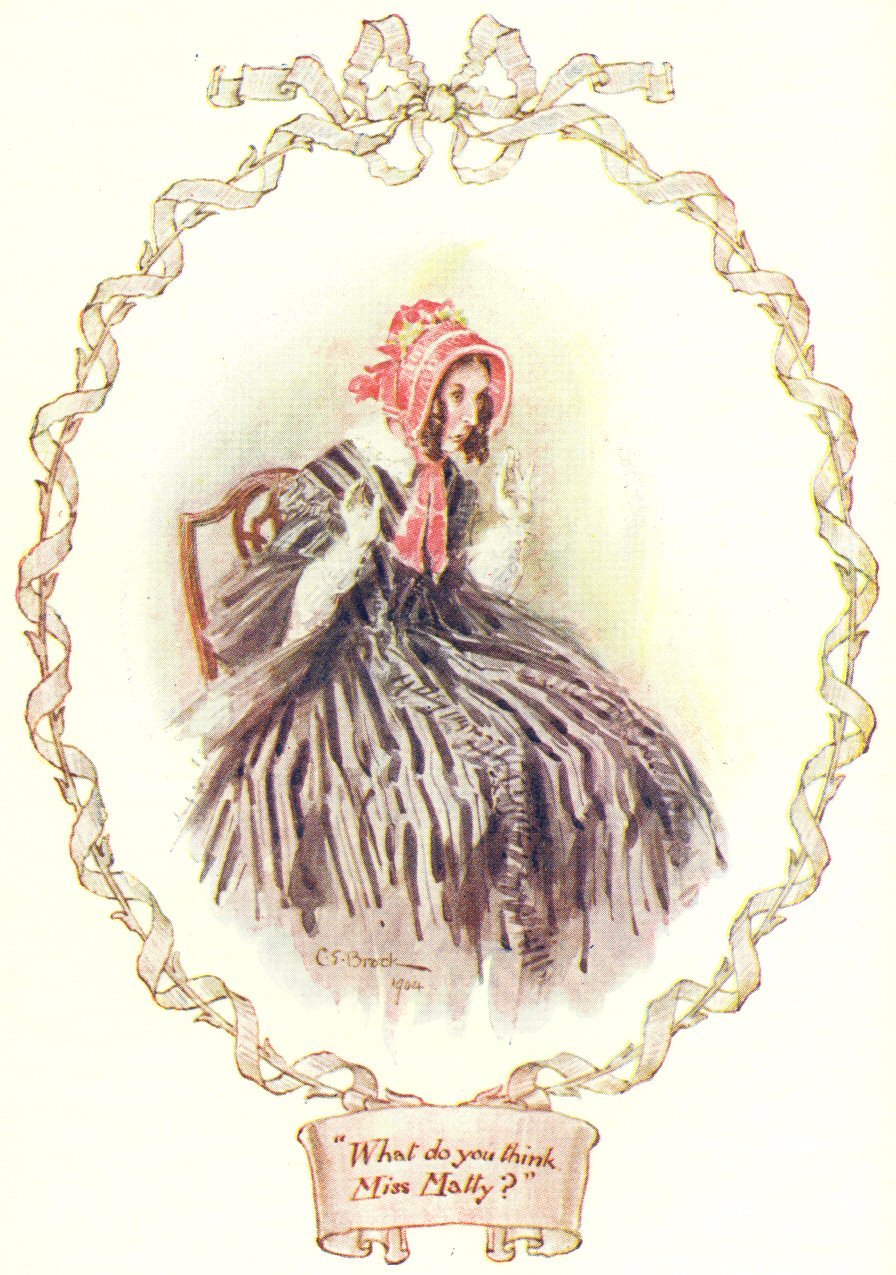
“What do you think, Miss Matty? What do you think? Lady Glenmire is to marry—is to be married, I mean—Lady Glenmire—Mr Hoggins—Mr Hoggins is going to marry Lady Glenmire!”
“What do you think, Miss Matty? What do you think? Lady Glenmire is going to marry. I mean, she is going to be married. Lady Glenmire, Mr Hoggins, Mr Hoggins is going to marry Lady Glenmire!”
“Marry!” said we. “Marry! Madness!”
“Marry!” we said. “Marry! That's madness!”
“Marry!” said Miss Pole, with the decision that belonged to her character. “I said marry! as you do; and I also said, ‘What a fool my lady is going to make of herself!’ I could have said ‘Madness!’ but I controlled myself, for it was in a public shop that I heard of it. Where feminine delicacy is gone to, I don’t know! You and I, Miss Matty, would have been ashamed to have known that our marriage was spoken of in a grocer’s shop, in the hearing of shopmen!”
“Marry!” said Miss Pole, in her usual decisive way. “I said marry! just as you did. I also said, ‘What a fool my lady is going to make of herself!’ I could have said ‘Madness!’ but I held back because I heard the news in a public shop. I don’t know what has happened to feminine modesty! You and I, Miss Matty, would have been ashamed to know our marriage was being discussed in a grocer’s shop, within hearing of the shop assistants!”
“But,” said Miss Matty, sighing as one recovering from a blow, “perhaps it is not true. Perhaps we are doing her injustice.”
“But,” said Miss Matty, sighing as if recovering from a blow, “perhaps it isn’t true. Perhaps we are being unfair to her.”
“No,” said Miss Pole. “I have taken care to ascertain that. I went straight to Mrs Fitz-Adam, to borrow a cookery-book which I knew she had; and I introduced my congratulations à propos of the difficulty gentlemen must have in house-keeping; and Mrs Fitz-Adam bridled up, and said that she believed it was true, though how and where I could have heard it she did not know. She said her brother and Lady Glenmire had come to an understanding at last. ‘Understanding!’ such a coarse word! But my lady will have to come down to many a want of refinement. I have reason to believe Mr Hoggins sups on bread-and-cheese and beer every night.
“No,” said Miss Pole. “I made sure of that. I went straight to Mrs Fitz-Adam to borrow a cookbook I knew she had. I brought up my congratulations in connection with how difficult housekeeping must be for gentlemen. Mrs Fitz-Adam drew herself up and said she believed it was true. But she did not know how or where I could have heard it. She said her brother and Lady Glenmire had finally come to an understanding. ‘Understanding!’ Such a coarse word! But my lady will have to put up with many things that lack refinement. I have reason to believe Mr Hoggins has bread and cheese and beer for supper every night.
“Marry!” said Miss Matty once again. “Well! I never thought of it. Two people that we know going to be married. It’s coming very near!”
“Married!” said Miss Matty again. “Well! I never thought of it. Two people we know are going to get married. It’s coming very close to home!”
“So near that my heart stopped beating when I heard of it, while you might have counted twelve,” said Miss Pole.
“So near that, when I heard about it, my heart stopped beating for a count of twelve,” said Miss Pole.
“One does not know whose turn may come next. Here, in Cranford, poor Lady Glenmire might have thought herself safe,” said Miss Matty, with a gentle pity in her tones.
“No one knows whose turn may come next. Here in Cranford, poor Lady Glenmire might have thought she was safe,” said Miss Matty, her voice full of gentle pity.
“Bah!” said Miss Pole, with a toss of her head. “Don’t you remember poor dear Captain Brown’s song ‘Tibbie Fowler,’ and the line—
“Bah!” said Miss Pole, tossing her head. “Don’t you remember poor dear Captain Brown’s song ‘Tibbie Fowler,’ and the line:
‘Set her on the Tintock tap, The wind will blaw a man till her.’”
‘Set her on top of Tintock, The wind will blow a man to her.’”
“That was because ‘Tibbie Fowler’ was rich, I think.”
“I think that was because ‘Tibbie Fowler’ was rich.”
“Well! there was a kind of attraction about Lady Glenmire that I, for one, should be ashamed to have.”
“Well! Lady Glenmire had a kind of appeal that I, for one, would be ashamed to have.”
I put in my wonder. “But how can she have fancied Mr Hoggins? I am not surprised that Mr Hoggins has liked her.”
I expressed my surprise. “But how could she have been attracted to Mr Hoggins? I’m not surprised that Mr Hoggins liked her.”
“Oh! I don’t know. Mr Hoggins is rich, and very pleasant-looking,” said Miss Matty, “and very good-tempered and kind-hearted.”
“Oh! I don’t know. Mr Hoggins is rich and very pleasant-looking,” said Miss Matty, “and he is very good-natured and kind.”
“She has married for an establishment, that’s it. I suppose she takes the surgery with it,” said Miss Pole, with a little dry laugh at her own joke. But, like many people who think they have made a severe and sarcastic speech, which yet is clever of its kind, she began to relax in her grimness from the moment when she made this allusion to the surgery; and we turned to speculate on the way in which Mrs Jamieson would receive the news. The person whom she had left in charge of her house to keep off followers from her maids to set up a follower of her own! And that follower a man whom Mrs Jamieson had tabooed as vulgar, and inadmissible to Cranford society, not merely on account of his name, but because of his voice, his complexion, his boots, smelling of the stable, and himself, smelling of drugs. Had he ever been to see Lady Glenmire at Mrs Jamieson’s? Chloride of lime would not purify the house in its owner’s estimation if he had. Or had their interviews been confined to the occasional meetings in the chamber of the poor sick conjuror, to whom, with all our sense of the mésalliance, we could not help allowing that they had both been exceedingly kind? And now it turned out that a servant of Mrs Jamieson’s had been ill, and Mr Hoggins had been attending her for some weeks. So the wolf had got into the fold, and now he was carrying off the shepherdess. What would Mrs Jamieson say? We looked into the darkness of futurity as a child gazes after a rocket up in the cloudy sky, full of wondering expectation of the rattle, the discharge, and the brilliant shower of sparks and light. Then we brought ourselves down to earth and the present time by questioning each other (being all equally ignorant, and all equally without the slightest data to build any conclusions upon) as to when IT would take place? Where? How much a year Mr Hoggins had? Whether she would drop her title? And how Martha and the other correct servants in Cranford would ever be brought to announce a married couple as Lady Glenmire and Mr Hoggins? But would they be visited? Would Mrs Jamieson let us? Or must we choose between the Honourable Mrs Jamieson and the degraded Lady Glenmire? We all liked Lady Glenmire the best. She was bright, and kind, and sociable, and agreeable; and Mrs Jamieson was dull, and inert, and pompous, and tiresome. But we had acknowledged the sway of the latter so long, that it seemed like a kind of disloyalty now even to meditate disobedience to the prohibition we anticipated.
“She has married for a comfortable home, that’s it. I suppose she gets the surgery with it,” said Miss Pole, giving a little dry laugh at her own joke. Like many people who believe they have made a harsh, sarcastic remark that is clever in its way, she began to soften as soon as she mentioned the surgery. We then began to wonder how Mrs Jamieson would receive the news. She had left Lady Glenmire in charge of her house to keep the maids’ suitors away. And now Lady Glenmire had found a suitor of her own! He was a man Mrs Jamieson had banned from Cranford society as vulgar and unacceptable. It was not merely because of his name, but because of his voice, his complexion, his boots, which smelled of the stable, and the man himself, who smelled of drugs. Had he ever visited Lady Glenmire at Mrs Jamieson’s house? If he had, Mrs Jamieson would think that not even chloride of lime could purify the house. Or had they met only occasionally in the room of the poor sick conjuror? Despite our sense of the mésalliance, we had to admit that they had both been exceedingly kind to him. And now it turned out that a servant of Mrs Jamieson’s had been ill, and Mr Hoggins had been treating her for some weeks. So the wolf had got into the fold, and now he was carrying off the shepherdess. What would Mrs Jamieson say? We looked into the dark future like a child watching a rocket rise into the cloudy sky. We waited, full of wonder, for the rattle, the explosion, and the brilliant shower of sparks and light. Then we brought ourselves back to earth and the present. We asked each other when IT would take place. Where would it happen? How much a year did Mr Hoggins have? Would she give up her title? And how would Martha and the other proper servants in Cranford ever manage to announce a married couple as Lady Glenmire and Mr Hoggins? We were all equally ignorant, and none of us had the slightest information on which to base an answer. But would people visit the couple? Would Mrs Jamieson let us? Or must we choose between the Honourable Mrs Jamieson and the disgraced Lady Glenmire? We all liked Lady Glenmire best. She was bright, kind, sociable, and pleasant. Mrs Jamieson was dull, inactive, pompous, and tiresome. But we had accepted Mrs Jamieson’s authority for so long that it seemed almost disloyal even to consider disobeying the ban we expected her to impose.
Mrs Forrester surprised us in our darned caps and patched collars; and we forgot all about them in our eagerness to see how she would bear the information, which we honourably left to Miss Pole, to impart, although, if we had been inclined to take unfair advantage, we might have rushed in ourselves, for she had a most out-of-place fit of coughing for five minutes after Mrs Forrester entered the room. I shall never forget the imploring expression of her eyes, as she looked at us over her pocket-handkerchief. They said, as plain as words could speak, “Don’t let Nature deprive me of the treasure which is mine, although for a time I can make no use of it.” And we did not.
Mrs Forrester caught us wearing our darned caps and patched collars. But we forgot all about them in our eagerness to see how she would react to the news. We honorably left it to Miss Pole to tell her. We might have rushed in and told her ourselves, if we had wanted to take unfair advantage. Miss Pole had a terribly ill-timed coughing fit that lasted five minutes after Mrs Forrester entered the room. I shall never forget the pleading look in her eyes as she looked at us over her handkerchief. Her eyes said as plainly as words, “Don’t let Nature rob me of the treasure that is mine, although I can’t make use of it for the moment.” And we didn’t.
Mrs Forrester’s surprise was equal to ours; and her sense of injury rather greater, because she had to feel for her Order, and saw more fully than we could do how such conduct brought stains on the aristocracy.
Mrs Forrester was as surprised as we were, and she felt rather more offended. This was because she felt for her own class. She also saw more clearly than we did how such conduct brought disgrace on the aristocracy.
When she and Miss Pole left us we endeavoured to subside into calmness; but Miss Matty was really upset by the intelligence she had heard. She reckoned it up, and it was more than fifteen years since she had heard of any of her acquaintance going to be married, with the one exception of Miss Jessie Brown; and, as she said, it gave her quite a shock, and made her feel as if she could not think what would happen next.
When she and Miss Pole left us, we tried to calm down. But Miss Matty was truly upset by the news she had heard. She counted the years since she had last heard of anyone she knew planning to marry. Except for Miss Jessie Brown, it had been more than fifteen years. As she said, the news gave her quite a shock. It made her feel as if she could not imagine what might happen next.
I don’t know whether it is a fancy of mine, or a real fact, but I have noticed that, just after the announcement of an engagement in any set, the unmarried ladies in that set flutter out in an unusual gaiety and newness of dress, as much as to say, in a tacit and unconscious manner, “We also are spinsters.” Miss Matty and Miss Pole talked and thought more about bonnets, gowns, caps, and shawls, during the fortnight that succeeded this call, than I had known them do for years before. But it might be the spring weather, for it was a warm and pleasant March; and merinoes and beavers, and woollen materials of all sorts were but ungracious receptacles of the bright sun’s glancing rays. It had not been Lady Glenmire’s dress that had won Mr Hoggins’s heart, for she went about on her errands of kindness more shabby than ever. Although in the hurried glimpses I caught of her at church or elsewhere she appeared rather to shun meeting any of her friends, her face seemed to have almost something of the flush of youth in it; her lips looked redder and more trembling full than in their old compressed state, and her eyes dwelt on all things with a lingering light, as if she was learning to love Cranford and its belongings. Mr Hoggins looked broad and radiant, and creaked up the middle aisle at church in a brand-new pair of top-boots—an audible, as well as visible, sign of his purposed change of state; for the tradition went, that the boots he had worn till now were the identical pair in which he first set out on his rounds in Cranford twenty-five years ago; only they had been new-pieced, high and low, top and bottom, heel and sole, black leather and brown leather, more times than any one could tell.
I don’t know whether I’m imagining it or whether it’s really true, but I’ve noticed something about engagements. Just after one is announced in any social circle, the unmarried ladies appear in unusually cheerful new clothes. It is as if they were saying, without meaning to or even knowing it, “We also are unmarried.” In the two weeks after this visit, Miss Matty and Miss Pole talked and thought more about clothes than I had known them to do for years. They discussed bonnets, gowns, caps, and shawls. But perhaps it was the spring weather. March was warm and pleasant, and merino wool, beaver-felt hats, and woolen materials of all kinds were hardly a fitting way to receive the bright rays of the sun. Lady Glenmire’s clothes had not won Mr Hoggins’s heart. She went about doing kind things in shabbier clothes than ever. I caught only hurried glimpses of her at church or elsewhere, and she seemed to avoid meeting her friends. Even so, her face seemed to have almost regained the glow of youth. Her lips looked redder and fuller, and they trembled, instead of being pressed together as before. Her eyes rested on everything with a lingering light, as if she were learning to love Cranford and everything in it. Mr Hoggins looked broad and radiant. At church, he creaked up the middle aisle in a brand-new pair of tall boots. His boots were a sign of his intended change of status, one that could be heard as well as seen. According to local tradition, his old boots were the very pair he had worn when he first began making his rounds in Cranford twenty-five years before. But they had been patched everywhere, high and low, top and bottom, heel and sole, in black leather and brown leather. No one could say how many times.
None of the ladies in Cranford chose to sanction the marriage by congratulating either of the parties. We wished to ignore the whole affair until our liege lady, Mrs Jamieson, returned. Till she came back to give us our cue, we felt that it would be better to consider the engagement in the same light as the Queen of Spain’s legs—facts which certainly existed, but the less said about the better. This restraint upon our tongues—for you see if we did not speak about it to any of the parties concerned, how could we get answers to the questions that we longed to ask?—was beginning to be irksome, and our idea of the dignity of silence was paling before our curiosity, when another direction was given to our thoughts, by an announcement on the part of the principal shopkeeper of Cranford, who ranged the trades from grocer and cheesemonger to man-milliner, as occasion required, that the spring fashions were arrived, and would be exhibited on the following Tuesday at his rooms in High Street. Now Miss Matty had been only waiting for this before buying herself a new silk gown. I had offered, it is true, to send to Drumble for patterns, but she had rejected my proposal, gently implying that she had not forgotten her disappointment about the sea-green turban. I was thankful that I was on the spot now, to counteract the dazzling fascination of any yellow or scarlet silk.
None of the ladies in Cranford chose to approve the marriage by congratulating either of the people involved. We wished to ignore the whole affair until our liege lady, Mrs Jamieson, returned. Until she came back to guide us, we felt it best to treat the engagement like the Queen of Spain’s legs. Both certainly existed, but the less said about them, the better. Holding our tongues was beginning to feel tiresome. After all, if we did not speak about the engagement to either person concerned, how could we get answers to the questions we longed to ask? Our sense that silence was dignified was beginning to fade before our curiosity. Then our thoughts were turned in another direction. Cranford’s principal shopkeeper announced that the spring fashions had arrived. They would be displayed the following Tuesday in his rooms on High Street. His business ranged from groceries and cheese to ladies’ hats, as the occasion required. Miss Matty had been waiting for the new fashions before buying herself a silk gown. I had indeed offered to send to Drumble for samples, but she had turned down my proposal. She gently suggested that she had not forgotten her disappointment over the sea-green turban. I was thankful to be there now, ready to counter the dazzling attraction of any yellow or scarlet silk.
I must say a word or two here about myself. I have spoken of my father’s old friendship for the Jenkyns family; indeed, I am not sure if there was not some distant relationship. He had willingly allowed me to remain all the winter at Cranford, in consideration of a letter which Miss Matty had written to him about the time of the panic, in which I suspect she had exaggerated my powers and my bravery as a defender of the house. But now that the days were longer and more cheerful, he was beginning to urge the necessity of my return; and I only delayed in a sort of odd forlorn hope that if I could obtain any clear information, I might make the account given by the signora of the Aga Jenkyns tally with that of “poor Peter,” his appearance and disappearance, which I had winnowed out of the conversation of Miss Pole and Mrs Forrester.
I must say a word or two about myself here. I have mentioned my father’s old friendship with the Jenkyns family. In fact, I am not sure that we were not distantly related. He had willingly allowed me to stay at Cranford all winter because of a letter Miss Matty had written to him around the time of the panic. I suspect she had exaggerated my abilities and my bravery in defending the house. But now that the days were longer and brighter, he was beginning to urge me to return. I delayed only because of a strange, faint hope. If I could get some clear information, I might be able to match the signora’s account of the Aga Jenkyns with what I had gathered about “poor Peter,” his appearance and disappearance, from Miss Pole and Mrs Forrester’s conversation.