Chapter 10
The Panic
I think a series of circumstances dated from Signor Brunoni’s visit to Cranford, which seemed at the time connected in our minds with him, though I don’t know that he had anything really to do with them. All at once all sorts of uncomfortable rumours got afloat in the town. There were one or two robberies—real bonâ fide robberies; men had up before the magistrates and committed for trial—and that seemed to make us all afraid of being robbed; and for a long time, at Miss Matty’s, I know, we used to make a regular expedition all round the kitchens and cellars every night, Miss Matty leading the way, armed with the poker, I following with the hearth-brush, and Martha carrying the shovel and fire-irons with which to sound the alarm; and by the accidental hitting together of them she often frightened us so much that we bolted ourselves up, all three together, in the back-kitchen, or store-room, or wherever we happened to be, till, when our affright was over, we recollected ourselves and set out afresh with double valiance. By day we heard strange stories from the shopkeepers and cottagers, of carts that went about in the dead of night, drawn by horses shod with felt, and guarded by men in dark clothes, going round the town, no doubt in search of some unwatched house or some unfastened door.
I think a series of events began with Signor Brunoni’s visit to Cranford. At the time, we all seemed to connect these events with him, though I don’t know that he had anything to do with them. All at once, all sorts of worrying rumours spread through the town. There were one or two robberies, real genuine robberies. Men were brought before the magistrates and sent for trial. That seemed to make us all afraid of being robbed. For a long time at Miss Matty’s, I remember, we made a regular expedition around the kitchens and cellars every night. Miss Matty led the way, armed with the poker, and I followed with the hearth brush. Martha carried the shovel and fire irons to sound the alarm. She often knocked them together by accident and frightened us so much that all three of us locked ourselves in together. We would bolt ourselves into the back kitchen, the storeroom, or wherever we happened to be. Then, when our fright had passed, we would pull ourselves together and set out again with twice the courage. During the day, we heard strange stories from the shopkeepers and cottagers. They told us of carts travelling around town in the dead of night, drawn by horses with felt over their shoes. Men in dark clothes guarded the carts. No doubt they were looking for an unwatched house or an unlocked door.
Miss Pole, who affected great bravery herself, was the principal person to collect and arrange these reports so as to make them assume their most fearful aspect. But we discovered that she had begged one of Mr Hoggins’s worn-out hats to hang up in her lobby, and we (at least I) had doubts as to whether she really would enjoy the little adventure of having her house broken into, as she protested she should. Miss Matty made no secret of being an arrant coward, but she went regularly through her housekeeper’s duty of inspection—only the hour for this became earlier and earlier, till at last we went the rounds at half-past six, and Miss Matty adjourned to bed soon after seven, “in order to get the night over the sooner.”
Miss Pole pretended to be very brave. She was the main person who collected and arranged these reports to make them sound as frightening as possible. But we discovered that she had begged for one of Mr Hoggins’s worn-out hats to hang in her hallway. And we had doubts about whether she would really enjoy the little adventure of having her house broken into, as she insisted she would. At least, I had doubts. Miss Matty made no secret of being a complete coward. But she regularly performed her duty as housekeeper by inspecting the house. She simply began her inspection earlier and earlier. At last, we made the rounds at half past six, and Miss Matty went to bed soon after seven, “in order to get the night over the sooner.”
Cranford had so long piqued itself on being an honest and moral town that it had grown to fancy itself too genteel and well-bred to be otherwise, and felt the stain upon its character at this time doubly. But we comforted ourselves with the assurance which we gave to each other that the robberies could never have been committed by any Cranford person; it must have been a stranger or strangers who brought this disgrace upon the town, and occasioned as many precautions as if we were living among the Red Indians or the French.
Cranford had long prided itself on being an honest and moral town. It had come to think itself too genteel and well-bred to be anything else. So the stain on its reputation was doubly painful. But we comforted one another with the assurance that no Cranford person could have committed the robberies. A stranger or strangers must have brought this disgrace upon the town. The robberies led us to take as many precautions as if we were living among the Red Indians or the French.
This last comparison of our nightly state of defence and fortification was made by Mrs Forrester, whose father had served under General Burgoyne in the American war, and whose husband had fought the French in Spain. She indeed inclined to the idea that, in some way, the French were connected with the small thefts, which were ascertained facts, and the burglaries and highway robberies, which were rumours. She had been deeply impressed with the idea of French spies at some time in her life; and the notion could never be fairly eradicated, but sprang up again from time to time. And now her theory was this:—The Cranford people respected themselves too much, and were too grateful to the aristocracy who were so kind as to live near the town, ever to disgrace their bringing up by being dishonest or immoral; therefore, we must believe that the robbers were strangers—if strangers, why not foreigners?—if foreigners, who so likely as the French? Signor Brunoni spoke broken English like a Frenchman; and, though he wore a turban like a Turk, Mrs Forrester had seen a print of Madame de Staël with a turban on, and another of Mr Denon in just such a dress as that in which the conjuror had made his appearance, showing clearly that the French, as well as the Turks, wore turbans. There could be no doubt Signor Brunoni was a Frenchman—a French spy come to discover the weak and undefended places of England, and doubtless he had his accomplices. For her part, she, Mrs Forrester, had always had her own opinion of Miss Pole’s adventure at the “George Inn”—seeing two men where only one was believed to be. French people had ways and means which, she was thankful to say, the English knew nothing about; and she had never felt quite easy in her mind about going to see that conjuror—it was rather too much like a forbidden thing, though the rector was there. In short, Mrs Forrester grew more excited than we had ever known her before, and, being an officer’s daughter and widow, we looked up to her opinion, of course.
Mrs Forrester made this last comparison of our nightly preparations for defense to military fortifications. Her father had served under General Burgoyne in the American war, and her husband had fought the French in Spain. She was inclined to think that the French were somehow connected with the small thefts, which were known facts, and the burglaries and highway robberies, which were rumors. At some point in her life, she had become deeply convinced that French spies were about. The idea could never quite be rooted out and came back from time to time. Now her theory was this: The people of Cranford respected themselves too much to be dishonest or immoral. They were also too grateful to the aristocracy, who were kind enough to live near the town, ever to disgrace their upbringing in that way. Therefore, we had to believe the robbers were strangers. If they were strangers, why not foreigners? And if they were foreigners, who was more likely than the French? Signor Brunoni spoke broken English like a Frenchman. He wore a turban like a Turk, but Mrs Forrester had seen a print of Madame de Staël wearing a turban. She had also seen a print of Mr Denon dressed just as the conjuror had been when he appeared. Clearly, the French wore turbans as well as the Turks. There could be no doubt that Signor Brunoni was a Frenchman, a French spy who had come to discover England’s weak and undefended places. And doubtless he had accomplices. For her part, Mrs Forrester had always had her own opinion of Miss Pole’s adventure at the “George Inn”. Miss Pole had seen two men where only one was believed to be. French people had ways and means that the English, she was thankful to say, knew nothing about. She had never felt quite easy about going to see that conjuror. It was rather too much like doing something forbidden, even though the rector was there. In short, Mrs Forrester grew more excited than we had ever known her to be. And, as she was an officer’s daughter and widow, we naturally respected her opinion.
Really I do not know how much was true or false in the reports which flew about like wildfire just at this time; but it seemed to me then that there was every reason to believe that at Mardon (a small town about eight miles from Cranford) houses and shops were entered by holes made in the walls, the bricks being silently carried away in the dead of the night, and all done so quietly that no sound was heard either in or out of the house. Miss Matty gave it up in despair when she heard of this. “What was the use,” said she, “of locks and bolts, and bells to the windows, and going round the house every night? That last trick was fit for a conjuror. Now she did believe that Signor Brunoni was at the bottom of it.”
I really do not know how much truth there was in the reports spreading like wildfire just then. But at the time, it seemed to me there was every reason to believe them. In Mardon, a small town about eight miles from Cranford, houses and shops were reportedly being entered through holes in the walls. The bricks were silently carried away in the dead of night. It was all done so quietly that no sound was heard inside or outside the buildings. Miss Matty gave up in despair when she heard this. “What was the use,” she said, “of locks and bolts, bells on the windows, and checking the house every night? That last trick was worthy of a magician. Now I do believe Signor Brunoni is behind it.”
One afternoon, about five o’clock, we were startled by a hasty knock at the door. Miss Matty bade me run and tell Martha on no account to open the door till she (Miss Matty) had reconnoitred through the window; and she armed herself with a footstool to drop down on the head of the visitor, in case he should show a face covered with black crape, as he looked up in answer to her inquiry of who was there. But it was nobody but Miss Pole and Betty. The former came upstairs, carrying a little hand-basket, and she was evidently in a state of great agitation.
One afternoon, at about five o’clock, a hurried knock at the door startled us. Miss Matty told me to run and tell Martha not to open the door under any circumstances. Miss Matty wanted to look through the window first. She armed herself with a footstool and asked who was there. If the visitor looked up and showed a face covered with black crape, she would drop the footstool on his head. But it was only Miss Pole and Betty. Miss Pole came upstairs carrying a small handbasket, and she was clearly very upset.
“Take care of that!” said she to me, as I offered to relieve her of her basket. “It’s my plate. I am sure there is a plan to rob my house to-night. I am come to throw myself on your hospitality, Miss Matty. Betty is going to sleep with her cousin at the ‘George.’ I can sit up here all night if you will allow me; but my house is so far from any neighbours, and I don’t believe we could be heard if we screamed ever so!”
“Be careful with that!” she said as I offered to carry her basket. “It’s my silver. I’m sure someone is planning to rob my house tonight. I’ve come to ask for your hospitality, Miss Matty. Betty is going to sleep at her cousin’s at the ‘George.’ I can sit up here all night if you’ll let me. But my house is so far from any neighbors, and I don’t believe anyone could hear us, however loudly we screamed!”
“But,” said Miss Matty, “what has alarmed you so much? Have you seen any men lurking about the house?”
“But,” said Miss Matty, “what has frightened you so much? Have you seen any men hiding around the house?”
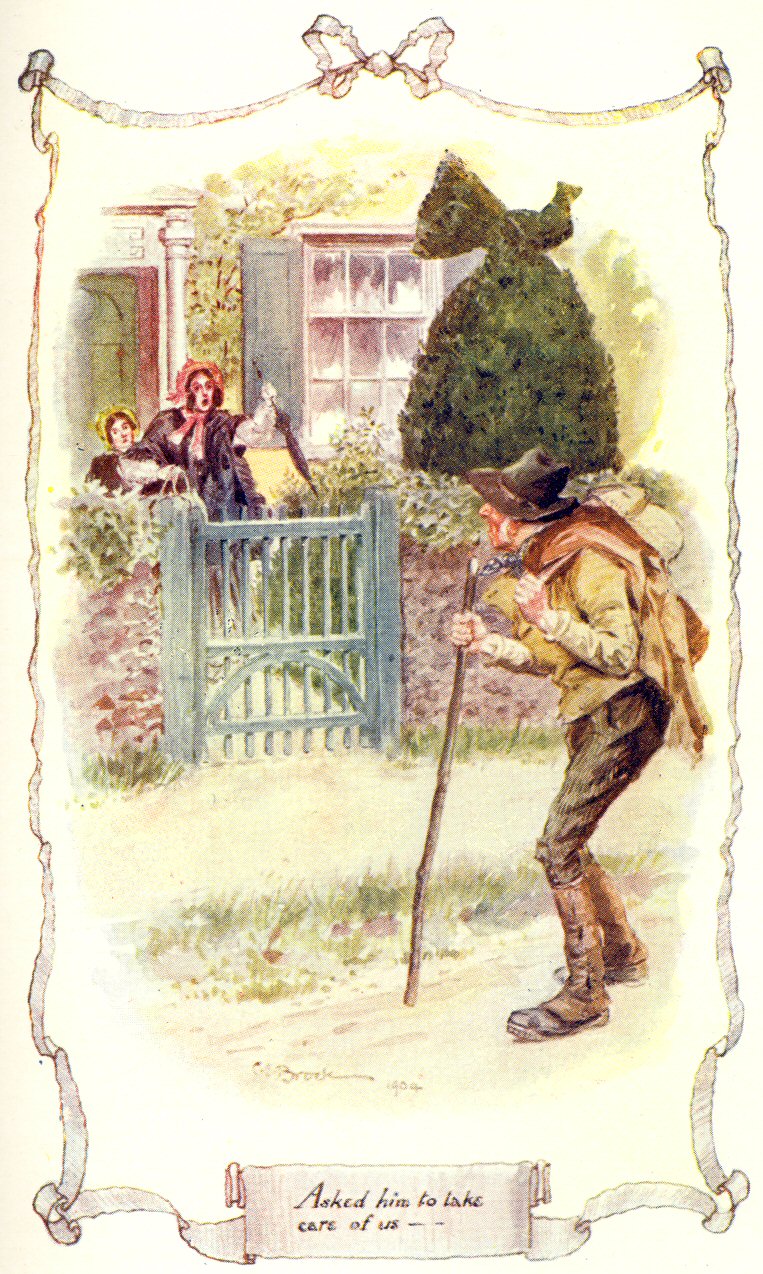
“Oh, yes!” answered Miss Pole. “Two very bad-looking men have gone three times past the house, very slowly; and an Irish beggar-woman came not half-an-hour ago, and all but forced herself in past Betty, saying her children were starving, and she must speak to the mistress. You see, she said ‘mistress,’ though there was a hat hanging up in the hall, and it would have been more natural to have said ‘master.’ But Betty shut the door in her face, and came up to me, and we got the spoons together, and sat in the parlour-window watching till we saw Thomas Jones going from his work, when we called to him and asked him to take care of us into the town.”
“Oh, yes!” answered Miss Pole. “Two very suspicious-looking men have walked slowly past the house three times. And less than half an hour ago, an Irish beggar woman came and almost forced her way past Betty. She said her children were starving and she had to speak to the mistress. You see, she said ‘mistress,’ though a hat was hanging in the hall. It would have been more natural to say ‘master.’ But Betty shut the door in her face and came upstairs to me. We gathered the spoons together and sat at the parlor window, watching. When we saw Thomas Jones leaving work, we called to him and asked him to escort us safely into town.”
We might have triumphed over Miss Pole, who had professed such bravery until she was frightened; but we were too glad to perceive that she shared in the weaknesses of humanity to exult over her; and I gave up my room to her very willingly, and shared Miss Matty’s bed for the night. But before we retired, the two ladies rummaged up, out of the recesses of their memory, such horrid stories of robbery and murder that I quite quaked in my shoes. Miss Pole was evidently anxious to prove that such terrible events had occurred within her experience that she was justified in her sudden panic; and Miss Matty did not like to be outdone, and capped every story with one yet more horrible, till it reminded me oddly enough, of an old story I had read somewhere, of a nightingale and a musician, who strove one against the other which could produce the most admirable music, till poor Philomel dropped down dead.
We might have gloated over Miss Pole, who had claimed to be so brave until she became frightened. But we were too glad to see that she shared in human weakness to gloat. I willingly gave her my room and shared Miss Matty’s bed for the night. Before we went to bed, however, the two ladies searched their memories for dreadful stories of robbery and murder. Their stories left me trembling in my shoes. Miss Pole was clearly anxious to prove that her experience of such terrible events justified her sudden panic. Miss Matty did not like to be outdone, so she topped every story with an even more horrifying one. Oddly enough, this reminded me of an old story I had read somewhere. A nightingale and a musician competed to see who could make the most beautiful music, until poor Philomel fell down dead.
One of the stories that haunted me for a long time afterwards was of a girl who was left in charge of a great house in Cumberland on some particular fair-day, when the other servants all went off to the gaieties. The family were away in London, and a pedlar came by, and asked to leave his large and heavy pack in the kitchen, saying he would call for it again at night; and the girl (a gamekeeper’s daughter), roaming about in search of amusement, chanced to hit upon a gun hanging up in the hall, and took it down to look at the chasing; and it went off through the open kitchen door, hit the pack, and a slow dark thread of blood came oozing out. (How Miss Pole enjoyed this part of the story, dwelling on each word as if she loved it!) She rather hurried over the further account of the girl’s bravery, and I have but a confused idea that, somehow, she baffled the robbers with Italian irons, heated red-hot, and then restored to blackness by being dipped in grease.
One of the stories haunted me for a long time afterward. A girl had been left in charge of a large house in Cumberland on a particular fair day. All the other servants had gone off to enjoy the festivities, and the family were away in London. A pedlar came by and asked to leave his large, heavy pack in the kitchen. He said he would call for it again at night. The girl, a gamekeeper’s daughter, wandered around looking for something to do. She happened to find a gun hanging in the hall and took it down to look at its engraved decoration. The gun went off through the open kitchen door and hit the pack. A slow, dark thread of blood came oozing out. (How Miss Pole enjoyed this part of the story, lingering over each word as if she loved it!) She hurried somewhat over the rest of the account of the girl’s bravery. I have only a confused idea that the girl somehow thwarted the robbers with Italian irons. These had been heated red-hot, then turned black again by dipping them in grease.
We parted for the night with an awe-stricken wonder as to what we should hear of in the morning—and, on my part, with a vehement desire for the night to be over and gone: I was so afraid lest the robbers should have seen, from some dark lurking-place, that Miss Pole had carried off her plate, and thus have a double motive for attacking our house.
We parted for the night, wondering with awe what we would hear in the morning. For my part, I desperately wanted the night to be over. I was afraid the robbers might have seen Miss Pole carry off her silverware from some dark hiding place. If so, they would have twice the reason to attack our house.
But until Lady Glenmire came to call next day we heard of nothing unusual. The kitchen fire-irons were in exactly the same position against the back door as when Martha and I had skilfully piled them up, like spillikins, ready to fall with an awful clatter if only a cat had touched the outside panels. I had wondered what we should all do if thus awakened and alarmed, and had proposed to Miss Matty that we should cover up our faces under the bed-clothes so that there should be no danger of the robbers thinking that we could identify them; but Miss Matty, who was trembling very much, scouted this idea, and said we owed it to society to apprehend them, and that she should certainly do her best to lay hold of them and lock them up in the garret till morning.
But we heard nothing unusual until Lady Glenmire came to call the next day. The kitchen fire irons were still in exactly the same position against the back door. Martha and I had skilfully stacked them like pick-up sticks. They were ready to fall with a terrible clatter if even a cat touched the outside panels. I had wondered what we would all do if we were awakened and alarmed like that. I suggested to Miss Matty that we should hide our faces under the bedcovers. Then there would be no danger of the robbers thinking we could identify them. But Miss Matty, who was trembling badly, dismissed the idea. She said we owed it to society to catch the robbers. She would certainly do her best to seize them and lock them in the attic until morning.
When Lady Glenmire came, we almost felt jealous of her. Mrs Jamieson’s house had really been attacked; at least there were men’s footsteps to be seen on the flower borders, underneath the kitchen windows, “where nae men should be;” and Carlo had barked all through the night as if strangers were abroad. Mrs Jamieson had been awakened by Lady Glenmire, and they had rung the bell which communicated with Mr Mulliner’s room in the third storey, and when his night-capped head had appeared over the bannisters, in answer to the summons, they had told him of their alarm, and the reasons for it; whereupon he retreated into his bedroom, and locked the door (for fear of draughts, as he informed them in the morning), and opened the window, and called out valiantly to say, if the supposed robbers would come to him he would fight them; but, as Lady Glenmire observed, that was but poor comfort, since they would have to pass by Mrs Jamieson’s room and her own before they could reach him, and must be of a very pugnacious disposition indeed if they neglected the opportunities of robbery presented by the unguarded lower storeys, to go up to a garret, and there force a door in order to get at the champion of the house. Lady Glenmire, after waiting and listening for some time in the drawing-room, had proposed to Mrs Jamieson that they should go to bed; but that lady said she should not feel comfortable unless she sat up and watched; and, accordingly, she packed herself warmly up on the sofa, where she was found by the housemaid, when she came into the room at six o’clock, fast asleep; but Lady Glenmire went to bed, and kept awake all night.
When Lady Glenmire came, we almost felt jealous of her. Mrs Jamieson’s house really had been attacked. At least, there were men’s footprints on the flower beds beneath the kitchen windows, “where nae men should be.” And Carlo had barked all night as if strangers were outside. Lady Glenmire had awakened Mrs Jamieson, and they had rung the bell connected to Mr Mulliner’s room on the third floor. His head appeared over the banister, wearing a nightcap, and they told him of their alarm and its causes. At this, Mr Mulliner went back into his bedroom and locked the door. In the morning, he told them he had locked it for fear of drafts. He opened the window and bravely called out that he would fight the supposed robbers if they came to him. But, as Lady Glenmire observed, this was little comfort. The robbers would have to pass Mrs Jamieson’s room and her own before reaching him. They would have to be very eager for a fight to ignore the chance to rob the unguarded lower floors. Instead, they would have to go up to an attic and force a door to get at the champion of the house. After waiting and listening in the drawing room for some time, Lady Glenmire had suggested that they go to bed. But Mrs Jamieson said she would not feel comfortable unless she sat up and kept watch. So she wrapped herself up warmly on the sofa. When the housemaid came into the room at six o’clock, she found Mrs Jamieson fast asleep. Lady Glenmire, however, went to bed and stayed awake all night.
When Miss Pole heard of this, she nodded her head in great satisfaction. She had been sure we should hear of something happening in Cranford that night; and we had heard. It was clear enough they had first proposed to attack her house; but when they saw that she and Betty were on their guard, and had carried off the plate, they had changed their tactics and gone to Mrs Jamieson’s, and no one knew what might have happened if Carlo had not barked, like a good dog as he was!
When Miss Pole heard this, she nodded with great satisfaction. She had been sure we would hear of something happening in Cranford that night, and we had. Clearly, they had first planned to attack her house. But when they saw that she and Betty were on guard and had taken away the silver, they changed their plans. They went to Mrs Jamieson’s instead, and no one knew what might have happened if Carlo had not barked, good dog that he was!
Poor Carlo! his barking days were nearly over. Whether the gang who infested the neighbourhood were afraid of him, or whether they were revengeful enough, for the way in which he had baffled them on the night in question, to poison him; or whether, as some among the more uneducated people thought, he died of apoplexy, brought on by too much feeding and too little exercise; at any rate, it is certain that, two days after this eventful night, Carlo was found dead, with his poor legs stretched out stiff in the attitude of running, as if by such unusual exertion he could escape the sure pursuer, Death.
Poor Carlo! His barking days were nearly over. Perhaps the gang that plagued the neighborhood was afraid of him. Or perhaps they were angry enough to poison him because he had thwarted them that night. Some of the less educated people thought he died of a stroke, brought on by too much food and too little exercise. In any case, Carlo was found dead two days after that eventful night. His poor legs were stretched out stiffly, as if he were running. It was as though, by such unusual effort, he could escape Death, the pursuer no one can evade.
We were all sorry for Carlo, the old familiar friend who had snapped at us for so many years; and the mysterious mode of his death made us very uncomfortable. Could Signor Brunoni be at the bottom of this? He had apparently killed a canary with only a word of command; his will seemed of deadly force; who knew but what he might yet be lingering in the neighbourhood willing all sorts of awful things!
We were all sorry for Carlo, our old, familiar friend who had snapped at us for so many years. The mysterious way he died made us very uncomfortable. Could Signor Brunoni be behind his death? He had apparently killed a canary with just a word. His will seemed strong enough to kill. Who knew whether he might still be lingering nearby, willing all sorts of terrible things to happen!
We whispered these fancies among ourselves in the evenings; but in the mornings our courage came back with the daylight, and in a week’s time we had got over the shock of Carlo’s death; all but Mrs Jamieson. She, poor thing, felt it as she had felt no event since her husband’s death; indeed, Miss Pole said, that as the Honourable Mr Jamieson drank a good deal, and occasioned her much uneasiness, it was possible that Carlo’s death might be the greater affliction. But there was always a tinge of cynicism in Miss Pole’s remarks. However, one thing was clear and certain—it was necessary for Mrs Jamieson to have some change of scene; and Mr Mulliner was very impressive on this point, shaking his head whenever we inquired after his mistress, and speaking of her loss of appetite and bad nights very ominously; and with justice too, for if she had two characteristics in her natural state of health they were a facility of eating and sleeping. If she could neither eat nor sleep, she must be indeed out of spirits and out of health.
In the evenings, we whispered these ideas to one another. But daylight brought back our courage each morning. Within a week, we had all recovered from the shock of Carlo’s death, except Mrs Jamieson. Poor woman, she had felt nothing so deeply since her husband’s death. In fact, Miss Pole said Carlo’s death might have been the greater loss. The Honourable Mr Jamieson drank a good deal and caused his wife much worry. But Miss Pole’s remarks always had a touch of cynicism. One thing was clear and certain: Mrs Jamieson needed a change of scene. Mr Mulliner was particularly emphatic about this. Whenever we asked after his mistress, he shook his head. He spoke very ominously about her loss of appetite and sleepless nights, and with good reason. When she was well, she was known for two things: eating and sleeping easily. If she could do neither, she must indeed be in low spirits and poor health.
Lady Glenmire (who had evidently taken very kindly to Cranford) did not like the idea of Mrs Jamieson’s going to Cheltenham, and more than once insinuated pretty plainly that it was Mr Mulliner’s doing, who had been much alarmed on the occasion of the house being attacked, and since had said, more than once, that he felt it a very responsible charge to have to defend so many women. Be that as it might, Mrs Jamieson went to Cheltenham, escorted by Mr Mulliner; and Lady Glenmire remained in possession of the house, her ostensible office being to take care that the maid-servants did not pick up followers. She made a very pleasant-looking dragon; and, as soon as it was arranged for her stay in Cranford, she found out that Mrs Jamieson’s visit to Cheltenham was just the best thing in the world. She had let her house in Edinburgh, and was for the time house-less, so the charge of her sister-in-law’s comfortable abode was very convenient and acceptable.
Lady Glenmire had evidently taken quite a liking to Cranford. She did not like the idea of Mrs Jamieson going to Cheltenham. More than once, she hinted quite plainly that the trip was Mr Mulliner’s idea. He had been very alarmed when the house was attacked. Since then, he had said more than once that defending so many women was a great responsibility. Whatever the reason, Mrs Jamieson went to Cheltenham, escorted by Mr Mulliner. Lady Glenmire stayed in charge of the house. Her stated duty was to make sure the maids did not acquire suitors. She made a very pleasant-looking dragon. As soon as her stay in Cranford was arranged, she decided that Mrs Jamieson’s visit to Cheltenham was the best thing in the world. She had rented out her house in Edinburgh and was temporarily without a home. So looking after her sister-in-law’s comfortable house was very convenient and welcome.
Miss Pole was very much inclined to instal herself as a heroine, because of the decided steps she had taken in flying from the two men and one woman, whom she entitled “that murderous gang.” She described their appearance in glowing colours, and I noticed that every time she went over the story some fresh trait of villainy was added to their appearance. One was tall—he grew to be gigantic in height before we had done with him; he of course had black hair—and by-and-by it hung in elf-locks over his forehead and down his back. The other was short and broad—and a hump sprouted out on his shoulder before we heard the last of him; he had red hair—which deepened into carroty; and she was almost sure he had a cast in the eye—a decided squint. As for the woman, her eyes glared, and she was masculine-looking—a perfect virago; most probably a man dressed in woman’s clothes; afterwards, we heard of a beard on her chin, and a manly voice and a stride.
Miss Pole was very inclined to make herself a heroine because of her decisive flight from the two men and one woman. She called them “that murderous gang.” She described their appearance vividly, and I noticed that each telling added some new sign of villainy. One man was tall. By the time she had finished with him, he had grown gigantic. Of course, he had black hair, which soon hung in tangled locks over his forehead and down his back. The other was short and broad, and a hump sprouted on his shoulder before we heard the last of him. He had red hair, which became carrot-colored. She was also almost sure he had a wandering eye, a definite squint. As for the woman, her eyes glared, and she looked masculine, a perfect shrew. She was most probably a man dressed in women’s clothes. Later, we heard of a beard on her chin, a manly voice, and a manly stride.
If Miss Pole was delighted to recount the events of that afternoon to all inquirers, others were not so proud of their adventures in the robbery line. Mr Hoggins, the surgeon, had been attacked at his own door by two ruffians, who were concealed in the shadow of the porch, and so effectually silenced him that he was robbed in the interval between ringing his bell and the servant’s answering it. Miss Pole was sure it would turn out that this robbery had been committed by “her men,” and went the very day she heard the report to have her teeth examined, and to question Mr Hoggins. She came to us afterwards; so we heard what she had heard, straight and direct from the source, while we were yet in the excitement and flutter of the agitation caused by the first intelligence; for the event had only occurred the night before.
Miss Pole was delighted to tell everyone who asked about the events of that afternoon, but others were less proud of their own encounters with robbers. Mr Hoggins, the surgeon, had been attacked at his own door by two ruffians hiding in the shadow of the porch. They silenced him so effectively that they robbed him between his ringing the bell and the servant answering it. Miss Pole was sure the robbery would turn out to be the work of “her men.” On the very day she heard about it, she went to have her teeth examined and to question Mr Hoggins. She came to us afterwards, so we heard her account straight from the source. We were still excited and flustered by the first news of the robbery, since it had happened only the night before.
“Well!” said Miss Pole, sitting down with the decision of a person who has made up her mind as to the nature of life and the world (and such people never tread lightly, or seat themselves without a bump), “well, Miss Matty! men will be men. Every mother’s son of them wishes to be considered Samson and Solomon rolled into one—too strong ever to be beaten or discomfited—too wise ever to be outwitted. If you will notice, they have always foreseen events, though they never tell one for one’s warning before the events happen. My father was a man, and I know the sex pretty well.”
“Well!” said Miss Pole, sitting down firmly, like someone who had made up her mind about life and the world. (Such people never walk lightly or sit down without a bump.) “Well, Miss Matty! Men will be men. Every mother’s son of them wants to be seen as Samson and Solomon rolled into one. Each wants to seem too strong ever to be beaten or upset, and too wise ever to be outwitted. If you notice, men have always foreseen what happens, though they never warn anyone beforehand. My father was a man, and I know the sex pretty well.”
She had talked herself out of breath, and we should have been very glad to fill up the necessary pause as chorus, but we did not exactly know what to say, or which man had suggested this diatribe against the sex; so we only joined in generally, with a grave shake of the head, and a soft murmur of “They are very incomprehensible, certainly!”
She had talked herself out of breath. We would have been glad to fill the pause by joining in, but we did not quite know what to say. We also did not know which man had prompted this attack on men. So we simply joined in, shaking our heads gravely and murmuring, “Men are very hard to understand, certainly!”
“Now, only think,” said she. “There, I have undergone the risk of having one of my remaining teeth drawn (for one is terribly at the mercy of any surgeon-dentist; and I, for one, always speak them fair till I have got my mouth out of their clutches), and, after all, Mr Hoggins is too much of a man to own that he was robbed last night.”
“Now, just think,” she said. “I risked having one of my remaining teeth pulled. (You are terribly at the mercy of a dentist. For my part, I always speak politely to dentists until my mouth is out of their clutches.) And after all that, Mr Hoggins is too proud to admit that he was robbed last night.”
“Not robbed!” exclaimed the chorus.
“Not robbed!” everyone exclaimed.
“Don’t tell me!” Miss Pole exclaimed, angry that we could be for a moment imposed upon. “I believe he was robbed, just as Betty told me, and he is ashamed to own it; and, to be sure, it was very silly of him to be robbed just at his own door; I daresay he feels that such a thing won’t raise him in the eyes of Cranford society, and is anxious to conceal it—but he need not have tried to impose upon me, by saying I must have heard an exaggerated account of some petty theft of a neck of mutton, which, it seems, was stolen out of the safe in his yard last week; he had the impertinence to add, he believed that that was taken by the cat. I have no doubt, if I could get at the bottom of it, it was that Irishman dressed up in woman’s clothes, who came spying about my house, with the story about the starving children.”
“Don’t tell me!” Miss Pole exclaimed, angry that we could be fooled even for a moment. “I believe he was robbed, just as Betty told me, and he is ashamed to admit it. And, of course, it was very silly of him to be robbed right at his own door. I daresay he feels that being robbed won’t improve his standing in Cranford society, and he wants to hide it. But he needn’t have tried to fool me by saying I must have heard an exaggerated account of a minor theft. A neck of mutton was apparently stolen from the food cupboard in his yard last week. He had the nerve to add that he believed the cat had taken it. I have no doubt that if I could get to the bottom of it, I’d find it was that Irishman. He was the one who came snooping around my house dressed in women’s clothes, with his story about starving children.”
After we had duly condemned the want of candour which Mr Hoggins had evinced, and abused men in general, taking him for the representative and type, we got round to the subject about which we had been talking when Miss Pole came in; namely, how far, in the present disturbed state of the country, we could venture to accept an invitation which Miss Matty had just received from Mrs Forrester, to come as usual and keep the anniversary of her wedding-day by drinking tea with her at five o’clock, and playing a quiet pool afterwards. Mrs Forrester had said that she asked us with some diffidence, because the roads were, she feared, very unsafe. But she suggested that perhaps one of us would not object to take the sedan, and that the others, by walking briskly, might keep up with the long trot of the chairmen, and so we might all arrive safely at Over Place, a suburb of the town. (No; that is too large an expression: a small cluster of houses separated from Cranford by about two hundred yards of a dark and lonely lane.) There was no doubt but that a similar note was awaiting Miss Pole at home; so her call was a very fortunate affair, as it enabled us to consult together. We would all much rather have declined this invitation; but we felt that it would not be quite kind to Mrs Forrester, who would otherwise be left to a solitary retrospect of her not very happy or fortunate life. Miss Matty and Miss Pole had been visitors on this occasion for many years, and now they gallantly determined to nail their colours to the mast, and to go through Darkness Lane rather than fail in loyalty to their friend.
After we had properly condemned Mr Hoggins for his lack of honesty, we criticized men in general, treating him as typical of them all. Then we returned to the subject we had been discussing when Miss Pole came in. Given the troubled state of the country, how far could we risk accepting an invitation Miss Matty had just received from Mrs Forrester? As usual, Mrs Forrester had invited us to mark her wedding anniversary by taking tea with her at five o’clock and playing a quiet game of cards afterwards. Mrs Forrester had said she hesitated to ask us because she feared the roads were very unsafe. But she suggested that perhaps one of us would not mind taking the sedan chair. The others could walk briskly enough to keep up with the steady trot of the men carrying it. That way, we might all arrive safely at Over Place, a suburb of the town. (No, that is too grand a word: it was a small group of houses, separated from Cranford by about two hundred yards of a dark and lonely lane.) There was no doubt that a similar note was waiting for Miss Pole at home. So her visit was very fortunate, as it allowed us to discuss the matter together. We would all much rather have declined the invitation. But we felt that would not be quite kind to Mrs Forrester. Otherwise, she would be left alone to look back on her life, which had been neither very happy nor fortunate. Miss Matty and Miss Pole had visited her on this occasion for many years. Now they bravely resolved to stand firm and go through Darkness Lane rather than fail in their loyalty to their friend.
But when the evening came, Miss Matty (for it was she who was voted into the chair, as she had a cold), before being shut down in the sedan, like jack-in-a-box, implored the chairmen, whatever might befall, not to run away and leave her fastened up there, to be murdered; and even after they had promised, I saw her tighten her features into the stern determination of a martyr, and she gave me a melancholy and ominous shake of the head through the glass. However, we got there safely, only rather out of breath, for it was who could trot hardest through Darkness Lane, and I am afraid poor Miss Matty was sadly jolted.
But when evening came, Miss Matty begged the chairmen not to run away and leave her locked inside to be murdered, whatever happened. She had been chosen to ride in the sedan chair because she had a cold. She made her plea before they shut her in, like a jack-in-a-box. Even after the chairmen had promised, I saw her face set with the grim resolve of a martyr. Through the glass, she gave me a sad, ominous shake of the head. However, we got there safely, though rather out of breath. It was a race to see who could trot fastest through Darkness Lane, and I am afraid poor Miss Matty was badly jolted.
Mrs Forrester had made extra preparations, in acknowledgment of our exertion in coming to see her through such dangers. The usual forms of genteel ignorance as to what her servants might send up were all gone through; and harmony and Preference seemed likely to be the order of the evening, but for an interesting conversation that began I don’t know how, but which had relation, of course, to the robbers who infested the neighbourhood of Cranford.
Mrs Forrester had made extra preparations to acknowledge our efforts in coming to see her through such dangers. She went through all the usual polite pretenses of not knowing what her servants might serve. Harmony and Preference seemed likely to fill the evening. But then an interesting conversation began, though I don’t know how. It was, of course, about the robbers who plagued the neighborhood around Cranford.
Having braved the dangers of Darkness Lane, and thus having a little stock of reputation for courage to fall back upon; and also, I daresay, desirous of proving ourselves superior to men (videlicet Mr Hoggins) in the article of candour, we began to relate our individual fears, and the private precautions we each of us took. I owned that my pet apprehension was eyes—eyes looking at me, and watching me, glittering out from some dull, flat, wooden surface; and that if I dared to go up to my looking-glass when I was panic-stricken, I should certainly turn it round, with its back towards me, for fear of seeing eyes behind me looking out of the darkness. I saw Miss Matty nerving herself up for a confession; and at last out it came. She owned that, ever since she had been a girl, she had dreaded being caught by her last leg, just as she was getting into bed, by some one concealed under it. She said, when she was younger and more active, she used to take a flying leap from a distance, and so bring both her legs up safely into bed at once; but that this had always annoyed Deborah, who piqued herself upon getting into bed gracefully, and she had given it up in consequence. But now the old terror would often come over her, especially since Miss Pole’s house had been attacked (we had got quite to believe in the fact of the attack having taken place), and yet it was very unpleasant to think of looking under a bed, and seeing a man concealed, with a great, fierce face staring out at you; so she had bethought herself of something—perhaps I had noticed that she had told Martha to buy her a penny ball, such as children play with—and now she rolled this ball under the bed every night: if it came out on the other side, well and good; if not she always took care to have her hand on the bell-rope, and meant to call out John and Harry, just as if she expected men-servants to answer her ring.
We had braved the dangers of Darkness Lane, so we had a little reputation for courage to fall back on. I daresay we also wanted to show that we were more candid than men (namely Mr Hoggins). So we began to share our fears and the private precautions we each took. I admitted that my particular fear was eyes. I imagined them looking at me and watching me, glittering out of some dull, flat wooden surface. If I dared approach my mirror when I was terrified, I would certainly turn it around. I would turn its back toward me for fear of seeing eyes behind me, looking out of the darkness. I saw Miss Matty gathering her courage to make a confession, and at last she made it. She admitted that ever since she was a girl, she had dreaded someone hiding under the bed. She feared being caught by her last leg just as she was getting into bed. When she was younger and more active, she used to leap into bed from a distance. That way, she got both legs safely into bed at once. But this had always annoyed Deborah, who prided herself on getting into bed gracefully. So Miss Matty had given up leaping. Now, though, the old terror often came over her, especially since the attack on Miss Pole’s house. We had come to believe quite firmly that the attack had happened. Yet looking under the bed was a very unpleasant thought. She might see a man hiding there, his great, fierce face staring out at her. So she had thought of something. Perhaps I had noticed that she had told Martha to buy her a penny ball, like those children play with. Now she rolled the ball under the bed every night. If it came out on the other side, all was well. If not, she always made sure her hand was on the bell-rope. She meant to call out for John and Harry, just as if she expected male servants to answer her ring.
We all applauded this ingenious contrivance, and Miss Matty sank back into satisfied silence, with a look at Mrs Forrester as if to ask for her private weakness.
We all applauded the clever idea. Miss Matty sank back into satisfied silence and looked at Mrs Forrester, as if asking about her private weakness.
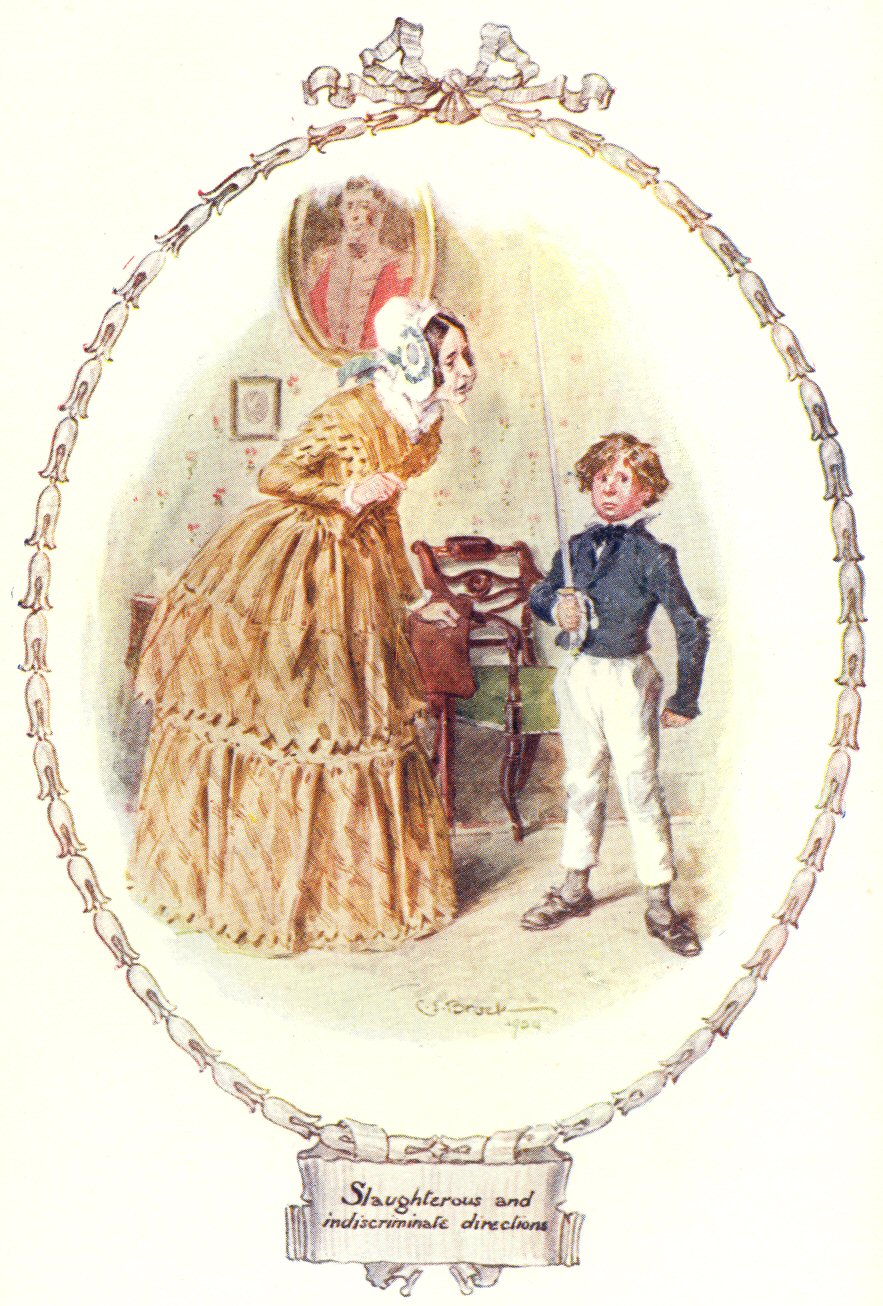
Mrs Forrester looked askance at Miss Pole, and tried to change the subject a little by telling us that she had borrowed a boy from one of the neighbouring cottages and promised his parents a hundredweight of coals at Christmas, and his supper every evening, for the loan of him at nights. She had instructed him in his possible duties when he first came; and, finding him sensible, she had given him the Major’s sword (the Major was her late husband), and desired him to put it very carefully behind his pillow at night, turning the edge towards the head of the pillow. He was a sharp lad, she was sure; for, spying out the Major’s cocked hat, he had said, if he might have that to wear, he was sure he could frighten two Englishmen, or four Frenchmen any day. But she had impressed upon him anew that he was to lose no time in putting on hats or anything else; but, if he heard any noise, he was to run at it with his drawn sword. On my suggesting that some accident might occur from such slaughterous and indiscriminate directions, and that he might rush on Jenny getting up to wash, and have spitted her before he had discovered that she was not a Frenchman, Mrs Forrester said she did not think that that was likely, for he was a very sound sleeper, and generally had to be well shaken or cold-pigged in a morning before they could rouse him. She sometimes thought such dead sleep must be owing to the hearty suppers the poor lad ate, for he was half-starved at home, and she told Jenny to see that he got a good meal at night.
Mrs Forrester looked sideways at Miss Pole and tried to change the subject. She told us she had borrowed a boy from a nearby cottage to stay with her at night. In return, she had promised his parents a hundredweight of coal at Christmas and the boy his supper every evening. When he first came, she had explained what he might have to do. Finding him sensible, she had given him the Major’s sword. The Major was her late husband. She had told the boy to put the sword carefully behind his pillow at night, with the edge toward the head of the pillow. She was sure he was a sharp lad. When he spotted the Major’s cocked hat, he had said that, if he could wear it, he was sure he could frighten two Englishmen or four Frenchmen any day. But she had reminded him not to waste time putting on hats or anything else. If he heard a noise, he was to run toward it with his sword drawn. I suggested that such murderous orders, given without distinction, might cause an accident. He might rush at Jenny when she got up to wash and run her through before discovering she was not a Frenchman. Mrs Forrester said she did not think that was likely. He slept very soundly and usually had to be shaken hard or have cold water poured over him before they could wake him in the morning. She sometimes thought such deep sleep must be due to the hearty suppers the poor lad ate. He was half-starved at home, and she told Jenny to make sure he had a good meal at night.
Still this was no confession of Mrs Forrester’s peculiar timidity, and we urged her to tell us what she thought would frighten her more than anything. She paused, and stirred the fire, and snuffed the candles, and then she said, in a sounding whisper—
Still, Mrs Forrester had not admitted what she was especially afraid of. We urged her to tell us what she thought would frighten her more than anything else. She paused, stirred the fire, and trimmed the candle wicks. Then she said in a loud whisper:
“Ghosts!”
“Ghosts!”
She looked at Miss Pole, as much as to say, she had declared it, and would stand by it. Such a look was a challenge in itself. Miss Pole came down upon her with indigestion, spectral illusions, optical delusions, and a great deal out of Dr Ferrier and Dr Hibbert besides. Miss Matty had rather a leaning to ghosts, as I have mentioned before, and what little she did say was all on Mrs Forrester’s side, who, emboldened by sympathy, protested that ghosts were a part of her religion; that surely she, the widow of a major in the army, knew what to be frightened at, and what not; in short, I never saw Mrs Forrester so warm either before or since, for she was a gentle, meek, enduring old lady in most things. Not all the elder-wine that ever was mulled could this night wash out the remembrance of this difference between Miss Pole and her hostess. Indeed, when the elder-wine was brought in, it gave rise to a new burst of discussion; for Jenny, the little maiden who staggered under the tray, had to give evidence of having seen a ghost with her own eyes, not so many nights ago, in Darkness Lane, the very lane we were to go through on our way home.
She looked at Miss Pole as if to say that she had made her claim and would stand by it. The look was a challenge in itself. Miss Pole came down on her with indigestion, ghostly illusions, tricks of the eye, and much more from Dr Ferrier and Dr Hibbert. As I have mentioned before, Miss Matty was rather inclined to believe in ghosts. What little she said was all on Mrs Forrester’s side. Encouraged by her sympathy, Mrs Forrester declared that ghosts were part of her religion. Surely she, the widow of an army major, knew what to be frightened of and what not to be frightened of. In short, I never saw Mrs Forrester so heated before or since. In most things, she was a gentle, meek, patient old lady. Not all the mulled elder-wine in the world could have washed away the memory of this disagreement between Miss Pole and her hostess that night. Indeed, when the elder-wine was brought in, it sparked another burst of discussion. Jenny, the young maid who staggered under the tray, had to testify that she had seen a ghost with her own eyes. She had seen it only a few nights before in Darkness Lane, the very lane we had to pass through on our way home.
In spite of the uncomfortable feeling which this last consideration gave me, I could not help being amused at Jenny’s position, which was exceedingly like that of a witness being examined and cross-examined by two counsel who are not at all scrupulous about asking leading questions. The conclusion I arrived at was, that Jenny had certainly seen something beyond what a fit of indigestion would have caused. A lady all in white, and without her head, was what she deposed and adhered to, supported by a consciousness of the secret sympathy of her mistress under the withering scorn with which Miss Pole regarded her. And not only she, but many others, had seen this headless lady, who sat by the roadside wringing her hands as in deep grief. Mrs Forrester looked at us from time to time with an air of conscious triumph; but then she had not to pass through Darkness Lane before she could bury herself beneath her own familiar bed-clothes.
Although this last thought made me uneasy, I could not help finding Jenny’s position amusing. She was very much like a witness being questioned and cross-examined by two lawyers with no scruples about asking leading questions. I concluded that Jenny had certainly seen something more than indigestion could have caused. She testified that she had seen a lady dressed all in white and without a head, and she stuck to her story. Miss Pole regarded Jenny with scathing contempt, but Jenny knew her mistress secretly believed her. Jenny was not the only one who had seen the headless lady. Many others had seen her too, sitting by the roadside and wringing her hands as if in deep grief. Mrs Forrester looked at us from time to time with an air of quiet triumph. But then, she did not have to pass through Darkness Lane before she could bury herself under her own familiar bedcovers.
We preserved a discreet silence as to the headless lady while we were putting on our things to go home, for there was no knowing how near the ghostly head and ears might be, or what spiritual connection they might be keeping up with the unhappy body in Darkness Lane; and, therefore, even Miss Pole felt that it was as well not to speak lightly on such subjects, for fear of vexing or insulting that woebegone trunk. At least, so I conjecture; for, instead of the busy clatter usual in the operation, we tied on our cloaks as sadly as mutes at a funeral. Miss Matty drew the curtains round the windows of the chair to shut out disagreeable sights, and the men (either because they were in spirits that their labours were so nearly ended, or because they were going down hill), set off at such a round and merry pace, that it was all Miss Pole and I could do to keep up with them. She had breath for nothing beyond an imploring “Don’t leave me!” uttered as she clutched my arm so tightly that I could not have quitted her, ghost or no ghost. What a relief it was when the men, weary of their burden and their quick trot, stopped just where Headingley Causeway branches off from Darkness Lane! Miss Pole unloosed me and caught at one of the men—
We kept a discreet silence about the headless lady as we put on our things to go home. There was no knowing how close the ghostly head and ears might be. Nor did we know what spiritual connection they might have with the unhappy body in Darkness Lane. So even Miss Pole felt it best not to speak lightly of such subjects, for fear of upsetting or insulting that woebegone trunk. At least, that is what I suppose. Instead of our usual busy chatter as we dressed, we tied on our cloaks as sadly as silent mourners at a funeral. Miss Matty drew the curtains around the windows of the chair to shut out unpleasant sights. The men set off at such a brisk, cheerful pace that Miss Pole and I could barely keep up. Perhaps they were in good spirits because their work was nearly over, or perhaps it was because they were going downhill. Miss Pole had enough breath only to plead, “Don’t leave me!” She clutched my arm so tightly that I could not have left her, ghost or no ghost. What a relief it was when the men, tired from their burden and their quick trot, stopped just where Headingley Causeway branches off from Darkness Lane! Miss Pole let go of me and grabbed one of the men.
“Could not you—could not you take Miss Matty round by Headingley Causeway?—the pavement in Darkness Lane jolts so, and she is not very strong.”
“Could you, could you take Miss Matty by way of Headingley Causeway? The pavement in Darkness Lane is so bumpy, and she isn’t very strong.”
A smothered voice was heard from the inside of the chair—
A muffled voice came from inside the chair:
“Oh! pray go on! What is the matter? What is the matter? I will give you sixpence more to go on very fast; pray don’t stop here.”
“Oh, please go on! What’s the matter? What’s the matter? I’ll give you another sixpence to go very fast. Please don’t stop here.”
“And I’ll give you a shilling,” said Miss Pole, with tremulous dignity, “if you’ll go by Headingley Causeway.”
“And I’ll give you a shilling,” said Miss Pole, trying to sound dignified despite her trembling, “if you go by Headingley Causeway.”
The two men grunted acquiescence and took up the chair, and went along the causeway, which certainly answered Miss Pole’s kind purpose of saving Miss Matty’s bones; for it was covered with soft, thick mud, and even a fall there would have been easy till the getting-up came, when there might have been some difficulty in extrication.
The two men grunted in agreement, picked up the chair, and went along the path. It certainly served Miss Pole’s kind purpose of protecting Miss Matty’s bones. The path was covered in soft, thick mud, so even a fall would have been gentle. Getting up again, however, might have been difficult.