Chapter 9
Signor Brunoni
Soon after the events of which I gave an account in my last paper, I was summoned home by my father’s illness; and for a time I forgot, in anxiety about him, to wonder how my dear friends at Cranford were getting on, or how Lady Glenmire could reconcile herself to the dulness of the long visit which she was still paying to her sister-in-law, Mrs Jamieson. When my father grew a little stronger I accompanied him to the seaside, so that altogether I seemed banished from Cranford, and was deprived of the opportunity of hearing any chance intelligence of the dear little town for the greater part of that year.
Soon after the events I described in my last account, I was called home because my father was ill. For a time, my anxiety about him kept me from wondering how my dear friends in Cranford were getting on. I also forgot to wonder how Lady Glenmire could bear the dullness of her long visit to her sister-in-law, Mrs Jamieson. She was still staying with her. When my father grew a little stronger, I went with him to the seaside. As a result, I felt banished from Cranford for most of that year. I had no chance to hear even an occasional piece of news about the dear little town.
Late in November—when we had returned home again, and my father was once more in good health—I received a letter from Miss Matty; and a very mysterious letter it was. She began many sentences without ending them, running them one into another, in much the same confused sort of way in which written words run together on blotting-paper. All I could make out was that, if my father was better (which she hoped he was), and would take warning and wear a great-coat from Michaelmas to Lady-day, if turbans were in fashion, could I tell her? Such a piece of gaiety was going to happen as had not been seen or known of since Wombwell’s lions came, when one of them ate a little child’s arm; and she was, perhaps, too old to care about dress, but a new cap she must have; and, having heard that turbans were worn, and some of the county families likely to come, she would like to look tidy, if I would bring her a cap from the milliner I employed; and oh, dear! how careless of her to forget that she wrote to beg I would come and pay her a visit next Tuesday; when she hoped to have something to offer me in the way of amusement, which she would not now more particularly describe, only sea-green was her favourite colour. So she ended her letter; but in a P.S. she added, she thought she might as well tell me what was the peculiar attraction to Cranford just now; Signor Brunoni was going to exhibit his wonderful magic in the Cranford Assembly Rooms on Wednesday and Friday evening in the following week.
Late in November, after we had returned home and my father was well again, I received a letter from Miss Matty. It was a very mysterious letter. She began many sentences without finishing them, running them together like words blurred on blotting paper. All I could make out was this: she hoped my father was better and would take warning and wear a greatcoat from Michaelmas to Lady-day. And could I tell her if turbans were fashionable? A celebration was coming, unlike anything seen or heard of since Wombwell’s lions came, when one ate a little child’s arm. Perhaps she was too old to care about dress, but she must have a new cap. She had heard that turbans were worn and that some of the county families were likely to come. So she would like to look tidy, if I would bring her a cap from the milliner I used. And oh, dear! How careless of her to forget that she had written to beg me to visit her next Tuesday. She hoped to offer me some amusement then, which she would not describe more particularly just yet. She would say only that sea-green was her favourite colour. So she ended her letter. But in a postscript she added that she might as well tell me what the special attraction in Cranford was. Signor Brunoni was going to perform his wonderful magic in the Cranford Assembly Rooms on Wednesday and Friday evenings the following week.
I was very glad to accept the invitation from my dear Miss Matty, independently of the conjuror, and most particularly anxious to prevent her from disfiguring her small, gentle, mousey face with a great Saracen’s head turban; and accordingly, I bought her a pretty, neat, middle-aged cap, which, however, was rather a disappointment to her when, on my arrival, she followed me into my bedroom, ostensibly to poke the fire, but in reality, I do believe, to see if the sea-green turban was not inside the cap-box with which I had travelled. It was in vain that I twirled the cap round on my hand to exhibit back and side fronts: her heart had been set upon a turban, and all she could do was to say, with resignation in her look and voice—
I was very happy to accept my dear Miss Matty’s invitation, quite apart from the conjuror. I was especially eager to stop her from spoiling her small, gentle, mouse-like face with a great Saracen’s head turban. So I bought her a pretty, neat cap suitable for a middle-aged woman. But she was rather disappointed with it. When I arrived, she followed me into my bedroom, supposedly to tend the fire. I believe she really wanted to see if the sea-green turban was inside the cap-box I had brought with me. I turned the cap around on my hand to show her the back and sides, but it was no use. Her heart was set on a turban. All she could do was say, with resignation in her face and voice:
“I am sure you did your best, my dear. It is just like the caps all the ladies in Cranford are wearing, and they have had theirs for a year, I dare say. I should have liked something newer, I confess—something more like the turbans Miss Betty Barker tells me Queen Adelaide wears; but it is very pretty, my dear. And I dare say lavender will wear better than sea-green. Well, after all, what is dress, that we should care anything about it? You’ll tell me if you want anything, my dear. Here is the bell. I suppose turbans have not got down to Drumble yet?”
“I’m sure you did your best, my dear. It’s just like the caps all the ladies in Cranford are wearing. I expect they’ve had theirs for a year. I admit I would have liked something newer, more like the turbans Miss Betty Barker tells me Queen Adelaide wears. But it’s very pretty, my dear. And I expect lavender will wear better than sea-green. Well, after all, why should we care about clothes? You’ll tell me if you need anything, my dear. There’s the bell. I suppose turbans haven’t reached Drumble yet?”
So saying, the dear old lady gently bemoaned herself out of the room, leaving me to dress for the evening, when, as she informed me, she expected Miss Pole and Mrs Forrester, and she hoped I should not feel myself too much tired to join the party. Of course I should not; and I made some haste to unpack and arrange my dress; but, with all my speed, I heard the arrivals and the buzz of conversation in the next room before I was ready. Just as I opened the door, I caught the words, “I was foolish to expect anything very genteel out of the Drumble shops; poor girl! she did her best, I’ve no doubt.” But, for all that, I had rather that she blamed Drumble and me than disfigured herself with a turban.
With those words, the dear old lady gently lamented her way out of the room, leaving me to dress for the evening. She had told me she expected Miss Pole and Mrs Forrester. She hoped I would not be too tired to join them. Of course I would not, so I hurried to unpack and arrange my dress. But despite my haste, I heard them arrive and begin chatting in the next room before I was ready. Just as I opened the door, I heard the words, “I was foolish to expect anything very elegant from the Drumble shops. Poor girl! I’ve no doubt she did her best.” But even so, I would rather she blamed Drumble and me than made herself look ridiculous in a turban.
Miss Pole was always the person, in the trio of Cranford ladies now assembled, to have had adventures. She was in the habit of spending the morning in rambling from shop to shop, not to purchase anything (except an occasional reel of cotton or a piece of tape), but to see the new articles and report upon them, and to collect all the stray pieces of intelligence in the town. She had a way, too, of demurely popping hither and thither into all sorts of places to gratify her curiosity on any point—a way which, if she had not looked so very genteel and prim, might have been considered impertinent. And now, by the expressive way in which she cleared her throat, and waited for all minor subjects (such as caps and turbans) to be cleared off the course, we knew she had something very particular to relate, when the due pause came—and I defy any people possessed of common modesty to keep up a conversation long, where one among them sits up aloft in silence, looking down upon all the things they chance to say as trivial and contemptible compared to what they could disclose, if properly entreated. Miss Pole began—
Of the three Cranford ladies now gathered, Miss Pole was always the one who had adventures. She usually spent the morning wandering from shop to shop, not to buy anything (except an occasional spool of thread or piece of tape). She went to see the new goods, report on them, and gather all the bits of news in town. She also had a way of primly popping into all sorts of places to satisfy her curiosity about something. If she had not looked so very respectable and proper, this might have been considered intrusive. Now, she cleared her throat meaningfully and waited for all lesser subjects, such as caps and turbans, to be put aside. We knew she had something very special to tell us once there was a proper pause. And I defy anyone with ordinary modesty to keep a conversation going for long in such circumstances. One person sits there in lofty silence, looking down on everything the others happen to say as trivial and contemptible. All of it is beneath what that person could reveal, if properly begged. Miss Pole began:
“As I was stepping out of Gordon’s shop to-day, I chanced to go into the ‘George’ (my Betty has a second-cousin who is chambermaid there, and I thought Betty would like to hear how she was), and, not seeing anyone about, I strolled up the staircase, and found myself in the passage leading to the Assembly Room (you and I remember the Assembly Room, I am sure, Miss Matty! and the minuets de la cour!); so I went on, not thinking of what I was about, when, all at once, I perceived that I was in the middle of the preparations for to-morrow night—the room being divided with great clothes-maids, over which Crosby’s men were tacking red flannel; very dark and odd it seemed; it quite bewildered me, and I was going on behind the screens, in my absence of mind, when a gentleman (quite the gentleman, I can assure you) stepped forwards and asked if I had any business he could arrange for me. He spoke such pretty broken English, I could not help thinking of Thaddeus of Warsaw, and the Hungarian Brothers, and Santo Sebastiani; and while I was busy picturing his past life to myself, he had bowed me out of the room. But wait a minute! You have not heard half my story yet! I was going downstairs, when who should I meet but Betty’s second-cousin. So, of course, I stopped to speak to her for Betty’s sake; and she told me that I had really seen the conjuror—the gentleman who spoke broken English was Signor Brunoni himself. Just at this moment he passed us on the stairs, making such a graceful bow! in reply to which I dropped a curtsey—all foreigners have such polite manners, one catches something of it. But when he had gone downstairs, I bethought me that I had dropped my glove in the Assembly Room (it was safe in my muff all the time, but I never found it till afterwards); so I went back, and, just as I was creeping up the passage left on one side of the great screen that goes nearly across the room, who should I see but the very same gentleman that had met me before, and passed me on the stairs, coming now forwards from the inner part of the room, to which there is no entrance—you remember, Miss Matty—and just repeating, in his pretty broken English, the inquiry if I had any business there—I don’t mean that he put it quite so bluntly, but he seemed very determined that I should not pass the screen—so, of course, I explained about my glove, which, curiously enough, I found at that very moment.”
“As I was leaving Gordon’s shop today, I happened to go into the ‘George’. My Betty has a second cousin who is a chambermaid there, and I thought Betty would like to know how she was. Seeing no one around, I wandered upstairs. I found myself in the passage leading to the Assembly Room. You and I remember the Assembly Room, I’m sure, Miss Matty! And the minuets de la cour! So I went on, without thinking where I was going. Suddenly, I realized I was in the middle of the preparations for tomorrow night. The room was divided by large clothes-drying racks, and Crosby’s men were tacking red flannel over them. It looked very dark and strange, and I was quite bewildered. Still not thinking, I was about to go behind the screens when a gentleman stepped forward. He was quite the gentleman, I can assure you. He asked whether I had any business he could take care of for me. He spoke such charming broken English that I couldn’t help thinking of Thaddeus of Warsaw, the Hungarian Brothers, and Santo Sebastiani. While I was busy imagining his past life, he bowed me out of the room. “But wait a minute! You haven’t heard half my story yet! As I was going downstairs, who should I meet but Betty’s second cousin? So, of course, I stopped to speak to her for Betty’s sake. She told me that I really had seen the conjuror. The gentleman who spoke broken English was Signor Brunoni himself. Just then, he passed us on the stairs and gave such a graceful bow! I curtsied in return. All foreigners have such polite manners that one picks up something of them. “But after he had gone downstairs, I remembered that I had dropped my glove in the Assembly Room. It was safe in my muff all the time, but I didn’t find it until later. So I went back and crept along the passage left at one side of the great screen. You remember, Miss Matty, that the screen goes nearly across the room. And who should I see coming forward from the inner part of the room? It was the very same gentleman who had met me before and passed me on the stairs. As you remember, Miss Matty, there is no entrance to that inner part of the room. Again, in his charming broken English, he asked whether I had any business there. I don’t mean that he put it quite so bluntly, but he seemed very determined not to let me past the screen. So, of course, I explained about my glove. Curiously enough, I found it at that very moment.”
Miss Pole, then, had seen the conjuror—the real, live conjuror! and numerous were the questions we all asked her. “Had he a beard?” “Was he young, or old?” “Fair, or dark?” “Did he look”—(unable to shape my question prudently, I put it in another form)—“How did he look?” In short, Miss Pole was the heroine of the evening, owing to her morning’s encounter. If she was not the rose (that is to say the conjuror) she had been near it.
Miss Pole had seen the conjuror, the real, live conjuror! We all asked her many questions. “Did he have a beard?” “Was he young or old?” “Fair or dark?” “Did he look...” I couldn’t find a sensible way to finish my question, so I asked it differently. “What did he look like?” In short, Miss Pole was the heroine of the evening because of her encounter that morning. If she was not the rose (that is, the conjuror), she had been near it.
Conjuration, sleight of hand, magic, witchcraft, were the subjects of the evening. Miss Pole was slightly sceptical, and inclined to think there might be a scientific solution found for even the proceedings of the Witch of Endor. Mrs Forrester believed everything, from ghosts to death-watches. Miss Matty ranged between the two—always convinced by the last speaker. I think she was naturally more inclined to Mrs Forrester’s side, but a desire of proving herself a worthy sister to Miss Jenkyns kept her equally balanced—Miss Jenkyns, who would never allow a servant to call the little rolls of tallow that formed themselves round candles “winding-sheets,” but insisted on their being spoken of as “roley-poleys!” A sister of hers to be superstitious! It would never do.
Conjuring, sleight of hand, magic, and witchcraft were the evening’s topics. Miss Pole was somewhat skeptical. She was inclined to think that even the Witch of Endor’s actions might have a scientific explanation. Mrs Forrester believed in everything, from ghosts to death-watches. Miss Matty fell somewhere between the two, always convinced by whoever had spoken last. I think she was naturally more inclined to agree with Mrs Forrester. But she also wanted to prove herself a worthy sister to Miss Jenkyns, and that kept her evenly balanced. Miss Jenkyns would never let a servant call the little rolls of tallow that formed around candles “winding-sheets.” She insisted that they be called “roley-poleys!” A sister of hers, superstitious! That would never do.
After tea, I was despatched downstairs into the dining-parlour for that volume of the old Encyclopædia which contained the nouns beginning with C, in order that Miss Pole might prime herself with scientific explanations for the tricks of the following evening. It spoilt the pool at Preference which Miss Matty and Mrs Forrester had been looking forward to, for Miss Pole became so much absorbed in her subject, and the plates by which it was illustrated, that we felt it would be cruel to disturb her otherwise than by one or two well-timed yawns, which I threw in now and then, for I was really touched by the meek way in which the two ladies were bearing their disappointment. But Miss Pole only read the more zealously, imparting to us no more information than this—
After tea, I was sent downstairs to the dining room to fetch a volume of the old Encyclopædia. It contained the entries for nouns beginning with C. Miss Pole wanted to prepare scientific explanations for the tricks planned for the following evening. This spoiled the pool at Preference that Miss Matty and Mrs Forrester had been looking forward to. Miss Pole became so absorbed in the subject and its illustrations that we felt it would be cruel to disturb her. I did, however, give one or two well-timed yawns now and then. I was genuinely touched by the meek way the two ladies bore their disappointment. But Miss Pole only read more eagerly, giving us no more information than this:
“Ah! I see; I comprehend perfectly. A represents the ball. Put A between B and D—no! between C and F, and turn the second joint of the third finger of your left hand over the wrist of your right H. Very clear indeed! My dear Mrs Forrester, conjuring and witchcraft is a mere affair of the alphabet. Do let me read you this one passage?”
“Ah! I see. I understand perfectly. A represents the ball. Put A between B and D. No, between C and F. Then turn the second joint of the third finger of your left hand over the wrist of your right H. Very clear indeed! My dear Mrs Forrester, conjuring and witchcraft are simply a matter of the alphabet. Please let me read you this one passage.”
Mrs Forrester implored Miss Pole to spare her, saying, from a child upwards, she never could understand being read aloud to; and I dropped the pack of cards, which I had been shuffling very audibly, and by this discreet movement I obliged Miss Pole to perceive that Preference was to have been the order of the evening, and to propose, rather unwillingly, that the pool should commence. The pleasant brightness that stole over the other two ladies’ faces on this! Miss Matty had one or two twinges of self-reproach for having interrupted Miss Pole in her studies: and did not remember her cards well, or give her full attention to the game, until she had soothed her conscience by offering to lend the volume of the Encyclopædia to Miss Pole, who accepted it thankfully, and said Betty should take it home when she came with the lantern.
Mrs Forrester begged Miss Pole to spare her, saying she had never been able to follow someone reading aloud, even as a child. I had been shuffling the cards quite loudly, and now I dropped the pack. This discreet gesture made Miss Pole realize that we had planned to play Preference that evening. So she rather reluctantly suggested that we start the game. How pleasantly the other two ladies’ faces brightened at this! Miss Matty felt a twinge or two of guilt for interrupting Miss Pole’s studies. She could not remember her cards well or give the game her full attention until she had soothed her conscience. She did this by offering to lend Miss Pole the volume of the Encyclopædia. Miss Pole accepted it gratefully and said Betty would take it home when she came with the lantern.
The next evening we were all in a little gentle flutter at the idea of the gaiety before us. Miss Matty went up to dress betimes, and hurried me until I was ready, when we found we had an hour-and-a-half to wait before the “doors opened at seven precisely.” And we had only twenty yards to go! However, as Miss Matty said, it would not do to get too much absorbed in anything, and forget the time; so she thought we had better sit quietly, without lighting the candles, till five minutes to seven. So Miss Matty dozed, and I knitted.
The next evening, we were all a little fluttery with excitement about the fun ahead. Miss Matty went upstairs to dress early and hurried me until I was ready. Then we found we had an hour and a half to wait before the “doors opened at seven precisely.” And we had only twenty yards to go! Still, as Miss Matty said, we must not get too absorbed in anything and forget the time. So she thought we had better sit quietly, without lighting the candles, until five minutes to seven. Miss Matty dozed, and I knitted.
At length we set off; and at the door under the carriage-way at the “George,” we met Mrs Forrester and Miss Pole: the latter was discussing the subject of the evening with more vehemence than ever, and throwing X’s and B’s at our heads like hailstones. She had even copied one or two of the “receipts”—as she called them—for the different tricks, on backs of letters, ready to explain and to detect Signor Brunoni’s arts.
At last we set off. At the door under the carriage entrance at the “George,” we met Mrs Forrester and Miss Pole. Miss Pole was discussing the evening’s subject more passionately than ever, throwing X’s and B’s at our heads like hailstones. She had even copied instructions for one or two of the tricks on the backs of letters. She called them “receipts” and was ready to use them to explain and expose Signor Brunoni’s tricks.
We went into the cloak-room adjoining the Assembly Room; Miss Matty gave a sigh or two to her departed youth, and the remembrance of the last time she had been there, as she adjusted her pretty new cap before the strange, quaint old mirror in the cloak-room. The Assembly Room had been added to the inn, about a hundred years before, by the different county families, who met together there once a month during the winter to dance and play at cards. Many a county beauty had first swung through the minuet that she afterwards danced before Queen Charlotte in this very room. It was said that one of the Gunnings had graced the apartment with her beauty; it was certain that a rich and beautiful widow, Lady Williams, had here been smitten with the noble figure of a young artist, who was staying with some family in the neighbourhood for professional purposes, and accompanied his patrons to the Cranford Assembly. And a pretty bargain poor Lady Williams had of her handsome husband, if all tales were true. Now, no beauty blushed and dimpled along the sides of the Cranford Assembly Room; no handsome artist won hearts by his bow, chapeau bras in hand; the old room was dingy; the salmon-coloured paint had faded into a drab; great pieces of plaster had chipped off from the fine wreaths and festoons on its walls; but still a mouldy odour of aristocracy lingered about the place, and a dusty recollection of the days that were gone made Miss Matty and Mrs Forrester bridle up as they entered, and walk mincingly up the room, as if there were a number of genteel observers, instead of two little boys with a stick of toffee between them with which to beguile the time.
We went into the cloakroom next to the Assembly Room. Miss Matty sighed once or twice for her lost youth and remembered the last time she had been there. She adjusted her pretty new cap in front of the strange, quaint old mirror. About a hundred years earlier, the county families had added the Assembly Room to the inn. They met there once a month during the winter to dance and play cards. Many a county beauty had first danced the minuet in this very room, before later dancing it for Queen Charlotte. One of the Gunnings was said to have graced the room with her beauty. It was certain that a rich and beautiful widow, Lady Williams, had fallen for a handsome young artist there. He was staying with a local family for professional work and had accompanied his patrons to the Cranford Assembly. And what a bargain poor Lady Williams got in her handsome husband, if all the stories were true. Now no beauty blushed and dimpled along the sides of the Cranford Assembly Room. No handsome artist won hearts with a bow, his chapeau bras in hand. The old room was dingy, and the salmon-coloured paint had faded to a dull brown. Great pieces of plaster had chipped off the fine wreaths and garlands on its walls. But a musty air of aristocracy still lingered there. A dusty memory of the past made Miss Matty and Mrs Forrester hold themselves proudly as they entered. They took dainty little steps up the room, as if a crowd of refined people were watching them. Instead, there were only two little boys sharing a stick of toffee to pass the time.
We stopped short at the second front row; I could hardly understand why, until I heard Miss Pole ask a stray waiter if any of the county families were expected; and when he shook his head, and believed not, Mrs Forrester and Miss Matty moved forwards, and our party represented a conversational square. The front row was soon augmented and enriched by Lady Glenmire and Mrs Jamieson. We six occupied the two front rows, and our aristocratic seclusion was respected by the groups of shopkeepers who strayed in from time to time and huddled together on the back benches. At least I conjectured so, from the noise they made, and the sonorous bumps they gave in sitting down; but when, in weariness of the obstinate green curtain that would not draw up, but would stare at me with two odd eyes, seen through holes, as in the old tapestry story, I would fain have looked round at the merry chattering people behind me, Miss Pole clutched my arm, and begged me not to turn, for “it was not the thing.” What “the thing” was, I never could find out, but it must have been something eminently dull and tiresome. However, we all sat eyes right, square front, gazing at the tantalising curtain, and hardly speaking intelligibly, we were so afraid of being caught in the vulgarity of making any noise in a place of public amusement. Mrs Jamieson was the most fortunate, for she fell asleep.
We stopped suddenly at the second row from the front. I could hardly understand why, until I heard Miss Pole ask a passing waiter if any of the county families were expected. He shook his head and said he did not think so. Then Mrs Forrester and Miss Matty moved forward, and our party formed a square for conversation. Lady Glenmire and Mrs Jamieson soon joined us, adding to and enriching the front row. The six of us occupied the two front rows. Groups of shopkeepers came in from time to time, but they respected our aristocratic seclusion and huddled together on the back benches. At least, I guessed they did, from their noise and the loud thumps they made as they sat down. The stubborn green curtain would not rise, and I grew tired of watching it. It seemed to stare at me with two strange eyes peering through holes, as in the old tapestry story. But whenever I wanted to turn and look at the cheerful people chatting behind me, Miss Pole clutched my arm. She begged me not to turn, because “it was not the thing.” I never could find out what “the thing” was, but it must have been something exceptionally dull and tiresome. So we all sat facing squarely forward, our eyes fixed on the tantalising curtain. We hardly spoke clearly enough to be understood. We were so afraid of being caught doing anything as vulgar as making noise in a place of public amusement. Mrs Jamieson was the most fortunate, for she fell asleep.
At length the eyes disappeared—the curtain quivered—one side went up before the other, which stuck fast; it was dropped again, and, with a fresh effort, and a vigorous pull from some unseen hand, it flew up, revealing to our sight a magnificent gentleman in the Turkish costume, seated before a little table, gazing at us (I should have said with the same eyes that I had last seen through the hole in the curtain) with calm and condescending dignity, “like a being of another sphere,” as I heard a sentimental voice ejaculate behind me.
At last, the eyes disappeared, and the curtain trembled. One side rose before the other, which was stuck fast. The curtain dropped again. Then, with another effort and a strong pull from an unseen hand, it flew up. A magnificent gentleman in Turkish costume sat before us at a small table. He gazed at us with calm, condescending dignity. I should say that his were the same eyes I had just seen through the hole in the curtain. “Like a being of another sphere,” I heard a sentimental voice exclaim behind me.
“That’s not Signor Brunoni!” said Miss Pole decidedly; and so audibly that I am sure he heard, for he glanced down over his flowing beard at our party with an air of mute reproach. “Signor Brunoni had no beard—but perhaps he’ll come soon.” So she lulled herself into patience. Meanwhile, Miss Matty had reconnoitred through her eye-glass, wiped it, and looked again. Then she turned round, and said to me, in a kind, mild, sorrowful tone—
“That’s not Signor Brunoni!” said Miss Pole firmly. She spoke so loudly that I am sure he heard. He glanced down at our group over his flowing beard, as if silently reproaching us. “Signor Brunoni had no beard, but perhaps he’ll come soon.” With that thought, she settled down to wait. Meanwhile, Miss Matty had looked through her eyeglass, wiped it, and looked again. Then she turned to me and spoke in a kind, gentle, sorrowful tone:
“You see, my dear, turbans are worn.”
“You see, my dear, turbans are worn.”
But we had no time for more conversation. The Grand Turk, as Miss Pole chose to call him, arose and announced himself as Signor Brunoni.
But we had no time to talk further. The Grand Turk, as Miss Pole liked to call him, stood up and introduced himself as Signor Brunoni.
“I don’t believe him!” exclaimed Miss Pole, in a defiant manner. He looked at her again, with the same dignified upbraiding in his countenance. “I don’t!” she repeated more positively than ever. “Signor Brunoni had not got that muffy sort of thing about his chin, but looked like a close-shaved Christian gentleman.”
“I don’t believe him!” Miss Pole exclaimed defiantly. He looked at her again, with the same dignified look of reproach. “I don’t!” she repeated, more firmly than ever. “Signor Brunoni didn’t have that muff-like thing around his chin. He looked like a clean-shaven Christian gentleman.”
Miss Pole’s energetic speeches had the good effect of wakening up Mrs Jamieson, who opened her eyes wide, in sign of the deepest attention—a proceeding which silenced Miss Pole and encouraged the Grand Turk to proceed, which he did in very broken English—so broken that there was no cohesion between the parts of his sentences; a fact which he himself perceived at last, and so left off speaking and proceeded to action.
Miss Pole’s energetic speeches had the good effect of waking Mrs Jamieson. She opened her eyes wide, showing the deepest attention. This silenced Miss Pole and encouraged the Grand Turk to continue. He spoke in very broken English, so broken that the parts of his sentences did not fit together. At last, he realized this himself, so he stopped speaking and took action.
Now we were astonished. How he did his tricks I could not imagine; no, not even when Miss Pole pulled out her pieces of paper and began reading aloud—or at least in a very audible whisper—the separate “receipts” for the most common of his tricks. If ever I saw a man frown and look enraged, I saw the Grand Turk frown at Miss Pole; but, as she said, what could be expected but unchristian looks from a Mussulman? If Miss Pole were sceptical, and more engrossed with her receipts and diagrams than with his tricks, Miss Matty and Mrs Forrester were mystified and perplexed to the highest degree. Mrs Jamieson kept taking her spectacles off and wiping them, as if she thought it was something defective in them which made the legerdemain; and Lady Glenmire, who had seen many curious sights in Edinburgh, was very much struck with the tricks, and would not at all agree with Miss Pole, who declared that anybody could do them with a little practice, and that she would, herself, undertake to do all he did, with two hours given to study the Encyclopædia and make her third finger flexible.
Now we were astonished. I could not imagine how he did his tricks. I could not imagine it even when Miss Pole pulled out her papers and began reading aloud. Or at least she read in a very audible whisper. The papers contained separate “receipts” for his most common tricks. If I ever saw a man frown and look enraged, I saw the Grand Turk frown at Miss Pole. But, as she said, what could one expect but unchristian looks from a Mussulman? While Miss Pole was skeptical and more absorbed in her instructions and diagrams than in his tricks, Miss Matty and Mrs Forrester were utterly mystified and perplexed. Mrs Jamieson kept taking off her spectacles and wiping them. She seemed to think there was something wrong with them that made the tricks possible. Lady Glenmire had seen many curious sights in Edinburgh, but she was very impressed by the tricks. She did not agree at all with Miss Pole. Miss Pole declared that anyone could do the tricks with a little practice. She said she would undertake to do everything he did herself, if given two hours to study the Encyclopædia and make her third finger flexible.
At last Miss Matty and Mrs Forrester became perfectly awestricken. They whispered together. I sat just behind them, so I could not help hearing what they were saying. Miss Matty asked Mrs Forrester “if she thought it was quite right to have come to see such things? She could not help fearing they were lending encouragement to something that was not quite”— A little shake of the head filled up the blank. Mrs Forrester replied, that the same thought had crossed her mind; she too was feeling very uncomfortable, it was so very strange. She was quite certain that it was her pocket-handkerchief which was in that loaf just now; and it had been in her own hand not five minutes before. She wondered who had furnished the bread? She was sure it could not be Dakin, because he was the churchwarden. Suddenly Miss Matty half-turned towards me—
At last, Miss Matty and Mrs Forrester were completely awestruck. They whispered to each other. I was sitting just behind them, so I could not help hearing what they said. Miss Matty asked Mrs Forrester “if she thought it was really right for them to have come to see such things? She could not help fearing they were encouraging something that was not quite...” A little shake of her head filled in the rest. Mrs Forrester replied that the same thought had crossed her mind. She too felt very uncomfortable, because it was all so strange. She was quite certain that the handkerchief in the loaf just now was hers. It had been in her own hand less than five minutes earlier. She wondered who had provided the bread. She was sure it could not have been Dakin, because he was the churchwarden. Suddenly, Miss Matty half-turned toward me.
“Will you look, my dear—you are a stranger in the town, and it won’t give rise to unpleasant reports—will you just look round and see if the rector is here? If he is, I think we may conclude that this wonderful man is sanctioned by the Church, and that will be a great relief to my mind.”
“Would you look around for me, my dear? You are a stranger in town, so it won’t cause unpleasant gossip. Would you just see if the rector is here? If he is, I think we may conclude that this wonderful man has the Church’s approval. That would be a great relief to me.”
I looked, and I saw the tall, thin, dry, dusty rector, sitting surrounded by National School boys, guarded by troops of his own sex from any approach of the many Cranford spinsters. His kind face was all agape with broad smiles, and the boys around him were in chinks of laughing. I told Miss Matty that the Church was smiling approval, which set her mind at ease.
I looked and saw the tall, thin, dry, dusty rector sitting among the National School boys. The crowd of boys protected him from any approach by the many unmarried women of Cranford. His kind face was lit up with broad smiles, and the boys around him were bursting with laughter. I told Miss Matty that the Church was smiling in approval, and that put her mind at ease.
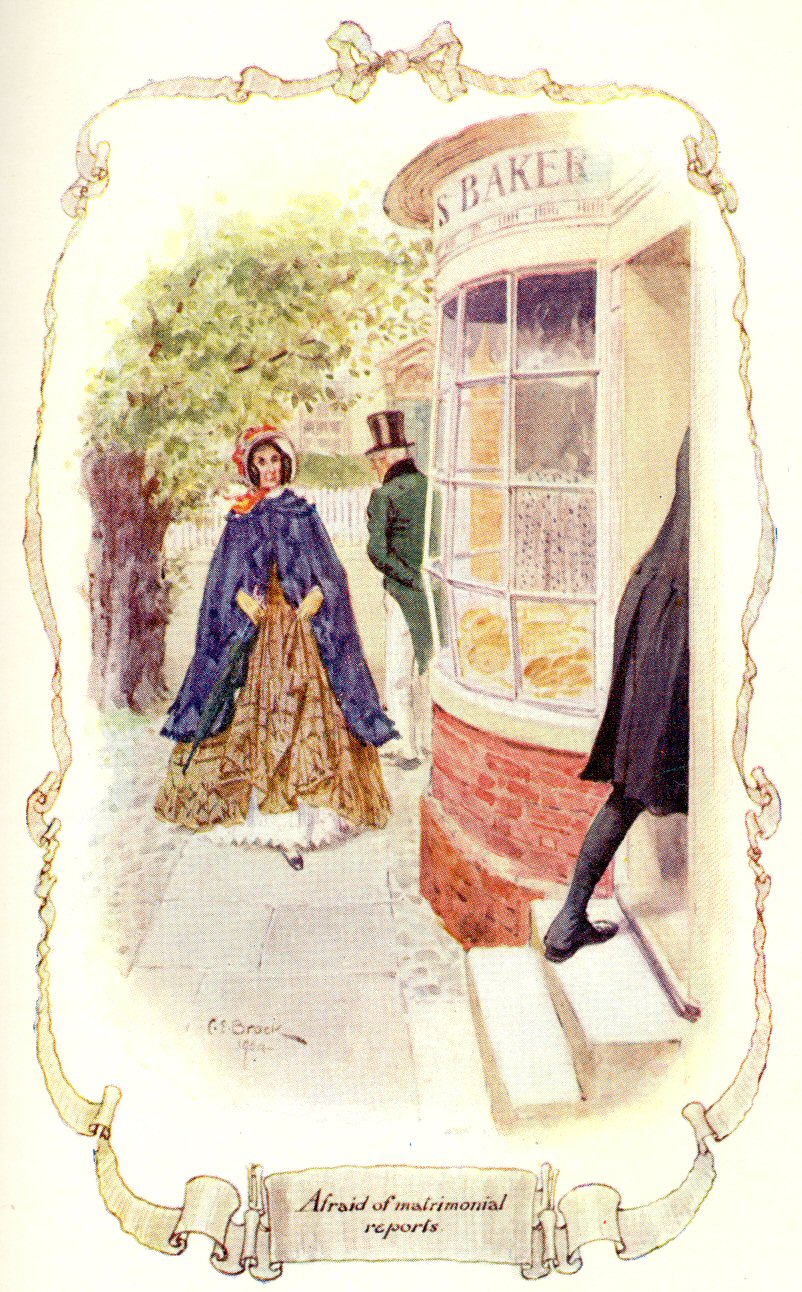
I have never named Mr Hayter, the rector, because I, as a well-to-do and happy young woman, never came in contact with him. He was an old bachelor, but as afraid of matrimonial reports getting abroad about him as any girl of eighteen: and he would rush into a shop or dive down an entry, sooner than encounter any of the Cranford ladies in the street; and, as for the Preference parties, I did not wonder at his not accepting invitations to them. To tell the truth, I always suspected Miss Pole of having given very vigorous chase to Mr Hayter when he first came to Cranford; and not the less, because now she appeared to share so vividly in his dread lest her name should ever be coupled with his. He found all his interests among the poor and helpless; he had treated the National School boys this very night to the performance; and virtue was for once its own reward, for they guarded him right and left, and clung round him as if he had been the queen-bee and they the swarm. He felt so safe in their environment that he could even afford to give our party a bow as we filed out. Miss Pole ignored his presence, and pretended to be absorbed in convincing us that we had been cheated, and had not seen Signor Brunoni after all.
I have never mentioned Mr Hayter, the rector, because I was a comfortable, happy young woman who never encountered him. He was an old bachelor, but he was as afraid of marriage rumors spreading about him as any eighteen-year-old girl. He would rush into a shop or duck into a passage rather than meet any of the Cranford ladies on the street. And I did not wonder that he refused invitations to the Preference parties. To tell the truth, I always suspected that Miss Pole had pursued Mr Hayter very eagerly when he first came to Cranford. I suspected it no less because she now seemed just as afraid as he was that their names might ever be linked. All his interests lay among the poor and helpless. That very night, he had treated the National School boys to the performance. For once, virtue was its own reward. The boys guarded him on both sides and clustered around him as if he were the queen bee and they were the swarm. He felt so safe surrounded by them that he could even afford to bow to our party as we filed out. Miss Pole ignored him and pretended to be absorbed in convincing us that we had been cheated. She insisted that we had not seen Signor Brunoni after all.