Chapter 4
A Visit to an Old Bachelor
A few days after, a note came from Mr Holbrook, asking us—impartially asking both of us—in a formal, old-fashioned style, to spend a day at his house—a long June day—for it was June now. He named that he had also invited his cousin, Miss Pole; so that we might join in a fly, which could be put up at his house.
A few days later, a note came from Mr Holbrook. In a formal, old-fashioned style, he invited both of us equally to spend a day at his house. It would be a long June day, for it was June now. He mentioned that he had also invited his cousin, Miss Pole. So we could share a hired carriage, which could be kept at his house.
I expected Miss Matty to jump at this invitation; but, no! Miss Pole and I had the greatest difficulty in persuading her to go. She thought it was improper; and was even half annoyed when we utterly ignored the idea of any impropriety in her going with two other ladies to see her old lover. Then came a more serious difficulty. She did not think Deborah would have liked her to go. This took us half a day’s good hard talking to get over; but, at the first sentence of relenting, I seized the opportunity, and wrote and despatched an acceptance in her name—fixing day and hour, that all might be decided and done with.
I expected Miss Matty to jump at the invitation, but no! Miss Pole and I had the greatest difficulty persuading her to go. She thought it was improper. She was even a little annoyed when we dismissed the idea that going with two other ladies to see her old lover was improper. Then came a more serious difficulty. She did not think Deborah would have liked her to go. It took us half a day of hard talking to get past that. But as soon as she began to give in, I seized the opportunity. I wrote and sent an acceptance in her name, fixing the day and hour so that everything would be settled.
The next morning she asked me if I would go down to the shop with her; and there, after much hesitation, we chose out three caps to be sent home and tried on, that the most becoming might be selected to take with us on Thursday.
The next morning, she asked me to go to the shop with her. After much hesitation, we chose three caps to send home and try on. We would choose the most flattering one to take with us on Thursday.
She was in a state of silent agitation all the way to Woodley. She had evidently never been there before; and, although she little dreamt I knew anything of her early story, I could perceive she was in a tremor at the thought of seeing the place which might have been her home, and round which it is probable that many of her innocent girlish imaginations had clustered. It was a long drive there, through paved jolting lanes. Miss Matilda sat bolt upright, and looked wistfully out of the windows as we drew near the end of our journey. The aspect of the country was quiet and pastoral. Woodley stood among fields; and there was an old-fashioned garden where roses and currant-bushes touched each other, and where the feathery asparagus formed a pretty background to the pinks and gilly-flowers; there was no drive up to the door. We got out at a little gate, and walked up a straight box-edged path.
She was silently agitated all the way to Woodley. Clearly, she had never been there before. She had no idea that I knew anything about her early life. Even so, I could see that she trembled at the thought of seeing the place that might have been her home. It was probably a place she had often dreamed about as an innocent girl. The drive was long, along bumpy paved lanes. Miss Matilda sat straight up and gazed wistfully out of the windows as we neared the end of our journey. The countryside was quiet and pastoral. Woodley stood among fields. Its old-fashioned garden had roses growing beside currant bushes. Feathery asparagus made a pretty background for the pinks and gillyflowers. There was no driveway to the door. We got out at a little gate and walked up a straight path edged with boxwood.
“My cousin might make a drive, I think,” said Miss Pole, who was afraid of ear-ache, and had only her cap on.
“I think my cousin might go for a drive,” said Miss Pole. She was afraid of getting an earache and was wearing only her cap.
“I think it is very pretty,” said Miss Matty, with a soft plaintiveness in her voice, and almost in a whisper, for just then Mr Holbrook appeared at the door, rubbing his hands in very effervescence of hospitality. He looked more like my idea of Don Quixote than ever, and yet the likeness was only external. His respectable housekeeper stood modestly at the door to bid us welcome; and, while she led the elder ladies upstairs to a bedroom, I begged to look about the garden. My request evidently pleased the old gentleman, who took me all round the place and showed me his six-and-twenty cows, named after the different letters of the alphabet. As we went along, he surprised me occasionally by repeating apt and beautiful quotations from the poets, ranging easily from Shakespeare and George Herbert to those of our own day. He did this as naturally as if he were thinking aloud, and their true and beautiful words were the best expression he could find for what he was thinking or feeling. To be sure he called Byron “my Lord Byrron,” and pronounced the name of Goethe strictly in accordance with the English sound of the letters—“As Goethe says, ‘Ye ever-verdant palaces,’” &c. Altogether, I never met with a man, before or since, who had spent so long a life in a secluded and not impressive country, with ever-increasing delight in the daily and yearly change of season and beauty.
“I think it is very pretty,” said Miss Matty. Her voice was soft and slightly sad, and she spoke almost in a whisper. Just then Mr Holbrook appeared at the door, rubbing his hands in an outpouring of hospitality. He looked more like my idea of Don Quixote than ever, though the resemblance was only in his appearance. His respectable housekeeper stood modestly at the door to welcome us. She led the older ladies upstairs to a bedroom, while I asked to look around the garden. My request clearly pleased the old gentleman. He took me all around the place and showed me his twenty-six cows, each named after a letter of the alphabet. As we walked, he sometimes surprised me by reciting fitting and beautiful quotations from poets. He moved easily from Shakespeare and George Herbert to poets of our own day. He quoted them as naturally as if he were thinking aloud. Their true and beautiful words were the best way he could find to express his thoughts and feelings. He did, of course, call Byron “my Lord Byrron.” He also pronounced Goethe exactly as the letters would sound in English: “As Goethe says, ‘Ye ever-verdant palaces,’” and so on. Altogether, I have never met another man like him, before or since. He had spent so long a life in a secluded and unimpressive part of the country. Yet he found ever more delight in the daily and yearly changes of season and beauty.
When he and I went in, we found that dinner was nearly ready in the kitchen—for so I suppose the room ought to be called, as there were oak dressers and cupboards all round, all over by the side of the fireplace, and only a small Turkey carpet in the middle of the flag-floor. The room might have been easily made into a handsome dark oak dining-parlour by removing the oven and a few other appurtenances of a kitchen, which were evidently never used, the real cooking-place being at some distance. The room in which we were expected to sit was a stiffly-furnished, ugly apartment; but that in which we did sit was what Mr Holbrook called the counting-house, where he paid his labourers their weekly wages at a great desk near the door. The rest of the pretty sitting-room—looking into the orchard, and all covered over with dancing tree-shadows—was filled with books. They lay on the ground, they covered the walls, they strewed the table. He was evidently half ashamed and half proud of his extravagance in this respect. They were of all kinds—poetry and wild weird tales prevailing. He evidently chose his books in accordance with his own tastes, not because such and such were classical or established favourites.
When he and I went in, we found that dinner was nearly ready in the kitchen. I suppose that is what the room should be called. Oak dressers and cupboards stood all around, including beside the fireplace, and a small Turkey carpet lay in the middle of the stone floor. The room could easily have been made into a handsome, dark oak dining room. The oven and a few other kitchen fixtures would have had to be removed. They were evidently never used, since the real cooking was done some distance away. The room where we were expected to sit was ugly and stiffly furnished. But we sat in what Mr Holbrook called the counting-house. There, he paid his labourers their weekly wages at a large desk near the door. The rest of the pretty sitting room was filled with books. It looked out onto the orchard and was covered with dancing shadows from the trees. Books lay on the floor, covered the walls, and were scattered across the table. He was evidently half ashamed and half proud of spending so much on them. There were books of all kinds, especially poetry and strange, wild tales. He evidently chose books to suit his own tastes, not because they were classics or established favourites.
“Ah!” he said, “we farmers ought not to have much time for reading; yet somehow one can’t help it.”
“Ah!” he said, “we farmers shouldn’t have much time to read, but somehow we can’t help reading.”
“What a pretty room!” said Miss Matty, sotto voce.
“What a pretty room!” said Miss Matty, quietly.
“What a pleasant place!” said I, aloud, almost simultaneously.
“What a pleasant place!” I said aloud, at almost the same time.
“Nay! if you like it,” replied he; “but can you sit on these great, black leather, three-cornered chairs? I like it better than the best parlour; but I thought ladies would take that for the smarter place.”
“No, if you like it,” he replied. “But can you sit on these big, black leather, three-cornered chairs? I like this room better than the best sitting room. But I thought ladies would consider the sitting room more elegant.”
It was the smarter place, but, like most smart things, not at all pretty, or pleasant, or home-like; so, while we were at dinner, the servant-girl dusted and scrubbed the counting-house chairs, and we sat there all the rest of the day.
It was the more fashionable place, but like most fashionable things, it was not at all pretty, pleasant, or homelike. So, while we ate dinner, the maid dusted and scrubbed the chairs in the counting-house. We sat there for the rest of the day.
We had pudding before meat; and I thought Mr Holbrook was going to make some apology for his old-fashioned ways, for he began—
We had pudding before the meat. I thought Mr Holbrook was going to apologize for his old-fashioned ways, because he began:
“I don’t know whether you like newfangled ways.”
“I don’t know whether you like new ways of doing things.”
“Oh, not at all!” said Miss Matty.
“Oh, not at all!” said Miss Matty.
“No more do I,” said he. “My housekeeper will have these in her new fashion; or else I tell her that, when I was a young man, we used to keep strictly to my father’s rule, ‘No broth, no ball; no ball, no beef’; and always began dinner with broth. Then we had suet puddings, boiled in the broth with the beef: and then the meat itself. If we did not sup our broth, we had no ball, which we liked a deal better; and the beef came last of all, and only those had it who had done justice to the broth and the ball. Now folks begin with sweet things, and turn their dinners topsy-turvy.”
“No more do I,” he said. “My housekeeper insists on having these in her new fashion. Otherwise, I tell her that when I was young, we kept strictly to my father’s rule: ‘No broth, no ball; no ball, no beef.’ We always began dinner with broth. Then we had suet puddings, boiled in the broth with the beef. After that came the meat itself. If we didn’t eat our broth, we got no ball, which we liked much better. The beef came last of all. Only those who had eaten their fill of broth and ball got any beef. Now people start with sweet things and turn their dinners upside down.”
When the ducks and green peas came, we looked at each other in dismay; we had only two-pronged, black-handled forks. It is true the steel was as bright as silver; but what were we to do? Miss Matty picked up her peas, one by one, on the point of the prongs, much as Aminé ate her grains of rice after her previous feast with the Ghoul. Miss Pole sighed over her delicate young peas as she left them on one side of her plate untasted, for they would drop between the prongs. I looked at my host: the peas were going wholesale into his capacious mouth, shovelled up by his large round-ended knife. I saw, I imitated, I survived! My friends, in spite of my precedent, could not muster up courage enough to do an ungenteel thing; and, if Mr Holbrook had not been so heartily hungry, he would probably have seen that the good peas went away almost untouched.
When the duck and green peas arrived, we looked at each other in dismay. We had only two-pronged forks with black handles. The steel was as bright as silver, but what were we to do? Miss Matty picked up her peas one by one on the points of her fork. She ate much as Aminé ate her grains of rice after her earlier feast with the Ghoul. Miss Pole sighed over her delicate young peas and left them untouched on one side of her plate. They would fall between the prongs. I looked at my host. He was shoveling peas into his enormous mouth by the load, using his large, round-ended knife. I saw, I copied him, I survived! Despite my example, my friends could not summon the courage to do something so improper. If Mr Holbrook had not been so hungry, he would probably have noticed the good peas being taken away almost untouched.
After dinner, a clay pipe was brought in, and a spittoon; and, asking us to retire to another room, where he would soon join us, if we disliked tobacco-smoke, he presented his pipe to Miss Matty, and requested her to fill the bowl. This was a compliment to a lady in his youth; but it was rather inappropriate to propose it as an honour to Miss Matty, who had been trained by her sister to hold smoking of every kind in utter abhorrence. But if it was a shock to her refinement, it was also a gratification to her feelings to be thus selected; so she daintily stuffed the strong tobacco into the pipe, and then we withdrew.
After dinner, a clay pipe and a spittoon were brought in. He asked us to go to another room if we disliked tobacco smoke, saying he would soon join us. Then he handed his pipe to Miss Matty and asked her to fill the bowl. In his youth, asking a lady to do this had been a compliment. But it was rather inappropriate to offer it as an honor to Miss Matty. Her sister had taught her to detest smoking of every kind. Still, though the request shocked her refined sensibilities, she was also pleased to have been chosen. So she delicately packed the strong tobacco into the pipe, and then we left the room.
“It is very pleasant dining with a bachelor,” said Miss Matty softly, as we settled ourselves in the counting-house. “I only hope it is not improper; so many pleasant things are!”
“It's very pleasant to dine with a bachelor,” said Miss Matty softly, as we settled into the counting-house. “I only hope dining with a bachelor isn't improper. So many pleasant things are!”
“What a number of books he has!” said Miss Pole, looking round the room. “And how dusty they are!”
“He has so many books!” said Miss Pole, looking around the room. “And they’re so dusty!”
“I think it must be like one of the great Dr Johnson’s rooms,” said Miss Matty. “What a superior man your cousin must be!”
“I think it must be like one of the great Dr Johnson’s rooms,” said Miss Matty. “Your cousin must be a remarkable man!”
“Yes!” said Miss Pole, “he’s a great reader; but I am afraid he has got into very uncouth habits with living alone.”
“Yes!” said Miss Pole. “He reads a lot, but I’m afraid living alone has given him some rather uncouth habits.”
“Oh! uncouth is too hard a word. I should call him eccentric; very clever people always are!” replied Miss Matty.
“Oh! Uncouth is too harsh a word. I would call him eccentric. Very clever people always are!” replied Miss Matty.
When Mr Holbrook returned, he proposed a walk in the fields; but the two elder ladies were afraid of damp, and dirt, and had only very unbecoming calashes to put on over their caps; so they declined, and I was again his companion in a turn which he said he was obliged to take to see after his men. He strode along, either wholly forgetting my existence, or soothed into silence by his pipe—and yet it was not silence exactly. He walked before me with a stooping gait, his hands clasped behind him; and, as some tree or cloud, or glimpse of distant upland pastures, struck him, he quoted poetry to himself, saying it out loud in a grand sonorous voice, with just the emphasis that true feeling and appreciation give. We came upon an old cedar tree, which stood at one end of the house—
When Mr Holbrook returned, he suggested a walk in the fields. But the two older ladies were afraid of damp and dirt. They also had only very unbecoming calashes to wear over their caps. So they declined, and I accompanied him again. He said he had to take the walk to check on his men. He strode along, either completely forgetting I was there or soothed into silence by his pipe. And yet it was not exactly silence. He walked ahead of me, stooping, with his hands clasped behind him. When a tree, a cloud, or a glimpse of distant upland pastures caught his attention, he quoted poetry to himself. He spoke aloud in a grand, resonant voice, with just the emphasis that comes from genuine feeling and appreciation. We came upon an old cedar tree standing at one end of the house.
“The cedar spreads his dark-green layers of shade.”
“The cedar spreads its dark green layers of shade.”
“Capital term—‘layers!’ Wonderful man!” I did not know whether he was speaking to me or not; but I put in an assenting “wonderful,” although I knew nothing about it, just because I was tired of being forgotten, and of being consequently silent.
“Great term, ‘layers!’ Wonderful man!” I didn’t know whether he was speaking to me. But I agreed, saying “wonderful,” although I knew nothing about it. I only said it because I was tired of being forgotten and having to stay silent.
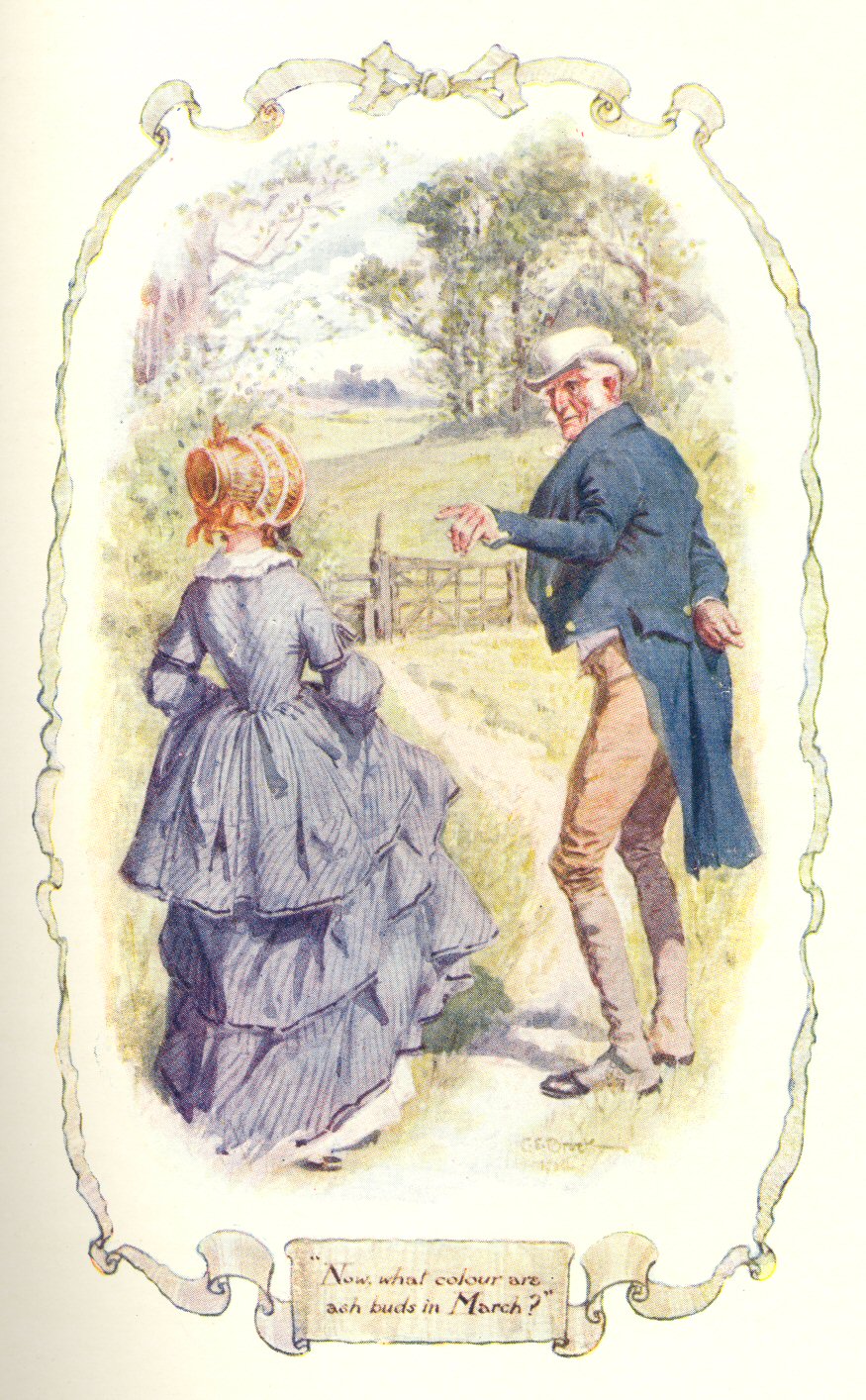
He turned sharp round. “Ay! you may say ‘wonderful.’ Why, when I saw the review of his poems in Blackwood, I set off within an hour, and walked seven miles to Misselton (for the horses were not in the way) and ordered them. Now, what colour are ash-buds in March?”
He turned around sharply. “Yes! You can say ‘wonderful.’ When I saw the review of his poems in Blackwood, I set off within an hour. The horses were not available, so I walked seven miles to Misselton and ordered the poems. Now, what colour are ash buds in March?”
Is the man going mad? thought I. He is very like Don Quixote.
Is the man going mad? I thought. He is very much like Don Quixote.
“What colour are they, I say?” repeated he vehemently.
“What color are they, I ask?” he repeated forcefully.
“I am sure I don’t know, sir,” said I, with the meekness of ignorance.
“I really don’t know, sir,” I said, meekly admitting my ignorance.
“I knew you didn’t. No more did I—an old fool that I am!—till this young man comes and tells me. Black as ash-buds in March. And I’ve lived all my life in the country; more shame for me not to know. Black: they are jet-black, madam.” And he went off again, swinging along to the music of some rhyme he had got hold of.
“I knew you didn’t. I didn’t either until this young man came and told me. What an old fool I am! Black as ash buds in March. And I’ve lived in the country all my life. I should be ashamed of myself for not knowing. Black: they’re jet-black, madam.” And he went off again, swinging along to the rhythm of some rhyme he had picked up.
When we came back, nothing would serve him but he must read us the poems he had been speaking of; and Miss Pole encouraged him in his proposal, I thought, because she wished me to hear his beautiful reading, of which she had boasted; but she afterwards said it was because she had got to a difficult part of her crochet, and wanted to count her stitches without having to talk. Whatever he had proposed would have been right to Miss Matty; although she did fall sound asleep within five minutes after he had begun a long poem, called “Locksley Hall,” and had a comfortable nap, unobserved, till he ended; when the cessation of his voice wakened her up, and she said, feeling that something was expected, and that Miss Pole was counting—
When we came back, he insisted on reading us the poems he had been talking about. Miss Pole encouraged him, I thought, because she wanted me to hear his beautiful reading, which she had praised. But she later said she had reached a difficult part of her crochet. She wanted to count her stitches without having to talk. Miss Matty would have approved of anything he proposed. Even so, she fell fast asleep within five minutes of his beginning a long poem called “Locksley Hall.” She had a comfortable nap, unnoticed, until he finished. When his voice stopped, she woke up. She felt that she was expected to say something, and that Miss Pole was counting, so she said:
“What a pretty book!”
“What a pretty book!”
“Pretty, madam! it’s beautiful! Pretty, indeed!”
“Pretty, ma’am! It’s beautiful! Pretty, indeed!”
“Oh yes! I meant beautiful!” said she, fluttered at his disapproval of her word. “It is so like that beautiful poem of Dr Johnson’s my sister used to read—I forget the name of it; what was it, my dear?” turning to me.
“Oh yes! I meant beautiful!” she said, flustered by his disapproval of her word. “It is so like that beautiful poem by Dr Johnson that my sister used to read. I forget its name. What was it, my dear?” She turned to me.
“Which do you mean, ma’am? What was it about?”
“Which one do you mean, ma’am? What was it about?”
“I don’t remember what it was about, and I’ve quite forgotten what the name of it was; but it was written by Dr Johnson, and was very beautiful, and very like what Mr Holbrook has just been reading.”
“I don’t remember what it was about, and I’ve completely forgotten its name. But Dr Johnson wrote it, and it was very beautiful. It was very like what Mr Holbrook has just been reading.”
“I don’t remember it,” said he reflectively. “But I don’t know Dr Johnson’s poems well. I must read them.”
“I don’t remember it,” he said thoughtfully. “But I don’t know Dr Johnson’s poems well. I should read them.”
As we were getting into the fly to return, I heard Mr Holbrook say he should call on the ladies soon, and inquire how they got home; and this evidently pleased and fluttered Miss Matty at the time he said it; but after we had lost sight of the old house among the trees her sentiments towards the master of it were gradually absorbed into a distressing wonder as to whether Martha had broken her word, and seized on the opportunity of her mistress’s absence to have a “follower.” Martha looked good, and steady, and composed enough, as she came to help us out; she was always careful of Miss Matty, and to-night she made use of this unlucky speech—
As we were getting into the carriage to return home, I heard Mr Holbrook say he would call on the ladies soon and ask how they had got home. His promise clearly pleased and flustered Miss Matty at the time. But after the old house disappeared from view among the trees, her feelings for its owner gradually gave way to an anxious worry. Had Martha broken her promise and taken advantage of her mistress’s absence to have a “follower,” a man courting her? Martha looked good, steady, and composed enough when she came to help us out. She was always thoughtful toward Miss Matty, and tonight she made this unfortunate remark:
“Eh! dear ma’am, to think of your going out in an evening in such a thin shawl! It’s no better than muslin. At your age, ma’am, you should be careful.”
“Oh, dear ma’am, going out in the evening in such a thin shawl! It’s no better than muslin. At your age, ma’am, you should be careful.”
“My age!” said Miss Matty, almost speaking crossly, for her, for she was usually gentle—“My age! Why, how old do you think I am, that you talk about my age?”
“My age!” said Miss Matty, sounding almost cross, which was unusual for her. She was usually gentle. “My age! How old do you think I am, to talk about my age?”
“Well, ma’am, I should say you were not far short of sixty: but folks’ looks is often against them—and I’m sure I meant no harm.”
“Well, ma’am, I’d say you’re not far from sixty. But people often look older than they are, and I’m sure I meant no harm.”
“Martha, I’m not yet fifty-two!” said Miss Matty, with grave emphasis; for probably the remembrance of her youth had come very vividly before her this day, and she was annoyed at finding that golden time so far away in the past.
“Martha, I’m not yet fifty-two!” said Miss Matty, with serious emphasis. Her memories of her youth had probably come vividly to mind that day. She was annoyed to find that golden time so far in the past.
But she never spoke of any former and more intimate acquaintance with Mr Holbrook. She had probably met with so little sympathy in her early love, that she had shut it up close in her heart; and it was only by a sort of watching, which I could hardly avoid since Miss Pole’s confidence, that I saw how faithful her poor heart had been in its sorrow and its silence.
But she never spoke of having known Mr Holbrook more intimately in the past. She had probably received so little sympathy for her early love that she had kept it locked in her heart. After Miss Pole confided in me, I could hardly help watching her. Only then did I see how faithful her poor heart had remained through its sorrow and silence.
She gave me some good reason for wearing her best cap every day, and sat near the window, in spite of her rheumatism, in order to see, without being seen, down into the street.
She gave me a good reason for wearing her best cap every day. Despite her rheumatism, she sat near the window so she could look down into the street without being seen.
He came. He put his open palms upon his knees, which were far apart, as he sat with his head bent down, whistling, after we had replied to his inquiries about our safe return. Suddenly he jumped up—
He came. After we answered his questions about our safe return, he sat with his knees far apart and his open palms resting on them. He bent his head down and whistled. Suddenly, he jumped up.
“Well, madam! have you any commands for Paris? I am going there in a week or two.”
“Well, madam! Is there anything you need from Paris? I’m going there in a week or two.”
“To Paris!” we both exclaimed.
“To Paris!” we both exclaimed.
“Yes, madam! I’ve never been there, and always had a wish to go; and I think if I don’t go soon, I mayn’t go at all; so as soon as the hay is got in I shall go, before harvest time.”
“Yes, madam! I’ve never been there, and I’ve always wanted to go. I think if I don’t go soon, I may never go. So I’ll go as soon as the hay is brought in, before harvest time.”
We were so much astonished that we had no commissions.
We were so surprised that we had no shopping requests.
Just as he was going out of the room, he turned back, with his favourite exclamation—
Just as he was leaving the room, he turned back with his favorite exclamation:
“God bless my soul, madam! but I nearly forgot half my errand. Here are the poems for you you admired so much the other evening at my house.” He tugged away at a parcel in his coat-pocket. “Good-bye, miss,” said he; “good-bye, Matty! take care of yourself.” And he was gone. But he had given her a book, and he had called her Matty, just as he used to do thirty years ago.
“Good heavens, madam! I nearly forgot half of what I came for. Here are the poems you admired so much at my house the other evening.” He pulled at a parcel in his coat pocket. “Goodbye, miss,” he said. “Goodbye, Matty! Take care of yourself.” And he was gone. But he had given her a book, and he had called her Matty, just as he used to thirty years ago.
“I wish he would not go to Paris,” said Miss Matilda anxiously. “I don’t believe frogs will agree with him; he used to have to be very careful what he ate, which was curious in so strong-looking a young man.”
“I wish he wouldn’t go to Paris,” said Miss Matilda anxiously. “I don’t think frogs will agree with him. He used to have to be very careful about what he ate. That was curious for such a strong-looking young man.”
Soon after this I took my leave, giving many an injunction to Martha to look after her mistress, and to let me know if she thought that Miss Matilda was not so well; in which case I would volunteer a visit to my old friend, without noticing Martha’s intelligence to her.
Soon after this, I left, repeatedly urging Martha to look after her mistress. I asked her to let me know if she thought Miss Matilda was not as well. If so, I would offer to visit my old friend without telling her what Martha had told me.
Accordingly I received a line or two from Martha every now and then; and, about November I had a note to say her mistress was “very low and sadly off her food”; and the account made me so uneasy that, although Martha did not decidedly summon me, I packed up my things and went.
So I received a few lines from Martha now and then. Around November, she wrote that her mistress was “very low and eating very little.” The news made me so uneasy that, although Martha did not actually ask me to come, I packed my things and went.
I received a warm welcome, in spite of the little flurry produced by my impromptu visit, for I had only been able to give a day’s notice. Miss Matilda looked miserably ill; and I prepared to comfort and cosset her.
I received a warm welcome, although my unplanned visit caused a little fuss. I had only been able to give one day’s notice. Miss Matilda looked terribly ill, and I prepared to comfort and pamper her.
I went down to have a private talk with Martha.
I went downstairs to talk privately with Martha.
“How long has your mistress been so poorly?” I asked, as I stood by the kitchen fire.
“How long has your mistress been so ill?” I asked as I stood by the kitchen fire.
“Well! I think it’s better than a fortnight; it is, I know; it was one Tuesday, after Miss Pole had been, that she went into this moping way. I thought she was tired, and it would go off with a night’s rest; but no! she has gone on and on ever since, till I thought it my duty to write to you, ma’am.”
“Well! I think it’s been more than two weeks. I know it has. She started moping one Tuesday, after Miss Pole had visited. I thought she was tired and would feel better after a night’s rest. But no! She has gone on moping ever since, until I thought it was my duty to write to you, ma’am.”
“You did quite right, Martha. It is a comfort to think she has so faithful a servant about her. And I hope you find your place comfortable?”
“You did the right thing, Martha. It is comforting to know she has such a loyal servant looking after her. And I hope you are comfortable in your job?”
“Well, ma’am, missus is very kind, and there’s plenty to eat and drink, and no more work but what I can do easily—but—” Martha hesitated.
“Well, ma’am, my mistress is very kind, and there’s plenty to eat and drink. The work is easy enough for me, but...” Martha hesitated.
“But what, Martha?”
“But what, Martha?”
“Why, it seems so hard of missus not to let me have any followers; there’s such lots of young fellows in the town; and many a one has as much as offered to keep company with me; and I may never be in such a likely place again, and it’s like wasting an opportunity. Many a girl as I know would have ’em unbeknownst to missus; but I’ve given my word, and I’ll stick to it; or else this is just the house for missus never to be the wiser if they did come: and it’s such a capable kitchen—there’s such dark corners in it—I’d be bound to hide any one. I counted up last Sunday night—for I’ll not deny I was crying because I had to shut the door in Jem Hearn’s face, and he’s a steady young man, fit for any girl; only I had given missus my word.” Martha was all but crying again; and I had little comfort to give her, for I knew, from old experience, of the horror with which both the Miss Jenkynses looked upon “followers”; and in Miss Matty’s present nervous state this dread was not likely to be lessened.
“It seems so unfair of my mistress not to let me have any young men calling on me. There are so many young men in town, and quite a few have practically offered to court me. I may never be in such a promising place again, and it feels like wasting an opportunity. Many girls I know would have young men visit without their mistresses knowing. But I’ve given my word, and I’ll stick to it. Otherwise, this is just the house where my mistress would never know they had come. And the kitchen is so well suited to it, with such dark corners. I’m sure I could hide anyone there. I counted them up last Sunday night. I won’t deny I was crying because I had to shut the door in Jem Hearn’s face. He’s a steady young man, good enough for any girl. But I had given my mistress my word.” Martha was nearly crying again, and I had little comfort to offer her. From long experience, I knew how horrified both Miss Jenkynses were by the idea of servants having male visitors. And Miss Matty’s current nervous state was unlikely to make her any less fearful of them.
I went to see Miss Pole the next day, and took her completely by surprise, for she had not been to see Miss Matilda for two days.
I went to see Miss Pole the next day and completely surprised her. She had not visited Miss Matilda for two days.
“And now I must go back with you, my dear, for I promised to let her know how Thomas Holbrook went on; and, I’m sorry to say, his housekeeper has sent me word to-day that he hasn’t long to live. Poor Thomas! that journey to Paris was quite too much for him. His housekeeper says he has hardly ever been round his fields since, but just sits with his hands on his knees in the counting-house, not reading or anything, but only saying what a wonderful city Paris was! Paris has much to answer for if it’s killed my cousin Thomas, for a better man never lived.”
“And now I must go back with you, my dear. I promised to tell her how Thomas Holbrook was doing. I’m sorry to say that his housekeeper sent me word today that he doesn’t have long to live. Poor Thomas! That trip to Paris was far too much for him. His housekeeper says he has hardly ever walked around his fields since then. Instead, he just sits in the counting-house with his hands on his knees. He doesn’t read or do anything else. He only talks about what a wonderful city Paris was! Paris has much to answer for if it has killed my cousin Thomas. A better man never lived.”
“Does Miss Matilda know of his illness?” asked I—a new light as to the cause of her indisposition dawning upon me.
“Does Miss Matilda know he is ill?” I asked. I was beginning to see what might have caused her to feel unwell.
“Dear! to be sure, yes! Has not she told you? I let her know a fortnight ago, or more, when first I heard of it. How odd she shouldn’t have told you!”
“Oh, yes, of course! Hasn’t she told you? I told her two weeks ago, or more, when I first heard about it. How strange that she didn’t tell you!”
Not at all, I thought; but I did not say anything. I felt almost guilty of having spied too curiously into that tender heart, and I was not going to speak of its secrets—hidden, Miss Matty believed, from all the world. I ushered Miss Pole into Miss Matilda’s little drawing-room, and then left them alone. But I was not surprised when Martha came to my bedroom door, to ask me to go down to dinner alone, for that missus had one of her bad headaches. She came into the drawing-room at tea-time, but it was evidently an effort to her; and, as if to make up for some reproachful feeling against her late sister, Miss Jenkyns, which had been troubling her all the afternoon, and for which she now felt penitent, she kept telling me how good and how clever Deborah was in her youth; how she used to settle what gowns they were to wear at all the parties (faint, ghostly ideas of grim parties, far away in the distance, when Miss Matty and Miss Pole were young!); and how Deborah and her mother had started the benefit society for the poor, and taught girls cooking and plain sewing; and how Deborah had once danced with a lord; and how she used to visit at Sir Peter Arley’s, and tried to remodel the quiet rectory establishment on the plans of Arley Hall, where they kept thirty servants; and how she had nursed Miss Matty through a long, long illness, of which I had never heard before, but which I now dated in my own mind as following the dismissal of the suit of Mr Holbrook. So we talked softly and quietly of old times through the long November evening.
Not at all, I thought, but I said nothing. I felt almost guilty for prying too closely into that tender heart. I would not speak of its secrets, which Miss Matty believed were hidden from all the world. I showed Miss Pole into Miss Matilda’s little drawing room, then left them alone. So I was not surprised when Martha came to my bedroom door. She asked me to go down to dinner alone, because her mistress had one of her bad headaches. Miss Matty came into the drawing room at tea time, but it was clearly an effort for her. That afternoon, she seemed to have been troubled by some reproachful feeling toward her late sister, Miss Jenkyns. Now, as if sorry for that feeling and trying to make up for it, she kept telling me how good and clever Deborah had been in her youth. She told me how Deborah used to decide what gowns they would wear to all the parties. I had faint, ghostly images of grim parties, far away in the past, when Miss Matty and Miss Pole were young! She told me how Deborah and her mother had started the benefit society for the poor. They had also taught girls cooking and plain sewing. Deborah had once danced with a lord. She used to visit Sir Peter Arley’s home and tried to reshape the quiet rectory household along the lines of Arley Hall, where they kept thirty servants. She had also nursed Miss Matty through a very long illness. I had never heard of it before, but I now assumed it had followed the rejection of Mr Holbrook’s marriage proposal. So we talked softly and quietly about old times throughout the long November evening.
The next day Miss Pole brought us word that Mr Holbrook was dead. Miss Matty heard the news in silence; in fact, from the account of the previous day, it was only what we had to expect. Miss Pole kept calling upon us for some expression of regret, by asking if it was not sad that he was gone, and saying—
The next day Miss Pole brought us news that Mr Holbrook had died. Miss Matty heard the news in silence. In fact, from what we had heard the previous day, his death was only to be expected. Miss Pole kept trying to get us to express regret. She asked if it was not sad that he was gone, and said:
“To think of that pleasant day last June, when he seemed so well! And he might have lived this dozen years if he had not gone to that wicked Paris, where they are always having revolutions.”
“To think of that lovely day last June, when he seemed so well! He might have lived another twelve years if he had not gone to wicked Paris, where they are always having revolutions.”
She paused for some demonstration on our part. I saw Miss Matty could not speak, she was trembling so nervously; so I said what I really felt; and after a call of some duration—all the time of which I have no doubt Miss Pole thought Miss Matty received the news very calmly—our visitor took her leave.
She paused, waiting for some reaction from us. I saw that Miss Matty was trembling too nervously to speak, so I said what I truly felt. After a fairly long visit, our visitor took her leave. I have no doubt that Miss Pole thought Miss Matty received the news calmly throughout the visit.
Miss Matty made a strong effort to conceal her feelings—a concealment she practised even with me, for she has never alluded to Mr Holbrook again, although the book he gave her lies with her Bible on the little table by her bedside. She did not think I heard her when she asked the little milliner of Cranford to make her caps something like the Honourable Mrs Jamieson’s, or that I noticed the reply—
Miss Matty made a great effort to hide her feelings, even from me. She has never mentioned Mr Holbrook again. Yet the book he gave her lies beside her Bible on the little table by her bed. She asked Cranford’s little milliner to make her caps rather like the Honourable Mrs Jamieson’s. She did not think I heard her ask or noticed the reply:
“But she wears widows’ caps, ma’am?”
“But she wears widow’s caps, ma’am?”
“Oh! I only meant something in that style; not widows’, of course, but rather like Mrs Jamieson’s.”
“Oh! I only meant something like that. Not widows’, of course, but more like Mrs Jamieson’s.”
This effort at concealment was the beginning of the tremulous motion of head and hands which I have seen ever since in Miss Matty.
This effort to hide it was when Miss Matty’s head and hands first began to tremble. I have seen them tremble ever since.
The evening of the day on which we heard of Mr Holbrook’s death, Miss Matilda was very silent and thoughtful; after prayers she called Martha back and then she stood uncertain what to say.
That evening, after we heard of Mr Holbrook’s death, Miss Matilda was very quiet and thoughtful. After prayers, she called Martha back. Then she stood there, unsure what to say.
“Martha!” she said, at last, “you are young”—and then she made so long a pause that Martha, to remind her of her half-finished sentence, dropped a curtsey, and said—
“Martha!” she said at last. “You are young.” Then she paused for so long that Martha curtsied to remind her of the unfinished sentence, and said:
“Yes, please, ma’am; two-and-twenty last third of October, please, ma’am.”
“Yes, please, ma’am. I turned twenty-two on October 3, ma’am.”
“And, perhaps, Martha, you may some time meet with a young man you like, and who likes you. I did say you were not to have followers; but if you meet with such a young man, and tell me, and I find he is respectable, I have no objection to his coming to see you once a week. God forbid!” said she in a low voice, “that I should grieve any young hearts.” She spoke as if she were providing for some distant contingency, and was rather startled when Martha made her ready eager answer—
“And perhaps, Martha, you may one day meet a young man you like, who likes you too. I did say you were not to have male visitors. But if you meet such a young man and tell me, and I find him respectable, I have no objection to his visiting you once a week. God forbid!” she said quietly, “that I should cause any young hearts grief.” She spoke as if she were preparing for a distant possibility. She was rather startled when Martha eagerly answered at once:
“Please, ma’am, there’s Jem Hearn, and he’s a joiner making three-and-sixpence a-day, and six foot one in his stocking-feet, please, ma’am; and if you’ll ask about him to-morrow morning, every one will give him a character for steadiness; and he’ll be glad enough to come to-morrow night, I’ll be bound.”
“Please, ma’am, there’s Jem Hearn. He’s a carpenter earning three shillings and sixpence a day, and he’s six foot one without his shoes, ma’am. If you ask about him tomorrow morning, everyone will say he’s reliable. And I’m sure he’d be very glad to come tomorrow night.”
Though Miss Matty was startled, she submitted to Fate and Love.
Although Miss Matty was startled, she gave in to Fate and Love.