Chapter 3
A Love Affair Long Ago
I thought that probably my connection with Cranford would cease after Miss Jenkyns’s death; at least, that it would have to be kept up by correspondence, which bears much the same relation to personal intercourse that the books of dried plants I sometimes see (“Hortus Siccus,” I think they call the thing) do to the living and fresh flowers in the lanes and meadows. I was pleasantly surprised, therefore, by receiving a letter from Miss Pole (who had always come in for a supplementary week after my annual visit to Miss Jenkyns) proposing that I should go and stay with her; and then, in a couple of days after my acceptance, came a note from Miss Matty, in which, in a rather circuitous and very humble manner, she told me how much pleasure I should confer if I could spend a week or two with her, either before or after I had been at Miss Pole’s; “for,” she said, “since my dear sister’s death I am well aware I have no attractions to offer; it is only to the kindness of my friends that I can owe their company.”
I thought my connection with Cranford would probably end after Miss Jenkyns’s death. At least, I thought it would have to continue through letters. Correspondence is much like the books of dried plants I sometimes see (“Hortus Siccus,” I think they call them). It compares to meeting in person as those books compare to the fresh, living flowers in the lanes and meadows. So I was pleasantly surprised to receive a letter from Miss Pole, inviting me to stay with her. She had always visited for an extra week after my annual visit to Miss Jenkyns. Then, a couple of days after I accepted, a note came from Miss Matty. In a rather roundabout and very humble way, she told me how much pleasure I would give her by staying for a week or two. I could come either before or after my visit to Miss Pole. “For,” she said, “since my dear sister’s death, I know very well that I have nothing to offer. I can only owe the company of my friends to their kindness.”
Of course I promised to come to dear Miss Matty as soon as I had ended my visit to Miss Pole; and the day after my arrival at Cranford I went to see her, much wondering what the house would be like without Miss Jenkyns, and rather dreading the changed aspect of things. Miss Matty began to cry as soon as she saw me. She was evidently nervous from having anticipated my call. I comforted her as well as I could; and I found the best consolation I could give was the honest praise that came from my heart as I spoke of the deceased. Miss Matty slowly shook her head over each virtue as it was named and attributed to her sister; and at last she could not restrain the tears which had long been silently flowing, but hid her face behind her handkerchief and sobbed aloud.
Of course, I promised to visit dear Miss Matty as soon as my visit to Miss Pole was over. The day after I arrived in Cranford, I went to see her. I wondered what the house would be like without Miss Jenkyns and rather dreaded seeing how things had changed. Miss Matty began to cry as soon as she saw me. She was clearly nervous from expecting my visit. I comforted her as well as I could. I found that the best comfort I could offer was the heartfelt praise I gave her sister. As I spoke of each of her sister’s virtues, Miss Matty slowly shook her head. Tears had been flowing silently for some time, and at last she could no longer hold back. She hid her face behind her handkerchief and sobbed aloud.
“Dear Miss Matty,” said I, taking her hand—for indeed I did not know in what way to tell her how sorry I was for her, left deserted in the world. She put down her handkerchief and said—
“Dear Miss Matty,” I said, taking her hand. I truly did not know how to tell her how sorry I was for her, left alone in the world. She put down her handkerchief and said:
“My dear, I’d rather you did not call me Matty. She did not like it; but I did many a thing she did not like, I’m afraid—and now she’s gone! If you please, my love, will you call me Matilda?”
“My dear, I’d rather you didn’t call me Matty. She didn’t like it, but I’m afraid I did many things she didn’t like. And now she’s gone! Please, my love, will you call me Matilda?”
I promised faithfully, and began to practise the new name with Miss Pole that very day; and, by degrees, Miss Matilda’s feeling on the subject was known through Cranford, and we all tried to drop the more familiar name, but with so little success that by-and-by we gave up the attempt.
I gave my sincere promise and began practising the new name with Miss Pole that very day. Gradually, Miss Matilda’s feelings about the name became known throughout Cranford. We all tried to stop using the more familiar name. But we had so little success that, eventually, we gave up trying.
My visit to Miss Pole was very quiet. Miss Jenkyns had so long taken the lead in Cranford that now she was gone, they hardly knew how to give a party. The Honourable Mrs Jamieson, to whom Miss Jenkyns herself had always yielded the post of honour, was fat and inert, and very much at the mercy of her old servants. If they chose that she should give a party, they reminded her of the necessity for so doing: if not, she let it alone. There was all the more time for me to hear old-world stories from Miss Pole, while she sat knitting, and I making my father’s shirts. I always took a quantity of plain sewing to Cranford; for, as we did not read much, or walk much, I found it a capital time to get through my work. One of Miss Pole’s stories related to a shadow of a love affair that was dimly perceived or suspected long years before.
My visit to Miss Pole was very quiet. Miss Jenkyns had led Cranford society for so long that, now she was gone, people hardly knew how to give a party. Miss Jenkyns herself had always given the place of honor to the Honourable Mrs Jamieson. But Mrs Jamieson was fat and inactive, and largely at the mercy of her longtime servants. If they wanted her to give a party, they reminded her that she needed to. If not, she did nothing about it. That gave me all the more time to hear old stories from Miss Pole as she knitted and I made my father’s shirts. I always took plenty of plain sewing to Cranford. Since we did not read or walk much, I found it an excellent time to get my work done. One of Miss Pole’s stories concerned a hint of a love affair, barely noticed or suspected many years before.
Presently, the time arrived when I was to remove to Miss Matilda’s house. I found her timid and anxious about the arrangements for my comfort. Many a time, while I was unpacking, did she come backwards and forwards to stir the fire which burned all the worse for being so frequently poked.
Soon, it was time for me to move to Miss Matilda’s house. I found her nervous and anxious about making me comfortable. While I was unpacking, she came in and out many times to stir the fire. But the fire burned all the worse for being poked so often.
“Have you drawers enough, dear?” asked she. “I don’t know exactly how my sister used to arrange them. She had capital methods. I am sure she would have trained a servant in a week to make a better fire than this, and Fanny has been with me four months.”
“Do you have enough drawers, dear?” she asked. “I don’t know exactly how my sister used to arrange them. She had excellent methods. I’m sure she would have trained a servant to make a better fire than this one in a week. And Fanny has been with me for four months.”
This subject of servants was a standing grievance, and I could not wonder much at it; for if gentlemen were scarce, and almost unheard of in the “genteel society” of Cranford, they or their counterparts—handsome young men—abounded in the lower classes. The pretty neat servant-maids had their choice of desirable “followers”; and their mistresses, without having the sort of mysterious dread of men and matrimony that Miss Matilda had, might well feel a little anxious lest the heads of their comely maids should be turned by the joiner, or the butcher, or the gardener, who were obliged, by their callings, to come to the house, and who, as ill-luck would have it, were generally handsome and unmarried. Fanny’s lovers, if she had any—and Miss Matilda suspected her of so many flirtations that, if she had not been very pretty, I should have doubted her having one—were a constant anxiety to her mistress. She was forbidden, by the articles of her engagement, to have “followers”; and though she had answered, innocently enough, doubling up the hem of her apron as she spoke, “Please, ma’am, I never had more than one at a time,” Miss Matty prohibited that one. But a vision of a man seemed to haunt the kitchen. Fanny assured me that it was all fancy, or else I should have said myself that I had seen a man’s coat-tails whisk into the scullery once, when I went on an errand into the store-room at night; and another evening, when, our watches having stopped, I went to look at the clock, there was a very odd appearance, singularly like a young man squeezed up between the clock and the back of the open kitchen door: and I thought Fanny snatched up the candle very hastily, so as to throw the shadow on the clock face, while she very positively told me the time half-an-hour too early, as we found out afterwards by the church clock. But I did not add to Miss Matty’s anxieties by naming my suspicions, especially as Fanny said to me, the next day, that it was such a queer kitchen for having odd shadows about it, she really was almost afraid to stay; “for you know, miss,” she added, “I don’t see a creature from six o’clock tea, till Missus rings the bell for prayers at ten.”
Servants were a constant source of complaint, and I could hardly wonder at it. Gentlemen were scarce and almost unheard of in Cranford’s “genteel society.” But gentlemen, or their counterparts, handsome young men, were plentiful among the lower classes. The pretty, tidy servant girls had their pick of desirable “followers.” Their mistresses did not share Miss Matilda’s mysterious dread of men and marriage. Even so, they might well worry that their attractive maids would have their heads turned. The joiner, the butcher, and the gardener all had to come to the house for work. As luck would have it, they were generally handsome and unmarried. Fanny’s lovers, if she had any, were a constant worry to her mistress. Miss Matilda suspected her of so many flirtations that, if Fanny had not been so pretty, I would have doubted she had even one lover. The terms of Fanny’s employment forbade her to have “followers.” When told this, she had folded up the hem of her apron and answered innocently enough, “Please, ma’am, I never had more than one at a time.” But Miss Matty forbade even that one. Still, the image of a man seemed to haunt the kitchen. Fanny assured me that it was all imagination. Otherwise, I would have said I had seen a man’s coat-tails whisk into the scullery one night. I had gone into the store-room on an errand. On another evening, our watches had stopped, and I went to look at the clock. There was a very odd sight, remarkably like a young man squeezed between the clock and the back of the open kitchen door. I thought Fanny snatched up the candle very hastily, casting a shadow over the clock face. All the while, she confidently told me the time was half an hour earlier than it really was, as we later discovered from the church clock. But I did not add to Miss Matty’s worries by mentioning my suspicions. This was especially true after what Fanny said to me the next day. She said the kitchen was such a strange place for odd shadows that she was almost afraid to stay there. “For you know, miss,” she added, “I don’t see a creature from six o’clock tea, till Missus rings the bell for prayers at ten.”
However, it so fell out that Fanny had to leave and Miss Matilda begged me to stay and “settle her” with the new maid; to which I consented, after I had heard from my father that he did not want me at home. The new servant was a rough, honest-looking, country girl, who had only lived in a farm place before; but I liked her looks when she came to be hired; and I promised Miss Matilda to put her in the ways of the house. The said ways were religiously such as Miss Matilda thought her sister would approve. Many a domestic rule and regulation had been a subject of plaintive whispered murmur to me during Miss Jenkyns’s life; but now that she was gone, I do not think that even I, who was a favourite, durst have suggested an alteration. To give an instance: we constantly adhered to the forms which were observed, at meal-times, in “my father, the rector’s house.” Accordingly, we had always wine and dessert; but the decanters were only filled when there was a party, and what remained was seldom touched, though we had two wine-glasses apiece every day after dinner, until the next festive occasion arrived, when the state of the remainder wine was examined into in a family council. The dregs were often given to the poor: but occasionally, when a good deal had been left at the last party (five months ago, it might be), it was added to some of a fresh bottle, brought up from the cellar. I fancy poor Captain Brown did not much like wine, for I noticed he never finished his first glass, and most military men take several. Then, as to our dessert, Miss Jenkyns used to gather currants and gooseberries for it herself, which I sometimes thought would have tasted better fresh from the trees; but then, as Miss Jenkyns observed, there would have been nothing for dessert in summer-time. As it was, we felt very genteel with our two glasses apiece, and a dish of gooseberries at the top, of currants and biscuits at the sides, and two decanters at the bottom. When oranges came in, a curious proceeding was gone through. Miss Jenkyns did not like to cut the fruit; for, as she observed, the juice all ran out nobody knew where; sucking (only I think she used some more recondite word) was in fact the only way of enjoying oranges; but then there was the unpleasant association with a ceremony frequently gone through by little babies; and so, after dessert, in orange season, Miss Jenkyns and Miss Matty used to rise up, possess themselves each of an orange in silence, and withdraw to the privacy of their own rooms to indulge in sucking oranges.
As it happened, however, Fanny had to leave. Miss Matilda begged me to stay and “help her settle in” with the new maid. I agreed after my father told me he did not need me at home. The new servant was a rough, honest-looking country girl who had only worked on a farm before. But I liked her looks when she came to apply, and I promised Miss Matilda to teach her the household routines. Those routines were followed faithfully, just as Miss Matilda thought her sister would have approved. While Miss Jenkyns was alive, Miss Matilda had often whispered sad complaints to me about the household rules. But now that her sister was gone, I do not think even I would have dared suggest a change, though I was a favorite. For example, we always followed the mealtime customs observed in “my father, the rector’s house.” So we always had wine and dessert. But the decanters were filled only when we had guests, and the wine left in them was seldom touched. Even so, we each had two wine glasses on the table every day after dinner. At the next festive occasion, the family would discuss the condition of the leftover wine. The dregs were often given to the poor. But sometimes a good deal had been left over from the last party, perhaps five months earlier. Then it was added to some wine from a fresh bottle brought up from the cellar. I imagine poor Captain Brown did not much like wine. I noticed that he never finished his first glass, though most military men take several. As for dessert, Miss Jenkyns used to pick currants and gooseberries for it herself. I sometimes thought they would have tasted better fresh from the bushes. But then, as Miss Jenkyns observed, there would have been nothing for dessert in summer. As it was, we felt very genteel with our two glasses each. We had a dish of gooseberries at the head of the table, currants and biscuits at the sides, and two decanters at the foot. When oranges came into season, we had a curious ritual. Miss Jenkyns did not like to cut the fruit. As she observed, all the juice ran out, and nobody knew where it went. Sucking was really the only way to enjoy oranges, though I think she used a more obscure word. But sucking brought to mind something little babies often did, and that was unpleasant. So, during orange season, Miss Jenkyns and Miss Matty would rise after dessert. Each would silently take an orange and withdraw to the privacy of her own room to enjoy sucking it.
I had once or twice tried, on such occasions, to prevail on Miss Matty to stay, and had succeeded in her sister’s lifetime. I held up a screen, and did not look, and, as she said, she tried not to make the noise very offensive; but now that she was left alone, she seemed quite horrified when I begged her to remain with me in the warm dining-parlour, and enjoy her orange as she liked best. And so it was in everything. Miss Jenkyns’s rules were made more stringent than ever, because the framer of them was gone where there could be no appeal. In all things else Miss Matilda was meek and undecided to a fault. I have heard Fanny turn her round twenty times in a morning about dinner, just as the little hussy chose; and I sometimes fancied she worked on Miss Matilda’s weakness in order to bewilder her, and to make her feel more in the power of her clever servant. I determined that I would not leave her till I had seen what sort of a person Martha was; and, if I found her trustworthy, I would tell her not to trouble her mistress with every little decision.
Once or twice on such occasions, I had tried to persuade Miss Matty to stay. While her sister was alive, I had succeeded. I held up a screen and did not look, and, as she said, she tried not to make the noise too offensive. But now that she was alone, she seemed horrified when I begged her to stay with me in the warm dining room and enjoy her orange as she liked best. It was the same with everything. Miss Jenkyns’s rules were enforced more strictly than ever because the person who made them had gone where no appeal could reach her. In all other matters, Miss Matilda was meek and indecisive to a fault. I have heard Fanny make her change her mind about dinner twenty times in one morning, however the little hussy pleased. I sometimes suspected that Fanny took advantage of Miss Matilda’s weakness to confuse her and make her feel more dependent on her clever servant. I decided not to leave until I had seen what sort of person Martha was. If I found her trustworthy, I would tell her not to trouble her mistress with every little decision.
Martha was blunt and plain-spoken to a fault; otherwise she was a brisk, well-meaning, but very ignorant girl. She had not been with us a week before Miss Matilda and I were astounded one morning by the receipt of a letter from a cousin of hers, who had been twenty or thirty years in India, and who had lately, as we had seen by the “Army List,” returned to England, bringing with him an invalid wife who had never been introduced to her English relations. Major Jenkyns wrote to propose that he and his wife should spend a night at Cranford, on his way to Scotland—at the inn, if it did not suit Miss Matilda to receive them into her house; in which case they should hope to be with her as much as possible during the day. Of course it must suit her, as she said; for all Cranford knew that she had her sister’s bedroom at liberty; but I am sure she wished the Major had stopped in India and forgotten his cousins out and out.
Martha was blunt and outspoken to a fault. Otherwise, she was a lively, well-meaning, but very ignorant girl. She had been with us less than a week when Miss Matilda and I were astonished to receive a letter one morning. It was from one of Miss Matilda’s cousins, who had spent twenty or thirty years in India. As we had seen in the “Army List,” he had recently returned to England. He had brought his sick wife with him, and she had never met her English relatives. Major Jenkyns wrote to suggest that he and his wife spend a night in Cranford on their way to Scotland. They would stay at the inn if Miss Matilda could not receive them at her house. In that case, they hoped to spend as much time with her as possible during the day. Of course it must suit her, as she said, for all Cranford knew her sister’s bedroom was available. But I am sure she wished the Major had stayed in India and forgotten his cousins altogether.
“Oh! how must I manage?” asked she helplessly. “If Deborah had been alive she would have known what to do with a gentleman-visitor. Must I put razors in his dressing-room? Dear! dear! and I’ve got none. Deborah would have had them. And slippers, and coat-brushes?” I suggested that probably he would bring all these things with him. “And after dinner, how am I to know when to get up and leave him to his wine? Deborah would have done it so well; she would have been quite in her element. Will he want coffee, do you think?” I undertook the management of the coffee, and told her I would instruct Martha in the art of waiting—in which it must be owned she was terribly deficient—and that I had no doubt Major and Mrs Jenkyns would understand the quiet mode in which a lady lived by herself in a country town. But she was sadly fluttered. I made her empty her decanters and bring up two fresh bottles of wine. I wished I could have prevented her from being present at my instructions to Martha, for she frequently cut in with some fresh direction, muddling the poor girl’s mind as she stood open-mouthed, listening to us both.
“Oh! How am I supposed to manage?” she asked helplessly. “If Deborah were alive, she would have known what to do with a gentleman visitor. Must I put razors in his dressing room? Dear, dear! I haven’t got any. Deborah would have had them. And slippers, and coat brushes?” I suggested that he would probably bring all those things with him. “And after dinner, how am I to know when to get up and leave him to his wine? Deborah would have done it so well. She would have been quite in her element. Will he want coffee, do you think?” I offered to take charge of the coffee. I also told her I would teach Martha how to wait at table. I had to admit that Martha was terribly bad at it. I said I was sure Major and Mrs Jenkyns would understand the quiet way a lady lived alone in a country town. But she was terribly flustered. I made her empty her decanters and bring up two fresh bottles of wine. I wished I could have kept her from being there while I instructed Martha. She kept interrupting with another instruction, confusing the poor girl, who stood open-mouthed, listening to us both.
“Hand the vegetables round,” said I (foolishly, I see now—for it was aiming at more than we could accomplish with quietness and simplicity); and then, seeing her look bewildered, I added, “take the vegetables round to people, and let them help themselves.”
“Pass the vegetables around,” I said. (I see now that this was foolish, because we could not do it quietly and simply.) Then, seeing her confused look, I added, “Take the vegetables around to the guests and let them serve themselves.”
“And mind you go first to the ladies,” put in Miss Matilda. “Always go to the ladies before gentlemen when you are waiting.”
“And make sure you go to the ladies first,” added Miss Matilda. “Always serve the ladies before the gentlemen when you are waiting on them.”
“I’ll do it as you tell me, ma’am,” said Martha; “but I like lads best.”
“I’ll do it as you tell me, ma’am,” said Martha, “but I like boys best.”
We felt very uncomfortable and shocked at this speech of Martha’s, yet I don’t think she meant any harm; and, on the whole, she attended very well to our directions, except that she “nudged” the Major when he did not help himself as soon as she expected to the potatoes, while she was handing them round.
We felt very uncomfortable and shocked by what Martha said, though I don’t think she meant any harm. Overall, she followed our directions very well. But when she passed the potatoes around, she “nudged” the Major if he didn’t help himself as quickly as she expected.
The major and his wife were quiet unpretending people enough when they did come; languid, as all East Indians are, I suppose. We were rather dismayed at their bringing two servants with them, a Hindoo body-servant for the Major, and a steady elderly maid for his wife; but they slept at the inn, and took off a good deal of the responsibility by attending carefully to their master’s and mistress’s comfort. Martha, to be sure, had never ended her staring at the East Indian’s white turban and brown complexion, and I saw that Miss Matilda shrunk away from him a little as he waited at dinner. Indeed, she asked me, when they were gone, if he did not remind me of Blue Beard? On the whole, the visit was most satisfactory, and is a subject of conversation even now with Miss Matilda; at the time it greatly excited Cranford, and even stirred up the apathetic and Honourable Mrs Jamieson to some expression of interest, when I went to call and thank her for the kind answers she had vouchsafed to Miss Matilda’s inquiries as to the arrangement of a gentleman’s dressing-room—answers which I must confess she had given in the wearied manner of the Scandinavian prophetess—
When the Major and his wife arrived, they were quiet, modest people. They seemed languid, as all East Indians are, I suppose. We were rather dismayed that they brought two servants with them. The Major had a Hindu personal servant, and his wife had a reliable elderly maid. But the servants slept at the inn and relieved us of much responsibility. They took careful care of their master and mistress. Martha, of course, could not stop staring at the East Indian servant’s white turban and brown complexion. I saw Miss Matilda shrink away from him a little as he served dinner. Indeed, after the visitors had gone, she asked me if he did not remind me of Blue Beard. On the whole, the visit was most satisfactory, and Miss Matilda still talks about it. At the time, it caused great excitement in Cranford. It even stirred the indifferent and Honourable Mrs Jamieson to show some interest. I had gone to call on her and thank her for her kind answers to Miss Matilda’s questions. Miss Matilda had asked how to arrange a gentleman’s dressing room. I must confess that Mrs Jamieson had answered in the weary manner of the Scandinavian prophetess.
“Leave me, leave me to repose.”
“Leave me, leave me to rest.”
And now I come to the love affair.
And now I come to the love affair.
It seems that Miss Pole had a cousin, once or twice removed, who had offered to Miss Matty long ago. Now this cousin lived four or five miles from Cranford on his own estate; but his property was not large enough to entitle him to rank higher than a yeoman; or rather, with something of the “pride which apes humility,” he had refused to push himself on, as so many of his class had done, into the ranks of the squires. He would not allow himself to be called Thomas Holbrook, Esq.; he even sent back letters with this address, telling the post-mistress at Cranford that his name was Mr Thomas Holbrook, yeoman. He rejected all domestic innovations; he would have the house door stand open in summer and shut in winter, without knocker or bell to summon a servant. The closed fist or the knob of a stick did this office for him if he found the door locked. He despised every refinement which had not its root deep down in humanity. If people were not ill, he saw no necessity for moderating his voice. He spoke the dialect of the country in perfection, and constantly used it in conversation; although Miss Pole (who gave me these particulars) added, that he read aloud more beautifully and with more feeling than any one she had ever heard, except the late rector.
It seems that Miss Pole had a cousin, once or twice removed, who had proposed to Miss Matty long ago. This cousin lived on his own estate, four or five miles from Cranford. But his property was not large enough to give him a rank higher than a yeoman. Or rather, with something of the “pride which apes humility,” he had refused to advance into the ranks of the squires, as so many of his class had done. He would not allow himself to be called Thomas Holbrook, Esq. He even returned letters addressed to him this way. He told the postmistress at Cranford that his name was Mr Thomas Holbrook, yeoman. He rejected all innovations in his home. He insisted that the front door stand open in summer and be shut in winter, with no knocker or bell to summon a servant. If he found the door locked, he knocked with his fist or the knob of a stick. He despised every refinement that was not deeply rooted in humanity. If people were not ill, he saw no need to lower his voice. He spoke the local dialect perfectly and used it constantly in conversation. Miss Pole gave me these details. She added that he read aloud more beautifully and with more feeling than anyone she had ever heard, except the late rector.
“And how came Miss Matilda not to marry him?” asked I.
“Why didn’t Miss Matilda marry him?” I asked.
“Oh, I don’t know. She was willing enough, I think; but you know Cousin Thomas would not have been enough of a gentleman for the rector and Miss Jenkyns.”
“Oh, I don’t know. I think she was willing enough. But you know the rector and Miss Jenkyns would not have considered Cousin Thomas enough of a gentleman.”
“Well! but they were not to marry him,” said I, impatiently.
“Well, but they weren’t going to marry him,” I said impatiently.
“No; but they did not like Miss Matty to marry below her rank. You know she was the rector’s daughter, and somehow they are related to Sir Peter Arley: Miss Jenkyns thought a deal of that.”
“No, but they did not want Miss Matty to marry someone of lower social standing. You know she was the rector’s daughter, and her family is related to Sir Peter Arley somehow. Miss Jenkyns thought that connection was very important.”
“Poor Miss Matty!” said I.
“Poor Miss Matty!” I said.
“Nay, now, I don’t know anything more than that he offered and was refused. Miss Matty might not like him—and Miss Jenkyns might never have said a word—it is only a guess of mine.”
“No, I don’t know anything more than that he proposed and was refused. Miss Matty might not have liked him, and Miss Jenkyns might never have said a word. It’s only a guess of mine.”
“Has she never seen him since?” I inquired.
“Has she never seen him since?” I asked.
“No, I think not. You see Woodley, Cousin Thomas’s house, lies half-way between Cranford and Misselton; and I know he made Misselton his market-town very soon after he had offered to Miss Matty; and I don’t think he has been into Cranford above once or twice since—once, when I was walking with Miss Matty, in High Street, and suddenly she darted from me, and went up Shire Lane. A few minutes after I was startled by meeting Cousin Thomas.”
“No, I don’t think so. You see, Cousin Thomas’s house, Woodley, is halfway between Cranford and Misselton. I know he began using Misselton as his market town soon after he proposed to Miss Matty. I don’t think he has been to Cranford more than once or twice since then. On one occasion, I was walking with Miss Matty on High Street. Suddenly, she hurried away from me and went up Shire Lane. A few minutes later, I was startled to meet Cousin Thomas.”
“How old is he?” I asked, after a pause of castle-building.
“How old is he?” I asked, after a pause spent daydreaming.
“He must be about seventy, I think, my dear,” said Miss Pole, blowing up my castle, as if by gun-powder, into small fragments.
“He must be about seventy, I think, my dear,” said Miss Pole, blowing my castle to pieces as if with gunpowder.
Very soon after—at least during my long visit to Miss Matilda—I had the opportunity of seeing Mr Holbrook; seeing, too, his first encounter with his former love, after thirty or forty years’ separation. I was helping to decide whether any of the new assortment of coloured silks which they had just received at the shop would do to match a grey and black mousseline-delaine that wanted a new breadth, when a tall, thin, Don Quixote-looking old man came into the shop for some woollen gloves. I had never seen the person (who was rather striking) before, and I watched him rather attentively while Miss Matty listened to the shopman. The stranger wore a blue coat with brass buttons, drab breeches, and gaiters, and drummed with his fingers on the counter until he was attended to. When he answered the shop-boy’s question, “What can I have the pleasure of showing you to-day, sir?” I saw Miss Matilda start, and then suddenly sit down; and instantly I guessed who it was. She had made some inquiry which had to be carried round to the other shopman.
Very soon afterward, or at least during my long visit to Miss Matilda, I had a chance to see Mr Holbrook. I also saw his first meeting with his former love after thirty or forty years apart. I was helping Miss Matty choose from a new assortment of colored silks at the shop. We were trying to find one to match a gray and black mousseline-delaine dress that needed a new panel. As we looked, a tall, thin old man who looked like Don Quixote came in to buy woolen gloves. I had never seen him before, and he was rather striking. I watched him quite closely while Miss Matty listened to the shopman. The stranger wore a blue coat with brass buttons, drab breeches, and gaiters. He drummed his fingers on the counter until someone came to serve him. The shop boy asked, “What can I have the pleasure of showing you today, sir?” When the stranger answered, I saw Miss Matilda start and then suddenly sit down. At once I guessed who he was. She had asked a question that had to be passed on to the other shopman.
“Miss Jenkyns wants the black sarsenet two-and-twopence the yard”; and Mr Holbrook had caught the name, and was across the shop in two strides.
“Miss Jenkyns wants the black sarsenet at two shillings and two pence a yard.” Mr Holbrook heard the name and crossed the shop in two strides.
“Matty—Miss Matilda—Miss Jenkyns! God bless my soul! I should not have known you. How are you? how are you?” He kept shaking her hand in a way which proved the warmth of his friendship; but he repeated so often, as if to himself, “I should not have known you!” that any sentimental romance which I might be inclined to build was quite done away with by his manner.
“Matty, Miss Matilda, Miss Jenkyns! Good heavens! I would not have recognized you. How are you? How are you?” He kept shaking her hand warmly, showing how much he valued her friendship. But he kept saying, as if to himself, “I would not have recognized you!” His manner put an end to any romantic story I might have been tempted to imagine.
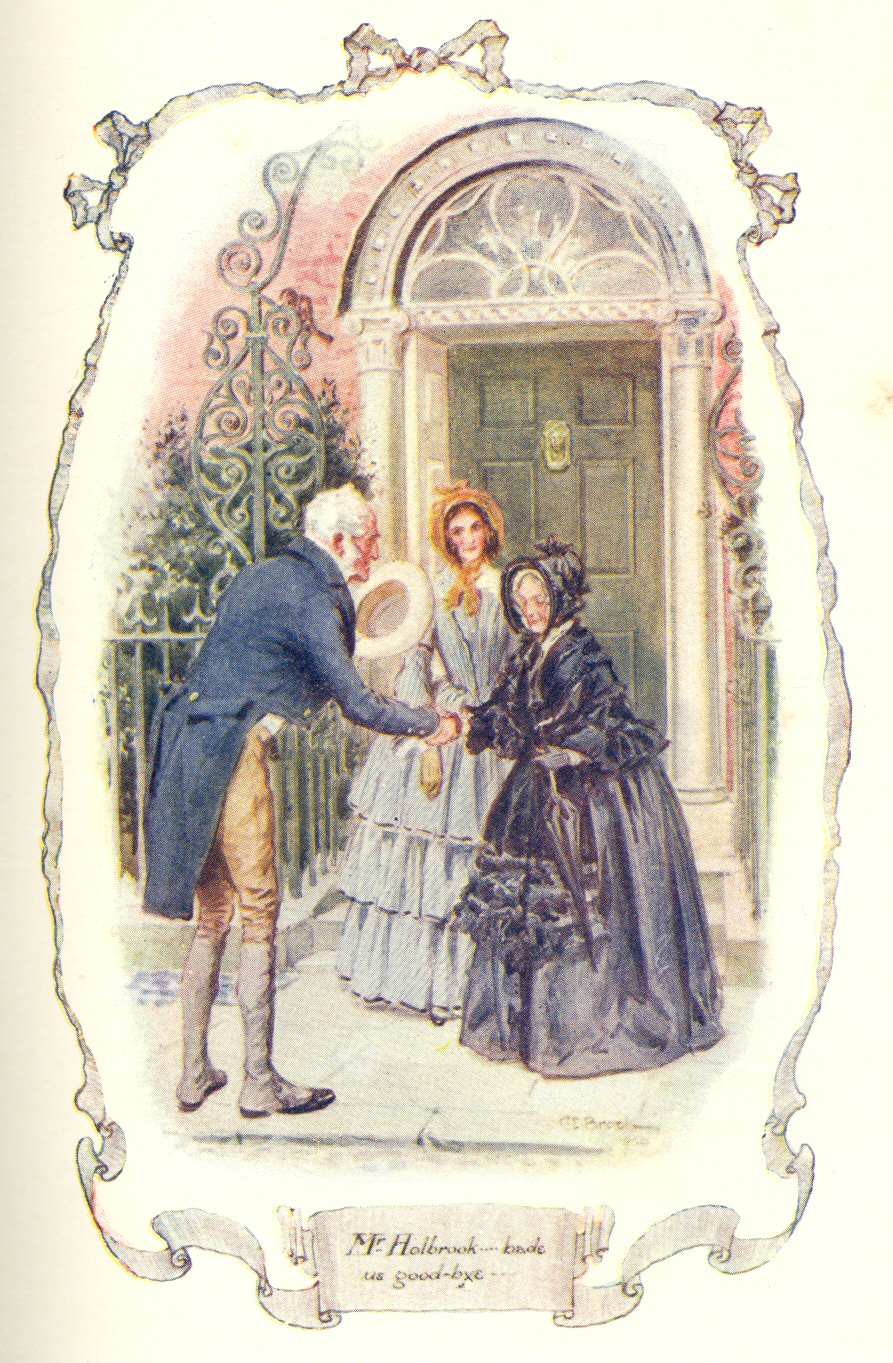
However, he kept talking to us all the time we were in the shop; and then waving the shopman with the unpurchased gloves on one side, with “Another time, sir! another time!” he walked home with us. I am happy to say my client, Miss Matilda, also left the shop in an equally bewildered state, not having purchased either green or red silk. Mr Holbrook was evidently full with honest loud-spoken joy at meeting his old love again; he touched on the changes that had taken place; he even spoke of Miss Jenkyns as “Your poor sister! Well, well! we have all our faults”; and bade us good-bye with many a hope that he should soon see Miss Matty again. She went straight to her room, and never came back till our early tea-time, when I thought she looked as if she had been crying.
However, he kept talking to us the whole time we were in the shop. Then he waved aside the shopman holding the gloves he had not bought. “Another time, sir! another time!” he said, and walked home with us. I am happy to say that my client, Miss Matilda, also left the shop just as bewildered. She had bought neither green nor red silk. Mr Holbrook was clearly filled with honest, loudly expressed joy at meeting his old love again. He mentioned the changes that had taken place. He even spoke of Miss Jenkyns, saying, “Your poor sister! Well, well! we have all our faults.” When he said goodbye, he expressed many hopes that he would soon see Miss Matty again. She went straight to her room and did not come back until our early tea-time. Then I thought she looked as if she had been crying.