Chapter 2
The Forest Gangs
She gave me a brief outline of the very peculiar social and economic system under which her people lived. At least it seemed very peculiar from my 20th Century viewpoint.
She briefly described the very peculiar social and economic system her people lived under. At least, it seemed very peculiar from my 20th-century perspective.
I learned with amazement that exactly 492 years had passed over my head as I lay unconscious in the mine.
I was amazed to learn that exactly 492 years had passed while I lay unconscious in the mine.
Wilma, for that was her name, did not profess to be a historian, and so could give me only a sketchy outline of the wars that had been fought, and the manner in which such radical changes had come about. It seemed that another war had followed the First World War, in which nearly all the European nations had banded together to break the financial and industrial power of America. They succeeded in their purpose, though they were beaten, for the war was a terrific one, and left America, like themselves, gasping, bleeding and disorganized, with only the hollow shell of a victory.
Her name was Wilma. She did not claim to be a historian, so she could give me only a rough outline of the wars and how such radical changes had come about. Apparently, another war had followed the First World War. In that war, nearly all the European nations had joined forces to break America's financial and industrial power. Though they were defeated, they succeeded. The war was terrible, and it left America, like the European nations, gasping, bleeding, and disorganized, with only a hollow victory.
This opportunity had been seized by the Russian Soviets, who had made a coalition with the Chinese, to sweep over all Europe and reduce it to a state of chaos.
The Russian Soviets seized this opportunity. They had formed an alliance with the Chinese, and together they swept across all of Europe, reducing it to chaos.
America, industrially geared to world production and the world trade, collapsed economically, and there ensued a long period of stagnation and desperate attempts at economic reconstruction. But it was impossible to stave off war with the Mongolians, who by now had subjugated the Russians, and were aiming at a world empire.
America’s industry was geared toward global production and trade, and its economy collapsed. A long period of stagnation followed, along with desperate attempts to rebuild the economy. But war with the Mongolians could not be avoided. By then, they had conquered the Russians and were seeking a world empire.
In about 2109, it seems, the conflict was finally precipitated. The Mongolians, with overwhelming fleets of great airships, and a science that far outstripped that of crippled America, swept in over the Pacific and Atlantic Coasts, and down from Canada, annihilating American aircraft, armies and cities with their terrific disintegrator rays. These rays were projected from a machine not unlike a searchlight in appearance, the reflector of which, however, was not material substance, but a complicated balance of interacting electronic forces. This resulted in a terribly destructive beam. Under its influence, material substance melted into "nothingness"; i. e., into electronic vibrations. It destroyed all then known substances, from air to the most dense metals and stone.
Around 2109, it seems, the conflict finally broke out. The Mongolians had overwhelming fleets of huge airships and technology far more advanced than that of crippled America. They swept in over the Pacific and Atlantic Coasts and down from Canada. With their terrifying disintegrator rays, they destroyed American aircraft, armies, and cities. The rays came from a machine that looked much like a searchlight. Its reflector, however, was not made of material substance. Instead, it was a complicated balance of interacting electronic forces. This produced a terribly destructive beam. Under the beam, material substance melted into "nothingness", meaning electronic vibrations. It destroyed every substance then known, from air to the densest metals and stone.
They settled down to the establishment of what became known as the Han dynasty in America, as a sort of province in their World Empire.
They set about establishing what became known as the Han dynasty in America, a sort of province in their World Empire.
Those were terrible days for the Americans. They were hunted like wild beasts. Only those survived who finally found refuge in mountains, canyons and forests. Government was at an end among them. Anarchy prevailed for several generations. Most would have been eager to submit to the Hans, even if it meant slavery. But the Hans did not want them, for they themselves had marvelous machinery and scientific process by which all difficult labor was accomplished.
Those were terrible days for the Americans. They were hunted like wild animals. Only those who found refuge in mountains, canyons, and forests survived. Their government had come to an end. Anarchy lasted for several generations. Most Americans would have eagerly submitted to the Hans, even if it meant slavery. But the Hans did not want them. They had marvelous machines and scientific methods to do all difficult labor.
Ultimately they stopped their active search for, and annihilation of, the widely scattered groups of now savage Americans. So long as they remained hidden in their forests, and did not venture near the great cities the Hans had built, little attention was paid to them.
Eventually, the Hans stopped actively hunting down and killing the scattered groups of Americans, who had become savage. As long as the Americans stayed hidden in their forests and away from the great cities the Hans had built, little attention was paid to them.
Then began the building of the new American civilization. Families and individuals gathered together in clans or "gangs" for mutual protection. For nearly a century they lived a nomadic and primitive life, moving from place to place, in desperate fear of the casual and occasional Han air raids, and the terrible disintegrator ray. As the frequency of these raids decreased, they began to stay permanently in given localities, organizing upon lines which in many respects were similar to those of the military households of the Norman feudal barons, except that instead of gathering together in castles, their defense tactics necessitated a certain scattering of living quarters for families and individuals. They lived virtually in the open air, in the forests, in green tents, resorting to camouflage tactics that would conceal their presence from air observers. They dug underground factories and laboratories, that they might better be shielded from the electrical detectors of the Hans. They tapped the radio communication lines of the Hans, with crude instruments at first; better ones later on. They bent every effort toward the redevelopment of science. For many generations they labored as unseen, unknown scholars of the Hans, picking up their knowledge piecemeal, as fast as they were able to.
Then the building of a new American civilization began. Families and individuals joined clans or "gangs" for mutual protection. For nearly a century, they lived a nomadic, primitive life, moving from place to place. They lived in desperate fear of the occasional Han air raids and the terrible disintegrator ray. As the raids became less frequent, they began to settle permanently in particular places. They organized themselves much like the military households of the Norman feudal barons. But instead of gathering in castles, they had to scatter their living quarters for defense. They lived almost entirely outdoors, in green tents in the forests. They used camouflage to hide their presence from observers in the air. They dug underground factories and laboratories to better protect themselves from the Hans' electrical detectors. They tapped the Hans' radio communication lines, using crude instruments at first and better ones later. They devoted every effort to rebuilding science. For many generations, they worked as unseen, unknown students of the Hans. They picked up the Hans' knowledge piece by piece, as fast as they could.
During the earlier part of this period, there were many deadly wars fought between the various gangs, and occasional courageous but childishly futile attacks upon the Hans, followed by terribly punitive raids.
Early in this period, the gangs fought many deadly wars among themselves. They also occasionally attacked the Hans. These attacks were brave but childishly futile, and the Hans responded with terribly punishing raids.
But as knowledge progressed, the sense of American brotherhood redeveloped. Reciprocal arrangements were made among the gangs over constantly increasing areas. Trade developed to a certain extent, as between one gang and another. But the interchange of knowledge became more important than that of goods, as skill in the handling of synthetic processes developed.
But as knowledge advanced, a sense of American brotherhood developed again. Gangs made mutual agreements across ever larger areas. They also traded goods with one another to some extent. But as they grew more skilled in synthetic processes, exchanging knowledge became more important than exchanging goods.
Within the gang, an economy was developed that was a compromise between individual liberty and a military socialism. The right of private property was limited practically to personal possessions, but private privileges were many, and sacredly regarded. Stimulation to achievement lay chiefly in the winning of various kinds of leadership and prerogatives, and only in a very limited degree in the hope of owning anything that might be classified as "wealth," and nothing that might be classified as "resources." Resources of every description, for military safety and efficiency, belonged as a matter of public interest to the community as a whole.
Within the gang, an economic system developed that balanced individual freedom with military socialism. Private property was practically limited to personal possessions, but people had many private privileges, which were held sacred. The main incentive to achieve was the chance to gain various forms of leadership and special privileges. There was little hope of owning anything that could be called "wealth," and none of owning anything called "resources." For military safety and efficiency, all kinds of resources belonged to the whole community, in the public interest.
In the meantime, through these many generations, the Hans had developed a luxury economy, and with it the perfection of gilded vice and degradation. The Americans were regarded as "wild men of the woods." And since they neither needed nor wanted the woods or the wild men, they treated them as beasts, and were conscious of no human brotherhood with them. As time went on, and synthetic processes of producing foods and materials were further developed, less and less ground was needed by the Hans for the purposes of agriculture, and finally, even the working of mines was abandoned when it became cheaper to build up metal from electronic vibrations than to dig them out of the ground.
Meanwhile, over many generations, the Hans had developed an economy built on luxury, along with a perfected culture of gilded vice and degradation. They regarded the Americans as "wild men of the woods." The Hans neither needed nor wanted the woods or the wild men, so they treated the Americans like beasts. They felt no sense of human kinship with them. Over time, synthetic methods of producing food and materials improved, and the Hans needed less and less land for agriculture. Eventually, they even stopped mining. It had become cheaper to build up metal from electronic vibrations than to dig it out of the ground.
The Han race, devitalized by its vices and luxuries, with machinery and scientific processes to satisfy its every want, with virtually no necessity of labor, began to assume a defensive attitude toward the Americans.
The Han race had been weakened by its vices and luxuries. Machinery and scientific processes satisfied its every want, leaving virtually no need for labor. The Han race began to take a defensive attitude toward the Americans.
And quite naturally, the Americans regarded the Hans with a deep, grim hatred. Conscious of individual superiority as men, knowing that latterly they were outstripping the Hans in science and civilization, they longed desperately for the day when they should be powerful enough to rise and annihilate the Yellow Blight that lay over the continent.
Naturally, the Americans felt a deep, grim hatred for the Hans. They knew they were individually superior as men. They also knew they had recently been surpassing the Hans in science and civilization. They desperately longed for the day when they would be powerful enough to rise up and annihilate the Yellow Blight covering the continent.
At the time of my awakening, the gangs were rather loosely organized, but were considering the establishment of a special military force, whose special business it would be to harry the Hans and bring down their air ships whenever possible without causing general alarm among the Mongolians. This force was destined to become the nucleus of the national force, when the Day of Retribution arrived. But that, however, did not happen for ten years, and is another story.
When I woke up, the gangs were rather loosely organized. But they were considering forming a special military force. Its job would be to harass the Hans and shoot down their airships whenever possible, without causing widespread alarm among the Mongolians. This force was destined to become the core of the national force when the Day of Retribution arrived. But the Day of Retribution did not arrive for ten years, and that is another story.
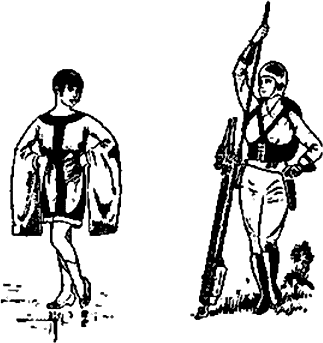
Wilma told me she was a member of the Wyoming Gang, which claimed the entire Wyoming Valley as its territory, under the leadership of Boss Hart. Her mother and father were dead, and she was unmarried, so she was not a "family member." She lived in a little group of tents known as Camp 17, under a woman Camp Boss, with seven other girls.
Wilma told me she belonged to the Wyoming Gang, which claimed the entire Wyoming Valley as its territory. Boss Hart led the gang. Her parents were dead, and she was unmarried, so she was not a "family member." She lived with seven other girls in a small group of tents called Camp 17. A woman Camp Boss led the camp.
Her duties alternated between military or police scouting and factory work. For the two-week period which would end the next day, she had been on "air patrol." This did not mean, as I first imagined, that she was flying, but rather that she was on the lookout for Han ships over this outlying section of the Wyoming territory, and had spent most of her time perched in the tree tops scanning the skies. Had she seen one she would have fired a "drop flare" several miles off to one side, which would ignite when it was floating vertically toward the earth, so that the direction or point from which it had been fired might not be guessed by the airship and bring a blasting play of the disintegrator ray in her vicinity. Other members of the air patrol would send up rockets on seeing hers, until finally a scout equipped with an ultrophone, which, unlike the ancient radio, operated on the ultronic ethereal vibrations, would pass the warning simultaneously to the headquarters of the Wyoming Gang and other communities within a radius of several hundred miles, not to mention the few American rocket ships that might be in the air, and which instantly would duck to cover either through forest clearings or by flattening down to earth in green fields where their coloring would probably protect them from observation. The favorite American method of propulsion was known as "rocketing." The rocket is what I would describe, from my 20th Century comprehension of the matter, as an extremely powerful gas blast, atomically produced through the stimulation of chemical action. Scientists of today regard it as a childishly simple reaction, but by that very virtue, most economical and efficient.
Her duties alternated between military or police scouting and factory work. For the two-week period ending the next day, she had been on "air patrol." At first I imagined she was flying, but she was actually watching for Han ships over this remote part of Wyoming territory. She had spent most of her time perched in the treetops, scanning the skies. If she had seen a ship, she would have fired a "drop flare" several miles to one side. It would ignite as it fell straight toward the earth. That way, the airship could not guess where the flare had been fired from and blast her vicinity with its disintegrator ray. On seeing her flare, other members of the air patrol would send up rockets. Eventually, a scout equipped with an ultrophone would pass the warning to several places at once. The ultrophone, unlike the ancient radio, operated on ultronic ethereal vibrations. The warning would go to the headquarters of the Wyoming Gang and other communities within several hundred miles. It would also reach any American rocket ships in the air. They would immediately take cover, either through forest clearings or by flattening down to earth in green fields. There, their coloring would probably keep them from being seen. The Americans' favorite method of propulsion was known as "rocketing." From my 20th Century understanding, I would describe the rocket as an extremely powerful gas blast, produced atomically by stimulating a chemical reaction. Scientists of today regard it as a childishly simple reaction, but for that very reason, it is most economical and efficient.
But tomorrow, she explained, she would go back to work in the cloth plant, where she would take charge of one of the synthetic processes by which those wonderful substitutes for woven fabrics of wool, cotton and silk are produced. At the end of another two weeks, she would be back on military duty again, perhaps at the same work, or maybe as a "contact guard," on duty where the territory of the Wyomings merged with that of the Delawares, or the "Susquannas" (Susquehannas) or one of the half dozen other "gangs" in that section of the country which I knew as Pennsylvania and New York States.
But tomorrow, she explained, she would return to work at the cloth plant. There, she would oversee one of the synthetic processes used to make those wonderful substitutes for woven wool, cotton, and silk fabrics. After another two weeks, she would return to military duty. Perhaps she would do the same work, or perhaps she would serve as a "contact guard." She might be stationed where the Wyomings' territory met that of the Delawares, the "Susquannas" (Susquehannas), or one of the half dozen other "gangs" in that part of the country. I knew the area as the states of Pennsylvania and New York.
Wilma cleared up for me the mystery of those flying leaps which she and her assailants had made, and explained in the following manner, how the inertron belt balances weight:
Wilma explained the mystery of the flying leaps she and her attackers had made. She explained how the inertron belt balances weight:
"Jumpers" were in common use at the time I "awoke," though they were costly, for at that time inertron had not been produced in very great quantity. They were very useful in the forest. They were belts, strapped high under the arms, containing an amount of inertron adjusted to the wearer's weight and purposes. In effect they made a man weigh as little as he desired; two pounds if he liked.
"Jumpers" were common when I "awoke," though they were expensive because inertron had not yet been produced in large quantities. They were very useful in the forest. They were belts strapped high under the arms. Each contained an amount of inertron adjusted to the wearer's weight and intended use. In effect, they made a man weigh as little as he wanted, even two pounds if he liked.
"Floaters" are a later development of "jumpers"—rocket motors encased in inertron blocks and strapped to the back in such a way that the wearer floats, when drifting, facing slightly downward. With his motor in operation, he moves like a diver, headforemost, controlling his direction by twisting his body and by movements of his outstretched arms and hands. Ballast weights locked in the front of the belt adjust weight and lift. Some men prefer a few ounces of weight in floating, using a slight motor thrust to overcome this. Others prefer a buoyance balance of a few ounces. The inadvertent dropping of weight is not a serious matter. The motor thrust always can be used to descend. But as an extra precaution, in case the motor should fail, for any reason, there are built into every belt a number of detachable sections, one or more of which can be discarded to balance off any loss in weight.
"Floaters" are a later development of "jumpers". They are rocket motors enclosed in inertron blocks and strapped to the back. They are positioned so that the wearer faces slightly downward while drifting. With the motor running, he moves headfirst like a diver. He controls his direction by twisting his body and moving his outstretched arms and hands. Ballast weights locked into the front of the belt adjust his weight and lift. Some men prefer to be a few ounces heavier than the lift they get while floating. They use a slight thrust from the motor to overcome the extra weight. Others prefer enough lift to make them buoyant by a few ounces. Accidentally dropping a weight is not a serious matter. The motor's thrust can always be used to descend. But as an extra precaution in case the motor fails for any reason, every belt has several detachable sections. One or more can be discarded to make up for any loss of weight.
"But who were your assailants," I asked, "and why were you attacked?"
"But who attacked you," I asked, "and why?"
Her assailants, she told me, were members of an outlaw gang, referred to as "Bad Bloods," a group which for several generations had been under the domination of conscienceless leaders who tried to advance the interests of their clan by tactics which their neighbors had come to regard as unfair, and who in consequence had been virtually boycotted. Their purpose had been to slay her near the Delaware frontier, making it appear that the crime had been committed by Delaware scouts and thus embroil the Delawares and Wyomings in acts of reprisal against each other, or at least cause suspicions.
She told me her attackers belonged to an outlaw gang known as the "Bad Bloods." For generations, their clan had been controlled by ruthless leaders. These leaders tried to advance the clan's interests through tactics their neighbors regarded as unfair. As a result, their neighbors had virtually boycotted the clan. The attackers had intended to kill her near the Delaware frontier and make it look like Delaware scouts had committed the crime. They hoped to provoke the Delawares and Wyomings into attacking each other in retaliation, or at least to create suspicion between them.
Fortunately they had not succeeded in surprising her, and she had been successful in dodging them for some two hours before the shooting began, at the moment when I arrived on the scene.
Fortunately, they had failed to catch her by surprise. She had dodged them for about two hours before the shooting began, just as I arrived.
"But we must not stay here talking," Wilma concluded. "I have to take you in, and besides I must report this attack right away. I think we had better slip over to the other side of the mountain. Whoever is on that post will have a phone, and I can make a direct report. But you'll have to have a belt. Mine alone won't help much against our combined weights, and there's little to be gained by jumping heavy. It's almost as bad as walking."
“But we can’t stay here talking,” Wilma concluded. “I have to take you in, and I need to report this attack right away. I think we’d better slip over to the other side of the mountain. Whoever is on that post will have a phone, so I can report directly. But you’ll need a belt. Mine alone won’t help much with our combined weight. And there’s little to gain from jumping with that much weight. It’s almost as bad as walking.”
After a little search, we found one of the men I had killed, who had floated down among the trees some distance away and whose belt was not badly damaged. In detaching it from his body, it nearly got away from me and shot up in the air. Wilma caught it, however, and though it reinforced the lift of her own belt so that she had to hook her knee around a branch to hold herself down, she saved it. I climbed the tree and, with my weight added to hers, we floated down easily.
After a short search, we found one of the men I had killed. He had floated down among the trees some distance away, and his belt was not badly damaged. As I took it off his body, it nearly got away from me and shot into the air. Wilma caught it, though. The belt added to the lift of her own belt, so she had to hook her knee around a branch to keep herself down. But she saved it. I climbed the tree, and with my weight added to hers, we floated down easily.