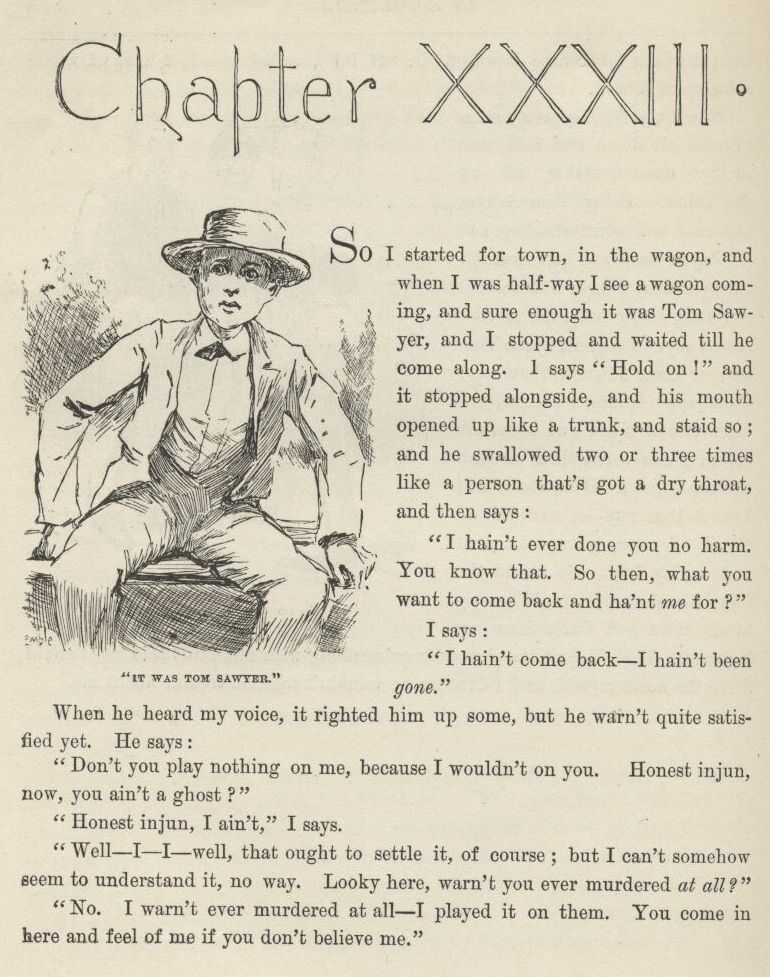
Chapter 32
When I got there it was all still and Sunday-like, and hot and sunshiny; the hands was gone to the fields; and there was them kind of faint dronings of bugs and flies in the air that makes it seem so lonesome and like everybody’s dead and gone; and if a breeze fans along and quivers the leaves it makes you feel mournful, because you feel like it’s spirits whispering—spirits that’s been dead ever so many years—and you always think they’re talking about you. As a general thing it makes a body wish he was dead, too, and done with it all.
When I got there, it was all quiet and Sunday-like, and hot and sunny. The hands was gone to the fields. And there was them faint droning sounds of bugs and flies in the air. Those sounds make it seem so lonely, like everybody’s dead and gone. And if a breeze comes along and shakes the leaves, it makes you feel mournful. That’s because you feel like it’s spirits whispering, spirits that’s been dead for so many years. And you always think they’re talking about you. Most times, it makes a body wish he was dead, too, and done with it all.
Phelps’ was one of these little one-horse cotton plantations, and they all look alike. A rail fence round a two-acre yard; a stile made out of logs sawed off and up-ended in steps, like barrels of a different length, to climb over the fence with, and for the women to stand on when they are going to jump on to a horse; some sickly grass-patches in the big yard, but mostly it was bare and smooth, like an old hat with the nap rubbed off; big double log-house for the white folks—hewed logs, with the chinks stopped up with mud or mortar, and these mud-stripes been whitewashed some time or another; round-log kitchen, with a big broad, open but roofed passage joining it to the house; log smoke-house back of the kitchen; three little log -cabins in a row t’other side the smoke-house; one little hut all by itself away down against the back fence, and some outbuildings down a piece the other side; ash-hopper and big kettle to bile soap in by the little hut; bench by the kitchen door, with bucket of water and a gourd; hound asleep there in the sun; more hounds asleep round about; about three shade trees away off in a corner; some currant bushes and gooseberry bushes in one place by the fence; outside of the fence a garden and a watermelon patch; then the cotton fields begins, and after the fields the woods.
Phelps’ was one of these little one-horse cotton plantations, and they all look alike. A rail fence ran around a two-acre yard. Steps made from logs stood by the fence, for climbing over it. The logs were cut to different lengths and stood on end, like barrels of different heights. The women stood on them, too, when they were going to jump onto a horse. Some sickly patches of grass grew in the big yard. But mostly the yard was bare and smooth, like an old hat with the fuzz rubbed off. There was a big double log house for the white folks, built of squared logs. The gaps were filled with mud or mortar, and these mud stripes had been whitewashed sometime or another. A kitchen built of round logs joined the house by a broad passage, open at the sides but roofed. A log smokehouse stood behind the kitchen. Three little log -cabins stood in a row on the other side of the smokehouse. One little hut stood all by itself, way down by the back fence. Some outbuildings stood a little farther down on the other side. By the little hut was an ash hopper and a big kettle to boil soap in. By the kitchen door was a bench, with a bucket of water and a gourd for drinking. A hound slept there in the sun, and more hounds slept here and there. About three shade trees stood way off in a corner. Some currant and gooseberry bushes grew together by the fence. Outside the fence was a garden and a watermelon patch. Then the cotton fields begins, and after the fields comes the woods.
I went around and clumb over the back stile by the ash-hopper, and started for the kitchen. When I got a little ways I heard the dim hum of a spinning-wheel wailing along up and sinking along down again; and then I knowed for certain I wished I was dead—for that is the lonesomest sound in the whole world.
I went around and clumb over the back stile by the ash-hopper, and started for the kitchen. When I got a little ways, I heard the dim hum of a spinning-wheel wailing along up and sinking along down again. And then I knowed for certain I wished I was dead, for that is the lonesomest sound in the whole world.
I went right along, not fixing up any particular plan, but just trusting to Providence to put the right words in my mouth when the time come; for I’d noticed that Providence always did put the right words in my mouth if I left it alone.
I went right along without making any particular plan. I just trusted Providence to put the right words in my mouth when the time come. For I’d noticed that Providence always did put the right words in my mouth if I left it alone.
When I got half-way, first one hound and then another got up and went for me, and of course I stopped and faced them, and kept still. And such another powwow as they made! In a quarter of a minute I was a kind of a hub of a wheel, as you may say—spokes made out of dogs—circle of fifteen of them packed together around me, with their necks and noses stretched up towards me, a-barking and howling; and more a-coming; you could see them sailing over fences and around corners from everywheres.
When I got halfway, first one hound and then another got up and came at me. Of course I stopped and faced them, and kept still. And what a racket they made! In fifteen seconds I was kind of like the hub of a wheel, you might say, with dogs for spokes. Fifteen of them were packed in a circle around me, their necks and noses stretched up toward me, barking and howling. And more were coming. You could see them flying over fences and around corners from everywhere.
A woman come tearing out of the kitchen with a rolling-pin in her hand, singing out, “Begone you Tige! you Spot! begone sah!” and she fetched first one and then another of them a clip and sent them howling, and then the rest followed; and the next second half of them come back, wagging their tails around me, and making friends with me. There ain’t no harm in a hound, nohow.
A woman come tearing out of the kitchen with a rolling pin in her hand. She was calling out, “Go away, you Tige! You Spot! Go away, sir!” And she hit first one dog and then another, sending them howling. Then the rest followed. And the next second half of them come back, wagging their tails around me and making friends with me. There ain’t no harm in a hound, nohow.
And behind the woman comes a little girl and two little boys without anything on but tow-linen shirts, and they hung on to their mother’s gown, and peeped out from behind her at me, bashful, the way they always do. And here comes the white woman running from the house, about forty-five or fifty year old, bareheaded, and her spinning-stick in her hand; and behind her comes her little white children, acting the same way the little was doing. She was smiling all over so she could hardly stand—and says:
And behind the woman comes a little girl and two little boys. They had nothing on but coarse linen shirts. They held on to their mother’s dress and peeked out from behind her at me, shy, the way they always do. And here comes the white woman running from the house, about forty-five or fifty year old. She had no hat on and carried her spinning-stick in her hand. And behind her comes her little white children, acting the same way the little was doing. She was smiling all over so she could hardly stand, and says:
“It’s you, at last!—ain’t it?”
“It’s you, at last! Ain’t it?”
I out with a “Yes’m” before I thought.
I blurted out a “Yes, ma’am” before I thought.
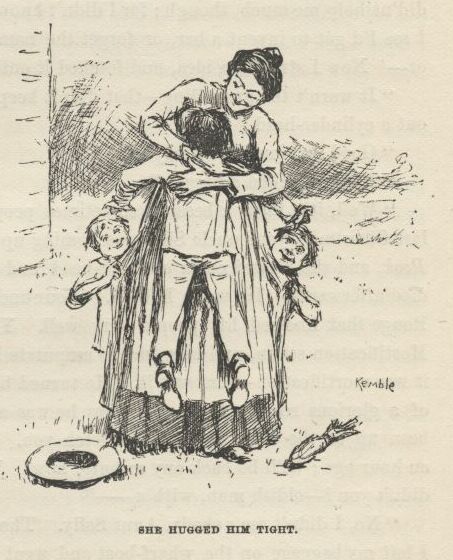
She grabbed me and hugged me tight; and then gripped me by both hands and shook and shook; and the tears come in her eyes, and run down over; and she couldn’t seem to hug and shake enough, and kept saying, “You don’t look as much like your mother as I reckoned you would; but law sakes, I don’t care for that, I’m so glad to see you! Dear, dear, it does seem like I could eat you up! Children, it’s your cousin Tom!—tell him howdy.”
She grabbed me and hugged me tight. Then she gripped both my hands and shook them over and over. Tears come into her eyes and ran down her face. She couldn’t seem to hug me and shake my hands enough. She kept saying, “You don’t look as much like your mother as I reckoned you would. But goodness sakes, I don’t care about that. I’m so glad to see you! Dear, dear, it does seem like I could eat you up! Children, it’s your cousin Tom! Say hello to him.”
But they ducked their heads, and put their fingers in their mouths, and hid behind her. So she run on:
But they ducked their heads, put their fingers in their mouths, and hid behind her. So she kept talking:
“Lize, hurry up and get him a hot breakfast right away—or did you get your breakfast on the boat?”
“Lize, hurry up and get him a hot breakfast right away. Or did you have breakfast on the boat?”
I said I had got it on the boat. So then she started for the house, leading me by the hand, and the children tagging after. When we got there she set me down in a split-bottomed chair, and set herself down on a little low stool in front of me, holding both of my hands, and says:
I said I had got it on the boat. So then she headed for the house, leading me by the hand, with the children tagging along behind. When we got there, she sat me down in a chair with a woven seat. She sat down on a little low stool in front of me, holding both my hands, and says:
“Now I can have a good look at you; and, laws-a-me, I’ve been hungry for it a many and a many a time, all these long years, and it’s come at last! We been expecting you a couple of days and more. What kep’ you?—boat get aground?”
“Now I can have a good look at you. And goodness me, I’ve been hungry for it many and many a time, all these long years. And the time has come at last! We been expecting you a couple of days and more. What kept you? Did the boat run aground?”
“Yes’m—she—”
“Yes, ma’am, she...”
“Don’t say yes’m—say Aunt Sally. Where’d she get aground?”
“Don’t say yes, ma’am. Say Aunt Sally. Where did she run aground?”
I didn’t rightly know what to say, because I didn’t know whether the boat would be coming up the river or down. But I go a good deal on instinct; and my instinct said she would be coming up—from down towards Orleans. That didn’t help me much, though; for I didn’t know the names of bars down that way. I see I’d got to invent a bar, or forget the name of the one we got aground on—or—Now I struck an idea, and fetched it out:
I didn’t rightly know what to say, because I didn’t know whether the boat would be coming upriver or downriver. But I go a good deal on instinct. And my instinct said she would be coming upriver, from down toward Orleans. That didn’t help me much, though, because I didn’t know the names of sandbars down that way. I see I’d got to invent a sandbar, or forget the name of the one we got stuck on. Or... Now an idea struck me, and I came out with it:
“It warn’t the grounding—that didn’t keep us back but a little. We blowed out a cylinder-head.”
“It wasn't running aground. That didn't keep us back but a little. We blowed out a cylinder head.”
“Good gracious! anybody hurt?”
“Good gracious! Anybody hurt?”
“No’m. Killed a .”
“No, ma’am. Killed a .”
“Well, it’s lucky; because sometimes people do get hurt. Two years ago last Christmas your uncle Silas was coming up from Newrleans on the old Lally Rook, and she blowed out a cylinder-head and crippled a man. And I think he died afterwards. He was a Baptist. Your uncle Silas knowed a family in Baton Rouge that knowed his people very well. Yes, I remember now, he did die. Mortification set in, and they had to amputate him. But it didn’t save him. Yes, it was mortification—that was it. He turned blue all over, and died in the hope of a glorious resurrection. They say he was a sight to look at. Your uncle’s been up to the town every day to fetch you. And he’s gone again, not more’n an hour ago; he’ll be back any minute now. You must a met him on the road, didn’t you?—oldish man, with a—”
“Well, it’s lucky, because sometimes people do get hurt. Two years ago last Christmas, your uncle Silas was coming up from Newrleans on the old Lally Rook. And she blowed out a cylinder head and crippled a man. And I think he died afterward. He was a Baptist. Your uncle Silas knowed a family in Baton Rouge that knowed his people very well. Yes, I remember now, he did die. Gangrene set in, and they had to amputate him. But it didn’t save him. Yes, it was gangrene, that was it. He turned blue all over, and died in the hope of a glorious resurrection. They say he was a sight to look at. Your uncle’s been up to the town every day to fetch you. And he’s gone again, not more than an hour ago. He’ll be back any minute now. You must have met him on the road, didn’t you? An older man, with a...”
“No, I didn’t see nobody, Aunt Sally. The boat landed just at daylight, and I left my baggage on the wharf-boat and went looking around the town and out a piece in the country, to put in the time and not get here too soon; and so I come down the back way.”
“No, I didn’t see nobody, Aunt Sally. The boat landed just at daylight, and I left my baggage on the floating dock. I went looking around town and a little way out into the country to pass the time. I didn’t want to get here too soon. And so I come down the back way.”
“Who’d you give the baggage to?”
“Who did you give the luggage to?”
“Nobody.”
“Nobody.”
“Why, child, it’ll be stole!”
“Why, child, it’ll be stole!”
“Not where I hid it I reckon it won’t,” I says.
“Not where I hid it, I reckon it won’t,” I says.
“How’d you get your breakfast so early on the boat?”
“How did you get your breakfast so early on the boat?”
It was kinder thin ice, but I says:
It was kind of thin ice, but I says:
“The captain see me standing around, and told me I better have something to eat before I went ashore; so he took me in the texas to the officers’ lunch, and give me all I wanted.”
“The captain see me standing around and told me I better have something to eat before I went ashore. So he took me into the officers’ quarters for lunch and give me all I wanted.”
I was getting so uneasy I couldn’t listen good. I had my mind on the children all the time; I wanted to get them out to one side and pump them a little, and find out who I was. But I couldn’t get no show, Mrs. Phelps kept it up and run on so. Pretty soon she made the cold chills streak all down my back, because she says:
I was getting so uneasy I couldn’t listen good. I had my mind on the children all the time. I wanted to get them off to one side and question them a little to find out who I was. But I couldn’t get no chance, because Mrs. Phelps kept talking and run on so. Pretty soon she sent cold chills all down my back, because she says:
“But here we’re a-running on this way, and you hain’t told me a word about Sis, nor any of them. Now I’ll rest my works a little, and you start up yourn; just tell me everything—tell me all about ’m all every one of ’m; and how they are, and what they’re doing, and what they told you to tell me; and every last thing you can think of.”
“But here we're going on this way, and you ain't told me a word about Sis, nor any of them. Now I'll stop talking for a bit, and you start. Just tell me everything. Tell me all about them, every one of them. Tell me how they are, and what they're doing, and what they told you to tell me. And every last thing you can think of.”
Well, I see I was up a stump—and up it good. Providence had stood by me this fur all right, but I was hard and tight aground now. I see it warn’t a bit of use to try to go ahead—I’d got to throw up my hand. So I says to myself, here’s another place where I got to resk the truth. I opened my mouth to begin; but she grabbed me and hustled me in behind the bed, and says:
Well, I see I was in a fix, and a bad one. Providence had stood by me this far all right, but I was completely stuck now. I see it wasn't a bit of use to try to go ahead. I'd got to give up. So I says to myself, here's another place where I got to risk the truth. I opened my mouth to begin. But she grabbed me and hurried me in behind the bed, and says:
“Here he comes! Stick your head down lower—there, that’ll do; you can’t be seen now. Don’t you let on you’re here. I’ll play a joke on him. Children, don’t you say a word.”
“Here he comes! Keep your head down lower. There, that’ll do. You can’t be seen now. Don’t you let on you’re here. I’ll play a joke on him. Children, don’t you say a word.”
I see I was in a fix now. But it warn’t no use to worry; there warn’t nothing to do but just hold still, and try and be ready to stand from under when the lightning struck.
I see I was in a fix now. But it wasn't no use to worry. There wasn't nothing to do but hold still and try to be ready to get out of the way when the lightning struck.
I had just one little glimpse of the old gentleman when he come in; then the bed hid him. Mrs. Phelps she jumps for him, and says:
I caught just one little glimpse of the old gentleman when he come in. Then the bed hid him. Mrs. Phelps she jumps toward him and says:
“Has he come?”
“Has he arrived?”
“No,” says her husband.
“No,” says her husband.
“Good-ness gracious!” she says, “what in the world can have become of him?”
“Good-ness gracious!” she says, “what in the world could have happened to him?”
“I can’t imagine,” says the old gentleman; “and I must say it makes me dreadful uneasy.”
“I can’t imagine,” says the old gentleman. “And I must say it makes me dreadful uneasy.”
“Uneasy!” she says; “I’m ready to go distracted! He must a come; and you’ve missed him along the road. I know it’s so—something tells me so.”
“Uneasy!” she says. “I’m about to lose my mind! He must have come, and you’ve missed him along the road. I know it’s so. Something tells me so.”
“Why, Sally, I couldn’t miss him along the road—you know that.”
“Why, Sally, I couldn’t miss him along the road. You know that.”
“But oh, dear, dear, what will Sis say! He must a come! You must a missed him. He—”
“But oh, dear, dear, what will Sis say! He must have come! You must have missed him. He...”
“Oh, don’t distress me any more’n I’m already distressed. I don’t know what in the world to make of it. I’m at my wit’s end, and I don’t mind acknowledging ’t I’m right down scared. But there’s no hope that he’s come; for he couldn’t come and me miss him. Sally, it’s terrible—just terrible—something’s happened to the boat, sure!”
“Oh, don’t upset me any more than I’m already upset. I don’t know what in the world to make of it. I’m at my wit’s end, and I don’t mind admitting that I’m right down scared. But there’s no hope that he’s come, because he couldn’t come and me miss him. Sally, it’s terrible, just terrible. Something’s happened to the boat, sure!”
“Why, Silas! Look yonder!—up the road!—ain’t that somebody coming?”
“Why, Silas! Look over there! Up the road! Ain’t that somebody coming?”
He sprung to the window at the head of the bed, and that give Mrs. Phelps the chance she wanted. She stooped down quick at the foot of the bed and give me a pull, and out I come; and when he turned back from the window there she stood, a-beaming and a-smiling like a house afire, and I standing pretty meek and sweaty alongside. The old gentleman stared, and says:
He sprung to the window at the head of the bed, and that give Mrs. Phelps the chance she wanted. She bent down quick at the foot of the bed and give me a pull, and out I come. And when he turned back from the window, there she stood, beaming and smiling like a house afire. And I standing pretty meek and sweaty beside her. The old gentleman stared, and says:
“Why, who’s that?”
“Why, who’s that?”
“Who do you reckon ’t is?”
“Who do you reckon it is?”
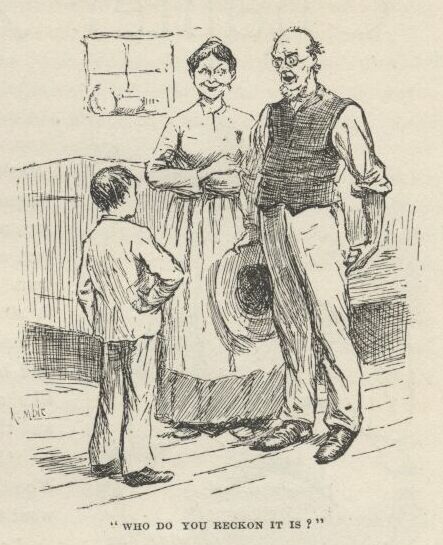
“I hain’t no idea. Who is it?”
“I ain’t no idea. Who is it?”
“It’s Tom Sawyer!”
“It’s Tom Sawyer!”
By jings, I most slumped through the floor! But there warn’t no time to swap knives; the old man grabbed me by the hand and shook, and kept on shaking; and all the time how the woman did dance around and laugh and cry; and then how they both did fire off questions about Sid, and Mary, and the rest of the tribe.
By jings, I almost fell through the floor! But there wasn't no time to swap knives. The old man grabbed me by the hand and shook it, and kept on shaking. And all the time, how the woman did dance around and laugh and cry! And then how they both did fire off questions about Sid, and Mary, and the rest of the family.
But if they was joyful, it warn’t nothing to what I was; for it was like being born again, I was so glad to find out who I was. Well, they froze to me for two hours; and at last, when my chin was so tired it couldn’t hardly go any more, I had told them more about my family—I mean the Sawyer family—than ever happened to any six Sawyer families. And I explained all about how we blowed out a cylinder-head at the mouth of White River, and it took us three days to fix it. Which was all right, and worked first-rate; because they didn’t know but what it would take three days to fix it. If I’d a called it a bolthead it would a done just as well.
But if they was joyful, it wasn't nothing to what I was. It was like being born again, I was so glad to find out who I was. Well, they stuck close to me for two hours. At last my chin was so tired it couldn't hardly go any more. By then, I had told them more about my family than ever happened to any six Sawyer families. I mean the Sawyer family. And I explained all about how we blowed out a cylinder-head at the mouth of White River. It took us three days to fix it. That story was all right, and worked first-rate. Because they didn't know whether fixing it would take three days or not. If I'd have called it a bolthead, it would have done just as well.
Now I was feeling pretty comfortable all down one side, and pretty uncomfortable all up the other. Being Tom Sawyer was easy and comfortable, and it stayed easy and comfortable till by-and-by I hear a steamboat coughing along down the river. Then I says to myself, s’pose Tom Sawyer comes down on that boat? And s’pose he steps in here any minute, and sings out my name before I can throw him a wink to keep quiet? Well, I couldn’t have it that way; it wouldn’t do at all. I must go up the road and waylay him. So I told the folks I reckoned I would go up to the town and fetch down my baggage. The old gentleman was for going along with me, but I said no, I could drive the horse myself, and I druther he wouldn’t take no trouble about me.
Now I was feeling pretty comfortable on one side, and pretty uncomfortable on the other. Being Tom Sawyer was easy and comfortable. And it stayed easy and comfortable till, after a while, I hear a steamboat coughing along down the river. Then I says to myself, suppose Tom Sawyer comes down on that boat? And suppose he steps in here any minute and calls out my name before I can wink him into keeping quiet? Well, I couldn’t have it that way. It wouldn’t do at all. I must go up the road and catch him before he gets here. So I told the folks I reckoned I would go up to town and bring back my baggage. The old gentleman wanted to go along with me, but I said no, I could drive the horse myself. And I would rather he wouldn’t take no trouble about me.