Chapter 21
It was after sun-up now, but we went right on and didn’t tie up. The king and the duke turned out by-and-by looking pretty rusty; but after they’d jumped overboard and took a swim it chippered them up a good deal. After breakfast the king he took a seat on the corner of the raft, and pulled off his boots and rolled up his britches, and let his legs dangle in the water, so as to be comfortable, and lit his pipe, and went to getting his Romeo and Juliet by heart. When he had got it pretty good, him and the duke begun to practice it together. The duke had to learn him over and over again how to say every speech; and he made him sigh, and put his hand on his heart, and after a while he said he done it pretty well; “only,” he says, “you mustn’t bellow out Romeo! that way, like a bull—you must say it soft and sick and languishy, so—R-o-o-meo! that is the idea; for Juliet’s a dear sweet mere child of a girl, you know, and she doesn’t bray like a jackass.”
It was after sunup now, but we went right on and didn’t tie up. The king and the duke turned out by-and-by looking pretty rusty. But after they’d jumped overboard and took a swim, it chippered them up a good deal. After breakfast the king he took a seat on the corner of the raft, and pulled off his boots and rolled up his britches, and let his legs dangle in the water, so as to be comfortable. He lit his pipe and went to getting his Romeo and Juliet by heart. When he had got it pretty good, him and the duke begun to practice it together. The duke had to learn him over and over again how to say every speech. He made him sigh, and put his hand on his heart, and after a while he said he done it pretty well. “Only,” he says, “you mustn’t bellow out Romeo! that way, like a bull. You must say it soft and sick and languishy, so: R-o-o-meo! That is the idea. For Juliet’s a dear sweet mere child of a girl, you know, and she doesn’t bray like a jackass.”
Well, next they got out a couple of long swords that the duke made out of oak laths, and begun to practice the sword fight—the duke called himself Richard III.; and the way they laid on and pranced around the raft was grand to see. But by-and-by the king tripped and fell overboard, and after that they took a rest, and had a talk about all kinds of adventures they’d had in other times along the river.
Well, next they got out a couple of long swords that the duke made out of thin oak strips. They begun to practice the sword fight, and the duke called himself Richard III. The way they swung their swords and pranced around the raft was grand to see. But after a while the king tripped and fell overboard. After that they took a rest and talked about all kinds of adventures they’d had along the river before.
After dinner the duke says:
After dinner, the duke says:
“Well, Capet, we’ll want to make this a first-class show, you know, so I guess we’ll add a little more to it. We want a little something to answer encores with, anyway.”
“Well, Capet, we’ll want to make this a first-rate show, you know. So I guess we’ll add a little more to the show. We want a little something to perform for encores, anyway.”
“What’s onkores, Bilgewater?”
“What’s encores, Bilgewater?”
The duke told him, and then says:
The duke told him, and then says:
“I’ll answer by doing the Highland fling or the sailor’s hornpipe; and you—well, let me see—oh, I’ve got it—you can do Hamlet’s soliloquy.”
“I’ll answer by dancing the Highland fling or the sailor’s hornpipe. And you, well, let me see. Oh, I’ve got it. You can perform Hamlet’s soliloquy.”
“Hamlet’s which?”
“Hamlet’s what?”
“Hamlet’s soliloquy, you know; the most celebrated thing in Shakespeare. Ah, it’s sublime, sublime! Always fetches the house. I haven’t got it in the book—I’ve only got one volume—but I reckon I can piece it out from memory. I’ll just walk up and down a minute, and see if I can call it back from recollection’s vaults.”
“Hamlet’s soliloquy, you know. The most famous speech in Shakespeare. Ah, it’s magnificent, magnificent! Always wins over the audience. I haven’t got it in the book. I’ve only got one volume, but I reckon I can piece the speech together from memory. I’ll just walk up and down a minute and see if I can bring it back to mind.”
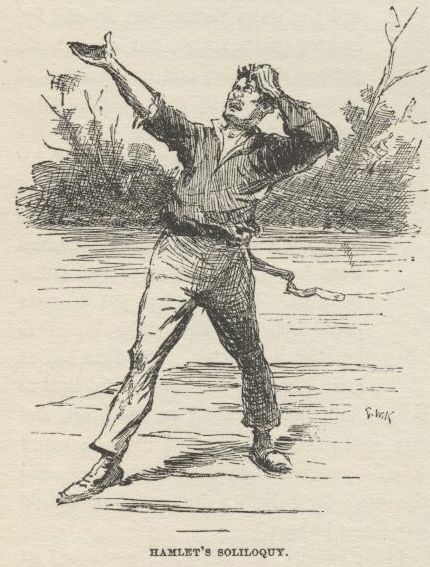
So he went to marching up and down, thinking, and frowning horrible every now and then; then he would hoist up his eyebrows; next he would squeeze his hand on his forehead and stagger back and kind of moan; next he would sigh, and next he’d let on to drop a tear. It was beautiful to see him. By-and-by he got it. He told us to give attention. Then he strikes a most noble attitude, with one leg shoved forwards, and his arms stretched away up, and his head tilted back, looking up at the sky; and then he begins to rip and rave and grit his teeth; and after that, all through his speech, he howled, and spread around, and swelled up his chest, and just knocked the spots out of any acting ever I see before. This is the speech—I learned it, easy enough, while he was learning it to the king:
So he went to marching up and down, thinking, and frowning horrible every now and then. Then he would hoist up his eyebrows. Next he would squeeze his hand on his forehead and stagger back and kind of moan. Next he would sigh, and next he’d let on to drop a tear. It was beautiful to see him. By-and-by he got it. He told us to give attention. Then he strikes a most noble attitude, with one leg shoved forwards, and his arms stretched away up, and his head tilted back, looking up at the sky. And then he begins to rip and rave and grit his teeth. After that, all through his speech, he howled, and spread around, and swelled up his chest, and just knocked the spots out of any acting ever I see before. This is the speech. I learned it, easy enough, while he was learning it to the king:
To be, or not to be; that is the bare bodkin That makes calamity of so long life; For who would fardels bear, till Birnam Wood do come to Dunsinane, But that the fear of something after death Murders the innocent sleep, Great nature’s second course, And makes us rather sling the arrows of outrageous fortune Than fly to others that we know not of. There’s the respect must give us pause: Wake Duncan with thy knocking! I would thou couldst; For who would bear the whips and scorns of time, The oppressor’s wrong, the proud man’s contumely, The law’s delay, and the quietus which his pangs might take. In the dead waste and middle of the night, when churchyards yawn In customary suits of solemn black, But that the undiscovered country from whose bourne no traveler returns, Breathes forth contagion on the world, And thus the native hue of resolution, like the poor cat i’ the adage, Is sicklied o’er with care. And all the clouds that lowered o’er our housetops, With this regard their currents turn awry, And lose the name of action. ’Tis a consummation devoutly to be wished. But soft you, the fair Ophelia: Ope not thy ponderous and marble jaws. But get thee to a nunnery—go!
To be, or not to be: that is the bare bodkin That makes calamity of so long life, For who would fardels bear, till Birnam Wood do come to Dunsinane, But that the fear of something after death Murders the innocent sleep, Great nature’s second course, And makes us rather sling the arrows of outrageous fortune Than fly to others that we know not of. There’s the respect must give us pause: Wake Duncan with thy knocking! I would thou couldst, For who would bear the whips and scorns of time, The oppressor’s wrong, the proud man’s contumely, The law’s delay, and the quietus which his pangs might take. In the dead waste and middle of the night, when churchyards yawn In customary suits of solemn black, But that the undiscovered country from whose bourne no traveler returns, Breathes forth contagion on the world, And thus the native hue of resolution, like the poor cat i’ the adage, Is sicklied o’er with care. And all the clouds that lowered o’er our housetops, With this regard their currents turn awry, And lose the name of action. ’Tis a consummation devoutly to be wished. But soft you, the fair Ophelia: Ope not thy ponderous and marble jaws. But get thee to a nunnery, go!
Well, the old man he liked that speech, and he mighty soon got it so he could do it first rate. It seemed like he was just born for it; and when he had his hand in and was excited, it was perfectly lovely the way he would rip and tear and rair up behind when he was getting it off.
Well, the old man he liked that speech, and he mighty soon learned to deliver it first rate. It seemed like he was just born for it. And when he got the hang of it and got excited, he was perfectly lovely to watch. He would rant and rave and kick up his heels while delivering the speech.
The first chance we got, the duke he had some show bills printed; and after that, for two or three days as we floated along, the raft was a most uncommon lively place, for there warn’t nothing but sword-fighting and rehearsing—as the duke called it—going on all the time. One morning, when we was pretty well down the State of Arkansaw, we come in sight of a little one-horse town in a big bend; so we tied up about three-quarters of a mile above it, in the mouth of a crick which was shut in like a tunnel by the cypress trees, and all of us but Jim took the canoe and went down there to see if there was any chance in that place for our show.
The first chance we got, the duke he had some show posters printed. After that, for two or three days as we floated along, the raft was a most uncommon lively place. There wasn't nothing but sword-fighting and rehearsing going on all the time. Rehearsing was what the duke called it. One morning, when we was pretty far down the State of Arkansaw, we spotted a little one-horse town. The town sat in a big bend in the river. So we tied up about three-quarters of a mile above the town, at the mouth of a creek. Cypress trees closed in around the creek like a tunnel. All of us but Jim took the canoe and went down to the town. We wanted to see if there was any chance for our show there.
We struck it mighty lucky; there was going to be a circus there that afternoon, and the country people was already beginning to come in, in all kinds of old shackly wagons, and on horses. The circus would leave before night, so our show would have a pretty good chance. The duke he hired the court house, and we went around and stuck up our bills. They read like this:
We struck it mighty lucky. There was going to be a circus there that afternoon, and the country people was already beginning to come in. They came in all kinds of old, rickety wagons and on horses. The circus would leave before night, so our show would have a pretty good chance. The duke he rented the courthouse, and we went around and put up our posters. The posters read like this:
Shaksperean Revival!!! Wonderful Attraction! For One Night Only! The world renowned tragedians, David Garrick the younger, of Drury Lane Theatre, London, and Edmund Kean the elder, of the Royal Haymarket Theatre, Whitechapel, Pudding Lane, Piccadilly, London, and the Royal Continental Theatres, in their sublime Shaksperean Spectacle entitled The Balcony Scene in Romeo and Juliet!!! Romeo...................................... Mr. Garrick. Juliet..................................... Mr. Kean. Assisted by the whole strength of the company! New costumes, new scenery, new appointments! Also: The thrilling, masterly, and blood-curdling Broad-sword conflict In Richard III.!!! Richard III................................ Mr. Garrick. Richmond................................... Mr. Kean. also: (by special request,) Hamlet’s Immortal Soliloquy!! By the Illustrious Kean! Done by him 300 consecutive nights in Paris! For One Night Only, On account of imperative European engagements! Admission 25 cents; children and servants, 10 cents.
Shakespearean Revival!!! Amazing Attraction! For One Night Only! The world-famous tragic actors, David Garrick the younger, of Drury Lane Theatre, London, and Edmund Kean the elder, of the Royal Haymarket Theatre, Whitechapel, Pudding Lane, Piccadilly, London, and the Royal Continental Theatres, in their magnificent Shakespearean Show called The Balcony Scene in Romeo and Juliet!!! Romeo...................................... Mr. Garrick. Juliet..................................... Mr. Kean. Supported by the entire cast! New costumes, new scenery, new stage equipment! Also: The thrilling, masterful, and bloodcurdling Broadsword Fight In Richard III.!!! Richard III................................ Mr. Garrick. Richmond................................... Mr. Kean. also: (by special request,) Hamlet’s Immortal Soliloquy!! By the Celebrated Kean! Performed by him for 300 nights in a row in Paris! For One Night Only, Because of European engagements he must keep! Admission 25 cents, children and servants, 10 cents.
Then we went loafing around the town. The stores and houses was most all old shackly dried-up frame concerns that hadn’t ever been painted; they was set up three or four foot above ground on stilts, so as to be out of reach of the water when the river was overflowed. The houses had little gardens around them, but they didn’t seem to raise hardly anything in them but jimpson weeds, and sunflowers, and ash-piles, and old curled-up boots and shoes, and pieces of bottles, and rags, and played-out tin-ware. The fences was made of different kinds of boards, nailed on at different times; and they leaned every which-way, and had gates that didn’t generly have but one hinge—a leather one. Some of the fences had been whitewashed, some time or another, but the duke said it was in Clumbus’s time, like enough. There was generly hogs in the garden, and people driving them out.
Then we went loafing around the town. The stores and houses was most all old, rickety, dried-out wooden buildings that hadn’t ever been painted. They was set up three or four foot above the ground on stilts. That was so they’d be out of reach of the water when the river overflowed. The houses had little gardens around them, but they didn’t seem to raise hardly anything but jimsonweed and sunflowers. The gardens also grew ash piles, old curled-up boots and shoes, pieces of bottles, rags, and worn-out tinware. The fences was made of different kinds of boards, nailed on at different times. They leaned every which way, and their gates didn’t generally have but one hinge, made of leather. Some of the fences had been whitewashed sometime or another. But the duke said it was in Columbus’s time, likely enough. There was generally hogs in the gardens, and people driving them out.
All the stores was along one street. They had white domestic awnings in front, and the country people hitched their horses to the awning-posts. There was empty drygoods boxes under the awnings, and loafers roosting on them all day long, whittling them with their Barlow knives; and chawing tobacco, and gaping and yawning and stretching—a mighty ornery lot. They generly had on yellow straw hats most as wide as an umbrella, but didn’t wear no coats nor waistcoats, they called one another Bill, and Buck, and Hank, and Joe, and Andy, and talked lazy and drawly, and used considerable many cuss words. There was as many as one loafer leaning up against every awning-post, and he most always had his hands in his britches-pockets, except when he fetched them out to lend a chaw of tobacco or scratch. What a body was hearing amongst them all the time was:
All the stores was along one street. They had white cotton awnings in front, and the country people hitched their horses to the awning posts. There was empty dry goods boxes under the awnings, and loafers sitting on them all day long. They whittled the boxes with their Barlow knives, chewed tobacco, and gaped and yawned and stretched. They was a mighty ornery lot. They generally had on yellow straw hats most as wide as an umbrella, but didn’t wear no coats nor vests. They called one another Bill, and Buck, and Hank, and Joe, and Andy. They talked lazy and drawly, and used considerable many cuss words. There was as many as one loafer leaning up against every awning post. He most always had his hands in his britches pockets, except when he fetched them out to lend a chew of tobacco or scratch. What a body was hearing amongst them all the time was:
“Gimme a chaw ’v tobacker, Hank.”
“Give me a chew of tobacco, Hank.”
“Cain’t; I hain’t got but one chaw left. Ask Bill.”
“Can’t. I ain’t got but one chew left. Ask Bill.”
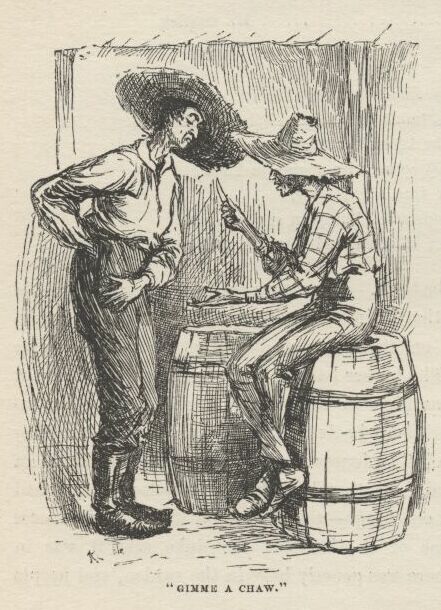
Maybe Bill he gives him a chaw; maybe he lies and says he ain’t got none. Some of them kinds of loafers never has a cent in the world, nor a chaw of tobacco of their own. They get all their chawing by borrowing; they say to a fellow, “I wisht you’d len’ me a chaw, Jack, I jist this minute give Ben Thompson the last chaw I had”—which is a lie pretty much everytime; it don’t fool nobody but a stranger; but Jack ain’t no stranger, so he says:
Maybe Bill he gives him a chew of tobacco. Maybe he lies and says he ain’t got none. Some of them kinds of loafers never has a cent in the world, nor any chewing tobacco of their own. They get all their chewing tobacco by borrowing. They say to a fellow, “I wish you’d lend me a chew, Jack. I just this minute give Ben Thompson the last chew I had.” That’s a lie pretty much every time. It don’t fool nobody but a stranger. But Jack ain’t no stranger, so he says:
“You give him a chaw, did you? So did your sister’s cat’s grandmother. You pay me back the chaws you’ve awready borry’d off’n me, Lafe Buckner, then I’ll loan you one or two ton of it, and won’t charge you no back intrust, nuther.”
“You give him a chaw, did you? So did your sister’s cat’s grandmother. You pay me back the chaws you’ve already borrowed off of me, Lafe Buckner. Then I’ll loan you one or two ton of it, and won’t charge you no back interest, either.”
“Well, I did pay you back some of it wunst.”
“Well, I did pay you back some of it once.”
“Yes, you did—’bout six chaws. You borry’d store tobacker and paid back -head.”
“Yes, you did, about six chews. You borrowed store-bought tobacco and paid back -head.”
Store tobacco is flat black plug, but these fellows mostly chaws the natural leaf twisted. When they borrow a chaw they don’t generly cut it off with a knife, but set the plug in between their teeth, and gnaw with their teeth and tug at the plug with their hands till they get it in two; then sometimes the one that owns the tobacco looks mournful at it when it’s handed back, and says, sarcastic:
Store tobacco comes in flat black plugs, but these fellows mostly chews natural tobacco leaves twisted together. When they borrow a chew, they don’t generally cut it off with a knife. Instead, they set the plug between their teeth. They gnaw on it and tug with their hands till they get it in two. Then sometimes the one that owns the tobacco looks mournful at it when it’s handed back, and says, sarcastic:
“Here, gimme the chaw, and you take the plug.”
“Here, give me the chew of tobacco, and you take the plug.”
All the streets and lanes was just mud; they warn’t nothing else but mud—mud as black as tar and nigh about a foot deep in some places, and two or three inches deep in all the places. The hogs loafed and grunted around everywheres. You’d see a muddy sow and a litter of pigs come lazying along the street and whollop herself right down in the way, where folks had to walk around her, and she’d stretch out and shut her eyes and wave her ears whilst the pigs was milking her, and look as happy as if she was on salary. And pretty soon you’d hear a loafer sing out, “Hi! so boy! sick him, Tige!” and away the sow would go, squealing most horrible, with a dog or two swinging to each ear, and three or four dozen more a-coming; and then you would see all the loafers get up and watch the thing out of sight, and laugh at the fun and look grateful for the noise. Then they’d settle back again till there was a dog fight. There couldn’t anything wake them up all over, and make them happy all over, like a dog fight—unless it might be putting turpentine on a stray dog and setting fire to him, or tying a tin pan to his tail and see him run himself to death.
All the streets and lanes was just mud. There wasn’t nothing else but mud, black as tar and nearly a foot deep in some places. It was two or three inches deep in all the places. The hogs loafed and grunted around everywhere. You’d see a muddy sow and a litter of pigs come ambling along the street. She’d flop right down in the way, where folks had to walk around her. She’d stretch out, shut her eyes, and wave her ears while the pigs was nursing. She’d look as happy as if she was on salary. And pretty soon you’d hear a loafer shout, “Hi! so boy! Sic him, Tige!” And away the sow would go, squealing something horrible, with a dog or two hanging from each ear. Three or four dozen more dogs would come running. And then you’d see all the loafers get up and watch till the chase was out of sight. They’d laugh at the fun and look grateful for the noise. Then they’d settle back again till there was a dogfight. There couldn’t anything wake them up all over and make them happy all over like a dogfight. Unless it might be putting turpentine on a stray dog and setting fire to him. Or tying a tin pan to his tail and seeing him run himself to death.
On the river front some of the houses was sticking out over the bank, and they was bowed and bent, and about ready to tumble in. The people had moved out of them. The bank was caved away under one corner of some others, and that corner was hanging over. People lived in them yet, but it was dangersome, because sometimes a strip of land as wide as a house caves in at a time. Sometimes a belt of land a quarter of a mile deep will start in and cave along and cave along till it all caves into the river in one summer. Such a town as that has to be always moving back, and back, and back, because the river’s always gnawing at it.
Along the riverfront, some of the houses was sticking out over the bank. They was bowed and bent, and about ready to tumble in. The people had moved out of them. Under one corner of some other houses, the bank had caved away, leaving that corner hanging over. People lived in them yet, but it was dangerous. Sometimes a strip of land as wide as a house caves in all at once. Sometimes a stretch of land a quarter of a mile deep starts caving in. It keeps caving in, bit by bit, till it all falls into the river in one summer. A town like that has to keep moving back, and back, and back, because the river’s always gnawing at it.
The nearer it got to noon that day the thicker and thicker was the wagons and horses in the streets, and more coming all the time. Families fetched their dinners with them from the country, and eat them in the wagons. There was considerable whisky drinking going on, and I seen three fights. By-and-by somebody sings out:
As noon got closer that day, there was more and more wagons and horses in the streets. And more was coming all the time. Families fetched their dinners with them from the country, and eat them in the wagons. There was a lot of whisky drinking going on, and I seen three fights. After a while somebody sings out:
“Here comes old Boggs!—in from the country for his little old monthly drunk; here he comes, boys!”
“Here comes old Boggs! He's in from the country for his little old monthly drinking binge. Here he comes, boys!”
All the loafers looked glad; I reckoned they was used to having fun out of Boggs. One of them says:
All the loafers looked happy. I reckoned they was used to getting laughs out of Boggs. One of them says:
“Wonder who he’s a-gwyne to chaw up this time. If he’d a-chawed up all the men he’s ben a-gwyne to chaw up in the last twenty year he’d have considerable ruputation now.”
“Wonder who he’s going to chew up this time. If he’d chewed up all the men he’s been going to chew up in the last twenty year, he’d have considerable reputation now.”
Another one says, “I wisht old Boggs ’d threaten me, ’cuz then I’d know I warn’t gwyne to die for a thousan’ year.”
Another one says, “I wish old Boggs would threaten me. Because then I’d know I weren’t going to die for a thousand year.”
Boggs comes a-tearing along on his horse, whooping and yelling like an Injun, and singing out:
Boggs comes tearing along on his horse, whooping and yelling like an Injun. He calls out:
“Cler the track, thar. I’m on the waw-path, and the price uv coffins is a-gwyne to raise.”
“Clear the track, there. I’m on the warpath, and the price of coffins is going to raise.”
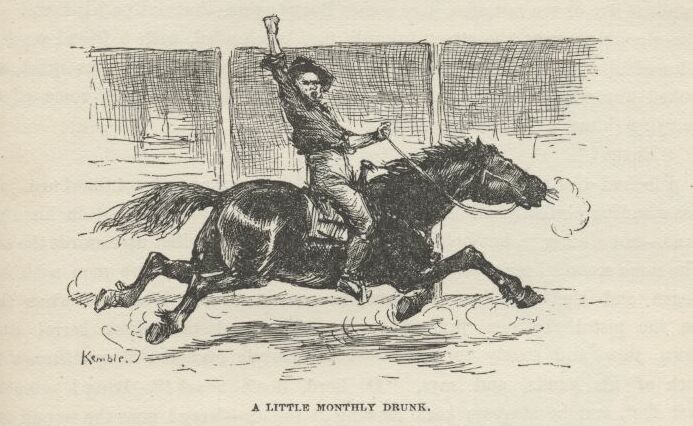
He was drunk, and weaving about in his saddle; he was over fifty year old, and had a very red face. Everybody yelled at him and laughed at him and sassed him, and he sassed back, and said he’d attend to them and lay them out in their regular turns, but he couldn’t wait now because he’d come to town to kill old Colonel Sherburn, and his motto was, “Meat first, and spoon vittles to top off on.”
He was drunk and swaying in his saddle. He was over fifty year old and had a very red face. Everybody yelled at him and laughed at him and sassed him, and he sassed back. He said he’d deal with them and knock them down, each in their turn. But he couldn’t wait now because he’d come to town to kill old Colonel Sherburn. His motto was, “Meat first, and food you eat with a spoon to finish off with.”
He see me, and rode up and says:
He see me, and rode up and says:
“Whar’d you come f’m, boy? You prepared to die?”
“Where’d you come from, boy? You prepared to die?”
Then he rode on. I was scared, but a man says:
Then he rode on. I was scared, but a man says:
“He don’t mean nothing; he’s always a-carryin’ on like that when he’s drunk. He’s the best naturedest old fool in Arkansaw—never hurt nobody, drunk nor sober.”
“He don’t mean nothing. He’s always carrying on like that when he’s drunk. He’s the best-naturedest old fool in Arkansaw. Never hurt nobody, drunk nor sober.”
Boggs rode up before the biggest store in town, and bent his head down so he could see under the curtain of the awning and yells:
Boggs rode up to the biggest store in town. He lowered his head so he could see under the awning’s curtain and yells:
“Come out here, Sherburn! Come out and meet the man you’ve swindled. You’re the houn’ I’m after, and I’m a-gwyne to have you, too!”
“Come out here, Sherburn! Come out and meet the man you’ve swindled. You’re the hound I’m after, and I’m going to have you, too!”
And so he went on, calling Sherburn everything he could lay his tongue to, and the whole street packed with people listening and laughing and going on. By-and-by a proud-looking man about fifty-five—and he was a heap the best dressed man in that town, too—steps out of the store, and the crowd drops back on each side to let him come. He says to Boggs, mighty ca’m and slow—he says:
And so he went on, calling Sherburn every name he could think of. The whole street was packed with people listening and laughing and carrying on. After a while, a proud-looking man about fifty-five steps out of the store. And he was by far the best-dressed man in that town, too. The crowd steps back on each side to let him through. He says to Boggs, mighty calm and slow, he says:
“I’m tired of this, but I’ll endure it till one o’clock. Till one o’clock, mind—no longer. If you open your mouth against me only once after that time you can’t travel so far but I will find you.”
“I’m tired of this, but I’ll put up with it until one o’clock. Until one o’clock, mind you. No longer. If you say one word against me after that, I’ll find you, no matter how far you go.”
Then he turns and goes in. The crowd looked mighty sober; nobody stirred, and there warn’t no more laughing. Boggs rode off blackguarding Sherburn as loud as he could yell, all down the street; and pretty soon back he comes and stops before the store, still keeping it up. Some men crowded around him and tried to get him to shut up, but he wouldn’t; they told him it would be one o’clock in about fifteen minutes, and so he must go home—he must go right away. But it didn’t do no good. He cussed away with all his might, and throwed his hat down in the mud and rode over it, and pretty soon away he went a-raging down the street again, with his gray hair a-flying. Everybody that could get a chance at him tried their best to coax him off of his horse so they could lock him up and get him sober; but it warn’t no use—up the street he would tear again, and give Sherburn another cussing. By-and-by somebody says:
Then he turns and goes in. The crowd looked mighty serious. Nobody stirred, and there wasn't no more laughing. Boggs rode off, shouting insults at Sherburn as loud as he could yell, all down the street. Pretty soon back he comes and stops in front of the store, still keeping it up. Some men crowded around him and tried to get him to shut up, but he wouldn't. They told him it would be one o'clock in about fifteen minutes, so he must go home. He must go right away. But it didn't do no good. He cussed away with all his might, and throwed his hat down in the mud and rode over it. Pretty soon away he went, raging down the street again, with his gray hair flying. Everybody that could get near him tried their best to coax him off his horse. They wanted to lock him up and get him sober. But it wasn't no use. Up the street he would race again, and give Sherburn another cussing. After a while somebody says:
“Go for his daughter!—quick, go for his daughter; sometimes he’ll listen to her. If anybody can persuade him, she can.”
“Get his daughter! Quick, get his daughter. Sometimes he’ll listen to her. If anybody can persuade him, she can.”
So somebody started on a run. I walked down street a ways and stopped. In about five or ten minutes here comes Boggs again, but not on his horse. He was a-reeling across the street towards me, bare-headed, with a friend on both sides of him a-holt of his arms and hurrying him along. He was quiet, and looked uneasy; and he warn’t hanging back any, but was doing some of the hurrying himself. Somebody sings out:
So somebody started running. I walked down the street a ways and stopped. In about five or ten minutes, here comes Boggs again, but not on his horse. He was staggering across the street toward me without his hat. He had a friend on each side holding his arms and hurrying him along. He was quiet and looked uneasy. And he wasn't hanging back any, but was doing some of the hurrying himself. Somebody calls out:
“Boggs!”
“Boggs!”
I looked over there to see who said it, and it was that Colonel Sherburn. He was standing perfectly still in the street, and had a pistol raised in his right hand—not aiming it, but holding it out with the barrel tilted up towards the sky. The same second I see a young girl coming on the run, and two men with her. Boggs and the men turned round to see who called him, and when they see the pistol the men jumped to one side, and the pistol-barrel come down slow and steady to a level—both barrels cocked. Boggs throws up both of his hands and says, “O Lord, don’t shoot!” Bang! goes the first shot, and he staggers back, clawing at the air—bang! goes the second one, and he tumbles backwards onto the ground, heavy and solid, with his arms spread out. That young girl screamed out and comes rushing, and down she throws herself on her father, crying, and saying, “Oh, he’s killed him, he’s killed him!” The crowd closed up around them, and shouldered and jammed one another, with their necks stretched, trying to see, and people on the inside trying to shove them back and shouting, “Back, back! give him air, give him air!”
I looked over there to see who said it, and it was that Colonel Sherburn. He was standing perfectly still in the street, with a pistol raised in his right hand. He wasn’t aiming it, just holding it out with the barrel tilted up towards the sky. That same second I see a young girl coming on the run, and two men with her. Boggs and the men turned round to see who called him. When they see the pistol, the men jumped to one side. The pistol barrel come down slow and steady until it was level, both barrels cocked. Boggs throws up both his hands and says, “O Lord, don’t shoot!” Bang! goes the first shot, and he staggers back, clawing at the air. Bang! goes the second one, and he tumbles backwards onto the ground, heavy and solid, with his arms spread out. That young girl screamed out and comes rushing over. Down she throws herself on her father, crying and saying, “Oh, he’s killed him, he’s killed him!” The crowd closed in around them. People shoved and squeezed against one another, stretching their necks, trying to see. People on the inside tried to shove them back, shouting, “Back, back! Give him air, give him air!”
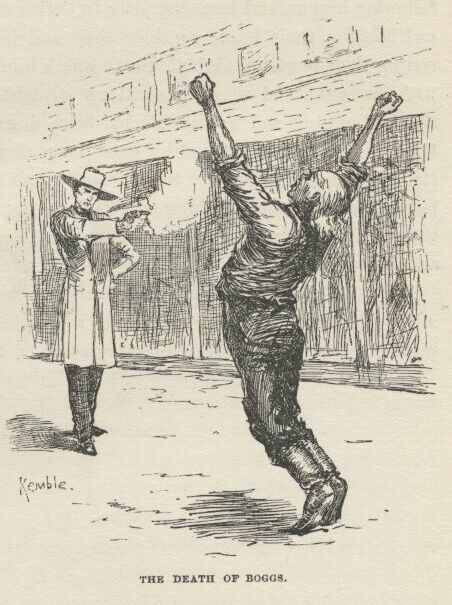
Colonel Sherburn he tossed his pistol onto the ground, and turned around on his heels and walked off.
Colonel Sherburn he tossed his pistol onto the ground. Then he turned on his heels and walked away.
They took Boggs to a little drug store, the crowd pressing around just the same, and the whole town following, and I rushed and got a good place at the window, where I was close to him and could see in. They laid him on the floor and put one large Bible under his head, and opened another one and spread it on his breast; but they tore open his shirt first, and I seen where one of the bullets went in. He made about a dozen long gasps, his breast lifting the Bible up when he drawed in his breath, and letting it down again when he breathed it out—and after that he laid still; he was dead. Then they pulled his daughter away from him, screaming and crying, and took her off. She was about sixteen, and very sweet and gentle-looking, but awful pale and scared.
They took Boggs to a little drugstore, with the crowd still pressing around and the whole town following. I rushed over and got a good place at the window, close to him, where I could see inside. They laid him on the floor and put one large Bible under his head. They opened another Bible and spread it on his chest. But first they tore open his shirt, and I seen where one of the bullets went in. He gave about a dozen long gasps. His chest lifted the Bible when he drawed in his breath and lowered it when he breathed out. After that he laid still. He was dead. Then they pulled his daughter away from him and took her off, screaming and crying. She was about sixteen, and very sweet and gentle-looking, but awful pale and scared.
Well, pretty soon the whole town was there, squirming and scrouging and pushing and shoving to get at the window and have a look, but people that had the places wouldn’t give them up, and folks behind them was saying all the time, “Say, now, you’ve looked enough, you fellows; ’tain’t right and ’tain’t fair for you to stay thar all the time, and never give nobody a chance; other folks has their rights as well as you.”
Well, pretty soon the whole town was there, squirming and crowding and pushing and shoving. They wanted to get at the window and have a look. But people that had the spots wouldn’t give them up. And folks behind them was saying all the time, “Say, now, you’ve looked enough, you fellows. It ain’t right and it ain’t fair for you to stay there all the time and never give nobody a chance. Other folks has their rights as well as you.”
There was considerable jawing back, so I slid out, thinking maybe there was going to be trouble. The streets was full, and everybody was excited. Everybody that seen the shooting was telling how it happened, and there was a big crowd packed around each one of these fellows, stretching their necks and listening. One long, lanky man, with long hair and a big white fur stovepipe hat on the back of his head, and a crooked-handled cane, marked out the places on the ground where Boggs stood and where Sherburn stood, and the people following him around from one place to t’other and watching everything he done, and bobbing their heads to show they understood, and stooping a little and resting their hands on their thighs to watch him mark the places on the ground with his cane; and then he stood up straight and stiff where Sherburn had stood, frowning and having his hat-brim down over his eyes, and sung out, “Boggs!” and then fetched his cane down slow to a level, and says “Bang!” staggered backwards, says “Bang!” again, and fell down flat on his back. The people that had seen the thing said he done it perfect; said it was just exactly the way it all happened. Then as much as a dozen people got out their bottles and treated him.
There was a lot of arguing back, so I slipped out, thinking maybe there was going to be trouble. The streets was full, and everybody was excited. Everybody that seen the shooting was telling how it happened. A big crowd was packed around each of these fellows, stretching their necks and listening. One tall, lanky man had long hair and a big white fur stovepipe hat tipped back on his head. He carried a cane with a crooked handle. He marked out the places on the ground where Boggs stood and where Sherburn stood. The people followed him from one place to the other, watching everything he done. They nodded to show they understood. They bent down a little, resting their hands on their thighs, to watch him mark the places with his cane. Then he stood up straight and stiff where Sherburn had stood. He frowned, pulled his hat brim down over his eyes, and called out, “Boggs!” Then he slowly lowered his cane till it was level, and says “Bang!” He staggered backwards, says “Bang!” again, and fell flat on his back. The people that had seen the shooting said he done it perfect. They said it was just exactly the way it all happened. Then as many as a dozen people got out their bottles and gave him a drink.
Well, by-and-by somebody said Sherburn ought to be lynched. In about a minute everybody was saying it; so away they went, mad and yelling, and snatching down every clothes-line they come to, to do the hanging with.
Well, after a while somebody said Sherburn ought to be lynched. In about a minute everybody was saying it. So off they went, angry and yelling, snatching down every clothesline they come to, to use for the hanging.