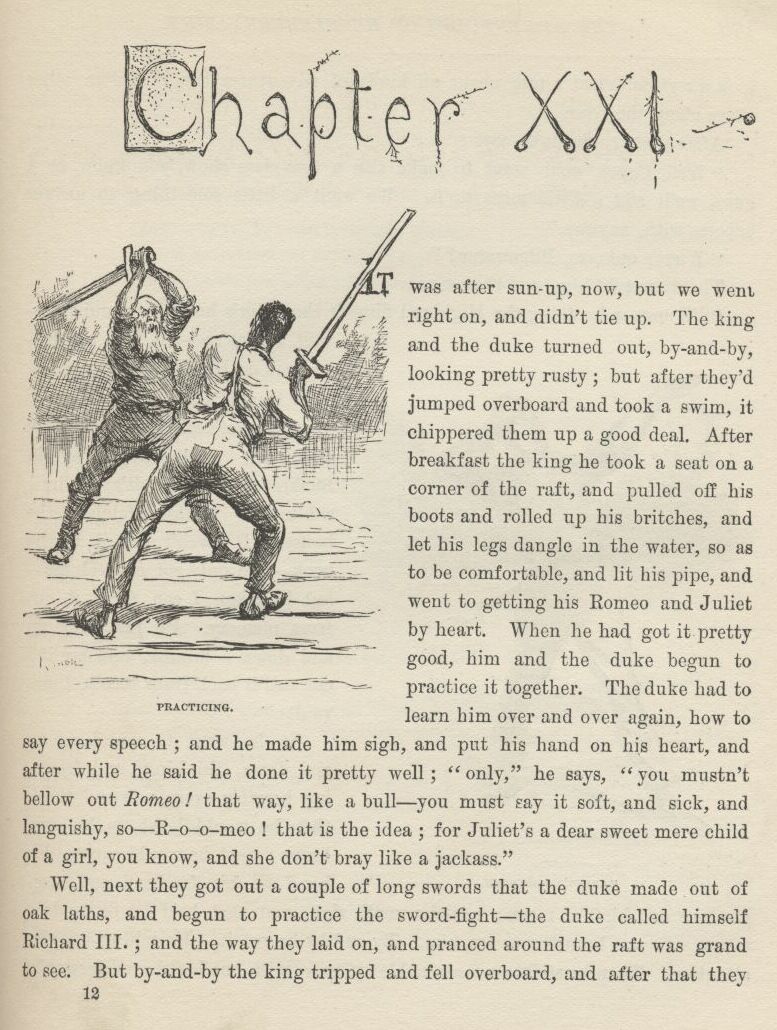
Chapter 20
They asked us considerable many questions; wanted to know what we covered up the raft that way for, and laid by in the daytime instead of running—was Jim a runaway ? Says I:
They asked us considerable many questions. Wanted to know what we covered up the raft that way for. And why we stayed put during the day instead of traveling. Was Jim a runaway ? Says I:
“Goodness sakes, would a runaway run south?”
“Goodness sakes, would a runaway run south?”
No, they allowed he wouldn’t. I had to account for things some way, so I says:
No, they agreed he wouldn’t. I had to explain things some way, so I says:
“My folks was living in Pike County, in Missouri, where I was born, and they all died off but me and pa and my brother Ike. Pa, he ’lowed he’d break up and go down and live with Uncle Ben, who’s got a little one-horse place on the river, forty-four mile below Orleans. Pa was pretty poor, and had some debts; so when he’d squared up there warn’t nothing left but sixteen dollars and our , Jim. That warn’t enough to take us fourteen hundred mile, deck passage nor no other way. Well, when the river rose pa had a streak of luck one day; he ketched this piece of a raft; so we reckoned we’d go down to Orleans on it. Pa’s luck didn’t hold out; a steamboat run over the forrard corner of the raft one night, and we all went overboard and dove under the wheel; Jim and me come up all right, but pa was drunk, and Ike was only four years old, so they never come up no more. Well, for the next day or two we had considerable trouble, because people was always coming out in skiffs and trying to take Jim away from me, saying they believed he was a runaway . We don’t run daytimes no more now; nights they don’t bother us.”
“My folks was living in Pike County, in Missouri, where I was born, and they all died off but me and pa and my brother Ike. Pa, he allowed he’d break up and go down and live with Uncle Ben, who’s got a little one-horse place on the river, forty-four mile below Orleans. Pa was pretty poor, and had some debts. So when he’d squared up there wasn’t nothing left but sixteen dollars and our , Jim. That wasn’t enough to take us fourteen hundred mile, deck passage nor no other way. Well, when the river rose pa had a streak of luck one day. He catched this piece of a raft, so we reckoned we’d go down to Orleans on it. Pa’s luck didn’t hold out. A steamboat run over the forward corner of the raft one night, and we all went overboard and dove under the wheel. Jim and me come up all right, but pa was drunk, and Ike was only four years old, so they never come up no more. Well, for the next day or two we had considerable trouble, because people was always coming out in skiffs and trying to take Jim away from me, saying they believed he was a runaway . We don’t run daytimes no more now. Nights they don’t bother us.”
The duke says:
The duke says:
“Leave me alone to cipher out a way so we can run in the daytime if we want to. I’ll think the thing over—I’ll invent a plan that’ll fix it. We’ll let it alone for to-day, because of course we don’t want to go by that town yonder in daylight—it mightn’t be healthy.”
“Leave me alone to figure out a way we can travel in the daytime if we want to. I’ll think it over. I’ll come up with a plan that’ll fix it. We’ll leave it alone for today, because of course we don’t want to pass that town over there in daylight. It might not be good for our health.”
Towards night it begun to darken up and look like rain; the heat lightning was squirting around low down in the sky, and the leaves was beginning to shiver—it was going to be pretty ugly, it was easy to see that. So the duke and the king went to overhauling our wigwam, to see what the beds was like. My bed was a straw tick better than Jim’s, which was a corn-shuck tick; there’s always cobs around about in a shuck tick, and they poke into you and hurt; and when you roll over the dry shucks sound like you was rolling over in a pile of dead leaves; it makes such a rustling that you wake up. Well, the duke allowed he would take my bed; but the king allowed he wouldn’t. He says:
Towards night it begun to get dark and look like rain. Heat lightning was flashing low in the sky, and the leaves was beginning to tremble. The weather was going to get pretty ugly. It was easy to see that. So the duke and the king went to looking through our wigwam to see what the beds was like. My bed was a straw mattress, better than Jim’s, which was a corn-husk mattress. There’s always bits of corncob in a corn-husk mattress, and they poke into you and hurt. And when you roll over, the dry husks sound like you was rolling over in a pile of dead leaves. The rustling is so loud that you wake up. Well, the duke said he would take my bed. But the king said the duke wouldn’t. He says:
“I should a reckoned the difference in rank would a sejested to you that a corn-shuck bed warn’t just fitten for me to sleep on. Your Grace’ll take the shuck bed yourself.”
“I should have reckoned the difference in rank would have suggested to you that a corn-shuck bed wasn’t just fitting for me to sleep on. Your Grace will take the shuck bed yourself.”
Jim and me was in a sweat again for a minute, being afraid there was going to be some more trouble amongst them; so we was pretty glad when the duke says:
Jim and me was in a sweat again for a minute. We was afraid there was going to be some more trouble among them. So we was pretty glad when the duke says:
“’Tis my fate to be always ground into the mire under the iron heel of oppression. Misfortune has broken my once haughty spirit; I yield, I submit; ’tis my fate. I am alone in the world—let me suffer; I can bear it.”
“It is my fate to always be ground into the mud under the iron heel of oppression. Misfortune has broken my once proud spirit. I give in. I submit. It is my fate. I am alone in the world. Let me suffer. I can bear it.”
We got away as soon as it was good and dark. The king told us to stand well out towards the middle of the river, and not show a light till we got a long ways below the town. We come in sight of the little bunch of lights by-and-by—that was the town, you know—and slid by, about a half a mile out, all right. When we was three-quarters of a mile below we hoisted up our signal lantern; and about ten o’clock it come on to rain and blow and thunder and lighten like everything; so the king told us to both stay on watch till the weather got better; then him and the duke crawled into the wigwam and turned in for the night. It was my watch below till twelve, but I wouldn’t a turned in anyway if I’d had a bed, because a body don’t see such a storm as that every day in the week, not by a long sight. My souls, how the wind did scream along! And every second or two there’d come a glare that lit up the white-caps for a half a mile around, and you’d see the islands looking dusty through the rain, and the trees thrashing around in the wind; then comes a h-whack!—bum! bum! bumble-umble-um-bum-bum-bum-bum—and the thunder would go rumbling and grumbling away, and quit—and then rip comes another flash and another sockdolager. The waves most washed me off the raft sometimes, but I hadn’t any clothes on, and didn’t mind. We didn’t have no trouble about snags; the lightning was glaring and flittering around so constant that we could see them plenty soon enough to throw her head this way or that and miss them.
We got away as soon as it was good and dark. The king told us to head well out toward the middle of the river. We wasn't to show a light till we got a long ways below the town. Before long, we come in sight of the little bunch of lights. That was the town, you know. We slid by all right, about half a mile out. When we was three-quarters of a mile below town, we raised our signal lantern. About ten o’clock it started to rain and blow and thunder and lightning like everything. So the king told us both to stay on watch till the weather got better. Then him and the duke crawled into the wigwam and went to bed for the night. I was off watch till twelve, but I wouldn’t have gone to bed anyway, even if I’d had one. Because a body don’t see such a storm as that every day of the week, not by a long shot. My souls, how the wind did scream along! And every second or two, a flash would light up the whitecaps for half a mile around. You’d see the islands looking dusty through the rain, and the trees thrashing around in the wind. Then comes a h-whack! Bum! bum! bumble-umble-um-bum-bum-bum-bum! The thunder would go rumbling and grumbling away, and stop. And then rip comes another flash and another sockdolager. The waves almost washed me off the raft sometimes, but I hadn’t any clothes on, and didn’t mind. We didn’t have no trouble with snags. The lightning flashed and flickered so constantly that we could see them plenty soon enough. We could turn the raft’s front end this way or that and miss them.
I had the middle watch, you know, but I was pretty sleepy by that time, so Jim he said he would stand the first half of it for me; he was always mighty good that way, Jim was. I crawled into the wigwam, but the king and the duke had their legs sprawled around so there warn’t no show for me; so I laid outside—I didn’t mind the rain, because it was warm, and the waves warn’t running so high now. About two they come up again, though, and Jim was going to call me; but he changed his mind, because he reckoned they warn’t high enough yet to do any harm; but he was mistaken about that, for pretty soon all of a sudden along comes a regular ripper and washed me overboard. It most killed Jim a-laughing. He was the easiest to laugh that ever was, anyway.
I had the middle watch, you know, but I was pretty sleepy by then. So Jim he said he would stand the first half of it for me. He was always mighty good that way, Jim was. I crawled into the wigwam, but the king and the duke had their legs sprawled out everywhere. There wasn't no room for me, so I laid outside. I didn't mind the rain, because it was warm, and the waves wasn't running so high now. About two the waves come up again, though, and Jim was going to call me. But he changed his mind, because he reckoned the waves wasn't high enough yet to do any harm. But he was mistaken about that. Pretty soon, all of a sudden, along comes a real whopper of a wave and washed me overboard. It nearly killed Jim laughing. He was the quickest to laugh that ever was, anyway.
I took the watch, and Jim he laid down and snored away; and by-and-by the storm let up for good and all; and the first cabin-light that showed, I rousted him out and we slid the raft into hiding quarters for the day.
I kept watch, and Jim he laid down and snored away. After a while, the storm stopped for good. When the first cabin light showed, I woke him up, and we slid the raft into hiding for the day.
The king got out an old ratty deck of cards after breakfast, and him and the duke played seven-up a while, five cents a game. Then they got tired of it, and allowed they would “lay out a campaign,” as they called it. The duke went down into his carpet-bag, and fetched up a lot of little printed bills and read them out loud. One bill said, “The celebrated Dr. Armand de Montalban, of Paris,” would “lecture on the Science of Phrenology” at such and such a place, on the blank day of blank, at ten cents admission, and “furnish charts of character at twenty-five cents apiece.” The duke said that was him. In another bill he was the “world-renowned Shakespearian tragedian, Garrick the Younger, of Drury Lane, London.” In other bills he had a lot of other names and done other wonderful things, like finding water and gold with a “divining-rod,” “dissipating witch spells,” and so on. By-and-by he says:
The king got out an old beat-up deck of cards after breakfast. Him and the duke played seven-up a while, five cents a game. Then they got tired of it and decided they would “lay out a campaign,” as they called it. The duke dug into his carpet-bag and pulled out a lot of little printed flyers. He read them out loud. One flyer said, “The celebrated Dr. Armand de Montalban, of Paris,” would “give a talk on the Science of Phrenology.” The talk would be at such and such a place, on the blank day of blank, with ten cents admission. He would also “provide character charts at twenty-five cents apiece.” The duke said that was him. In another flyer he was the “world-famous Shakespearian tragic actor, Garrick the Younger, of Drury Lane, London.” In other flyers he had a lot of other names and done other wonderful things. These included finding water and gold with a “divining-rod,” “breaking witches’ spells,” and so on. After a while he says:
“But the histrionic muse is the darling. Have you ever trod the boards, Royalty?”
“But acting is my favorite. Have you ever performed on stage, Royalty?”
“No,” says the king.
“No,” says the king.
“You shall, then, before you’re three days older, Fallen Grandeur,” says the duke. “The first good town we come to we’ll hire a hall and do the sword fight in Richard III. and the balcony scene in Romeo and Juliet. How does that strike you?”
“You will, then, within three days, Fallen Grandeur,” says the duke. “At the first good town we reach, we’ll rent a hall. We’ll perform the sword fight from Richard III and the balcony scene from Romeo and Juliet. How does that sound to you?”
“I’m in, up to the hub, for anything that will pay, Bilgewater; but, you see, I don’t know nothing about play-actin’, and hain’t ever seen much of it. I was too small when pap used to have ’em at the palace. Do you reckon you can learn me?”
“I’m all in for anything that will pay, Bilgewater. But, you see, I don’t know nothing about acting, and ain’t ever seen much of it. I was too small when pap used to have plays at the palace. Do you reckon you can learn me?”
“Easy!”
“Easy!”
“All right. I’m jist a-freezn’ for something fresh, anyway. Le’s commence right away.”
“All right. I’m just itching for something new, anyway. Let’s start right away.”
So the duke he told him all about who Romeo was and who Juliet was, and said he was used to being Romeo, so the king could be Juliet.
So the duke he told him all about who Romeo was and who Juliet was. And he said he was used to playing Romeo, so the king could play Juliet.
“But if Juliet’s such a young gal, duke, my peeled head and my white whiskers is goin’ to look oncommon odd on her, maybe.”
“But if Juliet’s such a young gal, duke, my bald head and my white whiskers is going to look unusually odd on her, maybe.”
“No, don’t you worry; these country jakes won’t ever think of that. Besides, you know, you’ll be in costume, and that makes all the difference in the world; Juliet’s in a balcony, enjoying the moonlight before she goes to bed, and she’s got on her night-gown and her ruffled nightcap. Here are the costumes for the parts.”
“No, don’t you worry. These country jakes won’t ever think of that. Besides, you know, you’ll be in costume, and that makes all the difference in the world. Juliet’s on a balcony, enjoying the moonlight before she goes to bed. She’s got on her nightgown and her ruffled nightcap. Here are the costumes for the parts.”
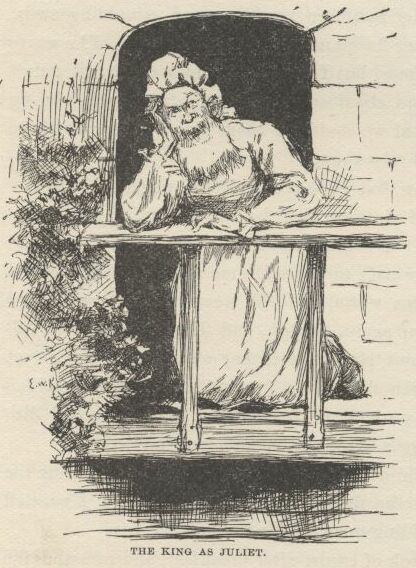
He got out two or three curtain-calico suits, which he said was meedyevil armor for Richard III. and t’other chap, and a long white cotton nightshirt and a ruffled nightcap to match. The king was satisfied; so the duke got out his book and read the parts over in the most splendid spread-eagle way, prancing around and acting at the same time, to show how it had got to be done; then he give the book to the king and told him to get his part by heart.
He got out two or three suits made of printed cotton curtain fabric. He said they was medieval armor for Richard III and the other fellow. He also got out a long white cotton nightshirt and a matching ruffled nightcap. The king was satisfied. So the duke got out his book and read the parts in the most grand, over-the-top way. He pranced around and acted as he read, to show how it had got to be done. Then he give the book to the king and told him to learn his part by heart.
There was a little one-horse town about three mile down the bend, and after dinner the duke said he had ciphered out his idea about how to run in daylight without it being dangersome for Jim; so he allowed he would go down to the town and fix that thing. The king allowed he would go, too, and see if he couldn’t strike something. We was out of coffee, so Jim said I better go along with them in the canoe and get some.
There was a little backwater town about three mile down the bend. After dinner, the duke said he had figured out how to travel in daylight without putting Jim in danger. So he said he would go down to the town and get that arranged. The king said he would go, too, and see if he couldn’t turn something up. We was out of coffee, so Jim said I better go along with them in the canoe and get some.
When we got there there warn’t nobody stirring; streets empty, and perfectly dead and still, like Sunday. We found a sick sunning himself in a back yard, and he said everybody that warn’t too young or too sick or too old was gone to camp-meeting, about two mile back in the woods. The king got the directions, and allowed he’d go and work that camp-meeting for all it was worth, and I might go, too.
When we got there, there wasn't nobody stirring. The streets were empty, and everything was dead and still, like Sunday. We found a sick sunning himself in a backyard. He said everybody that wasn't too young or too sick or too old had gone to a camp meeting. The meeting was about two mile back in the woods. The king got directions and said he'd go and work that camp meeting for all it was worth. And I could go, too.
The duke said what he was after was a printing-office. We found it; a little bit of a concern, up over a carpenter shop—carpenters and printers all gone to the meeting, and no doors locked. It was a dirty, littered-up place, and had ink marks, and handbills with pictures of horses and runaway on them, all over the walls. The duke shed his coat and said he was all right now. So me and the king lit out for the camp-meeting.
The duke said what he was after was a printing shop. We found it, a tiny place upstairs over a carpenter’s shop. The carpenters and printers had all gone to the meeting, and no doors were locked. It was a dirty, cluttered place. The walls were covered with ink marks and flyers with pictures of horses and runaway on them. The duke took off his coat and said he was all right now. So me and the king headed off to the camp meeting.
We got there in about a half an hour fairly dripping, for it was a most awful hot day. There was as much as a thousand people there from twenty mile around. The woods was full of teams and wagons, hitched everywheres, feeding out of the wagon-troughs and stomping to keep off the flies. There was sheds made out of poles and roofed over with branches, where they had lemonade and gingerbread to sell, and piles of watermelons and green corn and such-like truck.
We got there in about a half an hour, just dripping with sweat because it was a most awful hot day. There was as many as a thousand people there from twenty mile around. The woods was full of teams of horses and wagons, hitched everywhere. The horses was feeding out of the wagon troughs and stomping to keep off the flies. There was sheds made out of poles, with roofs of branches, where they sold lemonade and gingerbread. They also had piles of watermelons and fresh corn and stuff like that.
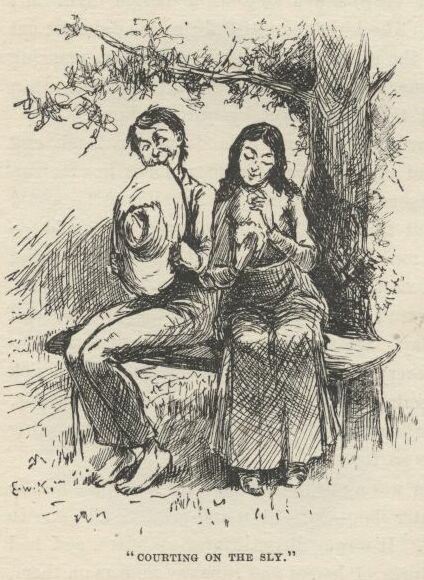
The preaching was going on under the same kinds of sheds, only they was bigger and held crowds of people. The benches was made out of outside slabs of logs, with holes bored in the round side to drive sticks into for legs. They didn’t have no backs. The preachers had high platforms to stand on at one end of the sheds. The women had on sun-bonnets; and some had linsey-woolsey frocks, some gingham ones, and a few of the young ones had on calico. Some of the young men was barefooted, and some of the children didn’t have on any clothes but just a tow-linen shirt. Some of the old women was knitting, and some of the young folks was courting on the sly.
The preaching was going on under the same kinds of sheds, only they was bigger and held crowds of people. The benches was made out of the outer slabs of logs. Holes were drilled in the rounded side so sticks could be driven in for legs. The benches didn’t have no backs. The preachers had high platforms to stand on at one end of the sheds. The women had on sunbonnets. Some had dresses made of linen and wool, some had gingham dresses, and a few young women had on calico. Some of the young men was barefoot, and some of the children didn’t have on any clothes but a coarse linen shirt. Some of the old women was knitting, and some of the young folks was flirting on the sly.
The first shed we come to the preacher was lining out a hymn. He lined out two lines, everybody sung it, and it was kind of grand to hear it, there was so many of them and they done it in such a rousing way; then he lined out two more for them to sing—and so on. The people woke up more and more, and sung louder and louder; and towards the end some begun to groan, and some begun to shout. Then the preacher begun to preach, and begun in earnest, too; and went weaving first to one side of the platform and then the other, and then a-leaning down over the front of it, with his arms and his body going all the time, and shouting his words out with all his might; and every now and then he would hold up his Bible and spread it open, and kind of pass it around this way and that, shouting, “It’s the brazen serpent in the wilderness! Look upon it and live!” And people would shout out, “Glory!—A-a-men!” And so he went on, and the people groaning and crying and saying amen:
At the first shed we come to, the preacher was calling out a hymn two lines at a time. He called out two lines, and everybody sung them. It was kind of grand to hear so many people singing in such a rousing way. Then he called out two more lines for them to sing, and so on. The people got more and more stirred up and sung louder and louder. Towards the end, some begun to groan, and some begun to shout. Then the preacher begun to preach, and he really put his heart into it, too. He moved back and forth across the platform, then leaned down over the front. His arms and body were moving the whole time, and he shouted his words with all his might. Every now and then he would hold up his Bible and spread it open. He would wave it this way and that, shouting, “It’s the bronze serpent in the wilderness! Look at it and live!” And people would shout out, “Glory! A-a-men!” And so he went on, with the people groaning and crying and saying amen:
“Oh, come to the mourners’ bench! come, black with sin! (amen!) come, sick and sore! (amen!) come, lame and halt and blind! (amen!) come, pore and needy, sunk in shame! (a-a-men!) come, all that’s worn and soiled and suffering!—come with a broken spirit! come with a contrite heart! come in your rags and sin and dirt! the waters that cleanse is free, the door of heaven stands open—oh, enter in and be at rest!” (a-a-men! glory, glory hallelujah!)
“Oh, come to the mourners’ bench! Come, black with sin! (amen!) Come, sick and hurting! (amen!) Come, the limping, the disabled, and the blind! (amen!) Come, poor and needy, sunk in shame! (a-a-men!) Come, all that’s worn out and dirty and suffering! Come with a broken spirit! Come with a repentant heart! Come in your rags and sin and dirt! The waters that cleanse is free. The door of heaven stands open. Oh, enter and be at rest!” (a-a-men! glory, glory hallelujah!)
And so on. You couldn’t make out what the preacher said any more, on account of the shouting and crying. Folks got up everywheres in the crowd, and worked their way just by main strength to the mourners’ bench, with the tears running down their faces; and when all the mourners had got up there to the front benches in a crowd, they sung and shouted and flung themselves down on the straw, just crazy and wild.
And so on. You couldn’t make out what the preacher said anymore because of the shouting and crying. Folks got up everywhere in the crowd and forced their way to the mourners’ bench, tears running down their faces. And when all the mourners had got up there in a crowd at the front benches, they sung and shouted. They flung themselves down on the straw, just crazy and wild.
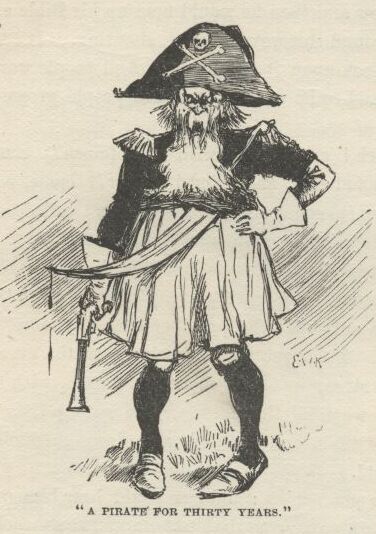
Well, the first I knowed the king got a-going, and you could hear him over everybody; and next he went a-charging up on to the platform, and the preacher he begged him to speak to the people, and he done it. He told them he was a pirate—been a pirate for thirty years out in the Indian Ocean—and his crew was thinned out considerable last spring in a fight, and he was home now to take out some fresh men, and thanks to goodness he’d been robbed last night and put ashore off of a steamboat without a cent, and he was glad of it; it was the blessedest thing that ever happened to him, because he was a changed man now, and happy for the first time in his life; and, poor as he was, he was going to start right off and work his way back to the Indian Ocean, and put in the rest of his life trying to turn the pirates into the true path; for he could do it better than anybody else, being acquainted with all pirate crews in that ocean; and though it would take him a long time to get there without money, he would get there anyway, and every time he convinced a pirate he would say to him, “Don’t you thank me, don’t you give me no credit; it all belongs to them dear people in Pokeville camp-meeting, natural brothers and benefactors of the race, and that dear preacher there, the truest friend a pirate ever had!”
Well, the first I knowed, the king got a-going, and you could hear him over everybody. Next he went charging up onto the platform, and the preacher begged him to speak to the people. And he done it. He told them he was a pirate and had been one for thirty years out in the Indian Ocean. His crew had lost a good many men last spring in a fight. He was home now to recruit some fresh men. And thanks to goodness, he’d been robbed last night and put ashore off a steamboat without a cent. He was glad of it. It was the blessedest thing that ever happened to him, because he was a changed man now. He was happy for the first time in his life. And poor as he was, he was going to start right off and work his way back to the Indian Ocean. He would spend the rest of his life trying to turn the pirates toward the right path. He could do it better than anybody else, because he knew all the pirate crews in that ocean. And though it would take him a long time to get there without money, he would get there anyway. And every time he convinced a pirate, he would say to him, “Don’t you thank me, don’t you give me no credit. It all belongs to them dear people at the Pokeville camp-meeting, true brothers and helpers of the human race. And to that dear preacher there, the truest friend a pirate ever had!”
And then he busted into tears, and so did everybody. Then somebody sings out, “Take up a collection for him, take up a collection!” Well, a half a dozen made a jump to do it, but somebody sings out, “Let him pass the hat around!” Then everybody said it, the preacher too.
And then he busted into tears, and so did everybody. Then somebody sings out, “Take up a collection for him, take up a collection!” Well, a half a dozen jumped up to do it. But somebody sings out, “Let him pass the hat around!” Then everybody said it, the preacher too.
So the king went all through the crowd with his hat swabbing his eyes, and blessing the people and praising them and thanking them for being so good to the poor pirates away off there; and every little while the prettiest kind of girls, with the tears running down their cheeks, would up and ask him would he let them kiss him for to remember him by; and he always done it; and some of them he hugged and kissed as many as five or six times—and he was invited to stay a week; and everybody wanted him to live in their houses, and said they’d think it was an honor; but he said as this was the last day of the camp-meeting he couldn’t do no good, and besides he was in a sweat to get to the Indian Ocean right off and go to work on the pirates.
So the king went all through the crowd with his hat, wiping his eyes and blessing the people. He praised them and thanked them for being so good to the poor pirates far away. And every little while, the prettiest kind of girls would come up with tears running down their cheeks. They’d ask him would he let them kiss him to remember him by, and he always done it. And some of them he hugged and kissed as many as five or six times. He was invited to stay a week. And everybody wanted him to stay at their houses and said they’d think it was an honor. But he said since this was the last day of the camp-meeting, he couldn’t do no good. Besides, he was in a hurry to get to the Indian Ocean right away and start working on the pirates.
When we got back to the raft and he come to count up he found he had collected eighty-seven dollars and seventy-five cents. And then he had fetched away a three-gallon jug of whisky, too, that he found under a wagon when he was starting home through the woods. The king said, take it all around, it laid over any day he’d ever put in in the missionarying line. He said it warn’t no use talking, heathens don’t amount to shucks alongside of pirates to work a camp-meeting with.
When we got back to the raft and he come to count up, he found he had collected $87.75. And he had brought along a three-gallon jug of whisky, too. He found it under a wagon when he was starting home through the woods. The king said, all in all, it beat any day he’d ever spent in the missionarying line. He said it wasn't no use talking. Heathens don't amount to shucks alongside of pirates when it comes to working a camp-meeting.
The duke was thinking he’d been doing pretty well till the king come to show up, but after that he didn’t think so so much. He had set up and printed off two little jobs for farmers in that printing-office—horse bills—and took the money, four dollars. And he had got in ten dollars’ worth of advertisements for the paper, which he said he would put in for four dollars if they would pay in advance—so they done it. The price of the paper was two dollars a year, but he took in three subscriptions for half a dollar apiece on condition of them paying him in advance; they were going to pay in cordwood and onions as usual, but he said he had just bought the concern and knocked down the price as low as he could afford it, and was going to run it for cash. He set up a little piece of poetry, which he made, himself, out of his own head—three verses—kind of sweet and saddish—the name of it was, “Yes, crush, cold world, this breaking heart”—and he left that all set up and ready to print in the paper, and didn’t charge nothing for it. Well, he took in nine dollars and a half, and said he’d done a pretty square day’s work for it.
The duke was thinking he’d been doing pretty well till the king come along. But after that he didn’t think so much of his own work. He had set up and printed two little jobs for farmers in that printing office, advertisements for horses. He took four dollars for them. And he had got ten dollars’ worth of advertisements for the paper. He said he would print them for four dollars if the advertisers paid in advance, so they done it. The paper cost two dollars a year, but he took three subscriptions for half a dollar apiece. The subscribers had to pay him in advance. They were going to pay in firewood and onions as usual. But he said he had just bought the business and lowered the price as far as he could afford. He was going to run it for cash. He set up a little poem for printing, which he made himself, out of his own head. It had three verses, kind of sweet and saddish. The name of it was, “Yes, crush, cold world, this breaking heart”. And he left the poem all set up and ready to print in the paper, and didn’t charge nothing for it. Well, he took in nine dollars and a half, and said he’d done a pretty fair day’s work for it.
Then he showed us another little job he’d printed and hadn’t charged for, because it was for us. It had a picture of a runaway with a bundle on a stick over his shoulder, and “$200 reward” under it. The reading was all about Jim, and just described him to a dot. It said he run away from St. Jacques’ plantation, forty mile below New Orleans, last winter, and likely went north, and whoever would catch him and send him back he could have the reward and expenses.
Then he showed us another little printing job he’d done. He hadn’t charged for it because it was for us. It showed a runaway with a bundle on a stick over his shoulder. Under the picture were the words “$200 reward”. The notice was all about Jim and described him exactly. It said he run away from St. Jacques’ plantation last winter, forty mile below New Orleans, and likely went north. Whoever would catch him and send him back could have the reward and expenses.
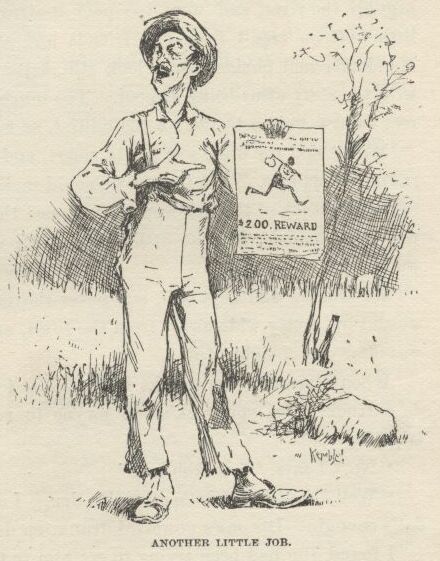
“Now,” says the duke, “after to-night we can run in the daytime if we want to. Whenever we see anybody coming we can tie Jim hand and foot with a rope, and lay him in the wigwam and show this handbill and say we captured him up the river, and were too poor to travel on a steamboat, so we got this little raft on credit from our friends and are going down to get the reward. Handcuffs and chains would look still better on Jim, but it wouldn’t go well with the story of us being so poor. Too much like jewelry. Ropes are the correct thing—we must preserve the unities, as we say on the boards.”
“Now,” says the duke, “after tonight we can travel in the daytime if we want to. Whenever we see anybody coming, we can tie Jim hand and foot with a rope. We can lay him in the wigwam and show this handbill. We can say we captured him upriver and were too poor to travel on a steamboat. So we got this little raft on credit from our friends and are heading downriver to get the reward. Handcuffs and chains would look even better on Jim, but they wouldn’t fit our story about being so poor. Too much like jewelry. Ropes are the right choice. We must keep the story consistent, as we say in the theater.”
We all said the duke was pretty smart, and there couldn’t be no trouble about running daytimes. We judged we could make miles enough that night to get out of the reach of the powwow we reckoned the duke’s work in the printing office was going to make in that little town; then we could boom right along if we wanted to.
We all said the duke was pretty smart, and there couldn’t be no trouble about traveling during the day. We figured we could travel miles enough that night to get beyond the reach of the fuss. We reckoned the duke’s work in the printing office was going to cause that fuss in the little town. Then we could move right along if we wanted to.
We laid low and kept still, and never shoved out till nearly ten o’clock; then we slid by, pretty wide away from the town, and didn’t hoist our lantern till we was clear out of sight of it.
We laid low and kept quiet, and didn’t push off till nearly ten o’clock. Then we slipped past, staying well away from the town. And we didn’t raise our lantern till we was completely out of sight of the town.
When Jim called me to take the watch at four in the morning, he says:
When Jim called me to take my turn on watch at four in the morning, he says:
“Huck, does you reck’n we gwyne to run acrost any mo’ kings on dis trip?”
“Huck, does you reckon we going to run across any more kings on this trip?”
“No,” I says, “I reckon not.”
“No,” I says, “I reckon not.”
“Well,” says he, “dat’s all right, den. I doan’ mine one er two kings, but dat’s enough. Dis one’s powerful drunk, en de duke ain’ much better.”
“Well,” says he, “that’s all right, then. I don’t mind one or two kings, but that’s enough. This one’s powerful drunk, and the duke ain’t much better.”
I found Jim had been trying to get him to talk French, so he could hear what it was like; but he said he had been in this country so long, and had so much trouble, he’d forgot it.
I found Jim had been trying to get him to speak French. Jim wanted to hear what French sounded like. But he said he'd been in this country so long, and had so much trouble, he'd forgot it.