Chapter 9
The Little Spaniard and His Unusual Wit, Vacuum, Specific Weights, and Other Philosophical Matters
I was no sooner come, but they carryed me to the Palace, where the Grandees received me with more Moderation, than the people had done as I passed the streets: but both great and small concluded, that without doubt I was the Female of the Queen's little Animal. My Guide was my Interpreter; and yet he himself understood not the Riddle, and knew not what to make of that little Animal of the Queen's; but we were soon satisfied as to that; for the King having some time considered me, ordered it to be brought, and about half an hour after I saw a company of Apes, wearing Ruffs and Breeches, come in, and amongst them a little Man almost of my own Built, for he went on Two Legs; so soon as he perceived me, he Accosted me with a Criado de vuestra merced I answered his Greeting much in the same Terms. But alas! no sooner had they seen us talk together, but they believed their Conjecture to be true; and so, indeed, it seemed; for he of all the By-standers, that past the most favourable Judgment upon us, protested that our Conversation was a Chattering we kept for Joy at our meeting again.
As soon as I arrived, they took me to the palace. There the nobles received me more calmly than the people had as I passed through the streets. But high and low alike concluded that I was undoubtedly the female of the Queen's little animal. My guide was my interpreter, yet he could not understand the mystery himself. He did not know what to make of the Queen's little animal. But we soon found out. After studying me for a while, the King ordered the animal brought in. About half an hour later, a group of apes came in, wearing ruffs and breeches. Among them was a little man built much like me, for he walked on two legs. As soon as he saw me, he greeted me with a Criado de vuestra merced. I answered his greeting in much the same terms. But alas! As soon as they saw us talking, they believed their guess was true. And indeed, it seemed so. Even the onlooker who judged us most favorably declared that our conversation was merely chattering. He said we were chattering for joy at meeting again.
"At your service, Your Excellency."
That little Man told me, that he was an European, a Native of old Castille: That he had found a means by the help of Birds to mount up to the World of the Moon, where then we were: That falling into the Queen's Hands, she had taken him for a Monkey, because Fate would have it so, That in that Country they cloath Apes in a Spanish Dress; and that upon his arrival, being found in that habit, she had made no doubt but he was of the same kind. "It could not otherwise be," replied I, "but having tried all Fashions of Apparel upon them, none were found so Ridiculous, and by consequence more becoming a kind of Animals which are only entertained for Pleasure and Diversion." "That shews you little understand the Dignity of our Nation," answered he, "for whom the Universe breeds Men only to be our Slaves, and Nature produces nothing but objects of Mirth and Laughter." He then intreated me to tell him, how I durst be so bold as to Scale the Moon with the Machine I told him of? I answered, That it was because he had carried away the Birds, which I intended to have made use of. He smiled at this Raillery; and about a quarter of an hour after, the King commanded the Keeper of the Monkeys to carry us back. The King's Pleasure was punctually obeyed; at which I was very glad, for the satisfaction I had, of having a Mate to converse with during the solitude of my Brutification.
The little man told me he was a European, a native of old Castille. With the help of birds, he had found a way to reach the world of the Moon, where we were. He had fallen into the Queen's hands, and she had taken him for a monkey. As fate would have it, people in that country dressed apes in Spanish clothes. He had arrived wearing such clothes, so she had no doubt that he was an ape. "It could hardly have been otherwise," I replied. "They must have tried every fashion on the apes and found none so ridiculous. And therefore none was more fitting for animals kept only for pleasure and amusement." "You clearly understand little of the dignity of our nation," he answered. "For our sake, the Universe breeds men only to be our slaves, and Nature produces nothing but things to laugh at." He then asked how I had dared to reach the Moon with the machine I had told him about. I answered that he had carried away the birds I had intended to use. He smiled at this joke. About a quarter of an hour later, the King ordered the Keeper of the Monkeys to take us back. The King's order was promptly obeyed. I was very glad, because I now had a companion to talk with during the solitude of my Brutification.
Domingo Gonzales is the hero of Bishop Francis Godwin's The Man in the Moone (see p. 4, note). He says of himself: "I must acknowledge my Stature is so little, as I think no Man living is less."
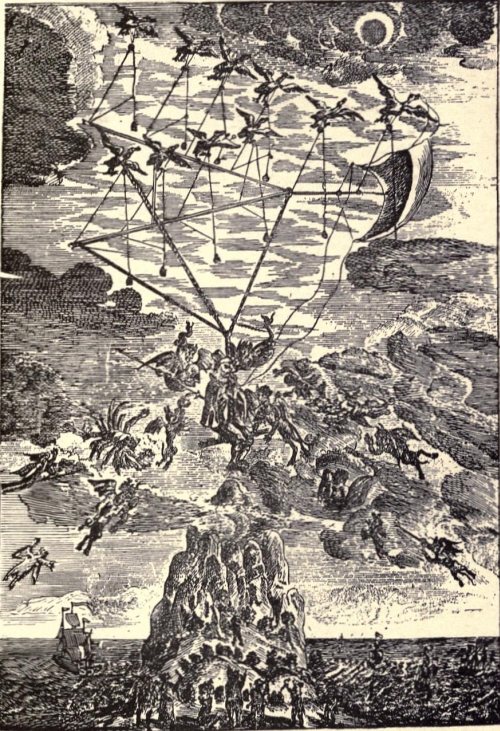
The illustration opposite shows how his birds carried him up. It is copied from an old edition of The Man in the Moone. The other winged figures around him are supposed to represent demons who attacked him just above "the middle region."
One Day my Male (for I was taken for the Female) told me, That the true reason which had obliged him to travel all over the Earth, and at length to abandon it for the Moon, was that he could not find so much as one Country where even Imagination was at liberty. "Look ye," said he, "how the Wittiest thing you can say, unless you wear a Cornered Cap, if it thwart the Principles of the Doctors of the Robe, you are an Ideot, a Fool, and something worse perhaps. I was about to have been put into the Inquisition at home, for maintaining to the Pedants Teeth, That there was a Vacuum, and that I knew no one matter in the World more Ponderous than another." I asked him, what probable Arguments he had, to confirm so new an Opinion? "To evince that," answered he, "you must suppose that there is but one Element; for though we see Water, Earth, Air and Fire distinct, yet are they never found to be so perfectly pure but that there still remains some Mixture. For example, When you behold Fire, it is not Fire but Air much extended; the Air is but Water much dilated; Water is but liquified Earth, and the Earth it self but condensed Water; and thus if you weigh Matter seriously, you'll find it is but one, which like an excellent Comedian here below acts all Parts, in all sorts of Dresses: Otherwise we must admit as many Elements as there are kinds of Bodies: And if you ask me why Fire burns, and Water cools, since it is but one and the same matter, I answer, That that matter acts by Sympathy, according to the Disposition it is in at the time when it acts. Fire, which is nothing but Earth also, more dilated than is fit for the constitution of Air, strives to change into it self, by Sympathy, what ever it meets with: Thus the heat of Coals, being the most subtile Fire, and most proper to penetrate a Body, at first slides through the pores of our Skin; and because it is a new matter that fills us, it makes us exhale in Sweat; that Sweat dilated by the Fire is converted to a Steam, and becomes Air; that Air being farther ratified by the heat of the Antiperistasis, or of the Neighbouring Stars, is called Fire, and the Earth abandoned by the Cold and Humidity which were Ligaments to the whole, falls to the ground: Water, on the other hand, though it no ways differ from the matter of Fire, but in that it is closer, burns us not; because that being dense by Sympathy, it closes up the Bodies it meets with, and the Cold we feel is no more but the effect of our Flesh contracting it self, because of the Vicinity of Earth or Water, which constrains it to a Resemblance. Hence it is, that those who are troubled with a Dropsie convert all their nourishment into Water; and the Cholerick convert all the Blood that is formed in their Liver into Choler.
One day my male companion (for I was taken for the female) told me why he had traveled all over the Earth. It was also why he had finally left Earth for the Moon. He could not find a single country where even the imagination was free. "Look," he said, "you can say the cleverest thing imaginable, but unless you wear a cornered cap, it makes no difference. If it contradicts the principles of the learned doctors, you are an idiot, a fool, and perhaps something worse. I was nearly put in the Inquisition at home for defying the pedants to their faces. I maintained that there was a vacuum and that I knew of no matter in the world heavier than another." I asked him what plausible arguments he had to support such a new opinion. "To prove it," he answered, "you must suppose that there is only one element. We see water, earth, air, and fire as distinct, but none is ever found perfectly pure. There is always some mixture. For example, when you see fire, it is not fire but highly expanded air. Air is only greatly expanded water. Water is only liquefied earth, and earth itself is only condensed water. So, if you consider matter carefully, you will find that it is all one. Like an excellent actor here on Earth, it plays every part in all kinds of costumes. Otherwise, we must accept that there are as many elements as there are kinds of bodies. "And if you ask why fire burns and water cools, when they are the same matter, I answer this. Matter acts by sympathy, according to its condition at the time. Fire is also nothing but earth, expanded beyond what is suitable for air. By sympathy, fire tries to turn everything it meets into itself. Thus the heat of coals is the subtlest fire and the best suited to penetrate a body. It first slips through the pores of our skin. Because it is new matter filling us, it makes us give off sweat. The sweat expands in the fire, turns to vapor, and becomes air. That air is further thinned by the heat of Antiperistasis, or of the neighboring stars, and is called fire. Cold and moisture had bound the whole together. Once they leave it, the earth falls to the ground. "Water, on the other hand, differs from the matter of fire only in being denser. It does not burn us. Because water is dense, it makes the bodies it meets contract by sympathy. The cold we feel is simply our flesh contracting. Nearby earth or water forces our flesh to become like it. That is why people with dropsy turn all their nourishment into water. Likewise, choleric people turn all the blood formed in their liver into choler."
"It being then supposed, that there is but one Element; it is most certain, that all Bodies, according to their several qualities, incline equally towards the Center of the Earth. But you'll ask me, Why then does Iron, Metal, Earth and Wood, descend more swiftly to the Center than a Sponge, if it be not that it is full of Air which naturally tends upwards? That is not at all the Reason, and thus I make it out: Though a Rock fall with greater Rapidity than a Feather, both of them have the same inclination for the Journey; but a Cannon Bullet, for instance, were the Earth pierced through, would precipitate with greater haste to the Center thereof than a Bladder full of Wind; and the reason is, because that mass of Metal is a great deal of Earth contracted into a little space, and that Wind a very little Earth in a large space: For all the parts of Matter, being so closely joined together in the Iron, encrease their force by their Union; because being thus compacted, they are many that Fight against a few, seeing a parcel of Air equal to the Bullet in Bigness is not equal in Quantity.
“If we assume that there is only one element, then all bodies certainly tend equally toward the Earth’s center, according to their different qualities. But you will ask me why iron, metal, earth, and wood fall toward the center faster than a sponge. Is it not because the sponge is full of air, which naturally rises? That is not the reason at all, and I will show you why. Though a rock falls faster than a feather, both are equally inclined to make the journey. But suppose the Earth were pierced through. A cannonball, for example, would fall toward its center faster than a bladder full of air. That is because the metal is a great deal of earth compressed into a small space. The air is a very little earth spread over a large space. All the particles of matter in the iron are joined so closely that their combined force increases. Being packed together, they are many fighting against a few. For an amount of air equal to the cannonball in size is not equal to it in quantity.”
"Not to insist on a long Deduction of Arguments to prove this, tell me in good earnest, How a Pike, a Sword or a Dagger wounds us? If it be not because the Steel, being a matter wherein the parts are more continuous and more closely knit together than your Flesh is, whose Pores and Softness shew that it contains but very little Matter within a great extent of Place; and that the point of the Steel that pricks us, being almost an innumerable number of Particles of matter against a very little Flesh, it forces it to yield to the stronger, in the same manner as a Squadron in close order will easily break through a more open Battalion; for why does a Bit of red hot Iron burn more than a Log of Wood all on Fire? Unless it be, that in the Iron there is more Fire in a small space, seeing it adheres to all the parts of the Metal, than in the Wood which being very Spongy by consequence contains a great deal of Vacuity; and that Vacuity, being but a Privation of Being, cannot receive the form of Fire. But, you'll object, you suppose a Vacuum, as if you had proved it, and that's begging of the question: Well then I'll prove it, and though that difficulty be the Sister of the Gordian knot, yet my Arms are strong enough to become its Alexander.
“Rather than offer a long chain of arguments to prove this, tell me honestly: How does a pike, sword, or dagger wound us? Is it not because the particles of steel are more continuous and more closely packed than those of your flesh? The pores and softness of flesh show that it contains very little matter within a large space. The steel point that pricks us brings an almost countless number of particles of matter against very little flesh. So it forces the flesh to yield to the stronger force, just as a tightly packed squadron can easily break through a more open battalion. Why does a piece of red-hot iron burn more than a log that is all on fire? Is it not because there is more fire in a small space in the iron, since fire clings to every part of the metal? Wood, being very spongy, contains a great deal of Vacuity. And Vacuity, being only an absence of being, cannot take the form of fire. But you will object that I assume a Vacuum as if I had already proved it exists. That, you will say, is begging the question. Well then, I will prove it. Though this difficulty is the sister of the Gordian knot, my arms are strong enough to become its Alexander.”
"Let that vulgar Beast, then, who does not think it self a Man, had it not been told so, answer me if it can: Suppose now there be but one Matter, as I think I have sufficiently proved; whence comes it, that according to its Appetite it enlarges or contracts its self; whence is it, that a piece of Earth by being Condensed becomes a Stone? Is it that the parts of that Stone are placed one with another, in such a manner that wherever that grain of Sand is settled, even there, or in the same point, another grain of Sand is Lodged? That cannot be, no not according to their own Principles, seeing there is no Penetration of Bodies: But that matter must have crowded together, and if you will, abridged it self, so that it hath filled some place which was empty before. To say that it is incomprehensible, that there should be a Nothing in the World, that we are in part made up of Nothing: Why not, pray? Is not the whole World wrapt up in Nothing? Since you yield me this point, then confess ingeniously, that it's as rational that the World should have a Nothing within it, as Nothing about it.
"Then let that common beast answer me, if it can. It would not think itself a man if it had not been told so. Suppose there is only one kind of matter, as I think I have sufficiently proved. Why does it expand or contract according to its appetite? How does a piece of earth become stone when it is compressed? Are the parts of that stone arranged so that two grains of sand occupy the same point? That cannot be, even by their own principles, since bodies cannot pass through one another. Rather, the matter must have crowded together and, if you like, made itself smaller. In doing so, it filled some space that was empty before. But you say it is impossible to understand how there can be nothingness in the world. You say it is impossible to understand how we can be partly made up of nothing. Why not, pray? Is not the whole world surrounded by nothing? Since you grant me that point, admit honestly that nothingness within the world is just as reasonable as nothingness around it."
"I well perceive you'll put the question to me, Why Water compressed in a Vessel by the Frost should break it, if it be not to hinder a Vacuity? But I answer, That that only happens, because the Air overhead, which as well as Earth and Water tends to the Center, meeting with an empty Tun by the way, takes tip his Lodging there: If it find the pores of that Vessel, that's to say, the ways that lead to that void place, too narrow, too long, and too crooked, with impatience it breaks through and arrives at its Tun.
“I can see that you will ask me a question. Why does water, compressed by frost in a vessel, break it, if not to prevent a vacuum? But I answer that this happens only because the air above tends toward the center, just as earth and water do. On its way, the air comes upon an empty cask and takes up residence there. The vessel’s pores are the passages that lead to that empty space. If the air finds them too narrow, too long, and too crooked, it impatiently breaks through and reaches its cask.
"But not to trifle away time, in answering all their objections, I dare be bold to say, That if there were no Vacuity, there could be no Motion; or else a Penetration of Bodies must be admitted; for it would be a little too ridiculous to think, that when a Gnat pushes back a parcel of Air with its Wings, that parcel drives another before it, that other another still; and that so the stirring of the little Toe of a Flea should raise a bunch upon the Back of the Universe. When they are at a stand, they have recourse to Rarefaction: But in good earnest, How can it be when a Body is ratified, that one Particle of the Mass does recede from another Particle, without leaving an empty Space betwixt them; must not the two Bodies, which are just separated, have been at the same time in the same place of this; and that so they must have all three penetrated each other? I expect you'll ask me, why through a Reed, a Syringe or a Pump, Water is forced to ascend contrary to its inclination? To which I answer, That that's by violence, and that it is not the fear of a Vacuity that turns it out of the right way; but that being linked to the Air by an imperceptible Chain, it rises when the Air, to which it is joined, is rarified.
"But I will not waste time answering all their objections. I dare say that without a vacuum, motion would be impossible, unless bodies could pass through one another. It would be rather ridiculous to think that a gnat pushes back some air with its wings, which pushes more air ahead of it, and so on. By that reasoning, a flea moving its little toe would raise a bump on the back of the universe. When they cannot answer this, they turn to rarefaction. But seriously, when a body becomes less dense, how can one particle move away from another without leaving an empty space between them? Must not the two bodies that have just separated have been in the same place as this at the same time? And must not all three have passed through one another? I expect you will ask why water is forced upward through a reed, a syringe, or a pump, against its natural tendency. I answer that the water is forced upward. It is not fear of a vacuum that turns it from its proper course. Rather, the water is linked to the air by an invisible chain. It rises when the air joined to it becomes less dense.
"That's no such knotty Difficulty, when one knows the perfect Circle and the delicate Concatenation of the Elements: For if you attentively consider the Slime which joines the Earth and Water together in Marriage, you'll find that it is neither Earth nor Water; but the Mediator betwixt these Two Enemies. In the same manner, the Water and Air reciprocally send a Mist, that dives into the Humours of both, to negotiate a Peace betwixt them; and the Air is reconciled to the Fire, by means of an interposing Exhalation which Unites them."
"That is not such a difficult problem if you understand the perfect circle and the delicate connections between the elements. Consider the slime that joins earth and water in marriage. You will find that it is neither earth nor water, but a mediator between these two enemies. In the same way, water and air send a mist between them. It penetrates the fluids of both to negotiate peace between them. And air is reconciled with fire by a vapor that comes between them and unites them."
I believe he would have proceeded in his Discourse, had they not brought us our Victuals; and seeing we were a hungry, I stopt my Ears to his discourse, and opened my Stomack to the Food they gave us.
I believe he would have continued speaking if they had not brought us our food. Since we were hungry, I closed my ears to his talk and opened my stomach to the food they gave us.
I remember another time, when we were upon our Philosophy, for neither of us took pleasure to Discourse of mean things: "I am vexed," said he, "to see a Wit of your stamp infected with the Errors of the Vulgar. You must know then, in spight of the Pedantry of Aristotle with which your Schools in France still ring, That every thing is in every thing; that's to say, for instance, That in the Water there is Fire, in the Fire Water, in the Air Earth, and in the Earth Air: Though that Opinion makes Scholars open their Eyes as big as Sawcers, yet it is easier to prove it, than perswade it. For I ask them, in the first place, if Water does not breed Filth: If they deny it, let them dig a Pit, fill it with meer Element, and to prevent all blind Objections let them if they please strain it through a Strainer, and I'll oblige my self, in case they find no Filth therein within a certain time, to drink up all the Water they have poured into it: But if they find Filth, as I make no doubt on't; it is a convincing Argument that there is both Salt and Fire there. Consequentially now, to find Water in Fire; I take it to be no difficult Task. For let them chuse Fire, even that which is most abstracted from Matter, as Comets are, there is a great deal in them still; seeing if that Unctuous Humour, whereof they are engendered, being reduced to a Sulphur by the heat of the Antiperistasis which kindles them, did not find a curb of its Violence in the humid Cold that qualifies and resists it, it would spend it self in a trice like Lightning. Now that there is Air in the Earth, they will not deny it; or otherwise they have never heard of the terrible Earth-quakes, that have so often shaken the Mountains of Sicily: Besides, the Earth is full of Pores, even to the least grains of Sand that com[pose] it. Nevertheless no Man hath as yet said, that these Hollows were filled with Vacuity: It will not be taken amiss then, I hope, if the Air takes up its quarters there. It remains to be proved, that there is Earth in the Air; but I think it scarcely worth my pains, seeing you are convinced of it, as often as you see such numberless Legions of Atomes fall upon your heads, as even stiffle Arithmetick.
I remember another time when we were discussing philosophy. Neither of us enjoyed talking about ordinary things. "It troubles me," he said, "to see a mind like yours infected with the errors of the common people. So you must understand this, despite the pedantry of Aristotle, which still echoes through your schools in France. Everything is in everything else. For example, there is fire in water, water in fire, earth in air, and air in earth. This opinion makes scholars' eyes open as wide as saucers. Yet it is easier to prove it than to persuade them of it. "First, I ask them whether water produces filth. If they deny it, let them dig a pit and fill it with pure water, the element itself. To prevent any groundless objections, they may even strain the water if they please. If they find no filth in it after a certain time, I promise to drink all the water they poured in. But if they find filth, as I have no doubt they will, it proves that both salt and fire are there. "Next, I think it is no difficult task to find water in fire. Let them choose any fire, even one as free from matter as comets are. There is still a great deal of water in them. Comets are born from an oily fluid, which the heat of Antiperistasis turns into sulfur and sets alight. If moist cold did not temper and resist its violence, it would burn itself out in an instant like lightning. "They will not deny that there is air in the earth. Otherwise, they have never heard of the terrible earthquakes that have so often shaken the mountains of Sicily. Besides, the earth is full of pores, even in the smallest grains of sand that make it up. Yet no one has ever said that these hollows were filled with Vacuity. So I hope no one will object if air takes up residence there. "It remains to prove that there is earth in the air. But I hardly think it worth the trouble. You are convinced of it whenever you see such countless legions of atoms falling on your heads that they overwhelm arithmetic itself.
With the pure element (Lat., merus), meaning water alone, unmixed with impurities or other elements.
"But let us pass from simple to compound Bodies, they'll furnish me with much more frequent Subjects; and to demonstrate that all things are in all things, not that they change into one another, as your Peripateticks Juggle: for I will maintain to their Teeth, that the Principles mingle, separate, and mingle again in such a manner, that that hath been made Water by the Wise Creator of the World, will always be Water; I shall suppose no Maxime, as they do, but what I prove.
"But let us move from simple bodies to compound bodies. They will give me many more subjects to discuss. I will show that all things are in all things, not that they change into one another, as your Peripateticks pretend. I will maintain to their faces that the principles mix, separate, and mix again. And whatever the wise Creator of the world made water will always be water. Unlike them, I will assume no maxim that I cannot prove.
Fr. gazouillent, babble.
"And therefore take a Billet, or any other combustible stuff, and set Fire to it, they'll say when it is in a Flame, That what was Wood is now become Fire; but I maintain the contrary, and that there is no more Fire in it, when it is all in Flame, than before it was kindled; but that which before was hid in the Billet, and by the Humidity and Cold hindered from acting; being now assisted by the Stranger, hath rallied its forces against the Phlegm that choaked it, and commanding the Field of Battle, that was possessed by its Enemy, triumphs over his Jaylor and appears without Fetters. Don't you see how the Water flees out at the two ends of the Billet, hot and smoaking from the Fight it was engaged in. That flame which you see rise on high is the purer Fire, unpestered from the Matter, and by consequence the readiest to return home to it self: Nevertheless it Unites it self by tapering into a Piramide till it rise to a certain height, that it may pierce through the thick Humidity of the Air which resists it; but as mounting it disengaged it self by little and little from the violent company of its Landlords; so it diffuses it self, because then it meets with nothing that thwarts its passage, which negligence, though, is many times the cause of a second Captivity: For marching stragglingly, it wanders sometimes into a Cloud, and if it meet there with a Party of its own sufficient to make head against a Vapour, they Engage, Grumble, Thunder and Roar, and the Death of Innocents is many times the effect of the animated Rage of those inanimated Things. If, when it finds it self pestered among those Crudities of the middle Region, it is not strong enough to make a defence, it yields to its Enemy upon discretion; which by its weight constrains it to fall again to the Earth: And this Wretch, inclosed in a drop of Rain, may per haps fall at the Foot of an Oak, whose Animal Fire will invite the poor Straggler to take a Lodging with him; and thus you have it in the same condition again as it was a few Days before.
“And so, take a log or any other combustible material and set it on fire. Once it is burning, people will say that the wood has become fire. But I maintain the opposite. There is no more fire in the log when it is ablaze than there was before it was lit. The fire was hidden in the log, prevented from acting by dampness and cold. Now, helped by the fire from outside, it has rallied its forces against the moisture that smothered it. It has taken command of the battlefield once held by its enemy. It triumphs over its jailer and appears without chains. Can you not see the water fleeing from both ends of the log, hot and steaming from the battle? The flame you see rising is the purer fire, freed from matter. It is therefore the most ready to return home to itself. Even so, it gathers into a tapering pyramid until it reaches a certain height. This allows it to pierce the thick dampness of the air that resists it. But as it rises, it gradually escapes the violent company of its hosts. Then it spreads out, because nothing stands in its way. Yet this carelessness often leads to a second captivity. As the fire travels in scattered bands, it sometimes wanders into a cloud. If it meets enough of its own kind there to stand against the vapor, they fight, rumble, thunder, and roar. The raging fury of these lifeless things often kills innocent people. If the fire finds itself trapped among the raw vapors of the middle region and cannot defend itself, it surrenders to its enemy without conditions. The enemy’s weight forces the fire to fall back to earth. And this poor wretch, shut inside a raindrop, may perhaps fall at the foot of an oak. The oak’s animal fire will invite the poor straggler to lodge with it. And so the fire is back in the same condition it was in a few days before.
Unfortunate creature ("ce malheureux").
"But let us trace the Fortune of the other Elements that composed that Billet. The Air retreats to its own Quarters also, though blended with Vapours; because the Fire all in a rage drove them briskly out Pell-mell together. Now you have it serving the Winds for a Tennis-ball, furnishing Breath to Animals, filling up the Vacuities that Nature hath left; and, it may be also, wrapt up in a drop of Dew, suckling the thirsty Leaves of that Tree, whither our Fire retreated: The Water driven from its Throne by the Flame, being by the heat elevated to the Nursery of the Meteors, will distil again in Rain upon our Oak, as soon as upon another; and the Earth being turned to Ashes, and then cured of its Sterility, either by the nourishing Heat of a Dunghill on which it hath been thrown, or by the vegetative Salt of some neighbouring Plants, or by the teeming Waters of some Rivers, may happen also to be near this Oak, which by the heat of its Germ will attract it, and convert it into a part of its bulk.
"But let us follow the fate of the other elements that made up that log. The air also returns to its own quarters, though mixed with vapors. For the fire, in a rage, drove them out together, pell-mell. Now the air serves as a tennis ball for the winds. It gives animals breath and fills the empty spaces nature has left. Perhaps it is also wrapped in a drop of dew, nourishing the thirsty leaves of the tree where our fire took refuge. The flame drove the water from its throne, and the heat lifted it to the nursery of the meteors. The water will fall again as rain, as likely on our oak as on any other tree. The earth is turned to ashes, then cured of its sterility. This may happen through the nourishing heat of a dung heap where it has been thrown, the growth-giving salt of nearby plants, or the fertile waters of rivers. The earth may also happen to be near this oak. The heat of the oak's germ will then attract the earth and turn it into part of the tree.
"In this manner, these Four Elements undergo the same Destiny, and return to the same State, which they quitted but a few days before: So that it may be said, that all that's necessary for the composition of a Tree, is in a Man; and in a Tree, all that's necessary for making of a Man. In fine, according to this way, all things will be found in all things; but we want a Prometheus, to pluck us out of the Bosom of Nature, and render us sensible, which I am willing to call the First Matter"
"In this way, these Four Elements share the same fate. They return to the state they left only a few days before. So it may be said that a man contains everything needed to make a tree. A tree also contains everything needed to make a man. In short, by this reasoning, all things can be found in all things. But we lack a Prometheus to pull us from the bosom of Nature and give us sensation, which I am willing to call the First Matter"
The translator has mistaken a Dative for an Accusative. The French means: "But we need a Prometheus to pluck out for us, from the bosom of Nature, and make tangible to us, that which I will call First Matter."
These were the things, I think, with which we past the time; for that little Spaniard had a quaint Wit. Our conversation, however, was only in the Night time; because from Six a clock in the morning until night, Crowds of the People, that came to stare at us in our Lodging, would have disturbed us: For some threw us Stones, others Nuts, and others Grass; there was no talk, but of the Kings Beasts; we had our Victuals daily at set hours. I cannot tell, whether it was that I minded their Gestures and Tones more than my Male did: But I learnt sooner than he to understand their Language, and to smatter a little of it, which made us to be lookt upon in another guess manner than formerly; and the news thereupon flew presently all over the Kingdom, that two Wild Men had been found, who were less than other Men, by reason of the bad Food we had had in the Desarts; and who through a defect of their Parents Seed, had not the fore Legs strong enough to support their Bodies.
I think these were the things we talked about to pass the time, for that little Spaniard had a lively wit. We could talk only at night, though. From six in the morning until nightfall, crowds came to our lodgings to stare at us. They would have disturbed our conversation. Some threw us stones, others nuts, and others grass. Everyone was talking about the King’s beasts. We were fed daily at set hours. Perhaps I paid more attention to their gestures and tones than my male companion did. In any case, I learned to understand their language sooner than he did, and to speak a little of it. As a result, people began to look at us differently. News soon spread throughout the Kingdom that two Wild Men had been found. People said we were smaller than other men because of the poor food we had eaten in the deserts. They also said a defect in our parents’ seed had left our front legs too weak to support our bodies.