Chapter 37
A Terrible Predicament
Sleep? It was impossible. It would naturally have been impossible in that noisome cavern of a jail, with its mangy crowd of drunken, quarrelsome, and song-singing rapscallions. But the thing that made sleep all the more a thing not to be dreamed of, was my racking impatience to get out of this place and find out the whole size of what might have happened yonder in the slave-quarters in consequence of that intolerable miscarriage of mine.
Sleep? It was impossible. Naturally, I could never have slept in that foul cavern of a jail. It was full of shabby, drunken rogues who quarreled and sang. But what made sleep even more out of the question was my agonizing impatience to get out. I wanted to find out the full extent of what might have happened in the slave-quarters because of my intolerable mistake.
It was a long night, but the morning got around at last. I made a full and frank explanation to the court. I said I was a slave, the property of the great Earl Grip, who had arrived just after dark at the Tabard inn in the village on the other side of the water, and had stopped there over night, by compulsion, he being taken deadly sick with a strange and sudden disorder. I had been ordered to cross to the city in all haste and bring the best physician; I was doing my best; naturally I was running with all my might; the night was dark, I ran against this common person here, who seized me by the throat and began to pummel me, although I told him my errand, and implored him, for the sake of the great earl my master’s mortal peril—
It was a long night, but morning finally came. I gave the court a full and frank explanation. I said I was a slave, the property of the great Earl Grip. He had arrived just after dark at the Tabard inn, in the village across the water. He had been forced to stay there overnight because a strange, sudden illness had left him deathly sick. I had been ordered to cross to the city at once and bring back the best doctor. I was doing my best, and naturally I was running as fast as I could. The night was dark, and I ran into this common fellow here. He grabbed me by the throat and began to beat me, although I told him about my errand. I begged him, for the sake of my master, the great earl, whose life was in danger...
The common person interrupted and said it was a lie; and was going to explain how I rushed upon him and attacked him without a word—
The common person interrupted and said it was a lie. He was about to explain how I rushed at him and attacked him without a word.
“Silence, sirrah!” from the court. “Take him hence and give him a few stripes whereby to teach him how to treat the servant of a nobleman after a different fashion another time. Go!”
“Silence, you!” came the command from the court. “Take him away and give him a few lashes. That will teach him to treat a nobleman’s servant differently next time. Go!”
Then the court begged my pardon, and hoped I would not fail to tell his lordship it was in no wise the court’s fault that this high-handed thing had happened. I said I would make it all right, and so took my leave. Took it just in time, too; he was starting to ask me why I didn’t fetch out these facts the moment I was arrested. I said I would if I had thought of it—which was true—but that I was so battered by that man that all my wit was knocked out of me—and so forth and so on, and got myself away, still mumbling.
Then the court apologized and hoped I would tell his lordship that it was in no way the court’s fault that this abuse of power had happened. I said I would set things right and took my leave. I got out just in time, too. He was starting to ask why I hadn’t brought up these facts as soon as I was arrested. I said I would have if I had thought of it, which was true. But I said that man had beaten me so badly that he had knocked all the sense out of me. I went on like that and got away, still mumbling.
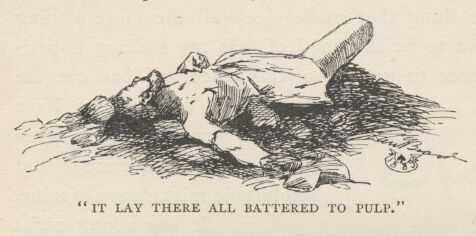
I didn’t wait for breakfast. No grass grew under my feet. I was soon at the slave quarters. Empty—everybody gone! That is, everybody except one body—the slave-master’s. It lay there all battered to pulp; and all about were the evidences of a terrific fight. There was a rude board coffin on a cart at the door, and workmen, assisted by the police, were thinning a road through the gaping crowd in order that they might bring it in.
I didn’t wait for breakfast. I wasted no time. I soon reached the slave quarters. Empty, everybody was gone! That is, everybody except one body, the slave-master’s. It lay there, battered to a pulp. All around were signs of a terrible fight. A crude wooden coffin sat on a cart at the door. Workers, helped by the police, were clearing a path through the staring crowd so they could bring the coffin inside.
I picked out a man humble enough in life to condescend to talk with one so shabby as I, and got his account of the matter.
I picked a man low enough in social standing to stoop to talking with someone as shabby as me. He gave me his account of the matter.
“There were sixteen slaves here. They rose against their master in the night, and thou seest how it ended.”
“There were sixteen slaves here. They rose against their master during the night, and you can see how it ended.”
“Yes. How did it begin?”
“Yes. How did it begin?”
“There was no witness but the slaves. They said the slave that was most valuable got free of his bonds and escaped in some strange way—by magic arts ’twas thought, by reason that he had no key, and the locks were neither broke nor in any wise injured. When the master discovered his loss, he was mad with despair, and threw himself upon his people with his heavy stick, who resisted and brake his back and in other and divers ways did give him hurts that brought him swiftly to his end.”
“There were no witnesses except the slaves. They said the most valuable slave freed himself from his bonds and escaped somehow. They thought he had used magic because he had no key, and the locks were neither broken nor damaged. When the master discovered his loss, he was frantic with despair. He attacked his people with his heavy stick, but they fought back. They broke his back and injured him in several other ways, and he soon died.”
“This is dreadful. It will go hard with the slaves, no doubt, upon the trial.”
“This is terrible. The trial will no doubt go badly for the slaves.”
“Marry, the trial is over.”
“Why, the trial is over.”
“Over!”
“Over!”
“Would they be a week, think you—and the matter so simple? They were not the half of a quarter of an hour at it.”
“Do you think they would take a week over something so simple? They took less than seven and a half minutes.”
“Why, I don’t see how they could determine which were the guilty ones in so short a time.”
“Why, I don’t see how they could figure out who was guilty so quickly.”
“Which ones? Indeed, they considered not particulars like to that. They condemned them in a body. Wit ye not the law?—which men say the Romans left behind them here when they went—that if one slave killeth his master all the slaves of that man must die for it.”
“Which ones? Indeed, they didn’t consider details like that. They condemned them all together. Don’t you know the law? People say the Romans left it behind when they departed. It says that if one slave kills his master, all that man’s slaves must die for it.”
“True. I had forgotten. And when will these die?”
“That’s right. I forgot. And when will these die?”
“Belike within a four and twenty hours; albeit some say they will wait a pair of days more, if peradventure they may find the missing one meantime.”
“Probably within twenty-four hours. But some say they will wait two more days, in case they find the missing one in the meantime.”
The missing one! It made me feel uncomfortable.
The missing one! It made me feel uncomfortable.
“Is it likely they will find him?”
“Are they likely to find him?”
“Before the day is spent—yes. They seek him everywhere. They stand at the gates of the town, with certain of the slaves who will discover him to them if he cometh, and none can pass out but he will be first examined.”
“Yes, before the day is over. They are looking for him everywhere. They are at the town gates with some slaves who will identify him if he comes. No one can leave without being examined first.”
“Might one see the place where the rest are confined?”
“Could I see where the rest are being held?”
“The outside of it—yes. The inside of it—but ye will not want to see that.”
“Yes, the outside of it. But you won’t want to see the inside.”
I took the address of that prison for future reference and then sauntered off. At the first second-hand clothing shop I came to, up a back street, I got a rough rig suitable for a common seaman who might be going on a cold voyage, and bound up my face with a liberal bandage, saying I had a toothache. This concealed my worst bruises. It was a transformation. I no longer resembled my former self. Then I struck out for that wire, found it and followed it to its den. It was a little room over a butcher’s shop—which meant that business wasn’t very brisk in the telegraphic line. The young chap in charge was drowsing at his table. I locked the door and put the vast key in my bosom. This alarmed the young fellow, and he was going to make a noise; but I said:
I took down the prison’s address for future reference and then strolled away. On a back street, I found a secondhand clothing shop. I bought a rough outfit fit for an ordinary sailor setting out on a cold voyage. I wrapped my face in plenty of bandages, saying I had a toothache. The bandages hid my worst bruises. What a transformation! I no longer looked like myself. Then I set out to find that wire. I found it and followed it to its den. The den was a little room over a butcher’s shop. That meant business wasn’t very brisk in the telegraph trade. The young man in charge was dozing at his table. I locked the door and tucked the enormous key inside my shirt. This alarmed the young fellow, and he was about to make a noise, but I said:
“Save your wind; if you open your mouth you are dead, sure. Tackle your instrument. Lively, now! Call Camelot.”
“Save your breath. If you open your mouth, you’re sure to die. Get to your instrument. Hurry up! Call Camelot.”
“This doth amaze me! How should such as you know aught of such matters as—”
“This amazes me! How could someone like you know anything about such matters as...”
“Call Camelot! I am a desperate man. Call Camelot, or get away from the instrument and I will do it myself.”
“Call Camelot! I’m desperate. Call Camelot, or step away from the phone and I’ll do it myself.”
“What—you?”
“What, you?”
“Yes—certainly. Stop gabbling. Call the palace.”
“Yes, of course. Stop babbling. Call the palace.”
He made the call.
He made the call.
“Now, then, call Clarence.”
“Now, call Clarence.”
“Clarence who?”
“Clarence who?”
“Never mind Clarence who. Say you want Clarence; you’ll get an answer.”
“Never mind which Clarence. Say you want Clarence, and you’ll get an answer.”
He did so. We waited five nerve-straining minutes—ten minutes—how long it did seem!—and then came a click that was as familiar to me as a human voice; for Clarence had been my own pupil.
He did so. We waited five tense minutes, then ten. How long it seemed! Then came a click as familiar to me as a human voice, because Clarence had been my own student.
“Now, my lad, vacate! They would have known my touch, maybe, and so your call was surest; but I’m all right now.”
“Now, lad, get out! They might have recognized my touch, so it was safer for you to make the call. But I’m all right now.”
He vacated the place and cocked his ear to listen—but it didn’t win. I used a cipher. I didn’t waste any time in sociabilities with Clarence, but squared away for business, straight-off—thus:
He left the spot and listened closely, but that didn't work. I used a cipher. I didn't waste time on small talk with Clarence. I got straight down to business, like this:
“The king is here and in danger. We were captured and brought here as slaves. We should not be able to prove our identity—and the fact is, I am not in a position to try. Send a telegram for the palace here which will carry conviction with it.”
“The king is here and in danger. We were captured and brought here as slaves. We would not be able to prove who we are. In fact, I am not in a position to try. Send a telegram to the palace here that will convince them.”
His answer came straight back:
He answered immediately:
“They don’t know anything about the telegraph; they haven’t had any experience yet, the line to London is so new. Better not venture that. They might hang you. Think up something else.”
“They don’t know anything about the telegraph. They haven’t had any experience with it yet because the line to London is so new. Better not try that. They might hang you. Think of something else.”
Might hang us! Little he knew how closely he was crowding the facts. I couldn’t think up anything for the moment. Then an idea struck me, and I started it along:
Might hang us! He had no idea how close he was to the truth. For a moment, I couldn’t think of anything to say. Then an idea struck me, and I began:
“Send five hundred picked knights with Launcelot in the lead; and send them on the jump. Let them enter by the southwest gate, and look out for the man with a white cloth around his right arm.”
“Send five hundred chosen knights, with Launcelot leading them. Send them right away. Have them enter through the southwest gate and look out for the man with a white cloth around his right arm.”
The answer was prompt:
The answer came quickly:
“They shall start in half an hour.”
“They will start in half an hour.”
“All right, Clarence; now tell this lad here that I’m a friend of yours and a dead-head; and that he must be discreet and say nothing about this visit of mine.”
“All right, Clarence. Tell this boy I’m a friend of yours and don’t have to pay. Tell him to be discreet and say nothing about my visit.”
The instrument began to talk to the youth and I hurried away. I fell to ciphering. In half an hour it would be nine o’clock. Knights and horses in heavy armor couldn’t travel very fast. These would make the best time they could, and now that the ground was in good condition, and no snow or mud, they would probably make a seven-mile gait; they would have to change horses a couple of times; they would arrive about six, or a little after; it would still be plenty light enough; they would see the white cloth which I should tie around my right arm, and I would take command. We would surround that prison and have the king out in no time. It would be showy and picturesque enough, all things considered, though I would have preferred noonday, on account of the more theatrical aspect the thing would have.
The instrument began talking to the young man, and I hurried away. I started calculating. In half an hour, it would be nine o’clock. Knights and horses in heavy armor couldn’t travel very fast. These knights would travel as fast as they could. The ground was in good condition now, with no snow or mud, so they would probably cover seven miles an hour. They would have to change horses a couple of times. They would arrive around six, or a little later. There would still be plenty of light. They would see the white cloth I planned to tie around my right arm, and I would take command. We would surround the prison and get the king out in no time. All things considered, it would be quite a show and a picturesque sight. Still, I would have preferred noon, because it would have looked more theatrical.
Now, then, in order to increase the strings to my bow, I thought I would look up some of those people whom I had formerly recognized, and make myself known. That would help us out of our scrape, without the knights. But I must proceed cautiously, for it was a risky business. I must get into sumptuous raiment, and it wouldn’t do to run and jump into it. No, I must work up to it by degrees, buying suit after suit of clothes, in shops wide apart, and getting a little finer article with each change, until I should finally reach silk and velvet, and be ready for my project. So I started.
Now, to give myself more options, I thought I would look up some people I had recognized earlier and introduce myself. That would help us out of our scrape without the knights. But I had to proceed carefully, because it was risky. I needed to dress in fine clothes, and I couldn’t just rush out and put them on. No, I had to work up to them gradually. I would buy one suit after another at shops far apart, getting something a little finer each time. Finally, I would reach silk and velvet and be ready for my plan. So I set out.
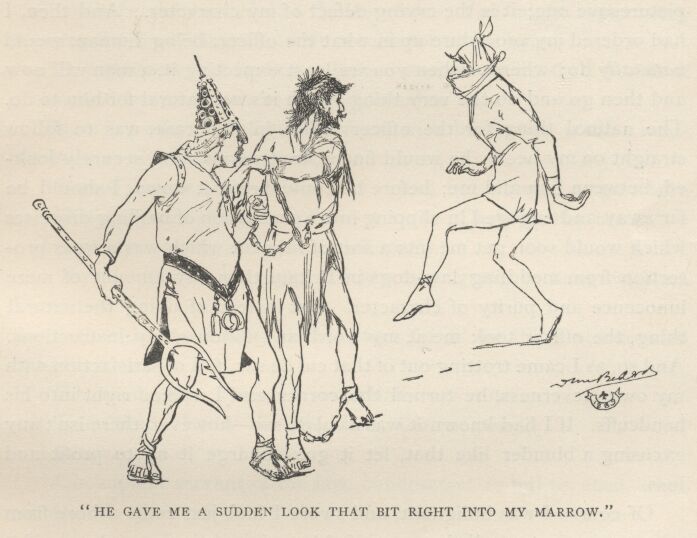
But the scheme fell through like scat! The first corner I turned, I came plump upon one of our slaves, snooping around with a watchman. I coughed at the moment, and he gave me a sudden look that bit right into my marrow. I judge he thought he had heard that cough before. I turned immediately into a shop and worked along down the counter, pricing things and watching out of the corner of my eye. Those people had stopped, and were talking together and looking in at the door. I made up my mind to get out the back way, if there was a back way, and I asked the shopwoman if I could step out there and look for the escaped slave, who was believed to be in hiding back there somewhere, and said I was an officer in disguise, and my pard was yonder at the door with one of the murderers in charge, and would she be good enough to step there and tell him he needn’t wait, but had better go at once to the further end of the back alley and be ready to head him off when I rousted him out.
But the plan fell apart in a flash! At the first corner, I ran smack into one of our slaves. He was snooping around with a watchman. Just then I coughed, and he shot me a look that chilled me to the bone. I figured he thought he had heard that cough before. I immediately turned into a shop and worked my way down the counter, asking prices and watching them out of the corner of my eye. They had stopped and were talking together and looking in through the door. I decided to get out the back way, if there was one. I asked the shopwoman if I could go out back and look for the escaped slave. People believed he was hiding somewhere back there. I said I was an officer in disguise. I told her my partner was over by the door with one of the murderers in his custody. Would she be kind enough to tell my partner he needn’t wait? He had better go straight to the far end of the back alley, ready to head off the escaped slave when I flushed him out.
She was blazing with eagerness to see one of those already celebrated murderers, and she started on the errand at once. I slipped out the back way, locked the door behind me, put the key in my pocket and started off, chuckling to myself and comfortable.
She was bursting with eagerness to see one of those already famous murderers, and she set off on the errand at once. I slipped out the back, locked the door behind me, and put the key in my pocket. Then I went off, chuckling to myself and feeling comfortable.
Well, I had gone and spoiled it again, made another mistake. A double one, in fact. There were plenty of ways to get rid of that officer by some simple and plausible device, but no, I must pick out a picturesque one; it is the crying defect of my character. And then, I had ordered my procedure upon what the officer, being human, would naturally do; whereas when you are least expecting it, a man will now and then go and do the very thing which it’s not natural for him to do. The natural thing for the officer to do, in this case, was to follow straight on my heels; he would find a stout oaken door, securely locked, between him and me; before he could break it down, I should be far away and engaged in slipping into a succession of baffling disguises which would soon get me into a sort of raiment which was a surer protection from meddling law-dogs in Britain than any amount of mere innocence and purity of character. But instead of doing the natural thing, the officer took me at my word, and followed my instructions. And so, as I came trotting out of that cul de sac, full of satisfaction with my own cleverness, he turned the corner and I walked right into his handcuffs. If I had known it was a cul de sac—however, there isn’t any excusing a blunder like that, let it go. Charge it up to profit and loss.
Well, I had gone and spoiled it again. I had made another mistake. Two mistakes, in fact. There were plenty of simple, believable ways to get rid of that officer. But no, I had to choose a dramatic one. That is the glaring flaw in my character. And then, I had based my plan on what the officer, being human, would naturally do. But just when you least expect it, a man will sometimes do the very thing that is not natural for him. In this case, the natural thing for the officer to do was to follow right behind me. He would find a heavy oak door, securely locked, between us. Before he could break it down, I would be far away, changing into one confusing disguise after another. Soon I would be wearing a kind of clothing that offered better protection from meddling British lawmen than any amount of innocence and purity of character. But instead of doing the natural thing, the officer took me at my word and followed my instructions. So I came trotting out of that dead end, pleased with my own cleverness. Just then, he turned the corner, and I walked right into his handcuffs. If I had known it was a dead end, well, there is no excusing a blunder like that. Let it go. Put it down to profit and loss.
Of course, I was indignant, and swore I had just come ashore from a long voyage, and all that sort of thing—just to see, you know, if it would deceive that slave. But it didn’t. He knew me. Then I reproached him for betraying me. He was more surprised than hurt. He stretched his eyes wide, and said:
Of course, I was outraged. I swore I had just come ashore after a long voyage, and all that sort of thing. I only said it to see, you know, if I could fool that slave. But I couldn’t. He knew me. Then I scolded him for betraying me. He was more surprised than hurt. He opened his eyes wide and said:
“What, wouldst have me let thee, of all men, escape and not hang with us, when thou’rt the very cause of our hanging? Go to!”
“What? You want me to let you, of all people, escape instead of hanging with us, when you’re the very cause of our hanging? Come on!”
“Go to” was their way of saying “I should smile!” or “I like that!” Queer talkers, those people.
“Go to” was their way of saying “You bet!” or “I like that!” Those people talked strangely.
Well, there was a sort of bastard justice in his view of the case, and so I dropped the matter. When you can’t cure a disaster by argument, what is the use to argue? It isn’t my way. So I only said:
Well, there was a sort of twisted justice in his view of the case, so I dropped the matter. If you can’t fix a disaster by arguing, what’s the use of arguing? It’s not my way. So I only said:
“You’re not going to be hanged. None of us are.”
“You’re not going to be hanged. None of us are.”
Both men laughed, and the slave said:
Both men laughed, and the slave said:
“Ye have not ranked as a fool—before. You might better keep your reputation, seeing the strain would not be for long.”
“You haven’t been thought a fool before. You’d better keep your reputation, since you won’t have to keep it up for long.”
“It will stand it, I reckon. Before to-morrow we shall be out of prison, and free to go where we will, besides.”
“I think it will hold up. By tomorrow, we’ll be out of prison and free to go wherever we want, too.”
The witty officer lifted at his left ear with his thumb, made a rasping noise in his throat, and said:
The witty officer lifted his left ear with his thumb, made a rasping sound in his throat, and said:
“Out of prison—yes—ye say true. And free likewise to go where ye will, so ye wander not out of his grace the Devil’s sultry realm.”
“Out of prison, yes, you’re right. And free to go wherever you want, as long as you don’t wander out of his grace the Devil’s sweltering realm.”
I kept my temper, and said, indifferently:
I stayed calm and said casually:
“Now I suppose you really think we are going to hang within a day or two.”
“Now I suppose you really think we are going to be hanged in a day or two.”
“I thought it not many minutes ago, for so the thing was decided and proclaimed.”
“I didn't think so a few minutes ago, because that was how it was decided and announced.”
“Ah, then you’ve changed your mind, is that it?”
“Oh, so you’ve changed your mind, is that it?”
“Even that. I only thought, then; I know, now.”
“Even that. I only thought so then. I know now.”
I felt sarcastical, so I said:
I felt sarcastic, so I said:
“Oh, sapient servant of the law, condescend to tell us, then, what you know.”
“Oh, wise servant of the law, please tell us, then, what you know.”
“That ye will all be hanged to-day, at mid-afternoon! Oho! that shot hit home! Lean upon me.”
“That you will all be hanged today, in the middle of the afternoon! Oh! That hit home! Lean on me.”
The fact is I did need to lean upon somebody. My knights couldn’t arrive in time. They would be as much as three hours too late. Nothing in the world could save the King of England; nor me, which was more important. More important, not merely to me, but to the nation—the only nation on earth standing ready to blossom into civilization. I was sick. I said no more, there wasn’t anything to say. I knew what the man meant; that if the missing slave was found, the postponement would be revoked, the execution take place to-day. Well, the missing slave was found.
The truth was, I did need someone to lean on. My knights couldn’t get there in time. They would be as much as three hours too late. Nothing in the world could save the King of England, or me. Saving me was more important, not just to me, but to the nation. It was the only nation on earth ready to blossom into civilization. I felt sick. I said no more. There was nothing to say. I knew what the man meant. If the missing slave was found, the delay would be canceled and the execution would take place today. Well, the missing slave was found.