Chapter 34
The Yankee and the King Sold as Slaves
Well, what had I better do? Nothing in a hurry, sure. I must get up a diversion; anything to employ me while I could think, and while these poor fellows could have a chance to come to life again. There sat Marco, petrified in the act of trying to get the hang of his miller-gun—turned to stone, just in the attitude he was in when my pile-driver fell, the toy still gripped in his unconscious fingers. So I took it from him and proposed to explain its mystery. Mystery! a simple little thing like that; and yet it was mysterious enough, for that race and that age.
Well, what should I do? Nothing in a hurry, that was certain. I needed a distraction, something to keep me busy while I thought and gave these poor fellows a chance to recover. There sat Marco, frozen as he tried to figure out his miller-gun. He was like a statue, still in the position he had been in when my pile-driver fell. The toy was still gripped in his unconscious fingers. So I took it from him and offered to explain its mystery. Mystery! Such a simple little thing, and yet mysterious enough for that race and that age.
I never saw such an awkward people, with machinery; you see, they were totally unused to it. The miller-gun was a little double-barreled tube of toughened glass, with a neat little trick of a spring to it, which upon pressure would let a shot escape. But the shot wouldn’t hurt anybody, it would only drop into your hand. In the gun were two sizes—wee mustard-seed shot, and another sort that were several times larger. They were money. The mustard-seed shot represented milrays, the larger ones mills. So the gun was a purse; and very handy, too; you could pay out money in the dark with it, with accuracy; and you could carry it in your mouth; or in your vest pocket, if you had one. I made them of several sizes—one size so large that it would carry the equivalent of a dollar. Using shot for money was a good thing for the government; the metal cost nothing, and the money couldn’t be counterfeited, for I was the only person in the kingdom who knew how to manage a shot tower. “Paying the shot” soon came to be a common phrase. Yes, and I knew it would still be passing men’s lips, away down in the nineteenth century, yet none would suspect how and when it originated.
I never saw people so awkward with machinery. You see, they were completely unused to it. The miller-gun was a small double-barreled tube made of toughened glass. It had a clever little spring that released a shot when pressed. But the shot would not hurt anyone. It would just drop into your hand. The gun held two sizes of shot. One was as tiny as a mustard seed, and the other was several times larger. They were money. The tiny shot represented milrays, and the larger ones represented mills. So the gun was a purse, and a very handy one too. You could use it to pay the exact amount in the dark. You could carry it in your mouth, or in your vest pocket, if you had one. I made them in several sizes. One was large enough to hold the equivalent of a dollar. Using shot for money was good for the government. The metal cost nothing, and the money could not be counterfeited. I was the only person in the kingdom who knew how to operate a shot tower. “Paying the shot” soon became a common phrase. Yes, and I knew people would still be saying it well into the nineteenth century. Yet no one would suspect how or when it began.
The king joined us, about this time, mightily refreshed by his nap, and feeling good. Anything could make me nervous now, I was so uneasy—for our lives were in danger; and so it worried me to detect a complacent something in the king’s eye which seemed to indicate that he had been loading himself up for a performance of some kind or other; confound it, why must he go and choose such a time as this?
Around this time, the king joined us, refreshed by his nap and feeling good. Our lives were in danger, and I was so uneasy that anything could make me nervous. So it worried me to see a smug look in the king’s eye. He seemed to be getting ready to put on some kind of performance. Confound it, why did he have to pick a time like this?
I was right. He began, straight off, in the most innocently artful, and transparent, and lubberly way, to lead up to the subject of agriculture. The cold sweat broke out all over me. I wanted to whisper in his ear, “Man, we are in awful danger! every moment is worth a principality till we get back these men’s confidence; don’t waste any of this golden time.” But of course I couldn’t do it. Whisper to him? It would look as if we were conspiring. So I had to sit there and look calm and pleasant while the king stood over that dynamite mine and mooned along about his damned onions and things. At first the tumult of my own thoughts, summoned by the danger-signal and swarming to the rescue from every quarter of my skull, kept up such a hurrah and confusion and fifing and drumming that I couldn’t take in a word; but presently when my mob of gathering plans began to crystallize and fall into position and form line of battle, a sort of order and quiet ensued and I caught the boom of the king’s batteries, as if out of remote distance:
I was right. He immediately began trying to steer the conversation toward farming. His approach was innocent but cunning, obvious and clumsy. Cold sweat broke out all over me. I wanted to whisper in his ear, “Man, we’re in terrible danger! Every moment is worth a kingdom until we regain these men’s confidence. Don’t waste any of this golden time.” But of course I couldn’t do it. Whisper to him? It would look as if we were conspiring. So I had to sit there looking calm and pleasant. Meanwhile, the king stood over that dynamite mine, rambling on about his damned onions and things. At first, my thoughts were in an uproar. The danger signal had brought them swarming to the rescue from every corner of my skull. They made such a racket, with all their cheering, fifing and drumming, that I couldn’t take in a word. But soon my crowd of forming plans began to take shape and fall into battle formation. A kind of order and quiet followed. Then I caught the boom of the king’s batteries, as if from far away:
“—were not the best way, methinks, albeit it is not to be denied that authorities differ as concerning this point, some contending that the onion is but an unwholesome berry when stricken early from the tree—”
“...were not the best way, I think. Still, experts differ on this point. Some argue that the onion is an unhealthy berry when picked early from the tree...”
The audience showed signs of life, and sought each other’s eyes in a surprised and troubled way.
The audience began to stir and looked at one another with surprise and concern.
“—whileas others do yet maintain, with much show of reason, that this is not of necessity the case, instancing that plums and other like cereals do be always dug in the unripe state—”
“While others still argue, with good reason, that this is not necessarily the case. They point out that plums and other such cereals are always dug up while unripe.”
The audience exhibited distinct distress; yes, and also fear.
The audience was clearly distressed. Yes, and frightened too.
“—yet are they clearly wholesome, the more especially when one doth assuage the asperities of their nature by admixture of the tranquilizing juice of the wayward cabbage—”
“Yet they are clearly wholesome, especially when one softens their harshness by mixing in the soothing juice of the wayward cabbage.”
The wild light of terror began to glow in these men’s eyes, and one of them muttered, “These be errors, every one—God hath surely smitten the mind of this farmer.” I was in miserable apprehension; I sat upon thorns.
A wild look of terror began to glow in the men’s eyes. One of them muttered, “These are all errors. God has surely struck this farmer’s mind.” I was terribly anxious. I was on pins and needles.
“—and further instancing the known truth that in the case of animals, the young, which may be called the green fruit of the creature, is the better, all confessing that when a goat is ripe, his fur doth heat and sore engame his flesh, the which defect, taken in connection with his several rancid habits, and fulsome appetites, and godless attitudes of mind, and bilious quality of morals—”
“. . . and further illustrating the known truth that young animals, which may be called the creature’s green fruit, are better. All agree that when a goat is ripe, his fur heats and badly taints his flesh. This defect, together with his various rancid habits, disgusting appetites, godless attitudes of mind, and sickly morals . . .”
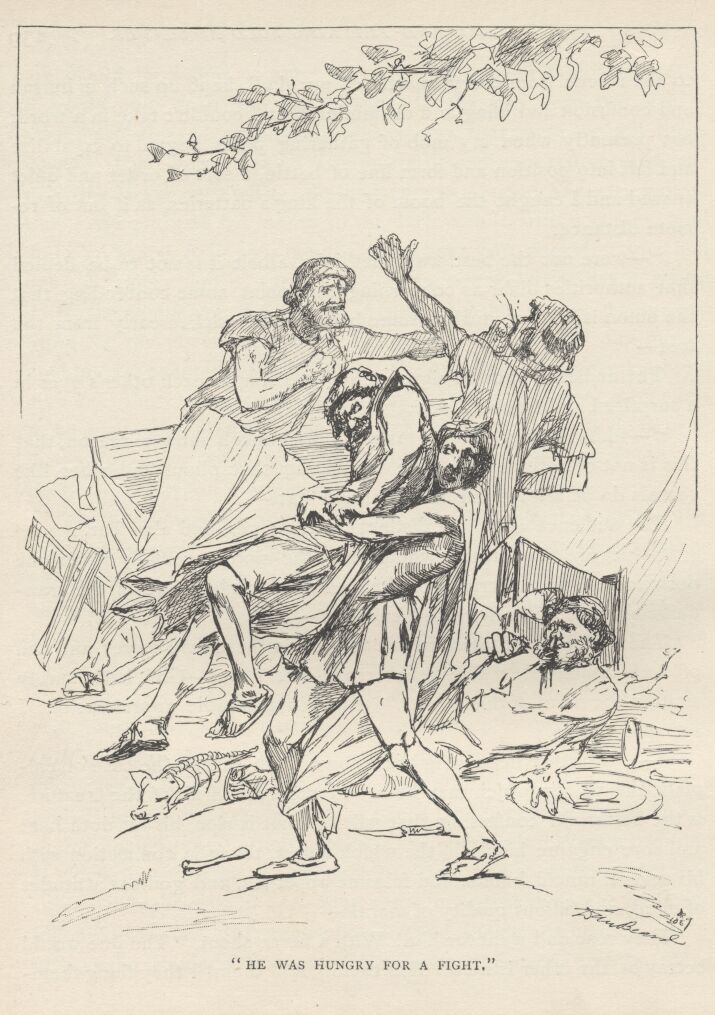
They rose and went for him! With a fierce shout, “The one would betray us, the other is mad! Kill them! Kill them!” they flung themselves upon us. What joy flamed up in the king’s eye! He might be lame in agriculture, but this kind of thing was just in his line. He had been fasting long, he was hungry for a fight. He hit the blacksmith a crack under the jaw that lifted him clear off his feet and stretched him flat on his back. “St. George for Britain!” and he downed the wheelwright. The mason was big, but I laid him out like nothing. The three gathered themselves up and came again; went down again; came again; and kept on repeating this, with native British pluck, until they were battered to jelly, reeling with exhaustion, and so blind that they couldn’t tell us from each other; and yet they kept right on, hammering away with what might was left in them. Hammering each other—for we stepped aside and looked on while they rolled, and struggled, and gouged, and pounded, and bit, with the strict and wordless attention to business of so many bulldogs. We looked on without apprehension, for they were fast getting past ability to go for help against us, and the arena was far enough from the public road to be safe from intrusion.
They got up and went for him! With a fierce shout, “One would betray us, the other is mad! Kill them! Kill them!” they threw themselves at us. What joy lit up the king’s eyes! He might be no good at farming, but this was just his kind of thing. He had gone a long time without a fight, and he was hungry for one. He struck the blacksmith under the jaw, lifting him off his feet and laying him flat on his back. “St. George for Britain!” he cried, and knocked down the wheelwright. The mason was big, but I knocked him out easily. The three got up and came at us again. We knocked them down again, and they came back. They kept doing this with native British pluck until they were beaten to a pulp and staggering with exhaustion. They were so blinded they couldn’t tell us from each other. Yet they kept hammering away with what strength they had left. They were hammering each other, that is. We stepped aside and watched as they rolled, struggled, gouged, punched, and bit. They fought with all the single-minded, silent focus of bulldogs. We watched without fear. They were quickly losing the strength to go for help against us. And the arena was far enough from the public road to keep anyone from interrupting.
Well, while they were gradually playing out, it suddenly occurred to me to wonder what had become of Marco. I looked around; he was nowhere to be seen. Oh, but this was ominous! I pulled the king’s sleeve, and we glided away and rushed for the hut. No Marco there, no Phyllis there! They had gone to the road for help, sure. I told the king to give his heels wings, and I would explain later. We made good time across the open ground, and as we darted into the shelter of the wood I glanced back and saw a mob of excited peasants swarm into view, with Marco and his wife at their head. They were making a world of noise, but that couldn’t hurt anybody; the wood was dense, and as soon as we were well into its depths we would take to a tree and let them whistle. Ah, but then came another sound—dogs! Yes, that was quite another matter. It magnified our contract—we must find running water.
Well, while they were gradually running out of steam, I suddenly wondered what had become of Marco. I looked around, but he was nowhere to be seen. Oh, that was a bad sign! I tugged the king’s sleeve, and we slipped away and rushed to the hut. No Marco there, no Phyllis either! They had surely gone to the road for help. I told the king to run as fast as he could, and I would explain later. We made good time across the open ground. As we darted into the shelter of the woods, I glanced back. A mob of excited peasants came swarming into view, led by Marco and his wife. They were making a tremendous racket, but that couldn’t hurt anyone. The woods were dense, and once we were deep enough inside, we would climb a tree and leave them searching in vain. Ah, but then came another sound: dogs! Yes, that was quite another matter. It made our job harder. We had to find running water.
We tore along at a good gait, and soon left the sounds far behind and modified to a murmur. We struck a stream and darted into it. We waded swiftly down it, in the dim forest light, for as much as three hundred yards, and then came across an oak with a great bough sticking out over the water. We climbed up on this bough, and began to work our way along it to the body of the tree; now we began to hear those sounds more plainly; so the mob had struck our trail. For a while the sounds approached pretty fast. And then for another while they didn’t. No doubt the dogs had found the place where we had entered the stream, and were now waltzing up and down the shores trying to pick up the trail again.
We raced along at a good pace, and soon the sounds faded to a murmur far behind us. We came to a stream and darted into it. We waded quickly downstream through the dim forest light for about three hundred yards. Then we came to an oak with a great branch sticking out over the water. We climbed onto the branch and began making our way along it toward the trunk. Now we could hear the sounds more clearly, so the mob had found our trail. For a while, the sounds came closer pretty fast. Then, for a while, they didn't. No doubt the dogs had found the place where we entered the stream. They were now waltzing up and down the banks, trying to pick up the trail again.
When we were snugly lodged in the tree and curtained with foliage, the king was satisfied, but I was doubtful. I believed we could crawl along a branch and get into the next tree, and I judged it worth while to try. We tried it, and made a success of it, though the king slipped, at the junction, and came near failing to connect. We got comfortable lodgment and satisfactory concealment among the foliage, and then we had nothing to do but listen to the hunt.
Once we were settled in the tree and hidden by the leaves, the king was satisfied, but I had doubts. I thought we could crawl along a branch into the next tree, and it was worth trying. We tried and succeeded, though the king slipped where the trees met and almost missed the next tree. We settled comfortably among the leaves, well hidden. Then we had nothing to do but listen to the hunt.
Presently we heard it coming—and coming on the jump, too; yes, and down both sides of the stream. Louder—louder—next minute it swelled swiftly up into a roar of shoutings, barkings, tramplings, and swept by like a cyclone.
Soon we heard it coming, and coming fast, too. Yes, it was coming down both sides of the stream. Louder and louder it grew. The next minute, it quickly swelled into a roar of shouting, barking, and trampling, and swept by like a cyclone.
“I was afraid that the overhanging branch would suggest something to them,” said I, “but I don’t mind the disappointment. Come, my liege, it were well that we make good use of our time. We’ve flanked them. Dark is coming on, presently. If we can cross the stream and get a good start, and borrow a couple of horses from somebody’s pasture to use for a few hours, we shall be safe enough.”
“I was afraid the overhanging branch would give them an idea,” I said, “but I don’t mind being disappointed. Come, my king, we should make good use of our time. We’ve gotten around them. It will be dark soon. If we can cross the stream and get a good head start, we’ll be safe enough. We can borrow a couple of horses from someone’s pasture for a few hours.”
We started down, and got nearly to the lowest limb, when we seemed to hear the hunt returning. We stopped to listen.
We started climbing down and had nearly reached the lowest branch when we thought we heard the hunt returning. We stopped to listen.
“Yes,” said I, “they’re baffled, they’ve given it up, they’re on their way home. We will climb back to our roost again, and let them go by.”
“Yes,” I said, “they’re stumped. They’ve given up and are heading home. We’ll climb back up to our perch and let them pass.”
So we climbed back. The king listened a moment and said:
So we climbed back. The king listened for a moment and said:
“They still search—I wit the sign. We did best to abide.”
“They are still searching. I recognize the sign. We had better stay.”
He was right. He knew more about hunting than I did. The noise approached steadily, but not with a rush. The king said:
He was right. He knew more about hunting than I did. The noise kept getting closer, but not quickly. The king said:
“They reason that we were advantaged by no parlous start of them, and being on foot are as yet no mighty way from where we took the water.”
“They figure we did not get much of a head start on them. Since we are on foot, we cannot be far from where we entered the water.”
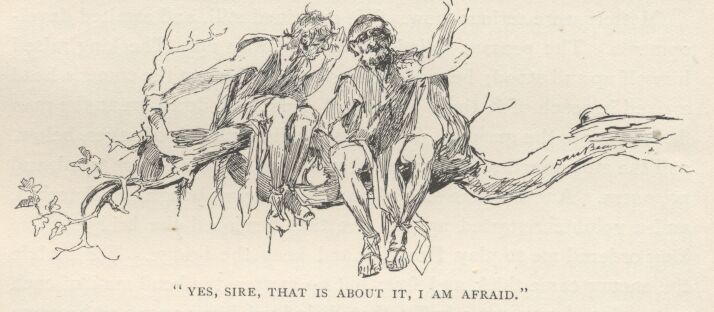
“Yes, sire, that is about it, I am afraid, though I was hoping better things.”
“Yes, sire, I’m afraid that’s about right, though I was hoping for better.”
The noise drew nearer and nearer, and soon the van was drifting under us, on both sides of the water. A voice called a halt from the other bank, and said:
The noise drew closer and closer. Soon the front of the procession was passing below us, on both sides of the water. A voice from the other bank called for a halt and said:
“An they were so minded, they could get to yon tree by this branch that overhangs, and yet not touch ground. Ye will do well to send a man up it.”
“If they wanted to, they could reach that tree by the overhanging branch without touching the ground. You should send a man up the branch.”
“Marry, that we will do!”
“Indeed, we will!”
I was obliged to admire my cuteness in foreseeing this very thing and swapping trees to beat it. But, don’t you know, there are some things that can beat smartness and foresight? Awkwardness and stupidity can. The best swordsman in the world doesn’t need to fear the second best swordsman in the world; no, the person for him to be afraid of is some ignorant antagonist who has never had a sword in his hand before; he doesn’t do the thing he ought to do, and so the expert isn’t prepared for him; he does the thing he ought not to do; and often it catches the expert out and ends him on the spot. Well, how could I, with all my gifts, make any valuable preparation against a near-sighted, cross-eyed, pudding-headed clown who would aim himself at the wrong tree and hit the right one? And that is what he did. He went for the wrong tree, which was, of course, the right one by mistake, and up he started.
I had to admire my own cleverness for seeing this coming and switching trees to avoid it. But, you know, some things can beat cleverness and foresight. Clumsiness and stupidity can. The best swordsman in the world doesn’t need to fear the second best. No, the person he should fear is an ignorant opponent who has never held a sword before. The opponent doesn’t do what he should, so the expert isn’t prepared for him. He does what he shouldn’t, and often catches the expert off guard and kills him on the spot. Well, how could I, with all my gifts, prepare for a nearsighted, cross-eyed, thickheaded clown? He would head for the wrong tree and end up at the right one. And that is what he did. He went for the wrong tree, which was, of course, the right one by mistake, and started climbing.
Matters were serious now. We remained still, and awaited developments. The peasant toiled his difficult way up. The king raised himself up and stood; he made a leg ready, and when the comer’s head arrived in reach of it there was a dull thud, and down went the man floundering to the ground. There was a wild outbreak of anger below, and the mob swarmed in from all around, and there we were treed, and prisoners. Another man started up; the bridging bough was detected, and a volunteer started up the tree that furnished the bridge. The king ordered me to play Horatius and keep the bridge. For a while the enemy came thick and fast; but no matter, the head man of each procession always got a buffet that dislodged him as soon as he came in reach. The king’s spirits rose, his joy was limitless. He said that if nothing occurred to mar the prospect we should have a beautiful night, for on this line of tactics we could hold the tree against the whole country-side.
Things were serious now. We stayed still and waited to see what would happen. The peasant struggled to climb up. The king stood and readied his leg. When the man’s head came within reach, the king kicked it with a dull thud. Down the man went, tumbling to the ground. The crowd below erupted in anger and swarmed in from every side. There we were, trapped in the tree and prisoners. Another man began to climb. The crowd spotted the branch that formed a bridge, and a volunteer began climbing the tree that supported it. The king ordered me to play Horatius and defend the bridge. For a while, the enemy came thick and fast. But it didn’t matter. The first man in each line always got a blow that knocked him off as soon as he came within reach. The king’s spirits rose, and his joy knew no bounds. He said that if nothing spoiled our prospects, we would have a beautiful night. With these tactics, we could hold the tree against the whole countryside.
However, the mob soon came to that conclusion themselves; wherefore they called off the assault and began to debate other plans. They had no weapons, but there were plenty of stones, and stones might answer. We had no objections. A stone might possibly penetrate to us once in a while, but it wasn’t very likely; we were well protected by boughs and foliage, and were not visible from any good aiming point. If they would but waste half an hour in stone-throwing, the dark would come to our help. We were feeling very well satisfied. We could smile; almost laugh.
However, the mob soon reached that conclusion themselves, so they called off the attack and began discussing other plans. They had no weapons, but there were plenty of stones, and those might do. We had no objection. A stone might reach us now and then, but it wasn’t very likely. Branches and leaves protected us well, and they couldn’t see us from any good spot to aim at us. If they wasted half an hour throwing stones, darkness would come to our aid. We felt very satisfied. We could smile, almost laugh.
But we didn’t; which was just as well, for we should have been interrupted. Before the stones had been raging through the leaves and bouncing from the boughs fifteen minutes, we began to notice a smell. A couple of sniffs of it was enough of an explanation—it was smoke! Our game was up at last. We recognized that. When smoke invites you, you have to come. They raised their pile of dry brush and damp weeds higher and higher, and when they saw the thick cloud begin to roll up and smother the tree, they broke out in a storm of joy-clamors. I got enough breath to say:
But we didn’t, which was just as well, because we would have been interrupted. Stones had been crashing through the leaves and bouncing off the branches for less than fifteen minutes when we noticed a smell. A couple of sniffs explained everything. It was smoke! Our game was finally up, and we knew it. When smoke invites you, you have to come. They piled the dry brush and damp weeds higher and higher. When they saw the thick cloud start to rise and smother the tree, they burst into cheers. I caught enough breath to say:
“Proceed, my liege; after you is manners.”
“Go ahead, my king. It’s polite to let you go first.”
The king gasped:
The king gasped:
“Follow me down, and then back thyself against one side of the trunk, and leave me the other. Then will we fight. Let each pile his dead according to his own fashion and taste.”
“Follow me down, then stand with your back against one side of the trunk. Leave the other side to me. Then we will fight. Each of us can pile up his dead however he likes.”
Then he descended, barking and coughing, and I followed. I struck the ground an instant after him; we sprang to our appointed places, and began to give and take with all our might. The powwow and racket were prodigious; it was a tempest of riot and confusion and thick-falling blows. Suddenly some horsemen tore into the midst of the crowd, and a voice shouted:
Then he climbed down, barking and coughing, and I followed. I hit the ground an instant after him. We sprang to our assigned places and began trading blows with all our might. The noise and commotion were tremendous. It was a storm of uproar, confusion, and rapid blows. Suddenly, some horsemen charged into the middle of the crowd, and a voice shouted:
“Hold—or ye are dead men!”
“Stop, or you're dead men!”
How good it sounded! The owner of the voice bore all the marks of a gentleman: picturesque and costly raiment, the aspect of command, a hard countenance, with complexion and features marred by dissipation. The mob fell humbly back, like so many spaniels. The gentleman inspected us critically, then said sharply to the peasants:
How good it sounded! The man who spoke had all the marks of a gentleman. He wore striking, expensive clothes and had a commanding presence. His face was hard, and his features and complexion were damaged by excessive drinking and other indulgences. The crowd backed away meekly, like a pack of spaniels. The gentleman looked us over critically, then spoke sharply to the peasants:
“What are ye doing to these people?”
“What are you doing to these people?”
“They be madmen, worshipful sir, that have come wandering we know not whence, and—”
“They are madmen, respected sir, who have wandered here from we know not where, and...”
“Ye know not whence? Do ye pretend ye know them not?”
“You don't know where they come from? Do you claim you don't know them?”
“Most honored sir, we speak but the truth. They are strangers and unknown to any in this region; and they be the most violent and bloodthirsty madmen that ever—”
“Honored sir, we are telling the truth. They are strangers, and no one in this region knows them. They are the most violent and bloodthirsty madmen who ever...”
“Peace! Ye know not what ye say. They are not mad. Who are ye? And whence are ye? Explain.”
“Quiet! You don't know what you're saying. They aren't insane. Who are you? Where are you from? Explain.”
“We are but peaceful strangers, sir,” I said, “and traveling upon our own concerns. We are from a far country, and unacquainted here. We have purposed no harm; and yet but for your brave interference and protection these people would have killed us. As you have divined, sir, we are not mad; neither are we violent or bloodthirsty.”
“We are peaceful strangers, sir,” I said, “traveling on our own business. We come from a faraway country and are unfamiliar with this place. We meant no harm. But if you had not bravely stepped in to protect us, these people would have killed us. As you guessed, sir, we are not mad. Nor are we violent or bloodthirsty.”
The gentleman turned to his retinue and said calmly: “Lash me these animals to their kennels!”
The gentleman turned to his attendants and said calmly: “Tie these animals to their kennels!”
The mob vanished in an instant; and after them plunged the horsemen, laying about them with their whips and pitilessly riding down such as were witless enough to keep the road instead of taking to the bush. The shrieks and supplications presently died away in the distance, and soon the horsemen began to straggle back. Meantime the gentleman had been questioning us more closely, but had dug no particulars out of us. We were lavish of recognition of the service he was doing us, but we revealed nothing more than that we were friendless strangers from a far country. When the escort were all returned, the gentleman said to one of his servants:
The mob vanished in an instant. The horsemen charged after them, swinging their whips. They mercilessly rode down anyone foolish enough to stay on the road instead of taking cover in the bushes. The screams and pleas soon faded into the distance, and the horsemen began to drift back. Meanwhile, the gentleman had been questioning us more closely, but he learned no details. We thanked him profusely for helping us, but revealed only that we were friendless strangers from a faraway country. When the whole escort had returned, the gentleman said to one of his servants:
“Bring the led-horses and mount these people.”
“Bring the spare horses and help these people get on them.”
“Yes, my lord.”
“Yes, my lord.”
We were placed toward the rear, among the servants. We traveled pretty fast, and finally drew rein some time after dark at a roadside inn some ten or twelve miles from the scene of our troubles. My lord went immediately to his room, after ordering his supper, and we saw no more of him. At dawn in the morning we breakfasted and made ready to start.
We were placed near the back, among the servants. We traveled fairly quickly. Sometime after dark, we stopped at a roadside inn about ten or twelve miles from where our troubles had occurred. My lord ordered his supper and went straight to his room. We didn't see him again. At dawn, we ate breakfast and got ready to leave.
My lord’s chief attendant sauntered forward at that moment with indolent grace, and said:
At that moment, my lord’s chief attendant strolled forward with lazy grace and said:
“Ye have said ye should continue upon this road, which is our direction likewise; wherefore my lord, the earl Grip, hath given commandment that ye retain the horses and ride, and that certain of us ride with ye a twenty mile to a fair town that hight Cambenet, whenso ye shall be out of peril.”
“You said you would continue along this road, and we are going the same way. So my lord, the earl Grip, has ordered you to keep the horses and ride. He has also ordered some of us to ride with you twenty miles to a fine town called Cambenet. There you will be out of danger.”
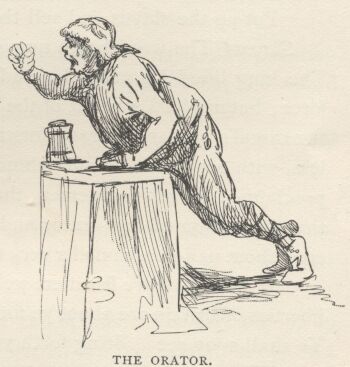
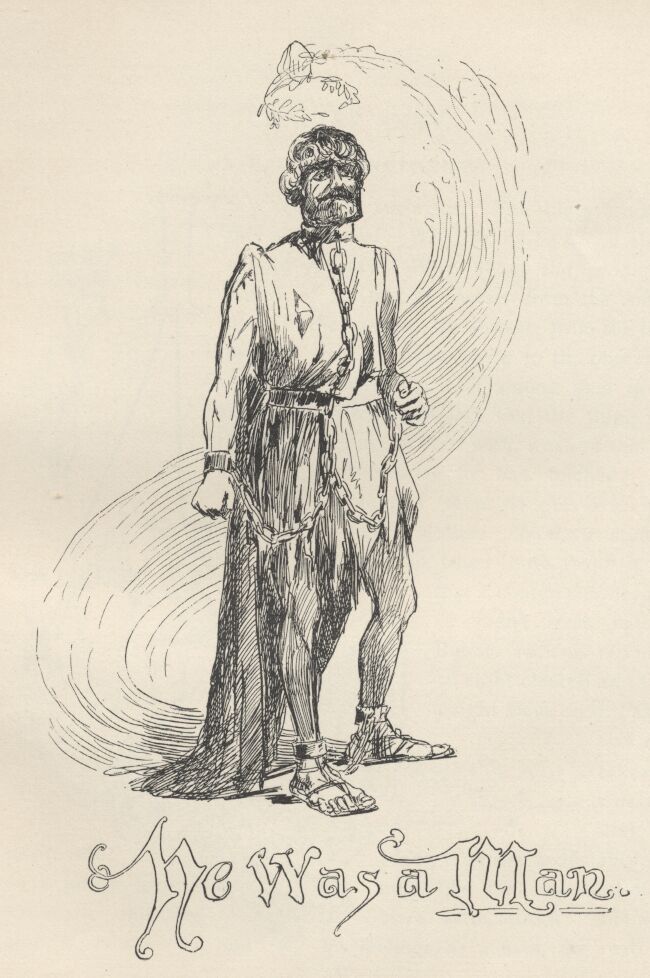
We could do nothing less than express our thanks and accept the offer. We jogged along, six in the party, at a moderate and comfortable gait, and in conversation learned that my lord Grip was a very great personage in his own region, which lay a day’s journey beyond Cambenet. We loitered to such a degree that it was near the middle of the forenoon when we entered the market square of the town. We dismounted, and left our thanks once more for my lord, and then approached a crowd assembled in the center of the square, to see what might be the object of interest. It was the remnant of that old peregrinating band of slaves! So they had been dragging their chains about, all this weary time. That poor husband was gone, and also many others; and some few purchases had been added to the gang. The king was not interested, and wanted to move along, but I was absorbed, and full of pity. I could not take my eyes away from these worn and wasted wrecks of humanity. There they sat, grounded upon the ground, silent, uncomplaining, with bowed heads, a pathetic sight. And by hideous contrast, a redundant orator was making a speech to another gathering not thirty steps away, in fulsome laudation of “our glorious British liberties!”
We could do nothing less than thank him and accept the offer. The six of us rode along at a comfortable pace. As we talked, we learned that my lord Grip was a very important person in his own region. It lay a day’s journey beyond Cambenet. We traveled so slowly that it was nearly midmorning when we entered the town’s market square. We dismounted, thanked my lord once more, and approached a crowd in the center of the square. We wanted to see what had drawn their attention. It was what remained of that old traveling band of slaves! They had been dragging their chains around all this weary time. That poor husband was gone, and so were many others. A few newly purchased slaves had been added to the group. The king was not interested and wanted to move on, but I was absorbed and full of pity. I could not take my eyes off these worn and wasted wrecks of humanity. There they sat on the ground, silent and uncomplaining, with bowed heads, a pitiful sight. In hideous contrast, a long-winded speaker was addressing another crowd less than thirty steps away. He was lavishly praising “our glorious British liberties!”
I was boiling. I had forgotten I was a plebeian, I was remembering I was a man. Cost what it might, I would mount that rostrum and—
I was furious. I had forgotten that I was a commoner. I remembered that I was a man. Whatever the cost, I would climb onto that platform and...
Click! the king and I were handcuffed together! Our companions, those servants, had done it; my lord Grip stood looking on. The king burst out in a fury, and said:
Click! The king and I were handcuffed together! Our companions, the servants, had done it. My lord Grip stood watching. The king burst out in a fury and said:
“What meaneth this ill-mannered jest?”
“What does this rude joke mean?”
My lord merely said to his head miscreant, coolly:
My lord simply said calmly to his chief villain:
“Put up the slaves and sell them!”
“Put the slaves up for sale and sell them!”
Slaves! The word had a new sound—and how unspeakably awful! The king lifted his manacles and brought them down with a deadly force; but my lord was out of the way when they arrived. A dozen of the rascal’s servants sprang forward, and in a moment we were helpless, with our hands bound behind us. We so loudly and so earnestly proclaimed ourselves freemen, that we got the interested attention of that liberty-mouthing orator and his patriotic crowd, and they gathered about us and assumed a very determined attitude. The orator said:
Slaves! The word sounded new to me, and unspeakably awful! The king raised his manacles and brought them down with deadly force. But my lord had moved out of the way. A dozen of the rascal’s servants sprang forward. In a moment, they had tied our hands behind our backs, leaving us helpless. We shouted so loudly and insisted so strongly that we were free men that the orator who talked so much about liberty and his patriotic crowd took an interest. They gathered around us and looked very determined. The orator said:
“If, indeed, ye are freemen, ye have nought to fear—the God-given liberties of Britain are about ye for your shield and shelter! (Applause.) Ye shall soon see. Bring forth your proofs.”
“If you are indeed free men, you have nothing to fear. Britain’s God-given liberties are your shield and shelter! (Applause.) You will soon see. Bring out your proof.”
“What proofs?”
“What proof?”
“Proof that ye are freemen.”
“Proof that you are free men.”
Ah—I remembered! I came to myself; I said nothing. But the king stormed out:
Ah, I remembered! I regained my composure and said nothing. But the king burst out:
“Thou’rt insane, man. It were better, and more in reason, that this thief and scoundrel here prove that we are not freemen.”
“You’re insane, man. It would be better and more reasonable for this thief and scoundrel to prove that we are not free men.”
You see, he knew his own laws just as other people so often know the laws; by words, not by effects. They take a meaning, and get to be very vivid, when you come to apply them to yourself.
You see, he knew his own laws just as people so often know the law: by their words, not their effects. Laws take on meaning and become very vivid when you apply them to yourself.
All hands shook their heads and looked disappointed; some turned away, no longer interested. The orator said—and this time in the tones of business, not of sentiment:
Everyone shook their heads and looked disappointed. Some turned away, no longer interested. The speaker spoke again, this time in a businesslike tone rather than an emotional one:
“An ye do not know your country’s laws, it were time ye learned them. Ye are strangers to us; ye will not deny that. Ye may be freemen, we do not deny that; but also ye may be slaves. The law is clear: it doth not require the claimant to prove ye are slaves, it requireth you to prove ye are not.”
“If you don’t know your country’s laws, it’s time you learned them. You are strangers to us. You won’t deny that. You may be free, and we don’t deny that. But you may also be slaves. The law is clear: the person claiming you are slaves does not have to prove it. You have to prove you are not slaves.”
I said:
I said:
“Dear sir, give us only time to send to Astolat; or give us only time to send to the Valley of Holiness—”
“Dear sir, just give us time to send word to Astolat, or to the Valley of Holiness...”
“Peace, good man, these are extraordinary requests, and you may not hope to have them granted. It would cost much time, and would unwarrantably inconvenience your master—”
“Calm down, good man. These requests are extraordinary, and you cannot expect them to be granted. It would take a lot of time and cause your master unnecessary inconvenience.”
“Master, idiot!” stormed the king. “I have no master, I myself am the m—”
“Master, you idiot!” the king shouted. “I have no master. I myself am the m...”
“Silence, for God’s sake!”
“Be quiet, for God’s sake!”
I got the words out in time to stop the king. We were in trouble enough already; it could not help us any to give these people the notion that we were lunatics.
I spoke in time to stop the king. We were already in enough trouble. It wouldn't help if these people thought we were crazy.
There is no use in stringing out the details. The earl put us up and sold us at auction. This same infernal law had existed in our own South in my own time, more than thirteen hundred years later, and under it hundreds of freemen who could not prove that they were freemen had been sold into lifelong slavery without the circumstance making any particular impression upon me; but the minute law and the auction block came into my personal experience, a thing which had been merely improper before became suddenly hellish. Well, that’s the way we are made.
There’s no point dragging out the details. The earl put us up for auction and sold us. This same hellish law had existed in our own South in my own time, more than thirteen hundred years later. Under it, hundreds of free people had been sold into lifelong slavery because they couldn’t prove they were free. That had made no particular impression on me. But the moment I experienced the law and the auction block myself, what had merely seemed improper suddenly became hellish. Well, that’s how we’re made.
Yes, we were sold at auction, like swine. In a big town and an active market we should have brought a good price; but this place was utterly stagnant and so we sold at a figure which makes me ashamed, every time I think of it. The King of England brought seven dollars, and his prime minister nine; whereas the king was easily worth twelve dollars and I as easily worth fifteen. But that is the way things always go; if you force a sale on a dull market, I don’t care what the property is, you are going to make a poor business of it, and you can make up your mind to it. If the earl had had wit enough to—
Yes, we were sold at auction, like pigs. In a big town with a busy market, we would have brought a good price. But this place was completely dead, so we sold for an amount that makes me ashamed whenever I think of it. The King of England brought seven dollars, and his prime minister brought nine. The king was easily worth twelve dollars, and I was just as easily worth fifteen. But that is how things always go. If you force a sale in a slow market, you can be sure you’ll get a poor price. It doesn’t matter what you’re selling. If the earl had been smart enough to...
However, there is no occasion for my working my sympathies up on his account. Let him go, for the present; I took his number, so to speak.
However, there is no need for me to feel sorry for him. I’ll let him go for now. I’ve got his number, so to speak.
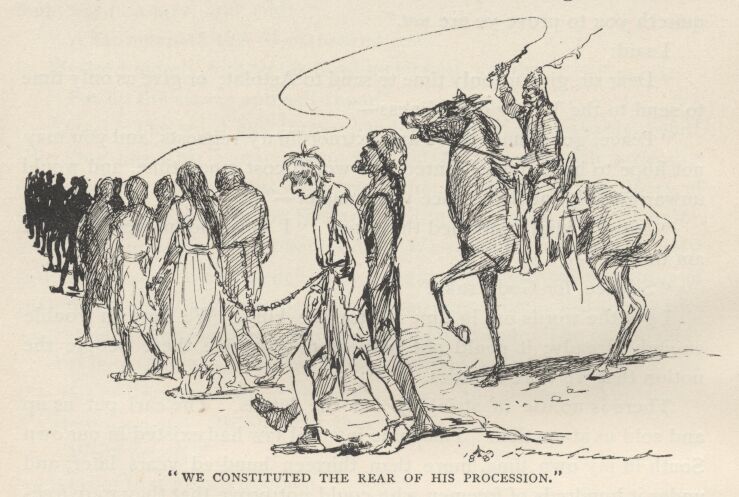
The slave-dealer bought us both, and hitched us onto that long chain of his, and we constituted the rear of his procession. We took up our line of march and passed out of Cambenet at noon; and it seemed to me unaccountably strange and odd that the King of England and his chief minister, marching manacled and fettered and yoked, in a slave convoy, could move by all manner of idle men and women, and under windows where sat the sweet and the lovely, and yet never attract a curious eye, never provoke a single remark. Dear, dear, it only shows that there is nothing diviner about a king than there is about a tramp, after all. He is just a cheap and hollow artificiality when you don’t know he is a king. But reveal his quality, and dear me it takes your very breath away to look at him. I reckon we are all fools. Born so, no doubt.
The slave-dealer bought us both and attached us to his long chain. We were at the back of his procession. We set out and left Cambenet at noon. The King of England and his chief minister were marching in a slave convoy, handcuffed, shackled, and yoked. It seemed incredibly strange to me that we passed all kinds of men and women standing around. We even passed under windows where beautiful, lovely women sat. Yet no one gave us a curious look or made a single remark. Dear, dear, it just shows that a king is no more divine than a tramp, after all. When you don't know he's a king, he's just a cheap, hollow imitation. But reveal that he's a king, and dear me, the sight of him takes your very breath away. I reckon we're all fools. Born that way, no doubt.