Chapter 30
The Manor House Tragedy
At midnight all was over, and we sat in the presence of four corpses. We covered them with such rags as we could find, and started away, fastening the door behind us. Their home must be these people’s grave, for they could not have Christian burial, or be admitted to consecrated ground. They were as dogs, wild beasts, lepers, and no soul that valued its hope of eternal life would throw it away by meddling in any sort with these rebuked and smitten outcasts.
By midnight, it was all over, and we sat with four corpses. We covered them with whatever rags we could find, then left and fastened the door behind us. Their home would have to be their grave. They could not have a Christian burial or be buried in consecrated ground. They were like dogs, wild beasts, or lepers. No one who valued their hope of eternal life would throw it away by having anything to do with these condemned and stricken outcasts.
We had not moved four steps when I caught a sound as of footsteps upon gravel. My heart flew to my throat. We must not be seen coming from that house. I plucked at the king’s robe and we drew back and took shelter behind the corner of the cabin.
We had barely taken four steps when I heard what sounded like footsteps on gravel. My heart jumped into my throat. We must not be seen coming from that house. I tugged at the king’s robe, and we drew back and hid behind the corner of the cabin.
“Now we are safe,” I said, “but it was a close call—so to speak. If the night had been lighter he might have seen us, no doubt, he seemed to be so near.”
“Now we are safe,” I said, “but it was a close call, so to speak. He seemed so close that if the night had been brighter, he might have seen us, no doubt.”
“Mayhap it is but a beast and not a man at all.”
“Perhaps it is only a beast and not a man at all.”
“True. But man or beast, it will be wise to stay here a minute and let it get by and out of the way.”
“True. But whether it’s a man or an animal, we should stay here a minute and let it pass.”
“Hark! It cometh hither.”
“Listen! It's coming this way.”
True again. The step was coming toward us—straight toward the hut. It must be a beast, then, and we might as well have saved our trepidation. I was going to step out, but the king laid his hand upon my arm. There was a moment of silence, then we heard a soft knock on the cabin door. It made me shiver. Presently the knock was repeated, and then we heard these words in a guarded voice:
Right again. The footsteps were coming toward us, straight toward the hut. It must be an animal, then, and we needn't have been afraid. I was about to step outside, but the king put his hand on my arm. There was a moment of silence. Then we heard a soft knock on the cabin door. The knock made me shiver. Soon the knock came again, and then we heard these words in a cautious voice:
“Mother! Father! Open—we have got free, and we bring news to pale your cheeks but glad your hearts; and we may not tarry, but must fly! And—but they answer not. Mother! father!—”
“Mother! Father! Open the door! We have escaped, and we bring news that will make you turn pale but fill your hearts with joy. We can't stay. We must flee! And... but they aren't answering. Mother! Father!”
I drew the king toward the other end of the hut and whispered:
I led the king to the other end of the hut and whispered:
“Come—now we can get to the road.”
“Come on, now we can get to the road.”
The king hesitated, was going to demur; but just then we heard the door give way, and knew that those desolate men were in the presence of their dead.
The king hesitated and was about to object. But just then we heard the door give way. We knew the grieving men were with their dead.
“Come, my liege! in a moment they will strike a light, and then will follow that which it would break your heart to hear.”
“Come, my king! In a moment, they will light a lamp. Then you will hear something that would break your heart.”
He did not hesitate this time. The moment we were in the road I ran; and after a moment he threw dignity aside and followed. I did not want to think of what was happening in the hut—I couldn’t bear it; I wanted to drive it out of my mind; so I struck into the first subject that lay under that one in my mind:
He did not hesitate this time. As soon as we reached the road, I ran. A moment later, he abandoned his dignity and followed. I couldn't bear to think about what was happening in the hut. I wanted to drive it out of my mind, so I turned to the next subject on my mind:
“I have had the disease those people died of, and so have nothing to fear; but if you have not had it also—”
“I have had the disease those people died of, so I have nothing to fear. But if you haven't had it too...”
He broke in upon me to say he was in trouble, and it was his conscience that was troubling him:
He interrupted me to say he was in trouble. His conscience was bothering him:
“These young men have got free, they say—but how? It is not likely that their lord hath set them free.”
“They say these young men are free, but how? Their lord is not likely to have set them free.”
“Oh, no, I make no doubt they escaped.”
“Oh, no, I’m sure they escaped.”
“That is my trouble; I have a fear that this is so, and your suspicion doth confirm it, you having the same fear.”
“That’s what troubles me. I’m afraid this is true, and your suspicion confirms it because you share my fear.”
“I should not call it by that name though. I do suspect that they escaped, but if they did, I am not sorry, certainly.”
“I wouldn't call it that, though. I do suspect they escaped, but if they did, I'm certainly not sorry.”
“I am not sorry, I think—but—”
“I’m not sorry, I think, but...”
“What is it? What is there for one to be troubled about?”
“What is it? What is there to worry about?”
“If they did escape, then are we bound in duty to lay hands upon them and deliver them again to their lord; for it is not seemly that one of his quality should suffer a so insolent and high-handed outrage from persons of their base degree.”
“If they escaped, we have a duty to catch them and return them to their lord. For a man of his rank should not have to suffer such an insolent and high-handed outrage from people of such low rank.”
There it was again. He could see only one side of it. He was born so, educated so, his veins were full of ancestral blood that was rotten with this sort of unconscious brutality, brought down by inheritance from a long procession of hearts that had each done its share toward poisoning the stream. To imprison these men without proof, and starve their kindred, was no harm, for they were merely peasants and subject to the will and pleasure of their lord, no matter what fearful form it might take; but for these men to break out of unjust captivity was insult and outrage, and a thing not to be countenanced by any conscientious person who knew his duty to his sacred caste.
There it was again. He could see only one side of it. He was born and raised that way. His ancestral blood was rotten with this kind of unconscious brutality. It had been passed down through a long line of hearts, each of which had helped poison the stream. To imprison these men without proof and starve their families did no harm. They were only peasants, subject to their lord's will and pleasure, no matter how terrible that might be. But for these men to escape their unjust imprisonment was an insult and an outrage. No conscientious person who knew his duty to his sacred caste could tolerate it.
I worked more than half an hour before I got him to change the subject—and even then an outside matter did it for me. This was a something which caught our eyes as we struck the summit of a small hill—a red glow, a good way off.
I spent more than half an hour trying to get him to change the subject. Even then, something else did it for me. As we reached the top of a small hill, we spotted a red glow far off in the distance.
“That’s a fire,” said I.
“That’s a fire,” I said.
Fires interested me considerably, because I was getting a good deal of an insurance business started, and was also training some horses and building some steam fire-engines, with an eye to a paid fire department by and by. The priests opposed both my fire and life insurance, on the ground that it was an insolent attempt to hinder the decrees of God; and if you pointed out that they did not hinder the decrees in the least, but only modified the hard consequences of them if you took out policies and had luck, they retorted that that was gambling against the decrees of God, and was just as bad. So they managed to damage those industries more or less, but I got even on my accident business. As a rule, a knight is a lummux, and some times even a labrick, and hence open to pretty poor arguments when they come glibly from a superstition-monger, but even he could see the practical side of a thing once in a while; and so of late you couldn’t clean up a tournament and pile the result without finding one of my accident-tickets in every helmet.
Fires interested me a great deal because I was getting a sizable insurance business started. I was also training horses and building steam fire engines, hoping to establish a paid fire department eventually. The priests opposed both my fire and life insurance. They said it was an insulting attempt to interfere with God’s decrees. If you pointed out that insurance did not interfere with those decrees at all, they had an answer. Insurance only softened the harsh consequences if you bought a policy and had luck. But they replied that this was gambling against God’s decrees, and that was just as bad. So they managed to hurt those businesses to some extent, but I made up for it with accident insurance. As a rule, a knight is a clumsy fool, and sometimes even a blockhead. That makes him susceptible to pretty poor arguments when they come smoothly from someone peddling superstition. But even he could see the practical side of things once in a while. So lately, you couldn’t clear up after a tournament and pile up the remains without finding one of my accident tickets in every helmet.
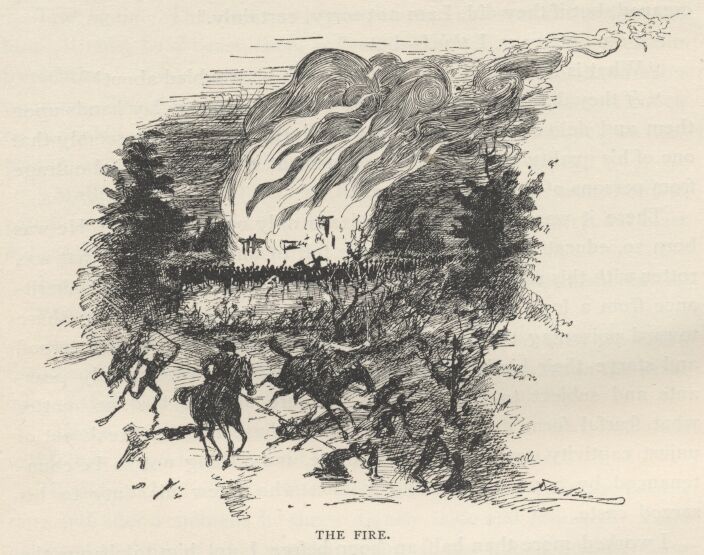
We stood there awhile, in the thick darkness and stillness, looking toward the red blur in the distance, and trying to make out the meaning of a far-away murmur that rose and fell fitfully on the night. Sometimes it swelled up and for a moment seemed less remote; but when we were hopefully expecting it to betray its cause and nature, it dulled and sank again, carrying its mystery with it. We started down the hill in its direction, and the winding road plunged us at once into almost solid darkness—darkness that was packed and crammed in between two tall forest walls. We groped along down for half a mile, perhaps, that murmur growing more and more distinct all the time. The coming storm threatening more and more, with now and then a little shiver of wind, a faint show of lightning, and dull grumblings of distant thunder. I was in the lead. I ran against something—a soft heavy something which gave, slightly, to the impulse of my weight; at the same moment the lightning glared out, and within a foot of my face was the writhing face of a man who was hanging from the limb of a tree! That is, it seemed to be writhing, but it was not. It was a grewsome sight. Straightway there was an ear-splitting explosion of thunder, and the bottom of heaven fell out; the rain poured down in a deluge. No matter, we must try to cut this man down, on the chance that there might be life in him yet, mustn’t we? The lightning came quick and sharp now, and the place was alternately noonday and midnight. One moment the man would be hanging before me in an intense light, and the next he was blotted out again in the darkness. I told the king we must cut him down. The king at once objected.
We stood there for a while in the thick darkness and silence, looking toward the distant red blur. We tried to make sense of a distant murmur that rose and fell unevenly in the night. Sometimes it grew louder and, for a moment, seemed closer. Just as we hoped it would reveal its source and nature, it faded again, taking its mystery with it. We started down the hill toward the sound. The winding road plunged us at once into almost solid darkness, packed between two tall walls of forest. We felt our way downhill for perhaps half a mile. All the while, the murmur grew clearer. The approaching storm grew more threatening, with occasional little gusts of wind, faint flashes of lightning, and distant rumbles of thunder. I was in the lead. I ran into something soft and heavy that gave slightly under my weight. At that same moment, lightning flashed, and a man's writhing face was less than a foot from mine. He was hanging from a tree limb! At least, his face seemed to be writhing, but it was not. It was a gruesome sight. Right away, thunder exploded with an ear-splitting crash, and the bottom fell out of heaven. Rain poured down in a deluge. No matter, we had to try to cut the man down, didn't we? There was still a chance he might be alive. Lightning now flashed quickly and sharply, and the place alternated between noonday and midnight. One moment the man hung before me in intense light. The next, he disappeared again into darkness. I told the king we had to cut him down. The king objected at once.
“If he hanged himself, he was willing to lose his property to his lord; so let him be. If others hanged him, belike they had the right—let him hang.”
“If he hanged himself, he was willing to lose his property to his lord, so leave him alone. If others hanged him, they probably had the right to do it. Let him hang.”
“But—”
“But...”
“But me no buts, but even leave him as he is. And for yet another reason. When the lightning cometh again—there, look abroad.”
“Don’t give me any buts. Just leave him as he is. And there’s another reason. When the lightning comes again, there, look outside.”
Two others hanging, within fifty yards of us!
Two others were hanging within fifty yards of us!
“It is not weather meet for doing useless courtesies unto dead folk. They are past thanking you. Come—it is unprofitable to tarry here.”
“It’s not the weather for paying useless respects to the dead. They can’t thank you anymore. Come, there’s no point in staying here.”
There was reason in what he said, so we moved on. Within the next mile we counted six more hanging forms by the blaze of the lightning, and altogether it was a grisly excursion. That murmur was a murmur no longer, it was a roar; a roar of men’s voices. A man came flying by now, dimly through the darkness, and other men chasing him. They disappeared. Presently another case of the kind occurred, and then another and another. Then a sudden turn of the road brought us in sight of that fire—it was a large manor-house, and little or nothing was left of it—and everywhere men were flying and other men raging after them in pursuit.
What he said made sense, so we moved on. Over the next mile, flashes of lightning revealed six more hanging bodies. All in all, it was a grisly trip. The murmur was no longer a murmur. It was a roar of men’s voices. A man came running past, dimly visible in the darkness, with other men chasing him. They disappeared. Soon another man ran past with others chasing him, and then another and another. Then a sudden turn in the road brought the fire into view. A large manor house was burning, and little or nothing was left of it. Everywhere, men were fleeing, with other men furiously chasing them.
I warned the king that this was not a safe place for strangers. We would better get away from the light, until matters should improve. We stepped back a little, and hid in the edge of the wood. From this hiding-place we saw both men and women hunted by the mob. The fearful work went on until nearly dawn. Then, the fire being out and the storm spent, the voices and flying footsteps presently ceased, and darkness and stillness reigned again.
I warned the king that this was not a safe place for strangers. We had better get away from the light until things improved. We stepped back a little and hid at the edge of the woods. From there, we saw the mob hunting both men and women. The terrible work went on until nearly dawn. Then the fire went out and the storm died down. Soon the voices and running footsteps stopped, and darkness and stillness returned.
We ventured out, and hurried cautiously away; and although we were worn out and sleepy, we kept on until we had put this place some miles behind us. Then we asked hospitality at the hut of a charcoal burner, and got what was to be had. A woman was up and about, but the man was still asleep, on a straw shake-down, on the clay floor. The woman seemed uneasy until I explained that we were travelers and had lost our way and been wandering in the woods all night. She became talkative, then, and asked if we had heard of the terrible goings-on at the manor-house of Abblasoure. Yes, we had heard of them, but what we wanted now was rest and sleep. The king broke in:
We ventured out and hurried away cautiously. Although we were exhausted and sleepy, we kept going until we were several miles away. Then we asked for shelter at a charcoal burner's hut and got what was available. A woman was awake and moving about, but the man was still asleep on a straw bed on the clay floor. The woman seemed uneasy until I explained that we were travelers. We had lost our way and wandered in the woods all night. Then she became talkative and asked if we had heard about the terrible events at the manor house of Abblasoure. Yes, we had heard about them, but what we wanted now was rest and sleep. The king interrupted:
“Sell us the house and take yourselves away, for we be perilous company, being late come from people that died of the Spotted Death.”
“Sell us the house and leave, because we are dangerous company. We have just come from people who died of the Spotted Death.”
It was good of him, but unnecessary. One of the commonest decorations of the nation was the waffle-iron face. I had early noticed that the woman and her husband were both so decorated. She made us entirely welcome, and had no fears; and plainly she was immensely impressed by the king’s proposition; for, of course, it was a good deal of an event in her life to run across a person of the king’s humble appearance who was ready to buy a man’s house for the sake of a night’s lodging. It gave her a large respect for us, and she strained the lean possibilities of her hovel to the utmost to make us comfortable.
That was kind of him, but unnecessary. A waffle-iron face was one of the most common features in the country. I had noticed early on that both the woman and her husband had one. She made us feel entirely welcome and had no fears. She was clearly very impressed by the king’s offer. Of course, it was quite an event in her life to meet someone as humble-looking as the king who was willing to buy a man’s house just for a night’s lodging. His offer gave her great respect for us, and she did everything she could with the little her hovel had to make us comfortable.
We slept till far into the afternoon, and then got up hungry enough to make cotter fare quite palatable to the king, the more particularly as it was scant in quantity. And also in variety; it consisted solely of onions, salt, and the national black bread made out of horse-feed. The woman told us about the affair of the evening before. At ten or eleven at night, when everybody was in bed, the manor-house burst into flames. The country-side swarmed to the rescue, and the family were saved, with one exception, the master. He did not appear. Everybody was frantic over this loss, and two brave yeomen sacrificed their lives in ransacking the burning house seeking that valuable personage. But after a while he was found—what was left of him—which was his corpse. It was in a copse three hundred yards away, bound, gagged, stabbed in a dozen places.
We slept until late afternoon, then got up hungry. Even the king found the peasant food quite tasty, especially since there was so little of it. There was little variety, too. The meal consisted only of onions, salt, and the national black bread made from horse feed. The woman told us what had happened the night before. At ten or eleven, when everyone was in bed, the manor house burst into flames. People from the surrounding countryside rushed to help, and the family was saved, except for the master. He did not appear. Everyone was frantic over the loss. Two brave farmers gave their lives searching the burning house for that valuable person. But after a while, he was found, or rather, what was left of him: his corpse. It lay in a thicket three hundred yards away, bound, gagged, and stabbed in a dozen places.
Who had done this? Suspicion fell upon a humble family in the neighborhood who had been lately treated with peculiar harshness by the baron; and from these people the suspicion easily extended itself to their relatives and familiars. A suspicion was enough; my lord’s liveried retainers proclaimed an instant crusade against these people, and were promptly joined by the community in general. The woman’s husband had been active with the mob, and had not returned home until nearly dawn. He was gone now to find out what the general result had been. While we were still talking he came back from his quest. His report was revolting enough. Eighteen persons hanged or butchered, and two yeomen and thirteen prisoners lost in the fire.
Who had done this? Suspicion fell on a poor local family whom the baron had recently treated with particular cruelty. Suspicion easily spread from them to their relatives and close friends. Suspicion was enough. The baron’s uniformed servants immediately launched a crusade against them, and the community quickly joined in. The woman’s husband had taken an active part in the mob and had not returned home until nearly dawn. He had now gone to find out the overall result. While we were still talking, he came back. His report was revolting enough. Eighteen people had been hanged or butchered, and two yeomen and thirteen prisoners had died in the fire.
“And how many prisoners were there altogether in the vaults?”
“And how many prisoners were in the vaults altogether?”
“Thirteen.”
“Thirteen.”
“Then every one of them was lost?”
“Then were all of them lost?”
“Yes, all.”
“Yes, all.”
“But the people arrived in time to save the family; how is it they could save none of the prisoners?”
“But the people arrived in time to save the family. Why couldn’t they save any of the prisoners?”
The man looked puzzled, and said:
The man looked puzzled and said:
“Would one unlock the vaults at such a time? Marry, some would have escaped.”
“Would anyone unlock the vaults at a time like that? Of course, some would have escaped.”
“Then you mean that nobody did unlock them?”
“Then you mean nobody did unlock them?”
“None went near them, either to lock or unlock. It standeth to reason that the bolts were fast; wherefore it was only needful to establish a watch, so that if any broke the bonds he might not escape, but be taken. None were taken.”
“No one went near them to lock or unlock them. The bolts must have been fastened. So all that was needed was a watch, to catch anyone who broke free before he could escape. No one was caught.”
“Natheless, three did escape,” said the king, “and ye will do well to publish it and set justice upon their track, for these murthered the baron and fired the house.”
“Nevertheless, three escaped,” said the king. “You should spread the news and have the authorities pursue them. For they murdered the baron and set the house on fire.”
I was just expecting he would come out with that. For a moment the man and his wife showed an eager interest in this news and an impatience to go out and spread it; then a sudden something else betrayed itself in their faces, and they began to ask questions. I answered the questions myself, and narrowly watched the effects produced. I was soon satisfied that the knowledge of who these three prisoners were had somehow changed the atmosphere; that our hosts’ continued eagerness to go and spread the news was now only pretended and not real. The king did not notice the change, and I was glad of that. I worked the conversation around toward other details of the night’s proceedings, and noted that these people were relieved to have it take that direction.
I had been expecting him to say that. For a moment, the man and his wife seemed excited by the news and eager to go out and spread it. Then something else suddenly showed in their faces, and they began asking questions. I answered the questions myself and watched closely to see how they reacted. I soon saw that learning who the three prisoners were had somehow changed the mood. Our hosts still acted eager to spread the news, but they were only pretending now. The king did not notice the change, and I was glad of that. I steered the conversation toward other details of what had happened that night. I noticed that our hosts were relieved by the change of subject.
The painful thing observable about all this business was the alacrity with which this oppressed community had turned their cruel hands against their own class in the interest of the common oppressor. This man and woman seemed to feel that in a quarrel between a person of their own class and his lord, it was the natural and proper and rightful thing for that poor devil’s whole caste to side with the master and fight his battle for him, without ever stopping to inquire into the rights or wrongs of the matter. This man had been out helping to hang his neighbors, and had done his work with zeal, and yet was aware that there was nothing against them but a mere suspicion, with nothing back of it describable as evidence, still neither he nor his wife seemed to see anything horrible about it.
The painful thing about all this was how eagerly these oppressed people turned their cruel hands against their own class. They did it in the interest of their common oppressor. The man and woman seemed to think a quarrel between a person of their class and his lord was straightforward. They thought it was natural, proper, and right for that poor devil’s whole class to side with the master. They should fight his battle without ever asking who was right or wrong. This man had been out helping to hang his neighbors, and he had done his work eagerly. Yet he knew there was nothing against them but suspicion, without anything that could be called evidence to support it. Still, neither he nor his wife seemed to see anything horrible about it.
This was depressing—to a man with the dream of a republic in his head. It reminded me of a time thirteen centuries away, when the “poor whites” of our South who were always despised and frequently insulted by the slave-lords around them, and who owed their base condition simply to the presence of slavery in their midst, were yet pusillanimously ready to side with the slave-lords in all political moves for the upholding and perpetuating of slavery, and did also finally shoulder their muskets and pour out their lives in an effort to prevent the destruction of that very institution which degraded them. And there was only one redeeming feature connected with that pitiful piece of history; and that was, that secretly the “poor white” did detest the slave-lord, and did feel his own shame. That feeling was not brought to the surface, but the fact that it was there and could have been brought out, under favoring circumstances, was something—in fact, it was enough; for it showed that a man is at bottom a man, after all, even if it doesn’t show on the outside.
This was depressing to a man who dreamed of a republic. It reminded me of a time thirteen centuries away. The “poor whites” of our South were always despised and often insulted by the slave-lords around them. They owed their lowly condition simply to the presence of slavery among them. Yet they were cowardly enough to side with the slave-lords in all political efforts to uphold and perpetuate slavery. In the end, they even took up their muskets and gave their lives trying to prevent slavery’s destruction. That was the very institution that degraded them. There was only one redeeming feature in that pitiful piece of history. Secretly, the “poor white” did hate the slave-lord and did feel ashamed of his own condition. Those feelings did not come to the surface. But they were there, and under favorable circumstances they could have come out. That was something. In fact, it was enough. It showed that, deep down, a man is still a man, even if it doesn’t show on the outside.
Well, as it turned out, this charcoal burner was just the twin of the Southern “poor white” of the far future. The king presently showed impatience, and said:
Well, as it turned out, this charcoal burner was just like the Southern “poor white” of the distant future. The king soon grew impatient and said:
“An ye prattle here all the day, justice will miscarry. Think ye the criminals will abide in their father’s house? They are fleeing, they are not waiting. You should look to it that a party of horse be set upon their track.”
“If you talk here all day, justice will fail. Do you think the criminals will stay in their father’s house? They are fleeing, not waiting. You should make sure a group of riders is sent after them.”
The woman paled slightly, but quite perceptibly, and the man looked flustered and irresolute. I said:
The woman turned slightly pale, but it was noticeable. The man looked flustered and unsure. I said:
“Come, friend, I will walk a little way with you, and explain which direction I think they would try to take. If they were merely resisters of the gabelle or some kindred absurdity I would try to protect them from capture; but when men murder a person of high degree and likewise burn his house, that is another matter.”
“Come, friend, I’ll walk with you a little way and explain which direction I think they would try to take. If they were only resisting the salt tax or some similar absurdity, I would try to protect them from capture. But murdering a person of high rank and burning his house is another matter.”
The last remark was for the king—to quiet him. On the road the man pulled his resolution together, and began the march with a steady gait, but there was no eagerness in it. By and by I said:
That last remark was meant to calm the king. On the road, the man gathered his resolve and began walking at a steady pace, but without eagerness. After a while, I said:
“What relation were these men to you—cousins?”
“How were these men related to you? Were they cousins?”
He turned as white as his layer of charcoal would let him, and stopped, trembling.
He turned as pale as his layer of charcoal would allow, then stopped, trembling.
“Ah, my God, how know ye that?”
“Ah, my God, how do you know that?”
“I didn’t know it; it was a chance guess.”
“I didn’t know it. It was just a guess.”
“Poor lads, they are lost. And good lads they were, too.”
“Poor boys, they're lost. They were good boys, too.”
“Were you actually going yonder to tell on them?”
“Were you really going over there to tell on them?”
He didn’t quite know how to take that; but he said, hesitatingly:
He wasn’t quite sure how to take that, but he answered hesitantly:
“Ye-s.”
“Yes.”
“Then I think you are a damned scoundrel!”
“Then I think you are a damned crook!”
It made him as glad as if I had called him an angel.
It made him as happy as if I had called him an angel.
“Say the good words again, brother! for surely ye mean that ye would not betray me an I failed of my duty.”
“Say those good words again, brother! Surely you mean you would not betray me if I failed in my duty.”
“Duty? There is no duty in the matter, except the duty to keep still and let those men get away. They’ve done a righteous deed.”
“Duty? The only duty here is to keep quiet and let those men get away. They’ve done the right thing.”
He looked pleased; pleased, and touched with apprehension at the same time. He looked up and down the road to see that no one was coming, and then said in a cautious voice:
He looked pleased, but also a little worried. He looked up and down the road to make sure no one was coming. Then he said cautiously:
“From what land come you, brother, that you speak such perilous words, and seem not to be afraid?”
“Where do you come from, brother, that you speak such dangerous words and seem unafraid?”
“They are not perilous words when spoken to one of my own caste, I take it. You would not tell anybody I said them?”
“I suppose those words aren't dangerous when spoken to someone of my own class. You won't tell anyone I said them, will you?”
“I? I would be drawn asunder by wild horses first.”
“Me? I would rather be torn apart by wild horses.”
“Well, then, let me say my say. I have no fears of your repeating it. I think devil’s work has been done last night upon those innocent poor people. That old baron got only what he deserved. If I had my way, all his kind should have the same luck.”
“Well, then, let me have my say. I’m not afraid you’ll repeat it. I think something devilish was done to those innocent poor people last night. That old baron got only what he deserved. If I had my way, everyone like him would meet the same fate.”
Fear and depression vanished from the man’s manner, and gratefulness and a brave animation took their place:
The man's fear and depression vanished, replaced by gratitude and a brave new energy:
“Even though you be a spy, and your words a trap for my undoing, yet are they such refreshment that to hear them again and others like to them, I would go to the gallows happy, as having had one good feast at least in a starved life. And I will say my say now, and ye may report it if ye be so minded. I helped to hang my neighbors for that it were peril to my own life to show lack of zeal in the master’s cause; the others helped for none other reason. All rejoice to-day that he is dead, but all do go about seemingly sorrowing, and shedding the hypocrite’s tear, for in that lies safety. I have said the words, I have said the words! the only ones that have ever tasted good in my mouth, and the reward of that taste is sufficient. Lead on, an ye will, be it even to the scaffold, for I am ready.”
“Even if you are a spy, and your words are a trap to destroy me, they are so refreshing. To hear them again, and more like them, I would go to the gallows happy. I would have had at least one good feast in a starved life. And now I will speak my mind. You may report it if you wish. I helped hang my neighbors because my life was at risk if I showed too little zeal for the master’s cause. The others helped for the same reason and no other. All rejoice today that he is dead, but all go about pretending to grieve and shedding hypocritical tears. That is how they stay safe. I have said the words, I have said the words! They are the only words that have ever tasted good in my mouth, and that taste is reward enough. Lead on, if you wish, even to the scaffold. I am ready.”
There it was, you see. A man is a man, at bottom. Whole ages of abuse and oppression cannot crush the manhood clear out of him. Whoever thinks it a mistake is himself mistaken. Yes, there is plenty good enough material for a republic in the most degraded people that ever existed—even the Russians; plenty of manhood in them—even in the Germans—if one could but force it out of its timid and suspicious privacy, to overthrow and trample in the mud any throne that ever was set up and any nobility that ever supported it. We should see certain things yet, let us hope and believe. First, a modified monarchy, till Arthur’s days were done, then the destruction of the throne, nobility abolished, every member of it bound out to some useful trade, universal suffrage instituted, and the whole government placed in the hands of the men and women of the nation there to remain. Yes, there was no occasion to give up my dream yet a while.
There it was, you see. A man is a man, deep down. Even ages of abuse and oppression cannot completely crush the manhood out of him. Anyone who thinks otherwise is mistaken. Yes, even the most degraded people who ever existed have plenty of material good enough for a republic, even the Russians. They have plenty of manhood, even the Germans. If only it could be forced out of its timid and suspicious hiding place! Then it could overthrow and trample in the mud any throne ever set up and any nobility that ever supported it. Let us hope and believe we would yet see certain things. First, a limited monarchy would last until Arthur’s days were done. Then the throne would be destroyed and the nobility abolished. Every member of the nobility would be apprenticed to some useful trade. Universal suffrage would be established. The whole government would be placed in the hands of the nation’s men and women, and it would remain there. Yes, there was no reason to give up my dream just yet.