Chapter 24
A Rival Magician
My influence in the Valley of Holiness was something prodigious now. It seemed worth while to try to turn it to some valuable account. The thought came to me the next morning, and was suggested by my seeing one of my knights who was in the soap line come riding in. According to history, the monks of this place two centuries before had been worldly minded enough to want to wash. It might be that there was a leaven of this unrighteousness still remaining. So I sounded a Brother:
My influence in the Valley of Holiness was enormous now. It seemed worth trying to put that influence to good use. The idea came to me the next morning when I saw one of my knights ride in. He was in the soap business. According to history, the monks here had been worldly enough to want to wash two centuries before. Perhaps a trace of this wickedness still remained. So I cautiously asked a Brother:
“Wouldn’t you like a bath?”
“Wouldn’t you like a bath?”
He shuddered at the thought—the thought of the peril of it to the well—but he said with feeling:
He shuddered at the thought of the danger to the well, but he said with feeling:
“One needs not to ask that of a poor body who has not known that blessed refreshment sith that he was a boy. Would God I might wash me! but it may not be, fair sir, tempt me not; it is forbidden.”
“You need not ask a poor soul who has not enjoyed that blessed refreshment since he was a boy. I wish to God I could wash! But I cannot, kind sir. Do not tempt me. It is forbidden.”
And then he sighed in such a sorrowful way that I was resolved he should have at least one layer of his real estate removed, if it sized up my whole influence and bankrupted the pile. So I went to the abbot and asked for a permit for this Brother. He blenched at the idea—I don’t mean that you could see him blench, for of course you couldn’t see it without you scraped him, and I didn’t care enough about it to scrape him, but I knew the blench was there, just the same, and within a book-cover’s thickness of the surface, too—blenched, and trembled. He said:
Then he sighed so sorrowfully that I decided he should have at least one layer of his real estate removed. I would do it even if it took all my influence and every penny I had. So I went to the abbot and asked for a permit for this Brother. He went pale at the idea, though you couldn’t actually see it. Of course, you couldn’t see him go pale without scraping him, and I didn’t care enough to do that. But I knew the paleness was there all the same, just a book cover’s thickness beneath the surface. He went pale and trembled. He said:
“Ah, son, ask aught else thou wilt, and it is thine, and freely granted out of a grateful heart—but this, oh, this! Would you drive away the blessed water again?”
“Ah, son, ask for anything else you want, and it is yours. I grant it freely with a grateful heart. But this, oh, this! Would you drive away the blessed water again?”
“No, Father, I will not drive it away. I have mysterious knowledge which teaches me that there was an error that other time when it was thought the institution of the bath banished the fountain.” A large interest began to show up in the old man’s face. “My knowledge informs me that the bath was innocent of that misfortune, which was caused by quite another sort of sin.”
“No, Father, I will not drive it away. I have mysterious knowledge that tells me people were mistaken before. They thought the bath had caused the fountain to disappear.” The old man’s face showed great interest. “My knowledge tells me the bath was innocent. The fountain’s disappearance was caused by a very different kind of sin.”
“These are brave words—but—but right welcome, if they be true.”
“Those are brave words, but, but very welcome if they are true.”
“They are true, indeed. Let me build the bath again, Father. Let me build it again, and the fountain shall flow forever.”
“They really are true. Let me rebuild the bath, Father. Let me rebuild it, and the fountain will flow forever.”
“You promise this?—you promise it? Say the word—say you promise it!”
“You promise this? You promise it? Say it. Say you promise it!”
“I do promise it.”
“I promise it.”
“Then will I have the first bath myself! Go—get ye to your work. Tarry not, tarry not, but go.”
“Then I’ll have the first bath myself! Go, get to work. Don’t delay, don’t delay, just go.”
I and my boys were at work, straight off. The ruins of the old bath were there yet in the basement of the monastery, not a stone missing. They had been left just so, all these lifetimes, and avoided with a pious fear, as things accursed. In two days we had it all done and the water in—a spacious pool of clear pure water that a body could swim in. It was running water, too. It came in, and went out, through the ancient pipes. The old abbot kept his word, and was the first to try it. He went down black and shaky, leaving the whole black community above troubled and worried and full of bodings; but he came back white and joyful, and the game was made! another triumph scored.
My boys and I got to work right away. The ruins of the old bath were still in the monastery basement, with not a stone missing. They had been left just as they were for generations. Everyone avoided them with a holy fear, as if they were cursed. In two days we had finished the work and filled the bath with water. It was a spacious pool of clear, pure water that a person could swim in. The water was running, too. It flowed in and out through the ancient pipes. The old abbot kept his word and was the first to try it. He went down black and shaky, leaving the whole black community upstairs, troubled and worried and full of dread. But he came back white and joyful, and the game was won! Another triumph scored.
It was a good campaign that we made in that Valley of Holiness, and I was very well satisfied, and ready to move on now, but I struck a disappointment. I caught a heavy cold, and it started up an old lurking rheumatism of mine. Of course the rheumatism hunted up my weakest place and located itself there. This was the place where the abbot put his arms about me and mashed me, what time he was moved to testify his gratitude to me with an embrace.
We had a good campaign in the Valley of Holiness, and I was very satisfied and ready to move on. But I ran into a setback. I caught a bad cold, and it brought back my old rheumatism. Of course, the rheumatism found my weakest spot and settled there. It was the spot the abbot had crushed when he put his arms around me to show his gratitude.
When at last I got out, I was a shadow. But everybody was full of attentions and kindnesses, and these brought cheer back into my life, and were the right medicine to help a convalescent swiftly up toward health and strength again; so I gained fast.
When I finally got out, I was a shadow of myself. But everyone was attentive and kind, and their kindness brought cheer back into my life. It was just the right medicine to help me recover my health and strength quickly. So I improved fast.
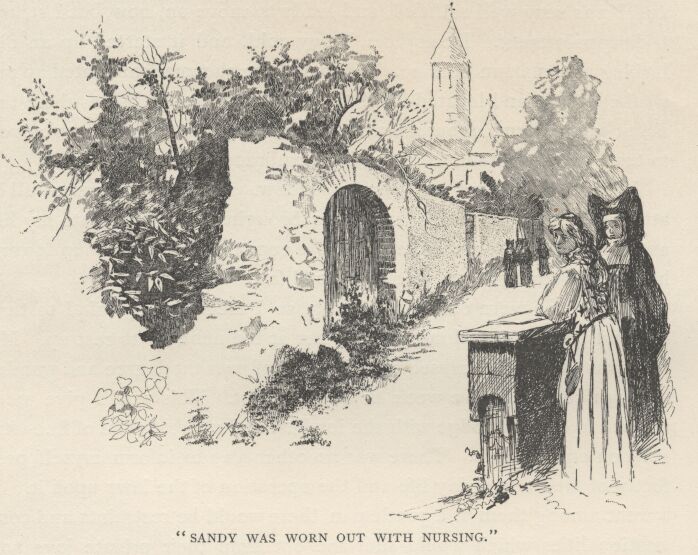
Sandy was worn out with nursing; so I made up my mind to turn out and go a cruise alone, leaving her at the nunnery to rest up. My idea was to disguise myself as a freeman of peasant degree and wander through the country a week or two on foot. This would give me a chance to eat and lodge with the lowliest and poorest class of free citizens on equal terms. There was no other way to inform myself perfectly of their everyday life and the operation of the laws upon it. If I went among them as a gentleman, there would be restraints and conventionalities which would shut me out from their private joys and troubles, and I should get no further than the outside shell.
Sandy was worn out from nursing, so I decided to set out alone and leave her at the nunnery to rest. I planned to disguise myself as a free peasant and wander through the countryside on foot for a week or two. That way, I could eat and stay with the lowest and poorest free citizens as an equal. There was no other way to fully understand their daily lives and how the laws affected them. If I visited them as a gentleman, social rules and formalities would keep me from sharing their private joys and troubles. I would see only the surface of their lives.
One morning I was out on a long walk to get up muscle for my trip, and had climbed the ridge which bordered the northern extremity of the valley, when I came upon an artificial opening in the face of a low precipice, and recognized it by its location as a hermitage which had often been pointed out to me from a distance as the den of a hermit of high renown for dirt and austerity. I knew he had lately been offered a situation in the Great Sahara, where lions and sandflies made the hermit-life peculiarly attractive and difficult, and had gone to Africa to take possession, so I thought I would look in and see how the atmosphere of this den agreed with its reputation.
One morning, I went for a long walk to build up my strength for the trip. I climbed the ridge at the northern end of the valley and came upon a man-made opening in a low cliff. From its location, I recognized it as a hermitage. It had often been pointed out to me from a distance as the den of a hermit famous for his filth and self-denial. I knew he had recently been offered a position in the Great Sahara. Lions and sandflies made life as a hermit there especially appealing and difficult. He had gone to Africa to take up the position, so I thought I would look inside. I wanted to see whether the atmosphere of his den lived up to its reputation.
My surprise was great: the place was newly swept and scoured. Then there was another surprise. Back in the gloom of the cavern I heard the clink of a little bell, and then this exclamation:
I was very surprised. The place had just been swept and scrubbed. Then came another surprise. From the darkness at the back of the cavern, I heard a little bell ring, followed by this exclamation:
“Hello Central! Is this you, Camelot?—Behold, thou mayst glad thy heart an thou hast faith to believe the wonderful when that it cometh in unexpected guise and maketh itself manifest in impossible places—here standeth in the flesh his mightiness The Boss, and with thine own ears shall ye hear him speak!”
“Hello Central! Is this you, Camelot? Rejoice, if you can believe in wonders when they appear in unexpected forms and impossible places. His mighty self, The Boss, stands here in the flesh, and you will hear him speak with your own ears!”
Now what a radical reversal of things this was; what a jumbling together of extravagant incongruities; what a fantastic conjunction of opposites and irreconcilables—the home of the bogus miracle become the home of a real one, the den of a mediaeval hermit turned into a telephone office!
What a complete reversal! What a jumble of wildly mismatched things! What a fantastic mix of opposites that could never be reconciled! The home of a fake miracle had become the home of a real one. A medieval hermit's den had turned into a telephone office!
The telephone clerk stepped into the light, and I recognized one of my young fellows. I said:
The telephone clerk stepped into the light, and I recognized one of my young men. I said:
“How long has this office been established here, Ulfius?”
“How long has this office been here, Ulfius?”
“But since midnight, fair Sir Boss, an it please you. We saw many lights in the valley, and so judged it well to make a station, for that where so many lights be needs must they indicate a town of goodly size.”
“But only since midnight, Sir Boss, if you please. We saw many lights in the valley, so we thought it best to stop. So many lights had to mean there was a good-sized town.”
“Quite right. It isn’t a town in the customary sense, but it’s a good stand, anyway. Do you know where you are?”
“That's right. It isn't a town in the usual sense, but it's a good spot anyway. Do you know where you are?”
“Of that I have had no time to make inquiry; for whenas my comradeship moved hence upon their labors, leaving me in charge, I got me to needed rest, purposing to inquire when I waked, and report the place’s name to Camelot for record.”
“I have had no time to ask about that. When my companions left for their work, they put me in charge. I got some needed rest, intending to ask when I woke and report the place’s name to Camelot for the record.”
“Well, this is the Valley of Holiness.”
“Well, this is the Valley of Holiness.”
It didn’t take; I mean, he didn’t start at the name, as I had supposed he would. He merely said:
It didn’t work. I mean, he didn’t react with surprise to the name, as I thought he would. He just said:
“I will so report it.”
“I will report it that way.”
“Why, the surrounding regions are filled with the noise of late wonders that have happened here! You didn’t hear of them?”
“Why, the surrounding regions are buzzing with news of the recent wonders that happened here! Didn’t you hear about them?”
“Ah, ye will remember we move by night, and avoid speech with all. We learn naught but that we get by the telephone from Camelot.”
“Ah, remember that we travel at night and avoid speaking to anyone. We learn nothing except what we hear by telephone from Camelot.”
“Why they know all about this thing. Haven’t they told you anything about the great miracle of the restoration of a holy fountain?”
“Why, they know all about this. Haven’t they told you about the great miracle of restoring a holy fountain?”
“Oh, that? Indeed yes. But the name of this valley doth woundily differ from the name of that one; indeed to differ wider were not pos—”
“Oh, that? Yes, indeed. But the name of this valley is very different from the name of that one. Indeed, they could not be more differ...”
“What was that name, then?”
“What was that name, then?”
“The Valley of Hellishness.”
“The Valley of Hellishness.”
“That explains it. Confound a telephone, anyway. It is the very demon for conveying similarities of sound that are miracles of divergence from similarity of sense. But no matter, you know the name of the place now. Call up Camelot.”
“That explains it. Damn the telephone, anyway. It’s a real devil for making things sound alike when their meanings are amazingly different. But never mind, you know the name of the place now. Call Camelot.”
He did it, and had Clarence sent for. It was good to hear my boy’s voice again. It was like being home. After some affectionate interchanges, and some account of my late illness, I said:
He did it and sent for Clarence. It was good to hear my boy’s voice again. It felt like being home. We exchanged a few affectionate words, and I told him about my recent illness. Then I said:
“What is new?”
“What’s new?”
“The king and queen and many of the court do start even in this hour, to go to your valley to pay pious homage to the waters ye have restored, and cleanse themselves of sin, and see the place where the infernal spirit spouted true hell-flames to the clouds—an ye listen sharply ye may hear me wink and hear me likewise smile a smile, sith ’twas I that made selection of those flames from out our stock and sent them by your order.”
“The king, the queen, and many of the court are setting out for your valley right now. They are going to pay pious homage to the waters you restored and cleanse themselves of sin. They will also see the place where the infernal spirit spouted real hellfire up to the clouds. If you listen closely, you may hear me wink and smile. For I was the one who selected those flames from our stock and sent them on your orders.”
“Does the king know the way to this place?”
“Does the king know the way to this place?”
“The king?—no, nor to any other in his realms, mayhap; but the lads that holp you with your miracle will be his guide and lead the way, and appoint the places for rests at noons and sleeps at night.”
“The king? No, nor perhaps anyone else in his kingdom. But the boys who helped you with your miracle will guide him and lead the way. They will choose where to rest at noon and sleep at night.”
“This will bring them here—when?”
“This will bring them here, but when?”
“Mid-afternoon, or later, the third day.”
“Mid-afternoon or later on the third day.”
“Anything else in the way of news?”
“Any other news?”
“The king hath begun the raising of the standing army ye suggested to him; one regiment is complete and officered.”
“The king has begun raising the standing army you suggested. One regiment is complete and has its officers.”
“The mischief! I wanted a main hand in that myself. There is only one body of men in the kingdom that are fitted to officer a regular army.”
“Darn it! I wanted a major role in that myself. There is only one group of men in the kingdom fit to serve as officers in a regular army.”
“Yes—and now ye will marvel to know there’s not so much as one West Pointer in that regiment.”
“Yes, and you’ll be amazed to learn that there isn’t a single West Pointer in that regiment.”
“What are you talking about? Are you in earnest?”
“What are you talking about? Are you serious?”
“It is truly as I have said.”
“It is just as I said.”
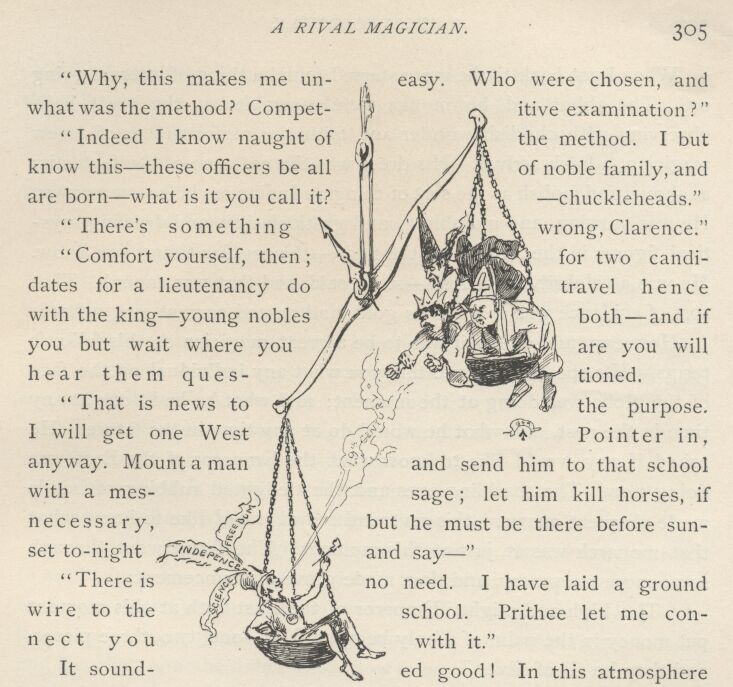
“Why, this makes me uneasy. Who were chosen, and what was the method? Competitive examination?”
“Why, this worries me. Who was chosen, and how? Through a competitive exam?”
“Indeed, I know naught of the method. I but know this—these officers be all of noble family, and are born—what is it you call it?—chuckleheads.”
“Indeed, I know nothing about the method. I only know this: these officers all come from noble families. And they are born, what do you call it, chuckleheads.”
“There’s something wrong, Clarence.”
“There’s something wrong, Clarence.”
“Comfort yourself, then; for two candidates for a lieutenancy do travel hence with the king—young nobles both—and if you but wait where you are you will hear them questioned.”
“Take comfort, then. Two candidates for a lieutenancy are traveling from here with the king. Both are young nobles. If you wait where you are, you will hear them being questioned.”
“That is news to the purpose. I will get one West Pointer in, anyway. Mount a man and send him to that school with a message; let him kill horses, if necessary, but he must be there before sunset to-night and say—”
“That is useful news. I’ll get one West Pointer in, anyway. Put a man on a horse and send him to that school with a message. Let him ride horses to death if necessary, but he must get there before sunset tonight and say...”
“There is no need. I have laid a ground wire to the school. Prithee let me connect you with it.”
“There’s no need. I’ve laid a ground wire to the school. Please let me connect you to it.”
It sounded good! In this atmosphere of telephones and lightning communication with distant regions, I was breathing the breath of life again after long suffocation. I realized, then, what a creepy, dull, inanimate horror this land had been to me all these years, and how I had been in such a stifled condition of mind as to have grown used to it almost beyond the power to notice it.
It sounded good! Surrounded by telephones and instant communication with distant places, I was breathing freely again after being suffocated for so long. I realized then what a creepy, dull, lifeless horror this land had been to me all these years. My mind had been so stifled that I had grown used to it and could hardly even notice it anymore.
I gave my order to the superintendent of the Academy personally. I also asked him to bring me some paper and a fountain pen and a box or so of safety matches. I was getting tired of doing without these conveniences. I could have them now, as I wasn’t going to wear armor any more at present, and therefore could get at my pockets.
I gave my order to the superintendent of the Academy in person. I also asked him to bring me some paper, a fountain pen, and a box or two of safety matches. I was getting tired of doing without these conveniences. I could have them now because I wasn’t going to wear armor for the time being. Without it, I could reach my pockets.
When I got back to the monastery, I found a thing of interest going on. The abbot and his monks were assembled in the great hall, observing with childish wonder and faith the performances of a new magician, a fresh arrival. His dress was the extreme of the fantastic; as showy and foolish as the sort of thing an Indian medicine-man wears. He was mowing, and mumbling, and gesticulating, and drawing mystical figures in the air and on the floor,—the regular thing, you know. He was a celebrity from Asia—so he said, and that was enough. That sort of evidence was as good as gold, and passed current everywhere.
When I got back to the monastery, I found something interesting going on. The abbot and his monks were gathered in the great hall, watching a newly arrived magician perform. They watched with childlike wonder and faith. His outfit was as fantastic as could be, as flashy and foolish as what an Indian medicine-man wears. He was making faces, mumbling, gesturing, and drawing mystical figures in the air and on the floor. The usual thing, you know. He was a celebrity from Asia, or so he said, and that was enough. That kind of evidence was as good as gold and accepted everywhere.
How easy and cheap it was to be a great magician on this fellow’s terms. His specialty was to tell you what any individual on the face of the globe was doing at the moment; and what he had done at any time in the past, and what he would do at any time in the future. He asked if any would like to know what the Emperor of the East was doing now? The sparkling eyes and the delighted rubbing of hands made eloquent answer—this reverend crowd would like to know what that monarch was at, just as this moment. The fraud went through some more mummery, and then made grave announcement:
How easy and cheap it was to be a great magician by this fellow’s standards. His specialty was telling you what anyone in the world was doing at that moment. He could also tell you what anyone had done at any time in the past, or would do at any time in the future. He asked if anyone would like to know what the Emperor of the East was doing now. Their sparkling eyes and delighted rubbing of hands gave an eloquent answer. This reverend crowd would like to know what the monarch was doing at that very moment. The fraud went through some more theatrical rituals, then made a solemn announcement:
“The high and mighty Emperor of the East doth at this moment put money in the palm of a holy begging friar—one, two, three pieces, and they be all of silver.”
“The high and mighty Emperor of the East is putting money into the hand of a holy begging friar right now. One, two, three coins, and they are all silver.”
A buzz of admiring exclamations broke out, all around:
A buzz of admiration broke out all around:
“It is marvelous!” “Wonderful!” “What study, what labor, to have acquired a so amazing power as this!”
“It’s amazing!” “Wonderful!” “What study and hard work it must have taken to gain such an amazing power!”
Would they like to know what the Supreme Lord of Inde was doing? Yes. He told them what the Supreme Lord of Inde was doing. Then he told them what the Sultan of Egypt was at; also what the King of the Remote Seas was about. And so on and so on; and with each new marvel the astonishment at his accuracy rose higher and higher. They thought he must surely strike an uncertain place some time; but no, he never had to hesitate, he always knew, and always with unerring precision. I saw that if this thing went on I should lose my supremacy, this fellow would capture my following, I should be left out in the cold. I must put a cog in his wheel, and do it right away, too. I said:
Would they like to know what the Supreme Lord of Inde was doing? Yes. He told them what the Supreme Lord of Inde was doing. Then he told them what the Sultan of Egypt was doing, and what the King of the Remote Seas was up to. And so on and so on. With each new marvel, they grew more amazed at his accuracy. They thought he must surely reach a point where he was unsure. But no, he never had to hesitate. He always knew, and he was always exactly right. I saw that if this went on, I would lose my supremacy. This fellow would win over my followers, and I would be left out in the cold. I had to throw a wrench in his plans, and do it right away. I said:
“If I might ask, I should very greatly like to know what a certain person is doing.”
“If I may ask, I’d really like to know what a certain person is doing.”
“Speak, and freely. I will tell you.”
“Speak freely. I will tell you.”
“It will be difficult—perhaps impossible.”
“It will be difficult, perhaps impossible.”
“My art knoweth not that word. The more difficult it is, the more certainly will I reveal it to you.”
“My art does not know that word. The more difficult it is, the more certain I am to reveal it to you.”
You see, I was working up the interest. It was getting pretty high, too; you could see that by the craning necks all around, and the half-suspended breathing. So now I climaxed it:
You see, I was building up their interest. It was getting pretty high, too. You could tell by all the craning necks and the way people were holding their breath. So now I brought it to a climax:
“If you make no mistake—if you tell me truly what I want to know—I will give you two hundred silver pennies.”
“If you make no mistake and tell me the truth about what I want to know, I'll give you two hundred silver pennies.”
“The fortune is mine! I will tell you what you would know.”
“The fortune is mine! I will tell you what you want to know.”
“Then tell me what I am doing with my right hand.”
“Then tell me what I’m doing with my right hand.”
“Ah-h!” There was a general gasp of surprise. It had not occurred to anybody in the crowd—that simple trick of inquiring about somebody who wasn’t ten thousand miles away. The magician was hit hard; it was an emergency that had never happened in his experience before, and it corked him; he didn’t know how to meet it. He looked stunned, confused; he couldn’t say a word. “Come,” I said, “what are you waiting for? Is it possible you can answer up, right off, and tell what anybody on the other side of the earth is doing, and yet can’t tell what a person is doing who isn’t three yards from you? Persons behind me know what I am doing with my right hand—they will indorse you if you tell correctly.” He was still dumb. “Very well, I’ll tell you why you don’t speak up and tell; it is because you don’t know. You a magician! Good friends, this tramp is a mere fraud and liar.”
“Ah!” The whole crowd gasped in surprise. No one had thought of that simple trick: asking about someone who wasn’t ten thousand miles away. The question hit the magician hard. He had never faced such a challenge before, and it left him stumped. He didn’t know how to handle it. He looked stunned and confused. He couldn’t say a word. “Come on,” I said, “what are you waiting for? Can you really answer right away and say what anyone on the other side of the earth is doing? And yet you can’t say what a person less than three yards away is doing? The people behind me know what I’m doing with my right hand. They’ll back you up if you get it right.” He still said nothing. “All right, I’ll tell you why you don’t answer. It’s because you don’t know. You a magician! Good friends, this tramp is nothing but a fraud and a liar.”
This distressed the monks and terrified them. They were not used to hearing these awful beings called names, and they did not know what might be the consequence. There was a dead silence now; superstitious bodings were in every mind. The magician began to pull his wits together, and when he presently smiled an easy, nonchalant smile, it spread a mighty relief around; for it indicated that his mood was not destructive. He said:
This upset and terrified the monks. They were not used to hearing these awful beings insulted, and they did not know what might happen. Now there was complete silence. Everyone was filled with superstitious fears. The magician began to collect his thoughts. When he soon gave a relaxed, carefree smile, everyone felt much relieved. His smile showed that he was not in a destructive mood. He said:
“It hath struck me speechless, the frivolity of this person’s speech. Let all know, if perchance there be any who know it not, that enchanters of my degree deign not to concern themselves with the doings of any but kings, princes, emperors, them that be born in the purple and them only. Had ye asked me what Arthur the great king is doing, it were another matter, and I had told ye; but the doings of a subject interest me not.”
“This person’s foolish speech has left me speechless. In case anyone does not know, let everyone know this: enchanters of my rank concern themselves only with kings, princes, emperors, and others born to royalty. If you had asked me what the great King Arthur is doing, that would be different. I would have told you. But I have no interest in what a subject is doing.”
“Oh, I misunderstood you. I thought you said ‘anybody,’ and so I supposed ‘anybody’ included—well, anybody; that is, everybody.”
“Oh, I misunderstood you. I thought you said ‘anybody,’ so I assumed ‘anybody’ included, well, anybody. In other words, everybody.”
“It doth—anybody that is of lofty birth; and the better if he be royal.”
“It does, anyone of noble birth. And it is even better if he is royal.”
“That, it meseemeth, might well be,” said the abbot, who saw his opportunity to smooth things and avert disaster, “for it were not likely that so wonderful a gift as this would be conferred for the revelation of the concerns of lesser beings than such as be born near to the summits of greatness. Our Arthur the king—”
“That seems quite possible,” said the abbot, seeing his chance to smooth things over and avert disaster. “For it is unlikely that such a wonderful gift would be given to reveal the affairs of anyone but those born close to the heights of greatness. Our King Arthur . . .”
“Would you know of him?” broke in the enchanter.
“Would you like to know about him?” the enchanter interrupted.
“Most gladly, yea, and gratefully.”
“Very gladly, and gratefully too.”
Everybody was full of awe and interest again right away, the incorrigible idiots. They watched the incantations absorbingly, and looked at me with a “There, now, what can you say to that?” air, when the announcement came:
Everyone was full of awe and curiosity again right away. The hopeless idiots. They watched the incantations with fascination. When the announcement came, they looked at me as if to say, “There, now, what can you say to that?”:
“The king is weary with the chase, and lieth in his palace these two hours sleeping a dreamless sleep.”
“The king is tired from the hunt. He has been sleeping a dreamless sleep in his palace for two hours.”
“God’s benison upon him!” said the abbot, and crossed himself; “may that sleep be to the refreshment of his body and his soul.”
“God bless him!” said the abbot, crossing himself. “May that sleep refresh his body and soul.”
“And so it might be, if he were sleeping,” I said, “but the king is not sleeping, the king rides.”
“That might be true if he were sleeping,” I said, “but the king isn't sleeping. He's riding.”
Here was trouble again—a conflict of authority. Nobody knew which of us to believe; I still had some reputation left. The magician’s scorn was stirred, and he said:
Here was trouble again. We had a conflict of authority. Nobody knew which of us to believe. I still had some reputation left. The magician was scornful, and he said:
“Lo, I have seen many wonderful soothsayers and prophets and magicians in my life days, but none before that could sit idle and see to the heart of things with never an incantation to help.”
“I have seen many wonderful fortune-tellers, prophets, and magicians in my life. But I have never seen one who could sit idle and see to the heart of things without a spell to help.”
“You have lived in the woods, and lost much by it. I use incantations myself, as this good brotherhood are aware—but only on occasions of moment.”
“You have lived in the woods and missed out on much. I use incantations myself, as the members of this brotherhood know, but only on important occasions.”
When it comes to sarcasming, I reckon I know how to keep my end up. That jab made this fellow squirm. The abbot inquired after the queen and the court, and got this information:
When it comes to sarcasm, I reckon I can hold my own. That jab made the fellow squirm. The abbot asked about the queen and the court, and got this information:
“They be all on sleep, being overcome by fatigue, like as to the king.”
“They are all asleep, overcome by fatigue, just like the king.”
I said:
I said:
“That is merely another lie. Half of them are about their amusements, the queen and the other half are not sleeping, they ride. Now perhaps you can spread yourself a little, and tell us where the king and queen and all that are this moment riding with them are going?”
“That is just another lie. Half of them are enjoying themselves. The queen and the other half are not sleeping. They are riding. Now perhaps you can show us what you can do. Tell us where the king, the queen, and everyone riding with them right now are going.”
“They sleep now, as I said; but on the morrow they will ride, for they go a journey toward the sea.”
“They are sleeping now, as I said. But tomorrow they will ride, because they are traveling toward the sea.”
“And where will they be the day after to-morrow at vespers?”
“And where will they be at evening prayers the day after tomorrow?”
“Far to the north of Camelot, and half their journey will be done.”
“Far north of Camelot, and half their journey will be over.”
“That is another lie, by the space of a hundred and fifty miles. Their journey will not be merely half done, it will be all done, and they will be here, in this valley.”
“That is another lie, off by a hundred and fifty miles. Their journey will not be just half over. It will be completely over, and they will be here, in this valley.”
That was a noble shot! It set the abbot and the monks in a whirl of excitement, and it rocked the enchanter to his base. I followed the thing right up:
That was a great shot! It sent the abbot and the monks into a whirl of excitement, and it shook the enchanter to his core. I followed right up:
“If the king does not arrive, I will have myself ridden on a rail: if he does I will ride you on a rail instead.”
“If the king doesn’t arrive, I’ll let myself be ridden on a rail. If he does arrive, I’ll ride you on a rail instead.”
Next day I went up to the telephone office and found that the king had passed through two towns that were on the line. I spotted his progress on the succeeding day in the same way. I kept these matters to myself. The third day’s reports showed that if he kept up his gait he would arrive by four in the afternoon. There was still no sign anywhere of interest in his coming; there seemed to be no preparations making to receive him in state; a strange thing, truly. Only one thing could explain this: that other magician had been cutting under me, sure. This was true. I asked a friend of mine, a monk, about it, and he said, yes, the magician had tried some further enchantments and found out that the court had concluded to make no journey at all, but stay at home. Think of that! Observe how much a reputation was worth in such a country. These people had seen me do the very showiest bit of magic in history, and the only one within their memory that had a positive value, and yet here they were, ready to take up with an adventurer who could offer no evidence of his powers but his mere unproven word.
The next day, I went to the telephone office. I found that the king had passed through two towns on the line. I tracked his progress the same way the following day. I kept all this to myself. On the third day, the reports showed that he would arrive by four that afternoon if he kept up his pace. Still, no one anywhere seemed interested in his arrival. No one seemed to be preparing to receive him with royal ceremony, either. A strange thing, truly. Only one thing could explain it: that other magician had been working against me, for sure. And I was right. I asked a friend of mine, a monk, about it. He said the magician had tried some more enchantments. From them, he had learned that the court had decided not to travel at all, but to stay home. Think of that! Just look at how much a reputation was worth in such a country. These people had seen me perform the flashiest bit of magic in history. It was also the only magic in their memory that had any real value. Yet here they were, ready to believe an adventurer whose only evidence of his powers was his own unproven word.
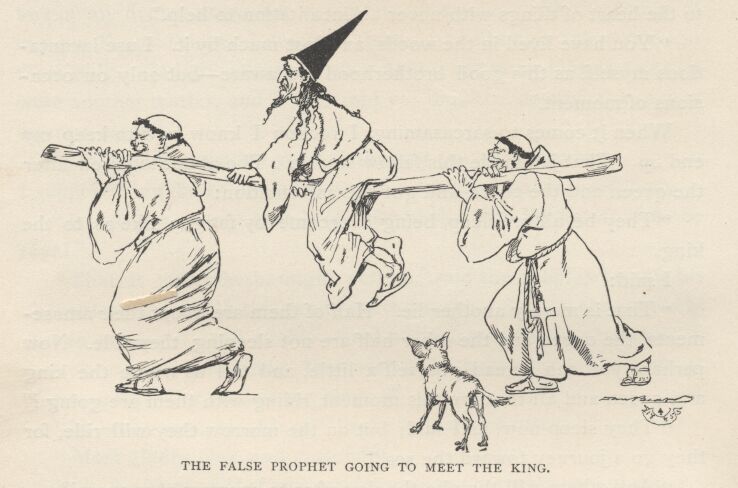
However, it was not good politics to let the king come without any fuss and feathers at all, so I went down and drummed up a procession of pilgrims and smoked out a batch of hermits and started them out at two o’clock to meet him. And that was the sort of state he arrived in. The abbot was helpless with rage and humiliation when I brought him out on a balcony and showed him the head of the state marching in and never a monk on hand to offer him welcome, and no stir of life or clang of joy-bell to glad his spirit. He took one look and then flew to rouse out his forces. The next minute the bells were dinning furiously, and the various buildings were vomiting monks and nuns, who went swarming in a rush toward the coming procession; and with them went that magician—and he was on a rail, too, by the abbot’s order; and his reputation was in the mud, and mine was in the sky again. Yes, a man can keep his trademark current in such a country, but he can’t sit around and do it; he has got to be on deck and attending to business right along.
However, it wasn’t good politics to let the king arrive without any pomp at all. So I went down and gathered a procession of pilgrims and rounded up a bunch of hermits. I sent them out at two o’clock to meet him. That was the kind of ceremony he arrived with. I brought the abbot out onto a balcony and showed him the head of state marching in. There wasn’t a monk on hand to welcome him. There wasn’t a sign of life or a joyful ringing of bells to lift his spirits. The abbot was helpless with rage and humiliation. He took one look and then rushed off to rouse his forces. The next minute the bells were ringing furiously, and the buildings were spewing out monks and nuns. They rushed in swarms toward the approaching procession. The magician went with them too. By the abbot’s orders, he was being carried on a rail. His reputation was in the mud, and mine was back in the sky. Yes, a man can keep his trademark up to date in a country like that, but he can’t do it sitting around. He has to stay on the job and attend to business all the time.