Chapter 25
A Competitive Exam
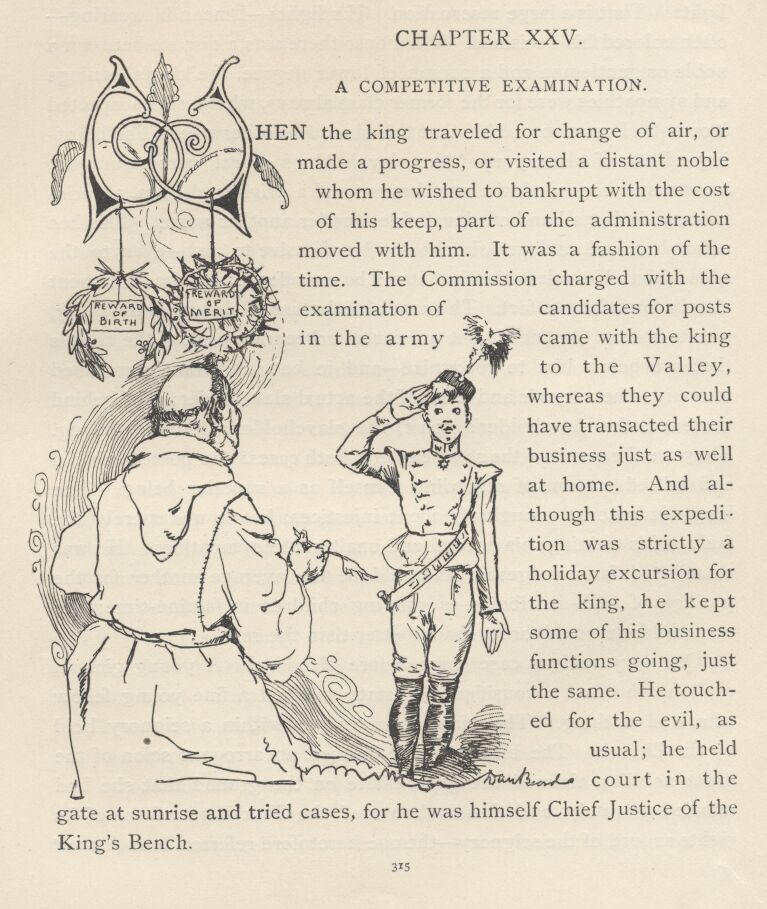
When the king traveled for change of air, or made a progress, or visited a distant noble whom he wished to bankrupt with the cost of his keep, part of the administration moved with him. It was a fashion of the time. The Commission charged with the examination of candidates for posts in the army came with the king to the Valley, whereas they could have transacted their business just as well at home. And although this expedition was strictly a holiday excursion for the king, he kept some of his business functions going just the same. He touched for the evil, as usual; he held court in the gate at sunrise and tried cases, for he was himself Chief Justice of the King’s Bench.
When the king traveled for a change of air or made a royal tour, part of the government went with him. The same was true when he visited a distant noble whom he wanted to bankrupt with the cost of hosting him. That was the fashion at the time. The Commission responsible for examining candidates for army posts came with the king to the Valley. Yet they could have done their work just as well at home. Although the trip was strictly a vacation for the king, he still carried on some of his official duties. As usual, he touched people to cure the evil. He held court at the gate at sunrise and tried cases, for he was Chief Justice of the King’s Bench.
He shone very well in this latter office. He was a wise and humane judge, and he clearly did his honest best and fairest,—according to his lights. That is a large reservation. His lights—I mean his rearing—often colored his decisions. Whenever there was a dispute between a noble or gentleman and a person of lower degree, the king’s leanings and sympathies were for the former class always, whether he suspected it or not. It was impossible that this should be otherwise. The blunting effects of slavery upon the slaveholder’s moral perceptions are known and conceded, the world over; and a privileged class, an aristocracy, is but a band of slaveholders under another name. This has a harsh sound, and yet should not be offensive to any—even to the noble himself—unless the fact itself be an offense: for the statement simply formulates a fact. The repulsive feature of slavery is the thing, not its name. One needs but to hear an aristocrat speak of the classes that are below him to recognize—and in but indifferently modified measure—the very air and tone of the actual slaveholder; and behind these are the slaveholder’s spirit, the slaveholder’s blunted feeling. They are the result of the same cause in both cases: the possessor’s old and inbred custom of regarding himself as a superior being. The king’s judgments wrought frequent injustices, but it was merely the fault of his training, his natural and unalterable sympathies. He was as unfitted for a judgeship as would be the average mother for the position of milk-distributor to starving children in famine-time; her own children would fare a shade better than the rest.
He did very well in this latter role. He was a wise and humane judge, and he clearly tried to be honest and fair, according to his own understanding. That is an important qualification. His understanding, I mean his upbringing, often colored his decisions. Whenever a noble or gentleman had a dispute with someone of lower rank, the king always favored the noble or gentleman. Whether he realized it or not, his sympathies lay with that class. It could not have been otherwise. The world over, people know and accept that slavery dulls a slaveholder’s moral sense. And a privileged class, an aristocracy, is just a group of slaveholders under another name. That sounds harsh, but it should offend no one, not even the noble himself, unless the fact itself is offensive. The statement simply puts a fact into words. What is repulsive about slavery is the thing, not its name. One need only hear an aristocrat speak of the classes below him. His manner and tone are much like those of an actual slaveholder. Behind them lie the slaveholder’s spirit and dulled feelings. In both cases, they come from the same cause: the possessor’s long, deeply rooted habit of seeing himself as a superior being. The king’s judgments often caused injustice, but that was simply the fault of his upbringing and his natural, unchangeable sympathies. He was as unfit to be a judge as the average mother would be to distribute milk to starving children during a famine. Her own children would get a little more than the rest.
One very curious case came before the king. A young girl, an orphan, who had a considerable estate, married a fine young fellow who had nothing. The girl’s property was within a seigniory held by the Church. The bishop of the diocese, an arrogant scion of the great nobility, claimed the girl’s estate on the ground that she had married privately, and thus had cheated the Church out of one of its rights as lord of the seigniory—the one heretofore referred to as le droit du seigneur. The penalty of refusal or avoidance was confiscation. The girl’s defense was, that the lordship of the seigniory was vested in the bishop, and the particular right here involved was not transferable, but must be exercised by the lord himself or stand vacated; and that an older law, of the Church itself, strictly barred the bishop from exercising it. It was a very odd case, indeed.
A very curious case came before the king. A young orphan girl with a considerable estate married a fine young man who had nothing. Her property lay within a seigniory held by the Church. The bishop of the diocese was an arrogant son of a great noble family. He claimed the girl’s estate because she had married privately. By doing so, he said, she had cheated the Church out of one of its rights as lord of the seigniory. This was the right previously mentioned as le droit du seigneur. The penalty for refusing or avoiding it was confiscation of the estate. The girl argued that the bishop held the lordship of the seigniory. This particular right could not be transferred. The lord had to exercise it himself, or the right was void. But an older law of the Church itself strictly forbade the bishop to exercise it. It was a very odd case, indeed.
It reminded me of something I had read in my youth about the ingenious way in which the aldermen of London raised the money that built the Mansion House. A person who had not taken the Sacrament according to the Anglican rite could not stand as a candidate for sheriff of London. Thus Dissenters were ineligible; they could not run if asked, they could not serve if elected. The aldermen, who without any question were Yankees in disguise, hit upon this neat device: they passed a by-law imposing a fine of L400 upon any one who should refuse to be a candidate for sheriff, and a fine of L600 upon any person who, after being elected sheriff, refused to serve. Then they went to work and elected a lot of Dissenters, one after another, and kept it up until they had collected L15,000 in fines; and there stands the stately Mansion House to this day, to keep the blushing citizen in mind of a long past and lamented day when a band of Yankees slipped into London and played games of the sort that has given their race a unique and shady reputation among all truly good and holy peoples that be in the earth.
It reminded me of something I had read as a young man. It was about the clever way London’s aldermen raised the money to build the Mansion House. Anyone who had not taken the Sacrament according to the Anglican rite could not run for sheriff of London. So Dissenters were ineligible. They could not run if asked, and they could not serve if elected. The aldermen, who were without question Yankees in disguise, came up with a neat scheme. They passed a bylaw fining anyone £400 for refusing to run for sheriff. It also fined anyone £600 for refusing to serve after being elected. Then they set to work electing Dissenters, one after another. They kept it up until they had collected £15,000 in fines. And there stands the stately Mansion House to this day. It reminds the blushing citizen of a long past and lamented day. Back then, a band of Yankees slipped into London and played games of that sort. Such games have given their race a unique and shady reputation among all the truly good and holy peoples on earth.
The girl’s case seemed strong to me; the bishop’s case was just as strong. I did not see how the king was going to get out of this hole. But he got out. I append his decision:
The girl’s case seemed strong to me. The bishop’s case was just as strong. I couldn’t see how the king was going to get out of this hole. But he got out. Here is his decision:
“Truly I find small difficulty here, the matter being even a child’s affair for simpleness. An the young bride had conveyed notice, as in duty bound, to her feudal lord and proper master and protector the bishop, she had suffered no loss, for the said bishop could have got a dispensation making him, for temporary conveniency, eligible to the exercise of his said right, and thus would she have kept all she had. Whereas, failing in her first duty, she hath by that failure failed in all; for whoso, clinging to a rope, severeth it above his hands, must fall; it being no defense to claim that the rest of the rope is sound, neither any deliverance from his peril, as he shall find. Pardy, the woman’s case is rotten at the source. It is the decree of the court that she forfeit to the said lord bishop all her goods, even to the last farthing that she doth possess, and be thereto mulcted in the costs. Next!”
“Truly, I find little difficulty here. The matter is simple enough for a child. The young bride should have notified the bishop, her feudal lord and rightful master and protector, as duty required. If she had, she would have suffered no loss. The bishop could have obtained a dispensation allowing him to exercise that right, for the sake of temporary convenience. In that way, she would have kept everything she had. But by failing in her first duty, she has failed in all her duties. Anyone who clings to a rope and cuts it above his hands must fall. It is no defense to claim that the rest of the rope is sound. Nor will that save him from danger, as he will discover. By heaven, the woman’s case is rotten at its source. The court decrees that she must surrender all her goods to the lord bishop, down to her last penny. She must also pay the court costs. Next!”
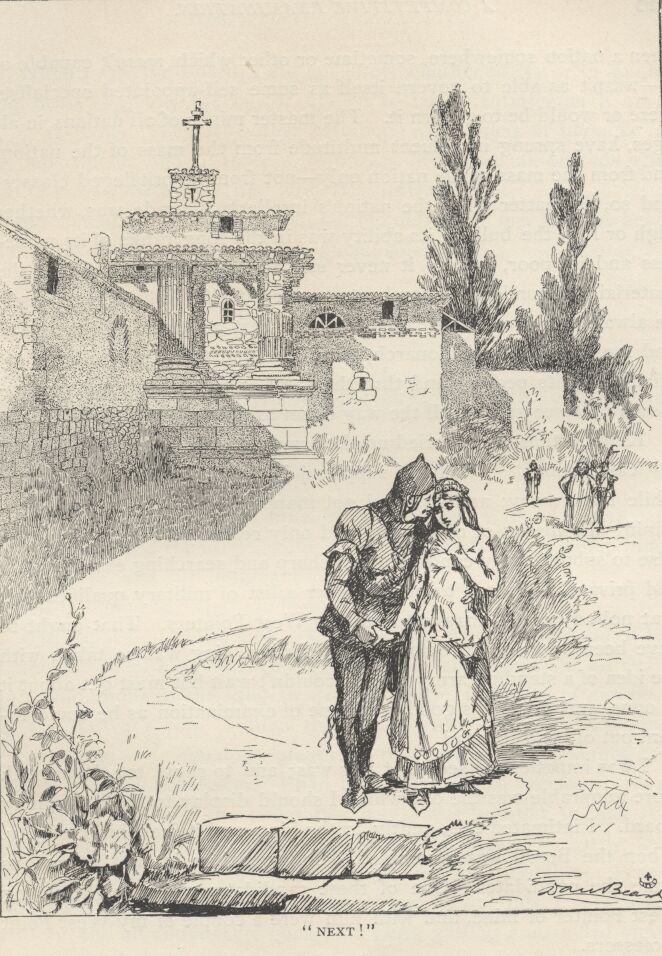
Here was a tragic end to a beautiful honeymoon not yet three months old. Poor young creatures! They had lived these three months lapped to the lips in worldly comforts. These clothes and trinkets they were wearing were as fine and dainty as the shrewdest stretch of the sumptuary laws allowed to people of their degree; and in these pretty clothes, she crying on his shoulder, and he trying to comfort her with hopeful words set to the music of despair, they went from the judgment seat out into the world homeless, bedless, breadless; why, the very beggars by the roadsides were not so poor as they.
This was a tragic end to a honeymoon that had begun less than three months ago. Poor young couple! They had spent those three months surrounded by every worldly comfort. Their clothes and jewelry were as fine and delicate as the sumptuary laws could be stretched to allow for their social rank. In those pretty clothes, they left the judgment seat and went out into the world. She cried on his shoulder, while he tried to comfort her with hopeful words spoken in a tone of despair. They had no home, no bed, and no bread. Why, even the beggars by the roadside were not so poor as they were.
Well, the king was out of the hole; and on terms satisfactory to the Church and the rest of the aristocracy, no doubt. Men write many fine and plausible arguments in support of monarchy, but the fact remains that where every man in a State has a vote, brutal laws are impossible. Arthur’s people were of course poor material for a republic, because they had been debased so long by monarchy; and yet even they would have been intelligent enough to make short work of that law which the king had just been administering if it had been submitted to their full and free vote. There is a phrase which has grown so common in the world’s mouth that it has come to seem to have sense and meaning—the sense and meaning implied when it is used; that is the phrase which refers to this or that or the other nation as possibly being “capable of self-government”; and the implied sense of it is, that there has been a nation somewhere, some time or other which wasn’t capable of it—wasn’t as able to govern itself as some self-appointed specialists were or would be to govern it. The master minds of all nations, in all ages, have sprung in affluent multitude from the mass of the nation, and from the mass of the nation only—not from its privileged classes; and so, no matter what the nation’s intellectual grade was; whether high or low, the bulk of its ability was in the long ranks of its nameless and its poor, and so it never saw the day that it had not the material in abundance whereby to govern itself. Which is to assert an always self-proven fact: that even the best governed and most free and most enlightened monarchy is still behind the best condition attainable by its people; and that the same is true of kindred governments of lower grades, all the way down to the lowest.
Well, the king was out of trouble, and no doubt on terms that satisfied the Church and the rest of the aristocracy. People write many fine, plausible arguments in favor of monarchy. But the fact remains that brutal laws are impossible where every man in a state has a vote. Arthur’s people were, of course, poorly suited to a republic, because monarchy had degraded them for so long. Yet even they would have been intelligent enough to quickly get rid of the law the king had just been enforcing, if it had been put to their full and free vote. A phrase has become so common that it seems to have the sense and meaning people intend when they use it. That is the phrase describing one nation or another as possibly being “capable of self-government.” It implies that somewhere, at some time, there was a nation that wasn’t capable of self-government. In other words, that nation was less able to govern itself than some self-appointed specialists were or would be. The great minds of all nations and all ages have come in vast numbers from the mass of the people alone, not from the privileged classes. So, whatever a nation’s level of intelligence, high or low, most of its ability lay among its countless nameless and poor people. There was never a day when any nation lacked abundant talent for governing itself. This states a fact that has always proved itself: even the best governed, freest, and most enlightened monarchy falls short of the best condition its people could achieve. The same is true of related forms of government at every lower level, down to the lowest.
King Arthur had hurried up the army business altogether beyond my calculations. I had not supposed he would move in the matter while I was away; and so I had not mapped out a scheme for determining the merits of officers; I had only remarked that it would be wise to submit every candidate to a sharp and searching examination; and privately I meant to put together a list of military qualifications that nobody could answer to but my West Pointers. That ought to have been attended to before I left; for the king was so taken with the idea of a standing army that he couldn’t wait but must get about it at once, and get up as good a scheme of examination as he could invent out of his own head.
King Arthur had moved ahead with the army much faster than I expected. I hadn’t thought he would do anything about it while I was away. So I hadn’t worked out a plan for judging the officers’ abilities. I had only said that every candidate should face a tough, thorough examination. Privately, I meant to draw up a list of military qualifications that only my West Pointers could meet. I should have done that before I left. The king was so taken with the idea of a standing army that he couldn’t wait. He had to get started at once and devise the best examination he could think of himself.
I was impatient to see what this was; and to show, too, how much more admirable was the one which I should display to the Examining Board. I intimated this, gently, to the king, and it fired his curiosity. When the Board was assembled, I followed him in; and behind us came the candidates. One of these candidates was a bright young West Pointer of mine, and with him were a couple of my West Point professors.
I was eager to see what this was. I also wanted to show how much more impressive the one I would present to the Examining Board was. I gently hinted at this to the king, and it sparked his curiosity. When the Board had gathered, I followed him in, and the candidates came in behind us. One was a bright young West Pointer of mine. Two of my West Point professors were with him.
When I saw the Board, I did not know whether to cry or to laugh. The head of it was the officer known to later centuries as Norroy King-at-Arms! The two other members were chiefs of bureaus in his department; and all three were priests, of course; all officials who had to know how to read and write were priests.
When I saw the Board, I didn't know whether to laugh or cry. Its head was the officer later known as Norroy King-at-Arms! The other two members were bureau chiefs in his department. All three were priests, of course. All officials who needed to read and write were priests.
My candidate was called first, out of courtesy to me, and the head of the Board opened on him with official solemnity:
As a courtesy to me, my candidate was called first. The head of the Board began questioning him with official solemnity:
“Name?”
“Name?”
“Mal-ease.”
“Mal-ease.”
“Son of?”
“Son of?”
“Webster.”
“Webster.”
“Webster—Webster. H’m—I—my memory faileth to recall the name. Condition?”
“Webster, Webster. Hmm, I can't recall the name. What is his status?”
“Weaver.”
“Weaver.”
“Weaver!—God keep us!”
“Weaver! God protect us!”
The king was staggered, from his summit to his foundations; one clerk fainted, and the others came near it. The chairman pulled himself together, and said indignantly:
The king was shaken from head to toe. One clerk fainted, and the others nearly did. The chairman pulled himself together and said indignantly:
“It is sufficient. Get you hence.”
“That’s enough. Go away.”
But I appealed to the king. I begged that my candidate might be examined. The king was willing, but the Board, who were all well-born folk, implored the king to spare them the indignity of examining the weaver’s son. I knew they didn’t know enough to examine him anyway, so I joined my prayers to theirs and the king turned the duty over to my professors. I had had a blackboard prepared, and it was put up now, and the circus began. It was beautiful to hear the lad lay out the science of war, and wallow in details of battle and siege, of supply, transportation, mining and countermining, grand tactics, big strategy and little strategy, signal service, infantry, cavalry, artillery, and all about siege guns, field guns, gatling guns, rifled guns, smooth bores, musket practice, revolver practice—and not a solitary word of it all could these catfish make head or tail of, you understand—and it was handsome to see him chalk off mathematical nightmares on the blackboard that would stump the angels themselves, and do it like nothing, too—all about eclipses, and comets, and solstices, and constellations, and mean time, and sidereal time, and dinner time, and bedtime, and every other imaginable thing above the clouds or under them that you could harry or bullyrag an enemy with and make him wish he hadn’t come—and when the boy made his military salute and stood aside at last, I was proud enough to hug him, and all those other people were so dazed they looked partly petrified, partly drunk, and wholly caught out and snowed under. I judged that the cake was ours, and by a large majority.
But I appealed to the king. I begged him to let my candidate be examined. The king was willing, but the Board members were all well-born. They begged the king to spare them the indignity of examining the weaver’s son. I knew they didn’t know enough to examine him anyway. So I joined in their plea, and the king handed the job over to my professors. I had had a blackboard prepared. It was set up now, and the circus began. It was beautiful to hear the lad explain the science of war. He reveled in the details of battle and siege, supply and transportation, mining and countermining. He covered grand tactics, big strategy and little strategy, signals, infantry, cavalry, and artillery. He explained siege guns, field guns, gatling guns, rifled guns, smoothbores, musket practice, and revolver practice. And these catfish couldn’t make heads or tails of a single word, you understand. It was wonderful to see him chalk mathematical nightmares on the blackboard, as if they were nothing. They would have stumped the angels themselves. He covered eclipses, comets, solstices, constellations, mean time, sidereal time, dinner time, and bedtime. He covered every other imaginable thing above or below the clouds that you could use to harass or bully an enemy. You could make him wish he hadn’t come. At last, the boy gave his military salute and stepped aside. I was proud enough to hug him. Everyone else was so dazed they looked partly petrified, partly drunk, and completely exposed and overwhelmed. I figured the prize was ours, by a large majority.
Education is a great thing. This was the same youth who had come to West Point so ignorant that when I asked him, “If a general officer should have a horse shot under him on the field of battle, what ought he to do?” answered up naively and said:
Education is a great thing. This was the same young man who had arrived at West Point knowing so little. When I asked him, “If a general’s horse is shot out from under him in battle, what should he do?” he answered innocently:
“Get up and brush himself.”
“Get up and brush himself off.”
One of the young nobles was called up now. I thought I would question him a little myself. I said:
One of the young nobles was called forward. I thought I would ask him a few questions myself. I said:
“Can your lordship read?”
“Can you read, my lord?”
His face flushed indignantly, and he fired this at me:
His face flushed with indignation, and he shot back at me:
“Takest me for a clerk? I trow I am not of a blood that—”
“Do you take me for a clerk? I believe I am not of a family that...”
“Answer the question!”
“Answer the question!”
He crowded his wrath down and made out to answer “No.”
He suppressed his anger and managed to answer “No.”
“Can you write?”
“Can you write?”
He wanted to resent this, too, but I said:
He wanted to take offense at this too, but I said:
“You will confine yourself to the questions, and make no comments. You are not here to air your blood or your graces, and nothing of the sort will be permitted. Can you write?”
“Stick to the questions and make no comments. You are not here to show off your noble blood or your manners. Nothing of the sort will be allowed. Can you write?”
“No.”
“No.”
“Do you know the multiplication table?”
“Do you know the multiplication table?”
“I wit not what ye refer to.”
“I don't know what you're referring to.”
“How much is 9 times 6?”
“How much is 9 times 6?”
“It is a mystery that is hidden from me by reason that the emergency requiring the fathoming of it hath not in my life-days occurred, and so, not having no need to know this thing, I abide barren of the knowledge.”
“It is a mystery to me because I have never faced an emergency that required me to solve it. So, having had no need to know, I remain ignorant of it.”
“If A trade a barrel of onions to B, worth 2 pence the bushel, in exchange for a sheep worth 4 pence and a dog worth a penny, and C kill the dog before delivery, because bitten by the same, who mistook him for D, what sum is still due to A from B, and which party pays for the dog, C or D, and who gets the money? If A, is the penny sufficient, or may he claim consequential damages in the form of additional money to represent the possible profit which might have inured from the dog, and classifiable as earned increment, that is to say, usufruct?”
“If A trades B a barrel of onions worth 2 pence per bushel for a sheep worth 4 pence and a dog worth a penny, what happens if C kills the dog before delivery? C kills the dog because it bit him, having mistaken him for D. How much does B still owe A? Who pays for the dog, C or D, and who gets the money? If A gets it, is the penny enough? Or can A claim additional money as consequential damages for the possible profit the dog might have brought in? Could this profit be classified as earned increment, that is, usufruct?”
“Verily, in the all-wise and unknowable providence of God, who moveth in mysterious ways his wonders to perform, have I never heard the fellow to this question for confusion of the mind and congestion of the ducts of thought. Wherefore I beseech you let the dog and the onions and these people of the strange and godless names work out their several salvations from their piteous and wonderful difficulties without help of mine, for indeed their trouble is sufficient as it is, whereas an I tried to help I should but damage their cause the more and yet mayhap not live myself to see the desolation wrought.”
“Truly, in the all-wise and unknowable providence of God, who works his wonders in mysterious ways, I have never heard a question to match this one for confusing the mind and clogging the channels of thought. So I beg you to let the dog, the onions, and these people with their strange and godless names work out their own ways through their pitiful and astonishing difficulties without my help. Their trouble is already great enough. If I tried to help, I would only make things worse for them. And perhaps I would not live to see the destruction I had caused.”
“What do you know of the laws of attraction and gravitation?”
“What do you know about the laws of attraction and gravity?”
“If there be such, mayhap his grace the king did promulgate them whilst that I lay sick about the beginning of the year and thereby failed to hear his proclamation.”
“If there are such things, perhaps the king announced them while I was sick at the beginning of the year. That would explain why I missed his announcement.”
“What do you know of the science of optics?”
“What do you know about the science of optics?”
“I know of governors of places, and seneschals of castles, and sheriffs of counties, and many like small offices and titles of honor, but him you call the Science of Optics I have not heard of before; peradventure it is a new dignity.”
“I know of governors of places, castle stewards, county sheriffs, and many other such minor offices and titles of honor. But I have not heard of the man you call the Science of Optics before. Perhaps it is a new title of honor.”
“Yes, in this country.”
“Yes, in this country.”
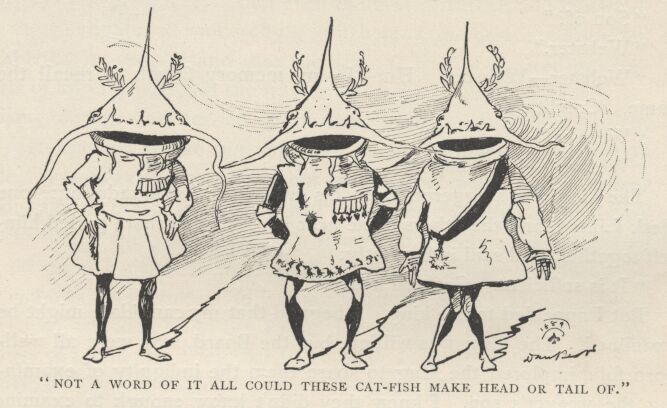
Try to conceive of this mollusk gravely applying for an official position, of any kind under the sun! Why, he had all the earmarks of a typewriter copyist, if you leave out the disposition to contribute uninvited emendations of your grammar and punctuation. It was unaccountable that he didn’t attempt a little help of that sort out of his majestic supply of incapacity for the job. But that didn’t prove that he hadn’t material in him for the disposition, it only proved that he wasn’t a typewriter copyist yet. After nagging him a little more, I let the professors loose on him and they turned him inside out, on the line of scientific war, and found him empty, of course. He knew somewhat about the warfare of the time—bushwhacking around for ogres, and bull-fights in the tournament ring, and such things—but otherwise he was empty and useless. Then we took the other young noble in hand, and he was the first one’s twin, for ignorance and incapacity. I delivered them into the hands of the chairman of the Board with the comfortable consciousness that their cake was dough. They were examined in the previous order of precedence.
Try to imagine this mollusk seriously applying for any official position under the sun! Why, he had all the marks of a typist, except the urge to correct your grammar and punctuation without being asked. It was hard to explain why he didn't try to help in that way, given how magnificently unqualified he was for the job. But that didn't prove he had no potential for such an urge. It only proved he wasn't a typist yet. After teasing him a little more, I let the professors loose on him. They examined him thoroughly on the science of warfare and found him empty, of course. He knew something about the warfare of the time: hunting ogres from ambush, bullfights in the tournament ring, and such things. But otherwise he was empty and useless. Then we examined the other young noble. He was the first one's twin in ignorance and incompetence. I handed them over to the chairman of the Board, comfortably certain that their chances were ruined. They were examined in the same order of precedence as before.
“Name, so please you?”
“Your name, please?”
“Pertipole, son of Sir Pertipole, Baron of Barley Mash.”
“Pertipole, son of Sir Pertipole, Baron of Barley Mash.”
“Grandfather?”
“Grandfather?”
“Also Sir Pertipole, Baron of Barley Mash.”
“Also Sir Pertipole, Baron of Barley Mash.”
“Great-grandfather?”
“Great-grandfather?”
“The same name and title.”
“The same name and title.”
“Great-great-grandfather?”
“Great-great-grandfather?”
“We had none, worshipful sir, the line failing before it had reached so far back.”
“We had none, sir, because the line did not go back that far.”
“It mattereth not. It is a good four generations, and fulfilleth the requirements of the rule.”
“It doesn't matter. It is a full four generations and meets the requirements of the rule.”
“Fulfills what rule?” I asked.
“What rule does it fulfill?” I asked.
“The rule requiring four generations of nobility or else the candidate is not eligible.”
“The rule that a candidate must have four generations of nobility to be eligible.”
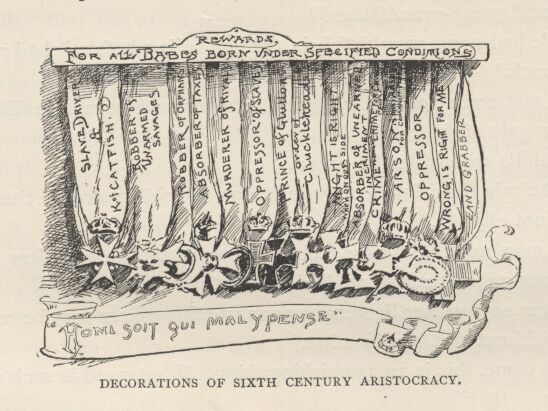
“A man not eligible for a lieutenancy in the army unless he can prove four generations of noble descent?”
“A man can’t become an army lieutenant unless he can prove he comes from four generations of nobles?”
“Even so; neither lieutenant nor any other officer may be commissioned without that qualification.”
“That’s right. Neither a lieutenant nor any other officer can be commissioned without that qualification.”
“Oh, come, this is an astonishing thing. What good is such a qualification as that?”
“Oh, come on, this is astonishing. What good is a qualification like that?”
“What good? It is a hardy question, fair sir and Boss, since it doth go far to impugn the wisdom of even our holy Mother Church herself.”
“What good? That is a bold question, sir and Boss, since it comes close to questioning the wisdom of our holy Mother Church herself.”
“As how?”
“How so?”
“For that she hath established the self-same rule regarding saints. By her law none may be canonized until he hath lain dead four generations.”
“Because she has established the same rule for saints. Under her law, no one may be canonized until he has been dead for four generations.”
“I see, I see—it is the same thing. It is wonderful. In the one case a man lies dead-alive four generations—mummified in ignorance and sloth—and that qualifies him to command live people, and take their weal and woe into his impotent hands; and in the other case, a man lies bedded with death and worms four generations, and that qualifies him for office in the celestial camp. Does the king’s grace approve of this strange law?”
“I see, I see. It is the same thing. It is amazing. In one case, a man lies half-dead for four generations, mummified in ignorance and laziness. That qualifies him to command living people and take their happiness and misery into his powerless hands. In the other case, a man lies buried with death and worms for four generations. That qualifies him for a post in the heavenly camp. Does the king approve of this strange law?”
The king said:
The king said:
“Why, truly I see naught about it that is strange. All places of honor and of profit do belong, by natural right, to them that be of noble blood, and so these dignities in the army are their property and would be so without this or any rule. The rule is but to mark a limit. Its purpose is to keep out too recent blood, which would bring into contempt these offices, and men of lofty lineage would turn their backs and scorn to take them. I were to blame an I permitted this calamity. You can permit it an you are minded so to do, for you have the delegated authority, but that the king should do it were a most strange madness and not comprehensible to any.”
“Why, I really don't see anything strange about it. All positions of honor and profit belong by natural right to people of noble birth. So these army offices are their property, and would be with or without this rule or any other. The rule merely sets a limit. It keeps out those whose families have only recently become noble. They would bring these offices into disrepute, and men of ancient noble families would refuse them with contempt. I would be to blame if I allowed this disaster. You can allow it if you wish, because you have been given the authority. But for the king to allow it would be an extraordinary madness that no one could understand.”
“I yield. Proceed, sir Chief of the Herald’s College.”
“I give in. Go ahead, sir Chief of the Herald’s College.”
The chairman resumed as follows:
The chairman continued:
“By what illustrious achievement for the honor of the Throne and State did the founder of your great line lift himself to the sacred dignity of the British nobility?”
“What great deed did the founder of your noble line perform for the honor of the Crown and the state? How did he rise to the sacred rank of British nobility?”
“He built a brewery.”
“He built a brewery.”
“Sire, the Board finds this candidate perfect in all the requirements and qualifications for military command, and doth hold his case open for decision after due examination of his competitor.”
“Sire, the Board finds that this candidate perfectly meets all the requirements and qualifications for military command. The Board will decide his case after fully examining his competitor.”
The competitor came forward and proved exactly four generations of nobility himself. So there was a tie in military qualifications that far.
The competitor came forward and proved that he, too, had exactly four generations of noble ancestry. So far, they were tied in military qualifications.
He stood aside a moment, and Sir Pertipole was questioned further:
He stepped aside for a moment, and Sir Pertipole was questioned further:
“Of what condition was the wife of the founder of your line?”
“What was the social standing of the wife of the founder of your family line?”
“She came of the highest landed gentry, yet she was not noble; she was gracious and pure and charitable, of a blameless life and character, insomuch that in these regards was she peer of the best lady in the land.”
“She came from the highest ranks of the landowning class, but she was not a noble. She was gracious, pure, and charitable, and her life and character were blameless. In all these respects, she was the equal of the finest lady in the land.”
“That will do. Stand down.” He called up the competing lordling again, and asked: “What was the rank and condition of the great-grandmother who conferred British nobility upon your great house?”
“That will do. Stand down.” He called the rival young lord forward again and asked: “What was the rank and status of the great-grandmother who gave your great family its British nobility?”
“She was a king’s leman and did climb to that splendid eminence by her own unholpen merit from the sewer where she was born.”
“She was a king’s mistress. She rose from the sewer where she was born to that splendid height by her own merit, without help.”
“Ah, this, indeed, is true nobility, this is the right and perfect intermixture. The lieutenancy is yours, fair lord. Hold it not in contempt; it is the humble step which will lead to grandeurs more worthy of the splendor of an origin like to thine.”
“Ah, this is true nobility indeed. This is the perfect combination. The lieutenancy is yours, my lord. Do not look down on it. It is a humble first step toward honors more worthy of your splendid origins.”
I was down in the bottomless pit of humiliation. I had promised myself an easy and zenith-scouring triumph, and this was the outcome!
I was in a bottomless pit of humiliation. I had expected an easy, sky-high triumph, and this was the result!
I was almost ashamed to look my poor disappointed cadet in the face. I told him to go home and be patient, this wasn’t the end.
I was almost ashamed to look my poor, disappointed cadet in the face. I told him to go home and be patient. This wasn't the end.
I had a private audience with the king, and made a proposition. I said it was quite right to officer that regiment with nobilities, and he couldn’t have done a wiser thing. It would also be a good idea to add five hundred officers to it; in fact, add as many officers as there were nobles and relatives of nobles in the country, even if there should finally be five times as many officers as privates in it; and thus make it the crack regiment, the envied regiment, the King’s Own regiment, and entitled to fight on its own hook and in its own way, and go whither it would and come when it pleased, in time of war, and be utterly swell and independent. This would make that regiment the heart’s desire of all the nobility, and they would all be satisfied and happy. Then we would make up the rest of the standing army out of commonplace materials, and officer it with nobodies, as was proper—nobodies selected on a basis of mere efficiency—and we would make this regiment toe the line, allow it no aristocratic freedom from restraint, and force it to do all the work and persistent hammering, to the end that whenever the King’s Own was tired and wanted to go off for a change and rummage around amongst ogres and have a good time, it could go without uneasiness, knowing that matters were in safe hands behind it, and business going to be continued at the old stand, same as usual. The king was charmed with the idea.
I had a private meeting with the king and made a proposal. I said he was quite right to put nobles in command of that regiment. He couldn’t have done anything wiser. It would also be a good idea to add five hundred officers to the regiment. In fact, he should add as many officers as there were nobles and relatives of nobles in the country. He should do this even if the regiment ended up with five times as many officers as privates. That would make it the elite regiment, the envy of all, the King’s Own regiment. In wartime, it would be entitled to fight on its own and in its own way. It could go wherever it wanted and return whenever it pleased, utterly grand and independent. Every noble would long to join it, and they would all be satisfied and happy. Then we would make up the rest of the standing army from ordinary people. We would put nobodies in command, as was proper, choosing them on the basis of mere efficiency. We would make this regiment follow the rules and give it no aristocratic freedom from restraint. We would force it to do all the work and keep up the steady hammering. Then, whenever the King’s Own got tired, it could go off for a change, rummage among ogres, and have a good time. It could leave without worrying, knowing that matters behind it were in safe hands. Business would carry on at the old stand, just as usual. The king was charmed with the idea.
When I noticed that, it gave me a valuable notion. I thought I saw my way out of an old and stubborn difficulty at last. You see, the royalties of the Pendragon stock were a long-lived race and very fruitful. Whenever a child was born to any of these—and it was pretty often—there was wild joy in the nation’s mouth, and piteous sorrow in the nation’s heart. The joy was questionable, but the grief was honest. Because the event meant another call for a Royal Grant. Long was the list of these royalties, and they were a heavy and steadily increasing burden upon the treasury and a menace to the crown. Yet Arthur could not believe this latter fact, and he would not listen to any of my various projects for substituting something in the place of the royal grants. If I could have persuaded him to now and then provide a support for one of these outlying scions from his own pocket, I could have made a grand to-do over it, and it would have had a good effect with the nation; but no, he wouldn’t hear of such a thing. He had something like a religious passion for royal grant; he seemed to look upon it as a sort of sacred swag, and one could not irritate him in any way so quickly and so surely as by an attack upon that venerable institution. If I ventured to cautiously hint that there was not another respectable family in England that would humble itself to hold out the hat—however, that is as far as I ever got; he always cut me short there, and peremptorily, too.
When I noticed that, it gave me a useful idea. I thought I had finally found a way around an old, stubborn problem. You see, the royals of the Pendragon family lived long lives and had many children. Whenever one of them had a child, which happened quite often, the nation shouted with joy but grieved in its heart. The joy was questionable, but the grief was honest. The birth meant another request for a Royal Grant. The list of royals was long, and they were a heavy and growing burden on the treasury. They were also a threat to the crown. But Arthur could not believe they were a threat. He would not listen to any of my plans for replacing the royal grants with something else. If I could have persuaded him to support an occasional distant relative out of his own pocket, I could have made a grand fuss over it. That would have had a good effect on the nation. But no, he would not hear of it. He had an almost religious passion for royal grants. He seemed to regard them as a kind of sacred loot. Nothing irritated him more quickly or surely than an attack on that venerable institution. Sometimes I cautiously hinted that no other respectable family in England would stoop to hold out a hat for money. But that was as far as I ever got. He always cut me off, and sharply, too.
But I believed I saw my chance at last. I would form this crack regiment out of officers alone—not a single private. Half of it should consist of nobles, who should fill all the places up to Major-General, and serve gratis and pay their own expenses; and they would be glad to do this when they should learn that the rest of the regiment would consist exclusively of princes of the blood. These princes of the blood should range in rank from Lieutenant-General up to Field Marshal, and be gorgeously salaried and equipped and fed by the state. Moreover—and this was the master stroke—it should be decreed that these princely grandees should be always addressed by a stunningly gaudy and awe-compelling title (which I would presently invent), and they and they only in all England should be so addressed. Finally, all princes of the blood should have free choice; join that regiment, get that great title, and renounce the royal grant, or stay out and receive a grant. Neatest touch of all: unborn but imminent princes of the blood could be born into the regiment, and start fair, with good wages and a permanent situation, upon due notice from the parents.
But I believed I finally saw my chance. I would make this elite regiment entirely of officers, with not a single private. Half would be nobles, filling all the ranks up to Major-General. They would serve without pay and cover their own expenses. They would be glad to do so once they learned that the rest of the regiment would consist exclusively of princes of the blood. These princes would hold ranks from Lieutenant-General up to Field Marshal. The state would pay them lavishly and provide their equipment and food. And here was the masterstroke. These princely grandees would always be addressed by a dazzling, awe-inspiring title, which I would soon invent. No one else in all England would be addressed by it. Finally, all princes of the blood would have a free choice. They could join the regiment, get that grand title, and give up the royal grant. Or they could stay out and receive a grant. The neatest touch of all was that princes of the blood who were soon to arrive could be born into the regiment. With proper notice from their parents, they could start life with good wages and a permanent position.
All the boys would join, I was sure of that; so, all existing grants would be relinquished; that the newly born would always join was equally certain. Within sixty days that quaint and bizarre anomaly, the Royal Grant, would cease to be a living fact, and take its place among the curiosities of the past.
I was sure all the boys would join, so all existing grants would be given up. I was equally sure that newborns would always join. Within sixty days, the strange and bizarre Royal Grant would no longer exist. It would take its place among the curiosities of the past.