Chapter 23
Restoring the Fountain
Saturday noon I went to the well and looked on a while. Merlin was still burning smoke-powders, and pawing the air, and muttering gibberish as hard as ever, but looking pretty down-hearted, for of course he had not started even a perspiration in that well yet. Finally I said:
At noon on Saturday, I went to the well and watched for a while. Merlin was still burning smoke powders, waving his hands in the air, and muttering gibberish as hard as ever. But he looked pretty discouraged. Of course, he had not even made the well sweat yet. Finally, I said:
“How does the thing promise by this time, partner?”
“How are things looking now, partner?”
“Behold, I am even now busied with trial of the powerfulest enchantment known to the princes of the occult arts in the lands of the East; an it fail me, naught can avail. Peace, until I finish.”
“Look, I am now testing the most powerful enchantment known to the masters of the occult arts in the East. If it fails me, nothing can help. Be quiet until I finish.”
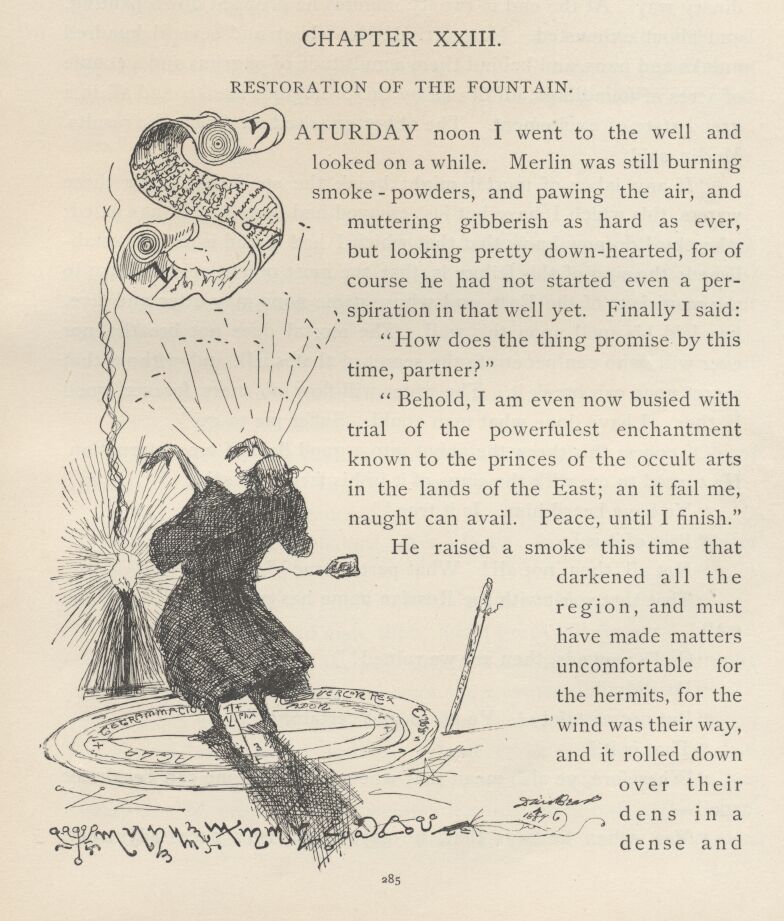
He raised a smoke this time that darkened all the region, and must have made matters uncomfortable for the hermits, for the wind was their way, and it rolled down over their dens in a dense and billowy fog. He poured out volumes of speech to match, and contorted his body and sawed the air with his hands in a most extraordinary way. At the end of twenty minutes he dropped down panting, and about exhausted. Now arrived the abbot and several hundred monks and nuns, and behind them a multitude of pilgrims and a couple of acres of foundlings, all drawn by the prodigious smoke, and all in a grand state of excitement. The abbot inquired anxiously for results. Merlin said:
This time he raised a cloud of smoke that darkened the whole region. It must have made the hermits uncomfortable, because the wind was blowing toward them. The smoke rolled over their dens like a thick, billowing fog. He poured out a matching flood of words, twisting his body and waving his hands wildly through the air. After twenty minutes, he collapsed, panting and nearly exhausted. Then the abbot arrived with several hundred monks and nuns. Behind them came a crowd of pilgrims and a couple of acres of foundlings. The enormous cloud of smoke had drawn them all, and they were all wildly excited. The abbot anxiously asked what the results were. Merlin said:
“If any labor of mortal might break the spell that binds these waters, this which I have but just essayed had done it. It has failed; whereby I do now know that that which I had feared is a truth established; the sign of this failure is, that the most potent spirit known to the magicians of the East, and whose name none may utter and live, has laid his spell upon this well. The mortal does not breathe, nor ever will, who can penetrate the secret of that spell, and without that secret none can break it. The water will flow no more forever, good Father. I have done what man could. Suffer me to go.”
“If any human effort could break the spell on these waters, what I just tried would have done it. It failed, so I now know that what I feared is true. The failure shows that the most powerful spirit known to the magicians of the East has cast this spell on the well. No one can speak his name and live. No person alive now or ever will be able to discover the secret of that spell. Without that secret, no one can break it. The water will never flow again, good Father. I have done what a man could. Allow me to go.”
Of course this threw the abbot into a good deal of a consternation. He turned to me with the signs of it in his face, and said:
Of course, this greatly alarmed the abbot. He turned to me, looking alarmed, and said:
“Ye have heard him. Is it true?”
“You heard him. Is it true?”
“Part of it is.”
“Part of it is.”
“Not all, then, not all! What part is true?”
“Then not all of it, not all of it! What part is true?”
“That that spirit with the Russian name has put his spell upon the well.”
“That the spirit with the Russian name has cast a spell on the well.”
“God’s wounds, then are we ruined!”
“God damn it, then we’re ruined!”
“Possibly.”
“Maybe.”
“But not certainly? Ye mean, not certainly?”
“But not for certain? You mean, not for certain?”
“That is it.”
“That’s it.”
“Wherefore, ye also mean that when he saith none can break the spell—”
“So, you also mean that when he says no one can break the spell... ”
“Yes, when he says that, he says what isn’t necessarily true. There are conditions under which an effort to break it may have some chance—that is, some small, some trifling chance—of success.”
“Yes, when he says that, what he says isn’t necessarily true. Under some conditions, an attempt to break it may have a chance of success. That chance is small, even tiny.”
“The conditions—”
“The conditions...”
“Oh, they are nothing difficult. Only these: I want the well and the surroundings for the space of half a mile, entirely to myself from sunset to-day until I remove the ban—and nobody allowed to cross the ground but by my authority.”
“Oh, they aren’t difficult. I just want the well and the surrounding area for half a mile entirely to myself. I want it from sunset today until I lift the ban. No one may cross the ground without my permission.”
“Are these all?”
“Are these all?”
“Yes.”
“Yes.”
“And you have no fear to try?”
“And you're not afraid to try?”
“Oh, none. One may fail, of course; and one may also succeed. One can try, and I am ready to chance it. I have my conditions?”
“Oh, none. You may fail, of course, but you may also succeed. You can try, and I'm willing to take the chance. I have my conditions?”
“These and all others ye may name. I will issue commandment to that effect.”
“These and all others you may name. I will give an order to that effect.”
“Wait,” said Merlin, with an evil smile. “Ye wit that he that would break this spell must know that spirit’s name?”
“Wait,” said Merlin, with an evil smile. “You know that anyone who wants to break this spell must know the spirit’s name?”
“Yes, I know his name.”
“Yes, I know his name.”
“And wit you also that to know it skills not of itself, but ye must likewise pronounce it? Ha-ha! Knew ye that?”
“And do you also know that knowing it is no use by itself? You must pronounce it too. Ha-ha! Did you know that?”
“Yes, I knew that, too.”
“Yes, I knew that, too.”
“You had that knowledge! Art a fool? Are ye minded to utter that name and die?”
“You knew that! Are you a fool? Do you want to say that name and die?”
“Utter it? Why certainly. I would utter it if it was Welsh.”
“Say it? Why, certainly. I would say it even if it were Welsh.”
“Ye are even a dead man, then; and I go to tell Arthur.”
“Then you're as good as dead, and I'm going to tell Arthur.”
“That’s all right. Take your gripsack and get along. The thing for you to do is to go home and work the weather, John W. Merlin.”
“That’s all right. Take your bag and get going. What you need to do is go home and work the weather, John W. Merlin.”
It was a home shot, and it made him wince; for he was the worst weather-failure in the kingdom. Whenever he ordered up the danger-signals along the coast there was a week’s dead calm, sure, and every time he prophesied fair weather it rained brickbats. But I kept him in the weather bureau right along, to undermine his reputation. However, that shot raised his bile, and instead of starting home to report my death, he said he would remain and enjoy it.
That hit home, and he winced. He was the worst weather forecaster in the kingdom. Whenever he ordered storm warnings along the coast, a week of complete calm was sure to follow. Every time he predicted fair weather, it rained bricks. But I kept him in the weather bureau to ruin his reputation. That jab made him angry, though. Instead of going home to report my death, he said he would stay and enjoy it.
My two experts arrived in the evening, and pretty well fagged, for they had traveled double tides. They had pack-mules along, and had brought everything I needed—tools, pump, lead pipe, Greek fire, sheaves of big rockets, roman candles, colored fire sprays, electric apparatus, and a lot of sundries—everything necessary for the stateliest kind of a miracle. They got their supper and a nap, and about midnight we sallied out through a solitude so wholly vacant and complete that it quite overpassed the required conditions. We took possession of the well and its surroundings. My boys were experts in all sorts of things, from the stoning up of a well to the constructing of a mathematical instrument. An hour before sunrise we had that leak mended in ship-shape fashion, and the water began to rise. Then we stowed our fireworks in the chapel, locked up the place, and went home to bed.
My two experts arrived that evening, pretty worn out from traveling at double speed. They had pack mules with them and had brought everything I needed: tools, a pump, lead pipe, Greek fire, bundles of big rockets, roman candles, colored fire sprays, electrical equipment, and assorted other supplies. It was everything necessary for the grandest kind of miracle. They ate supper and took a nap. Around midnight we set out through a place so completely deserted that it more than met our needs. We took possession of the well and the area around it. My boys were experts at all sorts of things, from lining a well with stone to making a mathematical instrument. An hour before sunrise, we had repaired the leak properly, and the water began to rise. Then we stored our fireworks in the chapel, locked it up, and went home to bed.
Before the noon mass was over, we were at the well again; for there was a deal to do yet, and I was determined to spring the miracle before midnight, for business reasons: for whereas a miracle worked for the Church on a week-day is worth a good deal, it is worth six times as much if you get it in on a Sunday. In nine hours the water had risen to its customary level—that is to say, it was within twenty-three feet of the top. We put in a little iron pump, one of the first turned out by my works near the capital; we bored into a stone reservoir which stood against the outer wall of the well-chamber and inserted a section of lead pipe that was long enough to reach to the door of the chapel and project beyond the threshold, where the gushing water would be visible to the two hundred and fifty acres of people I was intending should be present on the flat plain in front of this little holy hillock at the proper time.
Before the noon mass was over, we were back at the well. There was still a lot to do, and I was determined to unveil the miracle before midnight, for business reasons. A miracle performed for the Church on a weekday is worth a good deal. But it is worth six times as much if you manage it on a Sunday. In nine hours, the water had risen to its usual level, twenty-three feet below the top. We installed a small iron pump, one of the first made at my works near the capital. We bored into a stone reservoir against the outer wall of the well chamber and inserted a length of lead pipe. The pipe was long enough to reach the chapel door and extend past the threshold. There, the gushing water would be visible to the two hundred and fifty acres of people I planned to have gathered at the proper time on the flat plain in front of this little holy hill.
We knocked the head out of an empty hogshead and hoisted this hogshead to the flat roof of the chapel, where we clamped it down fast, poured in gunpowder till it lay loosely an inch deep on the bottom, then we stood up rockets in the hogshead as thick as they could loosely stand, all the different breeds of rockets there are; and they made a portly and imposing sheaf, I can tell you. We grounded the wire of a pocket electrical battery in that powder, we placed a whole magazine of Greek fire on each corner of the roof—blue on one corner, green on another, red on another, and purple on the last—and grounded a wire in each.
We knocked one end out of an empty hogshead and hoisted the barrel onto the chapel’s flat roof. We clamped it firmly in place and poured in a loose layer of gunpowder, an inch deep. Then we stood rockets in the barrel, packing them as closely as we could without squeezing them together. We used every kind of rocket there was. They made a big, impressive bundle, I can tell you. We put the wire from a pocket electrical battery into the powder. Then we placed a whole supply of Greek fire at each corner of the roof: blue at one corner, green at another, red at another, and purple at the last. We put a wire into each supply.
About two hundred yards off, in the flat, we built a pen of scantlings, about four feet high, and laid planks on it, and so made a platform. We covered it with swell tapestries borrowed for the occasion, and topped it off with the abbot’s own throne. When you are going to do a miracle for an ignorant race, you want to get in every detail that will count; you want to make all the properties impressive to the public eye; you want to make matters comfortable for your head guest; then you can turn yourself loose and play your effects for all they are worth. I know the value of these things, for I know human nature. You can’t throw too much style into a miracle. It costs trouble, and work, and sometimes money; but it pays in the end. Well, we brought the wires to the ground at the chapel, and then brought them under the ground to the platform, and hid the batteries there. We put a rope fence a hundred feet square around the platform to keep off the common multitude, and that finished the work. My idea was, doors open at 10:30, performance to begin at 11:25 sharp. I wished I could charge admission, but of course that wouldn’t answer. I instructed my boys to be in the chapel as early as 10, before anybody was around, and be ready to man the pumps at the proper time, and make the fur fly. Then we went home to supper.
About two hundred yards away, on the flat ground, we built a four-foot-high frame of wooden beams. We laid planks across it to make a platform. We covered the platform with fancy tapestries borrowed for the occasion and put the abbot’s own throne on top. When you’re going to perform a miracle for an ignorant race, you want every detail to count. You want all the props to impress the public, and you want your guest of honor to be comfortable. Then you can let loose and make the most of your effects. I know the value of these things because I know human nature. You can’t put too much style into a miracle. It takes trouble, work, and sometimes money, but it pays off in the end. Well, we ran the wires down to the ground at the chapel, then underground to the platform. We hid the batteries there. We put a rope fence around the platform, forming a square a hundred feet on each side. That would keep the common crowd away, and it finished the job. My plan was to open the doors at 10:30 and start the performance at 11:25 sharp. I wished I could charge admission, but of course that wouldn’t do. I told my boys to get to the chapel by 10, before anyone else was around. They were to be ready to work the pumps at the right time and really let things fly. Then we went home to supper.
The news of the disaster to the well had traveled far by this time; and now for two or three days a steady avalanche of people had been pouring into the valley. The lower end of the valley was become one huge camp; we should have a good house, no question about that. Criers went the rounds early in the evening and announced the coming attempt, which put every pulse up to fever heat. They gave notice that the abbot and his official suite would move in state and occupy the platform at 10:30, up to which time all the region which was under my ban must be clear; the bells would then cease from tolling, and this sign should be permission to the multitudes to close in and take their places.
By now, news of the disaster at the well had traveled far. For two or three days, a steady avalanche of people had been pouring into the valley. The lower end of the valley had become one huge camp. We would have a good crowd, no question about that. Early in the evening, criers went around announcing the coming attempt. The news sent everyone’s excitement soaring. They announced that the abbot and his official party would arrive in a grand procession and take the platform at 10:30. By then, everyone had to leave the entire area I had declared off-limits. The bells would then stop tolling. That would be the signal for the crowds to move in and take their places.
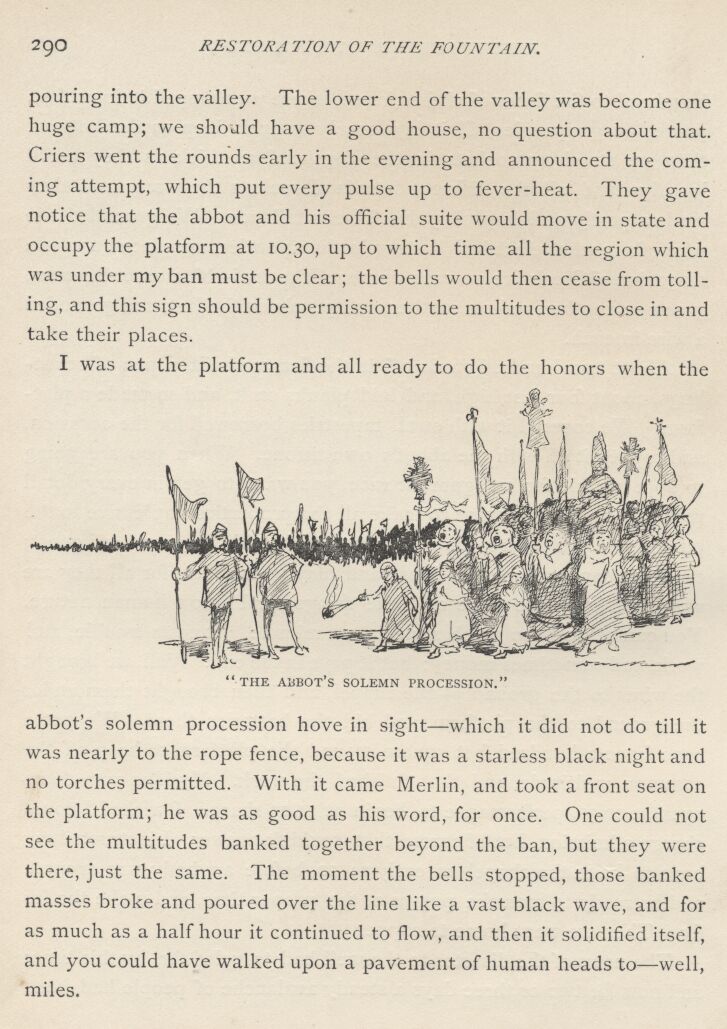
I was at the platform and all ready to do the honors when the abbot’s solemn procession hove in sight—which it did not do till it was nearly to the rope fence, because it was a starless black night and no torches permitted. With it came Merlin, and took a front seat on the platform; he was as good as his word for once. One could not see the multitudes banked together beyond the ban, but they were there, just the same. The moment the bells stopped, those banked masses broke and poured over the line like a vast black wave, and for as much as a half hour it continued to flow, and then it solidified itself, and you could have walked upon a pavement of human heads to—well, miles.
I was at the platform, ready to welcome everyone, when the abbot's solemn procession came into view. It was nearly at the rope fence before I could see it. The night was pitch black and starless, and no torches were allowed. Merlin came with the procession and took a front seat on the platform. For once, he kept his word. You couldn't see the crowds packed together beyond the boundary, but they were there all the same. The moment the bells stopped, the packed crowd surged across the line like a vast black wave. It kept flowing for as much as half an hour. Then it packed tight again, and you could have walked on a pavement of human heads for, well, miles.
We had a solemn stage-wait, now, for about twenty minutes—a thing I had counted on for effect; it is always good to let your audience have a chance to work up its expectancy. At length, out of the silence a noble Latin chant—men’s voices—broke and swelled up and rolled away into the night, a majestic tide of melody. I had put that up, too, and it was one of the best effects I ever invented. When it was finished I stood up on the platform and extended my hands abroad, for two minutes, with my face uplifted—that always produces a dead hush—and then slowly pronounced this ghastly word with a kind of awfulness which caused hundreds to tremble, and many women to faint:
We now had a solemn pause on stage for about twenty minutes. I had planned it for effect. It is always good to give your audience a chance to build up its anticipation. At last, a noble Latin chant broke the silence. Men’s voices swelled and rolled away into the night, a majestic tide of melody. I had arranged that, too, and it was one of the best effects I ever invented. When the chant ended, I stood up on the platform. I held out my hands for two minutes with my face raised. That always produces a dead silence. Then I slowly spoke this ghastly word with such a sense of dread that hundreds trembled and many women fainted:
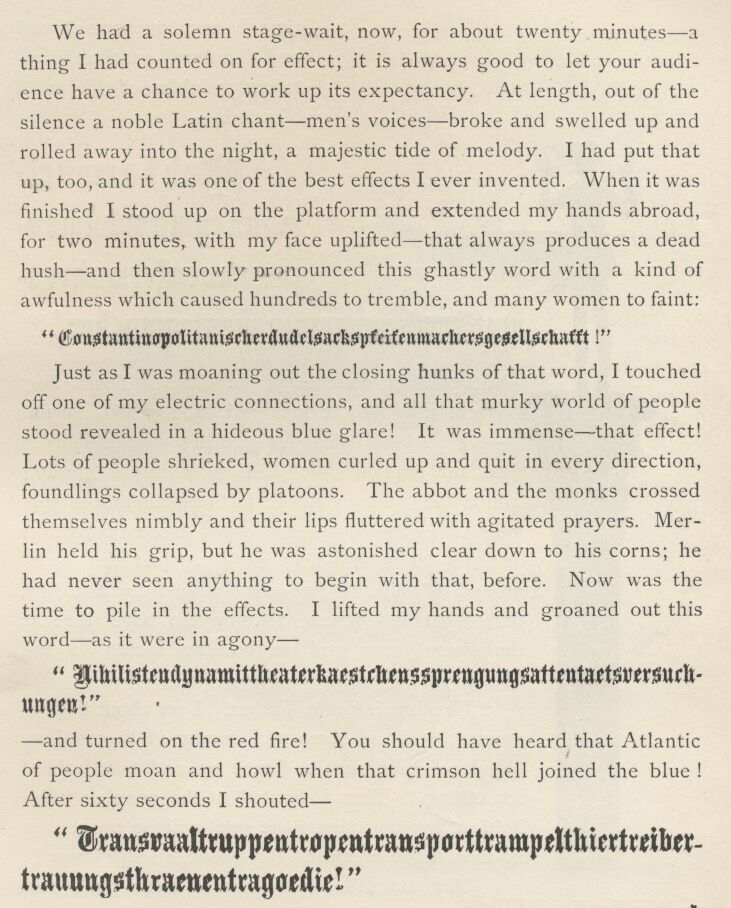
“Constantinopolitanischerdudelsackspfeifenmachersgesellschafft!”
“Constantinopolitanischerdudelsackspfeifenmachersgesellschafft!”
Just as I was moaning out the closing hunks of that word, I touched off one of my electric connections and all that murky world of people stood revealed in a hideous blue glare! It was immense—that effect! Lots of people shrieked, women curled up and quit in every direction, foundlings collapsed by platoons. The abbot and the monks crossed themselves nimbly and their lips fluttered with agitated prayers. Merlin held his grip, but he was astonished clear down to his corns; he had never seen anything to begin with that, before. Now was the time to pile in the effects. I lifted my hands and groaned out this word—as it were in agony:
Just as I was moaning out the last parts of that word, I triggered one of my electrical connections. The whole dark crowd was revealed in a hideous blue glare! The effect was tremendous! Lots of people shrieked. Women fainted in every direction, and foundlings collapsed by the dozen. The abbot and the monks quickly crossed themselves, their lips fluttering with anxious prayers. Merlin held his ground, but he was astonished down to his toes. He had never seen anything that even came close to that before. Now was the time to pile on the effects. I raised my hands and groaned out this word, as if in agony:
“Nihilistendynamittheaterkaestchenssprengungsattentaetsversuchungen!”
“Nihilistendynamittheaterkaestchenssprengungsattentaetsversuchungen!”
—and turned on the red fire! You should have heard that Atlantic of people moan and howl when that crimson hell joined the blue! After sixty seconds I shouted:
And turned on the red fire! You should have heard that ocean of people moan and howl when that crimson hell joined the blue! After sixty seconds, I shouted:
“Transvaaltruppentropentransporttrampelthiertreibertrauungsthraenentragoedie!”
“Transvaaltruppentropentransporttrampelthiertreibertrauungsthraenentragoedie!”
—and lit up the green fire! After waiting only forty seconds this time, I spread my arms abroad and thundered out the devastating syllables of this word of words:
and lit the green fire! This time, I waited only forty seconds. Then I spread my arms wide and thundered out the devastating syllables of this ultimate word:
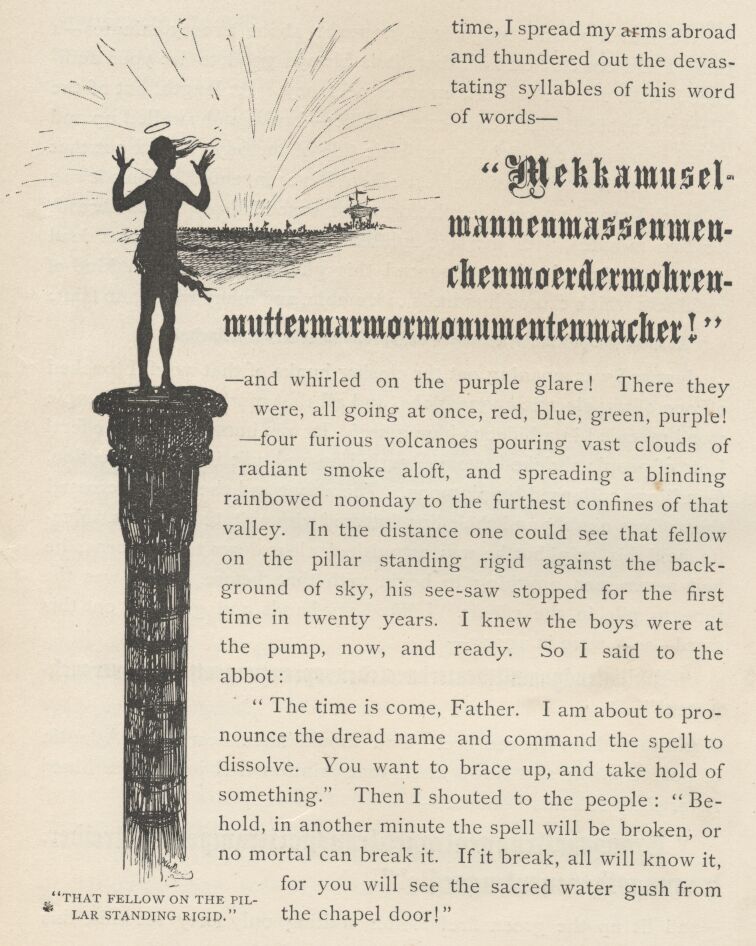
“Mekkamuselmannenmassenmenchenmoerdermohrenmuttermarmormonumentenmacher!”
“Mekkamuselmannenmassenmenchenmoerdermohrenmuttermarmormonumentenmacher!”
—and whirled on the purple glare! There they were, all going at once, red, blue, green, purple!—four furious volcanoes pouring vast clouds of radiant smoke aloft, and spreading a blinding rainbowed noonday to the furthest confines of that valley. In the distance one could see that fellow on the pillar standing rigid against the background of sky, his seesaw stopped for the first time in twenty years. I knew the boys were at the pump now and ready. So I said to the abbot:
The purple glare whirled on! There they were, all going at once: red, blue, green, purple! Four furious volcanoes poured huge clouds of glowing smoke into the sky. They spread a blinding, rainbow-colored noonday light to the farthest reaches of the valley. In the distance, I could see that fellow on the pillar, standing rigid against the sky. His seesaw had stopped for the first time in twenty years. I knew the boys were at the pump now and ready. So I said to the abbot:
“The time is come, Father. I am about to pronounce the dread name and command the spell to dissolve. You want to brace up, and take hold of something.” Then I shouted to the people: “Behold, in another minute the spell will be broken, or no mortal can break it. If it break, all will know it, for you will see the sacred water gush from the chapel door!”
“The time has come, Father. I am about to speak the dread name and command the spell to break. Brace yourself and hold on to something.” Then I shouted to the people: “Look! In another minute, the spell will be broken, or no mortal can break it. If the spell breaks, everyone will know. You will see the sacred water gush from the chapel door!”
I stood a few moments, to let the hearers have a chance to spread my announcement to those who couldn’t hear, and so convey it to the furthest ranks, then I made a grand exhibition of extra posturing and gesturing, and shouted:
I stood still for a few moments so those who heard me could pass my announcement on to those who couldn't. That way, it could reach the farthest ranks. Then I put on a grand show of extra poses and gestures, and shouted:
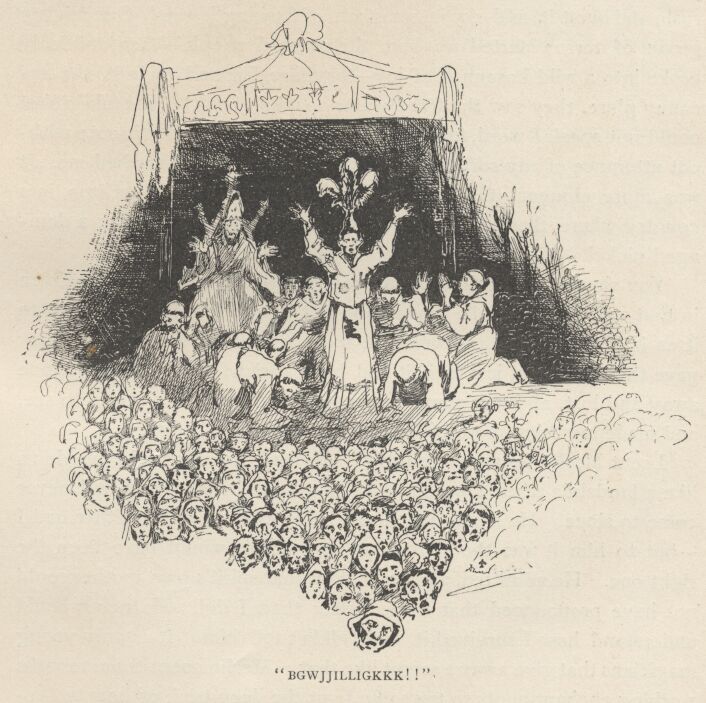
“Lo, I command the fell spirit that possesses the holy fountain to now disgorge into the skies all the infernal fires that still remain in him, and straightway dissolve his spell and flee hence to the pit, there to lie bound a thousand years. By his own dread name I command it—BGWJJILLIGKKK!”
“Listen, I command the evil spirit possessing the holy fountain to spew all its remaining hellfire into the sky. Then it must immediately break its spell and flee to the pit, where it will be bound for a thousand years. By its own dreadful name, I command it: BGWJJILLIGKKK!”
Then I touched off the hogshead of rockets, and a vast fountain of dazzling lances of fire vomited itself toward the zenith with a hissing rush, and burst in mid-sky into a storm of flashing jewels! One mighty groan of terror started up from the massed people—then suddenly broke into a wild hosannah of joy—for there, fair and plain in the uncanny glare, they saw the freed water leaping forth! The old abbot could not speak a word, for tears and the chokings in his throat; without utterance of any sort, he folded me in his arms and mashed me. It was more eloquent than speech. And harder to get over, too, in a country where there were really no doctors that were worth a damaged nickel.
Then I lit the barrel of rockets. A huge fountain of dazzling spears of fire shot toward the sky with a hiss and burst into a storm of flashing jewels! The gathered crowd let out a mighty groan of terror. Then it suddenly turned into a wild shout of joy. There, clear in the eerie light, they saw the freed water leaping out! The old abbot could not speak through his tears and the choking in his throat. Without a word, he wrapped his arms around me and crushed me. It was more eloquent than speech. It was harder to recover from, too, in a country where no doctors were really worth a bad nickel.
You should have seen those acres of people throw themselves down in that water and kiss it; kiss it, and pet it, and fondle it, and talk to it as if it were alive, and welcome it back with the dear names they gave their darlings, just as if it had been a friend who was long gone away and lost, and was come home again. Yes, it was pretty to see, and made me think more of them than I had done before.
You should have seen that vast crowd throw themselves down in the water and kiss it. They kissed it, stroked it, and talked to it as if it were alive. They welcomed it back with the pet names they gave their loved ones. It was as if a friend who had been gone and lost for a long time had come home again. Yes, it was lovely to see, and it made me think more highly of them than I had before.
I sent Merlin home on a shutter. He had caved in and gone down like a landslide when I pronounced that fearful name, and had never come to since. He never had heard that name before,—neither had I—but to him it was the right one. Any jumble would have been the right one. He admitted, afterward, that that spirit’s own mother could not have pronounced that name better than I did. He never could understand how I survived it, and I didn’t tell him. It is only young magicians that give away a secret like that. Merlin spent three months working enchantments to try to find out the deep trick of how to pronounce that name and outlive it. But he didn’t arrive.
I sent Merlin home on a shutter. When I said that terrifying name, he had collapsed like a landslide and still hadn't come around. He had never heard the name before, and neither had I. But to him, it was the right name. Any jumble would have been the right name. Later, he admitted that the spirit's own mother could not have pronounced the name better than I did. He never understood how I survived saying it, and I didn't tell him. Only young magicians give away a secret like that. Merlin spent three months working enchantments to discover the deep trick of pronouncing the name and surviving. But he never figured it out.
When I started to the chapel, the populace uncovered and fell back reverently to make a wide way for me, as if I had been some kind of a superior being—and I was. I was aware of that. I took along a night shift of monks, and taught them the mystery of the pump, and set them to work, for it was plain that a good part of the people out there were going to sit up with the water all night, consequently it was but right that they should have all they wanted of it. To those monks that pump was a good deal of a miracle itself, and they were full of wonder over it; and of admiration, too, of the exceeding effectiveness of its performance.
When I started toward the chapel, the crowd took off their hats and respectfully stepped back to make a wide path for me. They acted as if I were some kind of superior being. And I was. I knew that. I brought along a night shift of monks, taught them the secret of the pump, and put them to work. Clearly, a good many people outside were going to stay up with the water all night. So it was only right that they should have all the water they wanted. To those monks, the pump itself was quite a miracle. They were full of wonder at it and admired how extremely well it worked.
It was a great night, an immense night. There was reputation in it. I could hardly get to sleep for glorying over it.
It was a great night, an amazing night. It would earn me a reputation. I could hardly get to sleep because I was so proud of it.