Chapter 22
The Holy Fountain
The pilgrims were human beings. Otherwise they would have acted differently. They had come a long and difficult journey, and now when the journey was nearly finished, and they learned that the main thing they had come for had ceased to exist, they didn’t do as horses or cats or angle-worms would probably have done—turn back and get at something profitable—no, anxious as they had before been to see the miraculous fountain, they were as much as forty times as anxious now to see the place where it had used to be. There is no accounting for human beings.
The pilgrims were human beings. Otherwise, they would have acted differently. They had made a long, difficult journey, and it was nearly over. Then they learned that the main thing they had come for no longer existed. They did not do what horses, cats, or earthworms probably would have done. They did not turn back and find something profitable to do. No, they had been anxious to see the miraculous fountain before. Now they were forty times as anxious to see where it had once been. There is no explaining human beings.
We made good time; and a couple of hours before sunset we stood upon the high confines of the Valley of Holiness, and our eyes swept it from end to end and noted its features. That is, its large features. These were the three masses of buildings. They were distant and isolated temporalities shrunken to toy constructions in the lonely waste of what seemed a desert—and was. Such a scene is always mournful, it is so impressively still, and looks so steeped in death. But there was a sound here which interrupted the stillness only to add to its mournfulness; this was the faint far sound of tolling bells which floated fitfully to us on the passing breeze, and so faintly, so softly, that we hardly knew whether we heard it with our ears or with our spirits.
We made good time. A couple of hours before sunset, we stood on the high ground overlooking the Valley of Holiness. Our eyes swept over it from end to end, taking in its features. That is, its main features. These were three groups of buildings. The buildings stood far apart in the lonely waste, and distance made them look like toys. The waste looked like a desert, and it was. Such a scene is always mournful. It is so impressively still and looks so steeped in death. But a sound interrupted the stillness here, only to make it more mournful. It was the faint, distant tolling of bells, drifting toward us now and then on the breeze. The sound was so faint and soft that we hardly knew whether we heard it with our ears or our spirits.
We reached the monastery before dark, and there the males were given lodging, but the women were sent over to the nunnery. The bells were close at hand now, and their solemn booming smote upon the ear like a message of doom. A superstitious despair possessed the heart of every monk and published itself in his ghastly face. Everywhere, these black-robed, soft-sandaled, tallow-visaged specters appeared, flitted about and disappeared, noiseless as the creatures of a troubled dream, and as uncanny.
We reached the monastery before dark. The men were given rooms there, but the women were sent to the nunnery. The bells were close now, and their solemn booming struck our ears like a message of doom. Every monk was gripped by superstitious despair, and it showed on his ghostly pale face. Everywhere, these ghostly figures appeared, flitted about, and vanished. They wore black robes and soft sandals, and their faces were pale as wax. They were as silent and uncanny as creatures in a troubled dream.
The old abbot’s joy to see me was pathetic. Even to tears; but he did the shedding himself. He said:
The old abbot’s joy at seeing me was touching. He was even moved to tears, though he did the crying himself. He said:
“Delay not, son, but get to thy saving work. An we bring not the water back again, and soon, we are ruined, and the good work of two hundred years must end. And see thou do it with enchantments that be holy, for the Church will not endure that work in her cause be done by devil’s magic.”
“Do not delay, son. Get to your work of saving us. If we do not bring the water back soon, we are ruined. And the good work of two hundred years must end. Make sure you use holy enchantments, for the Church will not allow the devil’s magic to be used for its cause.”
“When I work, Father, be sure there will be no devil’s work connected with it. I shall use no arts that come of the devil, and no elements not created by the hand of God. But is Merlin working strictly on pious lines?”
“When I work, Father, you can be sure the devil will have no part in it. I will use no arts that come from the devil, and nothing that God did not create. But is Merlin working in a strictly godly way?”
“Ah, he said he would, my son, he said he would, and took oath to make his promise good.”
“Ah, he said he would, my son. He said he would, and he swore to keep his promise.”
“Well, in that case, let him proceed.”
“Well, in that case, let him continue.”
“But surely you will not sit idle by, but help?”
“But surely you won't just sit by and do nothing. You'll help, won't you?”
“It will not answer to mix methods, Father; neither would it be professional courtesy. Two of a trade must not underbid each other. We might as well cut rates and be done with it; it would arrive at that in the end. Merlin has the contract; no other magician can touch it till he throws it up.”
“Mixing methods won't work, Father. Besides, it wouldn't be professional courtesy. Two people in the same trade must not underbid each other. We might as well cut our rates now and get it over with. That's what it would come to in the end. Merlin has the contract. No other magician can touch it until he gives it up.”
“But I will take it from him; it is a terrible emergency and the act is thereby justified. And if it were not so, who will give law to the Church? The Church giveth law to all; and what she wills to do, that she may do, hurt whom it may. I will take it from him; you shall begin upon the moment.”
“But I will take it from him. This is a terrible emergency, so the act is justified. And even if it were not, who can make laws for the Church? The Church makes laws for everyone. It may do whatever it wants, no matter whom it hurts. I will take it from him. You must begin at once.”
“It may not be, Father. No doubt, as you say, where power is supreme, one can do as one likes and suffer no injury; but we poor magicians are not so situated. Merlin is a very good magician in a small way, and has quite a neat provincial reputation. He is struggling along, doing the best he can, and it would not be etiquette for me to take his job until he himself abandons it.”
“That cannot be, Father. No doubt, as you say, someone with supreme power can do as they like without suffering harm. But we poor magicians are not in that position. Merlin is a very good magician in a small way, with quite a nice local reputation. He is getting by and doing his best. It would not be proper for me to take his job until he gives it up himself.”
The abbot’s face lighted.
The abbot’s face lit up.
“Ah, that is simple. There are ways to persuade him to abandon it.”
“Ah, that's simple. There are ways to persuade him to give it up.”
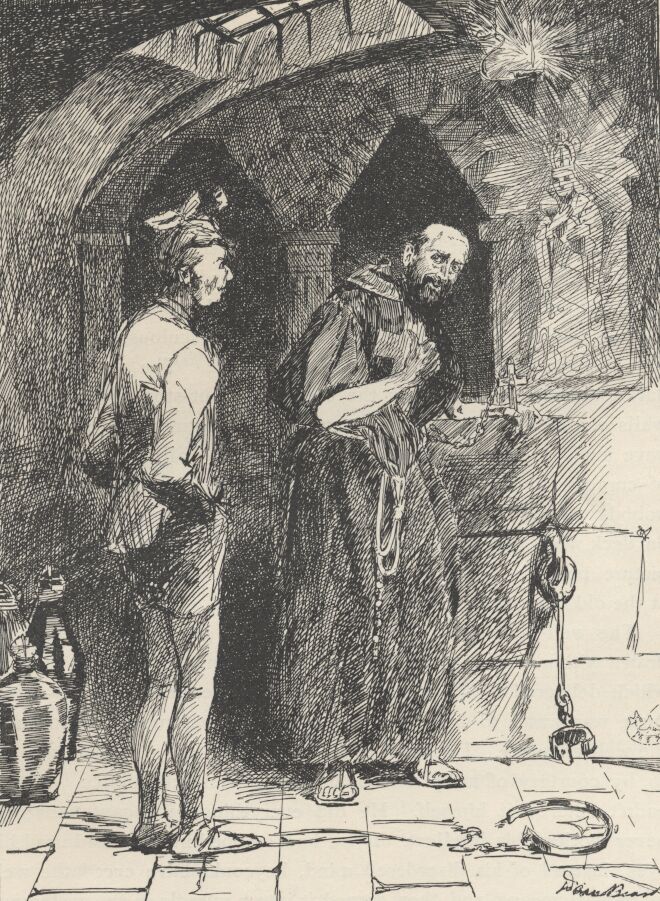
“No-no, Father, it skills not, as these people say. If he were persuaded against his will, he would load that well with a malicious enchantment which would balk me until I found out its secret. It might take a month. I could set up a little enchantment of mine which I call the telephone, and he could not find out its secret in a hundred years. Yes, you perceive, he might block me for a month. Would you like to risk a month in a dry time like this?”
“No, no, Father, it won’t work, as these people say. If he were persuaded against his will, he would put a malicious enchantment on that well. It would stop me until I discovered its secret. That might take a month. I could set up a little enchantment of my own called the telephone. He couldn’t discover its secret in a hundred years. Yes, you see, he could stop me for a month. Would you like to risk a month without water in a dry spell like this?”
“A month! The mere thought of it maketh me to shudder. Have it thy way, my son. But my heart is heavy with this disappointment. Leave me, and let me wear my spirit with weariness and waiting, even as I have done these ten long days, counterfeiting thus the thing that is called rest, the prone body making outward sign of repose where inwardly is none.”
“A month! The mere thought of it makes me shudder. Have it your way, my son. But my heart is heavy with disappointment. Leave me to exhaust my spirit with weariness and waiting, as I have done for these ten long days. I have been pretending to rest. My body lies still, appearing at rest, though I have no rest within.”
Of course, it would have been best, all round, for Merlin to waive etiquette and quit and call it half a day, since he would never be able to start that water, for he was a true magician of the time; which is to say, the big miracles, the ones that gave him his reputation, always had the luck to be performed when nobody but Merlin was present; he couldn’t start this well with all this crowd around to see; a crowd was as bad for a magician’s miracle in that day as it was for a spiritualist’s miracle in mine; there was sure to be some skeptic on hand to turn up the gas at the crucial moment and spoil everything. But I did not want Merlin to retire from the job until I was ready to take hold of it effectively myself; and I could not do that until I got my things from Camelot, and that would take two or three days.
Of course, it would have been best for everyone if Merlin had ignored etiquette, quit, and called it half a day. He would never be able to get the water flowing, because he was a true magician of his time. That is, the big miracles that made his reputation always had the good luck to happen when Merlin was alone. He couldn’t get this well flowing with a crowd watching. A crowd was as bad for a magician’s miracle in his day as it was for a spiritualist’s miracle in mine. There was sure to be some skeptic who would turn up the gas at the crucial moment and spoil everything. But I didn’t want Merlin to quit the job until I was ready to take it over effectively myself. And I couldn’t do that until I got my things from Camelot, which would take two or three days.
My presence gave the monks hope, and cheered them up a good deal; insomuch that they ate a square meal that night for the first time in ten days. As soon as their stomachs had been properly reinforced with food, their spirits began to rise fast; when the mead began to go round they rose faster. By the time everybody was half-seas over, the holy community was in good shape to make a night of it; so we stayed by the board and put it through on that line. Matters got to be very jolly. Good old questionable stories were told that made the tears run down and cavernous mouths stand wide and the round bellies shake with laughter; and questionable songs were bellowed out in a mighty chorus that drowned the boom of the tolling bells.
My presence gave the monks hope and cheered them up considerably. That night, they ate a full meal for the first time in ten days. As soon as they had filled their stomachs, their spirits began to rise quickly. When the mead started going around, their spirits rose even faster. By the time everyone was half drunk, the holy community was ready to make a night of it. So we stayed at the table and kept it up. Things got very jolly. We told good old risqué stories that brought tears to our eyes and made our huge mouths gape and our round bellies shake with laughter. We also bellowed risqué songs in a mighty chorus that drowned out the booming bells.
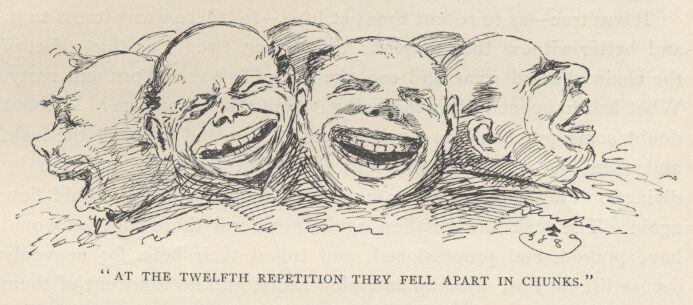
At last I ventured a story myself; and vast was the success of it. Not right off, of course, for the native of those islands does not, as a rule, dissolve upon the early applications of a humorous thing; but the fifth time I told it, they began to crack in places; the eight time I told it, they began to crumble; at the twelfth repetition they fell apart in chunks; and at the fifteenth they disintegrated, and I got a broom and swept them up. This language is figurative. Those islanders—well, they are slow pay at first, in the matter of return for your investment of effort, but in the end they make the pay of all other nations poor and small by contrast.
At last I ventured to tell a story myself, and it was a huge success. Not right away, of course. The natives of those islands do not usually dissolve the first time they hear a joke. But the fifth time I told it, they began to crack in places. The eighth time, they began to crumble. At the twelfth telling, they fell apart in chunks. At the fifteenth, they disintegrated, and I got a broom and swept them up. That is figurative language. Those islanders, well, they are slow to pay you back for your efforts at first. But in the end, they make the returns from all other nations look poor and small by comparison.
I was at the well next day betimes. Merlin was there, enchanting away like a beaver, but not raising the moisture. He was not in a pleasant humor; and every time I hinted that perhaps this contract was a shade too hefty for a novice he unlimbered his tongue and cursed like a bishop—French bishop of the Regency days, I mean.
I was at the well early the next day. Merlin was there, working like a beaver at his spells, but not bringing up any water. He was in a bad mood. Whenever I hinted that perhaps this job was a bit too big for a beginner, he let loose and cursed like a bishop. I mean a French bishop from the Regency days.
Matters were about as I expected to find them. The “fountain” was an ordinary well, it had been dug in the ordinary way, and stoned up in the ordinary way. There was no miracle about it. Even the lie that had created its reputation was not miraculous; I could have told it myself, with one hand tied behind me. The well was in a dark chamber which stood in the center of a cut-stone chapel, whose walls were hung with pious pictures of a workmanship that would have made a chromo feel good; pictures historically commemorative of curative miracles which had been achieved by the waters when nobody was looking. That is, nobody but angels; they are always on deck when there is a miracle to the fore—so as to get put in the picture, perhaps. Angels are as fond of that as a fire company; look at the old masters.
Things were about as I expected. The “fountain” was an ordinary well. It had been dug and lined with stone in the usual way. There was nothing miraculous about it. Even the lie that had made the well famous was nothing special. I could have told it myself with one hand tied behind my back. The well was in a dark room at the center of a stone chapel. The chapel walls were hung with religious pictures so poorly made they would have made a cheap color print look good. The pictures commemorated the healing miracles the water had performed when nobody was looking. That is, nobody but angels. Angels are always on hand when there’s a miracle, perhaps so they can get into the picture. Angels love doing that as much as a fire company does. Just look at the old masters.
The well-chamber was dimly lighted by lamps; the water was drawn with a windlass and chain by monks, and poured into troughs which delivered it into stone reservoirs outside in the chapel—when there was water to draw, I mean—and none but monks could enter the well-chamber. I entered it, for I had temporary authority to do so, by courtesy of my professional brother and subordinate. But he hadn’t entered it himself. He did everything by incantations; he never worked his intellect. If he had stepped in there and used his eyes, instead of his disordered mind, he could have cured the well by natural means, and then turned it into a miracle in the customary way; but no, he was an old numskull, a magician who believed in his own magic; and no magician can thrive who is handicapped with a superstition like that.
Lamps dimly lit the well chamber. Monks drew water with a windlass and chain, then poured it into troughs. The troughs carried it to stone reservoirs outside the chamber, in the chapel. That was when there was water to draw, I mean. Only monks could enter the well chamber. I went in because my fellow professional and subordinate had given me temporary permission. But he hadn’t gone in himself. He did everything with incantations. He never used his brain. If he had gone in and used his eyes instead of his muddled mind, he could have fixed the well by natural means. Then he could have turned it into a miracle in the usual way. But no, he was an old fool, a magician who believed in his own magic. And no magician can thrive with a superstition like that holding him back.
I had an idea that the well had sprung a leak; that some of the wall stones near the bottom had fallen and exposed fissures that allowed the water to escape. I measured the chain—98 feet. Then I called in a couple of monks, locked the door, took a candle, and made them lower me in the bucket. When the chain was all paid out, the candle confirmed my suspicion; a considerable section of the wall was gone, exposing a good big fissure.
I thought the well had sprung a leak. Some stones near the bottom might have fallen out, exposing cracks that let the water escape. I measured the chain. It was 98 feet long. Then I called in a couple of monks, locked the door, and took a candle. I had the monks lower me into the well in the bucket. When they had let out the whole chain, the candlelight confirmed my suspicion. A large section of the wall was gone, exposing a big crack.
I almost regretted that my theory about the well’s trouble was correct, because I had another one that had a showy point or two about it for a miracle. I remembered that in America, many centuries later, when an oil well ceased to flow, they used to blast it out with a dynamite torpedo. If I should find this well dry and no explanation of it, I could astonish these people most nobly by having a person of no especial value drop a dynamite bomb into it. It was my idea to appoint Merlin. However, it was plain that there was no occasion for the bomb. One cannot have everything the way he would like it. A man has no business to be depressed by a disappointment, anyway; he ought to make up his mind to get even. That is what I did. I said to myself, I am in no hurry, I can wait; that bomb will come good yet. And it did, too.
I almost regretted that my theory about what was wrong with the well was correct. I had another theory that offered a few impressive possibilities for a miracle. I remembered that, many centuries later in America, people used dynamite torpedoes to blast oil wells back into flow. If I found the well dry and couldn't explain why, I could really astonish these people. I could have someone of no particular value drop a dynamite bomb into it. I planned to choose Merlin. But clearly there was no need for the bomb. You can't have everything the way you want it. Anyway, a man has no business being depressed by a disappointment. He should make up his mind to get even. That's what I did. I said to myself, I'm in no hurry. I can wait. That bomb will come in handy yet. And it did, too.
When I was above ground again, I turned out the monks, and let down a fish-line; the well was a hundred and fifty feet deep, and there was forty-one feet of water in it. I called in a monk and asked:
When I was above ground again, I sent the monks out and lowered a fishing line into the well. The well was 150 feet deep, with 41 feet of water in it. I called a monk in and asked:
“How deep is the well?”
“How deep is the well?”
“That, sir, I wit not, having never been told.”
“I don’t know, sir. I’ve never been told.”
“How does the water usually stand in it?”
“How high is the water in it usually?”
“Near to the top, these two centuries, as the testimony goeth, brought down to us through our predecessors.”
“Near the top for these past two centuries, according to testimony passed down by our predecessors.”
It was true—as to recent times at least—for there was witness to it, and better witness than a monk; only about twenty or thirty feet of the chain showed wear and use, the rest of it was unworn and rusty. What had happened when the well gave out that other time? Without doubt some practical person had come along and mended the leak, and then had come up and told the abbot he had discovered by divination that if the sinful bath were destroyed the well would flow again. The leak had befallen again now, and these children would have prayed, and processioned, and tolled their bells for heavenly succor till they all dried up and blew away, and no innocent of them all would ever have thought to drop a fish-line into the well or go down in it and find out what was really the matter. Old habit of mind is one of the toughest things to get away from in the world. It transmits itself like physical form and feature; and for a man, in those days, to have had an idea that his ancestors hadn’t had, would have brought him under suspicion of being illegitimate. I said to the monk:
It was true, at least in recent times. There was evidence of it, and better evidence than a monk. Only about twenty or thirty feet of the chain showed wear from use. The rest was unworn and rusty. What had happened the other time the well ran dry? No doubt some practical person had come along and fixed the leak. Then he had come up and told the abbot he had discovered something through divination. If the sinful bath were destroyed, the well would flow again. Now the leak had returned. These children would have prayed, marched in processions, and rung their bells for help from heaven until they all dried up and blew away. Not one of those innocents would ever have thought to lower a fishing line into the well. Nor would any of them have gone down into it to find out what was really wrong. Old habits of thought are among the hardest things in the world to shake. They are passed down like a person's physical form and features. In those days, if a man had an idea his ancestors had not had, people would have suspected him of being illegitimate. I said to the monk:
“It is a difficult miracle to restore water in a dry well, but we will try, if my brother Merlin fails. Brother Merlin is a very passable artist, but only in the parlor-magic line, and he may not succeed; in fact, is not likely to succeed. But that should be nothing to his discredit; the man that can do this kind of miracle knows enough to keep hotel.”
“It's a difficult miracle to put water back in a dry well, but we'll try if my brother Merlin fails. Brother Merlin is a decent enough magician, but he only does parlor tricks. He may not succeed. In fact, he probably won't. But that shouldn't count against him. A man who can perform this kind of miracle knows enough to run a hotel.”
“Hotel? I mind not to have heard—”
“Hotel? I don't remember hearing of one...”
“Of hotel? It’s what you call hostel. The man that can do this miracle can keep hostel. I can do this miracle; I shall do this miracle; yet I do not try to conceal from you that it is a miracle to tax the occult powers to the last strain.”
“Hotel? It’s what you call a hostel. The man who can perform this miracle can run a hostel. I can perform this miracle, and I will. But I won’t hide from you that it will strain the occult powers to their limit.”
“None knoweth that truth better than the brotherhood, indeed; for it is of record that aforetime it was parlous difficult and took a year. Natheless, God send you good success, and to that end will we pray.”
“No one knows that truth better than the brotherhood. The records show that it was once terribly difficult and took a year. Nevertheless, may God grant you success. We will pray for that.”
As a matter of business it was a good idea to get the notion around that the thing was difficult. Many a small thing has been made large by the right kind of advertising. That monk was filled up with the difficulty of this enterprise; he would fill up the others. In two days the solicitude would be booming.
From a business standpoint, it was smart to spread the idea that the job was difficult. The right kind of advertising has made many a small thing seem big. The monk was convinced this task was difficult, and he would convince the others. In two days, concern would be booming.
On my way home at noon, I met Sandy. She had been sampling the hermits. I said:
On my way home at noon, I met Sandy. She had been sampling the hermits. I said:
“I would like to do that myself. This is Wednesday. Is there a matinee?”
“I’d like to do that myself. It’s Wednesday. Is there a matinee?”
“A which, please you, sir?”
“A what, sir?”
“Matinee. Do they keep open afternoons?”
“Matinee. Are they open in the afternoons?”
“Who?”
“Who?”
“The hermits, of course.”
“The hermits, of course.”
“Keep open?”
“Keep open?”
“Yes, keep open. Isn’t that plain enough? Do they knock off at noon?”
“Yes, stay open. Isn’t that clear enough? Do they stop working at noon?”
“Knock off?”
“Knock off?”
“Knock off?—yes, knock off. What is the matter with knock off? I never saw such a dunderhead; can’t you understand anything at all? In plain terms, do they shut up shop, draw the game, bank the fires—”
“Knock off? Yes, knock off. What’s wrong with ‘knock off’? I’ve never seen such an idiot. Can’t you understand anything at all? In plain English, do they close up shop, stop the game, bank the fires...”
“Shut up shop, draw—”
“Close up shop, draw...”
“There, never mind, let it go; you make me tired. You can’t seem to understand the simplest thing.”
“Never mind, let it go. You’re exhausting me. You can’t seem to understand the simplest thing.”
“I would I might please thee, sir, and it is to me dole and sorrow that I fail, albeit sith I am but a simple damsel and taught of none, being from the cradle unbaptized in those deep waters of learning that do anoint with a sovereignty him that partaketh of that most noble sacrament, investing him with reverend state to the mental eye of the humble mortal who, by bar and lack of that great consecration seeth in his own unlearned estate but a symbol of that other sort of lack and loss which men do publish to the pitying eye with sackcloth trappings whereon the ashes of grief do lie bepowdered and bestrewn, and so, when such shall in the darkness of his mind encounter these golden phrases of high mystery, these shut-up-shops, and draw-the-game, and bank-the-fires, it is but by the grace of God that he burst not for envy of the mind that can beget, and tongue that can deliver so great and mellow-sounding miracles of speech, and if there do ensue confusion in that humbler mind, and failure to divine the meanings of these wonders, then if so be this miscomprehension is not vain but sooth and true, wit ye well it is the very substance of worshipful dear homage and may not lightly be misprized, nor had been, an ye had noted this complexion of mood and mind and understood that that I would I could not, and that I could not I might not, nor yet nor might nor could, nor might-not nor could-not, might be by advantage turned to the desired would, and so I pray you mercy of my fault, and that ye will of your kindness and your charity forgive it, good my master and most dear lord.”
“I wish I could please you, sir, and it pains and saddens me to fail. But I am only a simple young woman, taught by no one. Since birth, I have never been baptized in those deep waters of learning. That most noble sacrament crowns those who receive it with authority. In the mind’s eye of a humble mortal, it gives them a revered status. A person denied that great consecration sees their own lack of learning as a sign of another kind of loss. People display that loss to pitying eyes by wearing sackcloth, sprinkled and covered with the ashes of grief. So, when such a person encounters these golden phrases of deep mystery, these shut-up-shops, and draw-the-game, and bank-the-fires, their mind is in darkness. Only by the grace of God do they not burst with envy. They envy the mind that can conceive and the tongue that can deliver such great, rich-sounding miracles of speech. And if that humbler mind becomes confused and cannot guess the meaning of these wonders, then, if the misunderstanding is real and not just imagined, know that it is truly a form of reverent, heartfelt homage. It should not be lightly dismissed. Nor would you have dismissed it if you had noticed this state of mind and understood me. What I wished to do, I could not. And what I could not do, I was not able to do. Neither my inability nor my lack of power, nor either of them, could be turned to my advantage to produce the desired wish. So I beg your mercy for my fault. In your kindness and charity, please forgive me, my good master and most dear lord.”
I couldn’t make it all out—that is, the details—but I got the general idea; and enough of it, too, to be ashamed. It was not fair to spring those nineteenth century technicalities upon the untutored infant of the sixth and then rail at her because she couldn’t get their drift; and when she was making the honest best drive at it she could, too, and no fault of hers that she couldn’t fetch the home plate; and so I apologized. Then we meandered pleasantly away toward the hermit holes in sociable converse together, and better friends than ever.
I couldn’t make out all the details, but I got the general idea. I understood enough to be ashamed, too. It wasn’t fair to spring those nineteenth-century technicalities on an untaught child of the sixth century. And it wasn’t fair to scold her because she couldn’t understand them. She was honestly doing her best, and it wasn’t her fault she couldn’t make it to home plate. So I apologized. Then we wandered pleasantly toward the hermit holes, chatting together and better friends than ever.
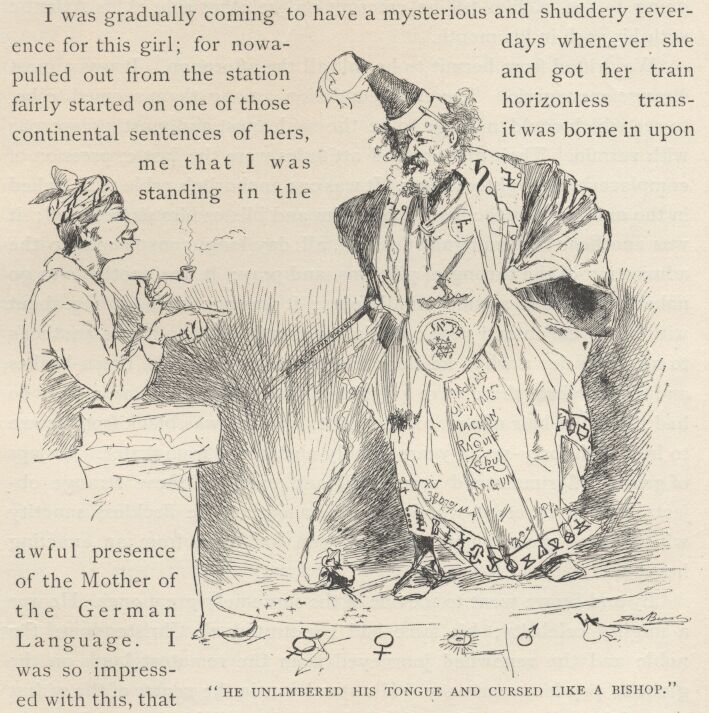
I was gradually coming to have a mysterious and shuddery reverence for this girl; nowadays whenever she pulled out from the station and got her train fairly started on one of those horizonless transcontinental sentences of hers, it was borne in upon me that I was standing in the awful presence of the Mother of the German Language. I was so impressed with this, that sometimes when she began to empty one of these sentences on me I unconsciously took the very attitude of reverence, and stood uncovered; and if words had been water, I had been drowned, sure. She had exactly the German way; whatever was in her mind to be delivered, whether a mere remark, or a sermon, or a cyclopedia, or the history of a war, she would get it into a single sentence or die. Whenever the literary German dives into a sentence, that is the last you are going to see of him till he emerges on the other side of his Atlantic with his verb in his mouth.
I was gradually coming to feel a mysterious, shivery reverence for this girl. Whenever she pulled out of the station and got her train started on one of her endless transcontinental sentences, it struck me. I was standing in the terrifying presence of the Mother of the German Language. The thought impressed me so much that sometimes, when she began pouring out a sentence, I unconsciously assumed a reverent pose. I stood there with my hat off. If words had been water, I would surely have drowned. She had exactly the German way. Whatever she wanted to say, she would fit it into a single sentence or die trying. It could be a simple remark, a sermon, an encyclopedia, or the history of a war. Whenever a literary German dives into a sentence, you won't see him again until he emerges across his Atlantic, with his verb in his mouth.
We drifted from hermit to hermit all the afternoon. It was a most strange menagerie. The chief emulation among them seemed to be, to see which could manage to be the uncleanest and most prosperous with vermin. Their manner and attitudes were the last expression of complacent self-righteousness. It was one anchorite’s pride to lie naked in the mud and let the insects bite him and blister him unmolested; it was another’s to lean against a rock, all day long, conspicuous to the admiration of the throng of pilgrims and pray; it was another’s to go naked and crawl around on all fours; it was another’s to drag about with him, year in and year out, eighty pounds of iron; it was another’s to never lie down when he slept, but to stand among the thorn-bushes and snore when there were pilgrims around to look; a woman, who had the white hair of age, and no other apparel, was black from crown to heel with forty-seven years of holy abstinence from water. Groups of gazing pilgrims stood around all and every of these strange objects, lost in reverent wonder, and envious of the fleckless sanctity which these pious austerities had won for them from an exacting heaven.
We wandered from hermit to hermit all afternoon. It was a most peculiar collection. They seemed to compete to see who could be the dirtiest and have the most vermin. Their manner and postures showed the utmost smug self-righteousness. One hermit took pride in lying naked in the mud, letting insects bite and blister him without bothering them. Another leaned against a rock and prayed all day, plainly visible to the admiring crowds of pilgrims. Another went naked and crawled around on all fours. Another dragged eighty pounds of iron around with him, year after year. Another never lay down to sleep. Instead, he stood among the thorn bushes and snored when pilgrims were around to watch. One woman had the white hair of old age and wore nothing else. She was black from head to toe after forty-seven years of holy abstinence from water. Groups of pilgrims stood gazing at every one of these strange figures. They were lost in reverent wonder and envied the spotless holiness these devout hardships had won them from a demanding heaven.
By and by we went to see one of the supremely great ones. He was a mighty celebrity; his fame had penetrated all Christendom; the noble and the renowned journeyed from the remotest lands on the globe to pay him reverence. His stand was in the center of the widest part of the valley; and it took all that space to hold his crowds.
After a while, we went to see one of the greatest of them all. He was a huge celebrity, famous throughout all Christendom. Noble and famous people traveled from the most distant lands on earth to pay him respect. His stand was in the center of the widest part of the valley. It took all that space to hold the crowds he drew.
His stand was a pillar sixty feet high, with a broad platform on the top of it. He was now doing what he had been doing every day for twenty years up there—bowing his body ceaselessly and rapidly almost to his feet. It was his way of praying. I timed him with a stop watch, and he made 1,244 revolutions in 24 minutes and 46 seconds. It seemed a pity to have all this power going to waste. It was one of the most useful motions in mechanics, the pedal movement; so I made a note in my memorandum book, purposing some day to apply a system of elastic cords to him and run a sewing machine with it. I afterward carried out that scheme, and got five years’ good service out of him; in which time he turned out upward of eighteen thousand first-rate tow-linen shirts, which was ten a day. I worked him Sundays and all; he was going, Sundays, the same as week days, and it was no use to waste the power. These shirts cost me nothing but just the mere trifle for the materials—I furnished those myself, it would not have been right to make him do that—and they sold like smoke to pilgrims at a dollar and a half apiece, which was the price of fifty cows or a blooded race horse in Arthurdom. They were regarded as a perfect protection against sin, and advertised as such by my knights everywhere, with the paint-pot and stencil-plate; insomuch that there was not a cliff or a boulder or a dead wall in England but you could read on it at a mile distance:
His place was a pillar sixty feet high, with a broad platform on top. Up there, he was doing what he had done every day for twenty years. He bowed rapidly and continuously, bending almost to his feet. That was how he prayed. I timed him with a stopwatch. He made 1,244 revolutions in 24 minutes and 46 seconds. It seemed a shame to waste all that power. The pedal movement was one of the most useful motions in mechanics. So I made a note in my notebook. I planned to attach a system of elastic cords to him someday and use it to run a sewing machine. I later carried out the plan and got five years of good service from him. In that time, he produced more than eighteen thousand first-rate tow-linen shirts, ten a day. I put him to work on Sundays too. He was moving on Sundays just as he did on weekdays, and there was no point wasting the power. The shirts cost me nothing except a tiny amount for materials. I supplied those myself. It would not have been right to make him do that. They sold like hotcakes to pilgrims for a dollar and a half each. In Arthurdom, that was the price of fifty cows or a purebred racehorse. The shirts were regarded as perfect protection against sin. My knights advertised them that way everywhere, using paint pots and stencils. As a result, there was not a cliff, a boulder, or a blank wall in England without an advertisement you could read from a mile away:
“Buy the only genuine St. Stylite; patronized by the Nobility. Patent applied for.”
“Buy the only genuine St. Stylite, used by the nobility. Patent pending.”
There was more money in the business than one knew what to do with. As it extended, I brought out a line of goods suitable for kings, and a nobby thing for duchesses and that sort, with ruffles down the forehatch and the running-gear clewed up with a featherstitch to leeward and then hauled aft with a back-stay and triced up with a half-turn in the standing rigging forward of the weather-gaskets. Yes, it was a daisy.
The business brought in more money than I knew what to do with. As it grew, I introduced a line of goods fit for kings. I also brought out a stylish item for duchesses and that sort. It had ruffles down the forehatch, with the running gear clewed up with a featherstitch to leeward. Then it was hauled aft with a backstay and triced up with a half turn in the standing rigging forward of the weather gaskets. Yes, it was a beauty.
But about that time I noticed that the motive power had taken to standing on one leg, and I found that there was something the matter with the other one; so I stocked the business and unloaded, taking Sir Bors de Ganis into camp financially along with certain of his friends; for the works stopped within a year, and the good saint got him to his rest. But he had earned it. I can say that for him.
But around that time, I noticed that the power source had started standing on one leg. I found that something was wrong with the other leg. So I issued stock in the business and sold out, financially swindling Sir Bors de Ganis and some of his friends. The works shut down within a year, and the good saint went to his rest. But he had earned it. I can say that for him.
When I saw him that first time—however, his personal condition will not quite bear description here. You can read it in the Lives of the Saints.*
When I first saw him, well, I can't quite describe his condition here. You can read about it in Lives of the Saints.*
[*All the details concerning the hermits, in this chapter, are from Lecky—but greatly modified. This book not being a history but only a tale, the majority of the historian’s frank details were too strong for reproduction in it.—Editor ]
[*All the details about the hermits in this chapter come from Lecky, but they have been greatly changed. This book is a tale, not a history. So most of the historian’s frank details were too strong to include here. Editor ]