Chapter 21
The Pilgrims
When I did get to bed at last I was unspeakably tired; the stretching out, and the relaxing of the long-tense muscles, how luxurious, how delicious! but that was as far as I could get—sleep was out of the question for the present. The ripping and tearing and squealing of the nobility up and down the halls and corridors was pandemonium come again, and kept me broad awake. Being awake, my thoughts were busy, of course; and mainly they busied themselves with Sandy’s curious delusion. Here she was, as sane a person as the kingdom could produce; and yet, from my point of view she was acting like a crazy woman. My land, the power of training! of influence! of education! It can bring a body up to believe anything. I had to put myself in Sandy’s place to realize that she was not a lunatic. Yes, and put her in mine, to demonstrate how easy it is to seem a lunatic to a person who has not been taught as you have been taught. If I had told Sandy I had seen a wagon, uninfluenced by enchantment, spin along fifty miles an hour; had seen a man, unequipped with magic powers, get into a basket and soar out of sight among the clouds; and had listened, without any necromancer’s help, to the conversation of a person who was several hundred miles away, Sandy would not merely have supposed me to be crazy, she would have thought she knew it. Everybody around her believed in enchantments; nobody had any doubts; to doubt that a castle could be turned into a sty, and its occupants into hogs, would have been the same as my doubting among Connecticut people the actuality of the telephone and its wonders,—and in both cases would be absolute proof of a diseased mind, an unsettled reason. Yes, Sandy was sane; that must be admitted. If I also would be sane—to Sandy—I must keep my superstitions about unenchanted and unmiraculous locomotives, balloons, and telephones, to myself. Also, I believed that the world was not flat, and hadn’t pillars under it to support it, nor a canopy over it to turn off a universe of water that occupied all space above; but as I was the only person in the kingdom afflicted with such impious and criminal opinions, I recognized that it would be good wisdom to keep quiet about this matter, too, if I did not wish to be suddenly shunned and forsaken by everybody as a madman.
When I finally got to bed, I was unbelievably tired. Stretching out and relaxing my long-tense muscles felt wonderfully luxurious! But that was as far as I could get. Sleep was out of the question for the moment. The nobles were ripping, tearing, and squealing up and down the halls and corridors. It was pandemonium all over again, and it kept me wide awake. Since I was awake, my thoughts were busy, of course. Mostly, I thought about Sandy’s strange delusion. She was as sane as anyone in the kingdom. Yet, from my point of view, she was acting like a crazy woman. My goodness, the power of training! Of influence! Of education! They can make a person believe anything. I had to put myself in Sandy’s place to realize she wasn’t a lunatic. And I had to put her in mine to see how easily you can seem crazy to someone taught differently. Suppose I had told Sandy that I had seen a wagon travel fifty miles an hour without any enchantment. Or that I had seen a man with no magic powers climb into a basket and rise out of sight among the clouds. Or that I had listened, without a sorcerer’s help, to someone speaking hundreds of miles away. Sandy would not merely have thought I was crazy. She would have thought she knew it. Everyone around her believed in enchantments. Nobody had any doubts. Suppose someone doubted that a castle could be turned into a pigsty and its occupants into pigs. That would have been like my doubting the reality of the telephone and its wonders among Connecticut people. In both cases, such doubt would be absolute proof of a diseased mind and an unsteady reason. Yes, Sandy was sane. I had to admit that. If I wanted Sandy to think I was sane, too, I had to keep my superstitions to myself. These were my beliefs about locomotives, balloons, and telephones that involved no enchantments or miracles. I also believed the world was not flat. I didn’t believe it had pillars underneath to support it, either. Nor did I believe it had a canopy overhead to keep out a universe of water filling all the space above. But I was the only person in the kingdom burdened with such sinful and criminal opinions. So I realized I’d be wise to keep quiet about those beliefs, too. Otherwise, everyone might suddenly shun and abandon me as a madman.
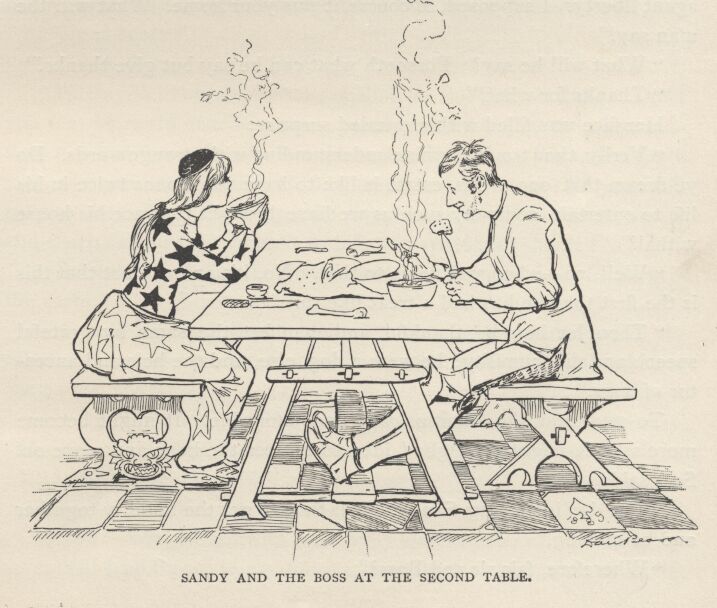
The next morning Sandy assembled the swine in the dining-room and gave them their breakfast, waiting upon them personally and manifesting in every way the deep reverence which the natives of her island, ancient and modern, have always felt for rank, let its outward casket and the mental and moral contents be what they may. I could have eaten with the hogs if I had had birth approaching my lofty official rank; but I hadn’t, and so accepted the unavoidable slight and made no complaint. Sandy and I had our breakfast at the second table. The family were not at home. I said:
The next morning Sandy gathered the pigs in the dining room and served them breakfast herself. In every way, she showed the deep respect her island’s people have always had for rank, both in ancient times and today. They have always felt this respect no matter what the outward appearance or the mental and moral qualities of the person of rank. I could have eaten with the pigs if my birth had been nearly as noble as my high official rank. But it wasn’t, so I accepted the unavoidable slight without complaint. Sandy and I had breakfast at the second table. The family was not at home. I said:
“How many are in the family, Sandy, and where do they keep themselves?”
“How many people are in the family, Sandy, and where do they live?”
“Family?”
“Family?”
“Yes.”
“Yes.”
“Which family, good my lord?”
“Which family, my lord?”
“Why, this family; your own family.”
“Why, this family, your own family.”
“Sooth to say, I understand you not. I have no family.”
“To tell the truth, I don't understand you. I have no family.”
“No family? Why, Sandy, isn’t this your home?”
“No family? Sandy, isn’t this your home?”
“Now how indeed might that be? I have no home.”
“How could that be? I have no home.”
“Well, then, whose house is this?”
“Well, then, whose house is this?”
“Ah, wit you well I would tell you an I knew myself.”
“Ah, you can be sure I would tell you if I knew myself.”
“Come—you don’t even know these people? Then who invited us here?”
“Come on, you don’t even know these people? Then who invited us here?”
“None invited us. We but came; that is all.”
“No one invited us. We just came, that’s all.”
“Why, woman, this is a most extraordinary performance. The effrontery of it is beyond admiration. We blandly march into a man’s house, and cram it full of the only really valuable nobility the sun has yet discovered in the earth, and then it turns out that we don’t even know the man’s name. How did you ever venture to take this extravagant liberty? I supposed, of course, it was your home. What will the man say?”
“Why, woman, this is extraordinary. The nerve of it is beyond belief. We calmly walk into a man’s house and fill it with the only truly valuable nobility the world has discovered. Then it turns out we don’t even know the man’s name. How could you dare to take such an outrageous liberty? I assumed, of course, that this was your home. What will the man say?”
“What will he say? Forsooth what can he say but give thanks?”
“What will he say? Surely, what can he say but thank you?”
“Thanks for what?”
“Thanks for what?”
Her face was filled with a puzzled surprise:
Her face showed puzzled surprise:
“Verily, thou troublest mine understanding with strange words. Do ye dream that one of his estate is like to have the honor twice in his life to entertain company such as we have brought to grace his house withal?”
“You’re confusing me with strange words. Do you really think a man of his standing could have such an honor twice? We have brought company to grace his house.”
“Well, no—when you come to that. No, it’s an even bet that this is the first time he has had a treat like this.”
“Well, no, now that you mention it. No, there’s a fifty-fifty chance this is the first time he’s had a treat like this.”
“Then let him be thankful, and manifest the same by grateful speech and due humility; he were a dog, else, and the heir and ancestor of dogs.”
“Then let him be thankful and show it with grateful words and proper humility. Otherwise, he is a dog, descended from dogs and destined to have dogs as descendants.”
To my mind, the situation was uncomfortable. It might become more so. It might be a good idea to muster the hogs and move on. So I said:
I thought the situation was uncomfortable. It could get worse. Maybe it was a good idea to gather the hogs and move on. So I said:
“The day is wasting, Sandy. It is time to get the nobility together and be moving.”
“Time is passing, Sandy. We need to gather the nobles and get moving.”
“Wherefore, fair sir and Boss?”
“Why, sir and Boss?”
“We want to take them to their home, don’t we?”
“We want to take them home, don’t we?”
“La, but list to him! They be of all the regions of the earth! Each must hie to her own home; wend you we might do all these journeys in one so brief life as He hath appointed that created life, and thereto death likewise with help of Adam, who by sin done through persuasion of his helpmeet, she being wrought upon and bewrayed by the beguilements of the great enemy of man, that serpent hight Satan, aforetime consecrated and set apart unto that evil work by overmastering spite and envy begotten in his heart through fell ambitions that did blight and mildew a nature erst so white and pure whenso it hove with the shining multitudes its brethren-born in glade and shade of that fair heaven wherein all such as native be to that rich estate and—”
“Oh, listen to him! They come from every region of the earth! Each must go to her own home. Do you think we could make all those journeys in one life? It is such a short life, as he who created life has appointed it. He also appointed death, with Adam’s help. Adam sinned because his wife persuaded him to. She was influenced and betrayed by the tricks of the great enemy of man, that serpent called Satan. He had long ago been set apart for that evil work by overwhelming spite and envy. These grew in his heart from fierce ambitions that blighted and spoiled his once pure and innocent nature. He had once moved with his fellow angels among the glades and shade of that fair heaven. And there, all who are native to that splendid place and…”
“Great Scott!”
“Wow!”
“My lord?”
“My lord?”
“Well, you know we haven’t got time for this sort of thing. Don’t you see, we could distribute these people around the earth in less time than it is going to take you to explain that we can’t. We mustn’t talk now, we must act. You want to be careful; you mustn’t let your mill get the start of you that way, at a time like this. To business now—and sharp’s the word. Who is to take the aristocracy home?”
“Well, you know we don’t have time for this. Don’t you see? We could send these people around the world faster than you can explain why we can’t. We mustn’t talk now. We must act. Be careful. You mustn’t let your mouth run away with you at a time like this. Now, let’s get to business, and be quick. Who will take the aristocracy home?”
“Even their friends. These will come for them from the far parts of the earth.”
“Even their friends. They will come for them from faraway places.”
This was lightning from a clear sky, for unexpectedness; and the relief of it was like pardon to a prisoner. She would remain to deliver the goods, of course.
This was as unexpected as lightning from a clear sky. The relief was like a pardon to a prisoner. She would stay to deliver the goods, of course.
“Well, then, Sandy, as our enterprise is handsomely and successfully ended, I will go home and report; and if ever another one—”
“Well, Sandy, since our mission has ended so well, I’ll go home and report. And if ever another one...”
“I also am ready; I will go with thee.”
“I’m ready too. I’ll go with you.”
This was recalling the pardon.
This meant the pardon was being taken back.
“How? You will go with me? Why should you?”
“What? You’ll come with me? Why would you?”
“Will I be traitor to my knight, dost think? That were dishonor. I may not part from thee until in knightly encounter in the field some overmatching champion shall fairly win and fairly wear me. I were to blame an I thought that that might ever hap.”
“Do you think I would betray my knight? That would be dishonorable. I cannot leave you until a stronger champion fairly wins me in a knightly contest and fairly wears me. I would be wrong to think that could ever happen.”
“Elected for the long term,” I sighed to myself. “I may as well make the best of it.” So then I spoke up and said:
“Elected for the long term,” I sighed to myself. “I may as well make the best of it.” So I spoke up and said:
“All right; let us make a start.”
“All right, let's get started.”
While she was gone to cry her farewells over the pork, I gave that whole peerage away to the servants. And I asked them to take a duster and dust around a little where the nobilities had mainly lodged and promenaded; but they considered that that would be hardly worth while, and would moreover be a rather grave departure from custom, and therefore likely to make talk. A departure from custom—that settled it; it was a nation capable of committing any crime but that. The servants said they would follow the fashion, a fashion grown sacred through immemorial observance; they would scatter fresh rushes in all the rooms and halls, and then the evidence of the aristocratic visitation would be no longer visible. It was a kind of satire on Nature: it was the scientific method, the geologic method; it deposited the history of the family in a stratified record; and the antiquary could dig through it and tell by the remains of each period what changes of diet the family had introduced successively for a hundred years.
While she was away crying her farewells over the pork, I gave the whole peerage to the servants. I asked them to dust a little where the nobles had mostly lodged and walked. But they thought that would hardly be worth the trouble. It would also be a serious break with custom, and people would probably talk. A break with custom settled the matter. This was a nation capable of committing any crime but that. The servants said they would follow the usual practice, made sacred by countless years of use. They would scatter fresh rushes in all the rooms and halls. Then the evidence of the aristocratic visit would no longer be visible. It was a kind of satire on Nature. It was the scientific method, the geological method. It recorded the family’s history in layers. An antiquarian could dig through them and see what changes the family had made to its diet over a hundred years. The remains from each period would tell the story.
The first thing we struck that day was a procession of pilgrims. It was not going our way, but we joined it, nevertheless; for it was hourly being borne in upon me now, that if I would govern this country wisely, I must be posted in the details of its life, and not at second hand, but by personal observation and scrutiny.
The first thing we came across that day was a procession of pilgrims. They were not going our way, but we joined them anyway. I was realizing more and more that if I wanted to govern this country wisely, I needed to know its daily life in detail. I needed to see and examine it for myself, not hear about it from others.
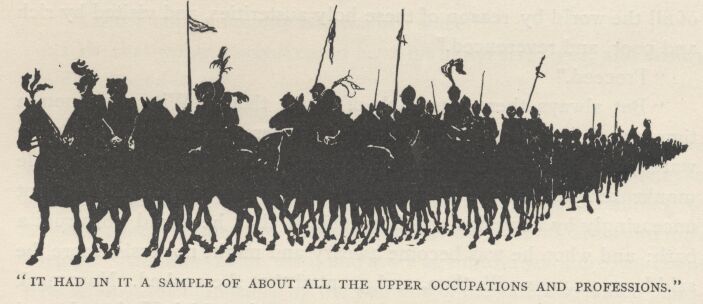
This company of pilgrims resembled Chaucer’s in this: that it had in it a sample of about all the upper occupations and professions the country could show, and a corresponding variety of costume. There were young men and old men, young women and old women, lively folk and grave folk. They rode upon mules and horses, and there was not a side-saddle in the party; for this specialty was to remain unknown in England for nine hundred years yet.
This group of pilgrims was like Chaucer’s in one way. It included people from nearly every upper occupation and profession in the country, dressed in an equally wide variety of clothes. There were young men and old men, young women and old women, lively people and serious people. They rode mules and horses, and not one of them had a side-saddle. For side-saddles would remain unknown in England for another nine hundred years.
It was a pleasant, friendly, sociable herd; pious, happy, merry and full of unconscious coarsenesses and innocent indecencies. What they regarded as the merry tale went the continual round and caused no more embarrassment than it would have caused in the best English society twelve centuries later. Practical jokes worthy of the English wits of the first quarter of the far-off nineteenth century were sprung here and there and yonder along the line, and compelled the delightedest applause; and sometimes when a bright remark was made at one end of the procession and started on its travels toward the other, you could note its progress all the way by the sparkling spray of laughter it threw off from its bows as it plowed along; and also by the blushes of the mules in its wake.
It was a pleasant, friendly, sociable crowd, pious, happy, and merry. They were also coarse without realizing it, and innocently indecent. What they thought of as a funny story kept making the rounds. It caused no more embarrassment than it would have in the best English society twelve centuries later. Practical jokes were played all along the procession, to the most delighted applause. They were worthy of the English wits of the early nineteenth century, far in the future. Sometimes someone at one end of the procession made a clever remark. As it traveled toward the other end, you could follow its progress. It plowed along like a ship, throwing off a sparkling spray of laughter from its bow. You could also see the mules blushing in its wake.
Sandy knew the goal and purpose of this pilgrimage, and she posted me. She said:
Sandy knew the goal and purpose of this journey, and she filled me in. She said:
“They journey to the Valley of Holiness, for to be blessed of the godly hermits and drink of the miraculous waters and be cleansed from sin.”
“They travel to the Valley of Holiness to be blessed by the holy hermits. They go to drink the miraculous waters and be cleansed of sin.”
“Where is this watering place?”
“Where is this watering place?”
“It lieth a two-day journey hence, by the borders of the land that hight the Cuckoo Kingdom.”
“It is a two-day journey from here, near the borders of the Cuckoo Kingdom.”
“Tell me about it. Is it a celebrated place?”
“Tell me about it. Is it a famous place?”
“Oh, of a truth, yes. There be none more so. Of old time there lived there an abbot and his monks. Belike were none in the world more holy than these; for they gave themselves to study of pious books, and spoke not the one to the other, or indeed to any, and ate decayed herbs and naught thereto, and slept hard, and prayed much, and washed never; also they wore the same garment until it fell from their bodies through age and decay. Right so came they to be known of all the world by reason of these holy austerities, and visited by rich and poor, and reverenced.”
“Oh, indeed, yes. There is no holier place. Long ago, an abbot and his monks lived there. Perhaps no one in the world was holier than they were. They devoted themselves to studying religious books and spoke neither to one another nor to anyone else. They ate nothing but decaying herbs, slept on hard beds, prayed often, and never washed. They also wore the same clothes until they fell off from age and decay. Because of these holy hardships, they became known throughout the world. Rich and poor alike visited and revered them.”
“Proceed.”
“Go on.”
“But always there was lack of water there. Whereas, upon a time, the holy abbot prayed, and for answer a great stream of clear water burst forth by miracle in a desert place. Now were the fickle monks tempted of the Fiend, and they wrought with their abbot unceasingly by beggings and beseechings that he would construct a bath; and when he was become aweary and might not resist more, he said have ye your will, then, and granted that they asked. Now mark thou what ’tis to forsake the ways of purity the which He loveth, and wanton with such as be worldly and an offense. These monks did enter into the bath and come thence washed as white as snow; and lo, in that moment His sign appeared, in miraculous rebuke! for His insulted waters ceased to flow, and utterly vanished away.”
“But there was always a lack of water there. Once, the holy abbot prayed, and in answer, a great stream of clear water miraculously burst forth in a desert place. Then the fickle monks were tempted by the Fiend. They begged and pleaded with their abbot without end to build a bath. When he grew weary and could resist no longer, he told them to have their way and granted their request. Now see what happens when people abandon the ways of purity he loves and indulge in worldly, offensive pleasures. These monks entered the bath and came out washed as white as snow. And at that moment, his sign appeared in miraculous rebuke! His insulted waters stopped flowing and vanished completely.”
“They fared mildly, Sandy, considering how that kind of crime is regarded in this country.”
“They got off lightly, Sandy, considering how this country views that kind of crime.”
“Belike; but it was their first sin; and they had been of perfect life for long, and differing in naught from the angels. Prayers, tears, torturings of the flesh, all was vain to beguile that water to flow again. Even processions; even burnt-offerings; even votive candles to the Virgin, did fail every each of them; and all in the land did marvel.”
“Perhaps. But it was their first sin. They had lived perfect lives for a long time and were no different from angels. Prayers, tears, and tortures of the flesh all failed to make the water flow again. Even processions, burnt offerings, and candles offered to the Virgin failed, every one of them. And everyone in the land marveled.”
“How odd to find that even this industry has its financial panics, and at times sees its assignats and greenbacks languish to zero, and everything come to a standstill. Go on, Sandy.”
“How strange to find that even this industry has financial panics. At times, its assignats and greenbacks become worthless, and everything comes to a standstill. Go on, Sandy.”
“And so upon a time, after year and day, the good abbot made humble surrender and destroyed the bath. And behold, His anger was in that moment appeased, and the waters gushed richly forth again, and even unto this day they have not ceased to flow in that generous measure.”
“Finally, after a year and a day, the good abbot humbly gave in and destroyed the bath. At that very moment, his anger was satisfied, and the water gushed forth again. Even to this day, it has never stopped flowing so generously.”
“Then I take it nobody has washed since.”
“Then I guess nobody has washed since.”
“He that would essay it could have his halter free; yes, and swiftly would he need it, too.”
“Anyone who tried it could have a free noose. Yes, and he would need it quickly, too.”
“The community has prospered since?”
“Has the community prospered since then?”
“Even from that very day. The fame of the miracle went abroad into all lands. From every land came monks to join; they came even as the fishes come, in shoals; and the monastery added building to building, and yet others to these, and so spread wide its arms and took them in. And nuns came, also; and more again, and yet more; and built over against the monastery on the yon side of the vale, and added building to building, until mighty was that nunnery. And these were friendly unto those, and they joined their loving labors together, and together they built a fair great foundling asylum midway of the valley between.”
“From that very day. News of the miracle spread to every land. Monks came from every land to join, like fish gathering in shoals. The monastery added building after building, spreading its arms wide to take them in. Nuns came too, more and more of them. They built across the valley from the monastery, adding building after building until the nunnery was mighty. The nuns and monks were friendly with one another and joined in loving work. Together they built a fine, large foundling asylum halfway between them in the valley.”
“You spoke of some hermits, Sandy.”
“You mentioned some hermits, Sandy.”
“These have gathered there from the ends of the earth. A hermit thriveth best where there be multitudes of pilgrims. Ye shall not find no hermit of no sort wanting. If any shall mention a hermit of a kind he thinketh new and not to be found but in some far strange land, let him but scratch among the holes and caves and swamps that line that Valley of Holiness, and whatsoever be his breed, it skills not, he shall find a sample of it there.”
“These have gathered there from the ends of the earth. A hermit does best where there are crowds of pilgrims. You will find every kind of hermit there. Suppose someone mentions a kind of hermit he thinks is new and found only in some faraway, strange land. Let him search among the holes, caves, and swamps that line the Valley of Holiness. No matter what kind of hermit it is, he will find one there.”
I closed up alongside of a burly fellow with a fat good-humored face, purposing to make myself agreeable and pick up some further crumbs of fact; but I had hardly more than scraped acquaintance with him when he began eagerly and awkwardly to lead up, in the immemorial way, to that same old anecdote—the one Sir Dinadan told me, what time I got into trouble with Sir Sagramor and was challenged of him on account of it. I excused myself and dropped to the rear of the procession, sad at heart, willing to go hence from this troubled life, this vale of tears, this brief day of broken rest, of cloud and storm, of weary struggle and monotonous defeat; and yet shrinking from the change, as remembering how long eternity is, and how many have wended thither who know that anecdote.
I moved alongside a burly fellow with a fat, good-natured face. I hoped to make myself agreeable and pick up a few more scraps of information. But I had barely made his acquaintance when he began eagerly and awkwardly to work his way toward that same old anecdote. He went about it in the usual, age-old way. It was the one Sir Dinadan had told me, the one that got me into trouble with Sir Sagramor and led him to challenge me. I excused myself and dropped to the back of the procession, sad at heart. I was ready to leave this troubled life, this valley of tears. It was a short day of broken rest, clouds and storms, weary struggle and constant defeat. And yet I shrank from the change. I remembered how long eternity is, and how many people have gone there who know that anecdote.
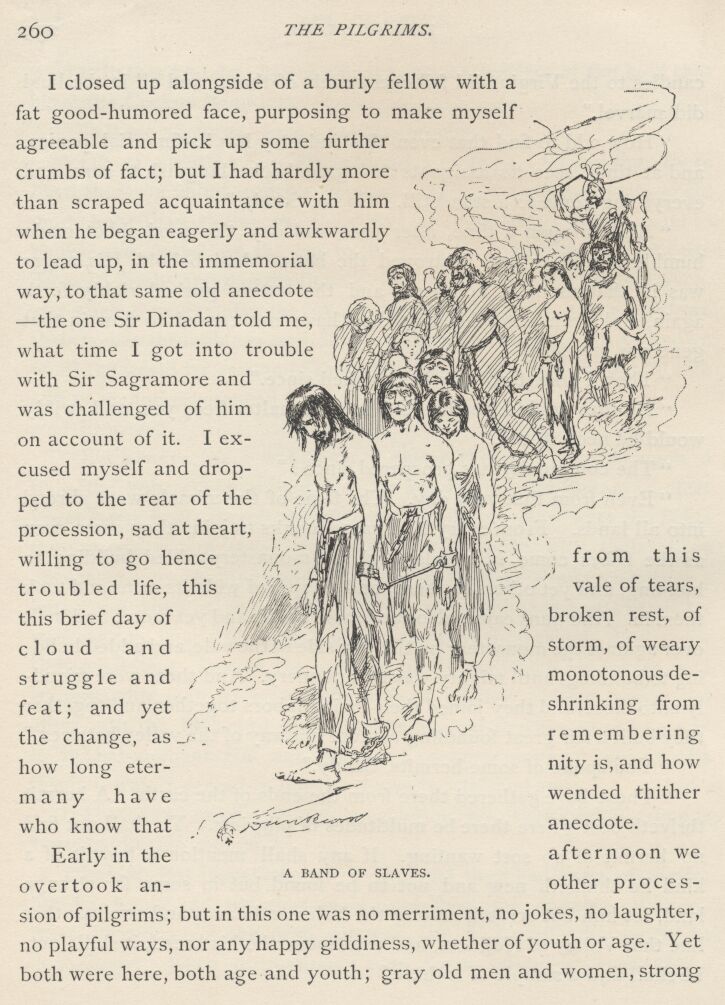
Early in the afternoon we overtook another procession of pilgrims; but in this one was no merriment, no jokes, no laughter, no playful ways, nor any happy giddiness, whether of youth or age. Yet both were here, both age and youth; gray old men and women, strong men and women of middle age, young husbands, young wives, little boys and girls, and three babies at the breast. Even the children were smileless; there was not a face among all these half a hundred people but was cast down, and bore that set expression of hopelessness which is bred of long and hard trials and old acquaintance with despair. They were slaves. Chains led from their fettered feet and their manacled hands to a sole-leather belt about their waists; and all except the children were also linked together in a file six feet apart, by a single chain which led from collar to collar all down the line. They were on foot, and had tramped three hundred miles in eighteen days, upon the cheapest odds and ends of food, and stingy rations of that. They had slept in these chains every night, bundled together like swine. They had upon their bodies some poor rags, but they could not be said to be clothed. Their irons had chafed the skin from their ankles and made sores which were ulcerated and wormy. Their naked feet were torn, and none walked without a limp. Originally there had been a hundred of these unfortunates, but about half had been sold on the trip. The trader in charge of them rode a horse and carried a whip with a short handle and a long heavy lash divided into several knotted tails at the end. With this whip he cut the shoulders of any that tottered from weariness and pain, and straightened them up. He did not speak; the whip conveyed his desire without that. None of these poor creatures looked up as we rode along by; they showed no consciousness of our presence. And they made no sound but one; that was the dull and awful clank of their chains from end to end of the long file, as forty-three burdened feet rose and fell in unison. The file moved in a cloud of its own making.
Early in the afternoon, we caught up with another procession of pilgrims. But there was no merriment, no joking or laughter, no playfulness or happy giddiness, among young or old. Yet both were there: gray-haired old men and women, strong middle-aged men and women, young husbands and wives, little boys and girls, and three nursing babies. Even the children did not smile. Every face among those fifty or so people was downcast. Each bore the fixed look of hopelessness that comes from long, hard trials and a long acquaintance with despair. They were slaves. Chains ran from the shackles on their feet and the manacles on their hands to thick leather belts around their waists. All except the children were also linked together in a line, six feet apart. A single chain ran from collar to collar down the whole line. They were on foot and had trudged three hundred miles in eighteen days. They had eaten meager portions of the cheapest scraps of food. Every night they had slept in their chains, packed together like pigs. They wore a few poor rags, but they could hardly be said to be clothed. Their irons had rubbed the skin off their ankles, leaving ulcerated sores infested with worms. Their bare feet were torn, and every one of them limped. Originally there had been a hundred of these unfortunate people, but about half had been sold along the way. The trader in charge rode a horse and carried a whip. It had a short handle and a long, heavy lash divided into several knotted tails at the end. Whenever anyone staggered from weariness and pain, he whipped their shoulders and made them straighten up. He did not speak. The whip told them what he wanted. None of these poor creatures looked up as we rode past. They showed no awareness of us. They made only one sound: the dull, terrible clanking of their chains along the whole line, as forty-three burdened feet rose and fell together. The line moved in a cloud of its own making.
All these faces were gray with a coating of dust. One has seen the like of this coating upon furniture in unoccupied houses, and has written his idle thought in it with his finger. I was reminded of this when I noticed the faces of some of those women, young mothers carrying babes that were near to death and freedom, how a something in their hearts was written in the dust upon their faces, plain to see, and lord, how plain to read! for it was the track of tears. One of these young mothers was but a girl, and it hurt me to the heart to read that writing, and reflect that it was come up out of the breast of such a child, a breast that ought not to know trouble yet, but only the gladness of the morning of life; and no doubt—
All these faces were gray with dust. You have seen a coating like it on furniture in empty houses. You may have idly written a thought in it with your finger. I was reminded of this when I noticed the faces of some of the women. They were young mothers carrying babies who were close to death and freedom. Something from their hearts was written plainly in the dust on their faces. And Lord, how plainly it could be read! It was the tracks of their tears. One of these young mothers was only a girl. It hurt me to the heart to read that writing and think that it came from such a child’s breast. Her breast should not yet have known trouble, only the joy of life’s morning. And no doubt...
She reeled just then, giddy with fatigue, and down came the lash and flicked a flake of skin from her naked shoulder. It stung me as if I had been hit instead. The master halted the file and jumped from his horse. He stormed and swore at this girl, and said she had made annoyance enough with her laziness, and as this was the last chance he should have, he would settle the account now. She dropped on her knees and put up her hands and began to beg, and cry, and implore, in a passion of terror, but the master gave no attention. He snatched the child from her, and then made the men-slaves who were chained before and behind her throw her on the ground and hold her there and expose her body; and then he laid on with his lash like a madman till her back was flayed, she shrieking and struggling the while piteously. One of the men who was holding her turned away his face, and for this humanity he was reviled and flogged.
Just then, she staggered, dizzy with exhaustion. The whip came down and tore a flake of skin from her bare shoulder. It stung me as if I had been hit instead. The master stopped the line and jumped off his horse. He raged and swore at the girl, saying she had caused enough trouble with her laziness. Since this was his last chance, he would settle the account now. She fell to her knees, raised her hands, and began to beg and cry and plead in a frenzy of terror. But the master paid no attention. He snatched the child from her. Then he made the men-slaves chained in front of and behind her throw her down, hold her there, and expose her body. He whipped her like a madman until the skin was stripped from her back. All the while, she shrieked and struggled pitifully. One of the men holding her turned his face away. For this act of humanity, he was insulted and whipped.
All our pilgrims looked on and commented—on the expert way in which the whip was handled. They were too much hardened by lifelong everyday familiarity with slavery to notice that there was anything else in the exhibition that invited comment. This was what slavery could do, in the way of ossifying what one may call the superior lobe of human feeling; for these pilgrims were kind-hearted people, and they would not have allowed that man to treat a horse like that.
All our pilgrims watched and commented on how skillfully the whip was handled. A lifetime of daily familiarity with slavery had hardened them. They did not notice anything else in the scene worth commenting on. This was what slavery could do to harden what one might call the higher part of human feeling. For these pilgrims were kind-hearted people, and they would not have allowed that man to treat a horse like that.
I wanted to stop the whole thing and set the slaves free, but that would not do. I must not interfere too much and get myself a name for riding over the country’s laws and the citizen’s rights roughshod. If I lived and prospered I would be the death of slavery, that I was resolved upon; but I would try to fix it so that when I became its executioner it should be by command of the nation.
I wanted to stop the whole thing and set the slaves free, but that would not do. I must not interfere too much and get a reputation for trampling on the country's laws and citizens' rights. If I lived and prospered, I was determined to put an end to slavery. But I would try to arrange things so that when I ended it, I would do so at the nation's command.
Just here was the wayside shop of a smith; and now arrived a landed proprietor who had bought this girl a few miles back, deliverable here where her irons could be taken off. They were removed; then there was a squabble between the gentleman and the dealer as to which should pay the blacksmith. The moment the girl was delivered from her irons, she flung herself, all tears and frantic sobbings, into the arms of the slave who had turned away his face when she was whipped. He strained her to his breast, and smothered her face and the child’s with kisses, and washed them with the rain of his tears. I suspected. I inquired. Yes, I was right; it was husband and wife. They had to be torn apart by force; the girl had to be dragged away, and she struggled and fought and shrieked like one gone mad till a turn of the road hid her from sight; and even after that, we could still make out the fading plaint of those receding shrieks. And the husband and father, with his wife and child gone, never to be seen by him again in life?—well, the look of him one might not bear at all, and so I turned away; but I knew I should never get his picture out of my mind again, and there it is to this day, to wring my heartstrings whenever I think of it.
There was a blacksmith’s shop beside the road. A landowner arrived who had bought the girl a few miles back. She was to be delivered here, where her chains could be removed. After they were removed, the gentleman and the dealer argued over who should pay the blacksmith. As soon as the girl was free of her chains, she threw herself into the arms of the slave. He was the one who had turned his face away when she was whipped. She was crying and sobbing wildly. He held her tightly to his chest and covered her face and the child’s with kisses. His tears rained down on them. I had a suspicion, so I asked. Yes, I was right. They were husband and wife. They had to be torn apart by force. The girl had to be dragged away. She struggled, fought, and shrieked like someone who had gone mad. She went on until a bend in the road hid her from sight. Even then, we could still hear her cries fading as she was taken farther away. And what of the husband and father, whose wife and child were gone, never to be seen by him again? Well, I could not bear to look at him, so I turned away. But I knew I would never get his image out of my mind. It is still there to this day, and it wrings my heart whenever I think of it.
We put up at the inn in a village just at nightfall, and when I rose next morning and looked abroad, I was ware where a knight came riding in the golden glory of the new day, and recognized him for knight of mine—Sir Ozana le Cure Hardy. He was in the gentlemen’s furnishing line, and his missionarying specialty was plug hats. He was clothed all in steel, in the beautifulest armor of the time—up to where his helmet ought to have been; but he hadn’t any helmet, he wore a shiny stove-pipe hat, and was ridiculous a spectacle as one might want to see. It was another of my surreptitious schemes for extinguishing knighthood by making it grotesque and absurd. Sir Ozana’s saddle was hung about with leather hat boxes, and every time he overcame a wandering knight he swore him into my service and fitted him with a plug and made him wear it. I dressed and ran down to welcome Sir Ozana and get his news.
We stayed at the inn in a village just as night fell. The next morning, I got up and looked outside. A knight was riding toward the village in the golden glory of the new day. I recognized him as one of my knights, Sir Ozana le Cure Hardy. He was in the men’s clothing business, and his missionary specialty was top hats. He wore the most beautiful steel armor of the time, all the way up to where his helmet should have been. But instead of a helmet, he wore a shiny stovepipe hat. He was as ridiculous a sight as anyone could wish to see. This was another of my secret schemes to put an end to knighthood by making it grotesque and absurd. Leather hatboxes hung from Sir Ozana’s saddle. Every time he defeated a wandering knight, he made him swear to serve me. Then he fitted the knight with a top hat and made him wear it. I dressed and ran downstairs to welcome Sir Ozana and hear his news.
“How is trade?” I asked.
“How is business?” I asked.
“Ye will note that I have but these four left; yet were they sixteen whenas I got me from Camelot.”
“You can see that I have only these four left. But I had sixteen when I left Camelot.”
“Why, you have certainly done nobly, Sir Ozana. Where have you been foraging of late?”
“Why, you have certainly done well, Sir Ozana. Where have you been foraging lately?”
“I am but now come from the Valley of Holiness, please you sir.”
“I have just come from the Valley of Holiness, sir.”
“I am pointed for that place myself. Is there anything stirring in the monkery, more than common?”
“I’m headed there myself. Is anything unusual happening at the monastery?”
“By the mass ye may not question it!.... Give him good feed, boy, and stint it not, an thou valuest thy crown; so get ye lightly to the stable and do even as I bid.... Sir, it is parlous news I bring, and—be these pilgrims? Then ye may not do better, good folk, than gather and hear the tale I have to tell, sith it concerneth you, forasmuch as ye go to find that ye will not find, and seek that ye will seek in vain, my life being hostage for my word, and my word and message being these, namely: That a hap has happened whereof the like has not been seen no more but once this two hundred years, which was the first and last time that that said misfortune strake the holy valley in that form by commandment of the Most High whereto by reasons just and causes thereunto contributing, wherein the matter—”
“By the Mass, you cannot doubt it!.... Give him plenty of good feed, boy, if you value your head. Now hurry to the stable and do exactly as I say.... Sir, I bring terrible news. Are these pilgrims? Then, good people, you would do well to gather and hear my tale. It concerns you, for you are going to find what you will not find. You are seeking what you will seek in vain. I stake my life on my word, and this is my message: Something has happened that has been seen only once in the last two hundred years. That was the first and last time this misfortune struck the holy valley in that form. It happened by the command of the Most High, for just reasons and contributing causes, in which the matter...”
“The miraculous fount hath ceased to flow!” This shout burst from twenty pilgrim mouths at once.
“The miraculous fountain has stopped flowing!” Twenty pilgrims shouted this at once.
“Ye say well, good people. I was verging to it, even when ye spake.”
“You’re right, good people. I was just getting to that when you spoke.”
“Has somebody been washing again?”
“Has somebody been washing again?”
“Nay, it is suspected, but none believe it. It is thought to be some other sin, but none wit what.”
“No, it is suspected, but no one believes it. People think it is some other sin, but no one knows what.”
“How are they feeling about the calamity?”
“How do they feel about the disaster?”
“None may describe it in words. The fount is these nine days dry. The prayers that did begin then, and the lamentations in sackcloth and ashes, and the holy processions, none of these have ceased nor night nor day; and so the monks and the nuns and the foundlings be all exhausted, and do hang up prayers writ upon parchment, sith that no strength is left in man to lift up voice. And at last they sent for thee, Sir Boss, to try magic and enchantment; and if you could not come, then was the messenger to fetch Merlin, and he is there these three days now, and saith he will fetch that water though he burst the globe and wreck its kingdoms to accomplish it; and right bravely doth he work his magic and call upon his hellions to hie them hither and help, but not a whiff of moisture hath he started yet, even so much as might qualify as mist upon a copper mirror an ye count not the barrel of sweat he sweateth betwixt sun and sun over the dire labors of his task; and if ye—”
“No one can describe it in words. The fountain has been dry for nine days now. The prayers, the mourning in sackcloth and ashes, and the holy processions began then. None of them have stopped, day or night. So the monks, the nuns, and the foundlings are all exhausted. They hang up prayers written on parchment, because no one has the strength left to speak them aloud. At last they sent for you, Sir Boss, to try magic and enchantment. If you could not come, the messenger was to fetch Merlin. Merlin has been there for three days now. He says he will bring back the water, even if he has to burst the globe and wreck its kingdoms. He works his magic very bravely. He calls on his hellions to hurry there and help him. But he has not produced a whiff of moisture yet, not even enough to make mist on a copper mirror. That is, unless you count the barrel of sweat he produces each day over the dreadful labor of his task. And if you...”
Breakfast was ready. As soon as it was over I showed to Sir Ozana these words which I had written on the inside of his hat: “Chemical Department, Laboratory extension, Section G. Pxxp. Send two of first size, two of No. 3, and six of No. 4, together with the proper complementary details—and two of my trained assistants.” And I said:
Breakfast was ready. As soon as we finished, I showed Sir Ozana what I had written inside his hat: “Chemical Department, Laboratory extension, Section G. Pxxp. Send two of the first size, two of No. 3, and six of No. 4. Include the proper accompanying details and two of my trained assistants.” And I said:
“Now get you to Camelot as fast as you can fly, brave knight, and show the writing to Clarence, and tell him to have these required matters in the Valley of Holiness with all possible dispatch.”
“Now go to Camelot as fast as you can, brave knight. Show the writing to Clarence, and tell him to get the required things to the Valley of Holiness as quickly as possible.”
“I will well, Sir Boss,” and he was off.
“I gladly will, Sir Boss,” and he was off.