Chapter 17
A Royal Banquet
Madame, seeing me pacific and unresentful, no doubt judged that I was deceived by her excuse; for her fright dissolved away, and she was soon so importunate to have me give an exhibition and kill somebody, that the thing grew to be embarrassing. However, to my relief she was presently interrupted by the call to prayers. I will say this much for the nobility: that, tyrannical, murderous, rapacious, and morally rotten as they were, they were deeply and enthusiastically religious. Nothing could divert them from the regular and faithful performance of the pieties enjoined by the Church. More than once I had seen a noble who had gotten his enemy at a disadvantage, stop to pray before cutting his throat; more than once I had seen a noble, after ambushing and despatching his enemy, retire to the nearest wayside shrine and humbly give thanks, without even waiting to rob the body. There was to be nothing finer or sweeter in the life of even Benvenuto Cellini, that rough-hewn saint, ten centuries later. All the nobles of Britain, with their families, attended divine service morning and night daily, in their private chapels, and even the worst of them had family worship five or six times a day besides. The credit of this belonged entirely to the Church. Although I was no friend to that Catholic Church, I was obliged to admit this. And often, in spite of me, I found myself saying, “What would this country be without the Church?”
Madame saw that I was calm and showed no resentment. No doubt she decided that I believed her excuse. Her fear faded, and she soon began pressing me to put on a demonstration and kill somebody. She became so insistent that it grew embarrassing. To my relief, though, the call to prayers soon interrupted her. I will say this much for the nobility: they were tyrannical, murderous, greedy, and morally rotten, but deeply and enthusiastically religious. Nothing could distract them from faithfully observing the religious duties required by the Church. More than once, I had seen a noble get the better of an enemy, then stop to pray before cutting his throat. More than once, I had seen a noble ambush and kill an enemy, then go to the nearest roadside shrine. There he humbly gave thanks without even waiting to rob the body. Ten centuries later, even Benvenuto Cellini, that rough saint, would do nothing finer or sweeter in his life. All the nobles of Britain and their families attended services in their private chapels every morning and night. Even the worst of them held family worship five or six times a day besides. The Church deserved all the credit for this. Although I was no friend of the Catholic Church, I had to admit it. And often, despite myself, I found myself asking, “What would this country be without the Church?”
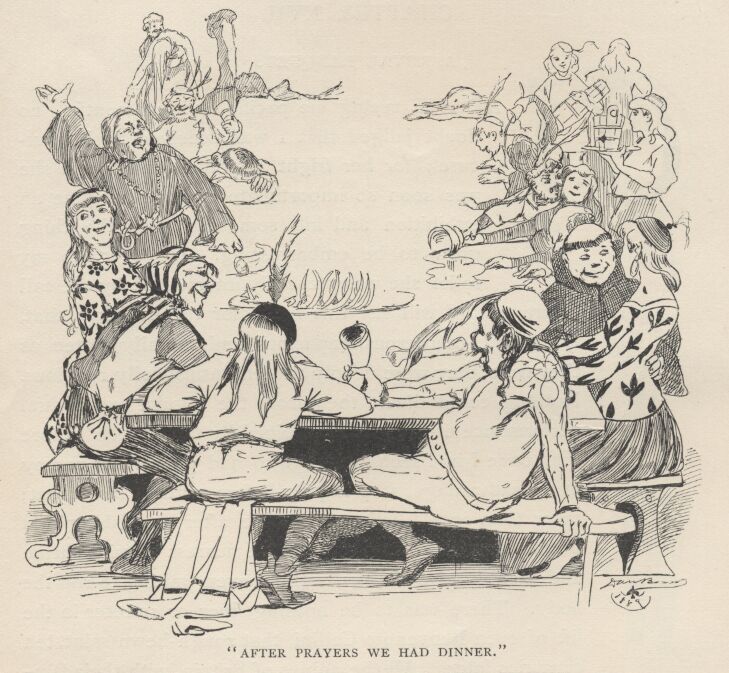
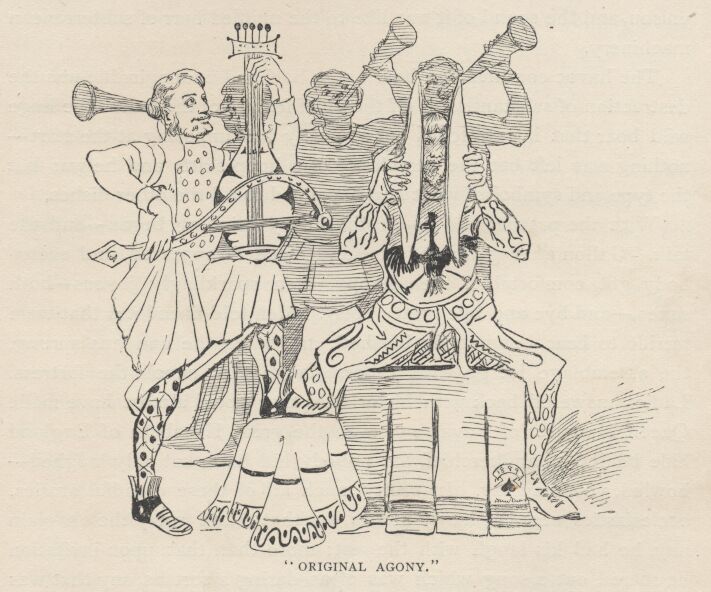
After prayers we had dinner in a great banqueting hall which was lighted by hundreds of grease-jets, and everything was as fine and lavish and rudely splendid as might become the royal degree of the hosts. At the head of the hall, on a dais, was the table of the king, queen, and their son, Prince Uwaine. Stretching down the hall from this, was the general table, on the floor. At this, above the salt, sat the visiting nobles and the grown members of their families, of both sexes,—the resident Court, in effect—sixty-one persons; below the salt sat minor officers of the household, with their principal subordinates: altogether a hundred and eighteen persons sitting, and about as many liveried servants standing behind their chairs, or serving in one capacity or another. It was a very fine show. In a gallery a band with cymbals, horns, harps, and other horrors, opened the proceedings with what seemed to be the crude first-draft or original agony of the wail known to later centuries as “In the Sweet Bye and Bye.” It was new, and ought to have been rehearsed a little more. For some reason or other the queen had the composer hanged, after dinner.
After prayers, we had dinner in a great banquet hall lit by hundreds of grease lamps. Everything was as fine, lavish, and roughly splendid as suited our royal hosts. At the head of the hall, on a raised platform, was the table of the king, queen, and their son, Prince Uwaine. The main table stretched from there down the length of the hall, at floor level. Above the salt sat the visiting nobles and the adult members of their families, both men and women. In effect, they made up the resident Court, sixty-one people in all. Below the salt sat minor household officers and their chief assistants. Altogether, 118 people were seated, with about as many uniformed servants standing behind their chairs or serving in other ways. It was a very fine show. In a gallery, a band with cymbals, horns, harps, and other horrors opened the proceedings. They played what sounded like the crude first draft, or original agony, of the wail later centuries knew as “In the Sweet Bye and Bye.” It was new, and ought to have been rehearsed a little more. For some reason or other, the queen had the composer hanged after dinner.
After this music, the priest who stood behind the royal table said a noble long grace in ostensible Latin. Then the battalion of waiters broke away from their posts, and darted, rushed, flew, fetched and carried, and the mighty feeding began; no words anywhere, but absorbing attention to business. The rows of chops opened and shut in vast unison, and the sound of it was like to the muffled burr of subterranean machinery.
After the music, the priest standing behind the royal table said a grand, long grace in what passed for Latin. Then the battalion of waiters left their posts. They darted, rushed, flew, fetched, and carried, and the mighty feast began. No one spoke. Everyone was absorbed in the business of eating. Rows of mouths opened and closed together, making a sound like the muffled hum of machinery underground.
The havoc continued an hour and a half, and unimaginable was the destruction of substantials. Of the chief feature of the feast—the huge wild boar that lay stretched out so portly and imposing at the start—nothing was left but the semblance of a hoop-skirt; and he was but the type and symbol of what had happened to all the other dishes.
The havoc went on for an hour and a half, and the amount of food destroyed was unimaginable. The main attraction of the feast was a huge wild boar. At the start, it had lain stretched out, plump and impressive. Now nothing was left of it but something resembling a hoop-skirt. The boar was a fitting symbol of what had happened to all the other dishes.
With the pastries and so on, the heavy drinking began—and the talk. Gallon after gallon of wine and mead disappeared, and everybody got comfortable, then happy, then sparklingly joyous—both sexes,—and by and by pretty noisy. Men told anecdotes that were terrific to hear, but nobody blushed; and when the nub was sprung, the assemblage let go with a horse-laugh that shook the fortress. Ladies answered back with historiettes that would almost have made Queen Margaret of Navarre or even the great Elizabeth of England hide behind a handkerchief, but nobody hid here, but only laughed—howled, you may say. In pretty much all of these dreadful stories, ecclesiastics were the hardy heroes, but that didn’t worry the chaplain any, he had his laugh with the rest; more than that, upon invitation he roared out a song which was of as daring a sort as any that was sung that night.
With the pastries and the rest, the heavy drinking began, along with the talk. Gallon after gallon of wine and mead disappeared. Everyone, men and women alike, grew comfortable, then happy, then gloriously merry, and eventually pretty noisy. The men told shocking stories, but nobody blushed. When the punch line came, the crowd burst into laughter that shook the fortress. The ladies answered with little stories of their own. These would almost have made Queen Margaret of Navarre or even the great Elizabeth of England hide behind a handkerchief. But nobody hid here. They only laughed. You might say they howled. In nearly all these dreadful stories, clergymen were the bold heroes. But that didn’t bother the chaplain. He laughed along with everyone else. More than that, when invited, he roared out a song as daring as any sung that night.
By midnight everybody was fagged out, and sore with laughing; and, as a rule, drunk: some weepingly, some affectionately, some hilariously, some quarrelsomely, some dead and under the table. Of the ladies, the worst spectacle was a lovely young duchess, whose wedding-eve this was; and indeed she was a spectacle, sure enough. Just as she was she could have sat in advance for the portrait of the young daughter of the Regent d’Orleans, at the famous dinner whence she was carried, foul-mouthed, intoxicated, and helpless, to her bed, in the lost and lamented days of the Ancient Regime.
By midnight, everyone was exhausted and sore from laughing. Most were drunk. Some were weepy, some affectionate, some cheerful, some quarrelsome, and some dead drunk under the table. Among the ladies, the worst spectacle was a lovely young duchess on the eve of her wedding. And she was a spectacle, all right. Just as she was, she could have posed for a portrait of the young daughter of the Regent d’Orleans. That daughter was carried to bed from the famous dinner, foul-mouthed, drunk, and helpless. Those were the lost and much-missed days of the Ancient Regime.
Suddenly, even while the priest was lifting his hands, and all conscious heads were bowed in reverent expectation of the coming blessing, there appeared under the arch of the far-off door at the bottom of the hall an old and bent and white-haired lady, leaning upon a crutch-stick; and she lifted the stick and pointed it toward the queen and cried out:
The priest was raising his hands, and all the conscious people had bowed their heads in reverent expectation of the blessing. Suddenly, an old, bent, white-haired lady appeared beneath the arch of the distant doorway at the far end of the hall. She was leaning on a crutch. She raised it, pointed it at the queen, and cried out:
“The wrath and curse of God fall upon you, woman without pity, who have slain mine innocent grandchild and made desolate this old heart that had nor chick, nor friend nor stay nor comfort in all this world but him!”
“May God's wrath and curse fall upon you, you heartless woman! You have killed my innocent grandchild and left my old heart desolate. He was my only family, my only friend, my only support and comfort in all this world!”
Everybody crossed himself in a grisly fright, for a curse was an awful thing to those people; but the queen rose up majestic, with the death-light in her eye, and flung back this ruthless command:
Everyone crossed themselves in horror, because a curse was a terrible thing to them. But the queen rose majestically, with a deadly look in her eyes, and fired back this ruthless command:
“Lay hands on her! To the stake with her!”
“Grab her! Take her to the stake!”
The guards left their posts to obey. It was a shame; it was a cruel thing to see. What could be done? Sandy gave me a look; I knew she had another inspiration. I said:
The guards left their posts to obey. It was shameful and cruel to watch. What could be done? Sandy gave me a look. I knew she had another idea. I said:
“Do what you choose.”
“Do whatever you want.”
She was up and facing toward the queen in a moment. She indicated me, and said:
She got up and faced the queen at once. She gestured toward me and said:
“Madame, he saith this may not be. Recall the commandment, or he will dissolve the castle and it shall vanish away like the instable fabric of a dream!”
“Madam, he says this cannot be done. Take back your order, or he will dissolve the castle. It will vanish like the fragile fabric of a dream!”
Confound it, what a crazy contract to pledge a person to! What if the queen—
Damn it, what a crazy agreement to make someone promise to keep! What if the queen...
But my consternation subsided there, and my panic passed off; for the queen, all in a collapse, made no show of resistance but gave a countermanding sign and sunk into her seat. When she reached it she was sober. So were many of the others. The assemblage rose, whiffed ceremony to the winds, and rushed for the door like a mob; overturning chairs, smashing crockery, tugging, struggling, shouldering, crowding—anything to get out before I should change my mind and puff the castle into the measureless dim vacancies of space. Well, well, well, they were a superstitious lot. It is all a body can do to conceive of it.
But my alarm eased, and my panic passed. The queen was utterly defeated. She showed no resistance, but signaled that her order was canceled and sank into her seat. By the time she sat down, she was sober. So were many of the others. The gathering rose, threw ceremony to the winds, and rushed for the door like a mob. They overturned chairs, smashed dishes, and tugged, struggled, shoved, and crowded together. They would do anything to get out before I changed my mind and blew the castle into the vast, dim emptiness of space. Well, well, well, they were a superstitious lot. It is almost impossible to imagine just how superstitious they were.
The poor queen was so scared and humbled that she was even afraid to hang the composer without first consulting me. I was very sorry for her—indeed, any one would have been, for she was really suffering; so I was willing to do anything that was reasonable, and had no desire to carry things to wanton extremities. I therefore considered the matter thoughtfully, and ended by having the musicians ordered into our presence to play that Sweet Bye and Bye again, which they did. Then I saw that she was right, and gave her permission to hang the whole band. This little relaxation of sternness had a good effect upon the queen. A statesman gains little by the arbitrary exercise of iron-clad authority upon all occasions that offer, for this wounds the just pride of his subordinates, and thus tends to undermine his strength. A little concession, now and then, where it can do no harm, is the wiser policy.
The poor queen was so frightened and humbled that she was even afraid to hang the composer without consulting me first. I felt very sorry for her. Anyone would have, for she was really suffering. So I was willing to do anything reasonable and had no wish to go to cruel extremes. I thought the matter over carefully. Finally, I ordered the musicians to come before us and play that Sweet Bye and Bye again. They did. Then I saw that she was right and gave her permission to hang the whole band. This small act of leniency had a good effect on the queen. A statesman gains little by imposing rigid authority at every opportunity. Such behavior wounds the rightful pride of his subordinates and tends to weaken his own power. It is wiser to make a small concession now and then, where it can do no harm.
Now that the queen was at ease in her mind once more, and measurably happy, her wine naturally began to assert itself again, and it got a little the start of her. I mean it set her music going—her silver bell of a tongue. Dear me, she was a master talker. It would not become me to suggest that it was pretty late and that I was a tired man and very sleepy. I wished I had gone off to bed when I had the chance. Now I must stick it out; there was no other way. So she tinkled along and along, in the otherwise profound and ghostly hush of the sleeping castle, until by and by there came, as if from deep down under us, a far-away sound, as of a muffled shriek—with an expression of agony about it that made my flesh crawl. The queen stopped, and her eyes lighted with pleasure; she tilted her graceful head as a bird does when it listens. The sound bored its way up through the stillness again.
Now that the queen was at ease again and fairly happy, the wine naturally began to take effect once more. It got a little ahead of her. I mean it set her music going, that silver bell of a tongue. Goodness, she was a master talker. It would not have been proper for me to suggest that it was very late and I was tired and sleepy. I wished I had gone to bed when I had the chance. Now I had to sit through it. There was no other way. So she tinkled on and on while the sleeping castle was otherwise profoundly and eerily quiet. At last, a distant sound came, as if from deep beneath us. It sounded like a muffled shriek, with such agony in it that my flesh crawled. The queen stopped, and her eyes lit up with pleasure. She tilted her graceful head like a bird listening. The sound pierced the silence again.
“What is it?” I said.
“What is it?” I said.
“It is truly a stubborn soul, and endureth long. It is many hours now.”
“It is truly a stubborn soul, and it holds out for a long time. It has been many hours now.”
“Endureth what?”
“Endures what?”
“The rack. Come—ye shall see a blithe sight. An he yield not his secret now, ye shall see him torn asunder.”
“The rack. Come, you’ll see a cheerful sight. If he doesn’t reveal his secret now, you’ll see him torn apart.”
What a silky smooth hellion she was; and so composed and serene, when the cords all down my legs were hurting in sympathy with that man’s pain. Conducted by mailed guards bearing flaring torches, we tramped along echoing corridors, and down stone stairways dank and dripping, and smelling of mould and ages of imprisoned night—a chill, uncanny journey and a long one, and not made the shorter or the cheerier by the sorceress’s talk, which was about this sufferer and his crime. He had been accused by an anonymous informer, of having killed a stag in the royal preserves. I said:
What a smooth, devilish woman she was. She was so calm and serene, while the muscles in my legs ached in sympathy with the man’s pain. Guards in armor led us with blazing torches. We trudged through echoing corridors and down damp, dripping stone stairs. They smelled of mold and ages of trapped darkness. It was a long, chilling, eerie journey. The sorceress’s talk about the suffering man and his crime made it seem no shorter or cheerier. An anonymous informant had accused him of killing a stag in the royal hunting grounds. I said:
“Anonymous testimony isn’t just the right thing, your Highness. It were fairer to confront the accused with the accuser.”
“Anonymous testimony isn’t quite right, your Highness. It would be fairer to let the accused face the accuser.”
“I had not thought of that, it being but of small consequence. But an I would, I could not, for that the accuser came masked by night, and told the forester, and straightway got him hence again, and so the forester knoweth him not.”
“I hadn’t thought of that, since it seemed unimportant. But even if I wanted to, I couldn’t. The accuser came at night wearing a mask, told the forester, and left at once. So the forester doesn’t know who the accuser was.”
“Then is this Unknown the only person who saw the stag killed?”
“Then is this Unknown the only person who saw the stag killed?”
“Marry, no man saw the killing, but this Unknown saw this hardy wretch near to the spot where the stag lay, and came with right loyal zeal and betrayed him to the forester.”
“Indeed, no man saw the killing. But this Unknown saw the bold wretch near the spot where the stag lay. With loyal zeal, he went and reported him to the forester.”
“So the Unknown was near the dead stag, too? Isn’t it just possible that he did the killing himself? His loyal zeal—in a mask—looks just a shade suspicious. But what is your highness’s idea for racking the prisoner? Where is the profit?”
“So the Unknown was near the dead stag, too? Isn’t it just possible that he killed it himself? His loyal enthusiasm, while wearing a mask, looks just a little suspicious. But what does your highness hope to gain by torturing the prisoner? What’s the benefit?”
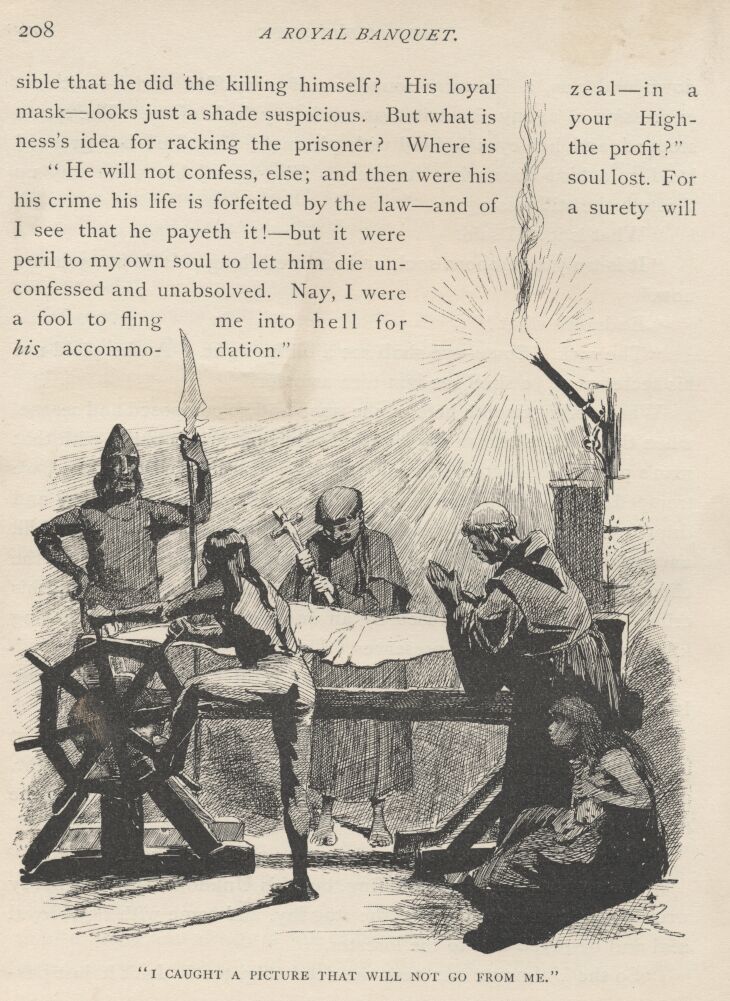
“He will not confess, else; and then were his soul lost. For his crime his life is forfeited by the law—and of a surety will I see that he payeth it!—but it were peril to my own soul to let him die unconfessed and unabsolved. Nay, I were a fool to fling me into hell for his accommodation.”
“He won't confess otherwise, and then his soul would be lost. The law says he must die for his crime, and I will certainly see that he does! But I would endanger my own soul if I let him die without confessing and receiving absolution. No, I'd be a fool to send myself to hell for his convenience.”
“But, your Highness, suppose he has nothing to confess?”
“But, Your Highness, what if he has nothing to confess?”
“As to that, we shall see, anon. An I rack him to death and he confess not, it will peradventure show that he had indeed naught to confess—ye will grant that that is sooth? Then shall I not be damned for an unconfessed man that had naught to confess—wherefore, I shall be safe.”
“As for that, we shall soon see. If I torture him to death and he does not confess, perhaps he had nothing to confess. You’ll agree that’s true, won’t you? Then I won’t be damned for leaving a man unconfessed when he had nothing to confess. So I’ll be safe.”
It was the stubborn unreasoning of the time. It was useless to argue with her. Arguments have no chance against petrified training; they wear it as little as the waves wear a cliff. And her training was everybody’s. The brightest intellect in the land would not have been able to see that her position was defective.
It was the stubborn, unthinking attitude of the time. There was no use arguing with her. Arguments have no chance against deeply ingrained beliefs. They wear those beliefs down as little as waves wear down a cliff. And everyone had been taught the same things she had. The brightest mind in the land would not have been able to see that her position was flawed.
As we entered the rack-cell I caught a picture that will not go from me; I wish it would. A native young giant of thirty or thereabouts lay stretched upon the frame on his back, with his wrists and ankles tied to ropes which led over windlasses at either end. There was no color in him; his features were contorted and set, and sweat-drops stood upon his forehead. A priest bent over him on each side; the executioner stood by; guards were on duty; smoking torches stood in sockets along the walls; in a corner crouched a poor young creature, her face drawn with anguish, a half-wild and hunted look in her eyes, and in her lap lay a little child asleep. Just as we stepped across the threshold the executioner gave his machine a slight turn, which wrung a cry from both the prisoner and the woman; but I shouted, and the executioner released the strain without waiting to see who spoke. I could not let this horror go on; it would have killed me to see it. I asked the queen to let me clear the place and speak to the prisoner privately; and when she was going to object I spoke in a low voice and said I did not want to make a scene before her servants, but I must have my way; for I was King Arthur’s representative, and was speaking in his name. She saw she had to yield. I asked her to indorse me to these people, and then leave me. It was not pleasant for her, but she took the pill; and even went further than I was meaning to require. I only wanted the backing of her own authority; but she said:
As we entered the rack room, I saw a sight I will never forget. I wish I could. A young local man, a giant of about thirty, lay on his back on the rack. His wrists and ankles were tied to ropes that ran over winches at either end. He was deathly pale. His face was twisted and rigid, and drops of sweat stood on his forehead. A priest bent over him on each side. The executioner stood nearby, and guards were on duty. Smoking torches stood in holders along the walls. In a corner crouched a poor young woman, her face drawn with anguish. Her eyes had a half-wild, hunted look, and a little child lay asleep in her lap. Just as we crossed the threshold, the executioner turned the machine slightly. Both the prisoner and the woman cried out. But I shouted, and the executioner loosened the ropes without waiting to see who had spoken. I could not let this horror go on. It would have killed me to watch it. I asked the queen to clear the room and let me speak to the prisoner privately. When she was about to object, I spoke quietly. I said I did not want to make a scene before her servants, but I had to have my way. I was King Arthur’s representative, and I was speaking in his name. She saw that she had to give in. I asked her to tell these people that I had her authority, then leave me alone. She did not like it, but she swallowed the pill. She even went further than I had intended to ask. I only wanted her to back me with her own authority, but she said:
“Ye will do in all things as this lord shall command. It is The Boss.”
“You will do everything this lord commands. He is The Boss.”
It was certainly a good word to conjure with: you could see it by the squirming of these rats. The queen’s guards fell into line, and she and they marched away, with their torch-bearers, and woke the echoes of the cavernous tunnels with the measured beat of their retreating footfalls. I had the prisoner taken from the rack and placed upon his bed, and medicaments applied to his hurts, and wine given him to drink. The woman crept near and looked on, eagerly, lovingly, but timorously,—like one who fears a repulse; indeed, she tried furtively to touch the man’s forehead, and jumped back, the picture of fright, when I turned unconsciously toward her. It was pitiful to see.
It was certainly a powerful word. You could tell by the way these rats squirmed. The queen’s guards fell into line, and they marched away with her and their torchbearers. Their steady footsteps echoed through the vast tunnels as they retreated. I had the prisoner taken off the rack and laid on his bed. I had medicine applied to his wounds and wine brought for him to drink. The woman crept closer and watched eagerly and lovingly, but timidly, like someone afraid of being turned away. She even tried to touch the man’s forehead when she thought no one was looking. When I turned toward her without thinking, she jumped back, looking terrified. It was pitiful to see.
“Lord,” I said, “stroke him, lass, if you want to. Do anything you’re a mind to; don’t mind me.”
“Lord,” I said, “pet him, girl, if you want to. Do whatever you like. Don’t mind me.”
Why, her eyes were as grateful as an animal’s, when you do it a kindness that it understands. The baby was out of her way and she had her cheek against the man’s in a minute and her hands fondling his hair, and her happy tears running down. The man revived and caressed his wife with his eyes, which was all he could do. I judged I might clear the den, now, and I did; cleared it of all but the family and myself. Then I said:
Why, her eyes were as grateful as an animal’s when you do it a kindness it understands. She quickly moved the baby out of her way and pressed her cheek against the man’s. She stroked his hair while tears of happiness ran down her face. The man revived and looked at his wife with affection. It was all he could do. I decided I could clear everyone out of the room now, and I did. I left only the family and myself. Then I said:
“Now, my friend, tell me your side of this matter; I know the other side.”
“Now, my friend, tell me your side of the story. I know the other side.”
The man moved his head in sign of refusal. But the woman looked pleased—as it seemed to me—pleased with my suggestion. I went on—
The man shook his head to refuse. But the woman seemed pleased with my suggestion. I continued:
“You know of me?”
“You know about me?”
“Yes. All do, in Arthur’s realms.”
“Yes. Everyone does in Arthur’s kingdom.”
“If my reputation has come to you right and straight, you should not be afraid to speak.”
“If you have heard the truth about my reputation, you should not be afraid to speak.”
The woman broke in, eagerly:
The woman eagerly interrupted:
“Ah, fair my lord, do thou persuade him! Thou canst an thou wilt. Ah, he suffereth so; and it is for me—for me! And how can I bear it? I would I might see him die—a sweet, swift death; oh, my Hugo, I cannot bear this one!”
“Oh, my good lord, please persuade him! You can if you will. Oh, he is suffering so much, and it is for me, for me! How can I bear it? I wish I could see him die a sweet, swift death. Oh, my Hugo, I cannot bear this death!”
And she fell to sobbing and grovelling about my feet, and still imploring. Imploring what? The man’s death? I could not quite get the bearings of the thing. But Hugo interrupted her and said:
She began sobbing and crawling around at my feet, still pleading. Pleading for what? The man’s death? I couldn’t quite make sense of it. But Hugo interrupted her and said:
“Peace! Ye wit not what ye ask. Shall I starve whom I love, to win a gentle death? I wend thou knewest me better.”
“Be quiet! You don't know what you're asking. Should I starve the one I love to gain a gentle death? I thought you knew me better.”
“Well,” I said, “I can’t quite make this out. It is a puzzle. Now—”
“Well,” I said, “I can’t quite figure this out. It’s a puzzle. Now...”
“Ah, dear my lord, an ye will but persuade him! Consider how these his tortures wound me! Oh, and he will not speak!—whereas, the healing, the solace that lie in a blessed swift death—”
“Oh, my dear lord, if only you would persuade him! Think how his suffering wounds me! Oh, and he will not speak! Yet a blessed, swift death would bring healing and comfort...”
“What are you maundering about? He’s going out from here a free man and whole—he’s not going to die.”
“What are you talking about? He’s leaving here a free man and unharmed. He’s not going to die.”
The man’s white face lit up, and the woman flung herself at me in a most surprising explosion of joy, and cried out:
The man’s pale face lit up. The woman threw herself at me in a surprising burst of joy and cried out:
“He is saved!—for it is the king’s word by the mouth of the king’s servant—Arthur, the king whose word is gold!”
“He is saved! The king’s servant has spoken the king’s word. It is the word of Arthur, the king whose word is gold!”
“Well, then you do believe I can be trusted, after all. Why didn’t you before?”
“Well, then you do believe you can trust me after all. Why didn’t you believe that before?”
“Who doubted? Not I, indeed; and not she.”
“Who doubted it? I certainly didn't, and neither did she.”
“Well, why wouldn’t you tell me your story, then?”
“Well, why wouldn’t you tell me your story, then?”
“Ye had made no promise; else had it been otherwise.”
“You had made no promise. Otherwise, things would have been different.”
“I see, I see.... And yet I believe I don’t quite see, after all. You stood the torture and refused to confess; which shows plain enough to even the dullest understanding that you had nothing to confess—”
“I see, I see.... And yet I don’t think I quite understand after all. You endured the torture and refused to confess. That makes it clear, even to the dullest person, that you had nothing to confess.”
“I, my lord? How so? It was I that killed the deer!”
“Me, my lord? How so? I was the one who killed the deer!”
“You did? Oh, dear, this is the most mixed-up business that ever—”
“You did? Oh, dear, this is the most mixed-up mess ever...”
“Dear lord, I begged him on my knees to confess, but—”
“Dear lord, I got down on my knees and begged him to confess, but...”
“You did! It gets thicker and thicker. What did you want him to do that for?”
“You did! This keeps getting more complicated. Why did you want him to do that?”
“Sith it would bring him a quick death and save him all this cruel pain.”
“Because it would bring him a quick death and spare him all this cruel pain.”
“Well—yes, there is reason in that. But he didn’t want the quick death.”
“Well, yes, that makes sense. But he didn’t want a quick death.”
“He? Why, of a surety he did.”
“He? Why, of course he did.”
“Well, then, why in the world didn’t he confess?”
“Well, then, why in the world didn’t he confess?”
“Ah, sweet sir, and leave my wife and chick without bread and shelter?”
“Oh, kind sir, and leave my wife and child without food or shelter?”
“Oh, heart of gold, now I see it! The bitter law takes the convicted man’s estate and beggars his widow and his orphans. They could torture you to death, but without conviction or confession they could not rob your wife and baby. You stood by them like a man; and you—true wife and the woman that you are—you would have bought him release from torture at cost to yourself of slow starvation and death—well, it humbles a body to think what your sex can do when it comes to self-sacrifice. I’ll book you both for my colony; you’ll like it there; it’s a Factory where I’m going to turn groping and grubbing automata into men.”
“Oh, heart of gold, now I see it! This cruel law takes a convicted man’s property and leaves his widow and orphans penniless. They could torture you to death, but they could not rob your wife and baby without a conviction or confession. You stood by them like a man. And you, a true wife and the woman you are, would have freed him from torture at the cost of your own slow starvation and death. Well, it humbles a person to think what your sex can do when it comes to self-sacrifice. I’ll sign you both up for my colony. You’ll like it there. It’s a Factory where I’m going to turn fumbling, toiling machines into men.”