Chapter 18
In the Queen's Dungeons
Well, I arranged all that; and I had the man sent to his home. I had a great desire to rack the executioner; not because he was a good, painstaking and paingiving official,—for surely it was not to his discredit that he performed his functions well—but to pay him back for wantonly cuffing and otherwise distressing that young woman. The priests told me about this, and were generously hot to have him punished. Something of this disagreeable sort was turning up every now and then. I mean, episodes that showed that not all priests were frauds and self-seekers, but that many, even the great majority, of these that were down on the ground among the common people, were sincere and right-hearted, and devoted to the alleviation of human troubles and sufferings. Well, it was a thing which could not be helped, so I seldom fretted about it, and never many minutes at a time; it has never been my way to bother much about things which you can’t cure. But I did not like it, for it was just the sort of thing to keep people reconciled to an Established Church. We must have a religion—it goes without saying—but my idea is, to have it cut up into forty free sects, so that they will police each other, as had been the case in the United States in my time. Concentration of power in a political machine is bad; and an Established Church is only a political machine; it was invented for that; it is nursed, cradled, preserved for that; it is an enemy to human liberty, and does no good which it could not better do in a split-up and scattered condition. That wasn’t law; it wasn’t gospel: it was only an opinion—my opinion, and I was only a man, one man: so it wasn’t worth any more than the pope’s—or any less, for that matter.
Well, I arranged all that and had the man sent home. I badly wanted to put the executioner on the rack. It wasn’t because he was a good, careful official who caused pain. Surely it was no fault of his that he did his job well. I wanted to pay him back for slapping and otherwise tormenting that young woman for no reason. The priests told me about this, and they were generously eager to see him punished. Things of this unpleasant kind kept coming up. I mean incidents showing that not all priests were frauds and self-seekers. Many were sincere and kindhearted, and devoted to easing human troubles and suffering. In fact, the great majority of those working among the common people were like that. Well, nothing could be done about it, so I seldom worried about it, and never for more than a few minutes. I’ve never been one to worry much about things you can’t fix. But I didn’t like it. Such things were just what kept people content with an Established Church. We must have a religion, of course. But I think it should be divided into forty independent sects, so they can police each other. That was how things worked in the United States in my time. Concentrating power in a political machine is bad, and an Established Church is nothing but a political machine. It was invented for that purpose. It is nurtured, sheltered, and preserved for that purpose. It is an enemy of human liberty. And it does no good that it couldn’t do better if it were split up and scattered. That wasn’t law or gospel. It was only an opinion, my opinion. And I was only a man, one man. So my opinion was worth no more than the pope’s, or any less, for that matter.
Well, I couldn’t rack the executioner, neither would I overlook the just complaint of the priests. The man must be punished somehow or other, so I degraded him from his office and made him leader of the band—the new one that was to be started. He begged hard, and said he couldn’t play—a plausible excuse, but too thin; there wasn’t a musician in the country that could.
Well, I couldn’t put the executioner on the rack, but I couldn’t ignore the priests’ legitimate complaint either. The man had to be punished somehow. So I removed him from his job and made him leader of the new band that was to be started. He begged me not to and said he couldn’t play. That sounded like a reasonable excuse, but it didn’t hold up. There wasn’t a musician in the country who could play.
The queen was a good deal outraged, next morning when she found she was going to have neither Hugo’s life nor his property. But I told her she must bear this cross; that while by law and custom she certainly was entitled to both the man’s life and his property, there were extenuating circumstances, and so in Arthur the king’s name I had pardoned him. The deer was ravaging the man’s fields, and he had killed it in sudden passion, and not for gain; and he had carried it into the royal forest in the hope that that might make detection of the misdoer impossible. Confound her, I couldn’t make her see that sudden passion is an extenuating circumstance in the killing of venison—or of a person—so I gave it up and let her sulk it out. I did think I was going to make her see it by remarking that her own sudden passion in the case of the page modified that crime.
The next morning, the queen was furious when she found out she would get neither Hugo’s life nor his property. But I told her she would have to bear this burden. By law and custom, she was certainly entitled to both his life and his property. But there were mitigating circumstances, so I had pardoned him in the name of Arthur the king. The deer was destroying Hugo’s fields, and he had killed it in a sudden rage, not for profit. He had carried it into the royal forest, hoping no one would discover who had killed it. Confound her, I couldn’t make her see that sudden anger was a mitigating circumstance in killing a deer or a person. So I gave up and let her sulk until she got over it. I did think I could make her see it by pointing out that her own sudden anger made her crime against the page less serious.
“Crime!” she exclaimed. “How thou talkest! Crime, forsooth! Man, I am going to pay for him!”
“Crime!” she exclaimed. “What a thing to say! Crime, indeed! Man, I’m going to pay for him!”
Oh, it was no use to waste sense on her. Training—training is everything; training is all there is to a person. We speak of nature; it is folly; there is no such thing as nature; what we call by that misleading name is merely heredity and training. We have no thoughts of our own, no opinions of our own; they are transmitted to us, trained into us. All that is original in us, and therefore fairly creditable or discreditable to us, can be covered up and hidden by the point of a cambric needle, all the rest being atoms contributed by, and inherited from, a procession of ancestors that stretches back a billion years to the Adam-clam or grasshopper or monkey from whom our race has been so tediously and ostentatiously and unprofitably developed. And as for me, all that I think about in this plodding sad pilgrimage, this pathetic drift between the eternities, is to look out and humbly live a pure and high and blameless life, and save that one microscopic atom in me that is truly me: the rest may land in Sheol and welcome for all I care.
Oh, it was no use trying to reason with her. Training, training is everything. Training is all there is to a person. We talk about nature, but that is nonsense. There is no such thing as nature. What we call by that misleading name is only heredity and training. We have no thoughts or opinions of our own. They are passed down to us or trained into us. Everything original in us, and therefore everything we can fairly be praised or blamed for, could be hidden under the point of a cambric needle. All the rest consists of atoms given to us by a line of ancestors. That line stretches back a billion years to the Adam-clam or grasshopper or monkey. From that creature, our race has developed so tediously, so showily, and to so little purpose. As for me, all I think about on this plodding, sad pilgrimage, this pathetic drift between the eternities, is taking care to live a humble, pure, noble, and blameless life. I want to save that one microscopic atom in me that is truly me: the rest can go to Sheol and welcome, for all I care.
No, confound her, her intellect was good, she had brains enough, but her training made her an ass—that is, from a many-centuries-later point of view. To kill the page was no crime—it was her right; and upon her right she stood, serenely and unconscious of offense. She was a result of generations of training in the unexamined and unassailed belief that the law which permitted her to kill a subject when she chose was a perfectly right and righteous one.
No, damn her, she was intelligent and had plenty of brains. But her upbringing made her an ass, at least from a point of view many centuries later. Killing the page was no crime. It was her right, and she stood by that right, calmly unaware that she had done anything wrong. Generations of upbringing had made her this way. She had been taught to believe, without question or challenge, that the law was perfectly just and righteous. That law allowed her to kill a subject whenever she chose.
Well, we must give even Satan his due. She deserved a compliment for one thing; and I tried to pay it, but the words stuck in my throat. She had a right to kill the boy, but she was in no wise obliged to pay for him. That was law for some other people, but not for her. She knew quite well that she was doing a large and generous thing to pay for that lad, and that I ought in common fairness to come out with something handsome about it, but I couldn’t—my mouth refused. I couldn’t help seeing, in my fancy, that poor old grandma with the broken heart, and that fair young creature lying butchered, his little silken pomps and vanities laced with his golden blood. How could she pay for him! Whom could she pay? And so, well knowing that this woman, trained as she had been, deserved praise, even adulation, I was yet not able to utter it, trained as I had been. The best I could do was to fish up a compliment from outside, so to speak—and the pity of it was, that it was true:
Well, we must give even Satan his due. She deserved a compliment for one thing. I tried to give it, but the words stuck in my throat. She had a right to kill the boy, but she was not obliged to pay for him. Other people were required by law to pay, but she was not. She knew very well that paying for the boy was a generous act. She also knew that, to be fair, I ought to say something gracious about it. But I couldn’t. My mouth refused. I couldn’t help picturing that poor old grandmother with her broken heart. I saw that beautiful young boy lying butchered, his little silken finery stained with his golden blood. How could she pay for him! Whom could she pay? I knew that a woman raised as she had been deserved praise, even adoration. Yet, raised as I had been, I could not give it. The best I could do was to find a compliment outside myself, so to speak. And the pity was that it was true:
“Madame, your people will adore you for this.”
“Madam, your people will love you for this.”
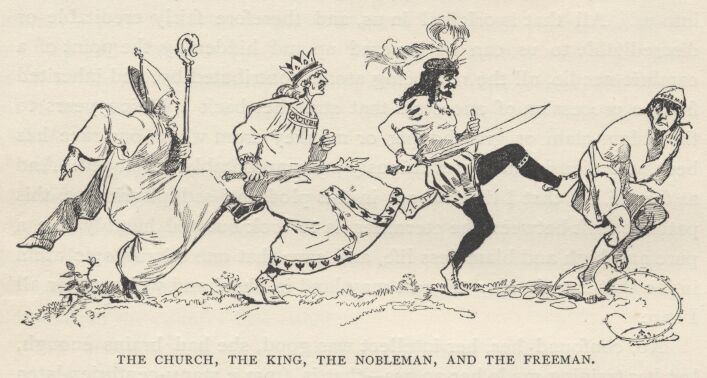
Quite true, but I meant to hang her for it some day if I lived. Some of those laws were too bad, altogether too bad. A master might kill his slave for nothing—for mere spite, malice, or to pass the time—just as we have seen that the crowned head could do it with his slave, that is to say, anybody. A gentleman could kill a free commoner, and pay for him—cash or garden-truck. A noble could kill a noble without expense, as far as the law was concerned, but reprisals in kind were to be expected. Any body could kill some body, except the commoner and the slave; these had no privileges. If they killed, it was murder, and the law wouldn’t stand murder. It made short work of the experimenter—and of his family, too, if he murdered somebody who belonged up among the ornamental ranks. If a commoner gave a noble even so much as a Damiens-scratch which didn’t kill or even hurt, he got Damiens’ dose for it just the same; they pulled him to rags and tatters with horses, and all the world came to see the show, and crack jokes, and have a good time; and some of the performances of the best people present were as tough, and as properly unprintable, as any that have been printed by the pleasant Casanova in his chapter about the dismemberment of Louis XV’s poor awkward enemy.
Quite true, but I meant to hang her for it someday if I lived. Some of those laws were too bad, altogether too bad. A master could kill his slave for nothing, out of spite or malice, or to pass the time. As we have seen, the king could do the same to his slave, meaning anyone at all. A gentleman could kill a free commoner and pay for him in cash or garden produce. A noble could kill a noble without paying anything, as far as the law was concerned. But he could expect revenge in kind. Any body could kill some body, except a commoner or a slave. They had no privileges. If they killed, it was murder, and the law wouldn’t tolerate murder. It made short work of anyone who tried it. It made short work of his family, too, if he murdered someone from the ornamental ranks. If a commoner gave a noble even a Damiens-scratch that didn’t kill or even hurt him, he got Damiens’ dose all the same. They tore him to rags and tatters with horses. All the world came to watch the show, crack jokes, and have a good time. Some of the performances by the best people there were just as rough and just as unprintable as anything the pleasant Casanova printed in his chapter about the dismemberment of Louis XV’s poor, awkward enemy.
I had had enough of this grisly place by this time, and wanted to leave, but I couldn’t, because I had something on my mind that my conscience kept prodding me about, and wouldn’t let me forget. If I had the remaking of man, he wouldn’t have any conscience. It is one of the most disagreeable things connected with a person; and although it certainly does a great deal of good, it cannot be said to pay, in the long run; it would be much better to have less good and more comfort. Still, this is only my opinion, and I am only one man; others, with less experience, may think differently. They have a right to their view. I only stand to this: I have noticed my conscience for many years, and I know it is more trouble and bother to me than anything else I started with. I suppose that in the beginning I prized it, because we prize anything that is ours; and yet how foolish it was to think so. If we look at it in another way, we see how absurd it is: if I had an anvil in me would I prize it? Of course not. And yet when you come to think, there is no real difference between a conscience and an anvil—I mean for comfort. I have noticed it a thousand times. And you could dissolve an anvil with acids, when you couldn’t stand it any longer; but there isn’t any way that you can work off a conscience—at least so it will stay worked off; not that I know of, anyway.
By now, I had had enough of this grisly place and wanted to leave. But I couldn’t. Something was on my mind, and my conscience kept prodding me about it and wouldn’t let me forget. If I could remake human beings, they wouldn’t have a conscience. It is one of the most unpleasant things a person has. And although it certainly does a great deal of good, it isn’t worth it in the long run. It would be much better to have less good and more comfort. Still, that’s only my opinion, and I’m only one man. Others, with less experience, may think differently. They have a right to their view. All I insist on is this: I’ve watched my conscience for many years. I know it causes me more trouble and bother than anything else I started with. I suppose I valued it at first, because we value anything that belongs to us. Yet how foolish it was to think that way. If we look at it another way, we can see how absurd it is. If I had an anvil inside me, would I value it? Of course not. And when you think about it, there’s no real difference between a conscience and an anvil. I mean, as far as comfort goes. I’ve noticed that a thousand times. And when you couldn’t stand an anvil any longer, you could dissolve it with acids. But there’s no way to get rid of a conscience, at least not for good. Not that I know of, anyway.
There was something I wanted to do before leaving, but it was a disagreeable matter, and I hated to go at it. Well, it bothered me all the morning. I could have mentioned it to the old king, but what would be the use?—he was but an extinct volcano; he had been active in his time, but his fire was out, this good while, he was only a stately ash-pile now; gentle enough, and kindly enough for my purpose, without doubt, but not usable. He was nothing, this so-called king: the queen was the only power there. And she was a Vesuvius. As a favor, she might consent to warm a flock of sparrows for you, but then she might take that very opportunity to turn herself loose and bury a city. However, I reflected that as often as any other way, when you are expecting the worst, you get something that is not so bad, after all.
There was something I wanted to do before leaving, but it was unpleasant, and I hated to start. It bothered me all morning. I could have mentioned it to the old king, but what good would that do? He was an extinct volcano. He had been active in his time, but his fire had been out for a long while. Now he was only a stately pile of ashes. He was certainly gentle and kind enough for my purpose, but he was no use. This so-called king was nothing. The queen was the only power there. And she was a Vesuvius. As a favor, she might agree to warm a flock of sparrows for you. But she might also take that very opportunity to let loose and bury a city. Still, I thought that when you expect the worst, you often get something that isn't so bad after all.
So I braced up and placed my matter before her royal Highness. I said I had been having a general jail-delivery at Camelot and among neighboring castles, and with her permission I would like to examine her collection, her bric-a-brac—that is to say, her prisoners. She resisted; but I was expecting that. But she finally consented. I was expecting that, too, but not so soon. That about ended my discomfort. She called her guards and torches, and we went down into the dungeons. These were down under the castle’s foundations, and mainly were small cells hollowed out of the living rock. Some of these cells had no light at all. In one of them was a woman, in foul rags, who sat on the ground, and would not answer a question or speak a word, but only looked up at us once or twice, through a cobweb of tangled hair, as if to see what casual thing it might be that was disturbing with sound and light the meaningless dull dream that was become her life; after that, she sat bowed, with her dirt-caked fingers idly interlocked in her lap, and gave no further sign. This poor rack of bones was a woman of middle age, apparently; but only apparently; she had been there nine years, and was eighteen when she entered. She was a commoner, and had been sent here on her bridal night by Sir Breuse Sance Pite, a neighboring lord whose vassal her father was, and to which said lord she had refused what has since been called le droit du seigneur, and, moreover, had opposed violence to violence and spilt half a gill of his almost sacred blood. The young husband had interfered at that point, believing the bride’s life in danger, and had flung the noble out into the midst of the humble and trembling wedding guests, in the parlor, and left him there astonished at this strange treatment, and implacably embittered against both bride and groom. The said lord being cramped for dungeon-room had asked the queen to accommodate his two criminals, and here in her bastile they had been ever since; hither, indeed, they had come before their crime was an hour old, and had never seen each other since. Here they were, kenneled like toads in the same rock; they had passed nine pitch dark years within fifty feet of each other, yet neither knew whether the other was alive or not. All the first years, their only question had been—asked with beseechings and tears that might have moved stones, in time, perhaps, but hearts are not stones: “Is he alive?” “Is she alive?” But they had never got an answer; and at last that question was not asked any more—or any other.
So I gathered my courage and presented my request to Her Royal Highness. I said I had been freeing prisoners at Camelot and in neighboring castles. With her permission, I would like to examine her collection, her bric-a-brac, that is, her prisoners. She resisted, but I expected that. Finally she agreed. I had expected that too, but not so soon. That pretty much ended my discomfort. She called for her guards and torches, and we went down to the dungeons. The dungeons lay beneath the castle’s foundations. Most of the cells were small chambers carved out of solid rock. Some had no light at all. In one sat a woman on the ground, dressed in filthy rags. She would not answer a question or say a word. She only looked up at us once or twice through a web of tangled hair. She seemed to be checking what passing thing might be disturbing her life’s meaningless, dull dream with sound and light. Then she sat with her head bowed and her dirt-caked fingers loosely intertwined in her lap. She gave no further sign. This poor skeleton of a woman appeared to be middle-aged, but only appeared so. She had been there nine years and was eighteen when she entered. She was a commoner. Sir Breuse Sance Pite, a neighboring lord whose vassal her father was, had sent her there on her wedding night. She had refused him what was later called le droit du seigneur. She had also met violence with violence and spilled half a gill of his nearly sacred blood. At that point, her young husband intervened, believing her life was in danger. He threw the nobleman into the parlor, among the humble, trembling wedding guests. He left him there, astonished by this strange treatment and filled with relentless bitterness toward both bride and groom. The lord was short of dungeon space, so he asked the queen to take in his two criminals. They had been in her prison ever since. They had arrived before their crime was an hour old and had never seen each other again. There they were, penned up like toads in the same rock. They had spent nine completely dark years within fifty feet of each other. Yet neither knew whether the other was alive. Throughout those first years, their only question had been asked with pleas and tears. Those might, in time, perhaps have moved stones, but hearts are not stones: “Is he alive?” “Is she alive?” But they never received an answer. At last, they stopped asking that question, or any other.
I wanted to see the man, after hearing all this. He was thirty-four years old, and looked sixty. He sat upon a squared block of stone, with his head bent down, his forearms resting on his knees, his long hair hanging like a fringe before his face, and he was muttering to himself. He raised his chin and looked us slowly over, in a listless dull way, blinking with the distress of the torchlight, then dropped his head and fell to muttering again and took no further notice of us. There were some pathetically suggestive dumb witnesses present. On his wrists and ankles were cicatrices, old smooth scars, and fastened to the stone on which he sat was a chain with manacles and fetters attached; but this apparatus lay idle on the ground, and was thick with rust. Chains cease to be needed after the spirit has gone out of a prisoner.
After hearing all this, I wanted to see the man. He was thirty-four years old and looked sixty. He sat on a square block of stone, his head bent down and his forearms resting on his knees. His long hair hung like a fringe in front of his face, and he was muttering to himself. He raised his chin and slowly looked us over, his expression dull and lifeless. He blinked, troubled by the torchlight. Then he dropped his head and began muttering again, paying us no further attention. There were some silent witnesses that told a heartbreaking story. His wrists and ankles bore old, smooth scars. A chain was fastened to the stone he sat on, with wrist and ankle shackles attached. But the chain and shackles lay unused on the ground, thick with rust. Chains are no longer needed once a prisoner's spirit has been broken.
I could not rouse the man; so I said we would take him to her, and see—to the bride who was the fairest thing in the earth to him, once—roses, pearls, and dew made flesh, for him; a wonder-work, the master-work of nature: with eyes like no other eyes, and voice like no other voice, and a freshness, and lithe young grace, and beauty, that belonged properly to the creatures of dreams—as he thought—and to no other. The sight of her would set his stagnant blood leaping; the sight of her—
I could not wake the man, so I said we would take him to her and see. Once, his bride had been the fairest thing on earth to him. To him, she was roses, pearls, and dew made flesh, a marvel, nature's masterpiece. Her eyes were like no other eyes, and her voice was like no other voice. Her freshness, graceful young movements, and beauty belonged only to creatures of dreams, or so he thought. The sight of her would set his sluggish blood racing. The sight of her...
But it was a disappointment. They sat together on the ground and looked dimly wondering into each other’s faces a while, with a sort of weak animal curiosity; then forgot each other’s presence, and dropped their eyes, and you saw that they were away again and wandering in some far land of dreams and shadows that we know nothing about.
But it was a disappointment. They sat together on the ground, looking into each other’s faces for a while. They seemed vaguely puzzled, with a kind of weak animal curiosity. Then they forgot each other was there and lowered their eyes. You could see that they were gone again, wandering in some faraway land of dreams and shadows we know nothing about.
I had them taken out and sent to their friends. The queen did not like it much. Not that she felt any personal interest in the matter, but she thought it disrespectful to Sir Breuse Sance Pite. However, I assured her that if he found he couldn’t stand it I would fix him so that he could.
I had them taken out and sent to their friends. The queen didn’t like it much. She had no personal interest in the matter, but she thought it was disrespectful to Sir Breuse Sance Pite. However, I assured her that if he couldn’t stand it, I would fix him so he could.
I set forty-seven prisoners loose out of those awful rat-holes, and left only one in captivity. He was a lord, and had killed another lord, a sort of kinsman of the queen. That other lord had ambushed him to assassinate him, but this fellow had got the best of him and cut his throat. However, it was not for that that I left him jailed, but for maliciously destroying the only public well in one of his wretched villages. The queen was bound to hang him for killing her kinsman, but I would not allow it: it was no crime to kill an assassin. But I said I was willing to let her hang him for destroying the well; so she concluded to put up with that, as it was better than nothing.
I freed forty-seven prisoners from those awful rat-holes and left only one behind. He was a lord who had killed another lord, a sort of relative of the queen. The other lord had ambushed him, intending to murder him. But this fellow got the better of him and cut his throat. That was not why I left him in jail, though. I left him there because he had maliciously destroyed the only public well in one of his wretched villages. The queen was determined to hang him for killing her relative, but I would not allow it. Killing an assassin was no crime. But I said I was willing to let her hang him for destroying the well. So she decided to accept that, since it was better than nothing.
Dear me, for what trifling offenses the most of those forty-seven men and women were shut up there! Indeed, some were there for no distinct offense at all, but only to gratify somebody’s spite; and not always the queen’s by any means, but a friend’s. The newest prisoner’s crime was a mere remark which he had made. He said he believed that men were about all alike, and one man as good as another, barring clothes. He said he believed that if you were to strip the nation naked and send a stranger through the crowd, he couldn’t tell the king from a quack doctor, nor a duke from a hotel clerk. Apparently here was a man whose brains had not been reduced to an ineffectual mush by idiotic training. I set him loose and sent him to the Factory.
Good grief, most of those forty-seven men and women were locked up for such trivial offenses! Some had committed no clear offense at all. They were there simply because someone wanted to spite them. And it was not always the queen who wanted revenge. Sometimes it was a friend of hers. The newest prisoner’s crime was just a remark he had made. He said he believed men were all much alike, and one man was as good as another, apart from their clothes. He said he believed that if you stripped the whole nation naked, a stranger walking through the crowd couldn’t tell the king from a quack doctor, or a duke from a hotel clerk. Apparently, here was a man whose brains had not been turned to useless mush by idiotic training. I set him free and sent him to the Factory.
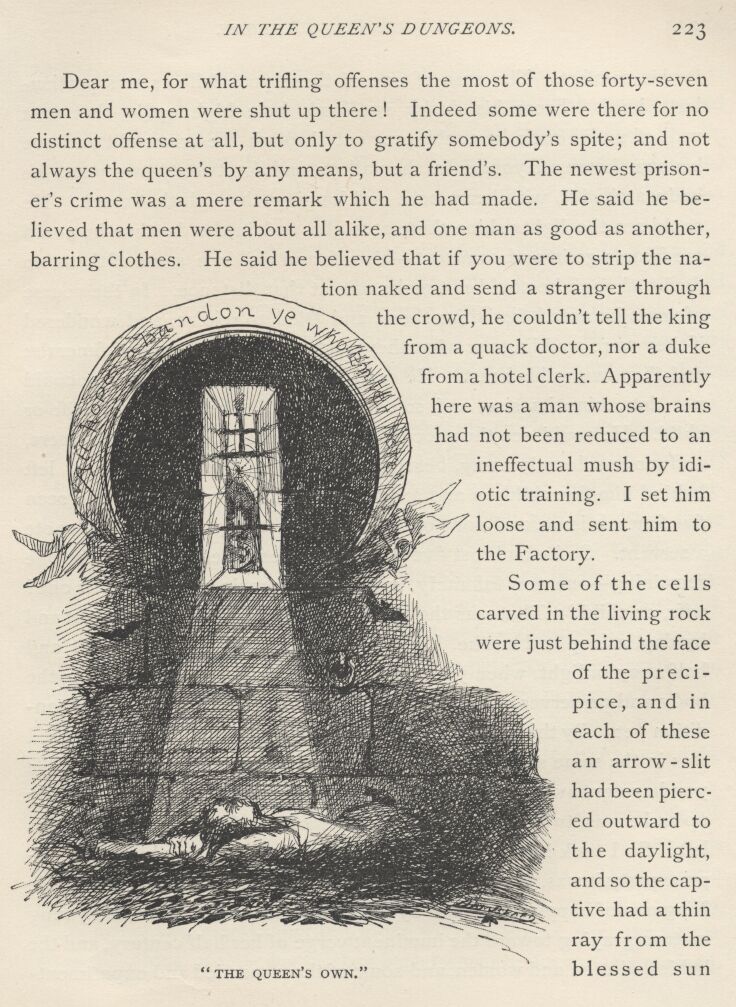
Some of the cells carved in the living rock were just behind the face of the precipice, and in each of these an arrow-slit had been pierced outward to the daylight, and so the captive had a thin ray from the blessed sun for his comfort. The case of one of these poor fellows was particularly hard. From his dusky swallow’s hole high up in that vast wall of native rock he could peer out through the arrow-slit and see his own home off yonder in the valley; and for twenty-two years he had watched it, with heartache and longing, through that crack. He could see the lights shine there at night, and in the daytime he could see figures go in and come out—his wife and children, some of them, no doubt, though he could not make out at that distance. In the course of years he noted festivities there, and tried to rejoice, and wondered if they were weddings or what they might be. And he noted funerals; and they wrung his heart. He could make out the coffin, but he could not determine its size, and so could not tell whether it was wife or child. He could see the procession form, with priests and mourners, and move solemnly away, bearing the secret with them. He had left behind him five children and a wife; and in nineteen years he had seen five funerals issue, and none of them humble enough in pomp to denote a servant. So he had lost five of his treasures; there must still be one remaining—one now infinitely, unspeakably precious,—but which one? wife, or child? That was the question that tortured him, by night and by day, asleep and awake. Well, to have an interest, of some sort, and half a ray of light, when you are in a dungeon, is a great support to the body and preserver of the intellect. This man was in pretty good condition yet. By the time he had finished telling me his distressful tale, I was in the same state of mind that you would have been in yourself, if you have got average human curiosity; that is to say, I was as burning up as he was to find out which member of the family it was that was left. So I took him over home myself; and an amazing kind of a surprise party it was, too—typhoons and cyclones of frantic joy, and whole Niagaras of happy tears; and by George! we found the aforetime young matron graying toward the imminent verge of her half century, and the babies all men and women, and some of them married and experimenting familywise themselves—for not a soul of the tribe was dead! Conceive of the ingenious devilishness of that queen: she had a special hatred for this prisoner, and she had invented all those funerals herself, to scorch his heart with; and the sublimest stroke of genius of the whole thing was leaving the family-invoice a funeral short, so as to let him wear his poor old soul out guessing.
Some of the cells carved into the solid rock lay just behind the cliff face. Each had an arrow-slit cut through to the daylight. So each prisoner had a thin ray from the blessed sun to comfort him. One poor fellow had a particularly hard time. From his dim swallow’s nest high in that vast wall of rock, he could peer through the arrow-slit. There he could see his own home, far away in the valley. For twenty-two years he had watched it through that crack, with heartache and longing. At night he could see lights shining there. During the day he could see figures going in and out. Some were no doubt his wife and children, though he could not make them out at that distance. Over the years he noticed celebrations there and tried to rejoice. He wondered whether they were weddings or what they might be. He also saw funerals, and they wrung his heart. He could make out the coffin, but he could not tell its size. So he could not tell whether it held his wife or a child. He could see the procession form, with priests and mourners, and move solemnly away, carrying the secret with them. He had left five children and a wife behind. In nineteen years he had seen five funerals leave the house. None had been modest enough to suggest it was for a servant. So he had lost five of his treasures. One must still be left, now infinitely, unspeakably precious. But which one? His wife, or a child? That question tortured him night and day, asleep and awake. Well, when you are in a dungeon, having some kind of interest and half a ray of light is a great support to the body and helps preserve the mind. This man was still in pretty good condition. By the time he finished telling me his distressing story, I felt just as you would have felt, if you have average human curiosity. That is, I was as eager as he was to find out which member of his family was left. So I took him home myself. And what an amazing surprise party it was! There were typhoons and cyclones of frantic joy, and whole Niagaras of happy tears. And by George! We found that his once young wife was turning gray and nearing fifty. The babies were all grown men and women. Some were married and experimenting with families of their own. For not a soul in the whole tribe was dead! Imagine the ingenious devilishness of that queen. She had a special hatred for this prisoner, and she had invented all those funerals herself to scorch his heart. The most brilliant stroke of all was leaving the family count one funeral short. That way, she could let him wear his poor old soul out guessing.
But for me, he never would have got out. Morgan le Fay hated him with her whole heart, and she never would have softened toward him. And yet his crime was committed more in thoughtlessness than deliberate depravity. He had said she had red hair. Well, she had; but that was no way to speak of it. When red-headed people are above a certain social grade their hair is auburn.
Without me, he never would have gotten out. Morgan le Fay hated him with all her heart, and she never would have softened toward him. Yet his crime was more thoughtless than deliberately wicked. He had said she had red hair. Well, she did, but that was no way to put it. When redheaded people are above a certain social class, their hair is auburn.
Consider it: among these forty-seven captives there were five whose names, offenses, and dates of incarceration were no longer known! One woman and four men—all bent, and wrinkled, and mind-extinguished patriarchs. They themselves had long ago forgotten these details; at any rate they had mere vague theories about them, nothing definite and nothing that they repeated twice in the same way. The succession of priests whose office it had been to pray daily with the captives and remind them that God had put them there, for some wise purpose or other, and teach them that patience, humbleness, and submission to oppression was what He loved to see in parties of a subordinate rank, had traditions about these poor old human ruins, but nothing more. These traditions went but little way, for they concerned the length of the incarceration only, and not the names of the offenses. And even by the help of tradition the only thing that could be proven was that none of the five had seen daylight for thirty-five years: how much longer this privation has lasted was not guessable. The king and the queen knew nothing about these poor creatures, except that they were heirlooms, assets inherited, along with the throne, from the former firm. Nothing of their history had been transmitted with their persons, and so the inheriting owners had considered them of no value, and had felt no interest in them. I said to the queen:
Consider this: among these forty-seven captives were five whose names, offenses, and dates of imprisonment were no longer known! One woman and four men, all bent and wrinkled, their minds gone with age. They had long ago forgotten these details themselves. At best, they had vague theories, nothing definite and nothing they repeated the same way twice. A succession of priests had prayed daily with the captives. The priests had reminded them that God had put them there for some wise purpose or other. They had taught them that he loved to see patience, humility, and submission to oppression in people of lower rank. These priests had passed down stories about the five poor old human ruins, but nothing more. The stories told very little. They concerned only the length of imprisonment, not the captives’ names or offenses. Even with the help of these stories, only one thing could be proved. None of the five had seen daylight for thirty-five years. No one could guess how much longer they had been deprived of it. The king and queen knew nothing about these poor creatures, except that they were heirlooms, assets inherited with the throne from the former firm. No history had been passed down with them. So their inheriting owners had regarded them as worthless and taken no interest in them. I said to the queen:
“Then why in the world didn’t you set them free?”
“Then why in the world didn’t you set them free?”
The question was a puzzler. She didn’t know why she hadn’t, the thing had never come up in her mind. So here she was, forecasting the veritable history of future prisoners of the Castle d’If, without knowing it. It seemed plain to me now, that with her training, those inherited prisoners were merely property—nothing more, nothing less. Well, when we inherit property, it does not occur to us to throw it away, even when we do not value it.
The question puzzled her. She didn’t know why she hadn’t. The question had never occurred to her. So, without knowing it, she was predicting the real history of future prisoners of the Castle d’If. It seemed clear to me now that, given her upbringing, those prisoners she had inherited were simply property, nothing more, nothing less. Well, when we inherit property, we don’t think of throwing it away, even when we don’t value it.
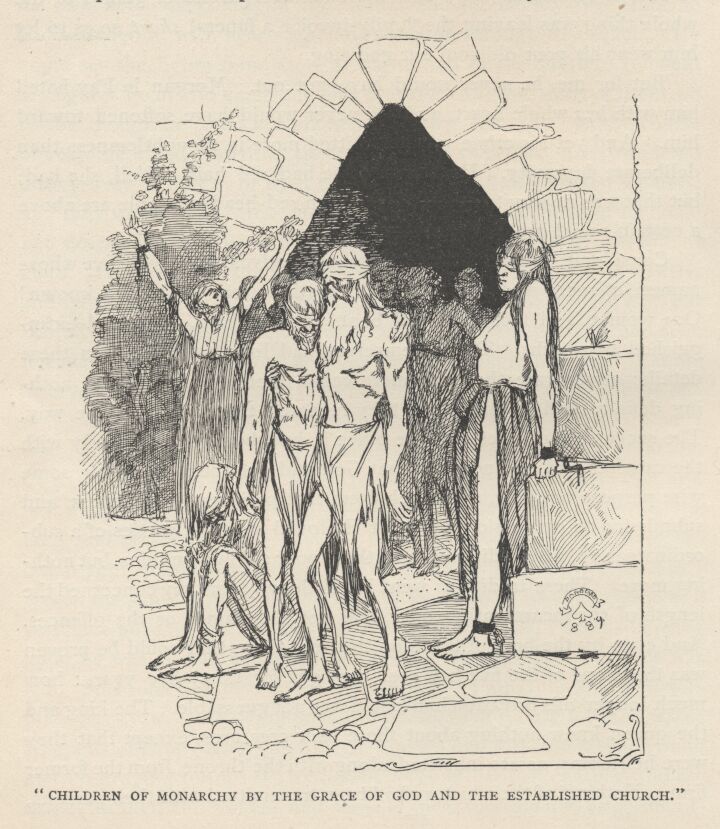
When I brought my procession of human bats up into the open world and the glare of the afternoon sun—previously blindfolding them, in charity for eyes so long untortured by light—they were a spectacle to look at. Skeletons, scarecrows, goblins, pathetic frights, every one; legitimatest possible children of Monarchy by the Grace of God and the Established Church. I muttered absently:
I brought my procession of human bats into the open world and the glare of the afternoon sun. Beforehand, I had blindfolded them, out of kindness to eyes so long spared the torture of light. They were a sight to behold. Every one of them was a skeleton, a scarecrow, a goblin, a pitiful fright. They were the most legitimate children imaginable of Monarchy by the Grace of God and the Established Church. I muttered absently:
“I wish I could photograph them!”
“I wish I could photograph them!”
You have seen that kind of people who will never let on that they don’t know the meaning of a new big word. The more ignorant they are, the more pitifully certain they are to pretend you haven’t shot over their heads. The queen was just one of that sort, and was always making the stupidest blunders by reason of it. She hesitated a moment; then her face brightened up with sudden comprehension, and she said she would do it for me.
You’ve seen people who will never admit they don’t know what a new, fancy word means. The more ignorant they are, the more pathetically determined they are to pretend they understood you. The queen was just that sort of person. Because of this, she was always making the stupidest mistakes. She hesitated for a moment. Then her face brightened as if she suddenly understood, and she said she would do it for me.
I thought to myself: She? why what can she know about photography? But it was a poor time to be thinking. When I looked around, she was moving on the procession with an axe!
I thought to myself: She? What could she know about photography? But this was no time to be thinking. When I looked around, she was advancing on the procession with an axe!
Well, she certainly was a curious one, was Morgan le Fay. I have seen a good many kinds of women in my time, but she laid over them all for variety. And how sharply characteristic of her this episode was. She had no more idea than a horse of how to photograph a procession; but being in doubt, it was just like her to try to do it with an axe.
Well, Morgan le Fay certainly was a curious one. I have seen many kinds of women in my time, but she beat them all for variety. And this episode was so typical of her. She had no more idea than a horse how to photograph a procession. But when she didn't know how to do something, it was just like her to try it with an axe.