Chapter 16
Morgan le Fay
If knights errant were to be believed, not all castles were desirable places to seek hospitality in. As a matter of fact, knights errant were not persons to be believed—that is, measured by modern standards of veracity; yet, measured by the standards of their own time, and scaled accordingly, you got the truth. It was very simple: you discounted a statement ninety-seven per cent; the rest was fact. Now after making this allowance, the truth remained that if I could find out something about a castle before ringing the door-bell—I mean hailing the warders—it was the sensible thing to do. So I was pleased when I saw in the distance a horseman making the bottom turn of the road that wound down from this castle.
If knights errant were to be believed, not all castles were good places to seek hospitality. In fact, knights errant were not people to believe, at least by modern standards of honesty. But if you judged them by the standards of their own time and adjusted accordingly, you got the truth. It was simple: you discounted a statement by ninety-seven percent. The rest was fact. Even after making that allowance, it was sensible to learn about a castle before ringing the doorbell. I mean, before calling out to the guards. So I was pleased to see a horseman in the distance, rounding the bottom bend of the road that wound down from the castle.
As we approached each other, I saw that he wore a plumed helmet, and seemed to be otherwise clothed in steel, but bore a curious addition also—a stiff square garment like a herald’s tabard. However, I had to smile at my own forgetfulness when I got nearer and read this sign on his tabard:
As we approached each other, I saw that he wore a plumed helmet and seemed to be dressed in steel. But he also wore a curious addition: a stiff, square garment like a herald’s tabard. When I got closer, I read the sign on his tabard and had to smile at my own forgetfulness:
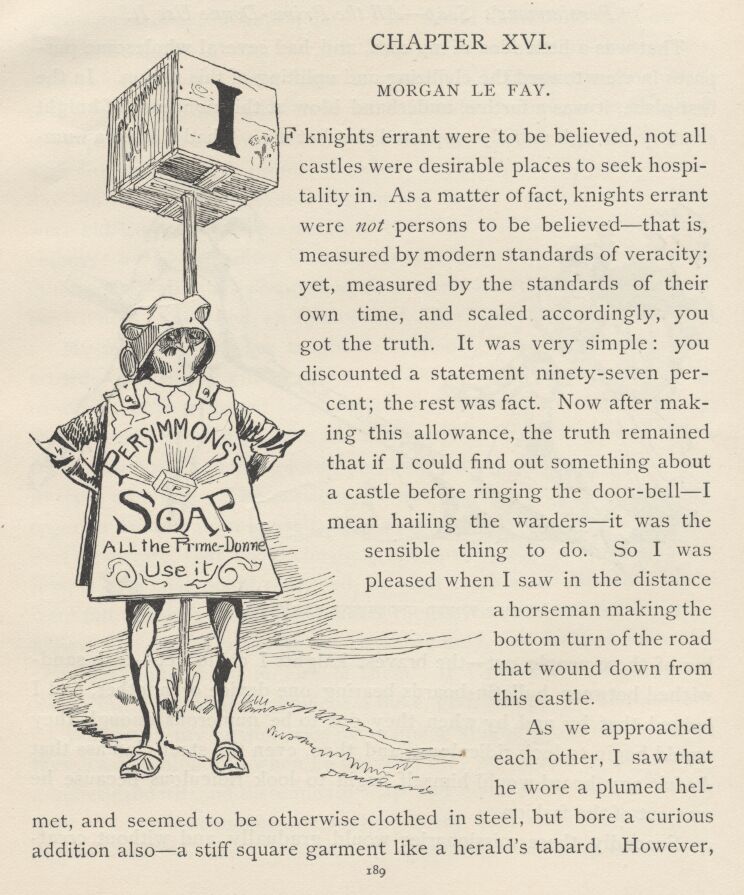
“Persimmon’s Soap—All the Prime-Donna Use It.”
“Persimmon’s Soap: All the Prima Donnas Use It.”
That was a little idea of my own, and had several wholesome purposes in view toward the civilizing and uplifting of this nation. In the first place, it was a furtive, underhand blow at this nonsense of knight errantry, though nobody suspected that but me. I had started a number of these people out—the bravest knights I could get—each sandwiched between bulletin-boards bearing one device or another, and I judged that by and by when they got to be numerous enough they would begin to look ridiculous; and then, even the steel-clad ass that hadn’t any board would himself begin to look ridiculous because he was out of the fashion.
That was a little idea of my own. It had several worthy purposes aimed at civilizing and uplifting this nation. First, it was a sneaky, underhanded blow at the nonsense of knight errantry, though nobody suspected that but me. I had sent out a number of these people, the bravest knights I could find. Each one was sandwiched between bulletin boards displaying one design or another. I figured that once there were enough of them, they would start to look ridiculous. Then even the steel-clad ass who didn’t have a board would start to look ridiculous because he was out of fashion.
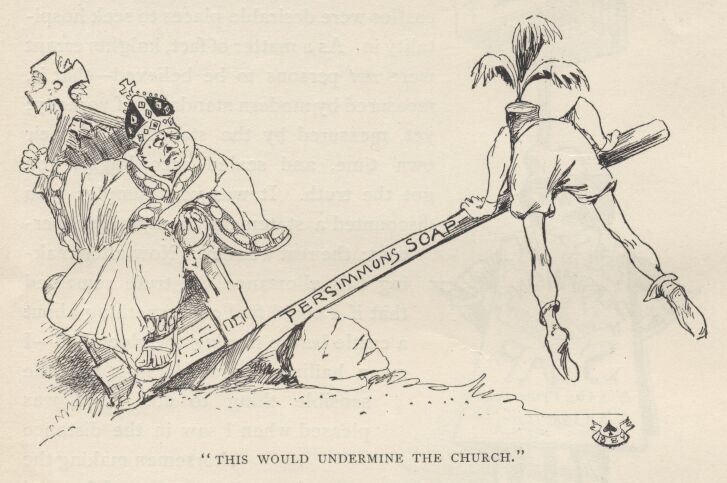
Secondly, these missionaries would gradually, and without creating suspicion or exciting alarm, introduce a rudimentary cleanliness among the nobility, and from them it would work down to the people, if the priests could be kept quiet. This would undermine the Church. I mean would be a step toward that. Next, education—next, freedom—and then she would begin to crumble. It being my conviction that any Established Church is an established crime, an established slave-pen, I had no scruples, but was willing to assail it in any way or with any weapon that promised to hurt it. Why, in my own former day—in remote centuries not yet stirring in the womb of time—there were old Englishmen who imagined that they had been born in a free country: a “free” country with the Corporation Act and the Test still in force in it—timbers propped against men’s liberties and dishonored consciences to shore up an Established Anachronism with.
Secondly, these missionaries would gradually introduce basic cleanliness among the nobility, without arousing suspicion or alarm. From the nobility, it would spread down to the people, if the priests could be kept quiet. This would undermine the Church. I mean, it would be a step in that direction. Next would come education, then freedom, and then the Church would begin to crumble. I believed that any Established Church was an established crime, an established slave-pen. So I had no scruples about attacking it in any way or with any weapon that promised to hurt it. Why, in my own former day, in distant centuries not yet stirring in the womb of time, there were old Englishmen who imagined they had been born in a free country. It was a “free” country where the Corporation Act and the Test were still in force. These were timbers propped against men’s liberties and dishonored consciences to shore up an Established Anachronism.
My missionaries were taught to spell out the gilt signs on their tabards—the showy gilding was a neat idea, I could have got the king to wear a bulletin-board for the sake of that barbaric splendor—they were to spell out these signs and then explain to the lords and ladies what soap was; and if the lords and ladies were afraid of it, get them to try it on a dog. The missionary’s next move was to get the family together and try it on himself; he was to stop at no experiment, however desperate, that could convince the nobility that soap was harmless; if any final doubt remained, he must catch a hermit—the woods were full of them; saints they called themselves, and saints they were believed to be. They were unspeakably holy, and worked miracles, and everybody stood in awe of them. If a hermit could survive a wash, and that failed to convince a duke, give him up, let him alone.
My missionaries were taught to read the gold-lettered signs on their tabards. The flashy gold lettering was a clever idea. I could have persuaded the king to wear a bulletin board for the sake of that barbaric splendor. The missionaries were to read the signs aloud and then explain to the lords and ladies what soap was. If the lords and ladies were afraid of soap, the missionaries were to get them to try it on a dog. Next, the missionary was to gather the family and try the soap on himself. He was to stop at no experiment, however desperate, that might convince the nobility that soap was harmless. If any final doubt remained, he had to catch a hermit. The woods were full of them. They called themselves saints, and people believed they were saints. They were unspeakably holy and worked miracles, and everyone was in awe of them. If a hermit survived a wash and that failed to convince a duke, give the duke up and leave him alone.
Whenever my missionaries overcame a knight errant on the road they washed him, and when he got well they swore him to go and get a bulletin-board and disseminate soap and civilization the rest of his days. As a consequence the workers in the field were increasing by degrees, and the reform was steadily spreading. My soap factory felt the strain early. At first I had only two hands; but before I had left home I was already employing fifteen, and running night and day; and the atmospheric result was getting so pronounced that the king went sort of fainting and gasping around and said he did not believe he could stand it much longer, and Sir Launcelot got so that he did hardly anything but walk up and down the roof and swear, although I told him it was worse up there than anywhere else, but he said he wanted plenty of air; and he was always complaining that a palace was no place for a soap factory anyway, and said if a man was to start one in his house he would be damned if he wouldn’t strangle him. There were ladies present, too, but much these people ever cared for that; they would swear before children, if the wind was their way when the factory was going.
Whenever my missionaries defeated a knight errant on the road, they washed him. When he recovered, they made him swear to get a bulletin board. He also had to swear to spread soap and civilization for the rest of his life. As a result, the number of workers in the field gradually increased, and the reform steadily spread. My soap factory felt the strain early. At first I had only two workers. But before I left home, I was already employing fifteen and running the factory night and day. The smell grew so strong that the king went around fainting and gasping. He said he didn't think he could stand it much longer. Sir Launcelot hardly did anything but walk up and down the roof and swear. I told him the smell was worse up there than anywhere else, but he said he wanted plenty of air. He was always complaining that a palace was no place for a soap factory anyway. He said that if a man started one in his house, he would be damned if he wouldn't strangle him. There were ladies present, too, but these people hardly cared about that. They would swear in front of children if the wind carried the smell their way while the factory was running.
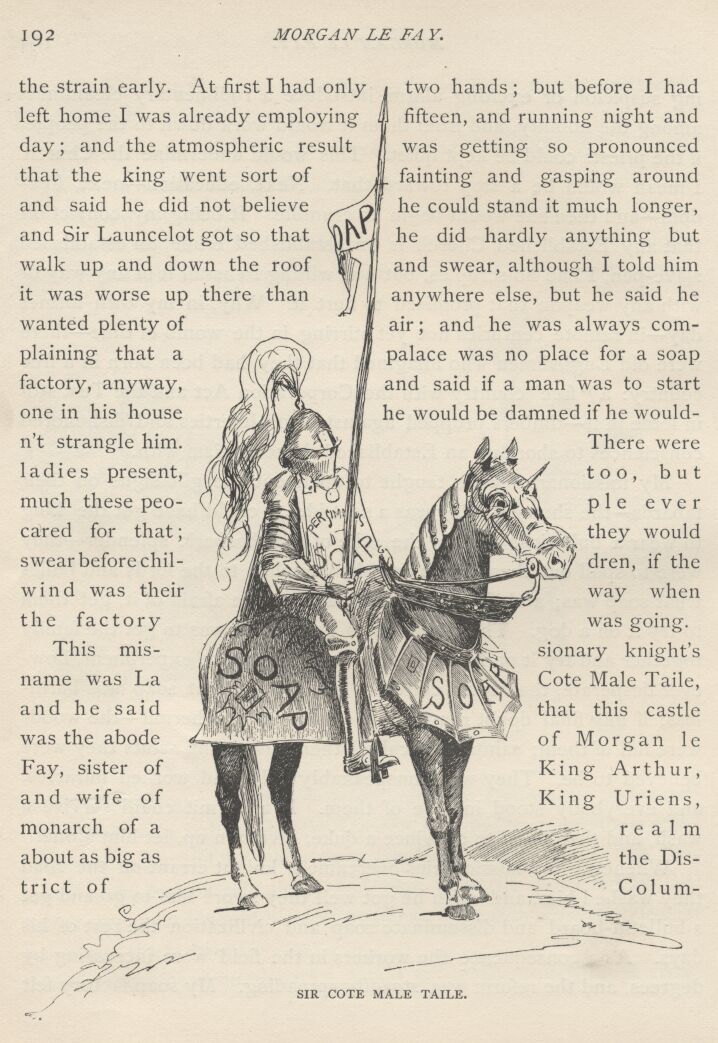
This missionary knight’s name was La Cote Male Taile, and he said that this castle was the abode of Morgan le Fay, sister of King Arthur, and wife of King Uriens, monarch of a realm about as big as the District of Columbia—you could stand in the middle of it and throw bricks into the next kingdom. “Kings” and “Kingdoms” were as thick in Britain as they had been in little Palestine in Joshua’s time, when people had to sleep with their knees pulled up because they couldn’t stretch out without a passport.
This missionary knight was named La Cote Male Taile. He said the castle was home to Morgan le Fay, King Arthur’s sister and King Uriens’s wife. Uriens ruled a kingdom about as big as the District of Columbia. You could stand in the middle and throw bricks into the next kingdom. “Kings” and “Kingdoms” were as plentiful in Britain as they had been in little Palestine in Joshua’s time. Back then, people had to sleep with their knees pulled up because they couldn’t stretch out without a passport.
La Cote was much depressed, for he had scored here the worst failure of his campaign. He had not worked off a cake; yet he had tried all the tricks of the trade, even to the washing of a hermit; but the hermit died. This was, indeed, a bad failure, for this animal would now be dubbed a martyr, and would take his place among the saints of the Roman calendar. Thus made he his moan, this poor Sir La Cote Male Taile, and sorrowed passing sore. And so my heart bled for him, and I was moved to comfort and stay him. Wherefore I said:
La Cote was deeply depressed, because he had suffered the worst failure of his campaign here. He had not managed to sell a single cake. Yet he had tried every trick of the trade, even washing a hermit. But the hermit died. This was a terrible failure, because the animal would now be called a martyr. He would take his place among the saints of the Roman calendar. Poor Sir La Cote Male Taile complained of his troubles and grieved bitterly. My heart bled for him, and I felt moved to comfort and support him. So I said:
“Forbear to grieve, fair knight, for this is not a defeat. We have brains, you and I; and for such as have brains there are no defeats, but only victories. Observe how we will turn this seeming disaster into an advertisement; an advertisement for our soap; and the biggest one, to draw, that was ever thought of; an advertisement that will transform that Mount Washington defeat into a Matterhorn victory. We will put on your bulletin-board, ‘Patronized by the elect.’ How does that strike you?”
“Don’t grieve, fair knight, because this is not a defeat. You and I have brains. For people with brains, there are no defeats, only victories. Watch how we turn this apparent disaster into an advertisement for our soap. It will be the biggest crowd-puller anyone has ever thought of. It will turn that Mount Washington defeat into a Matterhorn victory. We’ll put this on your bulletin board: ‘Patronized by the elect.’ What do you think of that?”
“Verily, it is wonderly bethought!”
“Truly, that is a wonderful idea!”
“Well, a body is bound to admit that for just a modest little one-line ad, it’s a corker.”
“Well, you have to admit that for a modest little one-line ad, it’s a real winner.”
So the poor colporteur’s griefs vanished away. He was a brave fellow, and had done mighty feats of arms in his time. His chief celebrity rested upon the events of an excursion like this one of mine, which he had once made with a damsel named Maledisant, who was as handy with her tongue as was Sandy, though in a different way, for her tongue churned forth only railings and insult, whereas Sandy’s music was of a kindlier sort. I knew his story well, and so I knew how to interpret the compassion that was in his face when he bade me farewell. He supposed I was having a bitter hard time of it.
So the poor colporteur’s troubles vanished. He was a brave fellow who had performed mighty feats of arms in his day. He was best known for an adventure like mine. He had once gone on an excursion with a damsel named Maledisant, who was as handy with her tongue as Sandy. But Maledisant used hers differently. Her tongue poured out nothing but scolding and insults, while Sandy’s music was kinder. I knew his story well, so I understood the compassion on his face when he said goodbye. He thought I was having a terribly hard time.
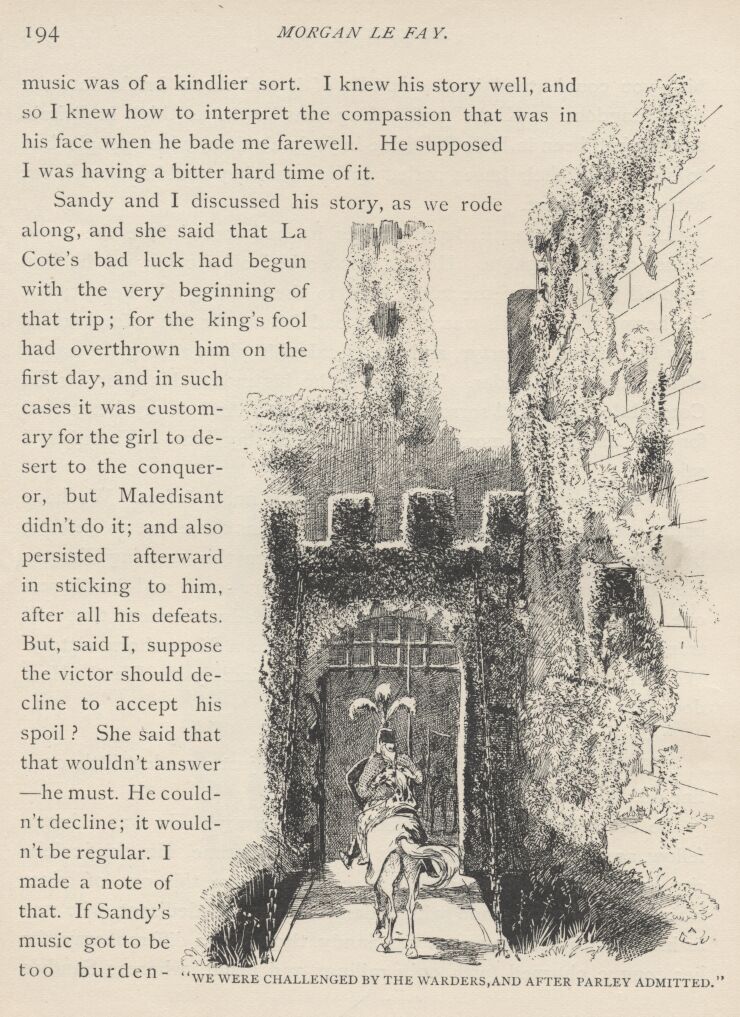
Sandy and I discussed his story, as we rode along, and she said that La Cote’s bad luck had begun with the very beginning of that trip; for the king’s fool had overthrown him on the first day, and in such cases it was customary for the girl to desert to the conqueror, but Maledisant didn’t do it; and also persisted afterward in sticking to him, after all his defeats. But, said I, suppose the victor should decline to accept his spoil? She said that that wouldn’t answer—he must. He couldn’t decline; it wouldn’t be regular. I made a note of that. If Sandy’s music got to be too burdensome, some time, I would let a knight defeat me, on the chance that she would desert to him.
Sandy and I discussed his story as we rode along. She said La Cote’s bad luck had begun at the very start of that trip. The king’s fool had defeated him on the first day. In such cases, it was customary for the girl to leave with the victor. But Maledisant didn’t do that. She also kept staying with La Cote after all his defeats. But I asked what would happen if the victor refused to accept his prize. She said that wouldn’t do. He had to accept her. He couldn’t refuse, because that wouldn’t follow the rules. I made a note of that. If Sandy’s music ever became too burdensome, I would let a knight defeat me. Then perhaps she would leave with him.
In due time we were challenged by the warders, from the castle walls, and after a parley admitted. I have nothing pleasant to tell about that visit. But it was not a disappointment, for I knew Mrs. le Fay by reputation, and was not expecting anything pleasant. She was held in awe by the whole realm, for she had made everybody believe she was a great sorceress. All her ways were wicked, all her instincts devilish. She was loaded to the eyelids with cold malice. All her history was black with crime; and among her crimes murder was common. I was most curious to see her; as curious as I could have been to see Satan. To my surprise she was beautiful; black thoughts had failed to make her expression repulsive, age had failed to wrinkle her satin skin or mar its bloomy freshness. She could have passed for old Uriens’ granddaughter, she could have been mistaken for sister to her own son.
Soon, guards on the castle walls challenged us. After a discussion, they let us in. I have nothing pleasant to tell about that visit. But I was not disappointed. I knew Mrs. le Fay by reputation and expected nothing pleasant. The whole realm feared her because she had convinced everyone she was a great sorceress. Everything she did was wicked, and all her instincts were devilish. She was full to the brim with cold malice. Her entire history was stained with crime, and murder was common among her crimes. I was as curious to see her as I would have been to see Satan. To my surprise, she was beautiful. Her evil thoughts had not made her expression ugly. Age had not wrinkled her silky skin or spoiled its youthful freshness. She could have passed for old Uriens’ granddaughter, or been mistaken for her own son’s sister.
As soon as we were fairly within the castle gates we were ordered into her presence. King Uriens was there, a kind-faced old man with a subdued look; and also the son, Sir Uwaine le Blanchemains, in whom I was, of course, interested on account of the tradition that he had once done battle with thirty knights, and also on account of his trip with Sir Gawaine and Sir Marhaus, which Sandy had been aging me with. But Morgan was the main attraction, the conspicuous personality here; she was head chief of this household, that was plain. She caused us to be seated, and then she began, with all manner of pretty graces and graciousnesses, to ask me questions. Dear me, it was like a bird or a flute, or something, talking. I felt persuaded that this woman must have been misrepresented, lied about. She trilled along, and trilled along, and presently a handsome young page, clothed like the rainbow, and as easy and undulatory of movement as a wave, came with something on a golden salver, and, kneeling to present it to her, overdid his graces and lost his balance, and so fell lightly against her knee. She slipped a dirk into him in as matter-of-course a way as another person would have harpooned a rat!
As soon as we were inside the castle gates, we were ordered to appear before her. King Uriens was there, a kind-faced old man who looked subdued. His son, Sir Uwaine le Blanchemains, was there too. Naturally, I was interested in him because of the story that he had once fought thirty knights. I was also interested because of his trip with Sir Gawaine and Sir Marhaus. Sandy had been making me feel old telling me about that trip. But Morgan was the main attraction, the personality who stood out. She was clearly the chief of this household. She had us sit down, then began asking me questions with all sorts of charming, gracious manners. Dear me, it sounded like a bird or a flute or something talking. I became convinced that this woman must have been misrepresented and lied about. She trilled on and on. Presently a handsome young page came in, dressed like a rainbow and moving as smoothly as a wave. He carried something on a golden tray. As he knelt to offer it to her, he overdid his graceful movements and lost his balance. He fell lightly against her knee. She slipped a dagger into him as casually as another person would have speared a rat!
Poor child! he slumped to the floor, twisted his silken limbs in one great straining contortion of pain, and was dead. Out of the old king was wrung an involuntary “O-h!” of compassion. The look he got, made him cut it suddenly short and not put any more hyphens in it. Sir Uwaine, at a sign from his mother, went to the anteroom and called some servants, and meanwhile madame went rippling sweetly along with her talk.
Poor child! He slumped to the floor, his silky limbs twisting in one great spasm of pain, and died. The old king let out an involuntary “O-h!” of compassion. The look he got made him cut it short and add no more hyphens. At a sign from his mother, Sir Uwaine went to the anteroom and called some servants. Meanwhile, madame went on chatting sweetly.
I saw that she was a good housekeeper, for while she talked she kept a corner of her eye on the servants to see that they made no balks in handling the body and getting it out; when they came with fresh clean towels, she sent back for the other kind; and when they had finished wiping the floor and were going, she indicated a crimson fleck the size of a tear which their duller eyes had overlooked. It was plain to me that La Cote Male Taile had failed to see the mistress of the house. Often, how louder and clearer than any tongue, does dumb circumstantial evidence speak.
I could see she was a good housekeeper. While she talked, she kept an eye on the servants to make sure they didn’t fumble as they carried the body out. When they brought fresh, clean towels, she sent them back for the other kind. After they had finished wiping the floor and were leaving, she pointed out a crimson spot the size of a tear that their less sharp eyes had missed. It was plain to me that La Cote Male Taile had failed to see the mistress of the house. How often silent circumstantial evidence speaks louder and clearer than any tongue.
Morgan le Fay rippled along as musically as ever. Marvelous woman. And what a glance she had: when it fell in reproof upon those servants, they shrunk and quailed as timid people do when the lightning flashes out of a cloud. I could have got the habit myself. It was the same with that poor old Brer Uriens; he was always on the ragged edge of apprehension; she could not even turn toward him but he winced.
Morgan le Fay went on speaking as musically as ever. What a remarkable woman. And what a look she had! When she gave the servants a disapproving glance, they shrank and cowered like timid people when lightning flashes from a cloud. I could have gotten into that habit myself. It was the same with poor old Brer Uriens. He was always on edge, expecting trouble. She couldn't even turn toward him without his flinching.
In the midst of the talk I let drop a complimentary word about King Arthur, forgetting for the moment how this woman hated her brother. That one little compliment was enough. She clouded up like storm; she called for her guards, and said:
During the conversation, I said something complimentary about King Arthur, forgetting for a moment how much this woman hated her brother. That one little compliment was enough. Her face darkened like a storm. She called for her guards and said:
“Hale me these varlets to the dungeons.”
“Drag these scoundrels to the dungeons.”
That struck cold on my ears, for her dungeons had a reputation. Nothing occurred to me to say—or do. But not so with Sandy. As the guard laid a hand upon me, she piped up with the tranquilest confidence, and said:
That sent a chill through me, because her dungeons had a reputation. I couldn't think of anything to say or do. But Sandy could. As the guard put a hand on me, she spoke up with perfect calm and confidence, and said:
“God’s wounds, dost thou covet destruction, thou maniac? It is The Boss!”
“Good God, do you want to be destroyed, you maniac? It’s The Boss!”
Now what a happy idea that was!—and so simple; yet it would never have occurred to me. I was born modest; not all over, but in spots; and this was one of the spots.
What a brilliant idea that was! It was so simple, yet I would never have thought of it. I was born modest. Not entirely modest, just in certain spots, and this was one of them.
The effect upon madame was electrical. It cleared her countenance and brought back her smiles and all her persuasive graces and blandishments; but nevertheless she was not able to entirely cover up with them the fact that she was in a ghastly fright. She said:
The effect on madame was electric. Her face brightened, and her smiles and all her persuasive charm returned. But even so, she could not entirely hide the fact that she was terribly frightened. She said:
“La, but do list to thine handmaid! as if one gifted with powers like to mine might say the thing which I have said unto one who has vanquished Merlin, and not be jesting. By mine enchantments I foresaw your coming, and by them I knew you when you entered here. I did but play this little jest with hope to surprise you into some display of your art, as not doubting you would blast the guards with occult fires, consuming them to ashes on the spot, a marvel much beyond mine own ability, yet one which I have long been childishly curious to see.”
“Oh, listen to your servant! As if someone with powers like mine could say such a thing to the man who defeated Merlin and not be joking. My magic foretold your coming, and it told me who you were when you entered. I played this little joke hoping to surprise you into showing your powers. I had no doubt you would blast the guards with magical fire, burning them to ashes on the spot. That is a wonder far beyond my own ability, but one I have long been childishly curious to see.”
The guards were less curious, and got out as soon as they got permission.
The guards were less curious and left as soon as they got permission.