Chapter 15
Sandy’s Story
“And so I’m proprietor of some knights,” said I, as we rode off. “Who would ever have supposed that I should live to list up assets of that sort. I shan’t know what to do with them; unless I raffle them off. How many of them are there, Sandy?”
“And so I own some knights,” I said as we rode off. “Who would have thought I’d live to list knights among my assets? I won’t know what to do with them, unless I raffle them off. How many are there, Sandy?”
“Seven, please you, sir, and their squires.”
“Seven, sir, and their squires.”
“It is a good haul. Who are they? Where do they hang out?”
“That’s a good haul. Who are they? Where do they hang out?”
“Where do they hang out?”
“Where do they hang out?”
“Yes, where do they live?”
“Yes, where do they live?”
“Ah, I understood thee not. That will I tell eftsoons.” Then she said musingly, and softly, turning the words daintily over her tongue: “Hang they out—hang they out—where hang—where do they hang out; eh, right so; where do they hang out. Of a truth the phrase hath a fair and winsome grace, and is prettily worded withal. I will repeat it anon and anon in mine idlesse, whereby I may peradventure learn it. Where do they hang out. Even so! already it falleth trippingly from my tongue, and forasmuch as—”
“Ah, I didn't understand you. I'll tell you soon.” Then she spoke softly and thoughtfully, savoring the words on her tongue: “Hang they out, hang they out, where hang, where do they hang out. Yes, that's right. Where do they hang out. Truly, the phrase has a lovely, charming grace, and it is prettily worded too. I'll repeat it again and again in my spare time, so that perhaps I can learn it. Where do they hang out. There! Already it trips off my tongue, and since...”
“Don’t forget the cowboys, Sandy.”
“Don’t forget the cowboys, Sandy.”
“Cowboys?”
“Cowboys?”
“Yes; the knights, you know: You were going to tell me about them. A while back, you remember. Figuratively speaking, game’s called.”
“Yes, the knights, you know. You were going to tell me about them. Remember? That was a while ago. Figuratively speaking, the game’s back on.”
“Game—”
“Game...”
“Yes, yes, yes! Go to the bat. I mean, get to work on your statistics, and don’t burn so much kindling getting your fire started. Tell me about the knights.”
“Yes, yes, yes! Step up to the plate. I mean, get to work on your statistics, and stop taking so long to get started. Tell me about the knights.”
“I will well, and lightly will begin. So they two departed and rode into a great forest. And—”
“I will gladly do so, and I will begin right away. So the two of them set out and rode into a great forest. And...”
“Great Scott!”
“Wow!”
You see, I recognized my mistake at once. I had set her works a-going; it was my own fault; she would be thirty days getting down to those facts. And she generally began without a preface and finished without a result. If you interrupted her she would either go right along without noticing, or answer with a couple of words, and go back and say the sentence over again. So, interruptions only did harm; and yet I had to interrupt, and interrupt pretty frequently, too, in order to save my life; a person would die if he let her monotony drip on him right along all day.
You see, I realized my mistake at once. I had gotten her started, so it was my own fault. She would take thirty days to get to those facts. She usually began without an introduction and finished without reaching a conclusion. If you interrupted her, she would either keep going without noticing or answer with a couple of words. Then she would go back and repeat the sentence. So interruptions only made things worse. Yet I had to interrupt her, and pretty often, too, to save my life. A person would die if he let her monotonous talk drip on him all day.
“Great Scott!” I said in my distress. She went right back and began over again:
“Great Scott!” I said, distressed. She went right back and started again:
“So they two departed and rode into a great forest. And—”
“So the two of them left and rode into a large forest. And…”
“Which two?”
“Which two?”
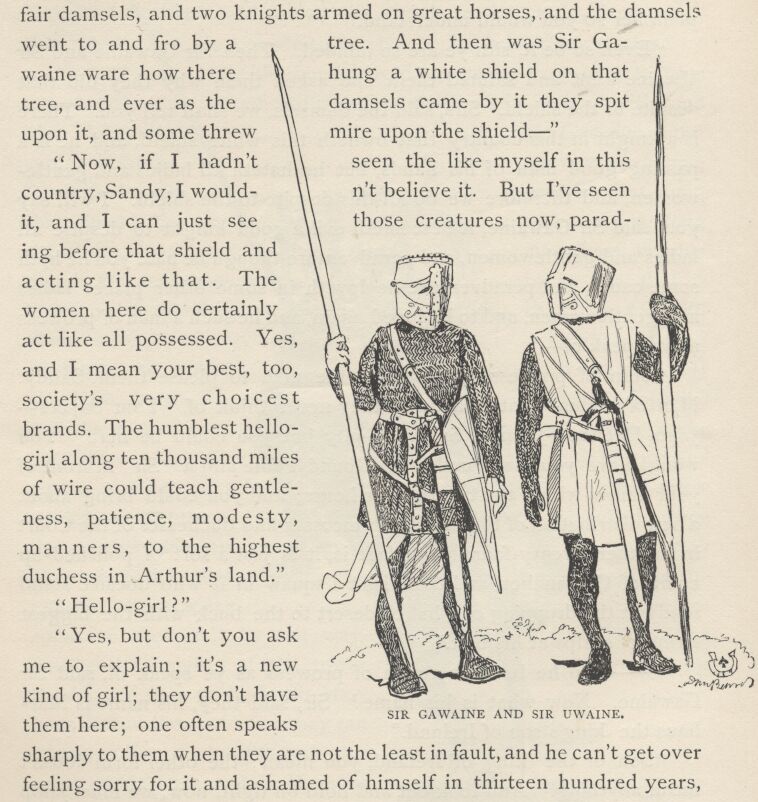
“Sir Gawaine and Sir Uwaine. And so they came to an abbey of monks, and there were well lodged. So on the morn they heard their masses in the abbey, and so they rode forth till they came to a great forest; then was Sir Gawaine ware in a valley by a turret, of twelve fair damsels, and two knights armed on great horses, and the damsels went to and fro by a tree. And then was Sir Gawaine ware how there hung a white shield on that tree, and ever as the damsels came by it they spit upon it, and some threw mire upon the shield—”
“Sir Gawaine and Sir Uwaine came to an abbey of monks, where they were well lodged. The next morning, they attended their masses in the abbey. Then they rode on until they came to a great forest. In a valley by a turret, Sir Gawaine saw twelve beautiful young women and two knights in armor on great horses. The young women were walking back and forth past a tree. Sir Gawaine noticed a white shield hanging on the tree. Each time the young women passed it, they spat on it, and some threw mud at it.”
“Now, if I hadn’t seen the like myself in this country, Sandy, I wouldn’t believe it. But I’ve seen it, and I can just see those creatures now, parading before that shield and acting like that. The women here do certainly act like all possessed. Yes, and I mean your best, too, society’s very choicest brands. The humblest hello-girl along ten thousand miles of wire could teach gentleness, patience, modesty, manners, to the highest duchess in Arthur’s land.”
“Now, Sandy, if I hadn’t seen the same thing myself in this country, I wouldn’t believe it. But I have seen it. I can just picture those creatures now, parading before that shield and acting that way. The women here certainly act as if they’re possessed. Yes, I mean your best women too, the very finest in society. The humblest telephone operator along ten thousand miles of wire could teach the highest duchess in Arthur’s land gentleness, patience, modesty, and manners.”
“Hello-girl?”
“Telephone operator?”
“Yes, but don’t you ask me to explain; it’s a new kind of a girl; they don’t have them here; one often speaks sharply to them when they are not the least in fault, and he can’t get over feeling sorry for it and ashamed of himself in thirteen hundred years, it’s such shabby mean conduct and so unprovoked; the fact is, no gentleman ever does it—though I—well, I myself, if I’ve got to confess—”
“Yes, but don’t ask me to explain. It’s a new kind of girl, and they don’t have them here. A man often speaks sharply to them when they haven’t done anything wrong. He can’t stop feeling sorry and ashamed for thirteen hundred years afterward. It’s such shabby, mean behavior, and so unprovoked. In fact, no gentleman ever does it. Though I, well, if I have to confess, I myself...”
“Peradventure she—”
“Perhaps she...”
“Never mind her; never mind her; I tell you I couldn’t ever explain her so you would understand.”
“Never mind her. Never mind her. I’m telling you, I could never explain her in a way you’d understand.”
“Even so be it, sith ye are so minded. Then Sir Gawaine and Sir Uwaine went and saluted them, and asked them why they did that despite to the shield. Sirs, said the damsels, we shall tell you. There is a knight in this country that owneth this white shield, and he is a passing good man of his hands, but he hateth all ladies and gentlewomen, and therefore we do all this despite to the shield. I will say you, said Sir Gawaine, it beseemeth evil a good knight to despise all ladies and gentlewomen, and peradventure though he hate you he hath some cause, and peradventure he loveth in some other places ladies and gentlewomen, and to be loved again, and he such a man of prowess as ye speak of—”
“So be it, since that is what you wish. Then Sir Gawaine and Sir Uwaine went and greeted them. They asked why the damsels were treating the shield with such disrespect. Sirs, the damsels said, we will tell you. A knight in this country owns this white shield. He is an exceptionally skilled fighter, but he hates all ladies and gentlewomen. That is why we treat his shield with such disrespect. I tell you, said Sir Gawaine, it is wrong for a good knight to despise all ladies and gentlewomen. Perhaps, though he hates you, he has some reason. And perhaps he loves ladies and gentlewomen elsewhere, and they love him in return. And he is such a valiant man as you say he is...”
“Man of prowess—yes, that is the man to please them, Sandy. Man of brains—that is a thing they never think of. Tom Sayers—John Heenan—John L. Sullivan—pity but you could be here. You would have your legs under the Round Table and a ‘Sir’ in front of your names within the twenty-four hours; and you could bring about a new distribution of the married princesses and duchesses of the Court in another twenty-four. The fact is, it is just a sort of polished-up court of Comanches, and there isn’t a squaw in it who doesn’t stand ready at the dropping of a hat to desert to the buck with the biggest string of scalps at his belt.”
“A man of strength and courage, yes, that’s the man to please them, Sandy. A man with brains is something they never think of. Tom Sayers, John Heenan, John L. Sullivan, it’s a pity you can’t be here. Within twenty-four hours, you’d have seats at the Round Table and a ‘Sir’ before your names. Within another twenty-four hours, you could have the Court’s married princesses and duchesses divided up among different men. The fact is, this is just a sort of polished-up court of Comanches. Every squaw in it is ready at the drop of a hat to desert to the buck with the most scalps on his belt.”
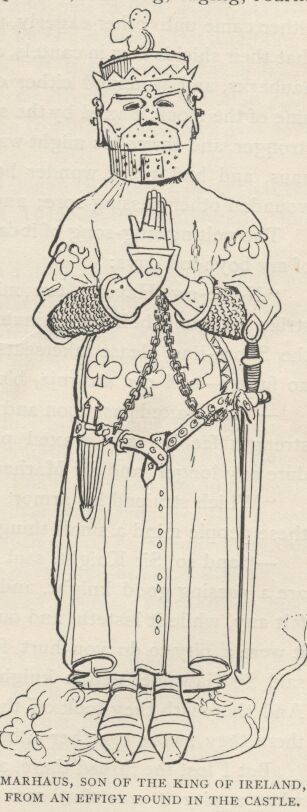
“—and he be such a man of prowess as ye speak of, said Sir Gawaine. Now, what is his name? Sir, said they, his name is Marhaus the king’s son of Ireland.”
“If he is as skilled a fighter as you say,” said Sir Gawaine, “what is his name?” They said, “Sir, his name is Marhaus. He is the son of the king of Ireland.”
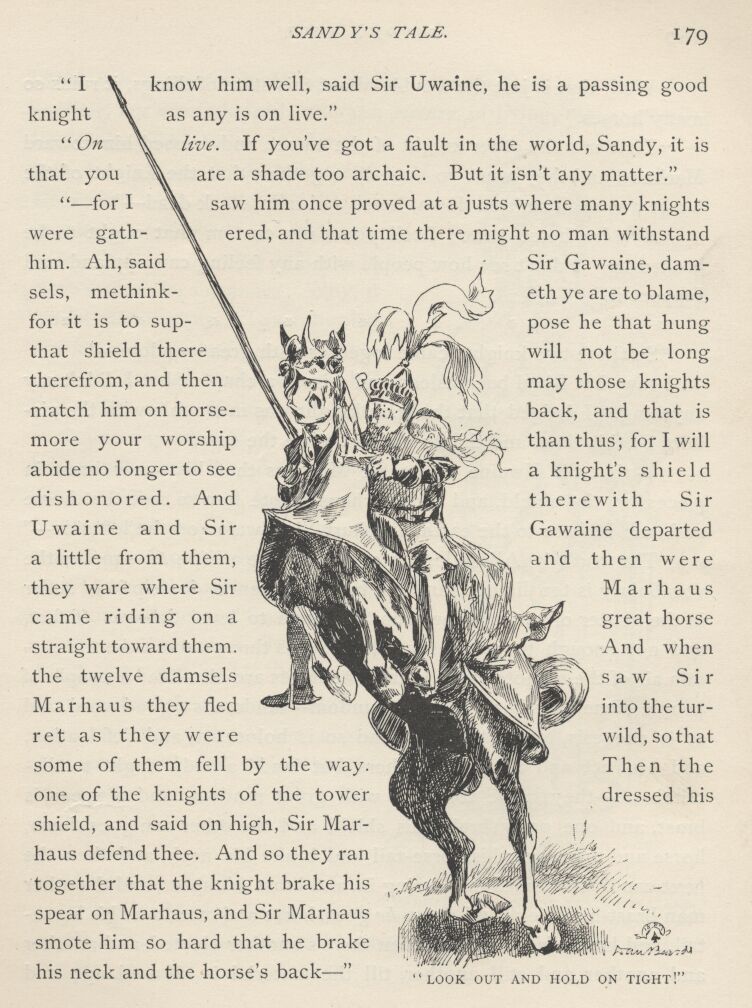
“Son of the king of Ireland, you mean; the other form doesn’t mean anything. And look out and hold on tight, now, we must jump this gully.... There, we are all right now. This horse belongs in the circus; he is born before his time.”
“Son of the king of Ireland, you mean. The other way of saying it doesn’t mean anything. Watch out and hold on tight now. We have to jump this ditch.... There, we’re all right now. This horse belongs in the circus. He was born before his time.”
“I know him well, said Sir Uwaine, he is a passing good knight as any is on live.”
“I know him well, said Sir Uwaine. He is as good a knight as any alive.”
“On live. If you’ve got a fault in the world, Sandy, it is that you are a shade too archaic. But it isn’t any matter.”
“Alive. If you have one fault, Sandy, it’s that you’re a little too old-fashioned. But it doesn’t matter.”
“—for I saw him once proved at a justs where many knights were gathered, and that time there might no man withstand him. Ah, said Sir Gawaine, damsels, methinketh ye are to blame, for it is to suppose he that hung that shield there will not be long therefrom, and then may those knights match him on horseback, and that is more your worship than thus; for I will abide no longer to see a knight’s shield dishonored. And therewith Sir Uwaine and Sir Gawaine departed a little from them, and then were they ware where Sir Marhaus came riding on a great horse straight toward them. And when the twelve damsels saw Sir Marhaus they fled into the turret as they were wild, so that some of them fell by the way. Then the one of the knights of the tower dressed his shield, and said on high, Sir Marhaus defend thee. And so they ran together that the knight brake his spear on Marhaus, and Sir Marhaus smote him so hard that he brake his neck and the horse’s back—”
“For I once saw him tested at a joust where many knights had gathered, and no man could withstand him then. Ah, damsels, said Sir Gawaine, I think you are at fault. The knight who hung that shield there will probably not be away long. Then those knights can fight him on horseback, which would bring you more honor than this. I will stay no longer to see a knight’s shield dishonored. Then Sir Uwaine and Sir Gawaine moved a little away from them. They saw Sir Marhaus riding straight toward them on a great horse. When the twelve damsels saw Sir Marhaus, they fled into the turret like madwomen. Some of them fell on the way. Then one of the tower’s knights raised his shield and called out, Sir Marhaus, defend yourself. They charged at each other, and the knight broke his spear against Marhaus. Sir Marhaus struck him so hard that he broke the knight’s neck and the horse’s back.”
“Well, that is just the trouble about this state of things, it ruins so many horses.”
“Well, that’s just the trouble with this situation. It ruins so many horses.”
“That saw the other knight of the turret, and dressed him toward Marhaus, and they went so eagerly together, that the knight of the turret was soon smitten down, horse and man, stark dead—”
“The other knight of the turret saw that and charged at Marhaus. They fought so fiercely that the knight of the turret was soon struck down. Both he and his horse were killed outright.”
“Another horse gone; I tell you it is a custom that ought to be broken up. I don’t see how people with any feeling can applaud and support it.”
“Another horse gone. I tell you, it’s a custom that ought to be stopped. I don’t see how people with any feelings can applaud and support it.”
“So these two knights came together with great random—”
“So the two knights clashed at great speed...”
I saw that I had been asleep and missed a chapter, but I didn’t say anything. I judged that the Irish knight was in trouble with the visitors by this time, and this turned out to be the case.
I realized I had fallen asleep and missed a chapter, but I didn’t say anything. I figured the Irish knight was in trouble with the visitors by now, and I was right.
“—that Sir Uwaine smote Sir Marhaus that his spear brast in pieces on the shield, and Sir Marhaus smote him so sore that horse and man he bare to the earth, and hurt Sir Uwaine on the left side—”
“Sir Uwaine struck Sir Marhaus so hard that his spear shattered against Sir Marhaus's shield. Sir Marhaus struck him so hard that both Sir Uwaine and his horse fell to the ground. Sir Marhaus also wounded Sir Uwaine on his left side.”
“The truth is, Alisande, these archaics are a little too simple; the vocabulary is too limited, and so, by consequence, descriptions suffer in the matter of variety; they run too much to level Saharas of fact, and not enough to picturesque detail; this throws about them a certain air of the monotonous; in fact the fights are all alike: a couple of people come together with great random—random is a good word, and so is exegesis, for that matter, and so is holocaust, and defalcation, and usufruct and a hundred others, but land! a body ought to discriminate—they come together with great random, and a spear is brast, and one party brake his shield and the other one goes down, horse and man, over his horse-tail and brake his neck, and then the next candidate comes randoming in, and brast his spear, and the other man brast his shield, and down he goes, horse and man, over his horse-tail, and brake his neck, and then there’s another elected, and another and another and still another, till the material is all used up; and when you come to figure up results, you can’t tell one fight from another, nor who whipped; and as a picture, of living, raging, roaring battle, sho! why, it’s pale and noiseless—just ghosts scuffling in a fog. Dear me, what would this barren vocabulary get out of the mightiest spectacle?—the burning of Rome in Nero’s time, for instance? Why, it would merely say, ‘Town burned down; no insurance; boy brast a window, fireman brake his neck!’ Why, that ain’t a picture!”
“The truth is, Alisande, these old writers are a little too simple. Their vocabulary is too limited, so their descriptions lack variety. They have too many flat deserts of fact and not enough vivid detail. That gives their descriptions a certain monotony. In fact, the fights are all alike. A couple of people charge at each other with great random. Random is a good word, and so are exegesis, holocaust, defalcation, usufruct, and a hundred others. But goodness, a person ought to choose carefully. They charge at each other with great random, and a spear breaks. One man breaks his shield, and the other falls backward over his horse’s tail, horse and all, and breaks his neck. Then the next candidate comes charging in, breaks his spear, and the other man breaks his shield. Down he goes, horse and all, over his horse’s tail, and breaks his neck. Then another is chosen, and another and another and still another, until they’ve used them all up. When you add up the results, you can’t tell one fight from another, or who won. And as a picture of a living, raging, roaring battle, well, it’s pale and silent. It’s just ghosts scuffling in a fog. “Good grief, what would this bare vocabulary make of the greatest spectacle? Take the burning of Rome in Nero’s time, for instance. Why, it would merely say, ‘Town burned down; no insurance; boy broke a window, fireman broke his neck!’ Why, that isn’t a picture!”
It was a good deal of a lecture, I thought, but it didn’t disturb Sandy, didn’t turn a feather; her steam soared steadily up again, the minute I took off the lid:
I thought it was quite a lecture, but Sandy wasn’t bothered. It didn’t ruffle a feather. The moment I took off the lid, her steam rose steadily again:
“Then Sir Marhaus turned his horse and rode toward Gawaine with his spear. And when Sir Gawaine saw that, he dressed his shield, and they aventred their spears, and they came together with all the might of their horses, that either knight smote other so hard in the midst of their shields, but Sir Gawaine’s spear brake—”
“Then Sir Marhaus turned his horse and rode toward Gawaine with his spear. When Sir Gawaine saw him coming, he raised his shield. They lowered their spears and charged each other at full speed. Each knight struck the other hard in the center of his shield, but Sir Gawaine’s spear broke.”
“I knew it would.”
“I knew it would.”
—“but Sir Marhaus’s spear held; and therewith Sir Gawaine and his horse rushed down to the earth—”
“but Sir Marhaus’s spear held, and Sir Gawaine and his horse fell to the ground.”
“Just so—and brake his back.”
“Exactly, and broke his back.”
—“and lightly Sir Gawaine rose upon his feet and pulled out his sword, and dressed him toward Sir Marhaus on foot, and therewith either came unto other eagerly, and smote together with their swords, that their shields flew in cantels, and they bruised their helms and their hauberks, and wounded either other. But Sir Gawaine, fro it passed nine of the clock, waxed by the space of three hours ever stronger and stronger and thrice his might was increased. All this espied Sir Marhaus, and had great wonder how his might increased, and so they wounded other passing sore; and then when it was come noon—”
“And Sir Gawaine sprang to his feet, drew his sword, and faced Sir Marhaus on foot. Then each eagerly rushed at the other, and they struck with their swords until their shields broke into pieces. They battered each other’s helmets and armor and wounded each other. But after nine o’clock, Sir Gawaine grew stronger and stronger for three hours, until his strength had tripled. Sir Marhaus noticed this and wondered greatly at how Sir Gawaine’s strength increased. They wounded each other very badly, and then, when noon came...”
The pelting sing-song of it carried me forward to scenes and sounds of my boyhood days:
Its relentless singsong brought back the sights and sounds of my boyhood:
“N-e-e-ew Haven! ten minutes for refreshments—knductr’ll strike the gong-bell two minutes before train leaves—passengers for the Shore-line please take seats in the rear k’yar, this k’yar don’t go no furder—ahh -pls, aw -rnjz, b’nan ners, s-a-n-d’ches, p—op-corn!”
“New Haven! Ten minutes for refreshments. The conductor’ll strike the gong bell two minutes before the train leaves. Passengers for the Shore-line, please take seats in the rear car. This car don’t go no further. _Ap_ples, _or_anges, ba_nan_as, _sand_wiches, popcorn!”
—“and waxed past noon and drew toward evensong. Sir Gawaine’s strength feebled and waxed passing faint, that unnethes he might dure any longer, and Sir Marhaus was then bigger and bigger—”
“and the day passed noon and drew toward evening. Sir Gawaine grew so weak that he could hardly hold out any longer, while Sir Marhaus grew stronger and stronger.”
“Which strained his armor, of course; and yet little would one of these people mind a small thing like that.”
“Which strained his armor, of course. But one of these people would hardly mind a small thing like that.”
—“and so, Sir Knight, said Sir Marhaus, I have well felt that ye are a passing good knight, and a marvelous man of might as ever I felt any, while it lasteth, and our quarrels are not great, and therefore it were a pity to do you hurt, for I feel you are passing feeble. Ah, said Sir Gawaine, gentle knight, ye say the word that I should say. And therewith they took off their helms and either kissed other, and there they swore together either to love other as brethren—”
“And so, Sir Knight,” said Sir Marhaus, “I have found you to be an exceptionally good knight. For as long as your strength lasts, you are as mighty as any man I have ever faced. Our quarrel is not serious, so it would be a pity to hurt you. I can feel that you are very weak.” “Ah,” said Sir Gawaine, “gentle knight, you have said what I should have said.” Then they took off their helmets and kissed each other. There they swore to love each other as brothers.
But I lost the thread there, and dozed off to slumber, thinking about what a pity it was that men with such superb strength—strength enabling them to stand up cased in cruelly burdensome iron and drenched with perspiration, and hack and batter and bang each other for six hours on a stretch—should not have been born at a time when they could put it to some useful purpose. Take a jackass, for instance: a jackass has that kind of strength, and puts it to a useful purpose, and is valuable to this world because he is a jackass; but a nobleman is not valuable because he is a jackass. It is a mixture that is always ineffectual, and should never have been attempted in the first place. And yet, once you start a mistake, the trouble is done and you never know what is going to come of it.
But I lost my train of thought and drifted off to sleep. I was thinking what a pity it was that men with such superb strength hadn't been born when they could use it for something useful. They could stand in painfully heavy iron armor, drenched in sweat, and hack and batter each other for six hours straight. Take a jackass, for instance. A jackass has that kind of strength and uses it for something useful. He is valuable to the world because he is a jackass. But a nobleman is not valuable because he is a jackass. That combination is always useless and should never have been tried in the first place. And yet, once you make a mistake, the damage is done, and you never know what will come of it.
When I came to myself again and began to listen, I perceived that I had lost another chapter, and that Alisande had wandered a long way off with her people.
When I came to myself and started listening again, I realized I had missed another chapter. Alisande had wandered far away with her people.
“And so they rode and came into a deep valley full of stones, and thereby they saw a fair stream of water; above thereby was the head of the stream, a fair fountain, and three damsels sitting thereby. In this country, said Sir Marhaus, came never knight since it was christened, but he found strange adventures—”
“And so they rode into a deep valley full of stones, where they saw a clear stream. Upstream was its source, a beautiful spring, with three young women sitting beside it. Sir Marhaus said, ‘No knight has ever come to this country since it became Christian without finding strange adventures.’”
“This is not good form, Alisande. Sir Marhaus the king’s son of Ireland talks like all the rest; you ought to give him a brogue, or at least a characteristic expletive; by this means one would recognize him as soon as he spoke, without his ever being named. It is a common literary device with the great authors. You should make him say, ‘In this country, be jabers, came never knight since it was christened, but he found strange adventures, be jabers.’ You see how much better that sounds.”
“This isn’t good form, Alisande. Sir Marhaus, the king of Ireland’s son, talks like everyone else. You should give him an Irish accent, or at least a characteristic exclamation. That way, readers would recognize him as soon as he spoke, without his name ever being mentioned. Great authors often use this literary device. You should make him say, ‘In this country, be jabers, no knight has ever come since it was christened without finding strange adventures, be jabers.’ You see how much better that sounds.”
—“came never knight but he found strange adventures, be jabers. Of a truth it doth indeed, fair lord, albeit ’tis passing hard to say, though peradventure that will not tarry but better speed with usage. And then they rode to the damsels, and either saluted other, and the eldest had a garland of gold about her head, and she was threescore winter of age or more—”
“Every knight who came found strange adventures, by jingo. It really does, my lord, though it is very hard to say. Perhaps it will come more easily with practice. Then they rode to the young women, and they greeted each other. The eldest wore a gold garland around her head. She was sixty years old or more.”
“The damsel was?”
“The young woman was?”
“Even so, dear lord—and her hair was white under the garland—”
“Yes, my lord, and her hair was white under the garland.”
“Celluloid teeth, nine dollars a set, as like as not—the loose-fit kind, that go up and down like a portcullis when you eat, and fall out when you laugh.”
“Celluloid teeth, probably nine dollars a set. The loose-fitting kind that move up and down like a portcullis when you eat and fall out when you laugh.”
“The second damsel was of thirty winter of age, with a circlet of gold about her head. The third damsel was but fifteen year of age—”
“The second young woman was thirty years old and wore a gold circlet on her head. The third young woman was only fifteen years old.”
Billows of thought came rolling over my soul, and the voice faded out of my hearing!
Waves of thought washed over me, and the voice faded from my hearing!
Fifteen! Break—my heart! oh, my lost darling! Just her age who was so gentle, and lovely, and all the world to me, and whom I shall never see again! How the thought of her carries me back over wide seas of memory to a vague dim time, a happy time, so many, many centuries hence, when I used to wake in the soft summer mornings, out of sweet dreams of her, and say “Hello, Central!” just to hear her dear voice come melting back to me with a “Hello, Hank!” that was music of the spheres to my enchanted ear. She got three dollars a week, but she was worth it.
Fifteen! Oh, my heart is breaking! My lost darling! She was just that age, so gentle and lovely, and she was all the world to me. I will never see her again! Thinking of her carries me back across vast seas of memory to a distant, hazy, happy time, many centuries from now. On soft summer mornings, I used to wake from sweet dreams of her and say “Hello, Central!” I said it just to hear her dear voice come back with a “Hello, Hank!” To my enchanted ears, it was the music of the spheres. She earned three dollars a week, but she was worth it.
I could not follow Alisande’s further explanation of who our captured knights were, now—I mean in case she should ever get to explaining who they were. My interest was gone, my thoughts were far away, and sad. By fitful glimpses of the drifting tale, caught here and there and now and then, I merely noted in a vague way that each of these three knights took one of these three damsels up behind him on his horse, and one rode north, another east, the other south, to seek adventures, and meet again and lie, after year and day. Year and day—and without baggage. It was of a piece with the general simplicity of the country.
I could no longer follow Alisande’s explanation of who our captured knights were. I mean, if she ever got around to explaining who they were. I had lost interest, and my thoughts were far away and sad. I caught bits of her rambling story here and there. From these, I vaguely gathered that each knight took one of the three damsels onto his horse behind him. One rode north, another east, and the third south. They went to seek adventures, then meet again and lie about them after a year and a day. A year and a day, without any baggage. It was typical of the country’s general simplicity.
The sun was now setting. It was about three in the afternoon when Alisande had begun to tell me who the cowboys were; so she had made pretty good progress with it—for her. She would arrive some time or other, no doubt, but she was not a person who could be hurried.
The sun was setting now. Alisande had begun telling me who the cowboys were at about three that afternoon. So she had made pretty good progress, for her. No doubt she would get to the point eventually, but she wasn't someone you could hurry.
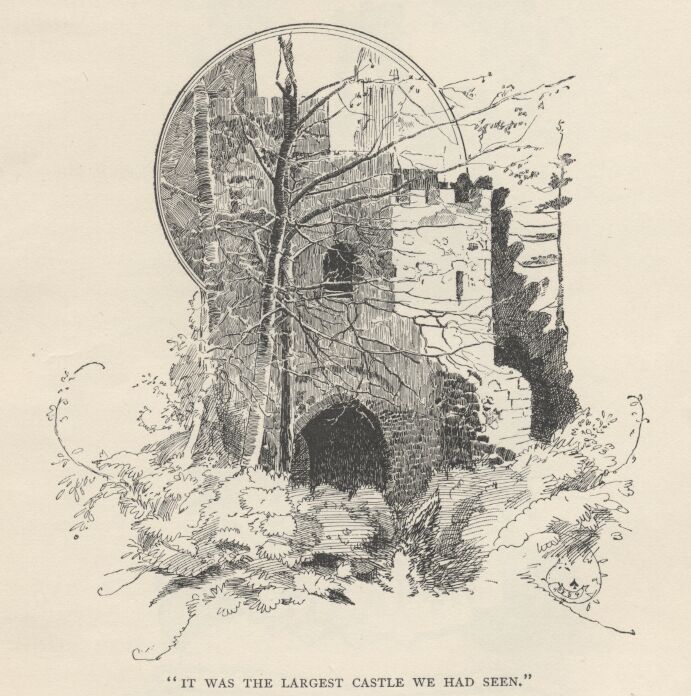
We were approaching a castle which stood on high ground; a huge, strong, venerable structure, whose gray towers and battlements were charmingly draped with ivy, and whose whole majestic mass was drenched with splendors flung from the sinking sun. It was the largest castle we had seen, and so I thought it might be the one we were after, but Sandy said no. She did not know who owned it; she said she had passed it without calling, when she went down to Camelot.
We were approaching a castle on high ground. It was huge, strong, and ancient, with gray towers and battlements charmingly draped in ivy. The whole majestic structure was bathed in the splendor of the setting sun. It was the largest castle we had seen, so I thought it might be the one we were looking for. But Sandy said no. She did not know who owned it. She said she had passed it without stopping to visit on her way down to Camelot.