Chapter 43
The Battle of the Sand Belt
In Merlin’s Cave—Clarence and I and fifty-two fresh, bright, well-educated, clean-minded young British boys. At dawn I sent an order to the factories and to all our great works to stop operations and remove all life to a safe distance, as everything was going to be blown up by secret mines, “and no telling at what moment—therefore, vacate at once.” These people knew me, and had confidence in my word. They would clear out without waiting to part their hair, and I could take my own time about dating the explosion. You couldn’t hire one of them to go back during the century, if the explosion was still impending.
In Merlin’s Cave: Clarence, fifty-two fresh, bright, well-educated, clean-minded young British boys, and I. At dawn, I sent an order to the factories and all our great works. They were to stop operations and move everyone to a safe distance. Everything was going to be blown up by secret mines, “and there’s no telling when, so get out at once.” These people knew me and trusted my word. They would clear out without stopping to part their hair. So I could take my time deciding when to set off the explosion. You couldn’t pay one of them to go back for a century, if the explosion was still pending.
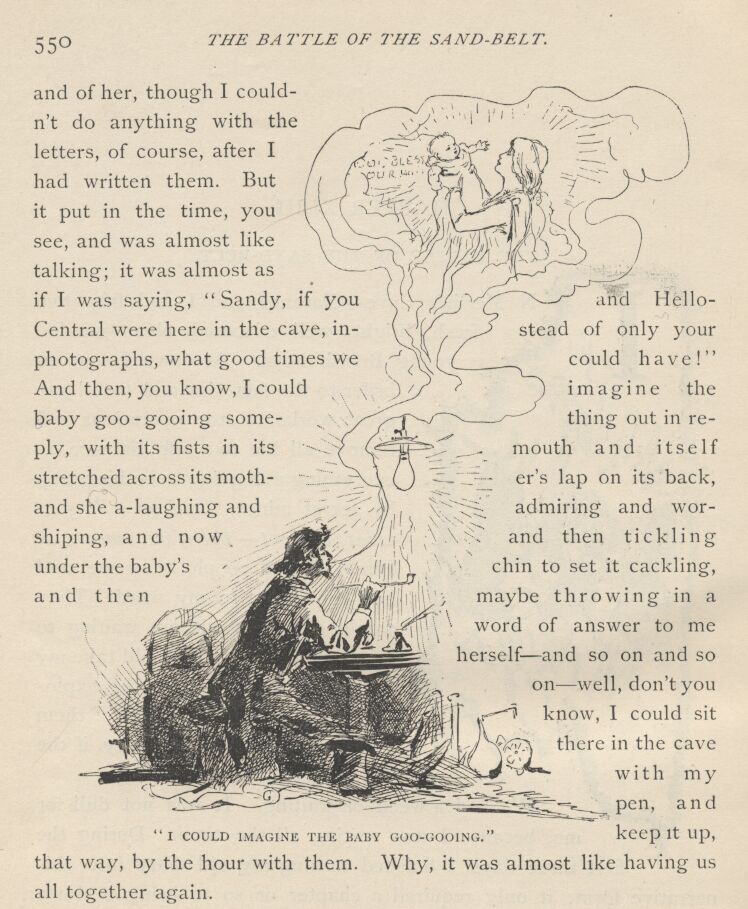
We had a week of waiting. It was not dull for me, because I was writing all the time. During the first three days, I finished turning my old diary into this narrative form; it only required a chapter or so to bring it down to date. The rest of the week I took up in writing letters to my wife. It was always my habit to write to Sandy every day, whenever we were separate, and now I kept up the habit for love of it, and of her, though I couldn’t do anything with the letters, of course, after I had written them. But it put in the time, you see, and was almost like talking; it was almost as if I was saying, “Sandy, if you and Hello-Central were here in the cave, instead of only your photographs, what good times we could have!” And then, you know, I could imagine the baby goo-gooing something out in reply, with its fists in its mouth and itself stretched across its mother’s lap on its back, and she a-laughing and admiring and worshipping, and now and then tickling under the baby’s chin to set it cackling, and then maybe throwing in a word of answer to me herself—and so on and so on—well, don’t you know, I could sit there in the cave with my pen, and keep it up, that way, by the hour with them. Why, it was almost like having us all together again.
We had a week to wait. It wasn’t dull for me, because I was writing all the time. During the first three days, I finished turning my old diary into this story. It took only another chapter or so to bring it up to date. I spent the rest of the week writing letters to my wife. I always wrote to Sandy every day whenever we were apart. Now I kept up the habit for love of writing to her and for love of her. Of course, I couldn’t do anything with the letters once I had written them. But writing passed the time, you see, and it was almost like talking. It was almost as if I were saying, “Sandy, if you and Hello-Central were here in the cave, instead of just your photographs, what good times we could have!” Then, you know, I could imagine the baby goo-gooing something in reply. The baby would be lying on its back across its mother’s lap, with its fists in its mouth. And Sandy would be laughing, admiring, and worshipping the baby. Now and then she would tickle it under the chin to make it cackle. Then perhaps she would say something to me herself, and so on and so on. Well, don’t you know, I could sit there in the cave with my pen and keep that up with them for hours. Why, it was almost like having us all together again.
I had spies out every night, of course, to get news. Every report made things look more and more impressive. The hosts were gathering, gathering; down all the roads and paths of England the knights were riding, and priests rode with them, to hearten these original Crusaders, this being the Church’s war. All the nobilities, big and little, were on their way, and all the gentry. This was all as was expected. We should thin out this sort of folk to such a degree that the people would have nothing to do but just step to the front with their republic and—
Of course, I sent spies out every night to gather news. Every report made things look more and more impressive. The armies were gathering, gathering. Knights were riding down every road and path in England. Priests rode with them to encourage these original Crusaders, since this was the Church’s war. All the nobles, great and small, were on their way, along with all the gentry. This was all as expected. We would thin out these people so much that the people would only have to step forward with their republic and...
Ah, what a donkey I was! Toward the end of the week I began to get this large and disenchanting fact through my head: that the mass of the nation had swung their caps and shouted for the republic for about one day, and there an end! The Church, the nobles, and the gentry then turned one grand, all-disapproving frown upon them and shriveled them into sheep! From that moment the sheep had begun to gather to the fold—that is to say, the camps—and offer their valueless lives and their valuable wool to the “righteous cause.” Why, even the very men who had lately been slaves were in the “righteous cause,” and glorifying it, praying for it, sentimentally slabbering over it, just like all the other commoners. Imagine such human muck as this; conceive of this folly!
Ah, what a fool I was! Toward the end of the week, a harsh, disillusioning fact began to sink in. Most of the nation had waved their caps and cheered for the republic for about one day. Then that was the end of it! The Church, the nobles, and the gentry gave them one grand look of disapproval and shriveled them into sheep! From that moment, the sheep began gathering at the fold, meaning the camps. They offered their worthless lives and their valuable wool to the “righteous cause.” Why, even the very men who had recently been slaves were supporting the “righteous cause.” They glorified it, prayed for it, and gushed sentimentally over it, just like all the other commoners. Imagine such human filth. Imagine such stupidity!
Yes, it was now “Death to the Republic!” everywhere—not a dissenting voice. All England was marching against us! Truly, this was more than I had bargained for.
Yes, the cry everywhere was now “Death to the Republic!” No one spoke against it. All England was marching against us! This was certainly more than I had bargained for.
I watched my fifty-two boys narrowly; watched their faces, their walk, their unconscious attitudes: for all these are a language—a language given us purposely that it may betray us in times of emergency, when we have secrets which we want to keep. I knew that that thought would keep saying itself over and over again in their minds and hearts, All England is marching against us! and ever more strenuously imploring attention with each repetition, ever more sharply realizing itself to their imaginations, until even in their sleep they would find no rest from it, but hear the vague and flitting creatures of the dreams say, All England—All England!—is marching against you! I knew all this would happen; I knew that ultimately the pressure would become so great that it would compel utterance; therefore, I must be ready with an answer at that time—an answer well chosen and tranquilizing.
I watched my fifty-two boys closely. I watched their faces, their walk, and their unconscious postures. All these are a language, given to us on purpose to betray us in emergencies when we have secrets to keep. I knew one thought would repeat itself in their minds and hearts: All England is marching against us! Each time, it would demand their attention more urgently and become more vivid in their imaginations. Eventually, they would find no rest from it, even in sleep. They would hear the vague, fleeting creatures in their dreams say, All England, All England! is marching against you! I knew all this would happen. I knew the pressure would eventually become so great that it would force them to speak. So I had to be ready with an answer then, one that was carefully chosen and reassuring.
I was right. The time came. They had to speak. Poor lads, it was pitiful to see, they were so pale, so worn, so troubled. At first their spokesman could hardly find voice or words; but he presently got both. This is what he said—and he put it in the neat modern English taught him in my schools:
I was right. The time came. They had to speak. Poor lads, it was heartbreaking to see how pale, worn out, and troubled they were. At first, their spokesman could hardly find his voice or the words. But soon he found both. This is what he said, in the clear modern English he had learned in my schools:
“We have tried to forget what we are—English boys! We have tried to put reason before sentiment, duty before love; our minds approve, but our hearts reproach us. While apparently it was only the nobility, only the gentry, only the twenty-five or thirty thousand knights left alive out of the late wars, we were of one mind, and undisturbed by any troubling doubt; each and every one of these fifty-two lads who stand here before you, said, ‘They have chosen—it is their affair.’ But think!—the matter is altered—All England is marching against us! Oh, sir, consider!—reflect!—these people are our people, they are bone of our bone, flesh of our flesh, we love them—do not ask us to destroy our nation!”
“We have tried to forget what we are: English boys! We have tried to put reason before feeling and duty before love. Our minds approve, but our hearts blame us. At first, it seemed we faced only the nobility, the gentry, and the twenty-five or thirty thousand knights who survived the recent wars. We all agreed then, without any troubling doubts. Every one of these fifty-two boys standing before you said, ‘They have made their choice. It is their affair.’ But think! Things have changed. All England is marching against us! Oh, sir, think about it! These people are our people. They are our own flesh and blood. We love them. Do not ask us to destroy our nation!”
Well, it shows the value of looking ahead, and being ready for a thing when it happens. If I hadn’t foreseen this thing and been fixed, that boy would have had me!—I couldn’t have said a word. But I was fixed. I said:
Well, it shows the value of looking ahead and being ready when something happens. If I hadn’t seen this coming and prepared, that boy would have had me! I wouldn’t have been able to say a word. But I was ready. I said:
“My boys, your hearts are in the right place, you have thought the worthy thought, you have done the worthy thing. You are English boys, you will remain English boys, and you will keep that name unsmirched. Give yourselves no further concern, let your minds be at peace. Consider this: while all England is marching against us, who is in the van? Who, by the commonest rules of war, will march in the front? Answer me.”
“My boys, your hearts are in the right place. You have thought and acted honorably. You are English boys, you will remain English boys, and you will keep that name untarnished. Don't worry any longer. Put your minds at ease. Consider this: all England is marching against us, but who is leading the way? According to the most basic rules of war, who will march in front? Answer me.”
“The mounted host of mailed knights.”
“The army of armored knights on horseback.”
“True. They are thirty thousand strong. Acres deep they will march. Now, observe: none but they will ever strike the sand-belt! Then there will be an episode! Immediately after, the civilian multitude in the rear will retire, to meet business engagements elsewhere. None but nobles and gentry are knights, and none but these will remain to dance to our music after that episode. It is absolutely true that we shall have to fight nobody but these thirty thousand knights. Now speak, and it shall be as you decide. Shall we avoid the battle, retire from the field?”
“True. There are thirty thousand of them. They will march in a formation acres deep. Now, notice this: only they will ever reach the sand-belt! Then something will happen! Right after that, the civilian crowd behind them will leave to attend to business elsewhere. Only nobles and gentry are knights. And only these will remain to dance to our music after that happens. It is absolutely true that we will have to fight only those thirty thousand knights. Now speak, and we will do as you decide. Shall we avoid the battle and leave the field?”
“NO!!!”
“NO!!!”
The shout was unanimous and hearty.
Everyone shouted together with enthusiasm.
“Are you—are you—well, afraid of these thirty thousand knights?”
“Are you, are you, well, afraid of these thirty thousand knights?”
That joke brought out a good laugh, the boys’ troubles vanished away, and they went gaily to their posts. Ah, they were a darling fifty-two! As pretty as girls, too.
The joke got a good laugh. The boys forgot their troubles and went happily to their posts. Ah, what a lovely group of fifty-two they were! As pretty as girls, too.
I was ready for the enemy now. Let the approaching big day come along—it would find us on deck.
I was ready for the enemy now. Let the big day come. We would be ready for it.
The big day arrived on time. At dawn the sentry on watch in the corral came into the cave and reported a moving black mass under the horizon, and a faint sound which he thought to be military music. Breakfast was just ready; we sat down and ate it.
The big day arrived on time. At dawn, the guard on watch in the corral came into the cave. He reported a moving black mass below the horizon and a faint sound he thought was military music. Breakfast was just ready, so we sat down and ate it.
This over, I made the boys a little speech, and then sent out a detail to man the battery, with Clarence in command of it.
Once that was over, I gave the boys a short speech. Then I sent a group to man the battery, with Clarence in command.
The sun rose presently and sent its unobstructed splendors over the land, and we saw a prodigious host moving slowly toward us, with the steady drift and aligned front of a wave of the sea. Nearer and nearer it came, and more and more sublimely imposing became its aspect; yes, all England was there, apparently. Soon we could see the innumerable banners fluttering, and then the sun struck the sea of armor and set it all aflash. Yes, it was a fine sight; I hadn’t ever seen anything to beat it.
The sun soon rose and spread its unobstructed light across the land. We saw an enormous army moving slowly toward us. It advanced steadily in a straight line, like a wave on the sea. It came nearer and nearer, looking more and more magnificent. Yes, all England seemed to be there. Soon we could see countless banners fluttering. Then the sun struck the sea of armor and made it all flash. Yes, it was a fine sight. I had never seen anything to beat it.
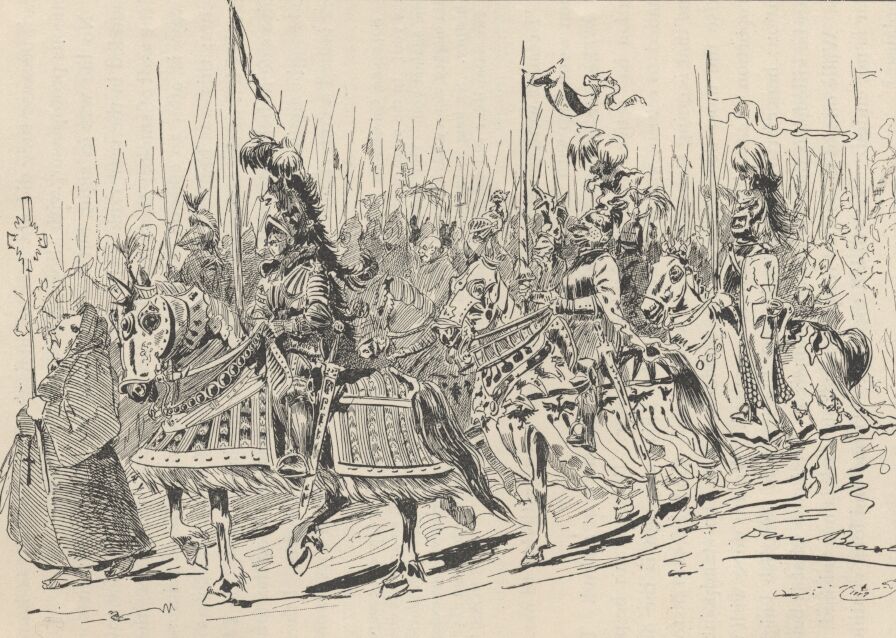
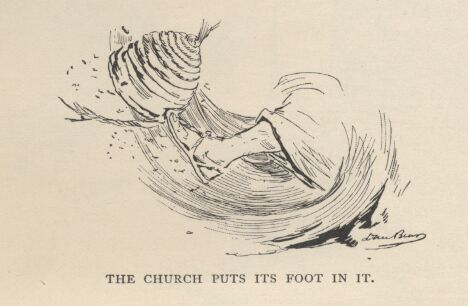
At last we could make out details. All the front ranks, no telling how many acres deep, were horsemen—plumed knights in armor. Suddenly we heard the blare of trumpets; the slow walk burst into a gallop, and then—well, it was wonderful to see! Down swept that vast horse-shoe wave—it approached the sand-belt—my breath stood still; nearer, nearer—the strip of green turf beyond the yellow belt grew narrow—narrower still—became a mere ribbon in front of the horses—then disappeared under their hoofs. Great Scott! Why, the whole front of that host shot into the sky with a thunder-crash, and became a whirling tempest of rags and fragments; and along the ground lay a thick wall of smoke that hid what was left of the multitude from our sight.
At last we could make out the details. The front ranks were all horsemen, stretching back over who knows how many acres. They were knights in armor with plumes. Suddenly we heard trumpets blare. The horses broke from a slow walk into a gallop, and then, well, it was wonderful to see! That vast horseshoe-shaped wave swept down toward the strip of sand. I held my breath. The riders came nearer and nearer. The strip of green turf beyond the yellow sand grew narrower and narrower. It became a mere ribbon in front of the horses, then disappeared under their hoofs. Great Scott! The whole front of that army shot into the sky with a thunderous crash. It became a whirling storm of rags and fragments. A thick wall of smoke lay along the ground, hiding the rest of the crowd from sight.
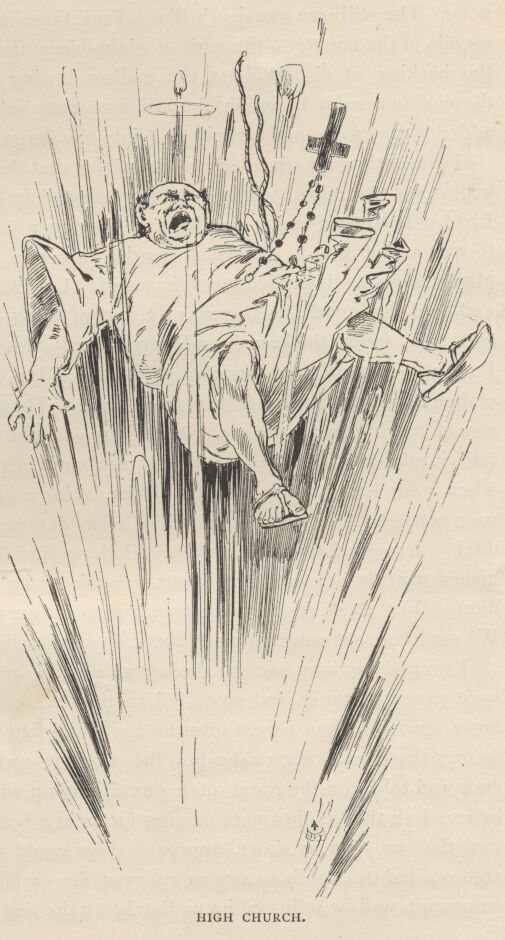
Time for the second step in the plan of campaign! I touched a button, and shook the bones of England loose from her spine!
Time for the second step in the campaign plan! I pressed a button and shook England’s bones loose from her spine!
In that explosion all our noble civilization-factories went up in the air and disappeared from the earth. It was a pity, but it was necessary. We could not afford to let the enemy turn our own weapons against us.
The explosion blew up all our noble civilization-factories and wiped them off the earth. It was a shame, but it was necessary. We could not let the enemy turn our own weapons against us.
Now ensued one of the dullest quarter-hours I had ever endured. We waited in a silent solitude enclosed by our circles of wire, and by a circle of heavy smoke outside of these. We couldn’t see over the wall of smoke, and we couldn’t see through it. But at last it began to shred away lazily, and by the end of another quarter-hour the land was clear and our curiosity was enabled to satisfy itself. No living creature was in sight! We now perceived that additions had been made to our defenses. The dynamite had dug a ditch more than a hundred feet wide, all around us, and cast up an embankment some twenty-five feet high on both borders of it. As to destruction of life, it was amazing. Moreover, it was beyond estimate. Of course, we could not count the dead, because they did not exist as individuals, but merely as homogeneous protoplasm, with alloys of iron and buttons.
What followed was one of the dullest fifteen minutes I had ever endured. We waited in silence and solitude, surrounded by our circles of wire. Beyond them was a circle of thick smoke. We couldn’t see over the wall of smoke or through it. But at last the smoke began to drift lazily apart. After another fifteen minutes, the land was clear, and we could satisfy our curiosity. Not a living creature was in sight! We now saw that our defenses had grown. The dynamite had dug a ditch more than a hundred feet wide all around us. It had also thrown up a bank about twenty-five feet high on each side. The loss of life was amazing. It was also impossible to estimate. Of course, we could not count the dead. They no longer existed as individuals, but merely as a uniform mass of protoplasm mixed with iron and buttons.
No life was in sight, but necessarily there must have been some wounded in the rear ranks, who were carried off the field under cover of the wall of smoke; there would be sickness among the others—there always is, after an episode like that. But there would be no reinforcements; this was the last stand of the chivalry of England; it was all that was left of the order, after the recent annihilating wars. So I felt quite safe in believing that the utmost force that could for the future be brought against us would be but small; that is, of knights. I therefore issued a congratulatory proclamation to my army in these words:
No one was alive in sight. But there must have been some wounded men in the rear ranks. They would have been carried off the field under cover of the wall of smoke. There would also be sickness among the others. There always is after an episode like that. But there would be no reinforcements. This was the last stand of the chivalry of England. These were all the knights left after the recent devastating wars. So I felt quite safe in believing that only a small force of knights could ever be brought against us again. I therefore issued a proclamation congratulating my army in these words:
SOLDIERS, CHAMPIONS OF HUMAN LIBERTY AND EQUALITY: Your General congratulates you! In the pride of his strength and the vanity of his renown, an arrogant enemy came against you. You were ready. The conflict was brief; on your side, glorious. This mighty victory, having been achieved utterly without loss, stands without example in history. So long as the planets shall continue to move in their orbits, the Battle Of The Sand-Belt will not perish out of the memories of men.
SOLDIERS, CHAMPIONS OF HUMAN LIBERTY AND EQUALITY: Your General congratulates you! An arrogant enemy attacked you, proud of his strength and vain about his fame. You were ready. The battle was brief, and you fought gloriously. This mighty victory was won without a single loss. Nothing like it has ever happened in history. As long as the planets move in their orbits, people will remember the Battle Of The Sand-Belt.
THE BOSS.
THE BOSS.
I read it well, and the applause I got was very gratifying to me. I then wound up with these remarks:
I read it well, and I was very pleased with the applause. I then ended with these remarks:
“The war with the English nation, as a nation, is at an end. The nation has retired from the field and the war. Before it can be persuaded to return, war will have ceased. This campaign is the only one that is going to be fought. It will be brief—the briefest in history. Also the most destructive to life, considered from the standpoint of proportion of casualties to numbers engaged. We are done with the nation; henceforth we deal only with the knights. English knights can be killed, but they cannot be conquered. We know what is before us. While one of these men remains alive, our task is not finished, the war is not ended. We will kill them all.” [Loud and long continued applause.]
“The war against the English nation as a whole is over. The nation has withdrawn from the battlefield and the war. By the time it can be persuaded to return, the war will be over. This campaign is the only one that will be fought. It will be brief, the briefest in history. It will also be the deadliest in proportion to the number of people fighting. We are done with the nation. From now on, we deal only with the knights. English knights can be killed, but they cannot be conquered. We know what lies ahead. As long as one of these men remains alive, our task is unfinished and the war is not over. We will kill them all.” [Loud, prolonged applause.]
I picketed the great embankments thrown up around our lines by the dynamite explosion—merely a lookout of a couple of boys to announce the enemy when he should appear again.
I posted guards on the great embankments the dynamite explosion had thrown up around our lines. It was just a couple of boys to watch for the enemy and announce when he appeared again.
Next, I sent an engineer and forty men to a point just beyond our lines on the south, to turn a mountain brook that was there, and bring it within our lines and under our command, arranging it in such a way that I could make instant use of it in an emergency. The forty men were divided into two shifts of twenty each, and were to relieve each other every two hours. In ten hours the work was accomplished.
Next, I sent an engineer and forty men to a spot just south of our lines. I sent them to divert a mountain brook and bring it inside our lines, under our control. I wanted it arranged so I could use it immediately in an emergency. The forty men were divided into two shifts of twenty, each relieving the other every two hours. The work was finished in ten hours.
It was nightfall now, and I withdrew my pickets. The one who had had the northern outlook reported a camp in sight, but visible with the glass only. He also reported that a few knights had been feeling their way toward us, and had driven some cattle across our lines, but that the knights themselves had not come very near. That was what I had been expecting. They were feeling us, you see; they wanted to know if we were going to play that red terror on them again. They would grow bolder in the night, perhaps. I believed I knew what project they would attempt, because it was plainly the thing I would attempt myself if I were in their places and as ignorant as they were. I mentioned it to Clarence.
Night was falling, so I called back my lookouts. The one who had been watching to the north reported a camp in sight, but only through his telescope. He also reported that a few knights had cautiously approached us and driven some cattle across our lines. But the knights themselves had not come very close. That was what I had expected. They were testing us, you see. They wanted to know if we were going to use that red terror on them again. Perhaps they would grow bolder during the night. I thought I knew what they would try. It was plainly what I would try if I were in their place and as ignorant as they were. I mentioned it to Clarence.
“I think you are right,” said he; “it is the obvious thing for them to try.”
“I think you’re right,” he said. “That’s the obvious thing for them to try.”
“Well, then,” I said, “if they do it they are doomed.”
“Well, then,” I said, “if they do it, they’re doomed.”
“Certainly.”
“Certainly.”
“They won’t have the slightest show in the world.”
“They won’t have the slightest chance.”
“Of course they won’t.”
“Of course they won’t.”
“It’s dreadful, Clarence. It seems an awful pity.”
“It’s terrible, Clarence. It seems like such a shame.”
The thing disturbed me so that I couldn’t get any peace of mind for thinking of it and worrying over it. So, at last, to quiet my conscience, I framed this message to the knights:
The thing bothered me so much that I couldn’t find peace of mind. I kept thinking and worrying about it. So, at last, to ease my conscience, I wrote this message to the knights:
TO THE HONORABLE THE COMMANDER OF THE INSURGENT CHIVALRY OF ENGLAND: You fight in vain. We know your strength—if one may call it by that name. We know that at the utmost you cannot bring against us above five and twenty thousand knights. Therefore, you have no chance—none whatever. Reflect: we are well equipped, well fortified, we number 54. Fifty-four what? Men? No, minds—the capablest in the world; a force against which mere animal might may no more hope to prevail than may the idle waves of the sea hope to prevail against the granite barriers of England. Be advised. We offer you your lives; for the sake of your families, do not reject the gift. We offer you this chance, and it is the last: throw down your arms; surrender unconditionally to the Republic, and all will be forgiven.
TO THE HONORABLE COMMANDER OF THE REBEL KNIGHTS OF ENGLAND: Your fight is hopeless. We know your strength, if you can call it that. We know you can bring no more than twenty-five thousand knights against us. So you have no chance at all. Think about it: we are well equipped and well fortified. We number 54. Fifty-four what? Men? No, minds, the most capable in the world. Against such a force, brute strength has no more hope of winning than the sea's idle waves have against England's granite barriers. Take our advice. We offer to spare your lives. For your families' sake, do not reject this gift. We offer you this chance, and it is your last: lay down your arms and surrender unconditionally to the Republic. Then all will be forgiven.
(Signed) THE BOSS.
(Signed) THE BOSS.
I read it to Clarence, and said I proposed to send it by a flag of truce. He laughed the sarcastic laugh he was born with, and said:
I read it to Clarence and said I planned to send it under a flag of truce. He gave the sarcastic laugh he was born with and said:
“Somehow it seems impossible for you to ever fully realize what these nobilities are. Now let us save a little time and trouble. Consider me the commander of the knights yonder. Now, then, you are the flag of truce; approach and deliver me your message, and I will give you your answer.”
“Somehow, you never seem able to fully understand what these nobles are like. Now let's save some time and trouble. Imagine I'm the commander of those knights over there. Now, you're the envoy under a flag of truce. Come forward and deliver your message, and I'll give you my answer.”
I humored the idea. I came forward under an imaginary guard of the enemy’s soldiers, produced my paper, and read it through. For answer, Clarence struck the paper out of my hand, pursed up a scornful lip and said with lofty disdain:
I went along with the idea. I came forward as if guarded by enemy soldiers, produced my paper, and read it through. In response, Clarence knocked the paper from my hand, curled his lip, and said with lofty disdain:
“Dismember me this animal, and return him in a basket to the base-born knave who sent him; other answer have I none!”
“Cut this animal to pieces and return him in a basket to the lowborn scoundrel who sent him. I have no other answer!”
How empty is theory in presence of fact! And this was just fact, and nothing else. It was the thing that would have happened, there was no getting around that. I tore up the paper and granted my mistimed sentimentalities a permanent rest.
How empty theory is when faced with fact! And this was pure fact, nothing else. It was what would have happened. There was no getting around that. I tore up the paper and put my badly timed sentimental feelings to rest for good.
Then, to business. I tested the electric signals from the gatling platform to the cave, and made sure that they were all right; I tested and retested those which commanded the fences—these were signals whereby I could break and renew the electric current in each fence independently of the others at will. I placed the brook-connection under the guard and authority of three of my best boys, who would alternate in two-hour watches all night and promptly obey my signal, if I should have occasion to give it—three revolver-shots in quick succession. Sentry-duty was discarded for the night, and the corral left empty of life; I ordered that quiet be maintained in the cave, and the electric lights turned down to a glimmer.
Then, down to business. I tested the electric signals from the Gatling platform to the cave and made sure they worked. I tested and retested the signals that controlled the fences. With these, I could turn the current in each fence off and on independently, whenever I wanted. I put three of my best boys in charge of guarding the brook connection. They would take turns on two-hour watches all night and promptly obey my signal if I needed to give it. The signal was three quick revolver shots. We dispensed with sentry duty for the night and left the corral empty of life. I ordered everyone in the cave to keep quiet and turn the electric lights down to a glimmer.
As soon as it was good and dark, I shut off the current from all the fences, and then groped my way out to the embankment bordering our side of the great dynamite ditch. I crept to the top of it and lay there on the slant of the muck to watch. But it was too dark to see anything. As for sounds, there were none. The stillness was deathlike. True, there were the usual night-sounds of the country—the whir of night-birds, the buzzing of insects, the barking of distant dogs, the mellow lowing of far-off kine—but these didn’t seem to break the stillness, they only intensified it, and added a grewsome melancholy to it into the bargain.
As soon as it was fully dark, I turned off the current to all the fences. Then I felt my way to the embankment on our side of the great dynamite ditch. I crept to the top and lay on the muddy slope to watch. But it was too dark to see anything. There were no sounds. The stillness was like death. Of course, there were the usual sounds of the country at night: the whir of night birds, buzzing insects, distant dogs barking, and the soft lowing of cows far away. But these sounds didn't seem to break the stillness. They only made it deeper and gave it a gruesome sadness as well.
I presently gave up looking, the night shut down so black, but I kept my ears strained to catch the least suspicious sound, for I judged I had only to wait, and I shouldn’t be disappointed. However, I had to wait a long time. At last I caught what you may call indistinct glimpses of sound—dulled metallic sound. I pricked up my ears, then, and held my breath, for this was the sort of thing I had been waiting for. This sound thickened, and approached—from toward the north. Presently, I heard it at my own level—the ridge-top of the opposite embankment, a hundred feet or more away. Then I seemed to see a row of black dots appear along that ridge—human heads? I couldn’t tell; it mightn’t be anything at all; you can’t depend on your eyes when your imagination is out of focus. However, the question was soon settled. I heard that metallic noise descending into the great ditch. It augmented fast, it spread all along, and it unmistakably furnished me this fact: an armed host was taking up its quarters in the ditch. Yes, these people were arranging a little surprise party for us. We could expect entertainment about dawn, possibly earlier.
I soon gave up looking, because the night had grown so black. But I strained my ears for the slightest suspicious sound. I figured I only had to wait, and I wouldn’t be disappointed. Still, I had to wait a long time. At last, I caught what you might call faint glimpses of sound: a muffled metallic noise. I pricked up my ears and held my breath. This was the kind of sound I had been waiting for. It grew louder and came closer from the north. Soon I heard it at my own level, on the ridge of the opposite embankment, more than a hundred feet away. Then I seemed to see a row of black dots along that ridge. Human heads? I couldn’t tell. There might have been nothing there at all. You can’t trust your eyes when your imagination is out of focus. The question was soon settled, though. I heard the metallic noise moving down into the great ditch. It quickly grew louder and spread along the ditch. There was no mistaking what it meant: an armed force was settling into the ditch. Yes, these people were planning a little surprise party for us. We could expect some entertainment around dawn, possibly earlier.
I groped my way back to the corral now; I had seen enough. I went to the platform and signaled to turn the current on to the two inner fences. Then I went into the cave, and found everything satisfactory there—nobody awake but the working-watch. I woke Clarence and told him the great ditch was filling up with men, and that I believed all the knights were coming for us in a body. It was my notion that as soon as dawn approached we could expect the ditch’s ambuscaded thousands to swarm up over the embankment and make an assault, and be followed immediately by the rest of their army.
I groped my way back to the corral. I had seen enough. I went to the platform and signaled for the current to be turned on to the two inner fences. Then I went into the cave and found everything in order. Only the working-watch was awake. I woke Clarence and told him the great ditch was filling up with men. I believed all the knights were coming for us together. I expected the thousands hiding in the ditch to swarm over the embankment and attack as dawn approached. The rest of their army would follow immediately.
Clarence said:
Clarence said:
“They will be wanting to send a scout or two in the dark to make preliminary observations. Why not take the lightning off the outer fences, and give them a chance?”
“They'll probably want to send a scout or two out in the dark to take a first look. Why not turn off the electricity on the outer fences and give them a chance?”
“I’ve already done it, Clarence. Did you ever know me to be inhospitable?”
“I’ve already done it, Clarence. Have you ever known me to be a bad host?”
“No, you are a good heart. I want to go and—”
“No, you have a good heart. I want to go and...”
“Be a reception committee? I will go, too.”
“Be a reception committee? I’ll go too.”
We crossed the corral and lay down together between the two inside fences. Even the dim light of the cave had disordered our eyesight somewhat, but the focus straightway began to regulate itself and soon it was adjusted for present circumstances. We had had to feel our way before, but we could make out to see the fence posts now. We started a whispered conversation, but suddenly Clarence broke off and said:
We crossed the corral and lay down together between the two inner fences. Even the dim light of the cave had affected our eyesight somewhat. But our eyes began to adjust right away, and soon they were suited to the conditions. Before, we had had to feel our way, but now we could make out the fence posts. We began talking in whispers, but suddenly Clarence stopped and said:
“What is that?”
“What is that?”
“What is what?”
“What is what?”
“That thing yonder.”
“That thing over there.”
“What thing—where?”
“What thing? Where?”
“There beyond you a little piece—dark something—a dull shape of some kind—against the second fence.”
“There, a little way beyond you, something dark, a dim shape of some kind, against the second fence.”
I gazed and he gazed. I said:
I stared, and he stared. I said:
“Could it be a man, Clarence?”
“Could it be a man, Clarence?”
“No, I think not. If you notice, it looks a lit—why, it is a man!—leaning on the fence.”
“No, I don't think so. If you look, it looks a lit... Why, it is a man! He's leaning on the fence.”
“I certainly believe it is; let us go and see.”
“I certainly believe it is. Let's go and see.”
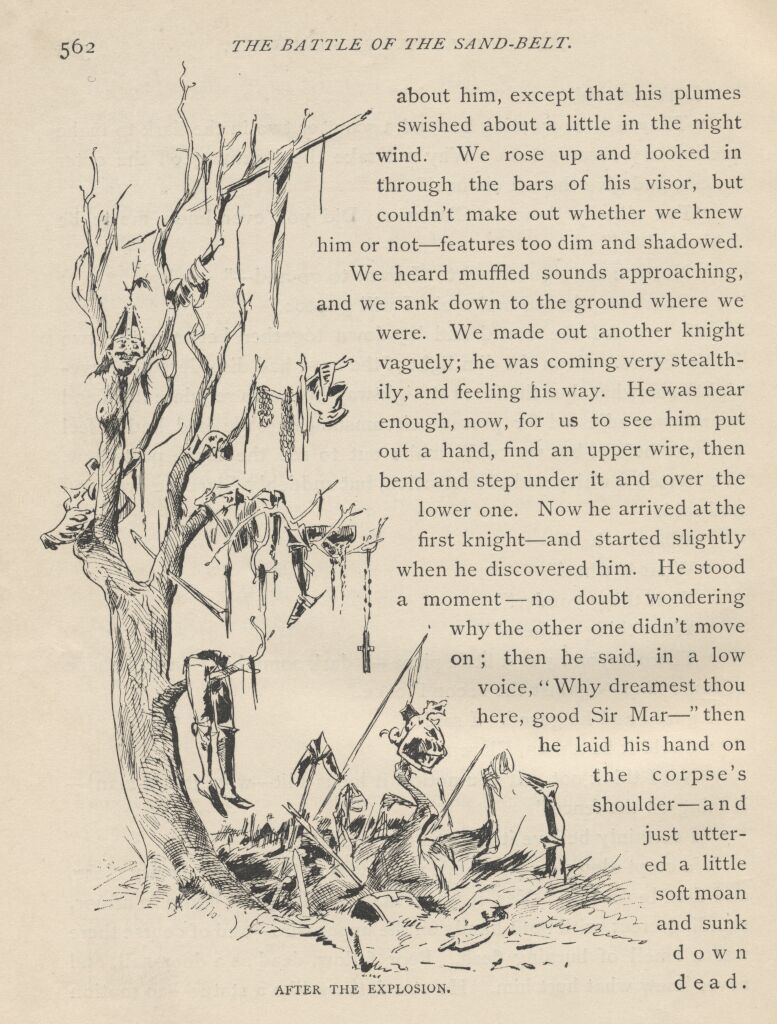
We crept along on our hands and knees until we were pretty close, and then looked up. Yes, it was a man—a dim great figure in armor, standing erect, with both hands on the upper wire—and, of course, there was a smell of burning flesh. Poor fellow, dead as a door-nail, and never knew what hurt him. He stood there like a statue—no motion about him, except that his plumes swished about a little in the night wind. We rose up and looked in through the bars of his visor, but couldn’t make out whether we knew him or not—features too dim and shadowed.
We crawled on our hands and knees until we were close, then looked up. Yes, it was a man. He was a huge, dim figure in armor, standing upright with both hands on the upper wire. And, of course, there was a smell of burning flesh. Poor fellow, he was dead and never knew what hurt him. He stood there like a statue. Nothing moved except his plumes, which swayed a little in the night wind. We stood up and looked through the bars of his visor. But his features were too dim and shadowed for us to tell whether we knew him.
We heard muffled sounds approaching, and we sank down to the ground where we were. We made out another knight vaguely; he was coming very stealthily, and feeling his way. He was near enough now for us to see him put out a hand, find an upper wire, then bend and step under it and over the lower one. Now he arrived at the first knight—and started slightly when he discovered him. He stood a moment—no doubt wondering why the other one didn’t move on; then he said, in a low voice, “Why dreamest thou here, good Sir Mar—” then he laid his hand on the corpse’s shoulder—and just uttered a little soft moan and sunk down dead. Killed by a dead man, you see—killed by a dead friend, in fact. There was something awful about it.
We heard muffled sounds approaching and sank to the ground where we were. We could just make out another knight. He was coming very stealthily, feeling his way. He was close enough now for us to see him reach out and find an upper wire. Then he bent down and stepped under it and over the lower wire. He came to the first knight and started slightly when he discovered him. He stood there a moment, no doubt wondering why the other knight didn’t move on. Then he said in a low voice, “Why are you dreaming here, good Sir Mar...” He laid his hand on the corpse’s shoulder, gave a little soft moan, and sank down dead. Killed by a dead man, you see. Killed by a dead friend, in fact. There was something awful about it.
These early birds came scattering along after each other, about one every five minutes in our vicinity, during half an hour. They brought no armor of offense but their swords; as a rule, they carried the sword ready in the hand, and put it forward and found the wires with it. We would now and then see a blue spark when the knight that caused it was so far away as to be invisible to us; but we knew what had happened, all the same; poor fellow, he had touched a charged wire with his sword and been electrocuted. We had brief intervals of grim stillness, interrupted with piteous regularity by the clash made by the falling of an iron-clad; and this sort of thing was going on, right along, and was very creepy there in the dark and lonesomeness.
These early birds came along one after another, about one every five minutes near us, for half an hour. Their only weapons were their swords. Usually, they held their swords ready and used them to feel for the wires. Now and then, we saw a blue spark from a knight too far away for us to see. But we knew what had happened. The poor fellow had touched a charged wire with his sword and been electrocuted. There were brief stretches of grim silence, broken with pitiful regularity by the crash of a falling armored knight. This kept happening, and it was very creepy there in the dark and loneliness.
We concluded to make a tour between the inner fences. We elected to walk upright, for convenience’s sake; we argued that if discerned, we should be taken for friends rather than enemies, and in any case we should be out of reach of swords, and these gentry did not seem to have any spears along. Well, it was a curious trip. Everywhere dead men were lying outside the second fence—not plainly visible, but still visible; and we counted fifteen of those pathetic statues—dead knights standing with their hands on the upper wire.
We decided to tour the space between the inner fences. We chose to walk upright for convenience. We figured that if anyone saw us, they would take us for friends rather than enemies. In any case, we would be out of reach of their swords, and they didn't seem to have any spears. Well, it was a curious trip. Dead men lay everywhere outside the second fence. They weren't easy to see, but they were visible. And we counted fifteen of those pathetic statues, dead knights standing with their hands on the upper wire.
One thing seemed to be sufficiently demonstrated: our current was so tremendous that it killed before the victim could cry out. Pretty soon we detected a muffled and heavy sound, and next moment we guessed what it was. It was a surprise in force coming! I whispered Clarence to go and wake the army, and notify it to wait in silence in the cave for further orders. He was soon back, and we stood by the inner fence and watched the silent lightning do its awful work upon that swarming host. One could make out but little of detail; but he could note that a black mass was piling itself up beyond the second fence. That swelling bulk was dead men! Our camp was enclosed with a solid wall of the dead—a bulwark, a breastwork, of corpses, you may say. One terrible thing about this thing was the absence of human voices; there were no cheers, no war cries; being intent upon a surprise, these men moved as noiselessly as they could; and always when the front rank was near enough to their goal to make it proper for them to begin to get a shout ready, of course they struck the fatal line and went down without testifying.
One thing seemed clear enough: our electric current was so powerful that it killed a man before he could cry out. Soon we heard a heavy, muffled sound. A moment later, we guessed what it was. A large force was coming to surprise us! I whispered to Clarence to wake the army and tell the men to wait silently in the cave for further orders. He soon returned, and we stood by the inner fence. We watched the silent lightning do its terrible work on the swarming army. We could make out little detail, but we could see a black mass piling up beyond the second fence. That growing mass was made of dead men! Our camp was surrounded by a solid wall of the dead. You might call it a defensive barrier, a breastwork of corpses. One terrible thing about it was the absence of human voices. There were no cheers, no war cries. The men were trying to surprise us, so they moved as quietly as they could. Each time the front rank got close enough to its goal to get ready to shout, the men struck the fatal line. Of course, they went down without a sound.
I sent a current through the third fence now; and almost immediately through the fourth and fifth, so quickly were the gaps filled up. I believed the time was come now for my climax; I believed that that whole army was in our trap. Anyway, it was high time to find out. So I touched a button and set fifty electric suns aflame on the top of our precipice.
I sent an electric current through the third fence. Almost immediately, I sent it through the fourth and fifth fences too, because the gaps filled up so quickly. I believed the time had come for the climax. I believed the whole army was in our trap. Anyway, it was high time to find out. So I pressed a button and lit up fifty electric suns at the top of our cliff.
Land, what a sight! We were enclosed in three walls of dead men! All the other fences were pretty nearly filled with the living, who were stealthily working their way forward through the wires. The sudden glare paralyzed this host, petrified them, you may say, with astonishment; there was just one instant for me to utilize their immobility in, and I didn’t lose the chance. You see, in another instant they would have recovered their faculties, then they’d have burst into a cheer and made a rush, and my wires would have gone down before it; but that lost instant lost them their opportunity forever; while even that slight fragment of time was still unspent, I shot the current through all the fences and struck the whole host dead in their tracks! There was a groan you could hear! It voiced the death-pang of eleven thousand men. It swelled out on the night with awful pathos.
Good heavens, what a sight! Three walls of dead men surrounded us! Nearly all the other fences were filled with living men, who were sneaking forward through the wires. The sudden glare froze the whole crowd. You might say it turned them to stone with amazement. I had just one instant to take advantage of their stillness, and I didn’t waste it. You see, another instant and they would have come to their senses. Then they would have cheered and rushed forward, and my wires would have fallen before them. But that lost instant cost them their chance forever. Before even that tiny fraction of time had passed, I sent the current through all the fences. It struck the whole crowd dead in their tracks! That was a groan you could hear! It was the sound of eleven thousand men dying in agony. It rose into the night with terrible sorrow.
A glance showed that the rest of the enemy—perhaps ten thousand strong—were between us and the encircling ditch, and pressing forward to the assault. Consequently we had them all! and had them past help. Time for the last act of the tragedy. I fired the three appointed revolver shots—which meant:
One glance showed that the rest of the enemy, perhaps ten thousand strong, stood between us and the surrounding ditch. They were advancing to attack. So we had all! of them, and they were beyond help. It was time for the final act of the tragedy. I fired the three agreed-upon revolver shots, which meant:
“Turn on the water!”
“Turn on the water!”
There was a sudden rush and roar, and in a minute the mountain brook was raging through the big ditch and creating a river a hundred feet wide and twenty-five deep.
There was a sudden rush and roar. Within a minute, the mountain brook was raging through the big ditch, creating a river 100 feet wide and 25 feet deep.
“Stand to your guns, men! Open fire!”
“Stay at your guns, men! Open fire!”
The thirteen gatlings began to vomit death into the fated ten thousand. They halted, they stood their ground a moment against that withering deluge of fire, then they broke, faced about and swept toward the ditch like chaff before a gale. A full fourth part of their force never reached the top of the lofty embankment; the three-fourths reached it and plunged over—to death by drowning.
The thirteen Gatling guns began to pour death into the doomed ten thousand. They stopped and stood their ground for a moment against the deadly flood of fire. Then they broke, turned around, and swept toward the ditch like chaff before a gale. A full quarter of their force never reached the top of the high embankment. The other three quarters reached it and plunged over, drowning in the ditch.
Within ten short minutes after we had opened fire, armed resistance was totally annihilated, the campaign was ended, we fifty-four were masters of England. Twenty-five thousand men lay dead around us.
Within ten minutes after we opened fire, all armed resistance had been wiped out. The campaign was over, and we fifty-four were masters of England. Twenty-five thousand men lay dead around us.
But how treacherous is fortune! In a little while—say an hour—happened a thing, by my own fault, which—but I have no heart to write that. Let the record end here.
But how treacherous fortune can be! About an hour later, something happened through my own fault. But I have no heart to write about it. Let the record end here.