Chapter 13
Freemen
Yes, it is strange how little a while at a time a person can be contented. Only a little while back, when I was riding and suffering, what a heaven this peace, this rest, this sweet serenity in this secluded shady nook by this purling stream would have seemed, where I could keep perfectly comfortable all the time by pouring a dipper of water into my armor now and then; yet already I was getting dissatisfied; partly because I could not light my pipe—for, although I had long ago started a match factory, I had forgotten to bring matches with me—and partly because we had nothing to eat. Here was another illustration of the childlike improvidence of this age and people. A man in armor always trusted to chance for his food on a journey, and would have been scandalized at the idea of hanging a basket of sandwiches on his spear. There was probably not a knight of all the Round Table combination who would not rather have died than been caught carrying such a thing as that on his flagstaff. And yet there could not be anything more sensible. It had been my intention to smuggle a couple of sandwiches into my helmet, but I was interrupted in the act, and had to make an excuse and lay them aside, and a dog got them.
Yes, it is strange how short a time a person can stay content. Just a little while ago, I was riding along and suffering. Then this peace, this rest, this sweet calm would have seemed like heaven. Here I was in a secluded, shady spot beside a bubbling stream. I could stay perfectly comfortable by pouring a dipper of water into my armor now and then. Yet I was already getting dissatisfied. Partly, that was because I couldn't light my pipe. Although I had started a match factory long ago, I had forgotten to bring matches. And partly, it was because we had nothing to eat. Here was another example of how childishly unprepared the people of this age were. A man in armor always trusted to chance for his food on a journey. He would have been scandalized at the idea of hanging a basket of sandwiches on his spear. Probably every knight in the whole Round Table crowd would rather have died than be caught carrying such a thing on his flagstaff. And yet nothing could be more sensible. I had meant to smuggle a couple of sandwiches into my helmet. But I was interrupted while doing it, and I had to make an excuse and lay them aside. Then a dog got them.
Night approached, and with it a storm. The darkness came on fast. We must camp, of course. I found a good shelter for the demoiselle under a rock, and went off and found another for myself. But I was obliged to remain in my armor, because I could not get it off by myself and yet could not allow Alisande to help, because it would have seemed so like undressing before folk. It would not have amounted to that in reality, because I had clothes on underneath; but the prejudices of one’s breeding are not gotten rid of just at a jump, and I knew that when it came to stripping off that bob-tailed iron petticoat I should be embarrassed.
Night approached, and a storm came with it. It grew dark quickly. Of course, we had to camp. I found a good shelter under a rock for the young lady, then went off and found another for myself. But I had to stay in my armor because I couldn't take it off by myself. I couldn't let Alisande help, either, because it would have seemed too much like undressing in front of people. It wouldn't really have been the same, because I had clothes on underneath. But you can't shake off the prejudices of your upbringing all at once. I knew I would be embarrassed when it came time to take off that short iron petticoat.
With the storm came a change of weather; and the stronger the wind blew, and the wilder the rain lashed around, the colder and colder it got. Pretty soon, various kinds of bugs and ants and worms and things began to flock in out of the wet and crawl down inside my armor to get warm; and while some of them behaved well enough, and snuggled up amongst my clothes and got quiet, the majority were of a restless, uncomfortable sort, and never stayed still, but went on prowling and hunting for they did not know what; especially the ants, which went tickling along in wearisome procession from one end of me to the other by the hour, and are a kind of creatures which I never wish to sleep with again. It would be my advice to persons situated in this way, to not roll or thrash around, because this excites the interest of all the different sorts of animals and makes every last one of them want to turn out and see what is going on, and this makes things worse than they were before, and of course makes you objurgate harder, too, if you can. Still, if one did not roll and thrash around he would die; so perhaps it is as well to do one way as the other; there is no real choice. Even after I was frozen solid I could still distinguish that tickling, just as a corpse does when he is taking electric treatment. I said I would never wear armor after this trip.
The storm brought a change in the weather. The harder the wind blew and the more wildly the rain lashed around, the colder it got. Before long, all sorts of bugs, ants, worms, and other things came in out of the rain. They crawled inside my armor to get warm. Some behaved well enough, snuggling into my clothes and settling down. But most were restless, uncomfortable creatures that never stayed still. They kept roaming and hunting for they knew not what. The ants were the worst. For hours, they marched in a tickling procession from one end of me to the other. I never want to sleep with ants again. I would advise anyone in this situation not to roll or thrash around. That excites the interest of all the different creatures, and every last one wants to come out and see what is happening. That makes things worse than before, and naturally makes you curse even harder, if you can. Still, if you did not roll and thrash around, you would die. So perhaps one way is as good as the other. There is no real choice. Even after I was frozen solid, I could still feel the tickling, just as a corpse does during electric treatment. I said I would never wear armor after this trip.
All those trying hours whilst I was frozen and yet was in a living fire, as you may say, on account of that swarm of crawlers, that same unanswerable question kept circling and circling through my tired head: How do people stand this miserable armor? How have they managed to stand it all these generations? How can they sleep at night for dreading the tortures of next day?
During all those miserable hours, I was freezing and yet, you might say, burning alive because of that swarm of crawlers. The same unanswerable question kept circling through my tired head: How do people stand this miserable armor? How have they managed to stand it for all these generations? How can they sleep at night when they dread the next day's tortures?
When the morning came at last, I was in a bad enough plight: seedy, drowsy, fagged, from want of sleep; weary from thrashing around, famished from long fasting; pining for a bath, and to get rid of the animals; and crippled with rheumatism. And how had it fared with the nobly born, the titled aristocrat, the Demoiselle Alisande la Carteloise? Why, she was as fresh as a squirrel; she had slept like the dead; and as for a bath, probably neither she nor any other noble in the land had ever had one, and so she was not missing it. Measured by modern standards, they were merely modified savages, those people. This noble lady showed no impatience to get to breakfast—and that smacks of the savage, too. On their journeys those Britons were used to long fasts, and knew how to bear them; and also how to freight up against probable fasts before starting, after the style of the Indian and the anaconda. As like as not, Sandy was loaded for a three-day stretch.
When morning finally came, I was in terrible shape. I was worn out, drowsy, and exhausted from lack of sleep. I was tired from tossing and turning and starving from going so long without food. I longed for a bath and wanted to get rid of the animals. And rheumatism had crippled me. And how had the nobly born, titled aristocrat, the Demoiselle Alisande la Carteloise, fared? Why, she was as fresh as a squirrel. She had slept like the dead. As for a bath, probably neither she nor any other noble in the land had ever had one. So she wasn't missing it. By modern standards, those people were merely modified savages. This noble lady showed no impatience to get to breakfast, and that smacks of the savage, too. On their journeys, those Britons were used to going without food for long stretches and knew how to bear it. They also knew how to load up on food before setting out, in case they had to go hungry. They ate like the Indian and the anaconda. Most likely, Sandy had eaten enough to last three days.
We were off before sunrise, Sandy riding and I limping along behind. In half an hour we came upon a group of ragged poor creatures who had assembled to mend the thing which was regarded as a road. They were as humble as animals to me; and when I proposed to breakfast with them, they were so flattered, so overwhelmed by this extraordinary condescension of mine that at first they were not able to believe that I was in earnest. My lady put up her scornful lip and withdrew to one side; she said in their hearing that she would as soon think of eating with the other cattle—a remark which embarrassed these poor devils merely because it referred to them, and not because it insulted or offended them, for it didn’t. And yet they were not slaves, not chattels. By a sarcasm of law and phrase they were freemen. Seven-tenths of the free population of the country were of just their class and degree: small “independent” farmers, artisans, etc.; which is to say, they were the nation, the actual Nation; they were about all of it that was useful, or worth saving, or really respect-worthy, and to subtract them would have been to subtract the Nation and leave behind some dregs, some refuse, in the shape of a king, nobility and gentry, idle, unproductive, acquainted mainly with the arts of wasting and destroying, and of no sort of use or value in any rationally constructed world.
We set off before sunrise, with Sandy riding and me limping along behind her. Half an hour later, we came upon a group of ragged, poor wretches. They had gathered to repair what passed for a road. They were as humble before me as animals. When I offered to eat breakfast with them, they were overwhelmed by my extraordinary condescension. They were so flattered that at first they could not believe I was serious. My lady curled her lip in scorn and moved aside. Within their hearing, she said she would just as soon eat with the other cattle. The remark embarrassed the poor devils only because it was about them. It did not insult or offend them. And yet they were not slaves or property. By a cruel joke of law and language, they were free people. Seven tenths of the country’s free population belonged to the same class and rank. They were small “independent” farmers, artisans, and the like. In other words, they were the nation, the actual Nation. They were nearly all of it that was useful, worth saving, or truly worthy of respect. Take them away, and you would have taken away the Nation. All that would remain was some dregs, some refuse, in the form of a king, nobility, and gentry. These were idle and unproductive people, skilled mainly in wasting and destroying. In any rationally organized world, they would have no use or value of any kind.
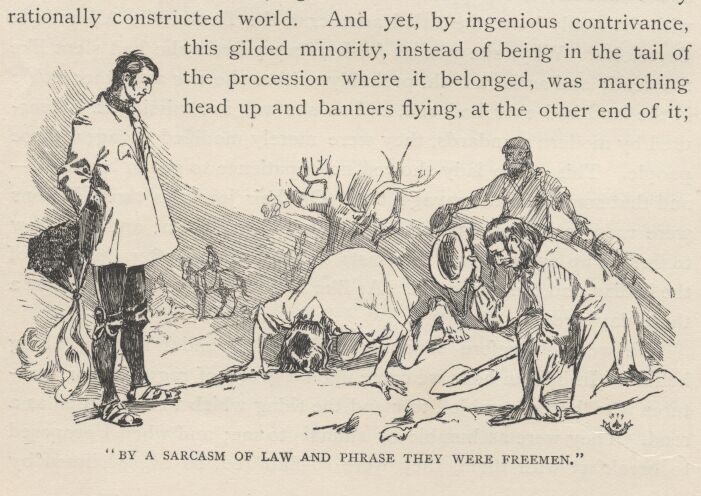
And yet, by ingenious contrivance, this gilded minority, instead of being in the tail of the procession where it belonged, was marching head up and banners flying, at the other end of it; had elected itself to be the Nation, and these innumerable clams had permitted it so long that they had come at last to accept it as a truth; and not only that, but to believe it right and as it should be. The priests had told their fathers and themselves that this ironical state of things was ordained of God; and so, not reflecting upon how unlike God it would be to amuse himself with sarcasms, and especially such poor transparent ones as this, they had dropped the matter there and become respectfully quiet.
And yet, through clever maneuvering, this gilded minority had taken the lead instead of bringing up the rear, where it belonged. It marched with its head held high and its banners flying. It had declared itself the Nation, and the countless clams had allowed this for so long that they finally accepted it as true. Not only that, they believed it was right and proper. The priests had told them and their fathers that God had ordained this ironic state of affairs. They never stopped to consider how unlike God it would be to amuse himself with sarcasm, especially sarcasm so obvious and feeble. So they let the matter rest and became respectfully quiet.
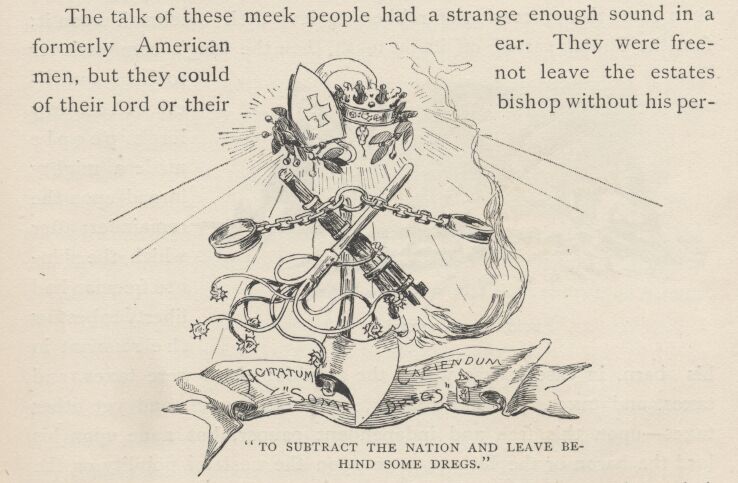
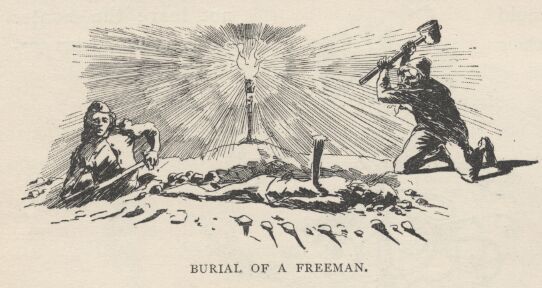
The talk of these meek people had a strange enough sound in a formerly American ear. They were freemen, but they could not leave the estates of their lord or their bishop without his permission; they could not prepare their own bread, but must have their corn ground and their bread baked at his mill and his bakery, and pay roundly for the same; they could not sell a piece of their own property without paying him a handsome percentage of the proceeds, nor buy a piece of somebody else’s without remembering him in cash for the privilege; they had to harvest his grain for him gratis, and be ready to come at a moment’s notice, leaving their own crop to destruction by the threatened storm; they had to let him plant fruit trees in their fields, and then keep their indignation to themselves when his heedless fruit-gatherers trampled the grain around the trees; they had to smother their anger when his hunting parties galloped through their fields laying waste the result of their patient toil; they were not allowed to keep doves themselves, and when the swarms from my lord’s dovecote settled on their crops they must not lose their temper and kill a bird, for awful would the penalty be; when the harvest was at last gathered, then came the procession of robbers to levy their blackmail upon it: first the Church carted off its fat tenth, then the king’s commissioner took his twentieth, then my lord’s people made a mighty inroad upon the remainder; after which, the skinned freeman had liberty to bestow the remnant in his barn, in case it was worth the trouble; there were taxes, and taxes, and taxes, and more taxes, and taxes again, and yet other taxes—upon this free and independent pauper, but none upon his lord the baron or the bishop, none upon the wasteful nobility or the all-devouring Church; if the baron would sleep unvexed, the freeman must sit up all night after his day’s work and whip the ponds to keep the frogs quiet; if the freeman’s daughter—but no, that last infamy of monarchical government is unprintable; and finally, if the freeman, grown desperate with his tortures, found his life unendurable under such conditions, and sacrificed it and fled to death for mercy and refuge, the gentle Church condemned him to eternal fire, the gentle law buried him at midnight at the cross-roads with a stake through his back, and his master the baron or the bishop confiscated all his property and turned his widow and his orphans out of doors.
The talk of these humble people sounded strange to a former American. They were freemen, but they could not leave their lord’s or bishop’s estates without his permission. They could not make their own bread. They had to have their grain ground at his mill and their bread baked at his bakery, paying dearly for both. They could not sell their own property without paying him a generous share of the proceeds. Nor could they buy someone else’s property without paying him cash for the privilege. They had to harvest his grain for free and be ready to come at a moment’s notice. They had to come even when a storm threatened to destroy their own crops. They had to let him plant fruit trees in their fields. Then they had to keep their outrage to themselves when his careless fruit pickers trampled the grain around the trees. They had to swallow their anger when his hunting parties galloped through their fields, destroying the results of their patient work. They were not allowed to keep doves. When flocks from my lord’s dovecote settled on their crops, they must not lose their temper and kill a bird. The penalty would be terrible. When the harvest was finally gathered, a procession of robbers came to collect their tribute. First the Church carted off its fat tenth. Then the king’s commissioner took his twentieth. Then my lord’s people took a huge share of what remained. After that, the fleeced freeman was free to store the leftovers in his barn, if they were worth the trouble. There were taxes, and taxes, and taxes, and more taxes, and taxes again, and still other taxes on this free and independent pauper. But there were none on his lord the baron or the bishop, none on the wasteful nobility or the all-devouring Church. If the baron wanted to sleep undisturbed, the freeman had to stay up all night after his day’s work. He had to whip the ponds to keep the frogs quiet. If the freeman’s daughter. But no, that last outrage of monarchical government cannot be printed. Finally, a freeman might grow desperate from his suffering and find life under such conditions unbearable. If he took his own life and fled to death for mercy and refuge, the gentle Church condemned him to eternal fire. The gentle law buried him at midnight at the crossroads with a stake through his back. And his master, the baron or the bishop, seized all his property and turned his widow and orphans out of their home.
And here were these freemen assembled in the early morning to work on their lord the bishop’s road three days each—gratis; every head of a family, and every son of a family, three days each, gratis, and a day or so added for their servants. Why, it was like reading about France and the French, before the ever memorable and blessed Revolution, which swept a thousand years of such villany away in one swift tidal-wave of blood—one: a settlement of that hoary debt in the proportion of half a drop of blood for each hogshead of it that had been pressed by slow tortures out of that people in the weary stretch of ten centuries of wrong and shame and misery the like of which was not to be mated but in hell. There were two “Reigns of Terror,” if we would but remember it and consider it; the one wrought murder in hot passion, the other in heartless cold blood; the one lasted mere months, the other had lasted a thousand years; the one inflicted death upon ten thousand persons, the other upon a hundred millions; but our shudders are all for the “horrors” of the minor Terror, the momentary Terror, so to speak; whereas, what is the horror of swift death by the axe, compared with lifelong death from hunger, cold, insult, cruelty, and heart-break? What is swift death by lightning compared with death by slow fire at the stake? A city cemetery could contain the coffins filled by that brief Terror which we have all been so diligently taught to shiver at and mourn over; but all France could hardly contain the coffins filled by that older and real Terror—that unspeakably bitter and awful Terror which none of us has been taught to see in its vastness or pity as it deserves.
Here were these freemen, gathered early in the morning to work on their lord the bishop’s road. Each had to work three days for free. Every head of a family and every son had to give three days, plus another day or so for their servants. Why, it was like reading about France and the French before the unforgettable and blessed Revolution. That Revolution swept away a thousand years of such wickedness in one swift tidal wave of blood. It settled that ancient debt with half a drop of blood for every hogshead slowly tortured out of those people. That blood had been drawn over ten weary centuries of wrong, shame, and misery, matched only in hell. There were two “Reigns of Terror,” if only we would remember and consider them. One committed murder in hot passion, the other in heartless cold blood. One lasted mere months, the other a thousand years. One killed ten thousand people, the other a hundred million. Yet we shudder only at the “horrors” of the lesser Terror, the momentary Terror, so to speak. What is the horror of a quick death by the axe compared with lifelong death from hunger, cold, insult, cruelty, and heartbreak? What is a quick death by lightning compared with a slow death by fire at the stake? A city cemetery could hold the coffins filled by that brief Terror. We have all been so carefully taught to shiver at it and mourn over it. But all France could hardly hold the coffins filled by that older and real Terror. That Terror was unspeakably bitter and awful, yet none of us has been taught to see its vastness or pity it as it deserves.
These poor ostensible freemen who were sharing their breakfast and their talk with me, were as full of humble reverence for their king and Church and nobility as their worst enemy could desire. There was something pitifully ludicrous about it. I asked them if they supposed a nation of people ever existed, who, with a free vote in every man’s hand, would elect that a single family and its descendants should reign over it forever, whether gifted or boobies, to the exclusion of all other families—including the voter’s; and would also elect that a certain hundred families should be raised to dizzy summits of rank, and clothed on with offensive transmissible glories and privileges to the exclusion of the rest of the nation’s families—including his own.
These poor, supposedly free men were sharing breakfast and conversation with me. They were as humbly devoted to their king, Church, and nobility as their worst enemy could wish. There was something sadly ridiculous about it. I asked them whether they thought any nation had ever existed where every man had a free vote and would vote for one family and its descendants to rule forever. They would rule whether they were gifted or fools. No other family could rule, including the voter’s own. Would those same voters also choose to raise a hundred families to dizzying heights of rank? Would they give those families offensive honors and privileges to pass down to their descendants? And would they deny those honors and privileges to every other family in the nation, including their own?
They all looked unhit, and said they didn’t know; that they had never thought about it before, and it hadn’t ever occurred to them that a nation could be so situated that every man could have a say in the government. I said I had seen one—and that it would last until it had an Established Church. Again they were all unhit—at first. But presently one man looked up and asked me to state that proposition again; and state it slowly, so it could soak into his understanding. I did it; and after a little he had the idea, and he brought his fist down and said he didn’t believe a nation where every man had a vote would voluntarily get down in the mud and dirt in any such way; and that to steal from a nation its will and preference must be a crime and the first of all crimes. I said to myself:
They all looked puzzled and said they didn’t know. They had never thought about it before. It had never occurred to them that a nation could be arranged so every man could have a say in the government. I said I had seen one, and that it would last until it had an Established Church. Again, they were all puzzled at first. But soon one man looked up and asked me to repeat what I had said. He wanted me to say it slowly, so he could take it in. I did, and after a while he understood. He brought his fist down and said he didn’t believe a nation where every man had a vote would willingly sink into the mud and dirt that way. He said that stealing a nation’s will and preference must be a crime, the greatest of all crimes. I said to myself:
“This one’s a man. If I were backed by enough of his sort, I would make a strike for the welfare of this country, and try to prove myself its loyalest citizen by making a wholesome change in its system of government.”
“This one’s a real man. If I had enough men like him behind me, I would fight for this country’s welfare. I would try to prove myself its most loyal citizen by making a healthy change to its system of government.”
You see my kind of loyalty was loyalty to one’s country, not to its institutions or its office-holders. The country is the real thing, the substantial thing, the eternal thing; it is the thing to watch over, and care for, and be loyal to; institutions are extraneous, they are its mere clothing, and clothing can wear out, become ragged, cease to be comfortable, cease to protect the body from winter, disease, and death. To be loyal to rags, to shout for rags, to worship rags, to die for rags—that is a loyalty of unreason, it is pure animal; it belongs to monarchy, was invented by monarchy; let monarchy keep it. I was from Connecticut, whose Constitution declares “that all political power is inherent in the people, and all free governments are founded on their authority and instituted for their benefit; and that they have at all times an undeniable and indefeasible right to alter their form of government in such a manner as they may think expedient.”
You see, my loyalty was to my country, not to its institutions or officeholders. The country is the real thing, the solid thing, the eternal thing. It is what we should watch over, care for, and be loyal to. Institutions are external, just the country’s clothing. And clothing can wear out and become ragged. It can stop being comfortable or protecting the body from winter, disease, and death. To be loyal to rags, to cheer for rags, to worship rags, to die for rags: that is mindless loyalty, purely animal loyalty. It belongs to monarchy. Monarchy invented it, so let monarchy keep it. I was from Connecticut, whose Constitution declares “that all political power belongs to the people. All free governments are founded on their authority and established for their benefit. And the people have at all times an undeniable and permanent right to change their form of government in whatever way they think best.”
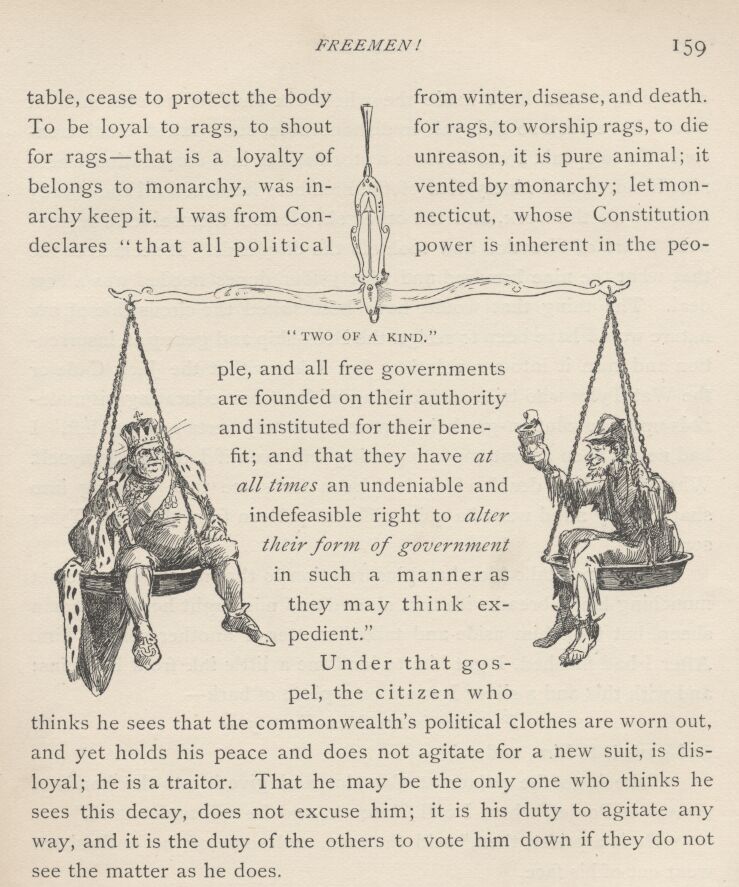
Under that gospel, the citizen who thinks he sees that the commonwealth’s political clothes are worn out, and yet holds his peace and does not agitate for a new suit, is disloyal; he is a traitor. That he may be the only one who thinks he sees this decay, does not excuse him; it is his duty to agitate anyway, and it is the duty of the others to vote him down if they do not see the matter as he does.
Under that belief, a citizen may think the commonwealth’s political clothes are worn out. If he stays quiet and does not demand a new suit, he is disloyal. He is a traitor. He may be the only one who thinks he sees this decay, but that does not excuse him. It is his duty to demand change anyway. If the others do not see the matter as he does, it is their duty to vote him down.
And now here I was, in a country where a right to say how the country should be governed was restricted to six persons in each thousand of its population. For the nine hundred and ninety-four to express dissatisfaction with the regnant system and propose to change it, would have made the whole six shudder as one man, it would have been so disloyal, so dishonorable, such putrid black treason. So to speak, I was become a stockholder in a corporation where nine hundred and ninety-four of the members furnished all the money and did all the work, and the other six elected themselves a permanent board of direction and took all the dividends. It seemed to me that what the nine hundred and ninety-four dupes needed was a new deal. The thing that would have best suited the circus side of my nature would have been to resign the Boss-ship and get up an insurrection and turn it into a revolution; but I knew that the Jack Cade or the Wat Tyler who tries such a thing without first educating his materials up to revolution grade is almost absolutely certain to get left. I had never been accustomed to getting left, even if I do say it myself. Wherefore, the “deal” which had been for some time working into shape in my mind was of a quite different pattern from the Cade-Tyler sort.
And now here I was, in a country where only six people in every thousand had a say in how the country was governed. If the other nine hundred and ninety-four complained about the ruling system and proposed changing it, all six would shudder as one. It would be so disloyal, so dishonorable, such rotten, black treason. In a way, I had become a stockholder in a corporation where nine hundred and ninety-four members supplied all the money and did all the work. The other six elected themselves a permanent board of directors and took all the dividends. It seemed to me that the nine hundred and ninety-four dupes needed a new deal. The showman in me would have loved to resign as Boss, start an uprising, and turn it into a revolution. But I knew that any Jack Cade or Wat Tyler who tried that without first educating his people for revolution was almost certain to fail. I had never been accustomed to failure, if I do say so myself. So the “deal” that had been taking shape in my mind for some time was quite different from the Cade-Tyler kind.
So I did not talk blood and insurrection to that man there who sat munching black bread with that abused and mistaught herd of human sheep, but took him aside and talked matter of another sort to him. After I had finished, I got him to lend me a little ink from his veins; and with this and a sliver I wrote on a piece of bark—
So I did not talk about bloodshed and rebellion to the man sitting there, munching black bread with that abused and miseducated herd of human sheep. Instead, I took him aside and talked to him about something else. When I had finished, I got him to lend me a little ink from his veins. With this and a sliver of wood, I wrote on a piece of bark:
Put him in the Man-factory—
Put him in the Man-factory.
and gave it to him, and said:
and gave it to him and said:
“Take it to the palace at Camelot and give it into the hands of Amyas le Poulet, whom I call Clarence, and he will understand.”
“Take it to the palace in Camelot and give it to Amyas le Poulet, whom I call Clarence. He will understand.”
“He is a priest, then,” said the man, and some of the enthusiasm went out of his face.
“So he’s a priest,” said the man, and some of the enthusiasm faded from his face.
“How—a priest? Didn’t I tell you that no chattel of the Church, no bond-slave of pope or bishop can enter my Man-Factory? Didn’t I tell you that you couldn’t enter unless your religion, whatever it might be, was your own free property?”
“What, a priest? Didn’t I tell you that no one owned by the Church can enter my Man-Factory? No slave of a pope or bishop can enter either. Didn’t I tell you that you couldn’t enter unless your religion, whatever it was, belonged freely to you?”
“Marry, it is so, and for that I was glad; wherefore it liked me not, and bred in me a cold doubt, to hear of this priest being there.”
“Indeed, that is so, and I was glad of it. So I was troubled to hear that this priest was there, and it filled me with a cold doubt.”
“But he isn’t a priest, I tell you.”
“But he isn’t a priest, I tell you.”
The man looked far from satisfied. He said:
The man looked anything but satisfied. He said:
“He is not a priest, and yet can read?”
“He’s not a priest, but he can read?”
“He is not a priest and yet can read—yes, and write, too, for that matter. I taught him myself.” The man’s face cleared. “And it is the first thing that you yourself will be taught in that Factory—”
“He isn't a priest, but he can read. He can write, too. I taught him myself.” The man's face brightened. “And reading is the first thing you'll be taught at that Factory.”
“I? I would give blood out of my heart to know that art. Why, I will be your slave, your—”
“Me? I would give my heart’s blood to learn that skill. Why, I would be your slave, your...”
“No you won’t, you won’t be anybody’s slave. Take your family and go along. Your lord the bishop will confiscate your small property, but no matter. Clarence will fix you all right.”
“No, you won’t. You won’t be anybody’s slave. Take your family and go on. Your lord, the bishop, will seize your small amount of property, but that doesn’t matter. Clarence will take care of you.”