Chapter 12
Slow Torture
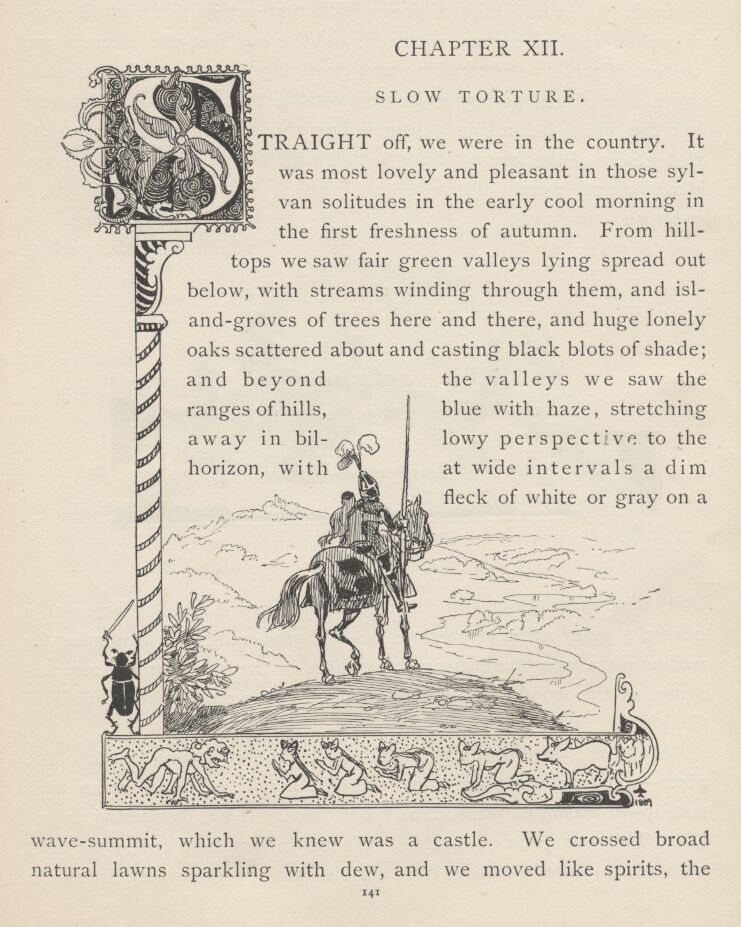
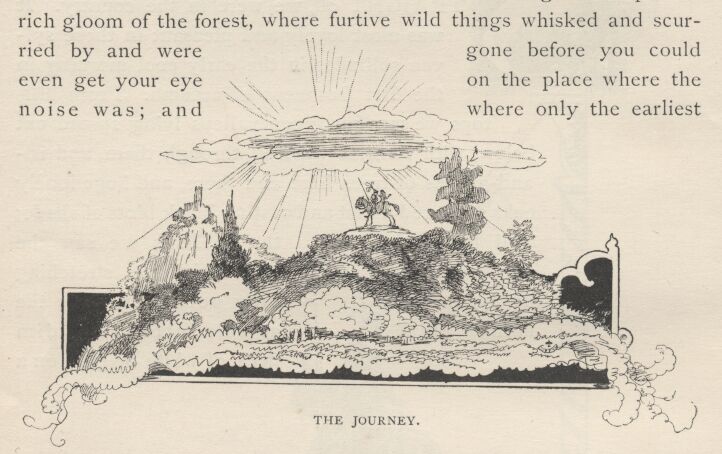
Straight off, we were in the country. It was most lovely and pleasant in those sylvan solitudes in the early cool morning in the first freshness of autumn. From hilltops we saw fair green valleys lying spread out below, with streams winding through them, and island groves of trees here and there, and huge lonely oaks scattered about and casting black blots of shade; and beyond the valleys we saw the ranges of hills, blue with haze, stretching away in billowy perspective to the horizon, with at wide intervals a dim fleck of white or gray on a wave-summit, which we knew was a castle. We crossed broad natural lawns sparkling with dew, and we moved like spirits, the cushioned turf giving out no sound of footfall; we dreamed along through glades in a mist of green light that got its tint from the sun-drenched roof of leaves overhead, and by our feet the clearest and coldest of runlets went frisking and gossiping over its reefs and making a sort of whispering music, comfortable to hear; and at times we left the world behind and entered into the solemn great deeps and rich gloom of the forest, where furtive wild things whisked and scurried by and were gone before you could even get your eye on the place where the noise was; and where only the earliest birds were turning out and getting to business with a song here and a quarrel yonder and a mysterious far-off hammering and drumming for worms on a tree trunk away somewhere in the impenetrable remotenesses of the woods. And by and by out we would swing again into the glare.
Right away, we were in the countryside. Those quiet woods were lovely and pleasant in the cool early morning, with autumn still fresh. From the hilltops, we saw beautiful green valleys spread out below. Streams wound through them, with clusters of trees here and there. Huge, solitary oaks stood scattered about, casting dark patches of shade. Beyond the valleys, hills blue with haze rolled away toward the horizon. Here and there, a faint white or gray speck stood on a distant hilltop. We knew it was a castle. We crossed broad natural lawns sparkling with dew. We moved like spirits, our footsteps silent on the soft grass. We wandered dreamily through clearings filled with a mist of green light, tinted by the sunlit canopy of leaves overhead. At our feet, the clearest, coldest little streams danced and chattered over rocks. They made a whispering music that was comforting to hear. At times, we left the world behind and entered the solemn depths and rich gloom of the forest. Shy wild creatures darted and scurried past. They were gone before you could even look toward the sound. Only the earliest birds were up and starting their day. One sang here, others quarreled there, and somewhere far away came mysterious hammering and drumming on a tree trunk. A bird was hunting for worms in the depths of the woods. Before long, we would emerge again into the glare.
About the third or fourth or fifth time that we swung out into the glare—it was along there somewhere, a couple of hours or so after sun-up—it wasn’t as pleasant as it had been. It was beginning to get hot. This was quite noticeable. We had a very long pull, after that, without any shade. Now it is curious how progressively little frets grow and multiply after they once get a start. Things which I didn’t mind at all, at first, I began to mind now—and more and more, too, all the time. The first ten or fifteen times I wanted my handkerchief I didn’t seem to care; I got along, and said never mind, it isn’t any matter, and dropped it out of my mind. But now it was different; I wanted it all the time; it was nag, nag, nag, right along, and no rest; I couldn’t get it out of my mind; and so at last I lost my temper and said hang a man that would make a suit of armor without any pockets in it. You see I had my handkerchief in my helmet; and some other things; but it was that kind of a helmet that you can’t take off by yourself. That hadn’t occurred to me when I put it there; and in fact I didn’t know it. I supposed it would be particularly convenient there. And so now, the thought of its being there, so handy and close by, and yet not get-at-able, made it all the worse and the harder to bear. Yes, the thing that you can’t get is the thing that you want, mainly; every one has noticed that. Well, it took my mind off from everything else; took it clear off, and centered it in my helmet; and mile after mile, there it stayed, imagining the handkerchief, picturing the handkerchief; and it was bitter and aggravating to have the salt sweat keep trickling down into my eyes, and I couldn’t get at it. It seems like a little thing, on paper, but it was not a little thing at all; it was the most real kind of misery. I would not say it if it was not so. I made up my mind that I would carry along a reticule next time, let it look how it might, and people say what they would. Of course these iron dudes of the Round Table would think it was scandalous, and maybe raise Sheol about it, but as for me, give me comfort first, and style afterwards. So we jogged along, and now and then we struck a stretch of dust, and it would tumble up in clouds and get into my nose and make me sneeze and cry; and of course I said things I oughtn’t to have said, I don’t deny that. I am not better than others.
About the third or fourth or fifth time we rode out into the glare, it wasn’t as pleasant as before. It was somewhere around then, a couple of hours or so after sunrise. It was beginning to get hot. This was quite noticeable. After that, we had a very long stretch without any shade. It’s curious how little annoyances keep growing and multiplying once they get started. Things I hadn’t minded at all at first began to bother me more and more. The first ten or fifteen times I wanted my handkerchief, I didn’t seem to care. I managed without it, told myself it didn’t matter, and forgot about it. But now it was different. I wanted it all the time. The thought kept nagging and nagging, giving me no rest. I couldn’t get it out of my mind. At last I lost my temper and said hang the man who made a suit of armor without pockets. You see, I had my handkerchief in my helmet, along with some other things. But it was the kind of helmet you can’t take off by yourself. That hadn’t occurred to me when I put the handkerchief there. In fact, I didn’t know it. I thought it would be particularly convenient there. So now, knowing it was so handy and close by, yet impossible to reach, made it even harder to bear. Yes, the thing you can’t get is usually the thing you want most. Everyone has noticed that. Well, it took my mind off everything else and fixed it entirely on my helmet. Mile after mile, my mind stayed there, imagining the handkerchief, picturing the handkerchief. It was bitterly aggravating to have salty sweat trickling into my eyes when I couldn’t reach it. It seems like a little thing on paper, but it wasn’t little at all. It was misery of the most real kind. I wouldn’t say so if it weren’t true. I decided that next time I would carry a small handbag, no matter how it looked or what people said. Of course, those iron dandies of the Round Table would think it was scandalous. They might even raise hell about it. But as for me, give me comfort first and style afterward. So we jogged along, and now and then we came to a dusty stretch. The dust rose in clouds, got into my nose, and made me sneeze and cry. And of course I said things I shouldn’t have said. I don’t deny it. I am no better than anyone else.
We couldn’t seem to meet anybody in this lonesome Britain, not even an ogre; and, in the mood I was in then, it was well for the ogre; that is, an ogre with a handkerchief. Most knights would have thought of nothing but getting his armor; but so I got his bandanna, he could keep his hardware, for all of me.
We couldn’t seem to meet anyone in this lonely Britain, not even an ogre. And in the mood I was in, that was lucky for the ogre. I mean an ogre with a handkerchief. Most knights would have thought only about getting his armor. But as long as I got his bandanna, he could keep his hardware for all I cared.
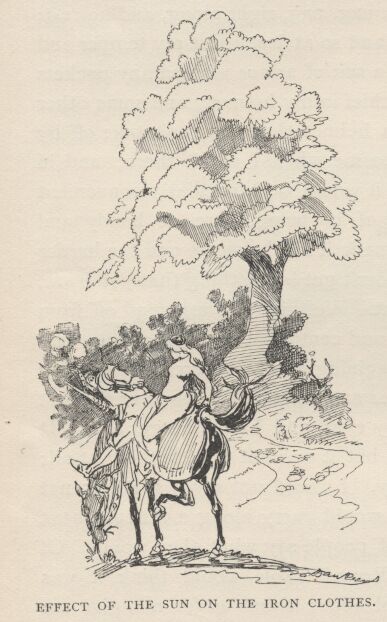
Meantime, it was getting hotter and hotter in there. You see, the sun was beating down and warming up the iron more and more all the time. Well, when you are hot, that way, every little thing irritates you. When I trotted, I rattled like a crate of dishes, and that annoyed me; and moreover I couldn’t seem to stand that shield slatting and banging, now about my breast, now around my back; and if I dropped into a walk my joints creaked and screeched in that wearisome way that a wheelbarrow does, and as we didn’t create any breeze at that gait, I was like to get fried in that stove; and besides, the quieter you went the heavier the iron settled down on you and the more and more tons you seemed to weigh every minute. And you had to be always changing hands, and passing your spear over to the other foot, it got so irksome for one hand to hold it long at a time.
Meanwhile, it was getting hotter and hotter inside the armor. You see, the sun kept beating down and heating the iron. Well, when you're that hot, every little thing irritates you. When I trotted, I rattled like a crate of dishes, and that annoyed me. What's more, I couldn't stand the shield slapping and banging against my chest, then against my back. But if I slowed to a walk, my joints creaked and screeched like a wheelbarrow. That got tiresome. And since we didn't create any breeze at that pace, I was nearly fried in that stove. Besides, the slower you went, the heavier the iron felt. You seemed to weigh more and more tons every minute. And you had to keep switching hands and moving your spear to the other foot. Holding it in one hand for long got so tiresome.
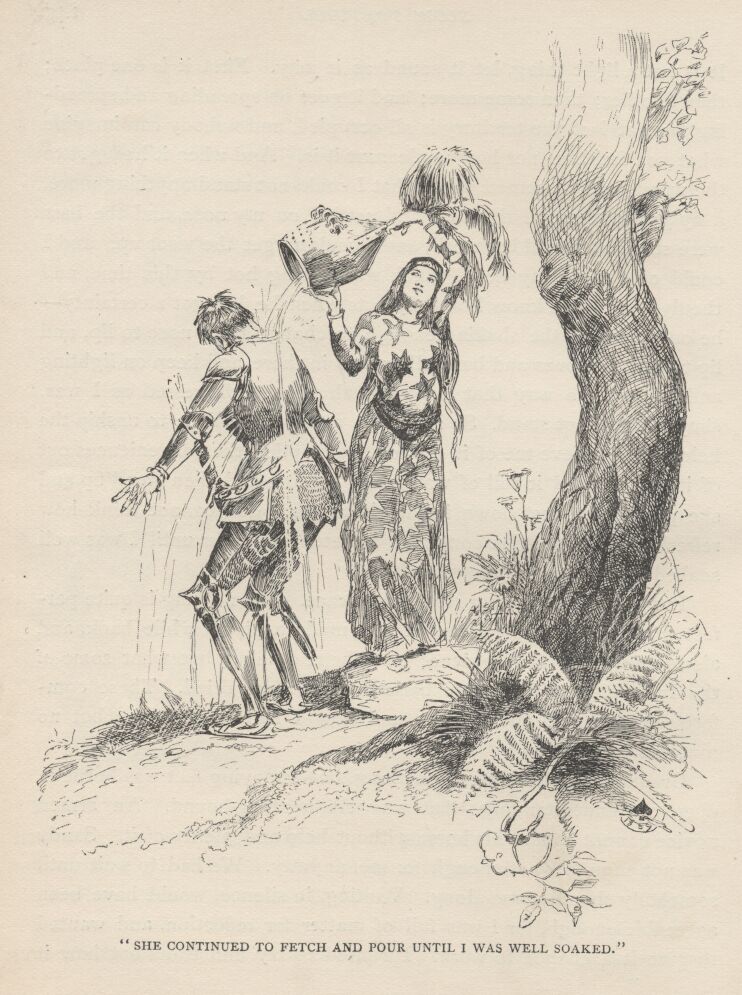
Well, you know, when you perspire that way, in rivers, there comes a time when you—when you—well, when you itch. You are inside, your hands are outside; so there you are; nothing but iron between. It is not a light thing, let it sound as it may. First it is one place; then another; then some more; and it goes on spreading and spreading, and at last the territory is all occupied, and nobody can imagine what you feel like, nor how unpleasant it is. And when it had got to the worst, and it seemed to me that I could not stand anything more, a fly got in through the bars and settled on my nose, and the bars were stuck and wouldn’t work, and I couldn’t get the visor up; and I could only shake my head, which was baking hot by this time, and the fly—well, you know how a fly acts when he has got a certainty—he only minded the shaking enough to change from nose to lip, and lip to ear, and buzz and buzz all around in there, and keep on lighting and biting, in a way that a person, already so distressed as I was, simply could not stand. So I gave in, and got Alisande to unship the helmet and relieve me of it. Then she emptied the conveniences out of it and fetched it full of water, and I drank and then stood up, and she poured the rest down inside the armor. One cannot think how refreshing it was. She continued to fetch and pour until I was well soaked and thoroughly comfortable.
Well, you know, when you sweat like that, in rivers, there comes a time when you, when you, well, when you itch. You are inside, your hands are outside, and there you are, with nothing but iron between them. It is no small matter, no matter how it sounds. First it is one place, then another, then more. The itching keeps spreading until every spot is covered. Nobody can imagine how you feel or how unpleasant it is. And when the itching was at its worst, I thought I couldn't stand anything more. Then a fly got in through the bars and landed on my nose. The bars were stuck and wouldn't work, so I couldn't raise the visor. All I could do was shake my head, which was baking hot by then. And the fly, well, you know how a fly acts when he has a sure thing. The shaking only made him move from my nose to my lip, then from my lip to my ear. He buzzed and buzzed all around in there, landing and biting again and again. A person already as distressed as I was simply couldn't stand it. So I gave in and got Alisande to take off the helmet and free me from it. Then she emptied the conveniences out of it and brought it back full of water. I drank, then stood up, and she poured the rest down inside the armor. You can't imagine how refreshing it was. She kept fetching and pouring water until I was well soaked and thoroughly comfortable.
It was good to have a rest—and peace. But nothing is quite perfect in this life, at any time. I had made a pipe a while back, and also some pretty fair tobacco; not the real thing, but what some of the Indians use: the inside bark of the willow, dried. These comforts had been in the helmet, and now I had them again, but no matches.
It was good to rest and have some peace. But nothing in this life is ever quite perfect. A while back, I had made a pipe and some pretty decent tobacco. It wasn't real tobacco, but the dried inner bark of a willow, which some Indians use. The pipe and tobacco had been in the helmet, and now I had them again, but no matches.
Gradually, as the time wore along, one annoying fact was borne in upon my understanding—that we were weather-bound. An armed novice cannot mount his horse without help and plenty of it. Sandy was not enough; not enough for me, anyway. We had to wait until somebody should come along. Waiting, in silence, would have been agreeable enough, for I was full of matter for reflection, and wanted to give it a chance to work. I wanted to try and think out how it was that rational or even half-rational men could ever have learned to wear armor, considering its inconveniences; and how they had managed to keep up such a fashion for generations when it was plain that what I had suffered to-day they had had to suffer all the days of their lives. I wanted to think that out; and moreover I wanted to think out some way to reform this evil and persuade the people to let the foolish fashion die out; but thinking was out of the question in the circumstances. You couldn’t think, where Sandy was.
As time passed, an annoying fact gradually dawned on me: we were stuck there by the weather. A beginner in armor cannot mount his horse without a great deal of help. Sandy was not enough help, not for me, anyway. We had to wait until someone came along. I would have been happy enough to wait in silence. I had plenty to reflect on, and I wanted to give it a chance to work. I wanted to figure out how rational or even half-rational men had ever learned to wear armor, given its inconveniences. I also wondered how they had kept the fashion going for generations. Clearly, they had suffered every day of their lives what I had suffered today. I wanted to think that through. I also wanted to find a way to reform this evil and persuade people to let the foolish fashion die out. But thinking was out of the question under the circumstances. You couldn’t think where Sandy was.
She was a quite biddable creature and good-hearted, but she had a flow of talk that was as steady as a mill, and made your head sore like the drays and wagons in a city. If she had had a cork she would have been a comfort. But you can’t cork that kind; they would die. Her clack was going all day, and you would think something would surely happen to her works, by and by; but no, they never got out of order; and she never had to slack up for words. She could grind, and pump, and churn, and buzz by the week, and never stop to oil up or blow out. And yet the result was just nothing but wind. She never had any ideas, any more than a fog has. She was a perfect blatherskite; I mean for jaw, jaw, jaw, talk, talk, talk, jabber, jabber, jabber; but just as good as she could be. I hadn’t minded her mill that morning, on account of having that hornets’ nest of other troubles; but more than once in the afternoon I had to say:
She was quite obedient and good-hearted, but she talked as steadily as a mill. She made your head ache like the carts and wagons in a city. If she had a cork, she would have been a comfort. But you can’t cork that kind. They would die. Her chatter went on all day. You would think something would surely go wrong with her machinery sooner or later. But no, it never broke down, and she never had to slow down for lack of words. She could grind, pump, churn, and buzz for weeks, never stopping to oil up or blow out. And yet the result was nothing but wind. She had no more ideas than a fog. She was a perfect chatterbox. I mean jaw, jaw, jaw, talk, talk, talk, jabber, jabber, jabber. But she was as good-hearted as could be. I hadn’t minded her mill that morning because of that hornets’ nest of other troubles. But more than once that afternoon I had to say:
“Take a rest, child; the way you are using up all the domestic air, the kingdom will have to go to importing it by to-morrow, and it’s a low enough treasury without that.”
“Take a rest, child. At the rate you’re using up all the air in the kingdom, we’ll have to import some by tomorrow. The treasury is low enough already without that expense.”