Chapter 11
The Yankee Seeks Adventure
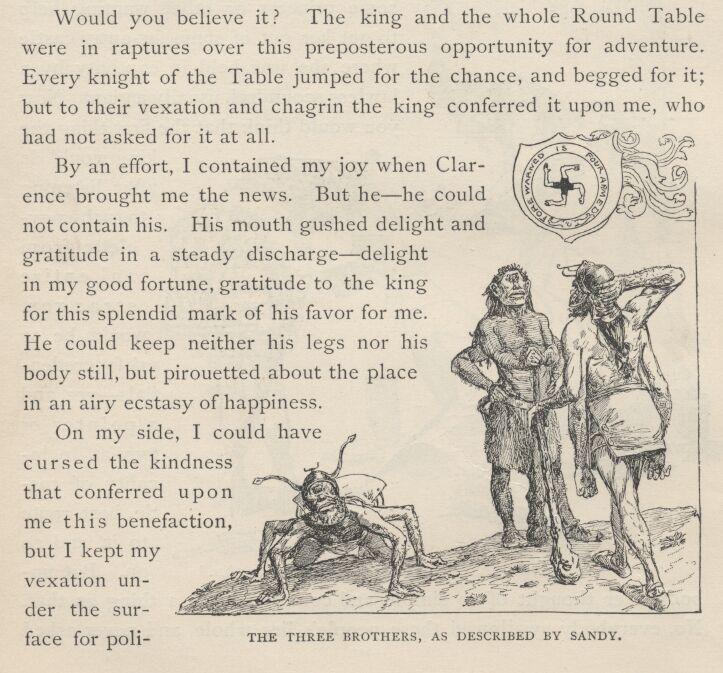
There never was such a country for wandering liars; and they were of both sexes. Hardly a month went by without one of these tramps arriving; and generally loaded with a tale about some princess or other wanting help to get her out of some far-away castle where she was held in captivity by a lawless scoundrel, usually a giant. Now you would think that the first thing the king would do after listening to such a novelette from an entire stranger, would be to ask for credentials—yes, and a pointer or two as to locality of castle, best route to it, and so on. But nobody ever thought of so simple and common-sense a thing at that. No, everybody swallowed these people’s lies whole, and never asked a question of any sort or about anything. Well, one day when I was not around, one of these people came along—it was a she one, this time—and told a tale of the usual pattern. Her mistress was a captive in a vast and gloomy castle, along with forty-four other young and beautiful girls, pretty much all of them princesses; they had been languishing in that cruel captivity for twenty-six years; the masters of the castle were three stupendous brothers, each with four arms and one eye—the eye in the center of the forehead, and as big as a fruit. Sort of fruit not mentioned; their usual slovenliness in statistics.
There never was a country with so many wandering liars, both men and women. Hardly a month went by without one of these tramps arriving. Usually, they came with a story about some princess who needed help escaping from a distant castle. She was held captive there by a lawless scoundrel, usually a giant. You would think the king’s first move, after hearing such a little novel from a complete stranger, would be to ask for credentials. He might also ask where the castle was, the best route to it, and so on. But nobody ever thought of anything so simple and sensible. No, everyone swallowed these people’s lies whole and never asked a single question about anything. Well, one day when I wasn’t around, one of these people came along. This time it was a woman, and she told a story along the usual lines. Her mistress was a captive in a vast, gloomy castle, along with forty-four other young, beautiful girls. Almost all of them were princesses. They had been suffering in that cruel captivity for twenty-six years. The castle’s masters were three enormous brothers, each with four arms and one eye. Each eye was in the center of its owner’s forehead and was as big as a piece of fruit. What kind of fruit, she didn’t say. The usual carelessness with statistics.
Would you believe it? The king and the whole Round Table were in raptures over this preposterous opportunity for adventure. Every knight of the Table jumped for the chance, and begged for it; but to their vexation and chagrin the king conferred it upon me, who had not asked for it at all.
Would you believe it? The king and the whole Round Table were thrilled by this ridiculous chance for adventure. Every knight of the Table jumped at the chance and begged for it. But to their disappointment and annoyance, the king gave it to me. I hadn't asked for it at all.
By an effort, I contained my joy when Clarence brought me the news. But he—he could not contain his. His mouth gushed delight and gratitude in a steady discharge—delight in my good fortune, gratitude to the king for this splendid mark of his favor for me. He could keep neither his legs nor his body still, but pirouetted about the place in an airy ecstasy of happiness.
I managed to contain my joy when Clarence brought me the news. But he could not contain his. He poured out a steady stream of delight and gratitude. He was delighted by my good fortune and grateful to the king for this splendid sign of favor toward me. He could not keep his legs or his body still. He danced around the room in a carefree ecstasy of happiness.
On my side, I could have cursed the kindness that conferred upon me this benefaction, but I kept my vexation under the surface for policy’s sake, and did what I could to let on to be glad. Indeed, I said I was glad. And in a way it was true; I was as glad as a person is when he is scalped.
For my part, I could have cursed the kindness that gave me this favor. But I hid my annoyance for the sake of appearances and tried to seem glad. In fact, I said I was glad. And in a way, that was true. I was as glad as a person being scalped.
Well, one must make the best of things, and not waste time with useless fretting, but get down to business and see what can be done. In all lies there is wheat among the chaff; I must get at the wheat in this case: so I sent for the girl and she came. She was a comely enough creature, and soft and modest, but, if signs went for anything, she didn’t know as much as a lady’s watch. I said:
Well, you have to make the best of things and not waste time worrying for nothing. You have to get down to business and see what can be done. Every lie has some wheat among the chaff. I had to find the wheat in this one, so I sent for the girl, and she came. She was pretty enough, gentle and modest, but if appearances meant anything, she knew less than a lady’s watch. I said:
“My dear, have you been questioned as to particulars?”
“My dear, have you been asked about the details?”
She said she hadn’t.
She said she hadn’t.
“Well, I didn’t expect you had, but I thought I would ask, to make sure; it’s the way I’ve been raised. Now you mustn’t take it unkindly if I remind you that as we don’t know you, we must go a little slow. You may be all right, of course, and we’ll hope that you are; but to take it for granted isn’t business. You understand that. I’m obliged to ask you a few questions; just answer up fair and square, and don’t be afraid. Where do you live, when you are at home?”
“Well, I didn’t expect you had, but I thought I’d ask to make sure. That’s how I was raised. Now, please don’t take offense when I say we have to be cautious because we don’t know you. You may be all right, of course, and we hope you are. But assuming you are isn’t good business. You understand that. I have to ask you a few questions. Just answer honestly, and don’t be afraid. Where do you live when you’re at home?”
“In the land of Moder, fair sir.”
“In the land of Moder, sir.”
“Land of Moder. I don’t remember hearing of it before. Parents living?”
“Land of Moder. I don’t remember hearing of it before. Are your parents alive?”
“As to that, I know not if they be yet on live, sith it is many years that I have lain shut up in the castle.”
“As for that, I don't know if they are still alive, because I have been shut up in the castle for many years.”
“Your name, please?”
“Your name, please?”
“I hight the Demoiselle Alisande la Carteloise, an it please you.”
“My name is Demoiselle Alisande la Carteloise, if you please.”
“Do you know anybody here who can identify you?”
“Do you know anyone here who can identify you?”
“That were not likely, fair lord, I being come hither now for the first time.”
“That’s not likely, my lord, since I’ve only just come here for the first time.”
“Have you brought any letters—any documents—any proofs that you are trustworthy and truthful?”
“Have you brought any letters, documents, or proof that you are trustworthy and truthful?”
“Of a surety, no; and wherefore should I? Have I not a tongue, and cannot I say all that myself?”
“Of course not. Why should I? Don't I have a tongue? Can't I say all that myself?”
“But your saying it, you know, and somebody else’s saying it, is different.”
“But you know, your saying it is different from somebody else saying it.”
“Different? How might that be? I fear me I do not understand.”
“Different? How could that be? I’m afraid I don’t understand.”
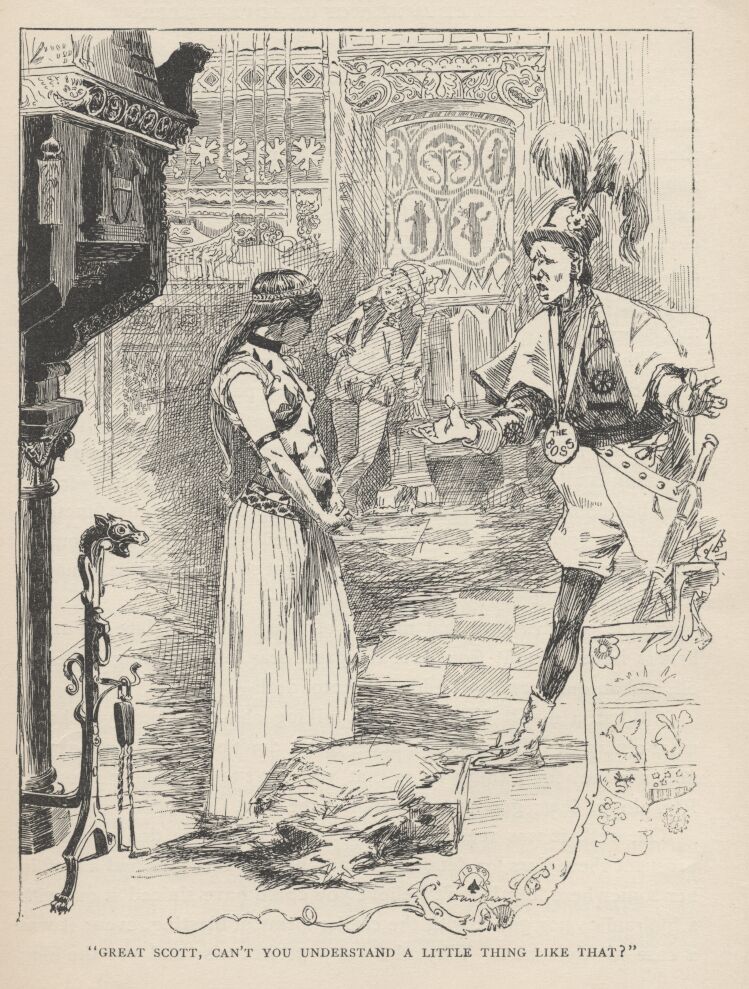
“Don’t understand? Land of—why, you see—you see—why, great Scott, can’t you understand a little thing like that? Can’t you understand the difference between your—why do you look so innocent and idiotic!”
“Don’t understand? Oh, come on. You see, you see. For goodness’ sake, can’t you understand something that simple? Can’t you understand the difference between your... why do you look so innocent and idiotic!”
“I? In truth I know not, but an it were the will of God.”
“Me? I really don't know, unless it was God's will.”
“Yes, yes, I reckon that’s about the size of it. Don’t mind my seeming excited; I’m not. Let us change the subject. Now as to this castle, with forty-five princesses in it, and three ogres at the head of it, tell me—where is this harem?”
“Yes, yes, I guess that’s about right. Don’t mind me if I seem excited. I’m not. Let’s change the subject. Now, about this castle with forty-five princesses and three ogres in charge. Tell me, where is this harem?”
“Harem?”
“Harem?”
“The castle, you understand; where is the castle?”
“The castle, you understand. Where is the castle?”
“Oh, as to that, it is great, and strong, and well beseen, and lieth in a far country. Yes, it is many leagues.”
“Oh, as for that, it is large, strong, and impressive to look at. It lies in a distant country. Yes, it is many leagues away.”
“How many?”
“How many?”
“Ah, fair sir, it were woundily hard to tell, they are so many, and do so lap the one upon the other, and being made all in the same image and tincted with the same color, one may not know the one league from its fellow, nor how to count them except they be taken apart, and ye wit well it were God’s work to do that, being not within man’s capacity; for ye will note—”
“Ah, good sir, it would be terribly hard to tell. There are so many, and they overlap one another so much. They are all made in the same image and painted the same color. So one cannot tell one league from another, or count them unless they are taken apart. And you know well that only God could do that. It is beyond human ability. For you will note...”
“Hold on, hold on, never mind about the distance; whereabouts does the castle lie? What’s the direction from here?”
“Hold on, hold on. Never mind the distance. Where is the castle? Which direction is it from here?”
“Ah, please you sir, it hath no direction from here; by reason that the road lieth not straight, but turneth evermore; wherefore the direction of its place abideth not, but is some time under the one sky and anon under another, whereso if ye be minded that it is in the east, and wend thitherward, ye shall observe that the way of the road doth yet again turn upon itself by the space of half a circle, and this marvel happing again and yet again and still again, it will grieve you that you had thought by vanities of the mind to thwart and bring to naught the will of Him that giveth not a castle a direction from a place except it pleaseth Him, and if it please Him not, will the rather that even all castles and all directions thereunto vanish out of the earth, leaving the places wherein they tarried desolate and vacant, so warning His creatures that where He will He will, and where He will not He—”
“Ah, please, sir, it has no direction from here because the road does not run straight. It keeps turning, so the castle’s direction never stays the same. Sometimes it lies under one part of the sky, and sometimes under another. If you think it is east and set out that way, you will see the road turn halfway around again. This marvel happens again and again. Then you will regret thinking that your foolish ideas could defeat the will of him who gives a castle no direction from a place unless he pleases. If he does not please, he would rather have all castles and all directions to them vanish from the earth. He would leave the places where they stood empty and desolate. Thus he warns his creatures that where he wills, he wills, and where he will not, he . . .”
“Oh, that’s all right, that’s all right, give us a rest; never mind about the direction, hang the direction—I beg pardon, I beg a thousand pardons, I am not well to-day; pay no attention when I soliloquize, it is an old habit, an old, bad habit, and hard to get rid of when one’s digestion is all disordered with eating food that was raised forever and ever before he was born; good land! a man can’t keep his functions regular on spring chickens thirteen hundred years old. But come—never mind about that; let’s—have you got such a thing as a map of that region about you? Now a good map—”
“Oh, that’s all right, that’s all right. Give me a break. Never mind the direction, hang the direction. I beg your pardon, I beg a thousand pardons. I’m not well today. Pay no attention when I talk to myself. It’s an old habit, an old, bad habit. It’s hard to break when your digestion is all messed up from eating food raised ages before you were born. Good grief! A man can’t keep his bowels regular on spring chickens that are thirteen hundred years old. But come on, never mind that. Let’s see. Do you happen to have a map of that region with you? A good map.”
“Is it peradventure that manner of thing which of late the unbelievers have brought from over the great seas, which, being boiled in oil, and an onion and salt added thereto, doth—”
“Could it perhaps be the kind of thing the unbelievers recently brought from across the great seas? When boiled in oil with an onion and salt, it . . .”
“What, a map? What are you talking about? Don’t you know what a map is? There, there, never mind, don’t explain, I hate explanations; they fog a thing up so that you can’t tell anything about it. Run along, dear; good-day; show her the way, Clarence.”
“What, a map? What are you talking about? Don’t you know what a map is? There, there, never mind. Don’t explain. I hate explanations. They make things so confusing that you can’t make sense of anything. Run along, dear. Goodbye. Show her the way, Clarence.”
Oh, well, it was reasonably plain, now, why these donkeys didn’t prospect these liars for details. It may be that this girl had a fact in her somewhere, but I don’t believe you could have sluiced it out with a hydraulic; nor got it with the earlier forms of blasting, even; it was a case for dynamite. Why, she was a perfect ass; and yet the king and his knights had listened to her as if she had been a leaf out of the gospel. It kind of sizes up the whole party. And think of the simple ways of this court: this wandering wench hadn’t any more trouble to get access to the king in his palace than she would have had to get into the poorhouse in my day and country. In fact, he was glad to see her, glad to hear her tale; with that adventure of hers to offer, she was as welcome as a corpse is to a coroner.
Oh, well, now it was fairly clear why these idiots didn’t question these liars for details. This girl may have had a fact somewhere inside her. But I don’t believe you could have washed it out with a high-pressure water jet. You couldn’t even have gotten it out with old-fashioned blasting. This was a job for dynamite. She was a complete fool, yet the king and his knights had listened to her as if she were a page from the gospel. That says something about the whole crowd. And think how informal this court was. This wandering girl had no more trouble reaching the king in his palace than she would have had entering the poorhouse in my time and country. In fact, he was glad to see her and hear her story. With her adventure to offer, she was as welcome as a corpse is to a coroner.
Just as I was ending-up these reflections, Clarence came back. I remarked upon the barren result of my efforts with the girl; hadn’t got hold of a single point that could help me to find the castle. The youth looked a little surprised, or puzzled, or something, and intimated that he had been wondering to himself what I had wanted to ask the girl all those questions for.
Just as I was finishing these thoughts, Clarence came back. I told him my efforts with the girl had been fruitless. I hadn't learned a single thing that could help me find the castle. The young man looked a little surprised, or puzzled, or something. He hinted that he had been wondering why I'd wanted to ask the girl all those questions.
“Why, great guns,” I said, “don’t I want to find the castle? And how else would I go about it?”
“Good grief,” I said, “of course I want to find the castle. How else would I find it?”
“La, sweet your worship, one may lightly answer that, I ween. She will go with thee. They always do. She will ride with thee.”
“Oh, my dear sir, I think that’s easy enough to answer. She will go with you. They always do. She will ride with you.”
“Ride with me? Nonsense!”
“Ride with me? Ridiculous!”
“But of a truth she will. She will ride with thee. Thou shalt see.”
“But she really will. She will ride with you. You’ll see.”
“What? She browse around the hills and scour the woods with me—alone—and I as good as engaged to be married? Why, it’s scandalous. Think how it would look.”
“What? She would wander the hills and search the woods with me, alone, when I’m practically engaged? Why, that’s scandalous. Think how it would look.”
My, the dear face that rose before me! The boy was eager to know all about this tender matter. I swore him to secrecy and then whispered her name—“Puss Flanagan.” He looked disappointed, and said he didn’t remember the countess. How natural it was for the little courtier to give her a rank. He asked me where she lived.
Oh, the dear face that came to mind! The boy was eager to know all about this tender matter. I made him swear to keep it secret, then whispered her name: “Puss Flanagan.” He looked disappointed and said he didn’t remember the countess. How natural it was for the little courtier to give her a title. He asked me where she lived.
“In East Har—” I came to myself and stopped, a little confused; then I said, “Never mind, now; I’ll tell you some time.”
“In East Har...” I caught myself and stopped, a little confused. Then I said, “Never mind. I’ll tell you sometime.”
And might he see her? Would I let him see her some day?
And could he see her? Would I let him see her someday?
It was but a little thing to promise—thirteen hundred years or so—and he so eager; so I said Yes. But I sighed; I couldn’t help it. And yet there was no sense in sighing, for she wasn’t born yet. But that is the way we are made: we don’t reason, where we feel; we just feel.
It was a small thing to promise, just thirteen hundred years or so, and he was so eager. So I said yes. But I sighed. I couldn’t help it. Still, there was no sense in sighing, since she wasn’t born yet. But that’s how we are. When we feel, we don’t reason. We just feel.
My expedition was all the talk that day and that night, and the boys were very good to me, and made much of me, and seemed to have forgotten their vexation and disappointment, and come to be as anxious for me to hive those ogres and set those ripe old virgins loose as if it were themselves that had the contract. Well, they were good children—but just children, that is all. And they gave me no end of points about how to scout for giants, and how to scoop them in; and they told me all sorts of charms against enchantments, and gave me salves and other rubbish to put on my wounds. But it never occurred to one of them to reflect that if I was such a wonderful necromancer as I was pretending to be, I ought not to need salves or instructions, or charms against enchantments, and, least of all, arms and armor, on a foray of any kind—even against fire-spouting dragons, and devils hot from perdition, let alone such poor adversaries as these I was after, these commonplace ogres of the back settlements.
My expedition was all anyone talked about that day and night. The boys were very good to me and made a great fuss over me. They seemed to have forgotten their annoyance and disappointment. They were now as eager for me to capture the ogres and free those ripe old virgins as if they had taken the job themselves. Well, they were good children, but just children, that is all. They gave me endless tips on how to search for giants and capture them. They told me all sorts of charms against enchantments. They also gave me salves and other rubbish to put on my wounds. But not one of them stopped to think about the wonderful necromancer I was pretending to be. If I really was that powerful, I should not need salves, instructions, or charms against enchantments. Least of all, I should not need weapons and armor on any expedition. That would be true even against fire-breathing dragons and devils fresh from hell. It would certainly be true against the poor opponents I was after, those ordinary ogres from the back settlements.
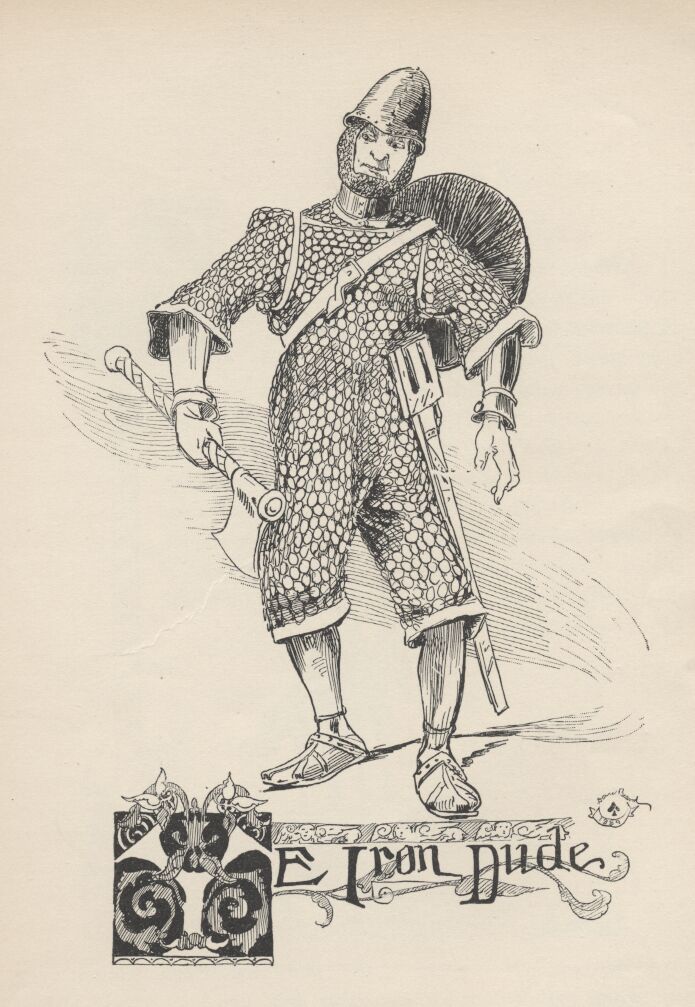
I was to have an early breakfast, and start at dawn, for that was the usual way; but I had the demon’s own time with my armor, and this delayed me a little. It is troublesome to get into, and there is so much detail. First you wrap a layer or two of blanket around your body, for a sort of cushion and to keep off the cold iron; then you put on your sleeves and shirt of chain mail—these are made of small steel links woven together, and they form a fabric so flexible that if you toss your shirt onto the floor, it slumps into a pile like a peck of wet fish-net; it is very heavy and is nearly the uncomfortablest material in the world for a night shirt, yet plenty used it for that—tax collectors, and reformers, and one-horse kings with a defective title, and those sorts of people; then you put on your shoes—flat-boats roofed over with interleaving bands of steel—and screw your clumsy spurs into the heels. Next you buckle your greaves on your legs, and your cuisses on your thighs; then come your backplate and your breastplate, and you begin to feel crowded; then you hitch onto the breastplate the half-petticoat of broad overlapping bands of steel which hangs down in front but is scolloped out behind so you can sit down, and isn’t any real improvement on an inverted coal scuttle, either for looks or for wear, or to wipe your hands on; next you belt on your sword; then you put your stove-pipe joints onto your arms, your iron gauntlets onto your hands, your iron rat-trap onto your head, with a rag of steel web hitched onto it to hang over the back of your neck—and there you are, snug as a candle in a candle-mould. This is no time to dance. Well, a man that is packed away like that is a nut that isn’t worth the cracking, there is so little of the meat, when you get down to it, by comparison with the shell.
I was supposed to eat an early breakfast and start at dawn, as was usual. But I had a devil of a time with my armor, and that delayed me a little. Armor is troublesome to put on, and there are so many details. First, you wrap a layer or two of blanket around your body. This cushions you and keeps the cold iron off your skin. Then you put on your chain-mail sleeves and shirt. They are made of small steel links woven together into a flexible fabric. If you toss your shirt onto the floor, it collapses into a pile like a basketful of wet fishing net. It is very heavy and almost the most uncomfortable material in the world for a nightshirt. Yet plenty of people wore it to bed: tax collectors, reformers, petty kings with a shaky claim to the throne, and that sort of person. Then you put on your shoes, which look like flat-bottomed boats roofed over with overlapping steel bands. You screw your clumsy spurs into the heels. Next, you buckle your greaves onto your lower legs and your cuisses onto your thighs. Then come your backplate and breastplate, and you begin to feel cramped. You attach a half-skirt of broad, overlapping steel bands to the breastplate. It hangs down in front but is cut away at the back so you can sit down. It is no real improvement on an upside-down coal bucket, whether for looks, comfort, or wiping your hands on. Next, you belt on your sword. Then you fit the stovepipe sections onto your arms and the iron gauntlets onto your hands. You put the iron rat trap on your head, with a scrap of steel mesh attached to cover your neck. And there you are, snug as a candle in a candle mold. This is no time to dance. A man packed away like that is a nut not worth cracking. Once you get down to it, there is so little meat compared with the shell.
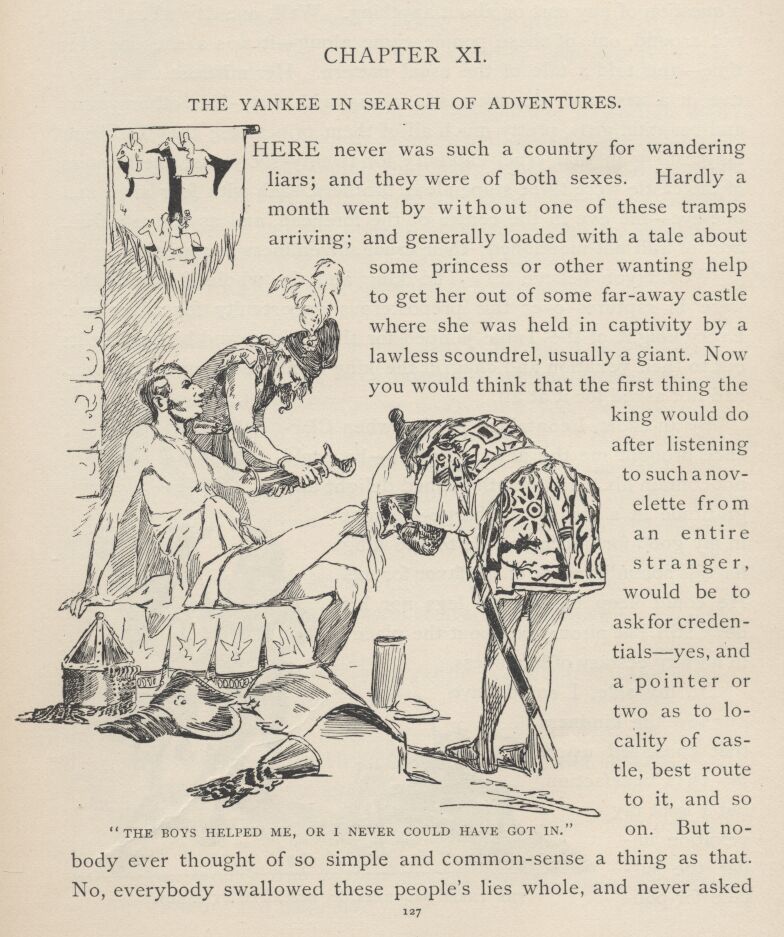
The boys helped me, or I never could have got in. Just as we finished, Sir Bedivere happened in, and I saw that as like as not I hadn’t chosen the most convenient outfit for a long trip. How stately he looked; and tall and broad and grand. He had on his head a conical steel casque that only came down to his ears, and for visor had only a narrow steel bar that extended down to his upper lip and protected his nose; and all the rest of him, from neck to heel, was flexible chain mail, trousers and all. But pretty much all of him was hidden under his outside garment, which of course was of chain mail, as I said, and hung straight from his shoulders to his ankles; and from his middle to the bottom, both before and behind, was divided, so that he could ride and let the skirts hang down on each side. He was going grailing, and it was just the outfit for it, too. I would have given a good deal for that ulster, but it was too late now to be fooling around. The sun was just up, the king and the court were all on hand to see me off and wish me luck; so it wouldn’t be etiquette for me to tarry. You don’t get on your horse yourself; no, if you tried it you would get disappointed. They carry you out, just as they carry a sun-struck man to the drug store, and put you on, and help get you to rights, and fix your feet in the stirrups; and all the while you do feel so strange and stuffy and like somebody else—like somebody that has been married on a sudden, or struck by lightning, or something like that, and hasn’t quite fetched around yet, and is sort of numb, and can’t just get his bearings. Then they stood up the mast they called a spear, in its socket by my left foot, and I gripped it with my hand; lastly they hung my shield around my neck, and I was all complete and ready to up anchor and get to sea. Everybody was as good to me as they could be, and a maid of honor gave me the stirrup-cup her own self. There was nothing more to do now, but for that damsel to get up behind me on a pillion, which she did, and put an arm or so around me to hold on.
The boys helped me, or I never could have gotten into my armor. Just as we finished, Sir Bedivere happened to come in. I saw that I probably hadn't chosen the most convenient outfit for a long trip. How stately he looked, so tall and broad and grand. He wore a cone-shaped steel helmet that came down only to his ears. Instead of a visor, it had a narrow steel bar that protected his nose and reached his upper lip. The rest of him, from neck to heel, was covered in flexible chain mail, trousers and all. But an outer garment hid almost all of him. It was chain mail too, of course, as I said, and hung straight from his shoulders to his ankles. It was split from the waist down, both in front and behind. That way, he could ride with the skirts hanging down on either side. He was going grailing, and that was just the outfit for it, too. I would have given a good deal for that overcoat, but it was too late to fool around now. The sun had just risen. The king and the whole court were there to see me off and wish me luck. So it wouldn't be proper for me to linger. You don't get on your horse yourself. No, if you tried, you'd be disappointed. They carry you out, just as they'd carry a man overcome by the sun to the drugstore. They put you on the horse, help settle you in place, and put your feet in the stirrups. All the while, you feel so strange and stuffy, and like somebody else. You feel like someone who has suddenly gotten married, or been struck by lightning, or something like that. You haven't quite recovered yet. You're sort of numb and can't quite get your bearings. Then they stood the mast they called a spear in its socket by my left foot, and I gripped it. Lastly, they hung my shield around my neck. I was fully equipped and ready to weigh anchor and put to sea. Everybody was as kind to me as could be. A maid of honor gave me the farewell drink herself. There was nothing left to do except have that damsel climb onto a pillion behind me. She did, and put an arm or so around me to hold on.
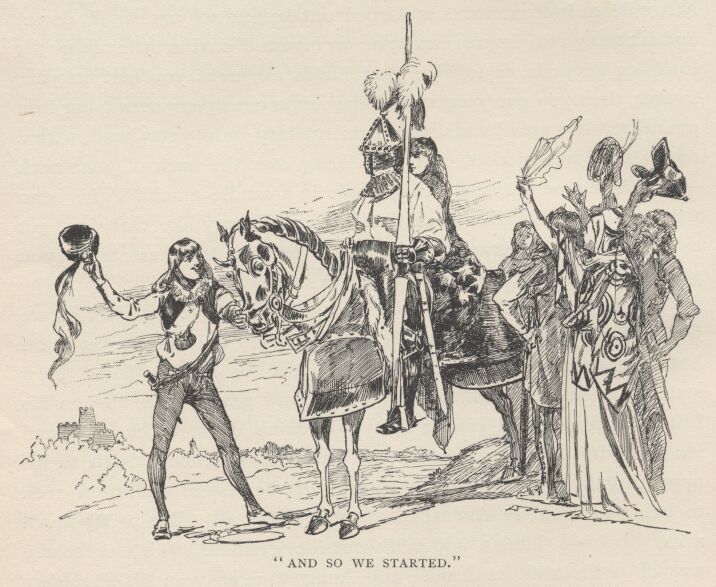
And so we started, and everybody gave us a goodbye and waved their handkerchiefs or helmets. And everybody we met, going down the hill and through the village was respectful to us, except some shabby little boys on the outskirts. They said:
And so we set off, and everyone said goodbye and waved their handkerchiefs or helmets. As we went down the hill and through the village, everyone we met was respectful to us, except some scruffy little boys on the outskirts. They said:
“Oh, what a guy!” And hove clods at us.
“Oh, what a sight!” And threw clumps of dirt at us.
In my experience boys are the same in all ages. They don’t respect anything, they don’t care for anything or anybody. They say “Go up, baldhead” to the prophet going his unoffending way in the gray of antiquity; they sass me in the holy gloom of the Middle Ages; and I had seen them act the same way in Buchanan’s administration; I remember, because I was there and helped. The prophet had his bears and settled with his boys; and I wanted to get down and settle with mine, but it wouldn’t answer, because I couldn’t have got up again. I hate a country without a derrick.
In my experience, boys are the same in every age. They don’t respect anything, and they don’t care about anything or anyone. They say “Go up, baldhead” to the prophet as he goes harmlessly on his way in ancient times. They talk back to me in the holy gloom of the Middle Ages. And I saw them act the same way during Buchanan’s administration. I remember because I was there and joined in. The prophet had his bears and used them to deal with his boys. I wanted to get down and deal with mine, but that wouldn’t work. I couldn’t have gotten up again. I hate a country without a derrick.