Chapter 2
King Arthur’s Court
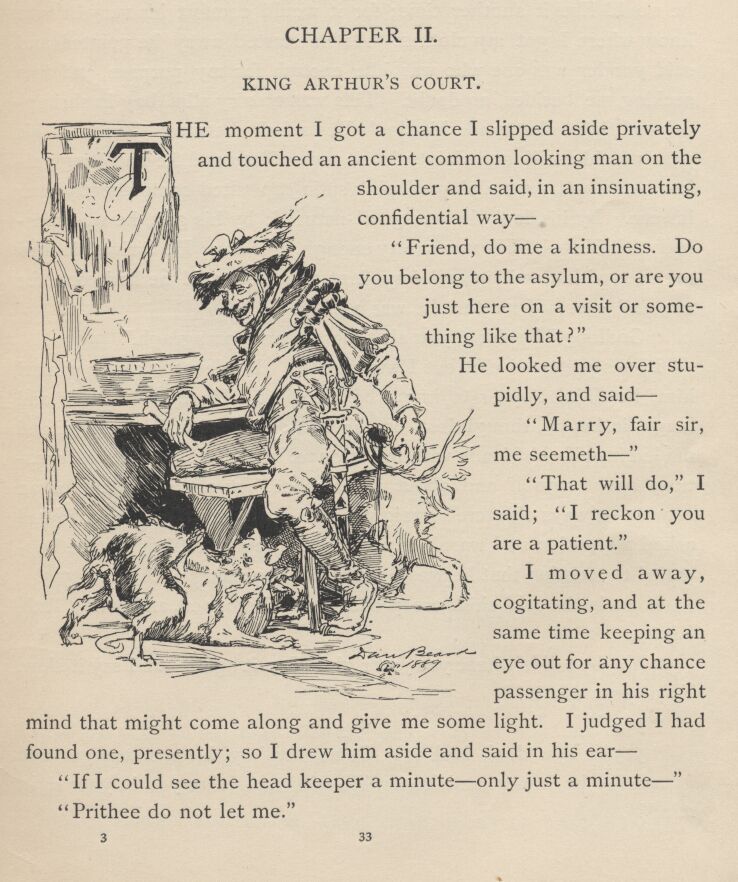
The moment I got a chance I slipped aside privately and touched an ancient common looking man on the shoulder and said, in an insinuating, confidential way:
As soon as I got a chance, I slipped aside and touched a very old, ordinary-looking man on the shoulder. I spoke to him in a sly, confidential tone:
“Friend, do me a kindness. Do you belong to the asylum, or are you just on a visit or something like that?”
“Friend, do me a favor. Do you live in the asylum, or are you just visiting or something?”
He looked me over stupidly, and said:
He looked me over with a stupid expression and said:
“Marry, fair sir, me seemeth—”
“Indeed, sir, it seems to me...”
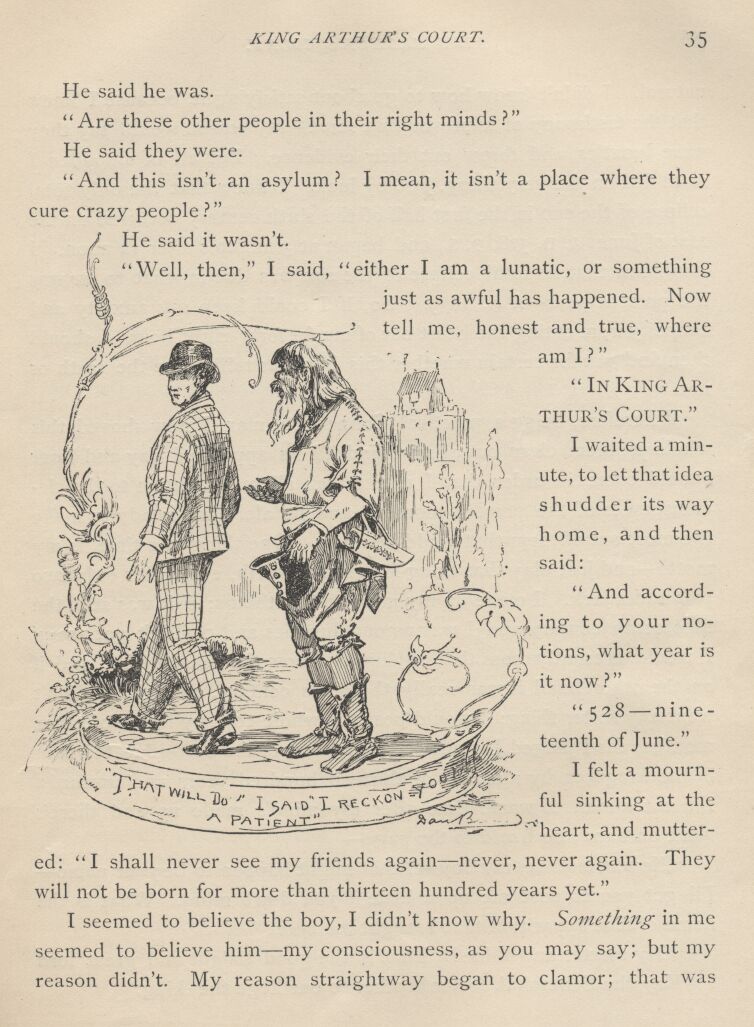
“That will do,” I said; “I reckon you are a patient.”
“That will do,” I said. “I suppose you are a patient.”
I moved away, cogitating, and at the same time keeping an eye out for any chance passenger in his right mind that might come along and give me some light. I judged I had found one, presently; so I drew him aside and said in his ear:
I walked away, thinking and watching for a sane passerby who might shed some light on the situation. Before long, I thought I had found one. So I drew him aside and whispered in his ear:
“If I could see the head keeper a minute—only just a minute—”
“If I could see the head keeper for a minute, just one minute...”
“Prithee do not let me.”
“Please don’t stop me.”
“Let you what?”
“Let you what?”
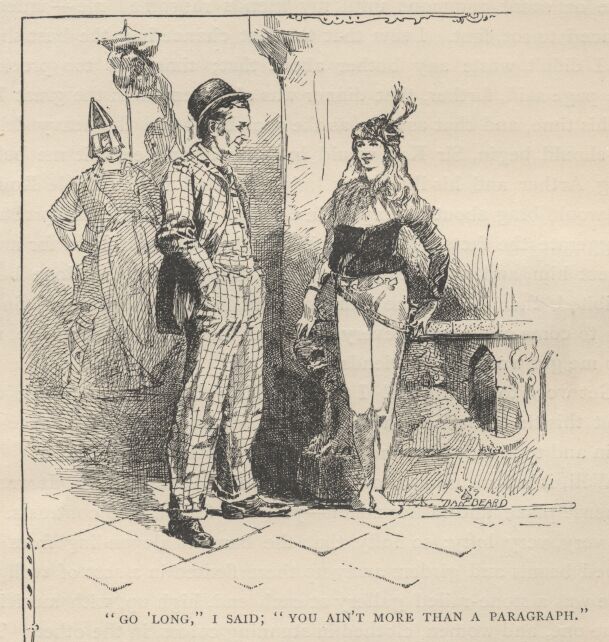
“Hinder me, then, if the word please thee better.” Then he went on to say he was an under-cook and could not stop to gossip, though he would like it another time; for it would comfort his very liver to know where I got my clothes. As he started away he pointed and said yonder was one who was idle enough for my purpose, and was seeking me besides, no doubt. This was an airy slim boy in shrimp-colored tights that made him look like a forked carrot, the rest of his gear was blue silk and dainty laces and ruffles; and he had long yellow curls, and wore a plumed pink satin cap tilted complacently over his ear. By his look, he was good-natured; by his gait, he was satisfied with himself. He was pretty enough to frame. He arrived, looked me over with a smiling and impudent curiosity; said he had come for me, and informed me that he was a page.
“Hinder me, then, if you like that word better.” He went on to say that he was an assistant cook and couldn’t stop to gossip. He would like to talk another time, though. It would comfort his very liver to know where I got my clothes. As he started away, he pointed out someone who had enough time for my purposes. No doubt, he said, the person was looking for me too. It was a carefree, slender boy in shrimp-colored tights that made him look like a forked carrot. The rest of his outfit was blue silk with delicate lace and ruffles. He had long yellow curls and wore a plumed pink satin cap, tilted smugly over his ear. He looked good-natured, and the way he walked showed he was pleased with himself. He was pretty enough to frame. He came over and looked me up and down with a smiling, cheeky curiosity. He said he had come for me and told me he was a page.
“Go ’long,” I said; “you ain’t more than a paragraph.”
“Go along,” I said. “You ain't more than a paragraph.”
It was pretty severe, but I was nettled. However, it never phazed him; he didn’t appear to know he was hurt. He began to talk and laugh, in happy, thoughtless, boyish fashion, as we walked along, and made himself old friends with me at once; asked me all sorts of questions about myself and about my clothes, but never waited for an answer—always chattered straight ahead, as if he didn’t know he had asked a question and wasn’t expecting any reply, until at last he happened to mention that he was born in the beginning of the year 513.
It was pretty harsh, but I was annoyed. Still, he wasn’t fazed. He didn’t seem to know he’d been hurt. As we walked along, he began talking and laughing in a happy, carefree, boyish way. He acted as if we were old friends right away. He asked me all sorts of questions about myself and my clothes, but never waited for an answer. He just kept chattering, as if he didn’t know he had asked a question or expect a reply. Finally, he happened to mention that he was born at the beginning of the year 513.
It made the cold chills creep over me! I stopped and said, a little faintly:
It sent chills down my spine! I stopped and said, in a faint voice:
“Maybe I didn’t hear you just right. Say it again—and say it slow. What year was it?”
“Maybe I didn’t hear you right. Say it again, and say it slowly. What year was it?”
“513.”
“513.”
“513! You don’t look it! Come, my boy, I am a stranger and friendless; be honest and honorable with me. Are you in your right mind?”
“513! You don’t look that old! Come on, my boy, I’m a stranger here and have no friends. Be honest and honorable with me. Are you in your right mind?”
He said he was.
He said he was.
“Are these other people in their right minds?”
“Are these other people sane?”
He said they were.
He said they were.
“And this isn’t an asylum? I mean, it isn’t a place where they cure crazy people?”
“And this isn’t a mental hospital? I mean, it isn’t a place where they cure crazy people?”
He said it wasn’t.
He said it wasn’t.
“Well, then,” I said, “either I am a lunatic, or something just as awful has happened. Now tell me, honest and true, where am I?”
“Well, then,” I said, “either I'm crazy, or something just as awful has happened. Now tell me honestly, where am I?”
“In King Arthur’s Court.”
“In King Arthur’s Court.”
I waited a minute, to let that idea shudder its way home, and then said:
I waited a minute to let that idea sink in with a shudder, then said:
“And according to your notions, what year is it now?”
“And what year do you think it is now?”
“528—nineteenth of June.”
“528, June 19.”
I felt a mournful sinking at the heart, and muttered: “I shall never see my friends again—never, never again. They will not be born for more than thirteen hundred years yet.”
My heart sank with sadness, and I muttered: “I’ll never see my friends again. Never, never again. They won’t be born for more than thirteen hundred years.”
I seemed to believe the boy, I didn’t know why. Something in me seemed to believe him—my consciousness, as you may say; but my reason didn’t. My reason straightway began to clamor; that was natural. I didn’t know how to go about satisfying it, because I knew that the testimony of men wouldn’t serve—my reason would say they were lunatics, and throw out their evidence. But all of a sudden I stumbled on the very thing, just by luck. I knew that the only total eclipse of the sun in the first half of the sixth century occurred on the 21st of June, A.D. 528, O.S., and began at 3 minutes after 12 noon. I also knew that no total eclipse of the sun was due in what to me was the present year—i.e., 1879. So, if I could keep my anxiety and curiosity from eating the heart out of me for forty-eight hours, I should then find out for certain whether this boy was telling me the truth or not.
I seemed to believe the boy, though I didn’t know why. Something in me seemed to believe him, my consciousness, you might say. But my reason didn’t. It immediately began to protest, which was natural. I didn’t know how to satisfy my reason. I knew that other men’s testimony wouldn’t do. My reason would call them lunatics and dismiss their evidence. But suddenly, by sheer luck, I stumbled on just the thing. I knew that the only total solar eclipse in the first half of the sixth century occurred on June 21, A.D. 528, O.S. It began at 12:03 noon. I also knew that no total solar eclipse was due in what was, to me, the present year, 1879. So, if I could keep my anxiety and curiosity from eating my heart out for forty-eight hours, I would know for certain whether the boy was telling me the truth.
Wherefore, being a practical Connecticut man, I now shoved this whole problem clear out of my mind till its appointed day and hour should come, in order that I might turn all my attention to the circumstances of the present moment, and be alert and ready to make the most out of them that could be made. One thing at a time, is my motto—and just play that thing for all it is worth, even if it’s only two pair and a jack. I made up my mind to two things: if it was still the nineteenth century and I was among lunatics and couldn’t get away, I would presently boss that asylum or know the reason why; and if, on the other hand, it was really the sixth century, all right, I didn’t want any softer thing: I would boss the whole country inside of three months; for I judged I would have the start of the best-educated man in the kingdom by a matter of thirteen hundred years and upward. I’m not a man to waste time after my mind’s made up and there’s work on hand; so I said to the page:
So, being a practical Connecticut man, I pushed the whole problem out of my mind until its appointed day and hour arrived. That way, I could give all my attention to the present moment. I could stay alert and ready to make the most of it. My motto is one thing at a time, and play it for all it’s worth, even if it’s only two pair and a jack. I made up my mind about two things. If it was still the nineteenth century and I was stuck among lunatics, I’d soon be running that asylum or know the reason why. If, on the other hand, it really was the sixth century, that was fine too. I couldn’t ask for an easier opportunity. I’d be running the whole country within three months. I figured I had a head start of at least thirteen hundred years on the best-educated man in the kingdom. I’m not one to waste time once my mind is made up and there’s work to do. So I said to the page:
“Now, Clarence, my boy—if that might happen to be your name—I’ll get you to post me up a little if you don’t mind. What is the name of that apparition that brought me here?”
“Now, Clarence, my boy, if that happens to be your name, I’d like you to fill me in a little, if you don’t mind. What is the name of that apparition who brought me here?”
“My master and thine? That is the good knight and great lord Sir Kay the Seneschal, foster brother to our liege the king.”
“My master and yours? That is the good knight and great lord Sir Kay the Seneschal, the king’s foster brother.”
“Very good; go on, tell me everything.”
“Very good. Go on, tell me everything.”
He made a long story of it; but the part that had immediate interest for me was this: He said I was Sir Kay’s prisoner, and that in the due course of custom I would be flung into a dungeon and left there on scant commons until my friends ransomed me—unless I chanced to rot, first. I saw that the last chance had the best show, but I didn’t waste any bother about that; time was too precious. The page said, further, that dinner was about ended in the great hall by this time, and that as soon as the sociability and the heavy drinking should begin, Sir Kay would have me in and exhibit me before King Arthur and his illustrious knights seated at the Table Round, and would brag about his exploit in capturing me, and would probably exaggerate the facts a little, but it wouldn’t be good form for me to correct him, and not over safe, either; and when I was done being exhibited, then ho for the dungeon; but he, Clarence, would find a way to come and see me every now and then, and cheer me up, and help me get word to my friends.
He told a long story, but the part that interested me immediately was this: I was Sir Kay’s prisoner. By custom, I would be thrown into a dungeon and given barely enough food until my friends paid my ransom. That was unless I happened to rot there first. I could see that rotting had the better chance, but I didn’t waste time worrying about it. Time was too precious. The page went on to say that dinner in the great hall was probably almost over. Once the conversation and heavy drinking began, Sir Kay would bring me in and show me off before King Arthur and his illustrious knights. They would be seated at the Table Round. Sir Kay would brag about capturing me and would probably stretch the facts a little. But it wouldn’t be proper for me to correct him, and it wouldn’t be very safe, either. Once Sir Kay was done showing me off, it was off to the dungeon. But the page, Clarence, would find a way to visit me now and then. He would cheer me up and help me get word to my friends.
Get word to my friends! I thanked him; I couldn’t do less; and about this time a lackey came to say I was wanted; so Clarence led me in and took me off to one side and sat down by me.
Get word to my friends! I thanked him. It was the least I could do. Around then, a servant came to say I was wanted. So Clarence led me in, took me aside, and sat down beside me.
Well, it was a curious kind of spectacle, and interesting. It was an immense place, and rather naked—yes, and full of loud contrasts. It was very, very lofty; so lofty that the banners depending from the arched beams and girders away up there floated in a sort of twilight; there was a stone-railed gallery at each end, high up, with musicians in the one, and women, clothed in stunning colors, in the other. The floor was of big stone flags laid in black and white squares, rather battered by age and use, and needing repair. As to ornament, there wasn’t any, strictly speaking; though on the walls hung some huge tapestries which were probably taxed as works of art; battle-pieces, they were, with horses shaped like those which children cut out of paper or create in gingerbread; with men on them in scale armor whose scales are represented by round holes—so that the man’s coat looks as if it had been done with a biscuit-punch. There was a fireplace big enough to camp in; and its projecting sides and hood, of carved and pillared stonework, had the look of a cathedral door. Along the walls stood men-at-arms, in breastplate and morion, with halberds for their only weapon—rigid as statues; and that is what they looked like.
Well, it was a strange sight, and interesting. The room was enormous and rather bare, with some striking contrasts. It was very, very high. The banners hanging from the arched beams and girders floated in a kind of twilight. High up at each end was a gallery with a stone railing. Musicians occupied one gallery, and women dressed in stunning colors occupied the other. The floor was made of large stone slabs in black and white squares. They were rather worn from age and use and needed repair. Strictly speaking, there were no decorations. Still, some huge tapestries hung on the walls, and they were probably taxed as works of art. They showed battles, with horses shaped like the ones children cut from paper or make from gingerbread. The men riding them wore scale armor, with the scales shown as round holes. So their coats looked as if they had been made with a biscuit cutter. The fireplace was big enough to camp in. Its projecting sides and hood were made of carved stone with pillars, and they looked like a cathedral entrance. Along the walls stood men-at-arms in breastplates and morions, armed only with halberds. They were as stiff as statues, and that is just what they looked like.
In the middle of this groined and vaulted public square was an oaken table which they called the Table Round. It was as large as a circus ring; and around it sat a great company of men dressed in such various and splendid colors that it hurt one’s eyes to look at them. They wore their plumed hats, right along, except that whenever one addressed himself directly to the king, he lifted his hat a trifle just as he was beginning his remark.
In the middle of the vaulted public square stood an oak table called the Table Round. It was as large as a circus ring. A large group of men sat around it, dressed in such varied and splendid colors that it hurt to look at them. They kept their plumed hats on the whole time. But whenever a man spoke directly to the king, he lifted his hat slightly as he began to speak.
Mainly they were drinking—from entire ox horns; but a few were still munching bread or gnawing beef bones. There was about an average of two dogs to one man; and these sat in expectant attitudes till a spent bone was flung to them, and then they went for it by brigades and divisions, with a rush, and there ensued a fight which filled the prospect with a tumultuous chaos of plunging heads and bodies and flashing tails, and the storm of howlings and barkings deafened all speech for the time; but that was no matter, for the dog-fight was always a bigger interest anyway; the men rose, sometimes, to observe it the better and bet on it, and the ladies and the musicians stretched themselves out over their balusters with the same object; and all broke into delighted ejaculations from time to time. In the end, the winning dog stretched himself out comfortably with his bone between his paws, and proceeded to growl over it, and gnaw it, and grease the floor with it, just as fifty others were already doing; and the rest of the court resumed their previous industries and entertainments.
Most of them were drinking from whole ox horns, but a few were still eating bread or gnawing beef bones. There were about two dogs for every man. They sat waiting until someone threw them a gnawed bone. Then they charged at it in brigades and divisions. A fight followed, filling the scene with a wild jumble of plunging heads and bodies and flashing tails. The storm of howling and barking drowned out all conversation for a while. But that didn't matter, because the dogfight was always more interesting anyway. The men sometimes stood up to get a better look and place bets. The ladies and musicians leaned over their railings to do the same. Now and then, everyone shouted with delight. In the end, the winning dog stretched out comfortably with the bone between his paws. He growled over it, gnawed it, and smeared grease on the floor with it, just as fifty others were already doing. Then the rest of the court went back to their earlier activities and amusements.
As a rule, the speech and behavior of these people were gracious and courtly; and I noticed that they were good and serious listeners when anybody was telling anything—I mean in a dog-fightless interval. And plainly, too, they were a childlike and innocent lot; telling lies of the stateliest pattern with a most gentle and winning naivety, and ready and willing to listen to anybody else’s lie, and believe it, too. It was hard to associate them with anything cruel or dreadful; and yet they dealt in tales of blood and suffering with a guileless relish that made me almost forget to shudder.
As a rule, these people spoke and behaved graciously and politely. I noticed that they listened well and seriously whenever anyone told a story. I mean, whenever there wasn't a dogfight going on. Clearly, they were also a childlike and innocent lot. They told the most magnificent lies with a gentle, charming innocence. They were just as ready and willing to listen to anyone else's lie and believe it, too. It was hard to imagine them doing anything cruel or dreadful. Yet they took such innocent delight in tales of blood and suffering that I almost forgot to shudder.
I was not the only prisoner present. There were twenty or more. Poor devils, many of them were maimed, hacked, carved, in a frightful way; and their hair, their faces, their clothing, were caked with black and stiffened drenchings of blood. They were suffering sharp physical pain, of course; and weariness, and hunger and thirst, no doubt; and at least none had given them the comfort of a wash, or even the poor charity of a lotion for their wounds; yet you never heard them utter a moan or a groan, or saw them show any sign of restlessness, or any disposition to complain. The thought was forced upon me: “The rascals—they have served other people so in their day; it being their own turn, now, they were not expecting any better treatment than this; so their philosophical bearing is not an outcome of mental training, intellectual fortitude, reasoning; it is mere animal training; they are white Indians.”
I was not the only prisoner there. There were twenty or more. Poor devils, many were horribly maimed, hacked, and cut up. Their hair, faces, and clothes were caked and stiff with dried black blood. Of course they were in sharp physical pain, and no doubt they were tired, hungry, and thirsty. No one had even given them the comfort of a wash or the small kindness of lotion for their wounds. Yet I never heard them moan or groan, or saw them show any restlessness or desire to complain. I could not help thinking: “The rascals, they have treated other people this way in their time. Now that it is their turn, they do not expect any better treatment. So their calm acceptance does not come from mental training, intellectual strength, or reasoning. It is mere animal training. They are white Indians.”