Chapter 3
Knights of the Round Table
Mainly the Round Table talk was monologues—narrative accounts of the adventures in which these prisoners were captured and their friends and backers killed and stripped of their steeds and armor. As a general thing—as far as I could make out—these murderous adventures were not forays undertaken to avenge injuries, nor to settle old disputes or sudden fallings out; no, as a rule they were simply duels between strangers—duels between people who had never even been introduced to each other, and between whom existed no cause of offense whatever. Many a time I had seen a couple of boys, strangers, meet by chance, and say simultaneously, “I can lick you,” and go at it on the spot; but I had always imagined until now that that sort of thing belonged to children only, and was a sign and mark of childhood; but here were these big boobies sticking to it and taking pride in it clear up into full age and beyond. Yet there was something very engaging about these great simple-hearted creatures, something attractive and lovable. There did not seem to be brains enough in the entire nursery, so to speak, to bait a fish-hook with; but you didn’t seem to mind that, after a little, because you soon saw that brains were not needed in a society like that, and indeed would have marred it, hindered it, spoiled its symmetry—perhaps rendered its existence impossible.
Most of the talk at the Round Table consisted of monologues. The knights told stories of the adventures in which they had captured these prisoners. They also told how they had killed the prisoners’ friends and supporters and taken their horses and armor. As far as I could make out, these murderous adventures were not usually raids to avenge injuries. Nor were they meant to settle old disputes or sudden quarrels. No, as a rule, they were simply duels between strangers. The fighters had never even been introduced, and neither had given the other any cause for offense. Many times I had seen two boys who were strangers meet by chance. They would both say, “I can beat you,” and start fighting on the spot. But until now, I had always thought that sort of thing belonged only to children. I thought it was a sign of childhood. Yet here were these big idiots still doing it and taking pride in it well into adulthood and beyond. Even so, there was something very appealing about these great, simple-hearted creatures. They were attractive and lovable. The whole nursery, so to speak, didn’t seem to have enough brains to bait a fishhook. But after a while, you didn’t seem to mind. You soon saw that brains weren’t needed in such a society. In fact, brains would have spoiled it, held it back, and ruined its symmetry. Perhaps brains would have made its existence impossible.
There was a fine manliness observable in almost every face; and in some a certain loftiness and sweetness that rebuked your belittling criticisms and stilled them. A most noble benignity and purity reposed in the countenance of him they called Sir Galahad, and likewise in the king’s also; and there was majesty and greatness in the giant frame and high bearing of Sir Launcelot of the Lake.
Almost every face showed a fine manliness. Some also showed a dignity and sweetness that silenced your belittling criticisms. The face of the man they called Sir Galahad showed a noble kindness and purity, as did the king’s. Sir Launcelot of the Lake had a giant frame and a proud bearing that conveyed majesty and greatness.
There was presently an incident which centered the general interest upon this Sir Launcelot. At a sign from a sort of master of ceremonies, six or eight of the prisoners rose and came forward in a body and knelt on the floor and lifted up their hands toward the ladies’ gallery and begged the grace of a word with the queen. The most conspicuously situated lady in that massed flower-bed of feminine show and finery inclined her head by way of assent, and then the spokesman of the prisoners delivered himself and his fellows into her hands for free pardon, ransom, captivity, or death, as she in her good pleasure might elect; and this, as he said, he was doing by command of Sir Kay the Seneschal, whose prisoners they were, he having vanquished them by his single might and prowess in sturdy conflict in the field.
Soon, an incident focused everyone’s attention on Sir Launcelot. At a signal from a kind of master of ceremonies, six or eight prisoners stood and came forward together. They knelt on the floor, raised their hands toward the ladies’ gallery, and begged to speak with the queen. The most prominent lady in that crowded flower bed of feminine display and finery nodded her consent. The prisoners’ spokesman then placed himself and his fellows in her hands. She could pardon them freely, ransom them, hold them captive, or put them to death, as she pleased. He said he was doing this by command of Sir Kay the Seneschal, whose prisoners they were. Sir Kay had defeated them by his own strength and skill in a hard fight on the field.
Surprise and astonishment flashed from face to face all over the house; the queen’s gratified smile faded out at the name of Sir Kay, and she looked disappointed; and the page whispered in my ear with an accent and manner expressive of extravagant derision—
Surprise and amazement spread from face to face throughout the house. At the name of Sir Kay, the queen’s pleased smile faded, and she looked disappointed. The page whispered in my ear, his voice and manner full of exaggerated scorn:
“Sir Kay, forsooth! Oh, call me pet names, dearest, call me a marine! In twice a thousand years shall the unholy invention of man labor at odds to beget the fellow to this majestic lie!”
“Sir Kay, indeed! Oh, call me pet names, dearest, call me a marine! For two thousand years, human ingenuity will struggle to come up with a lie to match this magnificent one!”
Every eye was fastened with severe inquiry upon Sir Kay. But he was equal to the occasion. He got up and played his hand like a major—and took every trick. He said he would state the case exactly according to the facts; he would tell the simple straightforward tale, without comment of his own; “and then,” said he, “if ye find glory and honor due, ye will give it unto him who is the mightiest man of his hands that ever bare shield or strake with sword in the ranks of Christian battle—even him that sitteth there!” and he pointed to Sir Launcelot. Ah, he fetched them; it was a rattling good stroke. Then he went on and told how Sir Launcelot, seeking adventures, some brief time gone by, killed seven giants at one sweep of his sword, and set a hundred and forty-two captive maidens free; and then went further, still seeking adventures, and found him (Sir Kay) fighting a desperate fight against nine foreign knights, and straightway took the battle solely into his own hands, and conquered the nine; and that night Sir Launcelot rose quietly, and dressed him in Sir Kay’s armor and took Sir Kay’s horse and gat him away into distant lands, and vanquished sixteen knights in one pitched battle and thirty-four in another; and all these and the former nine he made to swear that about Whitsuntide they would ride to Arthur’s court and yield them to Queen Guenever’s hands as captives of Sir Kay the Seneschal, spoil of his knightly prowess; and now here were these half dozen, and the rest would be along as soon as they might be healed of their desperate wounds.
Every eye turned to Sir Kay with a stern, questioning look. But he was ready for the occasion. He got up and played his hand like a pro, taking every trick. He said he would give them the exact facts. He would tell the simple, straightforward story without adding any comment of his own. “And then,” he said, “if you find glory and honor are due, give them to him. He is the mightiest fighter who ever carried a shield or struck with a sword in a Christian battle. I mean the man sitting there!” He pointed to Sir Launcelot. Ah, he had them. It was a splendid move. Then he told how Sir Launcelot had recently gone looking for adventures. With one sweep of his sword, he killed seven giants and freed 142 captive maidens. Still seeking adventures, he went farther and found Sir Kay fighting desperately against nine foreign knights. Sir Launcelot immediately took over the fight and defeated all nine. That night he quietly got up, put on Sir Kay’s armor, and rode Sir Kay’s horse to distant lands. There he defeated sixteen knights in one pitched battle and thirty-four in another. He made all of these knights, along with the nine he had defeated earlier, swear an oath. Around Whitsuntide, they would ride to Arthur’s court and surrender to Queen Guenever. They would present themselves as captives of Sir Kay the Seneschal, won by his knightly skill. And now here were these half dozen. The rest would come as soon as their terrible wounds had healed.
Well, it was touching to see the queen blush and smile, and look embarrassed and happy, and fling furtive glances at Sir Launcelot that would have got him shot in Arkansas, to a dead certainty.
Well, it was touching to see the queen blush and smile, looking embarrassed and happy. She kept stealing glances at Sir Launcelot that would certainly have gotten him shot in Arkansas.
Everybody praised the valor and magnanimity of Sir Launcelot; and as for me, I was perfectly amazed, that one man, all by himself, should have been able to beat down and capture such battalions of practiced fighters. I said as much to Clarence; but this mocking featherhead only said:
Everybody praised Sir Launcelot’s courage and generosity. I was amazed that one man, all by himself, could defeat and capture such battalions of experienced fighters. I told Clarence how amazed I was, but that mocking fool only said:
“An Sir Kay had had time to get another skin of sour wine into him, ye had seen the accompt doubled.”
“If Sir Kay had had time to drink another wineskin of sour wine, you would have seen the count doubled.”
I looked at the boy in sorrow; and as I looked I saw the cloud of a deep despondency settle upon his countenance. I followed the direction of his eye, and saw that a very old and white-bearded man, clothed in a flowing black gown, had risen and was standing at the table upon unsteady legs, and feebly swaying his ancient head and surveying the company with his watery and wandering eye. The same suffering look that was in the page’s face was observable in all the faces around—the look of dumb creatures who know that they must endure and make no moan.
I looked at the boy sadly. As I watched, I saw a cloud of deep despair settle over his face. I followed his gaze and saw a very old man with a white beard and a flowing black gown. He had risen and was standing at the table on unsteady legs. His old head swayed weakly as he surveyed the company with watery, wandering eyes. Everyone around him wore the same suffering look as the page. They looked like speechless creatures who know they must endure without complaint.
“Marry, we shall have it again,” sighed the boy; “that same old weary tale that he hath told a thousand times in the same words, and that he will tell till he dieth, every time he hath gotten his barrel full and feeleth his exaggeration-mill a-working. Would God I had died or I saw this day!”
“Here we go again,” sighed the boy. “That same old tiresome story he has told a thousand times in the same words. And he will tell it until he dies, every time he gets drunk and feels his exaggeration mill start working. Would God I had died before I saw this day!”
“Who is it?”
“Who is it?”
“Merlin, the mighty liar and magician, perdition singe him for the weariness he worketh with his one tale! But that men fear him for that he hath the storms and the lightnings and all the devils that be in hell at his beck and call, they would have dug his entrails out these many years ago to get at that tale and squelch it. He telleth it always in the third person, making believe he is too modest to glorify himself—maledictions light upon him, misfortune be his dole! Good friend, prithee call me for evensong.”
“Merlin, the mighty liar and magician! May hell scorch him for boring us with his one tale! Men fear him because storms, lightning, and all the devils in hell are at his beck and call. Otherwise, they would have dug out his guts years ago to get at that tale and stamp it out. He always tells it in the third person, pretending he is too modest to praise himself. Curses on him, and may misfortune be his lot! Good friend, please wake me for evensong.”
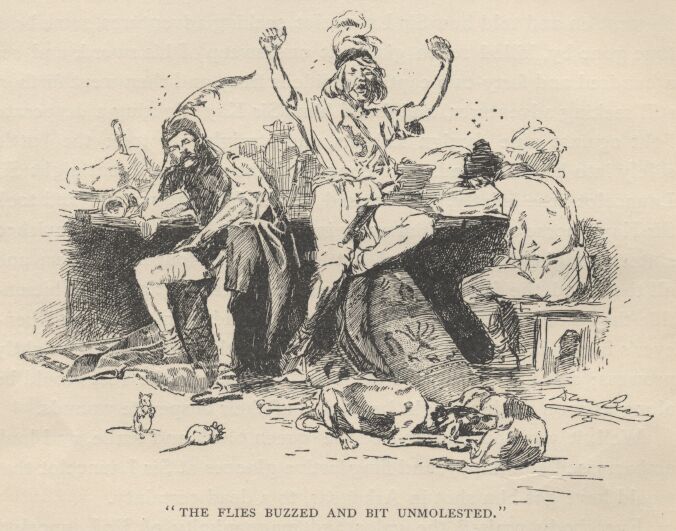
The boy nestled himself upon my shoulder and pretended to go to sleep. The old man began his tale; and presently the lad was asleep in reality; so also were the dogs, and the court, the lackeys, and the files of men-at-arms. The droning voice droned on; a soft snoring arose on all sides and supported it like a deep and subdued accompaniment of wind instruments. Some heads were bowed upon folded arms, some lay back with open mouths that issued unconscious music; the flies buzzed and bit, unmolested, the rats swarmed softly out from a hundred holes, and pattered about, and made themselves at home everywhere; and one of them sat up like a squirrel on the king’s head and held a bit of cheese in its hands and nibbled it, and dribbled the crumbs in the king’s face with naive and impudent irreverence. It was a tranquil scene, and restful to the weary eye and the jaded spirit.
The boy snuggled against my shoulder and pretended to fall asleep. The old man began his story, and soon the boy really was asleep. So were the dogs, the court, the servants, and the ranks of armed men. The old man’s monotonous voice went on and on. Soft snores rose all around, accompanying it like a deep, quiet chorus of wind instruments. Some heads rested on folded arms. Others leaned back, their open mouths producing unconscious music. Flies buzzed and bit without being disturbed. Rats crept out of a hundred holes, pattered around, and made themselves at home everywhere. One sat up like a squirrel on the king’s head, holding a bit of cheese in its hands. It nibbled the cheese and dropped crumbs onto the king’s face with innocent and shameless disrespect. It was a peaceful scene, restful to weary eyes and a worn-out spirit.
This was the old man’s tale. He said:
This was the old man’s story. He said:
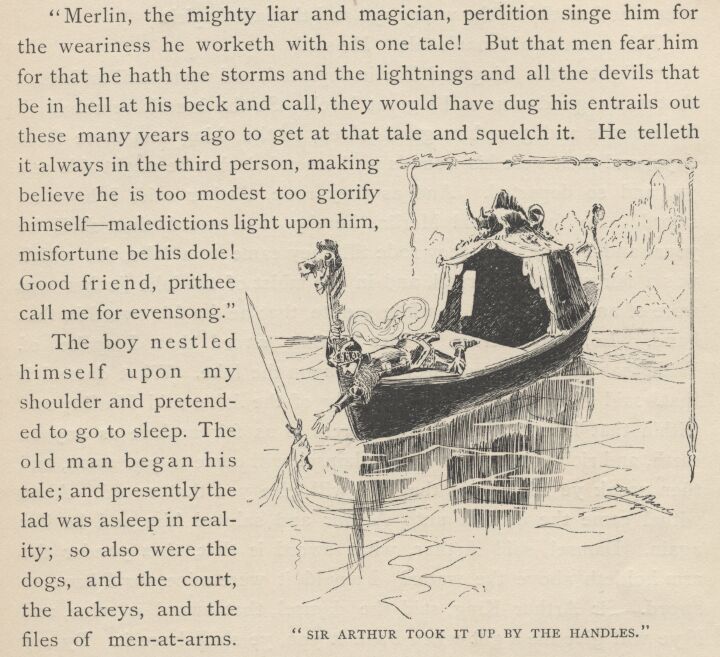
“Right so the king and Merlin departed, and went until an hermit that was a good man and a great leech. So the hermit searched all his wounds and gave him good salves; so the king was there three days, and then were his wounds well amended that he might ride and go, and so departed. And as they rode, Arthur said, I have no sword. No force,* [*Footnote from M.T.: No matter.] said Merlin, hereby is a sword that shall be yours and I may. So they rode till they came to a lake, the which was a fair water and broad, and in the midst of the lake Arthur was ware of an arm clothed in white samite, that held a fair sword in that hand. Lo, said Merlin, yonder is that sword that I spake of. With that they saw a damsel going upon the lake. What damsel is that? said Arthur. That is the Lady of the lake, said Merlin; and within that lake is a rock, and therein is as fair a place as any on earth, and richly beseen, and this damsel will come to you anon, and then speak ye fair to her that she will give you that sword. Anon withal came the damsel unto Arthur and saluted him, and he her again. Damsel, said Arthur, what sword is that, that yonder the arm holdeth above the water? I would it were mine, for I have no sword. Sir Arthur King, said the damsel, that sword is mine, and if ye will give me a gift when I ask it you, ye shall have it. By my faith, said Arthur, I will give you what gift ye will ask. Well, said the damsel, go ye into yonder barge and row yourself to the sword, and take it and the scabbard with you, and I will ask my gift when I see my time. So Sir Arthur and Merlin alight, and tied their horses to two trees, and so they went into the ship, and when they came to the sword that the hand held, Sir Arthur took it up by the handles, and took it with him.
“Then the king and Merlin went to a hermit who was a good man and a skilled healer. The hermit examined all the king’s wounds and gave him healing ointments. The king stayed there three days. By then his wounds had healed enough for him to walk and ride, so he left. As they rode, Arthur said, I have no sword. No matter,* [*Footnote from M.T.: No matter.] said Merlin. There is a sword nearby that shall be yours if I can get it for you. So they rode until they came to a beautiful, broad lake. In the middle of the lake, Arthur saw an arm clothed in white silk, holding a beautiful sword. Look, said Merlin, there is the sword I spoke of. Then they saw a young woman walking on the lake. Who is that? said Arthur. That is the Lady of the lake, said Merlin. There is a rock within the lake, and inside it is a place as beautiful as any on earth, richly decorated. The young woman will come to you soon. Then speak kindly to her, so that she will give you the sword. Soon the young woman came to Arthur and greeted him, and he greeted her in return. Young woman, said Arthur, what sword is that, which the arm holds above the water? I wish it were mine, for I have no sword. King Arthur, said the young woman, that sword is mine. If you will give me a gift when I ask for it, you shall have it. On my word, said Arthur, I will give you whatever gift you ask for. Well, said the young woman, get into that boat and row out to the sword. Take it and its scabbard with you. I will ask for my gift when I choose the time. So Sir Arthur and Merlin dismounted and tied their horses to two trees. Then they got into the boat. When they reached the sword the hand held, Sir Arthur took it by the hilt and carried it with him.
And the arm and the hand went under the water; and so they came unto the land and rode forth. And then Sir Arthur saw a rich pavilion. What signifieth yonder pavilion? It is the knight’s pavilion, said Merlin, that ye fought with last, Sir Pellinore, but he is out, he is not there; he hath ado with a knight of yours, that hight Egglame, and they have fought together, but at the last Egglame fled, and else he had been dead, and he hath chased him even to Carlion, and we shall meet with him anon in the highway. That is well said, said Arthur, now have I a sword, now will I wage battle with him, and be avenged on him. Sir, ye shall not so, said Merlin, for the knight is weary of fighting and chasing, so that ye shall have no worship to have ado with him; also, he will not lightly be matched of one knight living; and therefore it is my counsel, let him pass, for he shall do you good service in short time, and his sons, after his days. Also ye shall see that day in short space ye shall be right glad to give him your sister to wed. When I see him, I will do as ye advise me, said Arthur. Then Sir Arthur looked on the sword, and liked it passing well. Whether liketh you better, said Merlin, the sword or the scabbard? Me liketh better the sword, said Arthur. Ye are more unwise, said Merlin, for the scabbard is worth ten of the sword, for while ye have the scabbard upon you ye shall never lose no blood, be ye never so sore wounded; therefore, keep well the scabbard always with you. So they rode into Carlion, and by the way they met with Sir Pellinore; but Merlin had done such a craft that Pellinore saw not Arthur, and he passed by without any words. I marvel, said Arthur, that the knight would not speak. Sir, said Merlin, he saw you not; for and he had seen you ye had not lightly departed. So they came unto Carlion, whereof his knights were passing glad. And when they heard of his adventures they marveled that he would jeopard his person so alone. But all men of worship said it was merry to be under such a chieftain that would put his person in adventure as other poor knights did.”
The arm and hand went under the water. Then Arthur and Merlin came ashore and rode on. Arthur saw a splendid pavilion. “What is that pavilion?” he asked. “It belongs to the last knight you fought, Sir Pellinore,” said Merlin. “But he is away. He has been fighting one of your knights, named Egglame. At last Egglame fled, or he would have been killed. Pellinore chased him all the way to Carlion, and we shall meet Pellinore soon on the road.” “Good,” said Arthur. “Now that I have a sword, I will fight him and take my revenge.” “Sir, you must not,” said Merlin. “The knight is tired from fighting and chasing, so you would win no honor by fighting him. Besides, hardly any knight alive could match him. So I advise you to let him pass. Before long he will serve you well, and his sons will serve you after his death. Before long you will be very glad to give him your sister in marriage.” “When I see him, I will do as you advise,” said Arthur. Then Arthur looked at the sword and liked it very much. “Which do you like better,” asked Merlin, “the sword or the scabbard?” “I like the sword better,” said Arthur. “You are unwise,” said Merlin. “The scabbard is worth ten swords. As long as you have it on you, you will never lose blood, however badly you are wounded. So always keep the scabbard with you.” They rode toward Carlion, and on the way they met Sir Pellinore. But Merlin had worked such magic that Pellinore did not see Arthur, and he passed without a word. “I wonder why the knight would not speak,” said Arthur. “Sir,” said Merlin, “he did not see you. If he had, you would not have parted so easily.” They came to Carlion, where Arthur’s knights were very glad to see him. When they heard of his adventures, they wondered that he would risk his life so alone. But all honorable men said it was a pleasure to serve such a leader. He faced danger himself, just as other poor knights did.”