Part One, Chapter 23
The Coral Kingdom
The next day I woke with my head singularly clear. To my great surprise, I was in my own room. My companions, no doubt, had been reinstated in their cabin, without having perceived it any more than I. Of what had passed during the night they were as ignorant as I was, and to penetrate this mystery I only reckoned upon the chances of the future.
The next day, I woke with an unusually clear head. To my great surprise, I was in my own room. No doubt my companions had been returned to their cabin without noticing, just as I had been returned to mine. They knew no more than I did about what had happened during the night. I could only hope that chance would reveal the mystery in time.
I then thought of quitting my room. Was I free again or a prisoner? Quite free. I opened the door, went to the half-deck, went up the central stairs. The panels, shut the evening before, were open. I went on to the platform.
I then thought about leaving my room. Was I free again, or was I a prisoner? I was completely free. I opened the door, went to the half-deck, and climbed the central stairs. The panels that had been shut the evening before were open. I went out onto the platform.
Ned Land and Conseil waited there for me. I questioned them; they knew nothing. Lost in a heavy sleep in which they had been totally unconscious, they had been astonished at finding themselves in their cabin.
Ned Land and Conseil were waiting there for me. I asked them what had happened, but they knew nothing. They had been completely unconscious in a deep sleep. They were astonished to find themselves in their cabin.
As for the Nautilus, it seemed quiet and mysterious as ever. It floated on the surface of the waves at a moderate pace. Nothing seemed changed on board.
The Nautilus seemed as quiet and mysterious as ever. It moved across the surface of the waves at a moderate speed. Nothing seemed to have changed on board.
The second lieutenant then came on to the platform, and gave the usual order below.
The second lieutenant then came onto the platform and gave the usual order to those below.
As for Captain Nemo, he did not appear.
As for Captain Nemo, he did not appear.
Of the people on board, I only saw the impassive steward, who served me with his usual dumb regularity.
The only person I saw on board was the expressionless steward, who served me with his usual silent regularity.
About two o’clock, I was in the drawing-room, busied in arranging my notes, when the Captain opened the door and appeared. I bowed. He made a slight inclination in return, without speaking. I resumed my work, hoping that he would perhaps give me some explanation of the events of the preceding night. He made none. I looked at him. He seemed fatigued; his heavy eyes had not been refreshed by sleep; his face looked very sorrowful. He walked to and fro, sat down and got up again, took a chance book, put it down, consulted his instruments without taking his habitual notes, and seemed restless and uneasy. At last, he came up to me, and said:
Around two o’clock, I was in the drawing room, arranging my notes, when the Captain opened the door and came in. I bowed. He nodded slightly in return but said nothing. I went back to work, hoping he might explain the events of the previous night. He said nothing. I looked at him. He seemed tired. His heavy eyes showed he had not had a refreshing sleep, and his face looked very sad. He paced back and forth, sat down, then got up again. He picked up a book at random and put it down. He checked his instruments without making his usual notes. He seemed restless and uneasy. At last, he came up to me and said:
“Are you a doctor, M. Aronnax?”
“Are you a doctor, Mr. Aronnax?”
I so little expected such a question that I stared some time at him without answering.
I was so surprised by the question that I stared at him for a while without answering.
“Are you a doctor?” he repeated. “Several of your colleagues have studied medicine.”
“Are you a doctor?” he repeated. “Several of your colleagues have studied medicine.”
“Well,” said I, “I am a doctor and resident surgeon to the hospital. I practised several years before entering the museum.”
“Well,” I said, “I am a doctor and the resident surgeon at the hospital. I practiced for several years before joining the museum.”
“Very well, sir.”
“All right, sir.”
My answer had evidently satisfied the Captain. But, not knowing what he would say next, I waited for other questions, reserving my answers according to circumstances.
My answer had apparently satisfied the Captain. But I didn't know what he would say next. I waited for more questions, planning to answer according to the circumstances.
“M. Aronnax, will you consent to prescribe for one of my men?” he asked.
“M. Aronnax, would you prescribe treatment for one of my men?” he asked.
“Is he ill?”
“Is he sick?”
“Yes.”
“Yes.”
“I am ready to follow you.”
“I'm ready to follow you.”
“Come, then.”
“Come on, then.”
I own my heart beat, I do not know why. I saw certain connection between the illness of one of the crew and the events of the day before; and this mystery interested me at least as much as the sick man.
I admit my heart was pounding, though I don't know why. I saw a connection between the crewman's illness and the events of the day before. The mystery interested me at least as much as the sick man.
Captain Nemo conducted me to the poop of the Nautilus, and took me into a cabin situated near the sailors’ quarters.
Captain Nemo led me to the stern of the Nautilus and took me into a cabin near the sailors’ quarters.
There, on a bed, lay a man about forty years of age, with a resolute expression of countenance, a true type of an Anglo-Saxon.
A man of about forty lay on a bed. He had a resolute expression and was a true type of an Anglo-Saxon.
I leant over him. He was not only ill, he was wounded. His head, swathed in bandages covered with blood, lay on a pillow. I undid the bandages, and the wounded man looked at me with his large eyes and gave no sign of pain as I did it. It was a horrible wound. The skull, shattered by some deadly weapon, left the brain exposed, which was much injured. Clots of blood had formed in the bruised and broken mass, in colour like the dregs of wine.
I leaned over him. He was not just ill. He was wounded. His head lay on a pillow, wrapped in bloodstained bandages. I removed the bandages. The wounded man looked at me with his large eyes and showed no sign of pain as I did so. It was a horrible wound. Some deadly weapon had shattered his skull, leaving his badly injured brain exposed. Blood clots had formed in the bruised and broken tissue, which was the color of wine dregs.
There was both contusion and suffusion of the brain. His breathing was slow, and some spasmodic movements of the muscles agitated his face. I felt his pulse. It was intermittent. The extremities of the body were growing cold already, and I saw death must inevitably ensue. After dressing the unfortunate man’s wounds, I readjusted the bandages on his head, and turned to Captain Nemo.
His brain was bruised and bleeding. His breathing was slow, and his facial muscles twitched. I felt his pulse. It was irregular. His hands and feet were already growing cold, and I could see that he would surely die. After treating the unfortunate man’s wounds, I adjusted the bandages on his head and turned to Captain Nemo.
“What caused this wound?” I asked.
“What caused this wound?” I asked.
“What does it signify?” he replied, evasively. “A shock has broken one of the levers of the engine, which struck myself. But your opinion as to his state?”
“What does it matter?” he replied evasively. “A jolt broke one of the engine’s levers, and it struck me. But what do you think of his condition?”
I hesitated before giving it.
I hesitated before giving it.
“You may speak,” said the Captain. “This man does not understand French.”
“You can speak,” said the Captain. “This man doesn’t understand French.”
I gave a last look at the wounded man.
I took one last look at the wounded man.
“He will be dead in two hours.”
“He will be dead in two hours.”
“Can nothing save him?”
“Is there nothing that can save him?”
“Nothing.”
“Nothing.”
Captain Nemo’s hand contracted, and some tears glistened in his eyes, which I thought incapable of shedding any.
Captain Nemo’s hand tightened, and tears glistened in his eyes. I had thought he was incapable of shedding tears.
For some moments I still watched the dying man, whose life ebbed slowly. His pallor increased under the electric light that was shed over his death-bed. I looked at his intelligent forehead, furrowed with premature wrinkles, produced probably by misfortune and sorrow. I tried to learn the secret of his life from the last words that escaped his lips.
For a few moments, I continued to watch the dying man as his life slowly faded. He grew paler under the electric light shining over his deathbed. I looked at his intelligent forehead, lined with premature wrinkles, probably caused by hardship and sorrow. I tried to discover the secret of his life from the last words that escaped his lips.
“You can go now, M. Aronnax,” said the Captain.
“You can go now, Mr. Aronnax,” said the captain.
I left him in the dying man’s cabin, and returned to my room much affected by this scene. During the whole day, I was haunted by uncomfortable suspicions, and at night I slept badly, and between my broken dreams I fancied I heard distant sighs like the notes of a funeral psalm. Were they the prayers of the dead, murmured in that language that I could not understand?
I left him in the dying man’s cabin and returned to my room, deeply affected by what I had seen. All day, troubling suspicions haunted me. That night, I slept badly. Between my broken dreams, I imagined I heard distant sighs, like the notes of a funeral psalm. Were they prayers for the dead, murmured in a language I could not understand?
The next morning I went on to the bridge. Captain Nemo was there before me. As soon as he perceived me he came to me.
The next morning I went onto the bridge. Captain Nemo was already there. As soon as he saw me, he came over to me.
“Professor, will it be convenient to you to make a submarine excursion to-day?”
“Professor, would it be convenient for you to take an underwater excursion today?”
“With my companions?” I asked.
“With my companions?” I asked.
“If they like.”
“If they like.”
“We obey your orders, Captain.”
“We follow your orders, Captain.”
“Will you be so good then as to put on your cork jackets?”
“Would you please put on your life jackets, then?”
It was not a question of dead or dying. I rejoined Ned Land and Conseil, and told them of Captain Nemo’s proposition. Conseil hastened to accept it, and this time the Canadian seemed quite willing to follow our example.
It was not a question of whether they were dead or dying. I went back to Ned Land and Conseil and told them about Captain Nemo’s proposal. Conseil quickly accepted it. This time, the Canadian seemed quite willing to follow our example.
It was eight o’clock in the morning. At half-past eight we were equipped for this new excursion, and provided with two contrivances for light and breathing. The double door was open; and, accompanied by Captain Nemo, who was followed by a dozen of the crew, we set foot, at a depth of about thirty feet, on the solid bottom on which the Nautilus rested.
It was eight o’clock in the morning. By eight thirty, we were equipped for this new excursion, with two devices for light and breathing. The double door was open. We stepped onto the solid bottom where the Nautilus rested, about thirty feet below the surface. Captain Nemo accompanied us, followed by a dozen crew members.
A slight declivity ended in an uneven bottom, at fifteen fathoms depth. This bottom differed entirely from the one I had visited on my first excursion under the waters of the Pacific Ocean. Here, there was no fine sand, no submarine prairies, no sea-forest. I immediately recognised that marvellous region in which, on that day, the Captain did the honours to us. It was the coral kingdom.
A gentle slope led to an uneven seabed, fifteen fathoms deep. It was completely different from the seabed I had seen on my first excursion beneath the Pacific Ocean. Here, there was no fine sand, no underwater meadows, and no sea forest. I immediately recognized the marvelous region the Captain was showing us that day. It was the coral kingdom.
The light produced a thousand charming varieties, playing in the midst of the branches that were so vividly coloured. I seemed to see the membraneous and cylindrical tubes tremble beneath the undulation of the waters. I was tempted to gather their fresh petals, ornamented with delicate tentacles, some just blown, the others budding, while a small fish, swimming swiftly, touched them slightly, like flights of birds. But if my hand approached these living flowers, these animated, sensitive plants, the whole colony took alarm. The white petals re-entered their red cases, the flowers faded as I looked, and the bush changed into a block of stony knobs.
The light played among the vividly colored branches, creating a thousand charming variations. The thin, tube-shaped forms seemed to tremble as the water rippled. I was tempted to gather their fresh petals, decorated with delicate tentacles. Some had just opened, while others were still budding. Small fish swam swiftly past, brushing them lightly like birds in flight. But if I brought my hand near these living flowers, these moving, sensitive plants, the whole colony took alarm. The white petals withdrew into their red cases. The flowers faded before my eyes, and the bush became a mass of stony knobs.
Chance had thrown me just by the most precious specimens of the zoophyte. This coral was more valuable than that found in the Mediterranean, on the coasts of France, Italy and Barbary. Its tints justified the poetical names of “Flower of Blood,” and “Froth of Blood,” that trade has given to its most beautiful productions. Coral is sold for £20 per ounce; and in this place the watery beds would make the fortunes of a company of coral-divers. This precious matter, often confused with other polypi, formed then the inextricable plots called “macciota,” and on which I noticed several beautiful specimens of pink coral.
By chance, I had come upon the most precious specimens of this zoophyte. This coral was more valuable than that found in the Mediterranean, along the coasts of France, Italy and Barbary. Its colors justified the poetic names “Flower of Blood,” and “Froth of Blood,” given to its most beautiful forms by traders. Coral sells for £20 per ounce, and the beds here could make a company of coral divers rich. This precious substance, often confused with other polyps, formed tangled masses called “macciota.” Among them, I noticed several beautiful specimens of pink coral.
But soon the bushes contract, and the arborisations increase. Real petrified thickets, long joists of fantastic architecture, were disclosed before us. Captain Nemo placed himself under a dark gallery, where by a slight declivity we reached a depth of a hundred yards. The light from our lamps produced sometimes magical effects, following the rough outlines of the natural arches and pendants disposed like lustres, that were tipped with points of fire.
But soon the bushes grew closer together, and the branching formations increased. Before us appeared veritable thickets of stone and long beams of fantastic design. Captain Nemo led us under a dark passage. There, a gentle slope took us down to a depth of a hundred yards. Our lamps sometimes created magical effects as their light followed the rough outlines of natural arches and hanging formations. The formations hung like chandeliers, their tips glowing like points of fire.
At last, after walking two hours, we had attained a depth of about three hundred yards, that is to say, the extreme limit on which coral begins to form. But there was no isolated bush, nor modest brushwood, at the bottom of lofty trees. It was an immense forest of large mineral vegetations, enormous petrified trees, united by garlands of elegant sea-bindweed, all adorned with clouds and reflections. We passed freely under their high branches, lost in the shade of the waves.
At last, after walking for two hours, we reached a depth of about three hundred yards. This was the outer limit at which coral begins to form. But there were no isolated bushes or small shrubs beneath tall trees. Instead, there was an immense forest of large mineral growths and enormous petrified trees. Garlands of graceful sea bindweed joined the trees, and clouds and reflections adorned them all. We passed freely under their high branches, lost in the shadow of the waves.
Captain Nemo had stopped. I and my companions halted, and, turning round, I saw his men were forming a semi-circle round their chief. Watching attentively, I observed that four of them carried on their shoulders an object of an oblong shape.
Captain Nemo had stopped. My companions and I stopped too. I turned around and saw his men forming a semicircle around him. Watching closely, I noticed that four of them were carrying an oblong object on their shoulders.
We occupied, in this place, the centre of a vast glade surrounded by the lofty foliage of the submarine forest. Our lamps threw over this place a sort of clear twilight that singularly elongated the shadows on the ground. At the end of the glade the darkness increased, and was only relieved by little sparks reflected by the points of coral.
We stood in the center of a vast clearing, surrounded by the tall foliage of the underwater forest. Our lamps cast a clear, twilight-like glow over the clearing, making the shadows on the ground strangely long. At the far end of the clearing, the darkness deepened. Only tiny sparks of light reflected from the tips of the coral broke through it.
Ned Land and Conseil were near me. We watched, and I thought I was going to witness a strange scene. On observing the ground, I saw that it was raised in certain places by slight excrescences encrusted with limy deposits, and disposed with a regularity that betrayed the hand of man.
Ned Land and Conseil were near me. We watched, and I thought I was about to witness a strange scene. I looked at the ground and saw small raised bumps covered with lime deposits. They were arranged so regularly that I could tell people had made them.
In the midst of the glade, on a pedestal of rocks roughly piled up, stood a cross of coral that extended its long arms that one might have thought were made of petrified blood. Upon a sign from Captain Nemo one of the men advanced; and at some feet from the cross he began to dig a hole with a pickaxe that he took from his belt. I understood all! This glade was a cemetery, this hole a tomb, this oblong object the body of the man who had died in the night! The Captain and his men had come to bury their companion in this general resting-place, at the bottom of this inaccessible ocean!
In the middle of the glade stood a coral cross on a pedestal of roughly piled rocks. Its long arms looked as if they were made of petrified blood. At a signal from Captain Nemo, one of the men stepped forward. He took a pickaxe from his belt and began digging a hole a few feet from the cross. I understood everything! The glade was a cemetery, the hole a grave, and the oblong object the body of the man who had died in the night! The Captain and his men had come to bury their companion in this shared resting place, at the bottom of this inaccessible ocean!
The grave was being dug slowly; the fish fled on all sides while their retreat was being thus disturbed; I heard the strokes of the pickaxe, which sparkled when it hit upon some flint lost at the bottom of the waters. The hole was soon large and deep enough to receive the body. Then the bearers approached; the body, enveloped in a tissue of white linen, was lowered into the damp grave. Captain Nemo, with his arms crossed on his breast, and all the friends of him who had loved them, knelt in prayer.
The grave was being dug slowly. Fish fled in every direction as their refuge was disturbed. I heard the blows of the pickaxe, which sparked when it struck flint on the seabed. The hole was soon wide and deep enough for the body. Then the bearers came forward. The body, wrapped in white linen, was lowered into the damp grave. Captain Nemo crossed his arms over his chest and knelt in prayer, along with all the dead man’s friends who had loved them.
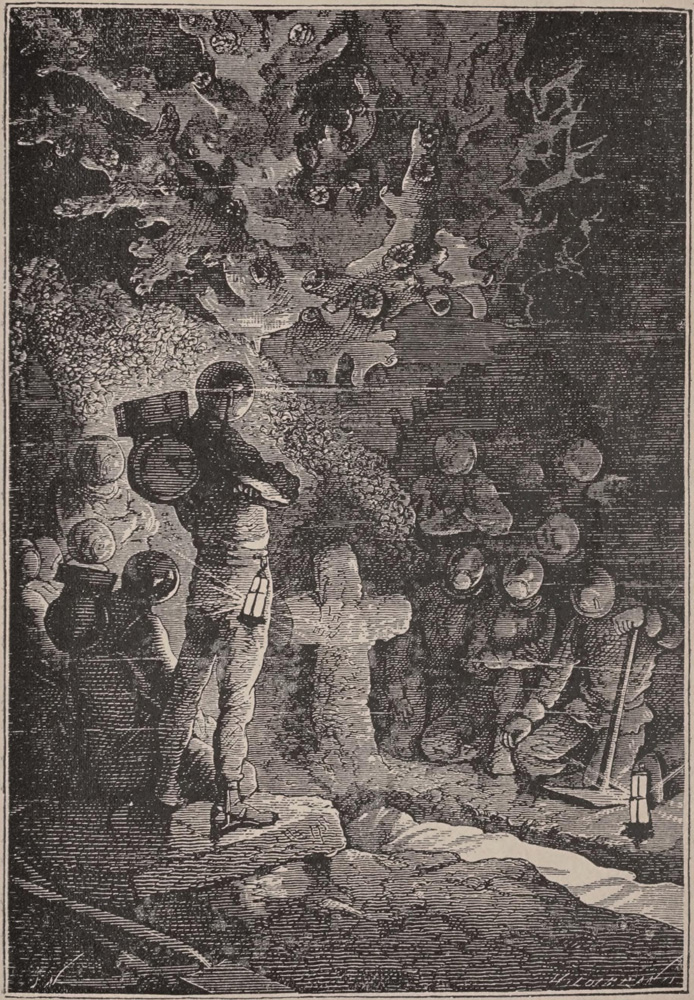
The grave was then filled in with the rubbish taken from the ground, which formed a slight mound. When this was done, Captain Nemo and his men rose; then, approaching the grave, they knelt again, and all extended their hands in sign of a last adieu. Then the funeral procession returned to the Nautilus, passing under the arches of the forest, in the midst of thickets, along the coral bushes, and still on the ascent. At last the light of the ship appeared, and its luminous track guided us to the Nautilus. At one o’clock we had returned.
They filled the grave with the material dug from the ground, leaving a small mound. When they had finished, Captain Nemo and his men stood up. Then they approached the grave and knelt again. They all stretched out their hands in a final farewell. The funeral procession then returned to the Nautilus. They continued uphill, passing under the forest arches, through thickets, and along the coral bushes. At last the ship's light appeared, and its glowing path guided us to the Nautilus. We returned at one o'clock.
As soon as I had changed my clothes I went up on to the platform, and, a prey to conflicting emotions, I sat down near the binnacle. Captain Nemo joined me. I rose and said to him:
As soon as I changed my clothes, I went up to the platform. Torn by conflicting emotions, I sat down near the binnacle. Captain Nemo joined me. I stood up and said to him:
“So, as I said he would, this man died in the night?”
“So the man died during the night, as I said he would?”
“Yes, M. Aronnax.”
“Yes, Mr. Aronnax.”
“And he rests now, near his companions, in the coral cemetery?”
“And is he buried now near his companions in the coral cemetery?”
“Yes, forgotten by all else, but not by us. We dug the grave, and the polypi undertake to seal our dead for eternity.” And, burying his face quickly in his hands, he tried in vain to suppress a sob. Then he added: “Our peaceful cemetery is there, some hundred feet below the surface of the waves.”
“Yes, forgotten by everyone else, but not by us. We dug the grave, and the coral polyps will seal our dead there forever.” He quickly buried his face in his hands and tried in vain to hold back a sob. Then he added: “Our peaceful cemetery is there, about a hundred feet below the surface of the waves.”
“Your dead sleep quietly, at least, Captain, out of the reach of sharks.”
“At least your dead rest peacefully, Captain, out of reach of the sharks.”
“Yes, sir, of sharks and men,” gravely replied the Captain.
“Yes, sir, of sharks and men,” the Captain replied seriously.