Part One, Chapter 21
Captain Nemo’s Thunderbolt
We looked at the edge of the forest without rising, my hand stopping in the action of putting it to my mouth, Ned Land’s completing its office.
We looked at the edge of the forest without standing up. My hand stopped halfway to my mouth, while Ned Land’s completed the movement.
“Stones do not fall from the sky,” remarked Conseil, “or they would merit the name aerolites.”
“Stones don’t fall from the sky,” Conseil said, “or they would deserve to be called aerolites.”
A second stone, carefully aimed, that made a savoury pigeon’s leg fall from Conseil’s hand, gave still more weight to his observation. We all three arose, shouldered our guns, and were ready to reply to any attack.
A second, carefully aimed stone knocked a tasty pigeon leg from Conseil’s hand. This gave even more weight to his observation. All three of us stood up, shouldered our guns, and prepared to respond to any attack.
“Are they apes?” cried Ned Land.
“Are they apes?” Ned Land shouted.
“Very nearly—they are savages.”
“Almost. They are savages.”
“To the boat!” I said, hurrying to the sea.
“To the boat!” I said, hurrying to the sea.
It was indeed necessary to beat a retreat, for about twenty natives armed with bows and slings appeared on the skirts of a copse that masked the horizon to the right, hardly a hundred steps from us.
We had to retreat. About twenty natives armed with bows and slings had appeared at the edge of a grove. The grove blocked our view of the horizon to the right and was hardly a hundred steps away.
Our boat was moored about sixty feet from us. The savages approached us, not running, but making hostile demonstrations. Stones and arrows fell thickly.
Our boat was tied up about sixty feet away. The savages approached us without running, but made threatening gestures. Stones and arrows fell thickly around us.
Ned Land had not wished to leave his provisions; and, in spite of his imminent danger, his pig on one side and kangaroos on the other, he went tolerably fast. In two minutes we were on the shore. To load the boat with provisions and arms, to push it out to sea, and ship the oars, was the work of an instant. We had not gone two cable-lengths, when a hundred savages, howling and gesticulating, entered the water up to their waists. I watched to see if their apparition would attract some men from the Nautilus on to the platform. But no. The enormous machine, lying off, was absolutely deserted.
Ned Land had not wanted to leave his provisions behind. Despite the immediate danger, he moved fairly quickly, carrying his pig on one side and the kangaroos on the other. In two minutes we reached the shore. We quickly loaded the boat with provisions and weapons, pushed it out to sea, and set the oars in place. We had not gone two cable-lengths when a hundred savages waded waist-deep into the water, howling and gesturing. I watched to see if their appearance would draw some men from the Nautilus onto the platform. But no one appeared. The enormous machine lay offshore, completely deserted.
Twenty minutes later we were on board. The panels were open. After making the boat fast, we entered into the interior of the Nautilus.
Twenty minutes later, we were on board. The panels were open. After securing the boat, we went inside the Nautilus.
I descended to the drawing-room, from whence I heard some chords. Captain Nemo was there, bending over his organ, and plunged in a musical ecstasy.
I went down to the drawing room, where I heard some chords. Captain Nemo was there, bent over his organ, lost in musical ecstasy.
“Captain!”
“Captain!”
He did not hear me.
He did not hear me.
“Captain!” I said, touching his hand.
“Captain!” I said, touching his hand.
He shuddered, and, turning round, said, “Ah! it is you, Professor? Well, have you had a good hunt, have you botanised successfully?”
He shuddered and turned around. “Ah! It’s you, Professor? Well, did you have a good hunt? Did you find many plants?”
“Yes Captain; but we have unfortunately brought a troop of bipeds, whose vicinity troubles me.”
“Yes, Captain, but unfortunately we have brought a group of bipeds with us. Having them nearby worries me.”
“What bipeds?”
“What two-legged creatures?”
“Savages.”
“Savages.”
“Savages!” he echoed, ironically. “So you are astonished, Professor, at having set foot on a strange land and finding savages? Savages! where are there not any? Besides, are they worse than others, these whom you call savages?”
“Savages!” he repeated ironically. “So you’re surprised, Professor, to find savages after setting foot in a strange land? Savages! Where aren’t there any? Besides, are these people you call savages any worse than others?”
“But Captain——”
“But Captain...”
“How many have you counted?”
“How many have you counted?”
“A hundred at least.”
“At least a hundred.”
“M. Aronnax,” replied Captain Nemo, placing his fingers on the organ stops, “when all the natives of Papua are assembled on this shore, the Nautilus will have nothing to fear from their attacks.”
“M. Aronnax,” replied Captain Nemo, placing his fingers on the organ stops, “even when all the natives of Papua gather on this shore, the Nautilus will have nothing to fear from their attacks.”
The Captain’s fingers were then running over the keys of the instrument, and I remarked that he touched only the black keys, which gave his melodies an essentially Scotch character. Soon he had forgotten my presence, and had plunged into a reverie that I did not disturb. I went up again on to the platform: night had already fallen; for, in this low latitude, the sun sets rapidly and without twilight. I could only see the island indistinctly; but the numerous fires, lighted on the beach, showed that the natives did not think of leaving it. I was alone for several hours, sometimes thinking of the natives—but without any dread of them, for the imperturbable confidence of the Captain was catching—sometimes forgetting them to admire the splendours of the night in the tropics. My remembrances went to France in the train of those zodiacal stars that would shine in some hours’ time. The moon shone in the midst of the constellations of the zenith.
The Captain’s fingers moved over the keys of the instrument. I noticed that he played only the black keys, giving his melodies a distinctly Scottish character. Soon he forgot I was there and became lost in thought. I did not disturb him. I went back up to the platform. Night had already fallen, for at this low latitude the sun sets quickly, without twilight. I could barely see the island. But the many fires lit on the beach showed that the natives had no intention of leaving it. I was alone for several hours. At times I thought of the natives, but without fear, for the Captain’s unshakable confidence was contagious. At other times I forgot them and admired the splendor of the tropical night. My thoughts turned to France, following the stars of the zodiac that would shine there in a few hours. The moon shone among the constellations overhead.
The night slipped away without any mischance, the islanders frightened no doubt at the sight of a monster aground in the bay. The panels were open, and would have offered an easy access to the interior of the Nautilus.
The night passed without trouble. The islanders were no doubt frightened by the sight of a monster stranded in the bay. The panels were open, and they would have allowed easy access to the inside of the Nautilus.
At six o’clock in the morning of the 8th January I went up on to the platform. The dawn was breaking. The island soon showed itself through the dissipating fogs, first the shore, then the summits.
At six o’clock on the morning of January 8, I went up onto the platform. Dawn was breaking. As the fog cleared, the island soon came into view, first the shore, then the peaks.
The natives were there, more numerous than on the day before—five or six hundred perhaps—some of them, profiting by the low water, had come on to the coral, at less than two cable-lengths from the Nautilus. I distinguished them easily; they were true Papuans, with athletic figures, men of good race, large high foreheads, large, but not broad and flat, and white teeth. Their woolly hair, with a reddish tinge, showed off on their black shining bodies like those of the Nubians. From the lobes of their ears, cut and distended, hung chaplets of bones. Most of these savages were naked. Amongst them, I remarked some women, dressed from the hips to knees in quite a crinoline of herbs, that sustained a vegetable waistband. Some chiefs had ornamented their necks with a crescent and collars of glass beads, red and white; nearly all were armed with bows, arrows, and shields and carried on their shoulders a sort of net containing those round stones which they cast from their slings with great skill. One of these chiefs, rather near to the Nautilus, examined it attentively. He was, perhaps, a “mado” of high rank, for he was draped in a mat of banana-leaves, notched round the edges, and set off with brilliant colours.
The natives were there, more numerous than the day before, perhaps five or six hundred of them. Taking advantage of the low water, some had come onto the coral, less than two cable-lengths from the Nautilus. I could see them clearly. They were true Papuans, athletic men of good race, with large, high foreheads that were not broad and flat, and white teeth. Their woolly, reddish hair stood out against their shiny black bodies, like those of the Nubians. Strings of bones hung from their cut and stretched earlobes. Most of these savages were naked. Among them, I noticed some women wearing full skirts of grass, from their hips to their knees, held up by plant-fiber waistbands. Some chiefs wore crescents and necklaces of red and white glass beads around their necks. Nearly all were armed with bows, arrows, and shields. They carried nets on their shoulders filled with the round stones they threw from their slings with great skill. One of these chiefs was fairly close to the Nautilus and studied it carefully. He was perhaps a high-ranking “mado”. He wore a brightly colored mat of banana leaves, notched around the edges, draped over his body.
I could easily have knocked down this native, who was within a short length; but I thought that it was better to wait for real hostile demonstrations. Between Europeans and savages, it is proper for the Europeans to parry sharply, not to attack.
I could easily have knocked down this native, who was close by. But I thought it was better to wait for a real sign of hostility. In encounters between Europeans and savages, Europeans should defend themselves firmly, not attack.
During low water the natives roamed about near the Nautilus, but were not troublesome; I heard them frequently repeat the word “Assai,” and by their gestures I understood that they invited me to go on land, an invitation that I declined.
At low tide, the natives wandered near the Nautilus, but they caused no trouble. I often heard them repeat the word “Assai.” Their gestures told me they were inviting me ashore, but I declined.
So that, on that day, the boat did not push off, to the great displeasure of Master Land, who could not complete his provisions.
So the boat did not leave that day. This greatly displeased Master Land, who could not finish gathering his supplies.
This adroit Canadian employed his time in preparing the viands and meat that he had brought off the island. As for the savages, they returned to the shore about eleven o’clock in the morning, as soon as the coral tops began to disappear under the rising tide; but I saw their numbers had increased considerably on the shore. Probably they came from the neighbouring islands, or very likely from Papua. However, I had not seen a single native canoe. Having nothing better to do, I thought of dragging these beautiful limpid waters, under which I saw a profusion of shells, zoophytes, and marine plants. Moreover, it was the last day that the Nautilus would pass in these parts, if it float in open sea the next day, according to Captain Nemo’s promise.
The skilled Canadian spent his time preparing the food and meat he had brought from the island. The savages returned to the shore at about eleven that morning, as the rising tide began to cover the coral tops. But I saw that their numbers on shore had grown considerably. They probably came from the neighboring islands, or very likely from Papua. However, I had not seen a single native canoe. With nothing better to do, I thought of dredging the beautiful clear water. Beneath it, I could see an abundance of shells, zoophytes, and marine plants. Besides, it was the last day the Nautilus would spend in these waters, if it floated in the open sea the next day, as Captain Nemo had promised.
I therefore called Conseil, who brought me a little light drag, very like those for the oyster fishery. Now to work! For two hours we fished unceasingly, but without bringing up any rarities. The drag was filled with midas-ears, harps, melames, and particularly the most beautiful hammers I have ever seen. We also brought up some sea-slugs, pearl-oysters, and a dozen little turtles that were reserved for the pantry on board.
So I called Conseil, who brought me a small, light dragnet, much like those used for oyster fishing. Now to work! We fished steadily for two hours, but brought up no rarities. The net was full of midas-ears, harps, melames, and especially the most beautiful hammers I had ever seen. We also brought up some sea slugs, pearl oysters, and a dozen small turtles, which we set aside for the ship’s pantry.
But just when I expected it least, I put my hand on a wonder, I might say a natural deformity, very rarely met with. Conseil was just dragging, and his net came up filled with divers ordinary shells, when, all at once, he saw me plunge my arm quickly into the net, to draw out a shell, and heard me utter a cry.
But just when I least expected it, I found a wonder, a natural deformity, you might say, very rarely encountered. Conseil was dragging his net along, and it came up filled with various ordinary shells. Suddenly, he saw me plunge my arm into the net and pull out a shell, crying out as I did so.
“What is the matter, sir?” he asked in surprise. “Has master been bitten?”
“What’s wrong, sir?” he asked in surprise. “Have you been bitten?”
“No, my boy; but I would willingly have given a finger for my discovery.”
“No, my boy, but I would gladly have given a finger for my discovery.”
“What discovery?”
“What discovery?”
“This shell,” I said, holding up the object of my triumph.
“This shell,” I said, holding up my prize.
“It is simply an olive porphyry, genus olive, order of the pectinibranchidæ, class of gasteropods, sub-class mollusca.”
“It is simply an olive porphyry. It belongs to the olive genus, the pectinibranch order, the gastropod class, and the mollusk subclass.”
“Yes, Conseil; but, instead of being rolled from right to left, this olive turns from left to right.”
“Yes, Conseil, but this olive rolls from left to right instead of right to left.”
“Is it possible?”
“Is it possible?”
“Yes, my boy; it is a left shell.”
“Yes, my boy, it is a left shell.”
Shells are all right-handed, with rare exceptions; and, when by chance their spiral is left, amateurs are ready to pay their weight in gold.
Almost all shells spiral to the right. On rare occasions, a shell spirals to the left, and collectors are willing to pay its weight in gold for it.
Conseil and I were absorbed in the contemplation of our treasure, and I was promising myself to enrich the museum with it, when a stone unfortunately thrown by a native struck against, and broke, the precious object in Conseil’s hand. I uttered a cry of despair! Conseil took up his gun, and aimed at a savage who was poising his sling at ten yards from him. I would have stopped him, but his blow took effect and broke the bracelet of amulets which encircled the arm of the savage.
Conseil and I were absorbed in admiring our treasure. I was planning to add it to the museum’s collection when a native threw a stone. It struck the precious object in Conseil’s hand and broke it. I cried out in despair! Conseil picked up his gun and aimed at a savage who was readying his sling ten yards away. I would have stopped him, but his shot hit the bracelet of amulets around the savage’s arm and broke it.
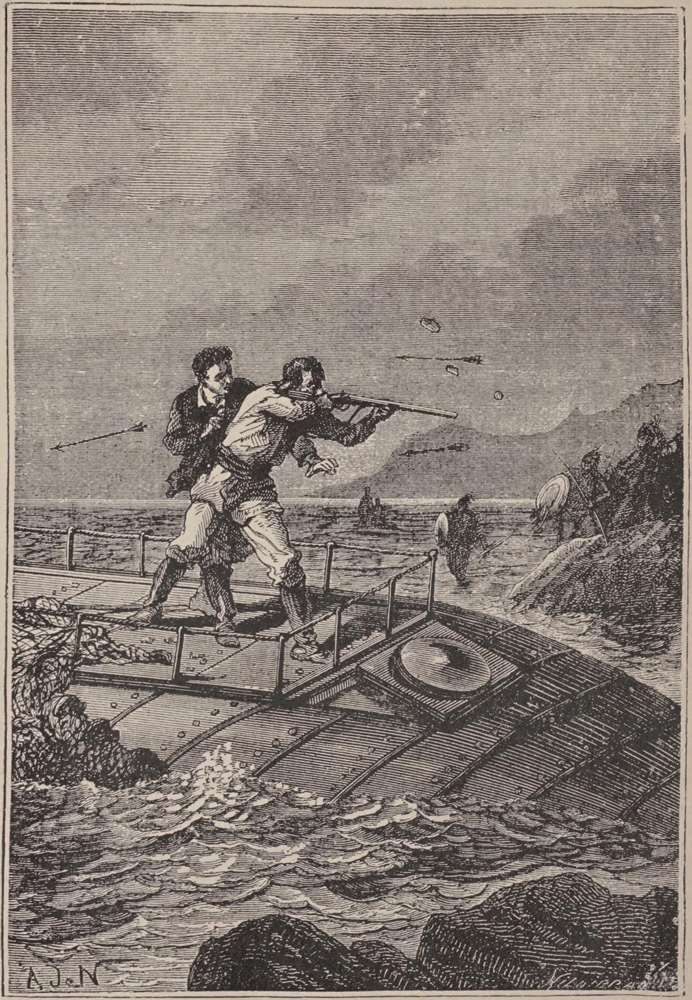
“Conseil!” cried I. “Conseil!”
“Conseil!” I cried. “Conseil!”
“Well, sir! do you not see that the cannibal has commenced the attack?”
“Well, sir! Don't you see that the cannibal has started the attack?”
“A shell is not worth the life of a man,” said I.
“A shell is not worth a man's life,” I said.
“Ah! the scoundrel!” cried Conseil; “I would rather he had broken my shoulder!”
“Oh, the jerk!” Conseil cried. “I would rather he had broken my shoulder!”
Conseil was in earnest, but I was not of his opinion. However, the situation had changed some minutes before, and we had not perceived. A score of canoes surrounded the Nautilus. These canoes, scooped out of the trunk of a tree, long, narrow, well adapted for speed, were balanced by means of a long bamboo pole, which floated on the water. They were managed by skilful, half-naked paddlers, and I watched their advance with some uneasiness. It was evident that these Papuans had already had dealings with the Europeans and knew their ships. But this long iron cylinder anchored in the bay, without masts or chimneys, what could they think of it? Nothing good, for at first they kept at a respectful distance. However, seeing it motionless, by degrees they took courage, and sought to familiarise themselves with it. Now this familiarity was precisely what it was necessary to avoid. Our arms, which were noiseless, could only produce a moderate effect on the savages, who have little respect for aught but blustering things. The thunderbolt without the reverberations of thunder would frighten man but little, though the danger lies in the lightning, not in the noise.
Conseil was serious, but I did not agree with him. However, the situation had changed a few minutes earlier, and we had not noticed. Twenty canoes surrounded the Nautilus. Each canoe was hollowed out from a tree trunk. They were long, narrow, and well suited for speed. A long bamboo pole floated on the water beside each canoe to keep it balanced. Skillful, half-naked paddlers steered them, and I watched them approach with some unease. Clearly, these Papuans had already dealt with Europeans and knew their ships. But what could they make of this long iron cylinder anchored in the bay, with no masts or chimneys? Nothing good, for at first they kept a respectful distance. But when they saw that it was motionless, they gradually grew bolder and tried to get familiar with it. That familiarity was exactly what we needed to avoid. Our weapons were silent, so they could have only a moderate effect on the savages, who have little respect for anything but noise and bluster. A lightning bolt without the rumble of thunder would frighten people very little, though the danger lies in the lightning, not the noise.
At this moment the canoes approached the Nautilus, and a shower of arrows alighted on her.
At that moment, the canoes approached the Nautilus, and a shower of arrows landed on her.
I went down to the saloon, but found no one there. I ventured to knock at the door that opened into the Captain’s room. “Come in,” was the answer.
I went down to the saloon, but no one was there. I dared to knock on the door to the Captain’s room. “Come in,” came the answer.
I entered, and found Captain Nemo deep in algebraical calculations of x and other quantities.
I went in and found Captain Nemo absorbed in algebraic calculations involving x and other quantities.
“I am disturbing you,” said I, for courtesy’s sake.
“I’m disturbing you,” I said, just to be polite.
“That is true, M. Aronnax,” replied the Captain; “but I think you have serious reasons for wishing to see me?”
“That is true, M. Aronnax,” the Captain replied. “But I think you have serious reasons for wanting to see me?”
“Very grave ones; the natives are surrounding us in their canoes, and in a few minutes we shall certainly be attacked by many hundreds of savages.”
“Very serious ones. The natives are surrounding us in their canoes. In a few minutes, hundreds of savages will certainly attack us.”
“Ah!” said Captain Nemo quietly, “they are come with their canoes?”
“Ah!” Captain Nemo said quietly, “have they come in their canoes?”
“Yes, sir.”
“Yes, sir.”
“Well, sir, we must close the hatches.”
“Well, sir, we need to close the hatches.”
“Exactly, and I came to say to you——”
“Exactly, and I came to tell you...”
“Nothing can be more simple,” said Captain Nemo. And, pressing an electric button, he transmitted an order to the ship’s crew.
“Nothing could be simpler,” said Captain Nemo. He pressed an electric button to send an order to the ship’s crew.
“It is all done, sir,” said he, after some moments. “The pinnace is ready, and the hatches are closed. You do not fear, I imagine, that these gentlemen could stave in walls on which the balls of your frigate have had no effect?”
“It’s all done, sir,” he said after a few moments. “The pinnace is ready, and the hatches are closed. I assume you’re not afraid these gentlemen could break through walls that your frigate’s cannonballs couldn’t damage?”
“No, Captain; but a danger still exists.”
“No, Captain, but there is still danger.”
“What is that, sir?”
“What is that, sir?”
“It is that to-morrow, at about this hour, we must open the hatches to renew the air of the Nautilus. Now, if, at this moment, the Papuans should occupy the platform, I do not see how you could prevent them from entering.”
“Tomorrow, at about this time, we must open the hatches to refresh the air in the Nautilus. But if the Papuans occupy the platform at that moment, I don’t see how you could stop them from entering.”
“Then, sir, you suppose that they will board us?”
“Then, sir, do you think they will board us?”
“I am certain of it.”
“I’m sure of it.”
“Well, sir, let them come. I see no reason for hindering them. After all, these Papuans are poor creatures, and I am unwilling that my visit to the island should cost the life of a single one of these wretches.”
“Well, sir, let them come. I see no reason to stop them. After all, these Papuans are poor creatures. I don’t want my visit to the island to cost a single one of these wretches their life.”
Upon that I was going away; But Captain Nemo detained me, and asked me to sit down by him. He questioned me with interest about our excursions on shore, and our hunting; and seemed not to understand the craving for meat that possessed the Canadian. Then the conversation turned on various subjects, and, without being more communicative, Captain Nemo showed himself more amiable.
I was about to leave, but Captain Nemo stopped me and asked me to sit beside him. He asked with interest about our trips ashore and our hunting. He seemed unable to understand the Canadian's craving for meat. Then we talked about various subjects. Captain Nemo was friendlier, though he did not reveal any more about himself.
Amongst other things, we happened to speak of the situation of the Nautilus, run aground in exactly the same spot in this strait where Dumont d’Urville was nearly lost. Apropos of this:
Among other things, we spoke about the Nautilus running aground in the strait. It had struck exactly where Dumont d’Urville had nearly been lost. On that subject:
“This D’Urville was one of your great sailors,” said the Captain to me, “one of your most intelligent navigators. He is the Captain Cook of you Frenchmen. Unfortunate man of science, after having braved the icebergs of the South Pole, the coral reefs of Oceania, the cannibals of the Pacific, to perish miserably in a railway train! If this energetic man could have reflected during the last moments of his life, what must have been uppermost in his last thoughts, do you suppose?”
“D’Urville was one of your great sailors,” the Captain said to me. “He was one of your most intelligent navigators, the French Captain Cook. That unfortunate man of science braved the icebergs of the South Pole, the coral reefs of Oceania, and the cannibals of the Pacific. And then he died miserably in a railway train! If this energetic man had been able to reflect during his final moments, what do you suppose was foremost in his thoughts?”
So speaking, Captain Nemo seemed moved, and his emotion gave me a better opinion of him. Then, chart in hand, we reviewed the travels of the French navigator, his voyages of circumnavigation, his double detention at the South Pole, which led to the discovery of Adelaide and Louis Philippe, and fixing the hydrographical bearings of the principal islands of Oceania.
As Captain Nemo spoke, he seemed moved, and his emotion gave me a better opinion of him. Then, with a chart in hand, we reviewed the French navigator's travels. We traced his voyages around the world and his two detentions at the South Pole. These led to the discovery of Adelaide and Louis Philippe. We also reviewed his charting of the principal islands of Oceania.
“That which your D’Urville has done on the surface of the seas,” said Captain Nemo, “that have I done under them, and more easily, more completely than he. The Astrolabe and the Zelee, incessantly tossed about by the hurricane, could not be worth the Nautilus, quiet repository of labour that she is, truly motionless in the midst of the waters.
“What your D’Urville has done on the surface of the seas,” said Captain Nemo, “I have done beneath them. I have done it more easily and more completely than he did. The Astrolabe and the Zelee were constantly tossed about by the hurricane. They could not compare with the Nautilus, a peaceful place to work, truly motionless in the water.
“To-morrow,” added the Captain, rising, “to-morrow, at twenty minutes to three p.m., the Nautilus shall float, and leave the Strait of Torres uninjured.”
“Tomorrow,” the Captain added, standing up, “tomorrow, at 2:40 p.m., the Nautilus will float and leave the Strait of Torres undamaged.”
Having curtly pronounced these words, Captain Nemo bowed slightly. This was to dismiss me, and I went back to my room.
After saying this curtly, Captain Nemo bowed slightly. He was dismissing me, so I went back to my room.
There I found Conseil, who wished to know the result of my interview with the Captain.
There I found Conseil, who wanted to know how my meeting with the Captain had gone.
“My boy,” said I, “when I feigned to believe that his Nautilus was threatened by the natives of Papua, the Captain answered me very sarcastically. I have but one thing to say to you: Have confidence in him, and go to sleep in peace.”
“My boy,” I said, “when I pretended to believe that the natives of Papua threatened his Nautilus, the Captain answered me sarcastically. I have only one thing to say to you: Trust him and go to sleep in peace.”
“Have you no need of my services, sir?”
“Don't you need my help, sir?”
“No, my friend. What is Ned Land doing?”
“No, my friend. What is Ned Land doing?”
“If you will excuse me, sir,” answered Conseil, “friend Ned is busy making a kangaroo-pie which will be a marvel.”
“If you’ll excuse me, sir,” Conseil replied, “our friend Ned is busy making a kangaroo pie that will be wonderful.”
I remained alone and went to bed, but slept indifferently. I heard the noise of the savages, who stamped on the platform, uttering deafening cries. The night passed thus, without disturbing the ordinary repose of the crew. The presence of these cannibals affected them no more than the soldiers of a masked battery care for the ants that crawl over its front.
I was left alone and went to bed, but I slept poorly. I heard the savages stamping on the platform and shouting deafeningly. The night passed like this, but the crew slept as peacefully as usual. The cannibals bothered them no more than ants crawling over a concealed battery bother the soldiers inside it.
At six in the morning I rose. The hatches had not been opened. The inner air was not renewed, but the reservoirs, filled ready for any emergency, were now resorted to, and discharged several cubic feet of oxygen into the exhausted atmosphere of the Nautilus.
At six in the morning, I got up. The hatches had not been opened, so the air inside had not been refreshed. But the reservoirs, kept full for emergencies, were now used. They released several cubic feet of oxygen into the stale air of the Nautilus.
I worked in my room till noon, without having seen Captain Nemo, even for an instant. On board no preparations for departure were visible.
I worked in my room until noon without seeing Captain Nemo, even for a moment. There were no visible preparations for departure on board.
I waited still some time, then went into the large saloon. The clock marked half-past two. In ten minutes it would be high-tide: and, if Captain Nemo had not made a rash promise, the Nautilus would be immediately detached. If not, many months would pass ere she could leave her bed of coral.
I waited a little longer, then went into the large saloon. The clock showed half past two. High tide would come in ten minutes. If Captain Nemo had not made a reckless promise, the Nautilus would break free immediately. If not, many months would pass before it could leave its bed of coral.
However, some warning vibrations began to be felt in the vessel. I heard the keel grating against the rough calcareous bottom of the coral reef.
But then we began to feel some warning vibrations in the vessel. I heard the keel scraping against the rough limestone bottom of the coral reef.
At five-and-twenty minutes to three, Captain Nemo appeared in the saloon.
At 2:35, Captain Nemo appeared in the lounge.
“We are going to start,” said he.
“We’re going to start,” he said.
“Ah!” replied I.
“Ah!” I replied.
“I have given the order to open the hatches.”
“I've ordered the hatches opened.”
“And the Papuans?”
“And the Papuans?”
“The Papuans?” answered Captain Nemo, slightly shrugging his shoulders.
“The Papuans?” Captain Nemo replied, shrugging slightly.
“Will they not come inside the Nautilus?”
“Won't they come inside the Nautilus?”
“How?”
“How?”
“Only by leaping over the hatches you have opened.”
“Only by jumping over the hatches you have opened.”
“M. Aronnax,” quietly answered Captain Nemo, “they will not enter the hatches of the Nautilus in that way, even if they were open.”
“M. Aronnax,” Captain Nemo replied quietly, “they will not enter the hatches of the Nautilus that way, even if the hatches were open.”
I looked at the Captain.
I looked at the Captain.
“You do not understand?” said he.
“You don't understand?” he said.
“Hardly.”
“Hardly.”
“Well, come and you will see.”
“Well, come and see.”
I directed my steps towards the central staircase. There Ned Land and Conseil were slyly watching some of the ship’s crew, who were opening the hatches, while cries of rage and fearful vociferations resounded outside.
I walked toward the central staircase. There, Ned Land and Conseil were secretly watching some crew members open the hatches. Angry cries and terrifying shouts rang out outside.
The port lids were pulled down outside. Twenty horrible faces appeared. But the first native who placed his hand on the stair-rail, struck from behind by some invisible force, I know not what, fled, uttering the most fearful cries and making the wildest contortions.
The port lids were pulled down outside. Twenty horrible faces appeared. But the first native to put his hand on the stair rail was struck from behind by some invisible force. I do not know what it was. He fled, screaming in terror and twisting wildly.
Ten of his companions followed him. They met with the same fate.
Ten of his companions followed him. They suffered the same fate.
Conseil was in ecstasy. Ned Land, carried away by his violent instincts, rushed on to the staircase. But the moment he seized the rail with both hands, he, in his turn, was overthrown.
Conseil was overjoyed. Carried away by his violent instincts, Ned Land rushed to the staircase. But the moment he grabbed the railing with both hands, he too was knocked down.
“I am struck by a thunderbolt,” cried he, with an oath.
“I've been struck by lightning!” he cried, swearing.
This explained all. It was no rail; but a metallic cable charged with electricity from the deck communicating with the platform. Whoever touched it felt a powerful shock—and this shock would have been mortal if Captain Nemo had discharged into the conductor the whole force of the current. It might truly be said that between his assailants and himself he had stretched a network of electricity which none could pass with impunity.
This explained everything. It was not a rail, but a metal cable carrying electricity from the deck to the platform. Anyone who touched it received a powerful shock. The shock would have been fatal if Captain Nemo had sent the full force of the current through the cable. He had effectively stretched a network of electricity between himself and his attackers. No one could cross it without paying a price.
Meanwhile, the exasperated Papuans had beaten a retreat paralysed with terror. As for us, half laughing, we consoled and rubbed the unfortunate Ned Land, who swore like one possessed.
Meanwhile, the furious Papuans had retreated, paralyzed with terror. Half laughing, we comforted and rubbed the unfortunate Ned Land, who cursed like a man possessed.
But at this moment the Nautilus, raised by the last waves of the tide, quitted her coral bed exactly at the fortieth minute fixed by the Captain. Her screw swept the waters slowly and majestically. Her speed increased gradually, and, sailing on the surface of the ocean, she quitted safe and sound the dangerous passes of the Straits of Torres.
But at that moment, the last waves of the tide lifted the Nautilus off her coral bed. It was exactly the fortieth minute the Captain had predicted. Her propeller swept through the water slowly and majestically. She gradually picked up speed and sailed on the ocean’s surface. She passed safely through the dangerous passages of the Straits of Torres.