Part Two, Chapter 21
A Massacre
The way of describing this unlooked-for scene, the history of the patriot ship, told at first so coldly, and the emotion with which this strange man pronounced the last words, the name of the Avenger, the significance of which could not escape me, all impressed itself deeply on my mind. My eyes did not leave the Captain, who, with his hand stretched out to sea, was watching with a glowing eye the glorious wreck. Perhaps I was never to know who he was, from whence he came, or where he was going to, but I saw the man move, and apart from the savant. It was no common misanthropy which had shut Captain Nemo and his companions within the Nautilus, but a hatred, either monstrous or sublime, which time could never weaken. Did this hatred still seek for vengeance? The future would soon teach me that. But the Nautilus was rising slowly to the surface of the sea, and the form of the Avenger disappeared by degrees from my sight. Soon a slight rolling told me that we were in the open air. At that moment a dull boom was heard. I looked at the Captain. He did not move.
The way he described this unexpected scene stayed with me. So did the story of the patriot ship, which he had told so coldly at first. I was also deeply impressed by the emotion in this strange man's voice as he spoke his last words. He had named the Avenger, and I could not miss the significance of that name. I kept my eyes on the Captain. He stretched his hand out toward the sea, watching the glorious wreck with shining eyes. Perhaps I would never know who he was, where he came from, or where he was going. But I saw the man beneath the savant. It was no ordinary hatred of humanity that had shut Captain Nemo and his companions inside the Nautilus. It was a hatred, either monstrous or sublime, that time could never weaken. Did this hatred still drive him to seek revenge? I would soon find out. But the Nautilus was rising slowly to the surface, and the shape of the Avenger gradually disappeared from sight. Soon a slight rolling told me that we were in the open air. At that moment I heard a dull boom. I looked at the Captain. He did not move.
“Captain?” said I.
“Captain?” I said.
He did not answer. I left him and mounted the platform. Conseil and the Canadian were already there.
He did not answer. I left him and climbed onto the platform. Conseil and the Canadian were already there.
“Where did that sound come from?” I asked.
“Where did that sound come from?” I asked.
“It was a gunshot,” replied Ned Land.
“It was a gunshot,” said Ned Land.
I looked in the direction of the vessel I had already seen. It was nearing the Nautilus, and we could see that it was putting on steam. It was within six miles of us.
I looked toward the ship I had seen earlier. It was approaching the Nautilus, and we could see that it was speeding up. It was less than six miles away.
“What is that ship, Ned?”
“What is that ship, Ned?”
“By its rigging, and the height of its lower masts,” said the Canadian, “I bet she is a ship-of-war. May it reach us; and, if necessary, sink this cursed Nautilus.”
“Judging by its rigging and the height of its lower masts,” said the Canadian, “I bet it’s a warship. I hope it reaches us and, if necessary, sinks this cursed Nautilus.”
“Friend Ned,” replied Conseil, “what harm can it do to the Nautilus? Can it attack it beneath the waves? Can its cannonade us at the bottom of the sea?”
“Friend Ned,” replied Conseil, “what harm can it do to the Nautilus? Can it attack us underwater? Can its cannons fire at us at the bottom of the sea?”
“Tell me, Ned,” said I, “can you recognise what country she belongs to?”
“Tell me, Ned,” I said, “can you tell what country she belongs to?”
The Canadian knitted his eyebrows, dropped his eyelids, and screwed up the corners of his eyes, and for a few moments fixed a piercing look upon the vessel.
The Canadian furrowed his brow, lowered his eyelids, and narrowed his eyes. For a few moments, he stared intently at the vessel.
“No, sir,” he replied; “I cannot tell what nation she belongs to, for she shows no colours. But I can declare she is a man-of-war, for a long pennant flutters from her main mast.”
“No, sir,” he replied. “I can’t tell what country the ship belongs to because she isn’t flying a flag. But I can say she’s a warship because a long pennant is flying from her mainmast.”
For a quarter of an hour we watched the ship which was steaming towards us. I could not, however, believe that she could see the Nautilus from that distance; and still less that she could know what this submarine engine was. Soon the Canadian informed me that she was a large, armoured, two-decker ram. A thick black smoke was pouring from her two funnels. Her closely-furled sails were stopped to her yards. She hoisted no flag at her mizzen-peak. The distance prevented us from distinguishing the colours of her pennant, which floated like a thin ribbon. She advanced rapidly. If Captain Nemo allowed her to approach, there was a chance of salvation for us.
For fifteen minutes we watched the ship steaming toward us. But I could not believe it could see the Nautilus from that distance. It was even less likely to know what this submarine vessel was. Soon the Canadian told me it was a large, armored, two deck ram. Thick black smoke poured from its two funnels. Its sails were tightly furled and secured to the yards. It flew no flag from the peak of its mizzenmast. It was too far away for us to see the colors of its pennant, which floated like a thin ribbon. The ship was approaching rapidly. If Captain Nemo let it come close, there was a chance we could be saved.
“Sir,” said Ned Land, “if that vessel passes within a mile of us I shall throw myself into the sea, and I should advise you to do the same.”
“Sir,” said Ned Land, “if that ship passes within a mile of us, I’ll jump into the sea. I suggest you do the same.”
I did not reply to the Canadian’s suggestion, but continued watching the ship. Whether English, French, American, or Russian, she would be sure to take us in if we could only reach her. Presently a white smoke burst from the fore part of the vessel; some seconds after, the water, agitated by the fall of a heavy body, splashed the stern of the Nautilus, and shortly afterwards a loud explosion struck my ear.
I did not answer the Canadian’s suggestion, but kept watching the ship. Whether it was English, French, American, or Russian, it would surely take us aboard if we could reach it. Soon, white smoke burst from the front of the ship. A few seconds later, a heavy object fell into the water, splashing the stern of the Nautilus. Shortly afterward, I heard a loud explosion.
“What! they are firing at us!” I exclaimed.
“What! They’re shooting at us!” I exclaimed.
“So please you, sir,” said Ned, “they have recognised the unicorn, and they are firing at us.”
“Please, sir,” said Ned, “they have recognized the unicorn, and they are firing at us.”
“But,” I exclaimed, “surely they can see that there are men in the case?”
“But,” I exclaimed, “surely they can see there are men inside?”
“It is, perhaps, because of that,” replied Ned Land, looking at me.
“Perhaps that’s why,” Ned Land replied, looking at me.
A whole flood of light burst upon my mind. Doubtless they knew now how to believe the stories of the pretended monster. No doubt, on board the Abraham Lincoln, when the Canadian struck it with the harpoon, Commander Farragut had recognised in the supposed narwhal a submarine vessel, more dangerous than a supernatural cetacean. Yes, it must have been so; and on every sea they were now seeking this engine of destruction. Terrible indeed! if, as we supposed, Captain Nemo employed the Nautilus in works of vengeance. On the night when we were imprisoned in that cell, in the midst of the Indian Ocean, had he not attacked some vessel? The man buried in the coral cemetery, had he not been a victim to the shock caused by the Nautilus? Yes, I repeat it, it must be so. One part of the mysterious existence of Captain Nemo had been unveiled; and, if his identity had not been recognised, at least, the nations united against him were no longer hunting a chimerical creature, but a man who had vowed a deadly hatred against them. All the formidable past rose before me. Instead of meeting friends on board the approaching ship, we could only expect pitiless enemies. But the shot rattled about us. Some of them struck the sea and ricochetted, losing themselves in the distance. But none touched the Nautilus. The vessel was not more than three miles from us. In spite of the serious cannonade, Captain Nemo did not appear on the platform; but, if one of the conical projectiles had struck the shell of the Nautilus, it would have been fatal. The Canadian then said, “Sir, we must do all we can to get out of this dilemma. Let us signal them. They will then, perhaps, understand that we are honest folks.”
Suddenly, everything became clear to me. They surely knew now what to make of the stories about the supposed monster. When the Canadian struck it with his harpoon, Commander Farragut must have recognized it as a submarine vessel. From aboard the Abraham Lincoln, he must have seen that the supposed narwhal was more dangerous than a supernatural whale. Yes, that must have been what happened. Now they were searching every sea for this weapon of destruction. How terrible, if Captain Nemo was using the Nautilus for revenge, as we supposed! Had he not attacked a vessel that night when we were locked in the cell in the Indian Ocean? Had the man buried in the coral cemetery not been killed by the impact of the Nautilus? Yes, I repeat, that must be what happened. Part of the mystery surrounding Captain Nemo’s life had been revealed. Even if his identity was still unknown, the nations united against him were no longer hunting an imaginary creature. They were hunting a man who had sworn deadly hatred against them. The whole terrifying past rose before me. We could expect no friends aboard the approaching ship, only merciless enemies. Meanwhile, shots rattled around us. Some struck the sea and bounced off the surface, disappearing into the distance. But none hit the Nautilus. The ship was no more than three miles away. Despite the heavy cannon fire, Captain Nemo did not appear on the platform. But if one of the cone-shaped projectiles had struck the hull of the Nautilus, it would have been fatal. The Canadian then said, “Sir, we must do everything we can to get out of this situation. Let’s signal them. Perhaps they’ll understand then that we’re honest people.”
Ned Land took his handkerchief to wave in the air; but he had scarcely displayed it, when he was struck down by an iron hand, and fell, in spite of his great strength, upon the deck.
Ned Land took out his handkerchief to wave it in the air. But he had barely raised it when an iron hand struck him down. Despite his great strength, he fell to the deck.
“Fool!” exclaimed the Captain, “do you wish to be pierced by the spur of the Nautilus before it is hurled at this vessel?”
“Fool!” shouted the Captain. “Do you want the Nautilus's spur to pierce you before it strikes this vessel?”
Captain Nemo was terrible to hear; he was still more terrible to see. His face was deadly pale, with a spasm at his heart. For an instant it must have ceased to beat. His pupils were fearfully contracted. He did not speak, he roared, as, with his body thrown forward, he wrung the Canadian’s shoulders. Then, leaving him, and turning to the ship of war, whose shot was still raining around him, he exclaimed, with a powerful voice, “Ah, ship of an accursed nation, you know who I am! I do not want your colours to know you by! Look! and I will show you mine!”
Captain Nemo sounded terrifying, but he looked even more terrifying. His face was deathly pale, and his heart spasmed. For an instant, it must have stopped beating. His pupils were frighteningly small. He did not speak. He roared, leaning forward and gripping the Canadian’s shoulders. Then he let go and turned toward the warship, whose shots were still raining down around him. He cried out in a powerful voice, “Ah, ship of a cursed nation, you know who I am! I don’t need to see your flag to know you! Look! I’ll show you mine!”
And on the fore part of the platform Captain Nemo unfurled a black flag, similar to the one he had placed at the South Pole. At that moment a shot struck the shell of the Nautilus obliquely, without piercing it; and, rebounding near the Captain, was lost in the sea. He shrugged his shoulders; and, addressing me, said shortly, “Go down, you and your companions, go down!”
At the front of the platform, Captain Nemo unfurled a black flag like the one he had placed at the South Pole. At that moment, a shot struck the hull of the Nautilus at an angle without piercing it. It bounced past the Captain and fell into the sea. He shrugged his shoulders and said to me curtly, “Go down, you and your companions, go down!”
“Sir,” I cried, “are you going to attack this vessel?”
“Sir,” I cried, “are you going to attack this ship?”
“Sir, I am going to sink it.”
“Sir, I'm going to sink it.”
“You will not do that?”
“You won't do that?”
“I shall do it,” he replied coldly. “And I advise you not to judge me, sir. Fate has shown you what you ought not to have seen. The attack has begun; go down.”
“I’ll do it,” he replied coldly. “And I advise you not to judge me, sir. Fate has shown you something you should not have seen. The attack has begun. Go down.”
“What is this vessel?”
“What is this ship?”
“You do not know? Very well! so much the better! Its nationality to you, at least, will be a secret. Go down!”
“You don’t know? Good! That’s even better! At least its nationality will remain a secret from you. Go down!”
We could but obey. About fifteen of the sailors surrounded the Captain, looking with implacable hatred at the vessel nearing them. One could feel that the same desire of vengeance animated every soul. I went down at the moment another projectile struck the Nautilus, and I heard the Captain exclaim:
We had no choice but to obey. About fifteen sailors surrounded the Captain, staring with relentless hatred at the approaching vessel. One could feel that every soul shared the same desire for revenge. I went down just as another projectile struck the Nautilus, and I heard the Captain cry out:
“Strike, mad vessel! Shower your useless shot! And then, you will not escape the spur of the Nautilus. But it is not here that you shall perish! I would not have your ruins mingle with those of the Avenger!”
“Fire, mad ship! Rain down your useless shots! Even so, you will not escape the ram of the Nautilus. But you will not sink here! I would not have your wreck mingle with the wreck of the Avenger!”
I reached my room. The Captain and his second had remained on the platform. The screw was set in motion, and the Nautilus, moving with speed, was soon beyond the reach of the ship’s guns. But the pursuit continued, and Captain Nemo contented himself with keeping his distance.
I reached my room. The Captain and his second-in-command had stayed on the platform. The propeller started, and the Nautilus sped beyond the range of the ship’s guns. But the ship continued to pursue us, and Captain Nemo simply kept his distance.
About four in the afternoon, being no longer able to contain my impatience, I went to the central staircase. The panel was open, and I ventured on to the platform. The Captain was still walking up and down with an agitated step. He was looking at the ship, which was five or six miles to leeward.
Around four in the afternoon, I could no longer contain my impatience, so I went to the central staircase. The panel was open, and I ventured onto the platform. The Captain was still pacing back and forth, clearly agitated. He was looking at the ship, five or six miles downwind.
He was going round it like a wild beast, and, drawing it eastward, he allowed them to pursue. But he did not attack. Perhaps he still hesitated? I wished to mediate once more. But I had scarcely spoken, when Captain Nemo imposed silence, saying:
He circled it like a wild beast, drawing it eastward and allowing them to pursue. But he did not attack. Was he still hesitating? I wanted to intervene once more. But I had barely spoken when Captain Nemo ordered me to be silent, saying:
“I am the law, and I am the judge! I am the oppressed, and there is the oppressor! Through him I have lost all that I loved, cherished, and venerated—country, wife, children, father, and mother. I saw all perish! All that I hate is there! Say no more!”
“I am the law, and I am the judge! I am the oppressed, and there is the oppressor! Because of him, I have lost everyone and everything I loved and held dear: my country, wife, children, father, and mother. I saw them all perish! Everything I hate is there! Say no more!”
I cast a last look at the man-of-war, which was putting on steam, and rejoined Ned and Conseil.
I took one last look at the warship as it picked up speed, then rejoined Ned and Conseil.
“We will fly!” I exclaimed.
“We will fly!” I exclaimed.
“Good!” said Ned. “What is this vessel?”
“Good!” said Ned. “What is this ship?”
“I do not know; but, whatever it is, it will be sunk before night. In any case, it is better to perish with it, than be made accomplices in a retaliation the justice of which we cannot judge.”
“I don't know, but whatever it is, it will be sunk before nightfall. In any case, it's better to die with it than to help carry out an act of revenge when we cannot judge whether it is just.”
“That is my opinion too,” said Ned Land, coolly. “Let us wait for night.”
“I agree,” said Ned Land calmly. “Let’s wait until night.”
Night arrived. Deep silence reigned on board. The compass showed that the Nautilus had not altered its course. It was on the surface, rolling slightly. My companions and I resolved to fly when the vessel should be near enough either to hear us or to see us; for the moon, which would be full in two or three days, shone brightly. Once on board the ship, if we could not prevent the blow which threatened it, we could, at least we would, do all that circumstances would allow. Several times I thought the Nautilus was preparing for attack; but Captain Nemo contented himself with allowing his adversary to approach, and then fled once more before it.
Night fell. A deep silence settled over the vessel. The compass showed that the Nautilus had not changed course. It was on the surface, rolling slightly. My companions and I decided to escape when we were close enough for the ship to hear or see us. The moon was shining brightly and would be full in two or three days. Once aboard the ship, we might not be able to prevent the attack that threatened it. But we would at least do everything circumstances allowed. Several times I thought the Nautilus was preparing to attack. But Captain Nemo merely let his adversary approach, then fled before it once more.
Part of the night passed without any incident. We watched the opportunity for action. We spoke little, for we were too much moved. Ned Land would have thrown himself into the sea, but I forced him to wait. According to my idea, the Nautilus would attack the ship at her waterline, and then it would not only be possible, but easy to fly.
Part of the night passed without incident. We watched for a chance to act. We spoke little because we were too emotional. Ned Land would have jumped into the sea, but I made him wait. I thought the Nautilus would attack the ship at its waterline. Then it would be not only possible, but easy to escape.
At three in the morning, full of uneasiness, I mounted the platform. Captain Nemo had not left it. He was standing at the fore part near his flag, which a slight breeze displayed above his head. He did not take his eyes from the vessel. The intensity of his look seemed to attract, and fascinate, and draw it onward more surely than if he had been towing it. The moon was then passing the meridian. Jupiter was rising in the east. Amid this peaceful scene of nature, sky and ocean rivalled each other in tranquillity, the sea offering to the orbs of night the finest mirror they could ever have in which to reflect their image. As I thought of the deep calm of these elements, compared with all those passions brooding imperceptibly within the Nautilus, I shuddered.
At three in the morning, I went up to the platform, full of unease. Captain Nemo was still there. He stood at the front near his flag, which a light breeze held out above his head. He never took his eyes off the vessel. His intense gaze seemed to attract, fascinate, and draw it onward. It seemed more certain to draw the vessel closer than if he had been towing it. The moon was then passing its highest point in the sky. Jupiter was rising in the east. In this peaceful scene, the sky and ocean were equally calm. The sea was the finest mirror the heavenly bodies could have found for their reflections. I thought of the deep calm of the sky and sea, and of all the passions quietly stirring inside the Nautilus. The contrast made me shudder.
The vessel was within two miles of us. It was ever nearing that phosphorescent light which showed the presence of the Nautilus. I could see its green and red lights, and its white lantern hanging from the large foremast. An indistinct vibration quivered through its rigging, showing that the furnaces were heated to the uttermost. Sheaves of sparks and red ashes flew from the funnels, shining in the atmosphere like stars.
The vessel was within two miles of us. It was drawing closer to the phosphorescent light that revealed the Nautilus. I could see the vessel's green and red lights and the white lantern hanging from its large foremast. A faint vibration ran through its rigging, showing that its furnaces were heated to their limit. Showers of sparks and red ashes flew from the funnels, shining in the air like stars.
I remained thus until six in the morning, without Captain Nemo noticing me. The ship stood about a mile and a half from us, and with the first dawn of day the firing began afresh. The moment could not be far off when, the Nautilus attacking its adversary, my companions and myself should for ever leave this man. I was preparing to go down to remind them, when the second mounted the platform, accompanied by several sailors. Captain Nemo either did not or would not see them. Some steps were taken which might be called the signal for action. They were very simple. The iron balustrade around the platform was lowered, and the lantern and pilot cages were pushed within the shell until they were flush with the deck. The long surface of the steel cigar no longer offered a single point to check its manœuvres. I returned to the saloon. The Nautilus still floated; some streaks of light were filtering through the liquid beds. With the undulations of the waves the windows were brightened by the red streaks of the rising sun, and this dreadful day of the 2nd of June had dawned.
I stayed there until six in the morning, without Captain Nemo noticing me. The ship was about a mile and a half away. At first light, it began firing again. Soon the Nautilus would attack its adversary, and my companions and I would leave this man forever. I was preparing to go below and remind them, when the second officer came onto the platform with several sailors. Captain Nemo either did not see them or chose not to. They took a few simple steps that might be called the signal for action. They lowered the iron railing around the platform. They also pushed the lantern and pilot cages into the hull until they were level with the deck. The long surface of the steel cigar no longer had a single projection to hinder its movements. I returned to the saloon. The Nautilus was still floating, and streaks of light filtered through the water. As the waves rose and fell, the rising sun lit the windows with red streaks. This dreadful day, the 2nd of June, had dawned.
At five o’clock, the log showed that the speed of the Nautilus was slackening, and I knew that it was allowing them to draw nearer. Besides, the reports were heard more distinctly, and the projectiles, labouring through the ambient water, were extinguished with a strange hissing noise.
At five o’clock, the log showed that the Nautilus was slowing down. I knew it was letting them draw closer. The gunfire could also be heard more clearly. The projectiles struggled through the surrounding water and went out with a strange hissing sound.
“My friends,” said I, “the moment is come. One grasp of the hand, and may God protect us!”
“My friends,” I said, “the moment has come. Let us shake hands, and may God protect us!”
Ned Land was resolute, Conseil calm, myself so nervous that I knew not how to contain myself. We all passed into the library; but the moment I pushed the door opening on to the central staircase, I heard the upper panel close sharply. The Canadian rushed on to the stairs, but I stopped him. A well-known hissing noise told me that the water was running into the reservoirs, and in a few minutes the Nautilus was some yards beneath the surface of the waves. I understood the manœuvre. It was too late to act. The Nautilus did not wish to strike at the impenetrable cuirass, but below the water-line, where the metallic covering no longer protected it.
Ned Land was determined, Conseil was calm, and I was so nervous I could hardly contain myself. We all went into the library. But as soon as I pushed open the door to the central staircase, I heard the upper hatch slam shut. The Canadian rushed toward the stairs, but I stopped him. A familiar hissing sound told me that water was flowing into the tanks. Within minutes, the Nautilus was several yards beneath the surface. I understood the maneuver. It was too late to act. The Nautilus did not intend to strike the impenetrable armor. It meant to strike below the waterline, where the metal covering no longer protected the ship.
We were again imprisoned, unwilling witnesses of the dreadful drama that was preparing. We had scarcely time to reflect; taking refuge in my room, we looked at each other without speaking. A deep stupor had taken hold of my mind: thought seemed to stand still. I was in that painful state of expectation preceding a dreadful report. I waited, I listened, every sense was merged in that of hearing! The speed of the Nautilus was accelerated. It was preparing to rush. The whole ship trembled. Suddenly I screamed. I felt the shock, but comparatively light. I felt the penetrating power of the steel spur. I heard rattlings and scrapings. But the Nautilus, carried along by its propelling power, passed through the mass of the vessel like a needle through sailcloth!
We were imprisoned again, unwilling witnesses to the terrible drama about to unfold. We barely had time to think. We took refuge in my room and looked at each other without speaking. My mind was numb. Thought seemed to stop. I was in that painful state of anticipation before hearing terrible news. I waited and listened. All my senses seemed focused on hearing! The Nautilus picked up speed. It was preparing to charge. The whole ship trembled. Suddenly I screamed. I felt the impact, but it was relatively light. I felt the steel ram pierce the vessel. I heard rattling and scraping. But the Nautilus, driven forward by its engines, passed through the vessel like a needle through sailcloth!
I could stand it no longer. Mad, out of my mind, I rushed from my room into the saloon. Captain Nemo was there, mute, gloomy, implacable; he was looking through the port panel. A large mass cast a shadow on the water; and, that it might lose nothing of her agony, the Nautilus was going down into the abyss with her. Ten yards from me I saw the open shell, through which the water was rushing with the noise of thunder, then the double line of guns and the netting. The bridge was covered with black, agitated shadows.
I could not stand it any longer. Frantic and out of my mind, I rushed from my room into the saloon. Captain Nemo was there, silent, gloomy, and unyielding. He was looking through the viewing panel. A large mass cast a shadow on the water. The Nautilus was descending into the abyss with the ship, so it would miss none of her agony. Ten yards away, I saw the torn hull. Water rushed through it with a thunderous roar. Then I saw the two rows of guns and the netting. The bridge was covered with dark, restless shadows.
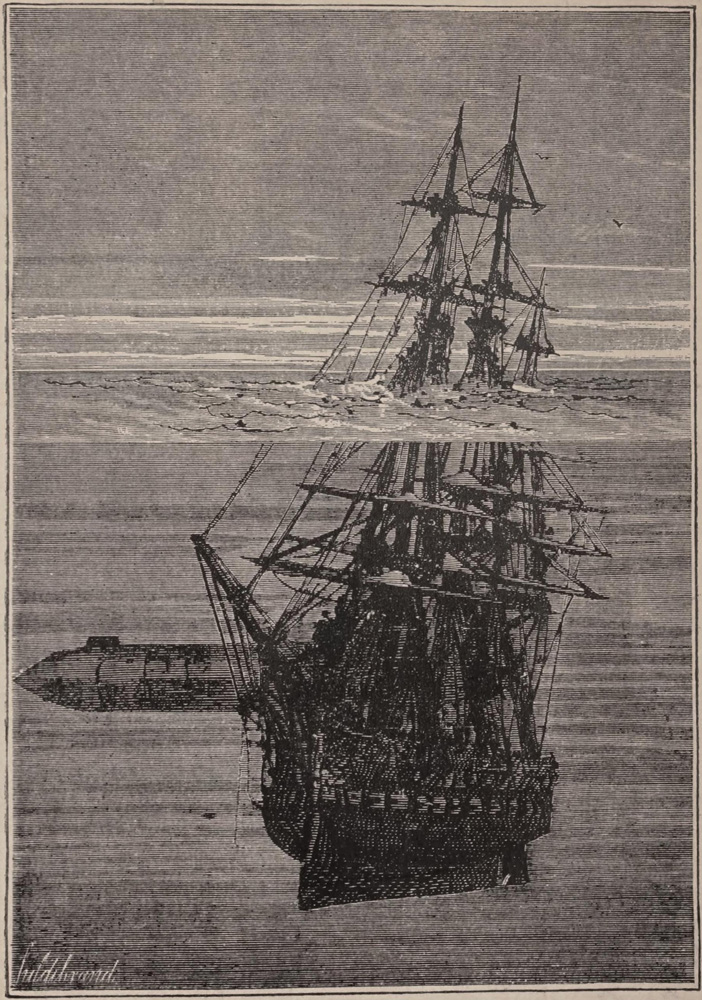
The water was rising. The poor creatures were crowding the ratlines, clinging to the masts, struggling under the water. It was a human ant-heap overtaken by the sea. Paralysed, stiffened with anguish, my hair standing on end, with eyes wide open, panting, without breath, and without voice, I too was watching! An irresistible attraction glued me to the glass! Suddenly an explosion took place. The compressed air blew up her decks, as if the magazines had caught fire. Then the unfortunate vessel sank more rapidly. Her topmast, laden with victims, now appeared; then her spars, bending under the weight of men; and, last of all, the top of her mainmast. Then the dark mass disappeared, and with it the dead crew, drawn down by the strong eddy.
The water was rising. The poor people crowded onto the rope ladders, clung to the masts, and struggled underwater. They were like an anthill of people overtaken by the sea. I watched too, paralyzed and rigid with anguish, my hair standing on end. My eyes were wide, and I panted, unable to breathe or speak. An irresistible force held me against the glass. Suddenly, there was an explosion. Compressed air blew up the ship’s decks, as if its ammunition stores had caught fire. Then the doomed vessel sank faster. Its topmast, crowded with victims, came into view. Then came its spars, bending under the weight of men. Last of all came the top of the mainmast. Then the dark mass vanished, and the powerful whirlpool dragged the dead crew down with it.
I turned to Captain Nemo. That terrible avenger, a perfect archangel of hatred, was still looking. When all was over, he turned to his room, opened the door, and entered. I followed him with my eyes. On the end wall beneath his heroes, I saw the portrait of a woman, still young, and two little children. Captain Nemo looked at them for some moments, stretched his arms towards them, and, kneeling down, burst into deep sobs.
I turned to Captain Nemo. That terrible avenger, a perfect archangel of hatred, was still watching. When it was all over, he turned toward his room, opened the door, and went inside. I watched him. On the far wall, beneath his heroes, I saw a portrait of a woman who was still young and two small children. Captain Nemo looked at them for a few moments and reached out toward them. Then he knelt and burst into deep sobs.