Part Two, Chapter 18
The Octopuses
For several days the Nautilus kept off from the American coast. Evidently it did not wish to risk the tides of the Gulf of Mexico or of the sea of the Antilles. April 16th, we sighted Martinique and Guadaloupe from a distance of about thirty miles. I saw their tall peaks for an instant. The Canadian, who counted on carrying out his projects in the Gulf, by either landing or hailing one of the numerous boats that coast from one island to another, was quite disheartened. Flight would have been quite practicable, if Ned Land had been able to take possession of the boat without the Captain’s knowledge. But in the open sea it could not be thought of. The Canadian, Conseil, and I had a long conversation on this subject. For six months we had been prisoners on board the Nautilus. We had travelled 17,000 leagues; and, as Ned Land said, there was no reason why it should come to an end. We could hope nothing from the Captain of the Nautilus, but only from ourselves. Besides, for some time past he had become graver, more retired, less sociable. He seemed to shun me. I met him rarely. Formerly he was pleased to explain the submarine marvels to me; now he left me to my studies, and came no more to the saloon. What change had come over him? For what cause? For my part, I did not wish to bury with me my curious and novel studies. I had now the power to write the true book of the sea; and this book, sooner or later, I wished to see daylight. The land nearest us was the archipelago of the Bahamas. There rose high submarine cliffs covered with large weeds. It was about eleven o’clock when Ned Land drew my attention to a formidable pricking, like the sting of an ant, which was produced by means of large seaweeds.
For several days the Nautilus stayed away from the American coast. Evidently, it did not want to risk the tides of the Gulf of Mexico or the sea of the Antilles. On April 16th, we sighted Martinique and Guadaloupe from about thirty miles away. I saw their tall peaks for a moment. The Canadian had hoped to carry out his plans in the Gulf. He meant to land or hail one of the many boats traveling between the islands. Now he was very discouraged. Escape would have been quite possible if Ned Land could have taken the boat without the Captain knowing. But in the open sea, escape was out of the question. The Canadian, Conseil, and I had a long conversation about it. We had been prisoners aboard the Nautilus for six months. We had traveled 17,000 leagues, and, as Ned Land said, there was no reason for our journey to end. We could expect no help from the Captain of the Nautilus. We had only ourselves to rely on. Besides, for some time the Captain had become more serious, withdrawn, and less sociable. He seemed to avoid me, and I rarely saw him. He had once enjoyed explaining the wonders of the sea to me. Now he left me to my studies and no longer came to the saloon. What had changed him? Why? For my part, I did not want my unusual and original studies to die with me. I could now write the true book of the sea. Sooner or later, I wanted that book to see the light of day. The nearest land was the archipelago of the Bahamas. Tall underwater cliffs rose there, covered with large seaweeds. At about eleven o’clock, Ned Land drew my attention to a sharp prickling caused by the large seaweeds. It was like the sting of an ant.
“Well,” I said, “these are proper caverns for poulps, and I should not be astonished to see some of these monsters.”
“Well,” I said, “these caves are perfect for octopuses, and I wouldn’t be surprised to see some of these monsters.”
“What!” said Conseil; “cuttlefish, real cuttlefish of the cephalopod class?”
“What!” said Conseil. “Cuttlefish, real cuttlefish from the cephalopod class?”
“No,” I said, “poulps of huge dimensions.”
“No,” I said, “huge octopuses.”
“I will never believe that such animals exist,” said Ned.
“I will never believe animals like that exist,” said Ned.
“Well,” said Conseil, with the most serious air in the world, “I remember perfectly to have seen a large vessel drawn under the waves by an octopus’s arm.”
“Well,” said Conseil, looking as serious as could be, “I remember perfectly well seeing an octopus’s arm pull a large ship under the waves.”
“You saw that?” said the Canadian.
“You saw that?” said the Canadian.
“Yes, Ned.”
“Yes, Ned.”
“With your own eyes?”
“With your own eyes?”
“With my own eyes.”
“With my own eyes.”
“Where, pray, might that be?”
“Where might that be?”
“At St. Malo,” answered Conseil.
“At St. Malo,” said Conseil.
“In the port?” said Ned, ironically.
“In the port?” Ned said sarcastically.
“No; in a church,” replied Conseil.
“No, in a church,” said Conseil.
“In a church!” cried the Canadian.
“In a church!” shouted the Canadian.
“Yes; friend Ned. In a picture representing the poulp in question.”
“Yes, Ned. In a picture of the octopus in question.”
“Good!” said Ned Land, bursting out laughing.
“Good!” said Ned Land, bursting out laughing.
“He is quite right,” I said. “I have heard of this picture; but the subject represented is taken from a legend, and you know what to think of legends in the matter of natural history. Besides, when it is a question of monsters, the imagination is apt to run wild. Not only is it supposed that these poulps can draw down vessels, but a certain Olaus Magnus speaks of an octopus a mile long that is more like an island than an animal. It is also said that the Bishop of Nidros was building an altar on an immense rock. Mass finished, the rock began to walk, and returned to the sea. The rock was a poulp. Another Bishop, Pontoppidan, speaks also of a poulp on which a regiment of cavalry could manœuvre. Lastly, the ancient naturalists speak of monsters whose mouths were like gulfs, and which were too large to pass through the Straits of Gibraltar.”
“He is quite right,” I said. “I have heard of this picture, but it depicts a legend. And you know how much legends can be trusted in natural history. Besides, when it comes to monsters, the imagination tends to run wild. People believe these octopuses can drag ships underwater. But Olaus Magnus goes further, describing an octopus a mile long, more like an island than an animal. There is also a story about the Bishop of Nidros building an altar on an enormous rock. After Mass, the rock began to walk and returned to the sea. The rock was an octopus. Another Bishop, Pontoppidan, also describes an octopus large enough for a cavalry regiment to maneuver on. Finally, ancient naturalists describe monsters with mouths like gulfs, too large to pass through the Straits of Gibraltar.”
“But how much is true of these stories?” asked Conseil.
“But how much of these stories is true?” asked Conseil.
“Nothing, my friends; at least of that which passes the limit of truth to get to fable or legend. Nevertheless, there must be some ground for the imagination of the story-tellers. One cannot deny that poulps and cuttlefish exist of a large species, inferior, however, to the cetaceans. Aristotle has stated the dimensions of a cuttlefish as five cubits, or nine feet two inches. Our fishermen frequently see some that are more than four feet long. Some skeletons of poulps are preserved in the museums of Trieste and Montpelier, that measure two yards in length. Besides, according to the calculations of some naturalists, one of these animals only six feet long would have tentacles twenty-seven feet long. That would suffice to make a formidable monster.”
“Nothing, my friends, at least nothing that goes beyond truth into fable or legend. Still, there must be some basis for the storytellers’ imagination. We cannot deny that large species of octopus and cuttlefish exist, though they are smaller than whales. Aristotle said that one cuttlefish was five cubits long, or nine feet two inches. Our fishermen often see some that are more than four feet long. The museums of Trieste and Montpelier have octopus skeletons that measure two yards long. Besides, some naturalists calculate that an animal only six feet long could have tentacles twenty-seven feet long. That would be enough to make a formidable monster.”
“Do they fish for them in these days?” asked Ned.
“Do they still fish for them these days?” asked Ned.
“If they do not fish for them, sailors see them at least. One of my friends, Captain Paul Bos of Havre, has often affirmed that he met one of these monsters of colossal dimensions in the Indian seas. But the most astonishing fact, and which does not permit of the denial of the existence of these gigantic animals, happened some years ago, in 1861.”
“If sailors do not fish for them, they at least see them. My friend Captain Paul Bos of Havre has often said he encountered one of these enormous monsters in the Indian seas. But the most astonishing event happened some years ago, in 1861. It leaves no doubt that these gigantic animals exist.”
“What is the fact?” asked Ned Land.
“What is it?” asked Ned Land.
“This is it. In 1861, to the north-east of Teneriffe, very nearly in the same latitude we are in now, the crew of the despatch-boat Alector perceived a monstrous cuttlefish swimming in the waters. Captain Bouguer went near to the animal, and attacked it with harpoon and guns, without much success, for balls and harpoons glided over the soft flesh. After several fruitless attempts the crew tried to pass a slip-knot round the body of the mollusc. The noose slipped as far as the tail fins and there stopped. They tried then to haul it on board, but its weight was so considerable that the tightness of the cord separated the tail from the body, and, deprived of this ornament, he disappeared under the water.”
“This is what happened. In 1861, the crew of the dispatch boat Alector spotted a monstrous cuttlefish swimming northeast of Teneriffe. It was very nearly at the same latitude as we are now. Captain Bouguer approached the animal and attacked it with harpoons and guns. But he had little success, because the bullets and harpoons slid over its soft flesh. After several failed attempts, the crew tried to slip a noose around the mollusk’s body. The noose slipped down to the tail fins and stopped there. They then tried to haul the cuttlefish aboard. But it was so heavy that the tightened rope tore its tail from its body. Deprived of this ornament, the cuttlefish disappeared beneath the water.”
“Indeed! is that a fact?”
“Really! Is that true?”
“An indisputable fact, my good Ned. They proposed to name this poulp ‘Bouguer’s cuttlefish.’”
“That’s an undeniable fact, Ned. They proposed naming this octopus ‘Bouguer’s cuttlefish.’”
“What length was it?” asked the Canadian.
“How long was it?” asked the Canadian.
“Did it not measure about six yards?” said Conseil, who, posted at the window, was examining again the irregular windings of the cliff.
“Wasn't it about six yards long?” said Conseil. He was at the window, studying the cliff's uneven curves again.
“Precisely,” I replied.
“Exactly,” I replied.
“Its head,” rejoined Conseil, “was it not crowned with eight tentacles, that beat the water like a nest of serpents?”
“And its head,” replied Conseil, “wasn't it crowned with eight tentacles that beat the water like a nest of snakes?”
“Precisely.”
“Exactly.”
“Had not its eyes, placed at the back of its head, considerable development?”
“Weren't its eyes, located at the back of its head, quite well developed?”
“Yes, Conseil.”
“Yes, Conseil.”
“And was not its mouth like a parrot’s beak?”
“And wasn’t its mouth like a parrot’s beak?”
“Exactly, Conseil.”
“Exactly, Conseil.”
“Very well! no offence to master,” he replied, quietly; “if this is not Bouguer’s cuttlefish, it is, at least, one of its brothers.”
“All right! No offense, master,” he replied quietly. “If this isn't Bouguer’s cuttlefish, it's at least one of its brothers.”
I looked at Conseil. Ned Land hurried to the window.
I looked at Conseil. Ned Land hurried to the window.
“What a horrible beast!” he cried.
“What a horrible beast!” he cried.
I looked in my turn, and could not repress a gesture of disgust. Before my eyes was a horrible monster worthy to figure in the legends of the marvellous. It was an immense cuttlefish, being eight yards long. It swam crossways in the direction of the Nautilus with great speed, watching us with its enormous staring green eyes. Its eight arms, or rather feet, fixed to its head, that have given the name of cephalopod to these animals, were twice as long as its body, and were twisted like the furies’ hair. One could see the 250 air holes on the inner side of the tentacles. The monster’s mouth, a horned beak like a parrot’s, opened and shut vertically. Its tongue, a horned substance, furnished with several rows of pointed teeth, came out quivering from this veritable pair of shears. What a freak of nature, a bird’s beak on a mollusc! Its spindle-like body formed a fleshy mass that might weigh 4,000 to 5,000 lbs.; the, varying colour changing with great rapidity, according to the irritation of the animal, passed successively from livid grey to reddish brown. What irritated this mollusc? No doubt the presence of the Nautilus, more formidable than itself, and on which its suckers or its jaws had no hold. Yet, what monsters these poulps are! what vitality the Creator has given them! what vigour in their movements! and they possess three hearts! Chance had brought us in presence of this cuttlefish, and I did not wish to lose the opportunity of carefully studying this specimen of cephalopods. I overcame the horror that inspired me, and, taking a pencil, began to draw it.
I looked in turn and could not suppress a gesture of disgust. Before me was a horrible monster worthy of a fantastical legend. It was an immense cuttlefish, eight yards long. It swam sideways toward the Nautilus at great speed, watching us with enormous, staring green eyes. Its eight arms, or rather feet, were attached to its head. These give such animals the name cephalopod. The arms were twice as long as its body and twisted like the furies’ hair. I could see 250 air holes on the inner side of the tentacles. The monster’s mouth was a horny beak like a parrot’s, opening and closing vertically. Its horny tongue, lined with several rows of pointed teeth, emerged quivering from this veritable pair of shears. What a freak of nature, a bird’s beak on a mollusc! Its spindle-shaped body was a fleshy mass that might weigh 4,000 to 5,000 lbs. Its color changed rapidly according to how irritated it was, passing from livid gray to reddish brown. What irritated this mollusc? No doubt it was the presence of the Nautilus, which was more formidable than the creature itself. Its suckers and jaws could find no grip on the vessel. Yet what monsters these poulps are! What vitality the Creator has given them! How vigorous their movements are! And they have three hearts! Chance had brought us face to face with this cuttlefish. I did not want to miss the opportunity to study this cephalopod carefully. I overcame my horror, took a pencil, and began to draw it.
“Perhaps this is the same which the Alector saw,” said Conseil.
“Perhaps this is the same one the Alector saw,” said Conseil.
“No,” replied the Canadian; “for this is whole, and the other had lost its tail.”
“No,” replied the Canadian, “because this one is whole, and the other had lost its tail.”
“That is no reason,” I replied. “The arms and tails of these animals are re-formed by renewal; and in seven years the tail of Bouguer’s cuttlefish has no doubt had time to grow.”
“That is no reason,” I replied. “These animals can regrow their arms and tails. So Bouguer’s cuttlefish has no doubt had time to grow its tail back in seven years.”
By this time other poulps appeared at the port light. I counted seven. They formed a procession after the Nautilus, and I heard their beaks gnashing against the iron hull. I continued my work. These monsters kept in the water with such precision that they seemed immovable. Suddenly the Nautilus stopped. A shock made it tremble in every plate.
By now, other octopuses appeared at the porthole. I counted seven. They followed the Nautilus in a line, and I heard their beaks scraping against the iron hull. I continued my work. The monsters held their positions in the water so precisely that they seemed motionless. Suddenly, the Nautilus stopped. A shock made every plate of the vessel tremble.
“Have we struck anything?” I asked.
“Did we hit something?” I asked.
“In any case,” replied the Canadian, “we shall be free, for we are floating.”
“In any case,” the Canadian replied, “we’ll be free because we’re floating.”
The Nautilus was floating, no doubt, but it did not move. A minute passed. Captain Nemo, followed by his lieutenant, entered the drawing-room. I had not seen him for some time. He seemed dull. Without noticing or speaking to us, he went to the panel, looked at the poulps, and said something to his lieutenant. The latter went out. Soon the panels were shut. The ceiling was lighted. I went towards the Captain.
The Nautilus was certainly floating, but it was not moving. A minute passed. Captain Nemo entered the drawing room, followed by his lieutenant. I had not seen him for some time. He seemed listless. Without noticing us or speaking to us, he went to the panel and looked at the octopuses. He said something to his lieutenant, who went out. Soon the panels were closed. The ceiling lit up. I went over to the Captain.
“A curious collection of poulps?” I said.
“An unusual collection of octopuses?” I said.
“Yes, indeed, Mr. Naturalist,” he replied; “and we are going to fight them, man to beast.”
“Yes, Mr. Naturalist,” he replied. “We're going to fight them, man against beast.”
I looked at him. I thought I had not heard aright.
I looked at him. I thought I had misheard him.
“Man to beast?” I repeated.
“Man to beast?” I repeated.
“Yes, sir. The screw is stopped. I think that the horny jaws of one of the cuttlefish is entangled in the blades. That is what prevents our moving.”
“Yes, sir. The propeller has stopped. I think one of the cuttlefish’s hard jaws is caught in the blades. That is what’s keeping us from moving.”
“What are you going to do?”
“What are you going to do?”
“Rise to the surface, and slaughter this vermin.”
“Surface and slaughter this vermin.”
“A difficult enterprise.”
“A difficult undertaking.”
“Yes, indeed. The electric bullets are powerless against the soft flesh, where they do not find resistance enough to go off. But we shall attack them with the hatchet.”
“Yes, indeed. The electric bullets are useless against soft flesh because they do not meet enough resistance to go off. But we shall attack them with the hatchet.”
“And the harpoon, sir,” said the Canadian, “if you do not refuse my help.”
“And the harpoon, sir,” said the Canadian, “if you’ll accept my help.”
“I will accept it, Master Land.”
“I’ll accept it, Master Land.”
“We will follow you,” I said, and, following Captain Nemo, we went towards the central staircase.
“We’ll follow you,” I said. We followed Captain Nemo toward the central staircase.
There, about ten men with boarding-hatchets were ready for the attack. Conseil and I took two hatchets; Ned Land seized a harpoon. The Nautilus had then risen to the surface. One of the sailors, posted on the top ladderstep, unscrewed the bolts of the panels. But hardly were the screws loosed, when the panel rose with great violence, evidently drawn by the suckers of a poulp’s arm. Immediately one of these arms slid like a serpent down the opening and twenty others were above. With one blow of the axe, Captain Nemo cut this formidable tentacle, that slid wriggling down the ladder. Just as we were pressing one on the other to reach the platform, two other arms, lashing the air, came down on the seaman placed before Captain Nemo, and lifted him up with irresistible power. Captain Nemo uttered a cry, and rushed out. We hurried after him.
There, about ten men stood ready to attack with boarding axes. Conseil and I took two axes, and Ned Land grabbed a harpoon. The Nautilus had risen to the surface. A sailor on the top step of the ladder unscrewed the bolts holding the hatch. But as soon as the bolts came loose, the hatch rose violently. It was evidently pulled up by the suckers on an octopus’s arm. One arm immediately slid like a snake down through the opening, while twenty others appeared above it. With one blow of his axe, Captain Nemo cut off the fearsome tentacle. It wriggled down the ladder. As we crowded together to reach the platform, two more arms came down, lashing the air. They seized the sailor in front of Captain Nemo and lifted him with irresistible force. Captain Nemo cried out and rushed onto the platform. We hurried after him.
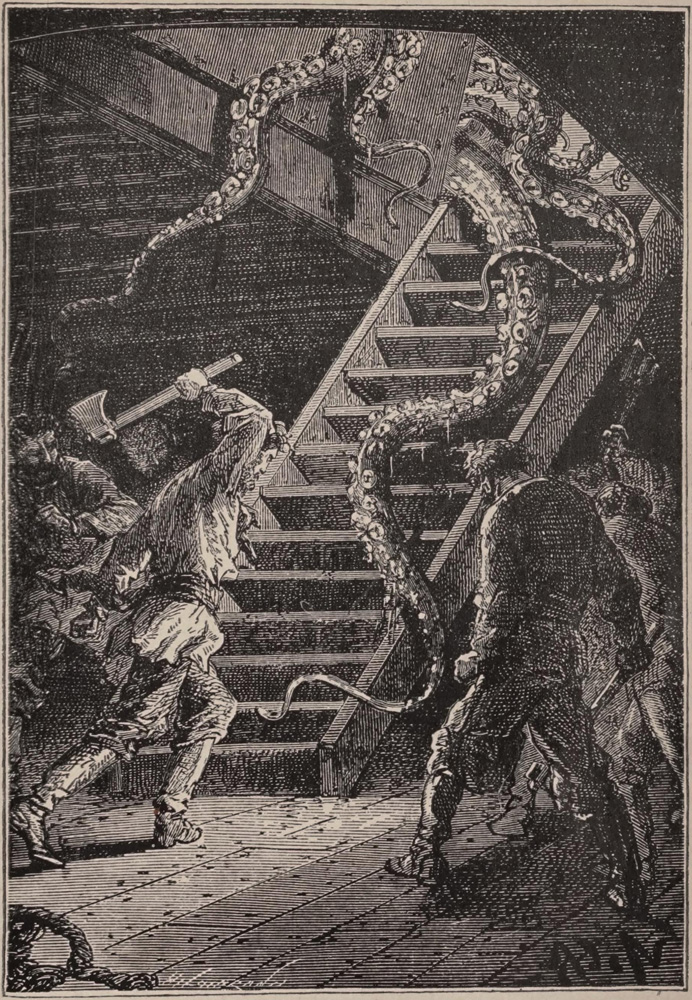
What a scene! The unhappy man, seized by the tentacle and fixed to the suckers, was balanced in the air at the caprice of this enormous trunk. He rattled in his throat, he was stifled, he cried, “Help! help!” These words, spoken in French, startled me! I had a fellow-countryman on board, perhaps several! That heart-rending cry! I shall hear it all my life. The unfortunate man was lost. Who could rescue him from that powerful pressure? However, Captain Nemo had rushed to the poulp, and with one blow of the axe had cut through one arm. His lieutenant struggled furiously against other monsters that crept on the flanks of the Nautilus. The crew fought with their axes. The Canadian, Conseil, and I buried our weapons in the fleshy masses; a strong smell of musk penetrated the atmosphere. It was horrible!
What a scene! The poor man was caught in the tentacle, held fast by its suckers. The enormous limb swung him through the air at will. His breath rattled in his throat. He was suffocating. He cried, “Help! help!” Those words, spoken in French, startled me! I had a fellow countryman on board, perhaps several! That heart-rending cry! I will hear it all my life. The poor man was doomed. Who could free him from that powerful grip? But Captain Nemo rushed at the poulp and cut through one of its arms with a single blow of his axe. His lieutenant fought furiously against other monsters crawling along the sides of the Nautilus. The crew fought with their axes. The Canadian, Conseil, and I drove our weapons into the fleshy masses. A strong smell of musk filled the air. It was horrible!
For one instant, I thought the unhappy man, entangled with the poulp, would be torn from its powerful suction. Seven of the eight arms had been cut off. One only wriggled in the air, brandishing the victim like a feather. But just as Captain Nemo and his lieutenant threw themselves on it, the animal ejected a stream of black liquid. We were blinded with it. When the cloud dispersed, the cuttlefish had disappeared, and my unfortunate countryman with it. Ten or twelve poulps now invaded the platform and sides of the Nautilus. We rolled pell-mell into the midst of this nest of serpents, that wriggled on the platform in the waves of blood and ink. It seemed as though these slimy tentacles sprang up like the hydra’s heads. Ned Land’s harpoon, at each stroke, was plunged into the staring eyes of the cuttle fish. But my bold companion was suddenly overturned by the tentacles of a monster he had not been able to avoid.
For a moment, I thought the unfortunate man tangled in the poulp’s arms would be freed from its powerful suction. Seven of its eight arms had been cut off. Only one still wriggled in the air, waving the victim like a feather. But just as Captain Nemo and his lieutenant rushed at it, the animal shot out a stream of black liquid. It blinded us. When the cloud cleared, the cuttlefish had disappeared, taking my unfortunate countryman with it. Ten or twelve poulps now invaded the platform and sides of the Nautilus. We rushed together into this nest of serpents. They writhed on the platform amid waves of blood and ink. Their slimy tentacles seemed to spring up like the hydra’s heads. With every thrust, Ned Land drove his harpoon into the staring eyes of a cuttlefish. But a monster my bold companion could not avoid suddenly knocked him down with its tentacles.
Ah! how my heart beat with emotion and horror! The formidable beak of a cuttlefish was open over Ned Land. The unhappy man would be cut in two. I rushed to his succour. But Captain Nemo was before me; his axe disappeared between the two enormous jaws, and, miraculously saved, the Canadian, rising, plunged his harpoon deep into the triple heart of the poulp.
Oh, how my heart pounded with emotion and horror! The cuttlefish's fearsome beak was open over Ned Land. The poor man was about to be cut in two. I rushed to help him. But Captain Nemo reached him first. His axe disappeared between the two enormous jaws. Miraculously saved, the Canadian rose and plunged his harpoon deep into the cuttlefish's triple heart.
“I owed myself this revenge!” said the Captain to the Canadian.
“I owed myself this revenge!” the Captain said to the Canadian.
Ned bowed without replying. The combat had lasted a quarter of an hour. The monsters, vanquished and mutilated, left us at last, and disappeared under the waves. Captain Nemo, covered with blood, nearly exhausted, gazed upon the sea that had swallowed up one of his companions, and great tears gathered in his eyes.
Ned bowed without replying. The fight had lasted fifteen minutes. Defeated and wounded, the monsters finally left us and disappeared beneath the waves. Captain Nemo was covered in blood and nearly exhausted. He stared at the sea that had swallowed one of his companions, and tears filled his eyes.