Part 1, Chapter 15
A Walk on the Seafloor
This cell was, to speak correctly, the arsenal and wardrobe of the Nautilus. A dozen diving apparatuses hung from the partition, waiting our use.
This room was, strictly speaking, the Nautilus's armory and wardrobe. A dozen diving suits hung on the partition, ready for us to use.
Ned Land, on seeing them, showed evident repugnance to dress himself in one.
When Ned Land saw them, he was clearly reluctant to put one on.
“But, my worthy Ned, the forests of the Island of Crespo are nothing but submarine forests.”
“But, my dear Ned, the forests of Crespo Island are entirely underwater.”
“Good!” said the disappointed harpooner, who saw his dreams of fresh meat fade away. “And you, M. Aronnax, are you going to dress yourself in those clothes?”
“Good!” said the disappointed harpooner, seeing his dreams of fresh meat fade away. “And you, M. Aronnax, are you going to put on those clothes?”
“There is no alternative, Master Ned.”
“There’s no other choice, Master Ned.”
“As you please, sir,” replied the harpooner, shrugging his shoulders; “but as for me, unless I am forced, I will never get into one.”
“As you wish, sir,” replied the harpooner, shrugging his shoulders. “But I’ll never get into one unless I’m forced to.”
“No one will force you, Master Ned,” said Captain Nemo.
“No one will force you, Master Ned,” said Captain Nemo.
“Is Conseil going to risk it?” asked Ned.
“Is Conseil going to risk it?” asked Ned.
“I follow my master wherever he goes,” replied Conseil.
“I follow my master wherever he goes,” Conseil replied.
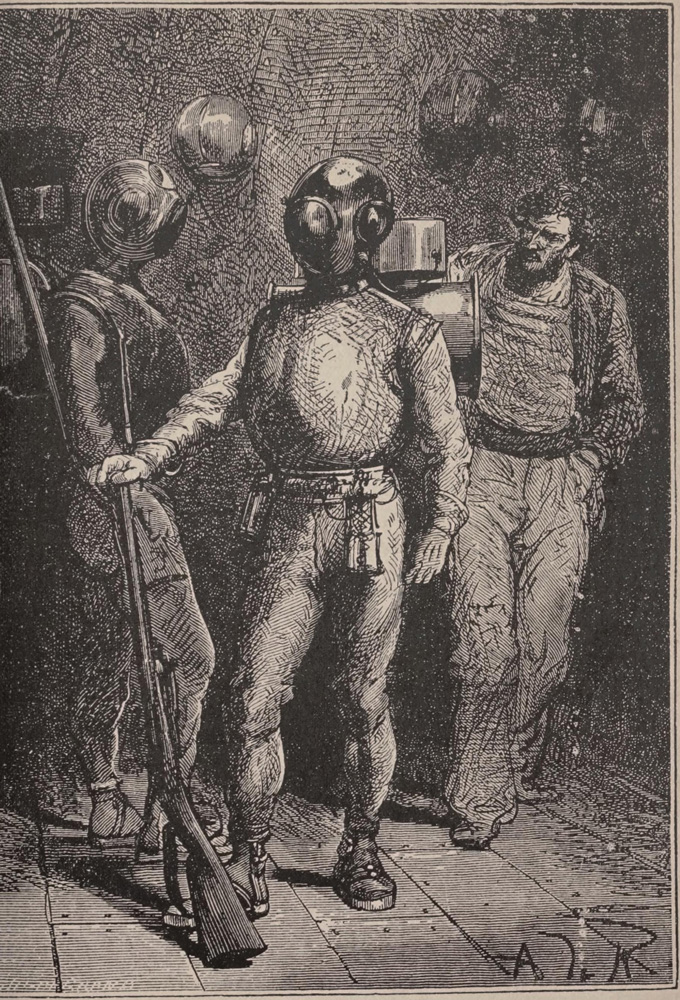
At the Captain’s call two of the ship’s crew came to help us to dress in these heavy and impervious clothes, made of india-rubber without seam, and constructed expressly to resist considerable pressure. One would have thought it a suit of armour, both supple and resisting. This suit formed trousers and waistcoat. The trousers were finished off with thick boots, weighted with heavy leaden soles. The texture of the waistcoat was held together by bands of copper, which crossed the chest, protecting it from the great pressure of the water, and leaving the lungs free to act; the sleeves ended in gloves, which in no way restrained the movement of the hands. There was a vast difference noticeable between these consummate apparatuses and the old cork breastplates, jackets, and other contrivances in vogue during the eighteenth century.
At the Captain’s call, two crew members came to help us put on the heavy, waterproof suits. They were made of seamless rubber and designed to withstand considerable pressure. They looked like suits of armor, both flexible and strong. Each suit consisted of trousers and a vest. The trousers ended in thick boots weighted with heavy lead soles. Copper bands held the vest together and crossed the chest. They protected the chest from the great pressure of the water while leaving the lungs free to work. The sleeves ended in gloves that did not restrict the hands’ movement at all. These superb suits were vastly different from the old cork breastplates, jackets, and other devices used in the eighteenth century.
Captain Nemo and one of his companions (a sort of Hercules, who must have possessed great strength), Conseil, and myself, were soon enveloped in the dresses. There remained nothing more to be done but to enclose our heads in the metal box. But before proceeding to this operation, I asked the Captain’s permission to examine the guns we were to carry.
Captain Nemo, one of his companions, Conseil, and I were soon dressed in the suits. The companion was a Hercules of a man, who must have been very strong. All that remained was to put our heads inside the metal boxes. But before doing so, I asked the Captain’s permission to examine the guns we were to carry.
One of the Nautilus men gave me a simple gun, the butt end of which, made of steel, hollow in the centre, was rather large. It served as a reservoir for compressed air, which a valve, worked by a spring, allowed to escape into a metal tube. A box of projectiles, in a groove in the thickness of the butt end, contained about twenty of these electric balls, which, by means of a spring, were forced into the barrel of the gun. As soon as one shot was fired, another was ready.
One of the Nautilus men gave me a simple gun. Its steel butt was rather large and hollow in the center. It served as a reservoir for compressed air. A spring-operated valve released the air into a metal tube. A box of projectiles sat in a groove inside the butt. It held about twenty electric balls, which a spring pushed into the gun’s barrel. As soon as one shot was fired, another was ready.
“Captain Nemo,” said I, “this arm is perfect, and easily handled: I only ask to be allowed to try it. But how shall we gain the bottom of the sea?”
“Captain Nemo,” I said, “this weapon is perfect and easy to handle. I only ask to be allowed to try it. But how will we reach the bottom of the sea?”
“At this moment, Professor, the Nautilus is stranded in five fathoms, and we have nothing to do but to start.”
“Right now, Professor, the Nautilus is stranded in five fathoms of water, and all we have to do is leave.”
“But how shall we get off?”
“But how will we get off?”
“You shall see.”
“You'll see.”
Captain Nemo thrust his head into the helmet, Conseil and I did the same, not without hearing an ironical “Good sport!” from the Canadian. The upper part of our dress terminated in a copper collar upon which was screwed the metal helmet. Three holes, protected by thick glass, allowed us to see in all directions, by simply turning our head in the interior of the head-dress. As soon as it was in position, the Rouquayrol apparatus on our backs began to act; and, for my part, I could breathe with ease.
Captain Nemo put his head into the helmet, and Conseil and I did the same. As we did, we heard the Canadian say sarcastically, “Good sport!” The top of each suit ended in a copper collar, onto which the metal helmet was screwed. Three openings, covered with thick glass, let us see in all directions. We only had to turn our heads inside the helmets. As soon as the helmets were in place, the Rouquayrol apparatus on our backs began to work. For my part, I could breathe easily.
With the Ruhmkorff lamp hanging from my belt, and the gun in my hand, I was ready to set out. But to speak the truth, imprisoned in these heavy garments, and glued to the deck by my leaden soles, it was impossible for me to take a step.
With the Ruhmkorff lamp hanging from my belt and the gun in my hand, I was ready to set out. But truthfully, I couldn't take a step. I was trapped in the heavy clothing, and my lead soles held me to the deck.
But this state of things was provided for. I felt myself being pushed into a little room contiguous to the wardrobe-room. My companions followed, towed along in the same way. I heard a water-tight door, furnished with stopper-plates, close upon us, and we were wrapped in profound darkness.
But this situation had been anticipated. I felt myself being pushed into a small room next to the wardrobe room. My companions followed, pulled along in the same way. I heard a watertight door fitted with stopper plates close behind us, and we were plunged into complete darkness.
After some minutes, a loud hissing was heard. I felt the cold mount from my feet to my chest. Evidently from some part of the vessel they had, by means of a tap, given entrance to the water, which was invading us, and with which the room was soon filled. A second door cut in the side of the Nautilus then opened. We saw a faint light. In another instant our feet trod the bottom of the sea.
After a few minutes, we heard a loud hissing sound. I felt the cold rise from my feet to my chest. Apparently, they had opened a valve somewhere on the vessel to let water in. It flowed around us and soon filled the room. Then a second door in the side of the Nautilus opened. We saw a faint light. A moment later, our feet touched the bottom of the sea.
And now, how can I retrace the impression left upon me by that walk under the waters? Words are impotent to relate such wonders! Captain Nemo walked in front, his companion followed some steps behind. Conseil and I remained near each other, as if an exchange of words had been possible through our metallic cases. I no longer felt the weight of my clothing, or of my shoes, of my reservoir of air, or my thick helmet, in the midst of which my head rattled like an almond in its shell.
And now, how can I describe the impression that walk beneath the water left on me? Words cannot convey such wonders! Captain Nemo walked in front, and his companion followed a few steps behind. Conseil and I stayed close together, as if we could talk through our metal suits. I no longer felt the weight of my clothes, shoes, air tank, or thick helmet. My head rattled inside the helmet like an almond in its shell.
The light, which lit the soil thirty feet below the surface of the ocean, astonished me by its power. The solar rays shone through the watery mass easily, and dissipated all colour, and I clearly distinguished objects at a distance of a hundred and fifty yards. Beyond that the tints darkened into fine gradations of ultramarine, and faded into vague obscurity. Truly this water which surrounded me was but another air denser than the terrestrial atmosphere, but almost as transparent. Above me was the calm surface of the sea.
The power of the light amazed me as it lit the seabed thirty feet below the ocean's surface. The sun's rays passed easily through the water and washed out all color. I could clearly see objects a hundred and fifty yards away. Beyond that distance, the colors darkened in subtle shades of ultramarine, then faded into a dim blur. The water around me was really just another kind of air, denser than Earth's atmosphere but almost as transparent. Above me, the surface of the sea was calm.
We were walking on fine, even sand, not wrinkled, as on a flat shore, which retains the impression of the billows. This dazzling carpet, really a reflector, repelled the rays of the sun with wonderful intensity, which accounted for the vibration which penetrated every atom of liquid. Shall I be believed when I say that, at the depth of thirty feet, I could see as if I was in broad daylight?
We were walking on fine, smooth sand. Unlike the sand on a flat shore, it had no ripples left by the waves. This dazzling carpet acted like a mirror, reflecting the sun’s rays with remarkable intensity. That explained the shimmering that reached every particle of water. Will anyone believe me when I say that, thirty feet deep, I could see as if it were broad daylight?
For a quarter of an hour I trod on this sand, sown with the impalpable dust of shells. The hull of the Nautilus, resembling a long shoal, disappeared by degrees; but its lantern, when darkness should overtake us in the waters, would help to guide us on board by its distinct rays.
For fifteen minutes I walked on sand scattered with fine shell dust. The hull of the Nautilus looked like a long sandbank and gradually disappeared from view. But when darkness fell around us in the water, its lantern’s clear rays would guide us back aboard.
Soon forms of objects outlined in the distance were discernible. I recognised magnificent rocks, hung with a tapestry of zoophytes of the most beautiful kind, and I was at first struck by the peculiar effect of this medium.
Soon I could make out the shapes of objects in the distance. I recognized magnificent rocks covered with a tapestry of beautiful zoophytes. At first, I was struck by the strange effect of this medium.
It was then ten in the morning; the rays of the sun struck the surface of the waves at rather an oblique angle, and at the touch of their light, decomposed by refraction as through a prism, flowers, rocks, plants, shells, and polypi were shaded at the edges by the seven solar colours. It was marvellous, a feast for the eyes, this complication of coloured tints, a perfect kaleidoscope of green, yellow, orange, violet, indigo, and blue; in one word, the whole palette of an enthusiastic colourist! Why could I not communicate to Conseil the lively sensations which were mounting to my brain, and rival him in expressions of admiration? For aught I knew, Captain Nemo and his companion might be able to exchange thoughts by means of signs previously agreed upon. So, for want of better, I talked to myself; I declaimed in the copper box which covered my head, thereby expending more air in vain words than was perhaps expedient.
It was ten in the morning. The sun’s rays struck the surface of the waves at a slant. The light broke into colors as it passed through the water, as if through a prism. It edged the flowers, rocks, plants, shells, and polyps with the seven colors of sunlight. The rich mix of colors was marvelous, a feast for the eyes. It was a perfect kaleidoscope of green, yellow, orange, violet, indigo, and blue. In short, it was the whole palette of an enthusiastic painter! Why couldn’t I share with Conseil the intense feelings rising in my mind and match his expressions of admiration? For all I knew, Captain Nemo and his companion might be able to exchange thoughts through signs they had agreed on beforehand. So, for lack of anything better to do, I talked to myself. I spoke passionately inside the copper box covering my head, perhaps wasting more air on words than was wise.
Various kinds of isis, clusters of pure tuft-coral, prickly fungi, and anemones formed a brilliant garden of flowers, enamelled with porphitæ, decked with their collarettes of blue tentacles, sea-stars studding the sandy bottom, together with asterophytons like fine lace embroidered by the hands of naïads, whose festoons were waved by the gentle undulations caused by our walk. It was a real grief to me to crush under my feet the brilliant specimens of molluscs which strewed the ground by thousands, of hammer-heads, donaciae (veritable bounding shells), of staircases, and red helmet-shells, angel-wings, and many others produced by this inexhaustible ocean. But we were bound to walk, so we went on, whilst above our heads waved shoals of physalides leaving their tentacles to float in their train, medusæ whose umbrellas of opal or rose-pink, escalloped with a band of blue, sheltered us from the rays of the sun and fiery pelagiæ, which, in the darkness, would have strewn our path with phosphorescent light.
Various kinds of isis, clusters of pure tuft coral, prickly fungi, and anemones formed a brilliant garden of flowers. Porphitæ decorated the garden with their collars of blue tentacles. Sea stars dotted the sandy bottom, along with asterophytons as delicate as lace embroidered by the hands of naiads. Their festoons waved in the gentle currents stirred up by our walk. It truly pained me to crush the brilliant molluscs that covered the ground by the thousands. There were hammerheads, donaciae (true bounding shells), staircases, red helmet shells, angel wings, and many others from this inexhaustible ocean. But we had to walk, so we went on. Above our heads, shoals of physalides waved, their tentacles trailing behind them. Medusae sheltered us from the sun with their opal or rose-pink umbrellas, edged with a scalloped band of blue. Fiery pelagiae also floated above us. In the dark, they would have scattered phosphorescent light along our path.
All these wonders I saw in the space of a quarter of a mile, scarcely stopping, and following Captain Nemo, who beckoned me on by signs. Soon the nature of the soil changed; to the sandy plain succeeded an extent of slimy mud, which the Americans call “ooze,” composed of equal parts of silicious and calcareous shells. We then travelled over a plain of sea-weed of wild and luxuriant vegetation. This sward was of close texture, and soft to the feet, and rivalled the softest carpet woven by the hand of man. But whilst verdure was spread at our feet, it did not abandon our heads. A light network of marine plants, of that inexhaustible family of sea-weeds of which more than two thousand kinds are known, grew on the surface of the water. I saw long ribbons of fucus floating, some globular, others tuberous; laurenciæ and cladostephi of most delicate foliage, and some rhodomeniæ palmatæ, resembling the fan of a cactus. I noticed that the green plants kept nearer the top of the sea, whilst the red were at a greater depth, leaving to the black or brown hydrophytes the care of forming gardens and parterres in the remote beds of the ocean.
I saw all these wonders within a quarter of a mile. I hardly stopped as I followed Captain Nemo, who beckoned me onward. Soon the ground changed. The sandy plain gave way to a stretch of slimy mud that Americans call “ooze.” It was made up of equal parts silica and limestone shells. We then crossed a plain covered in wild, lush seaweed. It formed a dense mat, soft underfoot, that rivaled the softest handmade carpet. But greenery was not just at our feet. A light network of marine plants also grew at the water’s surface. They belonged to the inexhaustible family of seaweeds, of which more than two thousand kinds are known. I saw long ribbons of fucus floating, some round and others covered in tubers. I saw laurenciæ and cladostephi with delicate foliage. There were also rhodomeniæ palmatæ, shaped like cactus fans. I noticed that the green plants stayed closer to the surface, while the red ones grew deeper. The black or brown hydrophytes formed gardens and flower beds in the remote depths of the ocean.
We had quitted the Nautilus about an hour and a half. It was near noon; I knew by the perpendicularity of the sun’s rays, which were no longer refracted. The magical colours disappeared by degrees, and the shades of emerald and sapphire were effaced. We walked with a regular step, which rang upon the ground with astonishing intensity; the slightest noise was transmitted with a quickness to which the ear is unaccustomed on the earth; indeed, water is a better conductor of sound than air, in the ratio of four to one. At this period the earth sloped downwards; the light took a uniform tint. We were at a depth of a hundred and five yards and twenty inches, undergoing a pressure of six atmospheres.
We had left the Nautilus about an hour and a half earlier. It was nearly noon. I knew because the sun’s rays were vertical and no longer bent. The magical colors gradually disappeared, and the shades of emerald and sapphire faded. We walked at a steady pace, and our footsteps rang against the ground with astonishing intensity. Even the slightest sound traveled faster than the ear is used to on land. In fact, water conducts sound four times better than air. At this point, the ground sloped downward, and the light became uniform in color. We were at a depth of 105 yards and 20 inches, under a pressure of six atmospheres.
At this depth I could still see the rays of the sun, though feebly; to their intense brilliancy had succeeded a reddish twilight, the lowest state between day and night; but we could still see well enough; it was not necessary to resort to the Ruhmkorff apparatus as yet. At this moment Captain Nemo stopped; he waited till I joined him, and then pointed to an obscure mass, looming in the shadow, at a short distance.
At this depth, I could still see the sun’s rays, though faintly. Their intense brilliance had given way to a reddish twilight, the dimmest light between day and night. But we could still see well enough, so we did not yet need the Ruhmkorff apparatus. At that moment, Captain Nemo stopped and waited for me to join him. Then he pointed to a dark mass looming in the shadows a short distance away.
“It is the forest of the Island of Crespo,” thought I;—and I was not mistaken.
“It is the forest of the Island of Crespo,” I thought. And I was right.