Part 2, Chapter 13
The Iceberg
The Nautilus was steadily pursuing its southerly course, following the fiftieth meridian with considerable speed. Did he wish to reach the pole? I did not think so, for every attempt to reach that point had hitherto failed. Again, the season was far advanced, for in the Antarctic regions the 13th of March corresponds with the 13th of September of northern regions, which begin at the equinoctial season. On the 14th of March I saw floating ice in latitude 55°, merely pale bits of debris from twenty to twenty-five feet long, forming banks over which the sea curled. The Nautilus remained on the surface of the ocean. Ned Land, who had fished in the Arctic Seas, was familiar with its icebergs; but Conseil and I admired them for the first time. In the atmosphere towards the southern horizon stretched a white dazzling band. English whalers have given it the name of “ice blink.” However thick the clouds may be, it is always visible, and announces the presence of an ice pack or bank. Accordingly, larger blocks soon appeared, whose brilliancy changed with the caprices of the fog. Some of these masses showed green veins, as if long undulating lines had been traced with sulphate of copper; others resembled enormous amethysts with the light shining through them. Some reflected the light of day upon a thousand crystal facets. Others shaded with vivid calcareous reflections resembled a perfect town of marble. The more we neared the south the more these floating islands increased both in number and importance.
The Nautilus continued steadily south along the fiftieth meridian at considerable speed. Did he intend to reach the pole? I did not think so, because every attempt to reach it had failed so far. Besides, the season was well advanced. In the Antarctic, March 13 corresponds to September 13 in the northern regions, where the equinoctial season begins then. On March 14, at latitude 55°, I saw floating ice. It consisted of pale fragments, only twenty to twenty-five feet long, forming banks over which the sea curled. The Nautilus stayed on the ocean’s surface. Ned Land had fished in the Arctic Seas and was familiar with icebergs. But Conseil and I were seeing and admiring them for the first time. A dazzling white band stretched across the sky toward the southern horizon. English whalers call it “ice blink.” It is always visible, however thick the clouds, and signals the presence of an ice pack or bank. Soon, larger blocks appeared. Their brilliance changed as the fog shifted. Some had green veins, as if long, wavy lines had been drawn through them with copper sulfate. Others looked like enormous amethysts with light shining through them. Some reflected daylight from a thousand crystal facets. Others had vivid, chalky highlights and looked like a perfect city of marble. The farther south we went, the more numerous and impressive these floating islands became.
At 60° lat. every pass had disappeared. But, seeking carefully, Captain Nemo soon found a narrow opening, through which he boldly slipped, knowing, however, that it would close behind him. Thus, guided by this clever hand, the Nautilus passed through all the ice with a precision which quite charmed Conseil; icebergs or mountains, ice-fields or smooth plains, seeming to have no limits, drift-ice or floating ice-packs, plains broken up, called palchs when they are circular, and streams when they are made up of long strips. The temperature was very low; the thermometer exposed to the air marked 2 deg. or 3° below zero, but we were warmly clad with fur, at the expense of the sea-bear and seal. The interior of the Nautilus, warmed regularly by its electric apparatus, defied the most intense cold. Besides, it would only have been necessary to go some yards beneath the waves to find a more bearable temperature. Two months earlier we should have had perpetual daylight in these latitudes; but already we had had three or four hours of night, and by and by there would be six months of darkness in these circumpolar regions. On the 15th of March we were in the latitude of New Shetland and South Orkney. The Captain told me that formerly numerous tribes of seals inhabited them; but that English and American whalers, in their rage for destruction, massacred both old and young; thus, where there was once life and animation, they had left silence and death.
At 60° latitude, every passage had disappeared. But Captain Nemo searched carefully and soon found a narrow opening. He boldly slipped through it, though he knew it would close behind him. Under his skillful guidance, the Nautilus passed through all the ice with a precision that delighted Conseil. There were icebergs, or mountains of ice, and ice fields, or smooth plains that seemed endless. There was also drift ice, or floating ice packs, and broken plains. These were called palchs when circular, and streams when made up of long strips. The temperature was very low. The thermometer exposed to the air read 2° or 3° below zero. But we were warmly dressed in fur taken from sea bears and seals. Inside the Nautilus, the electric heating kept out the most intense cold. Besides, we needed only to go a few yards beneath the waves to find a more bearable temperature. Two months earlier, we would have had continuous daylight in these latitudes. But we were already experiencing three or four hours of night. Soon, these circumpolar regions would have six months of darkness. On March 15, we reached the latitude of New Shetland and South Orkney. The Captain told me that large colonies of seals had once lived there. But English and American whalers, in their rage for destruction, had slaughtered old and young alike. Where there had once been life and activity, they had left silence and death.
About eight o’clock on the morning of the 16th of March the Nautilus, following the fifty-fifth meridian, cut the Antarctic polar circle. Ice surrounded us on all sides, and closed the horizon. But Captain Nemo went from one opening to another, still going higher. I cannot express my astonishment at the beauties of these new regions. The ice took most surprising forms. Here the grouping formed an oriental town, with innumerable mosques and minarets; there a fallen city thrown to the earth, as it were, by some convulsion of nature. The whole aspect was constantly changed by the oblique rays of the sun, or lost in the greyish fog amidst hurricanes of snow. Detonations and falls were heard on all sides, great overthrows of icebergs, which altered the whole landscape like a diorama. Often seeing no exit, I thought we were definitely prisoners; but, instinct guiding him at the slightest indication, Captain Nemo would discover a new pass. He was never mistaken when he saw the thin threads of bluish water trickling along the ice-fields; and I had no doubt that he had already ventured into the midst of these Antarctic seas before. On the 16th of March, however, the ice-fields absolutely blocked our road. It was not the iceberg itself, as yet, but vast fields cemented by the cold. But this obstacle could not stop Captain Nemo: he hurled himself against it with frightful violence. The Nautilus entered the brittle mass like a wedge, and split it with frightful crackings. It was the battering ram of the ancients hurled by infinite strength. The ice, thrown high in the air, fell like hail around us. By its own power of impulsion our apparatus made a canal for itself; some times carried away by its own impetus, it lodged on the ice-field, crushing it with its weight, and sometimes buried beneath it, dividing it by a simple pitching movement, producing large rents in it. Violent gales assailed us at this time, accompanied by thick fogs, through which, from one end of the platform to the other, we could see nothing. The wind blew sharply from all parts of the compass, and the snow lay in such hard heaps that we had to break it with blows of a pickaxe. The temperature was always at 5 deg. below zero; every outward part of the Nautilus was covered with ice. A rigged vessel would have been entangled in the blocked up gorges. A vessel without sails, with electricity for its motive power, and wanting no coal, could alone brave such high latitudes. At length, on the 18th of March, after many useless assaults, the Nautilus was positively blocked. It was no longer either streams, packs, or ice-fields, but an interminable and immovable barrier, formed by mountains soldered together.
At about eight on the morning of March 16, the Nautilus crossed the Antarctic Circle along the fifty-fifth meridian. Ice surrounded us on all sides and filled the horizon. But Captain Nemo moved from one opening to another, continuing farther south. I cannot express my amazement at the beauty of these new regions. The ice took on the most surprising shapes. In one place, it formed an Eastern city with countless mosques and minarets. In another, it looked like a city thrown down by some violent upheaval of nature. The whole scene changed constantly under the slanting rays of the sun. At other times, it disappeared into grayish fog amid raging snowstorms. Crashes and explosions sounded on all sides as great icebergs fell. They changed the entire landscape like a diorama. Often, when I saw no way out, I thought we were trapped for good. But instinct guided Captain Nemo, and at the slightest sign he would find a new passage. He was never mistaken when he saw thin streams of bluish water trickling along the ice fields. I had no doubt that he had ventured into these Antarctic seas before. On March 16, however, the ice fields completely blocked our path. It was not yet the ice barrier itself, but vast fields of ice frozen together by the cold. This obstacle could not stop Captain Nemo. He drove the Nautilus against it with terrifying force. The vessel entered the brittle mass like a wedge and split it with tremendous cracks. It was like an ancient battering ram driven by limitless strength. Ice flew high into the air and fell around us like hail. Under its own power, our vessel carved a channel for itself. Sometimes its momentum carried it up onto the ice field, which it crushed beneath its weight. At other times, it plunged beneath the ice and split it with a simple pitching motion, tearing large cracks in it. Violent gales struck us then, along with thick fog. In the fog, we could not see from one end of the platform to the other. The wind blew fiercely from every direction. Snow piled up so hard that we had to break it with a pickaxe. The temperature remained at 5 degrees below zero, and every exposed part of the Nautilus was covered with ice. A sailing ship would have been trapped in the blocked passages. Only a vessel without sails, powered by electricity and needing no coal, could brave such high latitudes. At last, on March 18, after many fruitless attempts to break through, the Nautilus was completely blocked. The obstruction was no longer streams of ice, packs, or ice fields. It was an endless, immovable barrier formed by mountains of ice frozen together.
“An iceberg!” said the Canadian to me.
“An iceberg!” the Canadian said to me.
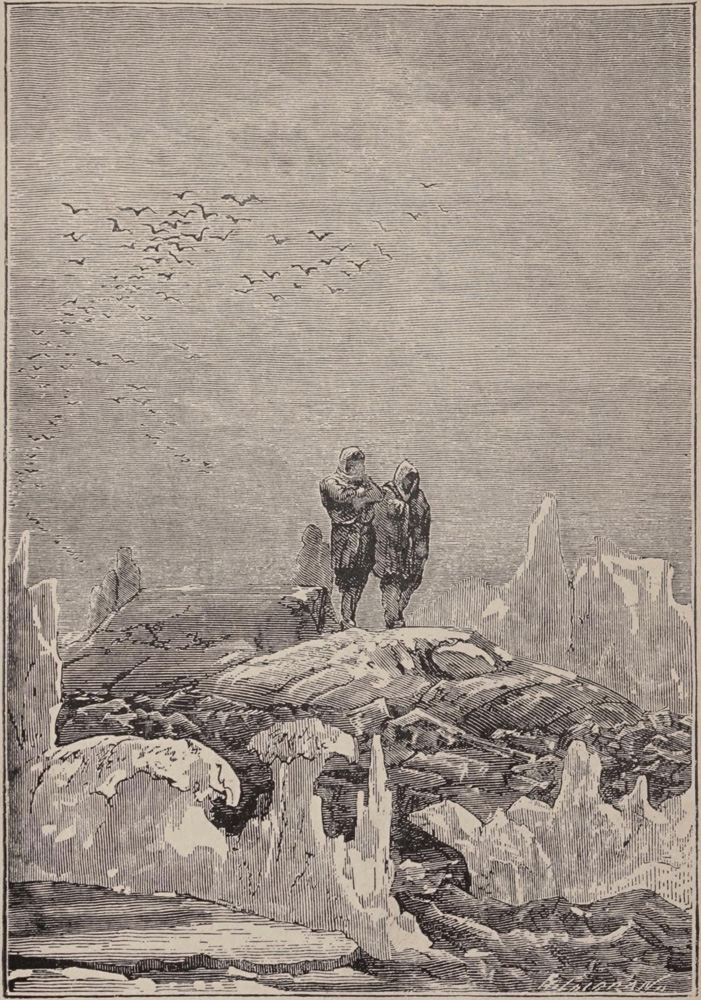
I knew that to Ned Land, as well as to all other navigators who had preceded us, this was an inevitable obstacle. The sun appearing for an instant at noon, Captain Nemo took an observation as near as possible, which gave our situation at 51° 30′ long. and 67° 39′ of S. lat. We had advanced one degree more in this Antarctic region. Of the liquid surface of the sea there was no longer a glimpse. Under the spur of the Nautilus lay stretched a vast plain, entangled with confused blocks. Here and there sharp points and slender needles rising to a height of 200 feet; further on a steep shore, hewn as it were with an axe and clothed with greyish tints; huge mirrors, reflecting a few rays of sunshine, half drowned in the fog. And over this desolate face of nature a stern silence reigned, scarcely broken by the flapping of the wings of petrels and puffins. Everything was frozen—even the noise. The Nautilus was then obliged to stop in its adventurous course amid these fields of ice. In spite of our efforts, in spite of the powerful means employed to break up the ice, the Nautilus remained immovable. Generally, when we can proceed no further, we have return still open to us; but here return was as impossible as advance, for every pass had closed behind us; and for the few moments when we were stationary, we were likely to be entirely blocked, which did indeed happen about two o’clock in the afternoon, the fresh ice forming around its sides with astonishing rapidity. I was obliged to admit that Captain Nemo was more than imprudent. I was on the platform at that moment. The Captain had been observing our situation for some time past, when he said to me:
I knew this was an unavoidable obstacle for Ned Land, as it had been for all navigators before us. The sun appeared for a moment at noon. Captain Nemo took as accurate a reading as he could. It placed us at 51° 30′ longitude and 67° 39′ south latitude. We had advanced another degree into the Antarctic region. No open water was visible anymore. Ahead of the Nautilus lay a vast plain covered with a jumble of ice blocks. Here and there, sharp peaks and slender spires rose 200 feet high. Farther on stood a steep, grayish wall of ice, as if cut with an axe. Huge mirrors of ice reflected a few rays of sunlight, almost lost in the fog. A stern silence ruled this desolate landscape, scarcely broken by the flapping wings of petrels and puffins. Everything was frozen, even the noise. The Nautilus had to stop its adventurous course among these fields of ice. Despite our efforts and the powerful means we used to break the ice, the Nautilus remained stuck. Usually, when we can go no farther, we can still turn back. But here, retreat was as impossible as advance. Every passage had closed behind us. Even during the few moments we stood still, we risked being completely trapped. That is exactly what happened at about two in the afternoon. New ice formed around the vessel's sides with astonishing speed. I had to admit that Captain Nemo was more than reckless. I was on the platform at that moment. The Captain had been studying our situation for some time when he said to me:
“Well, sir, what do you think of this?”
“Well, sir, what do you think of this?”
“I think that we are caught, Captain.”
“I think we're caught, Captain.”
“So, M. Aronnax, you really think that the Nautilus cannot disengage itself?”
“So, M. Aronnax, do you really think the Nautilus can't free itself?”
“With difficulty, Captain; for the season is already too far advanced for you to reckon on the breaking of the ice.”
“With difficulty, Captain, because the season is already too far advanced for you to count on the ice breaking up.”
“Ah! sir,” said Captain Nemo, in an ironical tone, “you will always be the same. You see nothing but difficulties and obstacles. I affirm that not only can the Nautilus disengage itself, but also that it can go further still.”
“Ah, sir,” said Captain Nemo ironically, “you never change. You see nothing but difficulties and obstacles. I assure you that the Nautilus can not only get free, but can go even farther.”
“Further to the South?” I asked, looking at the Captain.
“Farther south?” I asked, looking at the captain.
“Yes, sir; it shall go to the pole.”
“Yes, sir, it will go to the pole.”
“To the pole!” I exclaimed, unable to repress a gesture of incredulity.
“To the pole!” I exclaimed, unable to hide my disbelief.
“Yes,” replied the Captain, coldly, “to the Antarctic pole—to that unknown point from whence springs every meridian of the globe. You know whether I can do as I please with the Nautilus!”
“Yes,” replied the Captain coldly, “to the Antarctic pole, that unknown point where every meridian on the globe begins. You know whether I can do as I please with the Nautilus!”
Yes, I knew that. I knew that this man was bold, even to rashness. But to conquer those obstacles which bristled round the South Pole, rendering it more inaccessible than the North, which had not yet been reached by the boldest navigators—was it not a mad enterprise, one which only a maniac would have conceived? It then came into my head to ask Captain Nemo if he had ever discovered that pole which had never yet been trodden by a human creature?
Yes, I knew that. I knew this man was bold, even reckless. But the South Pole was surrounded by obstacles that made it even harder to reach than the North Pole. The boldest explorers had not yet reached the North Pole. Wasn't it madness to try to overcome those obstacles? Only a maniac could have thought of such a plan. Then I thought of asking Captain Nemo whether he had ever discovered the South Pole, where no human being had ever set foot.
“No, sir,” he replied; “but we will discover it together. Where others have failed, I will not fail. I have never yet led my Nautilus so far into southern seas; but, I repeat, it shall go further yet.”
“No, sir,” he replied. “But we will discover it together. Where others have failed, I will not fail. I have never taken my Nautilus this far into southern seas before. But I repeat, it will go even farther.”
“I can well believe you, Captain,” said I, in a slightly ironical tone. “I believe you! Let us go ahead! There are no obstacles for us! Let us smash this iceberg! Let us blow it up; and, if it resists, let us give the Nautilus wings to fly over it!”
“I can certainly believe you, Captain,” I said, with a hint of irony. “I believe you! Let's go ahead! Nothing can stop us! Let's smash this iceberg! Let's blow it up. And if it holds firm, let's give the Nautilus wings to fly over it!”
“Over it, sir!” said Captain Nemo, quietly; “no, not over it, but under it!”
“Over it, sir!” Captain Nemo said quietly. “No, not over it, but under it!”
“Under it!” I exclaimed, a sudden idea of the Captain’s projects flashing upon my mind. I understood; the wonderful qualities of the Nautilus were going to serve us in this superhuman enterprise.
“Under it!” I exclaimed, as the Captain’s plan suddenly flashed into my mind. I understood now. The Nautilus and its remarkable abilities would help us in this superhuman undertaking.
“I see we are beginning to understand one another, sir,” said the Captain, half smiling. “You begin to see the possibility—I should say the success—of this attempt. That which is impossible for an ordinary vessel is easy to the Nautilus. If a continent lies before the pole, it must stop before the continent; but if, on the contrary, the pole is washed by open sea, it will go even to the pole.”
“I see we're beginning to understand each other, sir,” said the Captain with a slight smile. “You're beginning to see that this attempt is possible. I should say you're beginning to see that it will succeed. What is impossible for an ordinary ship is easy for the Nautilus. If a continent lies before the pole, the Nautilus must stop at the continent. But if the pole is surrounded by open sea, the Nautilus will go all the way to the pole.”
“Certainly,” said I, carried away by the Captain’s reasoning; “if the surface of the sea is solidified by the ice, the lower depths are free by the Providential law which has placed the maximum of density of the waters of the ocean one degree higher than freezing-point; and, if I am not mistaken, the portion of this iceberg which is above the water is as one to four to that which is below.”
“Certainly,” I said, carried away by the Captain’s reasoning. “If the sea’s surface is frozen, the deeper water remains free of ice. This is because of the law of Providence that makes seawater densest one degree above its freezing point. And if I am not mistaken, for every part of this iceberg above the water, four parts are below it.”
“Very nearly, sir; for one foot of iceberg above the sea there are three below it. If these ice mountains are not more than 300 feet above the surface, they are not more than 900 beneath. And what are 900 feet to the Nautilus?”
“Very nearly, sir. For every foot of an iceberg above the sea, there are three feet below it. So if these ice mountains rise no more than 300 feet above the surface, they extend no more than 900 feet below it. And what are 900 feet to the Nautilus?”
“Nothing, sir.”
“Nothing, sir.”
“It could even seek at greater depths that uniform temperature of sea-water, and there brave with impunity the thirty or forty degrees of surface cold.”
“It could even go deeper, where the seawater stays at a constant temperature. There, it could safely withstand the thirty or forty degrees of cold at the surface.”
“Just so, sir—just so,” I replied, getting animated.
“Exactly, sir, exactly,” I replied, growing excited.
“The only difficulty,” continued Captain Nemo, “is that of remaining several days without renewing our provision of air.”
“The only difficulty,” Captain Nemo continued, “is going several days without replenishing our air supply.”
“Is that all? The Nautilus has vast reservoirs; we can fill them, and they will supply us with all the oxygen we want.”
“Is that all? The Nautilus has huge tanks. We can fill them, and they will supply all the oxygen we need.”
“Well thought of, M. Aronnax,” replied the Captain, smiling. “But, not wishing you to accuse me of rashness, I will first give you all my objections.”
“Good thinking, M. Aronnax,” replied the Captain, smiling. “But I don't want you to think I'm being reckless, so I'll first tell you all my objections.”
“Have you any more to make?”
“Do you have any more to make?”
“Only one. It is possible, if the sea exists at the South Pole, that it may be covered; and, consequently, we shall be unable to come to the surface.”
“Only one. If there is a sea at the South Pole, it may be covered. If so, we won't be able to come to the surface.”
“Good, sir! but do you forget that the Nautilus is armed with a powerful spur, and could we not send it diagonally against these fields of ice, which would open at the shocks.”
“Good, sir! But have you forgotten that the Nautilus has a powerful ram? Couldn't we drive it diagonally against these ice fields and break them open with the impacts?”
“Ah! sir, you are full of ideas to-day.”
“Ah, sir, you have so many ideas today.”
“Besides, Captain,” I added, enthusiastically, “why should we not find the sea open at the South Pole as well as at the North? The frozen poles of the earth do not coincide, either in the southern or in the northern regions; and, until it is proved to the contrary, we may suppose either a continent or an ocean free from ice at these two points of the globe.”
“Besides, Captain,” I added enthusiastically, “why shouldn’t we find open water at the South Pole, just as at the North Pole? The frozen poles do not coincide with the geographic poles in either the south or the north. So, until proven otherwise, we may suppose that either an ice-free continent or an ice-free ocean lies at each pole.”
“I think so too, M. Aronnax,” replied Captain Nemo. “I only wish you to observe that, after having made so many objections to my project, you are now crushing me with arguments in its favour!”
“I think so too, M. Aronnax,” replied Captain Nemo. “I just want to point out that you raised so many objections to my plan. And now you’re overwhelming me with arguments in its favor!”
The preparations for this audacious attempt now began. The powerful pumps of the Nautilus were working air into the reservoirs and storing it at high pressure. About four o’clock, Captain Nemo announced the closing of the panels on the platform. I threw one last look at the massive iceberg which we were going to cross. The weather was clear, the atmosphere pure enough, the cold very great, being 12° below zero; but, the wind having gone down, this temperature was not so unbearable. About ten men mounted the sides of the Nautilus, armed with pickaxes to break the ice around the vessel, which was soon free. The operation was quickly performed, for the fresh ice was still very thin. We all went below. The usual reservoirs were filled with the newly-liberated water, and the Nautilus soon descended. I had taken my place with Conseil in the saloon; through the open window we could see the lower beds of the Southern Ocean. The thermometer went up, the needle of the compass deviated on the dial. At about 900 feet, as Captain Nemo had foreseen, we were floating beneath the undulating bottom of the iceberg. But the Nautilus went lower still—it went to the depth of four hundred fathoms. The temperature of the water at the surface showed twelve degrees, it was now only ten; we had gained two. I need not say the temperature of the Nautilus was raised by its heating apparatus to a much higher degree; every manœuvre was accomplished with wonderful precision.
Preparations for this daring attempt now began. The powerful pumps of the Nautilus were pumping air into the reservoirs and storing it under high pressure. Around four o’clock, Captain Nemo announced that the panels on the platform were being closed. I took one last look at the massive iceberg we were going to cross. The weather was clear and the air quite pure. The cold was intense, at 12° below zero. But the wind had died down, so the temperature was not so unbearable. About ten men climbed onto the sides of the Nautilus, armed with pickaxes. They broke the ice around the vessel, and it was soon free. The work went quickly because the fresh ice was still very thin. We all went below. The usual reservoirs were filled with the water now freed from the ice, and the Nautilus soon descended. Conseil and I had taken our places in the saloon. Through the open window, we could see the depths of the Southern Ocean. The thermometer rose, and the compass needle moved on the dial. At about 900 feet, we were floating beneath the uneven bottom of the iceberg, just as Captain Nemo had predicted. But the Nautilus went lower still, to a depth of four hundred fathoms. The water temperature at the surface had been twelve degrees. Now it was only ten, a gain of two degrees. Needless to say, the heating system kept the Nautilus much warmer. Every maneuver was carried out with remarkable precision.
“We shall pass it, if you please, sir,” said Conseil.
“We'll pass it, if you please, sir,” said Conseil.
“I believe we shall,” I said, in a tone of firm conviction.
“I believe we will,” I said with firm conviction.
In this open sea, the Nautilus had taken its course direct to the pole, without leaving the fifty-second meridian. From 67° 30′ to 90 deg., twenty-two degrees and a half of latitude remained to travel; that is, about five hundred leagues. The Nautilus kept up a mean speed of twenty-six miles an hour—the speed of an express train. If that was kept up, in forty hours we should reach the pole.
In the open sea, the Nautilus headed straight for the pole, staying on the fifty-second meridian. From 67° 30′ to 90°, we still had twenty-two and a half degrees of latitude to cover. That was about five hundred leagues. The Nautilus maintained an average speed of twenty-six miles an hour, as fast as an express train. If it kept up that speed, we would reach the pole in forty hours.
For a part of the night the novelty of the situation kept us at the window. The sea was lit with the electric lantern; but it was deserted; fishes did not sojourn in these imprisoned waters; they only found there a passage to take them from the Antarctic Ocean to the open polar sea. Our pace was rapid; we could feel it by the quivering of the long steel body. About two in the morning I took some hours’ repose, and Conseil did the same. In crossing the waist I did not meet Captain Nemo: I supposed him to be in the pilot’s cage. The next morning, the 19th of March, I took my post once more in the saloon. The electric log told me that the speed of the Nautilus had been slackened. It was then going towards the surface; but prudently emptying its reservoirs very slowly. My heart beat fast. Were we going to emerge and regain the open polar atmosphere? No! A shock told me that the Nautilus had struck the bottom of the iceberg, still very thick, judging from the deadened sound. We had in deed “struck,” to use a sea expression, but in an inverse sense, and at a thousand feet deep. This would give three thousand feet of ice above us; one thousand being above the water-mark. The iceberg was then higher than at its borders—not a very reassuring fact. Several times that day the Nautilus tried again, and every time it struck the wall which lay like a ceiling above it. Sometimes it met with but 900 yards, only 200 of which rose above the surface. It was twice the height it was when the Nautilus had gone under the waves. I carefully noted the different depths, and thus obtained a submarine profile of the chain as it was developed under the water. That night no change had taken place in our situation. Still ice between four and five hundred yards in depth! It was evidently diminishing, but, still, what a thickness between us and the surface of the ocean! It was then eight. According to the daily custom on board the Nautilus, its air should have been renewed four hours ago; but I did not suffer much, although Captain Nemo had not yet made any demand upon his reserve of oxygen. My sleep was painful that night; hope and fear besieged me by turns: I rose several times. The groping of the Nautilus continued. About three in the morning, I noticed that the lower surface of the iceberg was only about fifty feet deep. One hundred and fifty feet now separated us from the surface of the waters. The iceberg was by degrees becoming an ice-field, the mountain a plain. My eyes never left the manometer. We were still rising diagonally to the surface, which sparkled under the electric rays. The iceberg was stretching both above and beneath into lengthening slopes; mile after mile it was getting thinner. At length, at six in the morning of that memorable day, the 19th of March, the door of the saloon opened, and Captain Nemo appeared.
For part of the night, the novelty of our situation kept us at the window. The electric lantern lit the sea, but the waters were deserted. Fish did not linger in these enclosed waters. They used them only as a passage from the Antarctic Ocean to the open polar sea. We were moving fast. We could feel it in the trembling of the long steel hull. Around two in the morning, I rested for a few hours, and Conseil did the same. As I crossed the middle of the vessel, I did not see Captain Nemo. I assumed he was in the pilot’s cage. The next morning, March 19, I returned to my place in the saloon. The electric log showed me that the Nautilus had slowed down. It was heading toward the surface, but it was carefully emptying its reservoirs very slowly. My heart beat fast. Were we going to emerge and reach the open air above the polar sea? No! A jolt told me that the Nautilus had struck the underside of the iceberg. Judging by the muffled sound, the ice was still very thick. We had indeed “struck,” to use a sailor’s expression, but in the opposite direction and a thousand feet down. That meant there were three thousand feet of ice above us, including one thousand feet above the waterline. The iceberg was higher here than at its edges, which was not very reassuring. Several times that day, the Nautilus tried again. Each time, it struck the wall of ice that lay above it like a ceiling. Sometimes the ice was only 900 yards thick, with just 200 yards rising above the surface. That was twice the height of the ice when the Nautilus had gone beneath the waves. I carefully recorded the different depths. In this way, I obtained a profile of the underwater extent of the ice chain. That night, our situation had not changed. There were still between four and five hundred yards of ice above us! The ice was clearly getting thinner, but what a thickness still separated us from the ocean’s surface! It was then eight o’clock. According to the daily routine aboard the Nautilus, its air should have been renewed four hours earlier. But I did not suffer much, although Captain Nemo had not yet drawn on his oxygen reserve. I slept badly that night, as hope and fear took turns besieging me. I got up several times. The Nautilus continued to feel its way forward. Around three in the morning, I noticed that the underside of the iceberg was only about fifty feet deep. One hundred and fifty feet now separated us from the surface of the water. The iceberg was gradually becoming an ice field, the mountain a plain. My eyes never left the pressure gauge. We were still rising diagonally toward the surface, which sparkled in the electric light. The iceberg stretched out in long slopes above and below. Mile after mile, it grew thinner. At last, at six in the morning of that memorable day, March 19, the saloon door opened. Captain Nemo appeared.
“The sea is open!” was all he said.
“The sea is open!” was all he said.