Part 1, Chapter 13
The Black River
The portion of the terrestrial globe which is covered by water is estimated at upwards of eighty millions of acres. This fluid mass comprises two billions two hundred and fifty millions of cubic miles, forming a spherical body of a diameter of sixty leagues, the weight of which would be three quintillions of tons. To comprehend the meaning of these figures, it is necessary to observe that a quintillion is to a billion as a billion is to unity; in other words, there are as many billions in a quintillion as there are units in a billion. This mass of fluid is equal to about the quantity of water which would be discharged by all the rivers of the earth in forty thousand years.
The part of the globe covered by water is estimated at more than eighty million acres. This mass of water amounts to two billion two hundred and fifty million cubic miles. It would form a sphere sixty leagues in diameter, weighing three quintillion tons. To understand these figures, a quintillion is to a billion as a billion is to one. In other words, a quintillion contains as many billions as a billion contains individual units. This mass equals roughly the amount of water all the rivers on earth would discharge in forty thousand years.
During the geological epochs, the igneous period succeeded to the aqeous. The ocean originally prevailed everywhere. Then by degrees, in the silurian period, the tops of the mountains began to appear, the islands emerged, then disappeared in partial deluges, reappeared, became settled, formed continents, till at length the earth became geographically arranged, as we see in the present day. The solid had wrested from the liquid thirty-seven million six hundred and fifty-seven square miles, equal to twelve billion nine hundred and sixty millions of acres.
During the geological ages, the fiery period followed the watery one. At first, the ocean covered everything. Then, gradually, during the Silurian period, mountain peaks began to appear. Islands emerged, then disappeared in partial floods. They reappeared, became permanent, and formed continents. At last, the earth took the geographical shape we see today. Land had claimed 37,657,000 square miles from the sea, equal to 12,960,000,000 acres.
The shape of continents allows us to divide the waters into five great portions: the Arctic or Frozen Ocean, the Antarctic or Frozen Ocean, the Indian, the Atlantic, and the Pacific Oceans.
The shape of the continents lets us divide the waters into five great oceans. These are the Arctic or Frozen Ocean, the Antarctic or Frozen Ocean, the Indian Ocean, the Atlantic Ocean, and the Pacific Ocean.
The Pacific Ocean extends from north to south between the two polar circles, and from east to west between Asia and America, over an extent of 145 degrees of longitude. It is the quietest of seas; its currents are broad and slow, it has medium tides, and abundant rain. Such was the ocean that my fate destined me first to travel over under these strange conditions.
The Pacific Ocean stretches north to south between the polar circles and east to west between Asia and America. It spans 145 degrees of longitude. It is the calmest of seas, with broad, slow currents, moderate tides, and abundant rain. Fate had chosen this ocean as the first I would travel across under these strange conditions.
“Sir,” said Captain Nemo, “we will, if you please, take our bearings and fix the starting-point of this voyage. It is a quarter to twelve; I will go up again to the surface.”
“Sir,” said Captain Nemo, “if you please, we will take our bearings and establish the starting point of this voyage. It is a quarter to twelve. I will go back up to the surface.”
The Captain pressed an electric clock three times. The pumps began to drive the water from the tanks; the needle of the manometer marked by a different pressure the ascent of the Nautilus, then it stopped.
The Captain pressed an electric clock three times. The pumps began to force water from the tanks. The pressure gauge showed a change in pressure as the Nautilus rose, then the needle stopped.
“We have arrived,” said the Captain.
“We’ve arrived,” said the Captain.
I went to the central staircase which opened on to the platform, clambered up the iron steps, and found myself on the upper part of the Nautilus.
I went to the central staircase leading to the platform. I climbed the iron steps and reached the upper part of the Nautilus.
The platform was only three feet out of water. The front and back of the Nautilus was of that spindle-shape which caused it justly to be compared to a cigar. I noticed that its iron plates, slightly overlaying each other, resembled the shell which clothes the bodies of our large terrestrial reptiles. It explained to me how natural it was, in spite of all glasses, that this boat should have been taken for a marine animal.
The platform rose only three feet above the water. The front and back of the Nautilus tapered to a point, making it look like a cigar. I noticed that its slightly overlapping iron plates resembled the scales covering the bodies of large land reptiles. This explained why people had naturally mistaken the boat for a sea animal, despite all their use of telescopes.
Toward the middle of the platform the long-boat, half buried in the hull of the vessel, formed a slight excrescence. Fore and aft rose two cages of medium height with inclined sides, and partly closed by thick lenticular glasses; one destined for the steersman who directed the Nautilus, the other containing a brilliant lantern to give light on the road.
Near the middle of the platform, the longboat was half buried in the vessel’s hull, forming a slight bulge. Two medium-height enclosures rose at the front and rear. They had sloping sides and were partly covered by thick, lens-shaped glass. One was for the helmsman who steered the Nautilus. The other held a brilliant lantern to light the way.
The sea was beautiful, the sky pure. Scarcely could the long vehicle feel the broad undulations of the ocean. A light breeze from the east rippled the surface of the waters. The horizon, free from fog, made observation easy. Nothing was in sight. Not a quicksand, not an island. A vast desert.
The sea was beautiful, and the sky was clear. The long vessel could hardly feel the ocean’s broad swells. A light breeze from the east rippled the water’s surface. The horizon was free of fog, making it easy to see. Nothing was in sight. Not a sandbank, not an island. A vast desert.
Captain Nemo, by the help of his sextant, took the altitude of the sun, which ought also to give the latitude. He waited for some moments till its disc touched the horizon. Whilst taking observations not a muscle moved, the instrument could not have been more motionless in a hand of marble.
Captain Nemo used his sextant to measure the sun’s altitude, which should also give him the latitude. He waited a few moments until the sun’s disc touched the horizon. As he took his measurements, not a muscle moved. The instrument could not have been steadier in a hand made of marble.
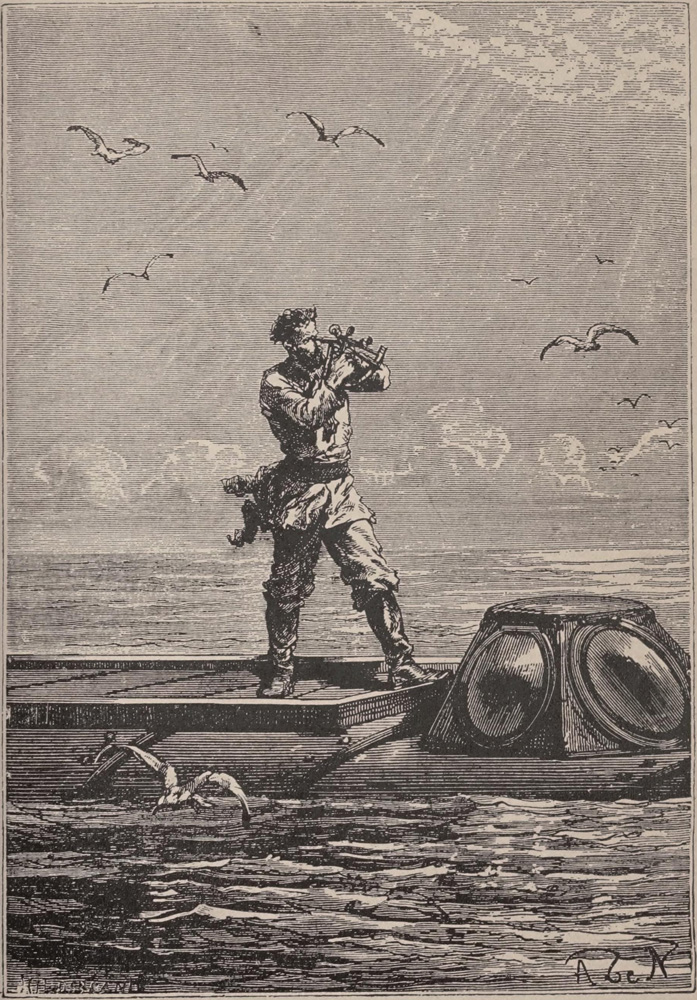
“Twelve o’clock, sir,” said he. “When you like——”
“Twelve o’clock, sir,” he said. “Whenever you like...”
I cast a last look upon the sea, slightly yellowed by the Japanese coast, and descended to the saloon.
I took one last look at the sea, slightly yellowed by the Japanese coast, then went down to the saloon.
“And now, sir, I leave you to your studies,” added the Captain; “our course is E.N.E., our depth is twenty-six fathoms. Here are maps on a large scale by which you may follow it. The saloon is at your disposal, and with your permission, I will retire.” Captain Nemo bowed, and I remained alone, lost in thoughts all bearing on the commander of the Nautilus.
“And now, sir, I’ll leave you to your studies,” the Captain added. “Our course is east-northeast, and our depth is twenty-six fathoms. Here are detailed maps you can use to follow our course. The saloon is at your disposal, and with your permission, I’ll leave you.” Captain Nemo bowed. I was left alone, lost in thoughts about the commander of the Nautilus.
For a whole hour was I deep in these reflections, seeking to pierce this mystery so interesting to me. Then my eyes fell upon the vast planisphere spread upon the table, and I placed my finger on the very spot where the given latitude and longitude crossed.
For a whole hour, I was lost in thought, trying to solve the mystery that so intrigued me. Then I noticed the large world map spread out on the table. I placed my finger on the exact spot where the given latitude and longitude crossed.
The sea has its large rivers like the continents. They are special currents known by their temperature and their colour. The most remarkable of these is known by the name of the Gulf Stream. Science has decided on the globe the direction of five principal currents: one in the North Atlantic, a second in the South, a third in the North Pacific, a fourth in the South, and a fifth in the Southern Indian Ocean. It is even probable that a sixth current existed at one time or another in the Northern Indian Ocean, when the Caspian and Aral Seas formed but one vast sheet of water.
The sea has great rivers, just as the continents do. These are special currents, distinguished by their temperature and color. The most remarkable is known as the Gulf Stream. Scientists have mapped the paths of five major currents around the globe. One is in the North Atlantic, another in the South Atlantic, a third in the North Pacific, a fourth in the South Pacific, and a fifth in the Southern Indian Ocean. A sixth current probably existed at some point in the Northern Indian Ocean, when the Caspian and Aral Seas formed one vast body of water.
At this point indicated on the planisphere one of these currents was rolling, the Kuro-Scivo of the Japanese, the Black River, which, leaving the Gulf of Bengal, where it is warmed by the perpendicular rays of a tropical sun, crosses the Straits of Malacca along the coast of Asia, turns into the North Pacific to the Aleutian Islands, carrying with it trunks of camphor-trees and other indigenous productions, and edging the waves of the ocean with the pure indigo of its warm water. It was this current that the Nautilus was to follow. I followed it with my eye; saw it lose itself in the vastness of the Pacific, and felt myself drawn with it, when Ned Land and Conseil appeared at the door of the saloon.
At the point marked on the map, one of these currents was flowing. The Japanese called it the Kuro-Scivo, or Black River. It leaves the Gulf of Bengal, where the direct rays of the tropical sun warm it. It crosses the Straits of Malacca along the coast of Asia. Then it turns into the North Pacific and flows toward the Aleutian Islands. It carries camphor-tree trunks and other native products with it. Its warm waters edge the ocean waves with pure indigo. The Nautilus was to follow this current. I traced it with my eyes and saw it disappear into the vast Pacific. I felt myself drawn along with it, when Ned Land and Conseil appeared at the saloon door.
My two brave companions remained petrified at the sight of the wonders spread before them.
My two brave companions stood frozen at the sight of the wonders before them.
“Where are we, where are we?” exclaimed the Canadian. “In the museum at Quebec?”
“Where are we? Where are we?” cried the Canadian. “Are we in the museum in Quebec?”
“My friends,” I answered, making a sign for them to enter, “you are not in Canada, but on board the Nautilus, fifty yards below the level of the sea.”
“My friends,” I replied, signaling for them to enter, “you are not in Canada. You are aboard the Nautilus, fifty yards below the surface of the sea.”
“But, M. Aronnax,” said Ned Land, “can you tell me how many men there are on board? Ten, twenty, fifty, a hundred?”
“But, M. Aronnax,” said Ned Land, “can you tell me how many men are on board? Ten, twenty, fifty, a hundred?”
“I cannot answer you, Mr. Land; it is better to abandon for a time all idea of seizing the Nautilus or escaping from it. This ship is a masterpiece of modern industry, and I should be sorry not to have seen it. Many people would accept the situation forced upon us, if only to move amongst such wonders. So be quiet and let us try and see what passes around us.”
“I cannot answer you, Mr. Land. For now, it is better to give up all thought of seizing the Nautilus or escaping from it. This ship is a masterpiece of modern industry, and I would have been sorry to miss seeing it. Many people would accept the situation forced on us, if only to experience such wonders. So be patient, and let us try to see what happens around us.”
“See!” exclaimed the harpooner, “but we can see nothing in this iron prison! We are walking—we are sailing—blindly.”
“See!” cried the harpooner. “But we can’t see anything in this iron prison! We’re walking, we’re sailing blindly.”
Ned Land had scarcely pronounced these words when all was suddenly darkness. The luminous ceiling was gone, and so rapidly that my eyes received a painful impression.
Ned Land had hardly finished speaking when everything suddenly went dark. The glowing ceiling vanished so quickly that it hurt my eyes.
We remained mute, not stirring, and not knowing what surprise awaited us, whether agreeable or disagreeable. A sliding noise was heard: one would have said that panels were working at the sides of the Nautilus.
We stayed silent and still, not knowing what surprise awaited us or whether it would be pleasant or unpleasant. We heard a sliding noise. It sounded as if panels were moving along the sides of the Nautilus.
“It is the end of the end!” said Ned Land.
“This is the very end!” said Ned Land.
Suddenly light broke at each side of the saloon, through two oblong openings. The liquid mass appeared vividly lit up by the electric gleam. Two crystal plates separated us from the sea. At first I trembled at the thought that this frail partition might break, but strong bands of copper bound them, giving an almost infinite power of resistance.
Suddenly, light appeared through two rectangular openings on either side of the saloon. The electric light illuminated the water vividly. Two glass plates separated us from the sea. At first, I trembled at the thought that this fragile barrier might break. But strong copper bands held the plates in place, giving them almost infinite strength.
The sea was distinctly visible for a mile all round the Nautilus. What a spectacle! What pen can describe it? Who could paint the effects of the light through those transparent sheets of water, and the softness of the successive graduations from the lower to the superior strata of the ocean?
The sea was clearly visible for a mile all around the Nautilus. What a sight! What writer could describe it? Who could paint the effects of light through those clear layers of water? Who could capture the gentle changes from the ocean’s lower layers to its upper ones?
We know the transparency of the sea and that its clearness is far beyond that of rock-water. The mineral and organic substances which it holds in suspension heightens its transparency. In certain parts of the ocean at the Antilles, under seventy-five fathoms of water, can be seen with surprising clearness a bed of sand. The penetrating power of the solar rays does not seem to cease for a depth of one hundred and fifty fathoms. But in this middle fluid travelled over by the Nautilus, the electric brightness was produced even in the bosom of the waves. It was no longer luminous water, but liquid light.
We know that seawater is clear, far clearer than spring water. The mineral and organic substances suspended in it make it even clearer. In parts of the ocean near the Antilles, a sandy seabed can be seen with surprising clarity through seventy-five fathoms of water. The sun’s rays seem to reach as deep as one hundred and fifty fathoms. But in the water through which the Nautilus traveled, electric light shone from within the waves themselves. It was no longer luminous water, but liquid light.
On each side a window opened into this unexplored abyss. The obscurity of the saloon showed to advantage the brightness outside, and we looked out as if this pure crystal had been the glass of an immense aquarium.
On each side, a window looked out into the unexplored depths. The darkness of the saloon made the brightness outside stand out. We looked out as if the clear crystal were the glass of an immense aquarium.
“You wished to see, friend Ned; well, you see now.”
“You wanted to see, my friend Ned. Well, now you can see.”
“Curious! curious!” muttered the Canadian, who, forgetting his ill-temper, seemed to submit to some irresistible attraction; “and one would come further than this to admire such a sight!”
“Curious! Curious!” muttered the Canadian. He forgot his bad temper and seemed drawn in by an irresistible attraction. “And one would travel farther than this to admire such a sight!”
“Ah!” thought I to myself, “I understand the life of this man; he has made a world apart for himself, in which he treasures all his greatest wonders.”
“Ah!” I thought, “I understand this man's life. He has made a world of his own, where he treasures all his greatest wonders.”
For two whole hours an aquatic army escorted the Nautilus. During their games, their bounds, while rivalling each other in beauty, brightness, and velocity, I distinguished the green labre; the banded mullet, marked by a double line of black; the round-tailed goby, of a white colour, with violet spots on the back; the Japanese scombrus, a beautiful mackerel of those seas, with a blue body and silvery head; the brilliant azurors, whose name alone defies description; some banded spares, with variegated fins of blue and yellow; the woodcocks of the seas, some specimens of which attain a yard in length; Japanese salamanders, spider lampreys, serpents six feet long, with eyes small and lively, and a huge mouth bristling with teeth; with many other species.
For two whole hours, an aquatic army escorted the Nautilus. As the creatures played and leaped, they competed in beauty, brightness, and speed. I spotted the green labre and the banded mullet, marked by a double black line. There was the white, round-tailed goby, with violet spots on its back. I also saw the Japanese scombrus, a beautiful mackerel of those seas, with a blue body and silvery head. There were brilliant azurors, whose name alone defies description, and banded spares with blue and yellow fins. I saw woodcocks of the sea, some of which grow to a yard long. There were also Japanese salamanders, spider lampreys, and serpents six feet long, with small, lively eyes and huge mouths bristling with teeth. Many other species were there as well.
Our imagination was kept at its height, interjections followed quickly on each other. Ned named the fish, and Conseil classed them. I was in ecstasies with the vivacity of their movements and the beauty of their forms. Never had it been given to me to surprise these animals, alive and at liberty, in their natural element. I will not mention all the varieties which passed before my dazzled eyes, all the collection of the seas of China and Japan. These fish, more numerous than the birds of the air, came, attracted, no doubt, by the brilliant focus of the electric light.
Our excitement stayed at its peak, and we exclaimed one after another. Ned named the fish, and Conseil classified them. I was delighted by their lively movements and beautiful shapes. I had never before been able to observe these creatures alive and free in their natural habitat. I will not mention every variety that passed before my dazzled eyes, the whole collection of fish from the seas of China and Japan. These fish were more numerous than the birds in the sky. They came, no doubt drawn by the brilliant beam of electric light.
Suddenly there was daylight in the saloon, the iron panels closed again, and the enchanting vision disappeared. But for a long time I dreamt on till my eyes fell on the instruments hanging on the partition. The compass still showed the course to be N.N.E., the manometer indicated a pressure of five atmospheres, equivalent to a depth of twenty-five fathoms, and the electric log gave a speed of fifteen miles an hour. I expected Captain Nemo, but he did not appear. The clock marked the hour of five.
Suddenly, daylight filled the saloon. The iron panels closed again, and the enchanting vision disappeared. But I remained lost in thought for a long time, until my eyes fell on the instruments hanging on the partition. The compass still showed a course of N.N.E. The pressure gauge showed five atmospheres, equivalent to a depth of twenty-five fathoms. The electric log showed a speed of fifteen miles an hour. I expected Captain Nemo, but he did not appear. The clock showed five o'clock.
Ned Land and Conseil returned to their cabin, and I retired to my chamber. My dinner was ready. It was composed of turtle soup made of the most delicate hawksbills, of a surmullet served with puff paste (the liver of which, prepared by itself, was most delicious), and fillets of the emperor-holocanthus, the savour of which seemed to me superior even to salmon.
Ned Land and Conseil returned to their cabin, and I went to my room. My dinner was ready. It consisted of turtle soup made from the most delicate hawksbills, surmullet served with puff pastry, and emperor-holocanthus fillets. The surmullet’s liver was prepared separately and was delicious. The emperor-holocanthus tasted even better than salmon to me.
I passed the evening reading, writing, and thinking. Then sleep overpowered me, and I stretched myself on my couch of zostera, and slept profoundly, whilst the Nautilus was gliding rapidly through the current of the Black River.
I spent the evening reading, writing, and thinking. Then sleep overcame me, and I stretched out on my zostera couch. I slept deeply as the Nautilus glided swiftly through the current of the Black River.