Part 2, Chapter 10
The Underwater Coal Mines
The next day, the 20th of February, I awoke very late: the fatigues of the previous night had prolonged my sleep until eleven o’clock. I dressed quickly, and hastened to find the course the Nautilus was taking. The instruments showed it to be still toward the south, with a speed of twenty miles an hour and a depth of fifty fathoms.
The next day, February 20, I woke up very late. The previous night’s exertions had kept me asleep until eleven o’clock. I dressed quickly and hurried to check the course of the Nautilus. The instruments showed that it was still heading south, at twenty miles an hour and fifty fathoms below the surface.
The species of fishes here did not differ much from those already noticed. There were rays of giant size, five yards long, and endowed with great muscular strength, which enabled them to shoot above the waves; sharks of many kinds; amongst others, one fifteen feet long, with triangular sharp teeth, and whose transparency rendered it almost invisible in the water.
The fish here were much like those we had already seen. There were giant rays, five yards long. Their powerful muscles enabled them to shoot above the waves. There were also many kinds of sharks. One was fifteen feet long, with sharp, triangular teeth. Its transparency made it almost invisible in the water.
Amongst bony fish Conseil noticed some about three yards long, armed at the upper jaw with a piercing sword; other bright-coloured creatures, known in the time of Aristotle by the name of the sea-dragon, which are dangerous to capture on account of the spikes on their back.
Among the bony fish, Conseil noticed some about three yards long, with a sharp sword on the upper jaw. He also noticed brightly colored creatures known as sea-dragons in Aristotle’s time. They were dangerous to catch because of the spikes on their backs.
About four o’clock, the soil, generally composed of a thick mud mixed with petrified wood, changed by degrees, and it became more stony, and seemed strewn with conglomerate and pieces of basalt, with a sprinkling of lava. I thought that a mountainous region was succeeding the long plains; and accordingly, after a few evolutions of the Nautilus, I saw the southerly horizon blocked by a high wall which seemed to close all exit. Its summit evidently passed the level of the ocean. It must be a continent, or at least an island—one of the Canaries, or of the Cape Verde Islands. The bearings not being yet taken, perhaps designedly, I was ignorant of our exact position. In any case, such a wall seemed to me to mark the limits of that Atlantis, of which we had in reality passed over only the smallest part.
Around four o’clock, the seabed gradually changed. It had generally been thick mud mixed with petrified wood, but now it grew stonier. It seemed scattered with conglomerate and pieces of basalt, with a sprinkling of lava. I thought a mountainous region was replacing the long plains. After the Nautilus made a few maneuvers, I saw a high wall blocking the southern horizon. It seemed to close off every exit. Its summit clearly rose above the surface of the ocean. It must be a continent, or at least an island, one of the Canaries or the Cape Verde Islands. Our bearings had not yet been taken, perhaps deliberately, so I did not know our exact position. In any case, the wall seemed to mark the limits of Atlantis. We had in fact crossed only the smallest part of it.
Much longer should I have remained at the window admiring the beauties of sea and sky, but the panels closed. At this moment the Nautilus arrived at the side of this high, perpendicular wall. What it would do, I could not guess. I returned to my room; it no longer moved. I laid myself down with the full intention of waking after a few hours’ sleep; but it was eight o’clock the next day when I entered the saloon. I looked at the manometer. It told me that the Nautilus was floating on the surface of the ocean. Besides, I heard steps on the platform. I went to the panel. It was open; but, instead of broad daylight, as I expected, I was surrounded by profound darkness. Where were we? Was I mistaken? Was it still night? No; not a star was shining and night has not that utter darkness.
I would have stayed at the window much longer, admiring the beauty of the sea and sky, but the panels closed. Just then, the Nautilus reached the side of the high, vertical wall. I could not guess what it would do. I returned to my room. The Nautilus had stopped moving. I lay down, fully intending to wake after a few hours of sleep. But it was eight o’clock the next day when I entered the saloon. I looked at the manometer. It showed that the Nautilus was floating on the ocean’s surface. I could also hear footsteps on the platform. I went to the hatch. It was open, but instead of the daylight I expected, I found myself surrounded by deep darkness. Where were we? Was I mistaken? Was it still night? No, not a single star was shining, and night is never so completely dark.
I knew not what to think, when a voice near me said:
I didn't know what to think when a voice near me said:
“Is that you, Professor?”
“Is that you, Professor?”
“Ah! Captain,” I answered, “where are we?”
“Ah, Captain,” I replied, “where are we?”
“Underground, sir.”
“Underground, sir.”
“Underground!” I exclaimed. “And the Nautilus floating still?”
“Underground!” I exclaimed. “And the Nautilus is still floating?”
“It always floats.”
“It always floats.”
“But I do not understand.”
“But I don't understand.”
“Wait a few minutes, our lantern will be lit, and, if you like light places, you will be satisfied.”
“Wait a few minutes. Our lantern will be lit, and if you like bright places, you'll be satisfied.”
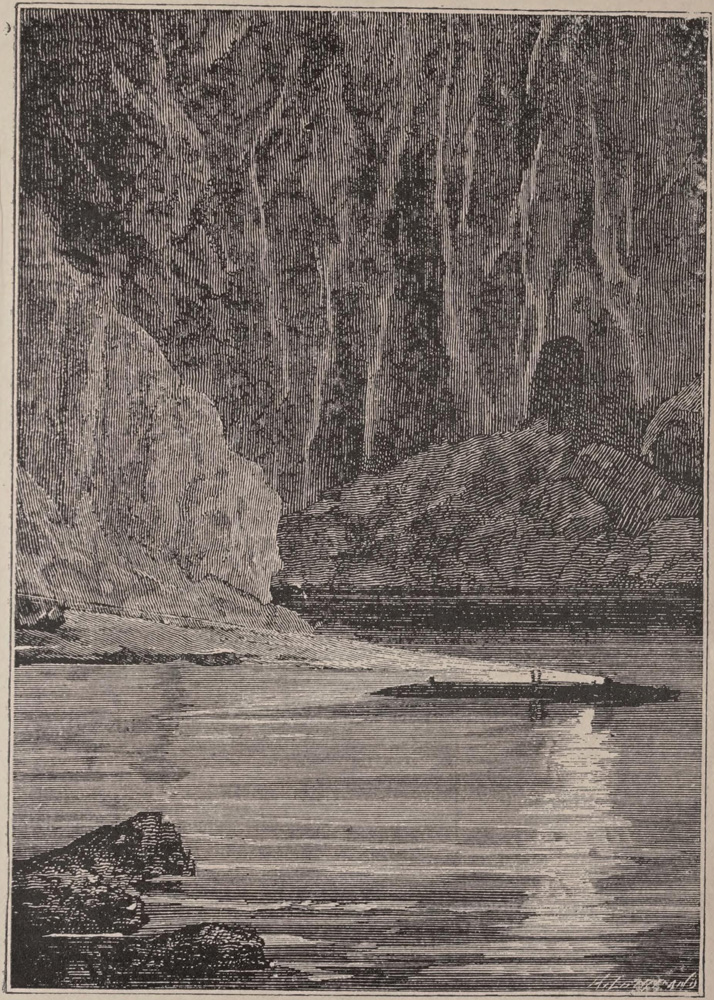
I stood on the platform and waited. The darkness was so complete that I could not even see Captain Nemo; but, looking to the zenith, exactly above my head, I seemed to catch an undecided gleam, a kind of twilight filling a circular hole. At this instant the lantern was lit, and its vividness dispelled the faint light. I closed my dazzled eyes for an instant, and then looked again. The Nautilus was stationary, floating near a mountain which formed a sort of quay. The lake, then, supporting it was a lake imprisoned by a circle of walls, measuring two miles in diameter and six in circumference. Its level (the manometer showed) could only be the same as the outside level, for there must necessarily be a communication between the lake and the sea. The high partitions, leaning forward on their base, grew into a vaulted roof bearing the shape of an immense funnel turned upside down, the height being about five or six hundred yards. At the summit was a circular orifice, by which I had caught the slight gleam of light, evidently daylight.
I stood on the platform and waited. The darkness was so complete that I could not even see Captain Nemo. But when I looked straight up, I seemed to see a faint, uncertain glow, like twilight, filling a circular opening. At that moment, the lantern was lit, and its brilliant light swept away the faint glow. I closed my dazzled eyes for a moment, then looked again. The Nautilus was stationary, floating near a mountain that formed a kind of dock. The lake supporting it was enclosed by a circle of walls. It measured two miles across and six miles around. The manometer showed that the lake could only be at the same level as the sea outside. There must therefore be a connection between the lake and the sea. The high walls sloped inward from their bases, forming a vaulted roof shaped like a huge upside-down funnel. It was about five or six hundred yards high. At the top was the circular opening where I had seen the faint glow, evidently daylight.
“Where are we?” I asked.
“Where are we?” I asked.
“In the very heart of an extinct volcano, the interior of which has been invaded by the sea, after some great convulsion of the earth. Whilst you were sleeping, Professor, the Nautilus penetrated to this lagoon by a natural canal, which opens about ten yards beneath the surface of the ocean. This is its harbour of refuge, a sure, commodious, and mysterious one, sheltered from all gales. Show me, if you can, on the coasts of any of your continents or islands, a road which can give such perfect refuge from all storms.”
“In the very heart of an extinct volcano, which the sea flooded after some great upheaval of the earth. While you were sleeping, Professor, the Nautilus entered this lagoon through a natural channel. It opens about ten yards below the surface of the ocean. This is its harbor of refuge, a safe, spacious, and mysterious place, sheltered from all gales. Show me, if you can, an anchorage on any of your continents or islands that offers such perfect shelter from all storms.”
“Certainly,” I replied, “you are in safety here, Captain Nemo. Who could reach you in the heart of a volcano? But did I not see an opening at its summit?”
“Of course,” I replied, “you’re safe here, Captain Nemo. Who could reach you inside a volcano? But didn’t I see an opening at the top?”
“Yes; its crater, formerly filled with lava, vapour, and flames, and which now gives entrance to the life-giving air we breathe.”
“Yes. Its crater was once filled with lava, vapor, and flames. Now it lets in the life-giving air we breathe.”
“But what is this volcanic mountain?”
“But what is this volcanic mountain?”
“It belongs to one of the numerous islands with which this sea is strewn—to vessels a simple sandbank—to us an immense cavern. Chance led me to discover it, and chance served me well.”
“It belongs to one of the many islands scattered across this sea. To ships, the island is just a sandbank. To us, it is an immense cavern. I discovered it by chance, and chance served me well.”
“But of what use is this refuge, Captain? The Nautilus wants no port.”
“But what use is this refuge, Captain? The Nautilus doesn't need a port.”
“No, sir; but it wants electricity to make it move, and the wherewithal to make the electricity—sodium to feed the elements, coal from which to get the sodium, and a coal-mine to supply the coal. And exactly on this spot the sea covers entire forests embedded during the geological periods, now mineralised and transformed into coal; for me they are an inexhaustible mine.”
“No, sir, but it needs electricity to move, and the means to produce that electricity. I need sodium to power the cells, coal to extract the sodium from, and a coal mine to supply the coal. And right here, beneath the sea, lie entire forests buried during past geological periods. They have mineralized and turned into coal. For me, they are an inexhaustible mine.”
“Your men follow the trade of miners here, then, Captain?”
“So your men work as miners here, Captain?”
“Exactly so. These mines extend under the waves like the mines of Newcastle. Here, in their diving-dresses, pick axe and shovel in hand, my men extract the coal, which I do not even ask from the mines of the earth. When I burn this combustible for the manufacture of sodium, the smoke, escaping from the crater of the mountain, gives it the appearance of a still-active volcano.”
“Exactly. These mines extend beneath the sea, like the mines of Newcastle. Here, my men wear diving suits and use picks and shovels to extract coal. I do not even need to get coal from mines on land. When I burn the coal to make sodium, smoke escapes from the mountain’s crater. This makes the mountain look like an active volcano.”
“And we shall see your companions at work?”
“And will we see your companions at work?”
“No; not this time at least; for I am in a hurry to continue our submarine tour of the earth. So I shall content myself with drawing from the reserve of sodium I already possess. The time for loading is one day only, and we continue our voyage. So, if you wish to go over the cavern and make the round of the lagoon, you must take advantage of to-day, M. Aronnax.”
“No, not this time at least. I’m eager to continue our underwater journey around the world. So I’ll make do with the sodium I already have in reserve. Loading will take only one day, and then we’ll continue our voyage. So, if you want to explore the cavern and go around the lagoon, you must do it today, M. Aronnax.”
I thanked the Captain and went to look for my companions, who had not yet left their cabin. I invited them to follow me without saying where we were. They mounted the platform. Conseil, who was astonished at nothing, seemed to look upon it as quite natural that he should wake under a mountain, after having fallen asleep under the waves. But Ned Land thought of nothing but finding whether the cavern had any exit. After breakfast, about ten o’clock, we went down on to the mountain.
I thanked the Captain and went to find my companions, who had not yet left their cabin. I asked them to follow me without telling them where we were. They climbed onto the platform. Nothing ever surprised Conseil. He seemed to think it perfectly natural to wake up under a mountain after falling asleep under the waves. But Ned Land thought only of finding out whether the cavern had an exit. After breakfast, at about ten o’clock, we went down onto the mountain.
“Here we are, once more on land,” said Conseil.
“Here we are, back on land again,” said Conseil.
“I do not call this land,” said the Canadian. “And besides, we are not on it, but beneath it.”
“I wouldn’t call this land,” said the Canadian. “Besides, we’re not on it. We’re beneath it.”
Between the walls of the mountains and the waters of the lake lay a sandy shore which, at its greatest breadth, measured five hundred feet. On this soil one might easily make the tour of the lake. But the base of the high partitions was stony ground, with volcanic blocks and enormous pumice-stones lying in picturesque heaps. All these detached masses, covered with enamel, polished by the action of the subterraneous fires, shone resplendent by the light of our electric lantern. The mica dust from the shore, rising under our feet, flew like a cloud of sparks. The bottom now rose sensibly, and we soon arrived at long circuitous slopes, or inclined planes, which took us higher by degrees; but we were obliged to walk carefully among these conglomerates, bound by no cement, the feet slipping on the glassy crystal, felspar, and quartz.
A sandy shore lay between the mountain walls and the lake. At its widest, it measured five hundred feet. One could easily walk around the lake along this shore. But the ground at the base of the high walls was stony. Volcanic rocks and enormous pumice stones lay there in picturesque heaps. All these scattered rocks were coated with enamel and polished by the underground fires. They shone brilliantly in the light of our electric lantern. Mica dust rose from the shore beneath our feet and flew up like a cloud of sparks. The ground now rose noticeably, and we soon reached long, winding slopes that gradually took us higher. But we had to walk carefully among these loose rocks, which were held together by no cement. Our feet slipped on the glassy crystal, feldspar, and quartz.
The volcanic nature of this enormous excavation was confirmed on all sides, and I pointed it out to my companions.
Evidence on all sides confirmed that this enormous hollow was volcanic, and I pointed it out to my companions.
“Picture to yourselves,” said I, “what this crater must have been when filled with boiling lava, and when the level of the incandescent liquid rose to the orifice of the mountain, as though melted on the top of a hot plate.”
“Imagine,” I said, “what this crater must have been like when it was filled with boiling lava. The glowing liquid rose to the mountain’s opening, as if it had melted on a hot plate.”
“I can picture it perfectly,” said Conseil. “But, sir, will you tell me why the Great Architect has suspended operations, and how it is that the furnace is replaced by the quiet waters of the lake?”
“I can picture it perfectly,” said Conseil. “But, sir, why has the Great Architect stopped working? And how did the quiet waters of the lake replace the furnace?”
“Most probably, Conseil, because some convulsion beneath the ocean produced that very opening which has served as a passage for the Nautilus. Then the waters of the Atlantic rushed into the interior of the mountain. There must have been a terrible struggle between the two elements, a struggle which ended in the victory of Neptune. But many ages have run out since then, and the submerged volcano is now a peaceable grotto.”
“Most likely, Conseil, an upheaval beneath the ocean created the opening that allowed the Nautilus to pass through. Then the Atlantic waters rushed into the mountain. There must have been a terrible struggle between the two elements, which ended in Neptune’s victory. But many ages have passed since then, and the submerged volcano is now a peaceful grotto.”
“Very well,” replied Ned Land; “I accept the explanation, sir; but, in our own interests, I regret that the opening of which you speak was not made above the level of the sea.”
“All right,” replied Ned Land. “I accept your explanation, sir. But for our own sake, I wish the opening you mentioned had been made above sea level.”
“But, friend Ned,” said Conseil, “if the passage had not been under the sea, the Nautilus could not have gone through it.”
“But, Ned, my friend,” said Conseil, “if the passage hadn't been under the sea, the Nautilus couldn't have gone through it.”
We continued ascending. The steps became more and more perpendicular and narrow. Deep excavations, which we were obliged to cross, cut them here and there; sloping masses had to be turned. We slid upon our knees and crawled along. But Conseil’s dexterity and the Canadian’s strength surmounted all obstacles. At a height of about 31 feet the nature of the ground changed without becoming more practicable. To the conglomerate and trachyte succeeded black basalt, the first dispread in layers full of bubbles, the latter forming regular prisms, placed like a colonnade supporting the spring of the immense vault, an admirable specimen of natural architecture. Between the blocks of basalt wound long streams of lava, long since grown cold, encrusted with bituminous rays; and in some places there were spread large carpets of sulphur. A more powerful light shone through the upper crater, shedding a vague glimmer over these volcanic depressions for ever buried in the bosom of this extinguished mountain. But our upward march was soon stopped at a height of about two hundred and fifty feet by impassable obstacles. There was a complete vaulted arch overhanging us, and our ascent was changed to a circular walk. At the last change vegetable life began to struggle with the mineral. Some shrubs, and even some trees, grew from the fractures of the walls. I recognised some euphorbias, with the caustic sugar coming from them; heliotropes, quite incapable of justifying their name, sadly drooped their clusters of flowers, both their colour and perfume half gone. Here and there some chrysanthemums grew timidly at the foot of an aloe with long, sickly-looking leaves. But between the streams of lava, I saw some little violets still slightly perfumed, and I admit that I smelt them with delight. Perfume is the soul of the flower, and sea-flowers have no soul.
We continued climbing. The steps grew steeper and narrower. Deep hollows cut across them here and there, forcing us to cross them. We also had to go around sloping masses of rock. We slid on our knees and crawled along. But Conseil’s skill and the Canadian’s strength overcame every obstacle. At about 31 feet, the ground changed, but it became no easier to cross. Conglomerate and trachyte gave way to black basalt. Some basalt lay in layers full of bubbles. The rest formed regular prisms, arranged like columns supporting the base of the immense vault. It was a magnificent example of natural architecture. Long streams of lava wound between the basalt blocks. The lava had long since cooled and was streaked with bituminous deposits. In some places, great carpets of sulphur covered the ground. A stronger light shone through the upper crater. It cast a faint glow over these volcanic hollows, buried forever in the depths of the extinct mountain. But impassable obstacles soon stopped our climb at about 250 feet. A complete vaulted arch hung over us, so our climb became a walk in a circle. At this last change, plant life began to struggle against the rock. Some shrubs, and even some trees, grew from cracks in the walls. I recognized some euphorbias, with caustic sap oozing from them. Heliotropes, quite unable to live up to their name, sadly drooped their clusters of flowers. Their color and scent had half faded. Here and there, chrysanthemums grew timidly at the foot of an aloe with long, sickly leaves. But between the streams of lava, I saw some little violets that still had a faint scent. I admit that I smelled them with delight. Scent is the soul of a flower, and sea-flowers have no soul.
We had arrived at the foot of some sturdy dragon-trees, which had pushed aside the rocks with their strong roots, when Ned Land exclaimed:
We had reached the base of some sturdy dragon-trees. Their strong roots had pushed the rocks aside. Then Ned Land exclaimed:
“Ah! sir, a hive! a hive!”
“Oh, sir, a hive! A hive!”
“A hive!” I replied, with a gesture of incredulity.
“A hive!” I replied, gesturing in disbelief.
“Yes, a hive,” repeated the Canadian, “and bees humming round it.”
“Yes, a hive,” the Canadian repeated, “with bees buzzing around it.”
I approached, and was bound to believe my own eyes. There at a hole bored in one of the dragon-trees were some thousands of these ingenious insects, so common in all the Canaries, and whose produce is so much esteemed. Naturally enough, the Canadian wished to gather the honey, and I could not well oppose his wish. A quantity of dry leaves, mixed with sulphur, he lit with a spark from his flint, and he began to smoke out the bees. The humming ceased by degrees, and the hive eventually yielded several pounds of the sweetest honey, with which Ned Land filled his haversack.
I went closer and had to believe my own eyes. Thousands of these ingenious insects were gathered at a hole in one of the dragon-trees. They are common throughout the Canaries, and their honey is highly prized. Naturally, the Canadian wanted to collect the honey, and I could hardly object. He gathered some dry leaves, mixed them with sulphur, and lit them with a spark from his flint. Then he began to smoke out the bees. The buzzing gradually died down, and the hive yielded several pounds of the sweetest honey. Ned Land filled his pack with it.
“When I have mixed this honey with the paste of the artocarpus,” said he, “I shall be able to offer you a succulent cake.”
“When I mix this honey with the artocarpus paste,” he said, “I can offer you a delicious cake.”
“’Pon my word,” said Conseil, “it will be gingerbread.”
“I swear,” said Conseil, “it will be gingerbread.”
“Never mind the gingerbread,” said I; “let us continue our interesting walk.”
“Never mind the gingerbread,” I said. “Let’s continue our interesting walk.”
At every turn of the path we were following, the lake appeared in all its length and breadth. The lantern lit up the whole of its peaceable surface, which knew neither ripple nor wave. The Nautilus remained perfectly immovable. On the platform, and on the mountain, the ship’s crew were working like black shadows clearly carved against the luminous atmosphere. We were now going round the highest crest of the first layers of rock which upheld the roof. I then saw that bees were not the only representatives of the animal kingdom in the interior of this volcano. Birds of prey hovered here and there in the shadows, or fled from their nests on the top of the rocks. There were sparrow hawks, with white breasts, and kestrels, and down the slopes scampered, with their long legs, several fine fat bustards. I leave anyone to imagine the covetousness of the Canadian at the sight of this savoury game, and whether he did not regret having no gun. But he did his best to replace the lead by stones, and, after several fruitless attempts, he succeeded in wounding a magnificent bird. To say that he risked his life twenty times before reaching it is but the truth; but he managed so well that the creature joined the honey-cakes in his bag. We were now obliged to descend toward the shore, the crest becoming impracticable. Above us the crater seemed to gape like the mouth of a well. From this place the sky could be clearly seen, and clouds, dissipated by the west wind, leaving behind them, even on the summit of the mountain, their misty remnants—certain proof that they were only moderately high, for the volcano did not rise more than eight hundred feet above the level of the ocean. Half an hour after the Canadian’s last exploit we had regained the inner shore. Here the flora was represented by large carpets of marine crystal, a little umbelliferous plant very good to pickle, which also bears the name of pierce-stone and sea-fennel. Conseil gathered some bundles of it. As to the fauna, it might be counted by thousands of crustacea of all sorts, lobsters, crabs, spider-crabs, chameleon shrimps, and a large number of shells, rockfish, and limpets. Three-quarters of an hour later we had finished our circuitous walk and were on board. The crew had just finished loading the sodium, and the Nautilus could have left that instant. But Captain Nemo gave no order. Did he wish to wait until night, and leave the submarine passage secretly? Perhaps so. Whatever it might be, the next day, the Nautilus, having left its port, steered clear of all land at a few yards beneath the waves of the Atlantic.
At every turn in the path, we could see the lake in its full length and breadth. The lantern lit up its peaceful surface, which had neither ripple nor wave. The Nautilus remained perfectly still. On the platform and on the mountain, the crew worked like black shadows sharply outlined against the glowing air. We were now going around the highest crest of the first layers of rock that supported the roof. I then saw that bees were not the only animals inside the volcano. Birds of prey hovered here and there in the shadows or fled their nests atop the rocks. There were white-breasted sparrow hawks and kestrels. Several fine, fat bustards scampered down the slopes on their long legs. Anyone can imagine how eagerly the Canadian looked at this tasty game, and how he regretted having no gun. But he did his best to use stones instead of lead shot. After several failed attempts, he managed to wound a magnificent bird. It is no exaggeration to say that he risked his life twenty times before reaching it. But he managed so well that the bird joined the honey-cakes in his bag. We now had to descend toward the shore because the crest had become impassable. Above us, the crater seemed to gape like the mouth of a well. From here we could clearly see the sky and the clouds breaking up in the west wind. The clouds left wisps of mist behind, even on the mountain’s summit. This was certain proof that they were only moderately high, since the volcano rose no more than eight hundred feet above the ocean. Half an hour after the Canadian’s last exploit, we reached the inner shore again. Here, large carpets of marine crystal covered the ground. This small umbelliferous plant is very good for pickling and is also called pierce-stone and sea-fennel. Conseil gathered several bundles of it. As for animal life, there were thousands of crustaceans of all kinds: lobsters, crabs, spider-crabs, and chameleon shrimps. There were also large numbers of shellfish, rockfish, and limpets. Three-quarters of an hour later, we finished our circuit and were back on board. The crew had just finished loading the sodium, and the Nautilus could have left immediately. But Captain Nemo gave no order. Did he want to wait until night and leave through the underwater passage in secret? Perhaps so. Whatever his reason, the next day the Nautilus left its port. It headed away from all land, a few yards beneath the waves of the Atlantic.