Part One, Chapter 10
The Man of the Seas
It was the commander of the vessel who thus spoke.
The ship's commander was the one who spoke.
At these words, Ned Land rose suddenly. The steward, nearly strangled, tottered out on a sign from his master; but such was the power of the commander on board, that not a gesture betrayed the resentment which this man must have felt towards the Canadian. Conseil, interested in spite of himself, I stupefied, awaited in silence the result of this scene.
At these words, Ned Land suddenly stood up. The steward, nearly strangled, staggered out at a signal from his master. But the commander had such power on board that the steward showed no sign of the resentment he must have felt toward the Canadian. Conseil, interested despite himself, and I, stunned, waited silently to see how the scene would end.
The commander, leaning against the corner of a table with his arms folded, scanned us with profound attention. Did he hesitate to speak? Did he regret the words which he had just spoken in French? One might almost think so.
The commander leaned against the corner of a table with his arms folded and studied us closely. Was he hesitant to speak? Did he regret the words he had just spoken in French? It almost seemed so.
After some moments of silence, which not one of us dreamed of breaking, “Gentlemen,” said he, in a calm and penetrating voice, “I speak French, English, German, and Latin equally well. I could, therefore, have answered you at our first interview, but I wished to know you first, then to reflect. The story told by each one, entirely agreeing in the main points, convinced me of your identity. I know now that chance has brought before me M. Pierre Aronnax, Professor of Natural History at the Museum of Paris, entrusted with a scientific mission abroad, Conseil, his servant, and Ned Land, of Canadian origin, harpooner on board the frigate Abraham Lincoln of the navy of the United States of America.”
For a few moments, none of us thought of breaking the silence. Then he spoke in a calm, penetrating voice. “Gentlemen, I speak French, English, German, and Latin equally well. So I could have answered you when we first met. But I wanted to get to know you first, and then to reflect. Your accounts agreed on the main points, and together they convinced me of your identities. I now know that chance has brought you before me: M. Pierre Aronnax, Professor of Natural History at the Museum of Paris, who is on a scientific mission abroad; Conseil, his servant; and Ned Land, a Canadian harpooner aboard the United States Navy frigate Abraham Lincoln.”
I bowed assent. It was not a question that the commander put to me. Therefore there was no answer to be made. This man expressed himself with perfect ease, without any accent. His sentences were well turned, his words clear, and his fluency of speech remarkable. Yet, I did not recognise in him a fellow-countryman.
I bowed in agreement. The commander had not asked me a question, so there was no need to answer. The man spoke with perfect ease and no accent. His sentences were well formed, his words clear, and his fluency remarkable. Yet I did not recognize him as a fellow countryman.
He continued the conversation in these terms:
He continued the conversation:
“You have doubtless thought, sir, that I have delayed long in paying you this second visit. The reason is that, your identity recognised, I wished to weigh maturely what part to act towards you. I have hesitated much. Most annoying circumstances have brought you into the presence of a man who has broken all the ties of humanity. You have come to trouble my existence.”
“You have no doubt thought, sir, that I took a long time to visit you again. Once I learned who you were, I wanted to think carefully about how to deal with you. I hesitated a great deal. Very unfortunate circumstances have brought you before a man who has broken all ties with humanity. You have come to disturb my life.”
“Unintentionally!” said I.
“Unintentionally!” I said.
“Unintentionally?” replied the stranger, raising his voice a little; “was it unintentionally that the Abraham Lincoln pursued me all over the seas? Was it unintentionally that you took passage in this frigate? Was it unintentionally that your cannon balls rebounded off the plating of my vessel? Was it unintentionally that Mr. Ned Land struck me with his harpoon?”
“Unintentionally?” the stranger replied, raising his voice slightly. “Did the Abraham Lincoln chase me across the seas unintentionally? Did you come aboard this frigate unintentionally? Did your cannonballs bounce off my vessel’s plating unintentionally? Did Mr. Ned Land strike me with his harpoon unintentionally?”
I detected a restrained irritation in these words. But to these recriminations I had a very natural answer to make and I made it.
I sensed restrained irritation in these words. But I had a natural answer to these complaints, and I gave it.
“Sir,” said I, “no doubt you are ignorant of the discussions which have taken place concerning you in America and Europe. You do not know that divers accidents, caused by collisions with your submarine machine, have excited public feeling in the two continents. I omit the hypotheses without number by which it was sought to explain the inexplicable phenomenon of which you alone possess the secret. But you must understand that, in pursuing you over the high seas of the Pacific, the Abraham Lincoln believed itself to be chasing some powerful sea-monster, of which it was necessary to rid the ocean at any price.”
“Sir,” I said, “you probably do not know about the discussions concerning you in America and Europe. Several accidents caused by collisions with your submarine machine have stirred public feeling on both continents. I will not go into the countless theories proposed to explain the mysterious phenomenon whose secret only you know. But you must understand that the Abraham Lincoln pursued you across the open Pacific believing it was chasing a powerful sea monster. It believed the ocean had to be rid of the monster at any price.”
A half-smile curled the lips of the commander: then, in a calmer tone—
A slight smile curled the commander's lips. Then, in a calmer tone:
“M. Aronnax,” he replied, “dare you affirm that your frigate would not as soon have pursued and cannonaded a submarine boat as a monster?”
“M. Aronnax,” he replied, “can you honestly say your frigate would not have pursued and fired on a submarine just as readily as a monster?”
This question embarrassed me, for certainly Captain Farragut might not have hesitated. He might have thought it his duty to destroy a contrivance of this kind, as he would a gigantic narwhal.
The question made me uneasy, because Captain Farragut might well not have hesitated. He might have thought it his duty to destroy such a device, just as he would a giant narwhal.
“You understand then, sir,” continued the stranger, “that I have the right to treat you as enemies?”
“Then you understand, sir,” the stranger continued, “that I have the right to treat you as enemies?”
I answered nothing, purposely. For what good would it be to discuss such a proposition, when force could destroy the best arguments?
I deliberately said nothing. What was the point of discussing such a proposal when force could defeat the best arguments?
“I have hesitated some time,” continued the commander; “nothing obliged me to show you hospitality. If I chose to separate myself from you, I should have no interest in seeing you again; I could place you upon the deck of this vessel which has served you as a refuge, I could sink beneath the waters, and forget that you had ever existed. Would not that be my right?”
“I have hesitated for some time,” the commander continued. “Nothing required me to offer you hospitality. If I chose to part from you, I would have no interest in seeing you again. I could put you on the deck of this vessel, which has given you refuge. Then I could sink beneath the water and forget you ever existed. Wouldn't that be my right?”
“It might be the right of a savage,” I answered, “but not that of a civilised man.”
“It might be the right of a savage,” I answered, “but not of a civilized man.”
“Professor,” replied the commander, quickly, “I am not what you call a civilised man! I have done with society entirely, for reasons which I alone have the right of appreciating. I do not therefore obey its laws, and I desire you never to allude to them before me again!”
“Professor,” the commander replied quickly, “I am not what you call a civilized man! I have completely given up on society, for reasons that only I have the right to judge. So I do not obey society’s laws, and I never want you to mention them to me again!”
This was said plainly. A flash of anger and disdain kindled in the eyes of the Unknown, and I had a glimpse of a terrible past in the life of this man. Not only had he put himself beyond the pale of human laws, but he had made himself independent of them, free in the strictest acceptation of the word, quite beyond their reach! Who then would dare to pursue him at the bottom of the sea, when, on its surface, he defied all attempts made against him? What vessel could resist the shock of his submarine monitor? What cuirass, however thick, could withstand the blows of his spur? No man could demand from him an account of his actions; God, if he believed in one—his conscience, if he had one—were the sole judges to whom he was answerable.
This was said plainly. A flash of anger and contempt lit up the Unknown's eyes. I caught a glimpse of a terrible past in this man's life. He had not only placed himself outside human laws, but had made himself independent of them. He was free in the strictest sense of the word, completely beyond their reach! Who would dare pursue him to the bottom of the sea, when he defied every attempt against him on its surface? What vessel could withstand a collision with his submarine warship? What armor, however thick, could withstand the blows of his ram? No man could demand that he answer for his actions. God, if he believed in one, and his conscience, if he had one, were his only judges.
These reflections crossed my mind rapidly, whilst the stranger personage was silent, absorbed, and as if wrapped up in himself. I regarded him with fear mingled with interest, as doubtless, Œdipus regarded the Sphinx.
These thoughts passed quickly through my mind while the stranger remained silent and absorbed, as if lost in his own thoughts. I watched him with a mixture of fear and interest, just as Œdipus must have watched the Sphinx.
After rather a long silence, the commander resumed the conversation.
After a fairly long silence, the commander resumed the conversation.
“I have hesitated,” said he, “but I have thought that my interest might be reconciled with that pity to which every human being has a right. You will remain on board my vessel, since fate has cast you there. You will be free; and, in exchange for this liberty, I shall only impose one single condition. Your word of honour to submit to it will suffice.”
“I have hesitated,” he said, “but I think my interests can be reconciled with the compassion every human being deserves. You will remain aboard my ship, since fate has brought you here. You will be free, and in exchange for that freedom, I will impose only one condition. Your word of honor that you will accept it will be enough.”
“Speak, sir,” I answered. “I suppose this condition is one which a man of honour may accept?”
“Go on, sir,” I replied. “I assume the condition is one an honorable man can accept?”
“Yes, sir; it is this. It is possible that certain events, unforeseen, may oblige me to consign you to your cabins for some hours or some days, as the case may be. As I desire never to use violence, I expect from you, more than all the others, a passive obedience. In thus acting, I take all the responsibility: I acquit you entirely, for I make it an impossibility for you to see what ought not to be seen. Do you accept this condition?”
“Yes, sir. The condition is this. Unforeseen events may force me to confine you to your cabins for a few hours or days, depending on the circumstances. Since I never want to use force, I expect passive obedience from you above all the others. By doing this, I take full responsibility. I absolve you entirely, because I make it impossible for you to see what you should not see. Do you accept this condition?”
Then things took place on board which, to say the least, were singular, and which ought not to be seen by people who were not placed beyond the pale of social laws. Amongst the surprises which the future was preparing for me, this might not be the least.
Then things happened on board that were strange, to say the least. People who were not beyond the reach of society's laws ought not to see such things. Of all the surprises the future held for me, this might not be the least.
“We accept,” I answered; “only I will ask your permission, sir, to address one question to you—one only.”
“We accept,” I answered. “But may I ask you one question, sir? Just one.”
“Speak, sir.”
“Go ahead, sir.”
“You said that we should be free on board.”
“You said we would be free on board.”
“Entirely.”
“Completely.”
“I ask you, then, what you mean by this liberty?”
“Then what do you mean by this freedom?”
“Just the liberty to go, to come, to see, to observe even all that passes here,—save under rare circumstances,—the liberty, in short, which we enjoy ourselves, my companions and I.”
“Just the freedom to come and go, to see and observe everything that happens here, except on rare occasions. In short, the freedom my companions and I enjoy ourselves.”
It was evident that we did not understand one another.
It was clear that we did not understand each other.
“Pardon me, sir,” I resumed, “but this liberty is only what every prisoner has of pacing his prison. It cannot suffice us.”
“Excuse me, sir,” I continued, “but this freedom is no more than any prisoner has to pace around a prison. It is not enough for us.”
“It must suffice you, however.”
“However, it will have to be enough for you.”
“What! we must renounce for ever seeing our country, our friends, our relations again?”
“What! Must we give up seeing our country, our friends, and our relatives forever?”
“Yes, sir. But to renounce that unendurable worldly yoke which men believe to be liberty, is not perhaps so painful as you think.”
“Yes, sir. But giving up the unbearable burden of worldly life, which people believe is freedom, may not be as painful as you think.”
“Well,” exclaimed Ned Land, “never will I give my word of honour not to try to escape.”
“Well,” exclaimed Ned Land, “I will never promise not to try to escape.”
“I did not ask you for your word of honour, Master Land,” answered the commander, coldly.
“I didn’t ask for your word of honor, Master Land,” the commander replied coldly.
“Sir,” I replied, beginning to get angry in spite of myself, “you abuse your situation towards us; it is cruelty.”
“Sir,” I replied, beginning to get angry despite myself, “you are abusing your power over us. It’s cruel.”
“No, sir, it is clemency. You are my prisoners of war. I keep you, when I could, by a word, plunge you into the depths of the ocean. You attacked me. You came to surprise a secret which no man in the world must penetrate,—the secret of my whole existence. And you think that I am going to send you back to that world which must know me no more? Never! In retaining you, it is not you whom I guard—it is myself.”
“No, sir, this is mercy. You are my prisoners of war. I am keeping you, though I could send you to the bottom of the ocean with a single word. You attacked me. You came to uncover a secret that no one in the world must discover: the secret of my entire existence. And you think I am going to send you back to the world that must never know me again? Never! By keeping you here, I am not protecting you. I am protecting myself.”
These words indicated a resolution taken on the part of the commander, against which no arguments would prevail.
These words showed that the commander had made up his mind, and no argument could change it.
“So, sir,” I rejoined, “you give us simply the choice between life and death?”
“So, sir,” I replied, “you’re giving us only a choice between life and death?”
“Simply.”
“Simply.”
“My friends,” said I, “to a question thus put, there is nothing to answer. But no word of honour binds us to the master of this vessel.”
“My friends,” I said, “there is no answer to a question put that way. But we have given no word of honor to the captain of this vessel.”
“None, sir,” answered the Unknown.
“None, sir,” said the Unknown.
Then, in a gentler tone, he continued—
Then he continued in a gentler tone:
“Now, permit me to finish what I have to say to you. I know you, M. Aronnax. You and your companions will not, perhaps, have so much to complain of in the chance which has bound you to my fate. You will find amongst the books which are my favourite study the work which you have published on ‘the depths of the sea.’ I have often read it. You have carried out your work as far as terrestrial science permitted you. But you do not know all—you have not seen all. Let me tell you then, Professor, that you will not regret the time passed on board my vessel. You are going to visit the land of marvels.”
“Now, let me finish what I have to say to you. I know you, M. Aronnax. Perhaps you and your companions will not have much to complain about in the chance that has bound you to my fate. Among the books I most enjoy studying, you will find your own work on ‘the depths of the sea.’ I have read it often. You took your work as far as science on land allowed. But you do not know everything. You have not seen everything. So let me tell you, Professor, that you will not regret your time aboard my vessel. You are going to visit a land of wonders.”
These words of the commander had a great effect upon me. I cannot deny it. My weak point was touched; and I forgot, for a moment, that the contemplation of these sublime subjects was not worth the loss of liberty. Besides, I trusted to the future to decide this grave question. So I contented myself with saying—
The commander’s words had a powerful effect on me. I cannot deny it. He had touched on my weakness. For a moment, I forgot that studying these sublime subjects was not worth losing my freedom. Besides, I trusted the future to settle this serious question. So I simply said:
“By what name ought I to address you?”
“What should I call you?”
“Sir,” replied the commander, “I am nothing to you but Captain Nemo; and you and your companions are nothing to me but the passengers of the Nautilus.”
“Sir,” the commander replied, “I am only Captain Nemo to you. And you and your companions are only passengers of the Nautilus to me.”
Captain Nemo called. A steward appeared. The captain gave him his orders in that strange language which I did not understand. Then, turning towards the Canadian and Conseil—
Captain Nemo called out. A steward appeared. The captain gave him orders in a strange language I did not understand. Then he turned to the Canadian and Conseil.
“A repast awaits you in your cabin,” said he. “Be so good as to follow this man.
“A meal is waiting for you in your cabin,” he said. “Please follow this man.
“And now, M. Aronnax, our breakfast is ready. Permit me to lead the way.”
“And now, M. Aronnax, breakfast is ready. Please let me lead the way.”
“I am at your service, Captain.”
“I’m here to help, Captain.”
I followed Captain Nemo; and as soon as I had passed through the door, I found myself in a kind of passage lighted by electricity, similar to the waist of a ship. After we had proceeded a dozen yards, a second door opened before me.
I followed Captain Nemo through the door and found myself in an electrically lit passage, like the waist of a ship. After we had walked about twelve yards, a second door opened before me.
I then entered a dining-room, decorated and furnished in severe taste. High oaken sideboards, inlaid with ebony, stood at the two extremities of the room, and upon their shelves glittered china, porcelain, and glass of inestimable value. The plate on the table sparkled in the rays which the luminous ceiling shed around, while the light was tempered and softened by exquisite paintings.
I then entered a dining room with simple, austere furnishings and decorations. Tall oak sideboards inlaid with ebony stood at either end of the room. Priceless china, porcelain, and glass glittered on their shelves. The silverware on the table sparkled in the light from the glowing ceiling. Exquisite paintings softened the light.
In the centre of the room was a table richly laid out. Captain Nemo indicated the place I was to occupy.
In the center of the room was a richly set table. Captain Nemo showed me where to sit.
The breakfast consisted of a certain number of dishes, the contents of which were furnished by the sea alone; and I was ignorant of the nature and mode of preparation of some of them. I acknowledged that they were good, but they had a peculiar flavour, which I easily became accustomed to. These different aliments appeared to me to be rich in phosphorus, and I thought they must have a marine origin.
Breakfast consisted of several dishes, all made with ingredients from the sea. I did not know what some of them were or how they were prepared. I admitted they were good, but they had a peculiar flavor that I quickly got used to. The different foods seemed rich in phosphorus, and I thought they must have come from the sea.
Captain Nemo looked at me. I asked him no questions, but he guessed my thoughts, and answered of his own accord the questions which I was burning to address to him.
Captain Nemo looked at me. I asked him nothing, but he guessed my thoughts. Without being asked, he answered the questions I was eager to ask him.
“The greater part of these dishes are unknown to you,” he said to me. “However, you may partake of them without fear. They are wholesome and nourishing. For a long time I have renounced the food of the earth, and am never ill now. My crew, who are healthy, are fed on the same food.”
“Most of these dishes are unfamiliar to you,” he said to me. “However, you can eat them without fear. They are wholesome and nourishing. I gave up food from the land long ago, and now I am never ill. My crew eat the same food and are healthy.”
“So,” said I, “all these eatables are the produce of the sea?”
“So,” I said, “does all this food come from the sea?”
“Yes, Professor, the sea supplies all my wants. Sometimes I cast my nets in tow, and I draw them in ready to break. Sometimes I hunt in the midst of this element, which appears to be inaccessible to man, and quarry the game which dwells in my submarine forests. My flocks, like those of Neptune’s old shepherds, graze fearlessly in the immense prairies of the ocean. I have a vast property there, which I cultivate myself, and which is always sown by the hand of the Creator of all things.”
“Yes, Professor, the sea supplies all my needs. Sometimes I tow my nets behind me and pull them in so full they are nearly bursting. Sometimes I hunt in the sea, a place that seems beyond human reach. There I pursue the creatures that live in my underwater forests. Like the flocks of Neptune’s ancient shepherds, my flocks graze without fear in the ocean’s vast meadows. I have a vast estate there, which I tend myself. The Creator of all things always sows it.”
“I can understand perfectly, sir, that your nets furnish excellent fish for your table; I can understand also that you hunt aquatic game in your submarine forests; but I cannot understand at all how a particle of meat, no matter how small, can figure in your bill of fare.”
“I can understand perfectly well, sir, that your nets provide excellent fish for your table. I can also understand that you hunt aquatic game in your underwater forests. But I cannot understand how any meat at all, no matter how little, can be on your menu.”
“This, which you believe to be meat, Professor, is nothing else than fillet of turtle. Here are also some dolphins’ livers, which you take to be ragout of pork. My cook is a clever fellow, who excels in dressing these various products of the ocean. Taste all these dishes. Here is a preserve of holothuria, which a Malay would declare to be unrivalled in the world; here is a cream, of which the milk has been furnished by the cetacea, and the sugar by the great fucus of the North Sea; and lastly, permit me to offer you some preserve of anemones, which is equal to that of the most delicious fruits.”
“What you think is meat, Professor, is actually turtle fillet. These are dolphins’ livers, which you mistook for pork stew. My cook is a talented man who excels at preparing these various products of the ocean. Taste all these dishes. Here is preserved holothuria, which a Malay would declare the best in the world. Here is a cream made with milk from cetaceans and sugar from the great fucus of the North Sea. Finally, let me offer you some preserved anemones, which are as delicious as the finest preserved fruit.”
I tasted, more from curiosity than as a connoisseur, whilst Captain Nemo enchanted me with his extraordinary stories.
I tasted it more out of curiosity than as an expert, while Captain Nemo captivated me with his extraordinary stories.
“You like the sea, Captain?”
“Do you like the sea, Captain?”
“Yes; I love it! The sea is everything. It covers seven-tenths of the terrestrial globe. Its breath is pure and healthy. It is an immense desert, where man is never lonely, for he feels life stirring on all sides. The sea is only the embodiment of a supernatural and wonderful existence. It is nothing but love and emotion; it is the ‘Living Infinite,’ as one of your poets has said. In fact, Professor, Nature manifests herself in it by her three kingdoms, mineral, vegetable, and animal. The sea is the vast reservoir of Nature. The globe began with sea, so to speak; and who knows if it will not end with it? In it is supreme tranquillity. The sea does not belong to despots. Upon its surface men can still exercise unjust laws, fight, tear one another to pieces, and be carried away with terrestrial horrors. But at thirty feet below its level, their reign ceases, their influence is quenched, and their power disappears. Ah! sir, live—live in the bosom of the waters! There only is independence! There I recognise no masters! There I am free!”
“Yes, I love it! The sea is everything. It covers seven-tenths of the globe. Its breath is pure and healthy. It is a vast desert where no one is ever lonely, because life stirs on every side. The sea is the embodiment of a supernatural and wonderful existence. It is nothing but love and emotion. It is the ‘Living Infinite,’ as one of your poets has said. “In fact, Professor, Nature reveals herself in the sea through her three kingdoms: mineral, vegetable, and animal. The sea is Nature’s vast reservoir. The globe began with the sea, so to speak. Who knows whether it will end with the sea too? In the sea there is supreme peace. “The sea does not belong to tyrants. On its surface, people can still enforce unjust laws, fight, tear one another apart, and be swept up in the horrors of life on land. But thirty feet below the surface, their rule ends, their influence fades, and their power disappears. Ah, sir, live, live in the heart of the waters! Only there is there independence! There I recognize no masters! There I am free!”
Captain Nemo suddenly became silent in the midst of this enthusiasm, by which he was quite carried away. For a few moments he paced up and down, much agitated. Then he became more calm, regained his accustomed coldness of expression, and turning towards me—
Captain Nemo suddenly fell silent, having been swept away by his enthusiasm. For a few moments, he paced back and forth in great agitation. Then he calmed down, regained his usual cold expression, and turned toward me:
“Now, Professor,” said he, “if you wish to go over the Nautilus, I am at your service.”
“Now, Professor,” he said, “if you’d like to see the Nautilus, I’m at your service.”
Captain Nemo rose. I followed him. A double door, contrived at the back of the dining-room, opened, and I entered a room equal in dimensions to that which I had just quitted.
Captain Nemo stood up. I followed him. A double door at the back of the dining room opened. I entered a room the same size as the one I had just left.
It was a library. High pieces of furniture, of black violet ebony inlaid with brass, supported upon their wide shelves a great number of books uniformly bound. They followed the shape of the room, terminating at the lower part in huge divans, covered with brown leather, which were curved, to afford the greatest comfort. Light movable desks, made to slide in and out at will, allowed one to rest one’s book while reading. In the centre stood an immense table, covered with pamphlets, amongst which were some newspapers, already of old date. The electric light flooded everything; it was shed from four unpolished globes half sunk in the volutes of the ceiling. I looked with real admiration at this room, so ingeniously fitted up, and I could scarcely believe my eyes.
It was a library. Tall bookcases of dark violet ebony, inlaid with brass, held many books on their wide shelves. The books were all bound alike. The bookcases followed the shape of the room. At their base were large, curved sofas covered in brown leather, designed for maximum comfort. Light, movable desks could be slid in and out as needed to support a book while one read. In the center stood an immense table covered with pamphlets, including some old newspapers. Electric light flooded the room from four frosted globes, half set into the ceiling’s scrollwork. I admired the ingeniously furnished room and could scarcely believe my eyes.
“Captain Nemo,” said I to my host, who had just thrown himself on one of the divans, “this is a library which would do honour to more than one of the continental palaces, and I am absolutely astounded when I consider that it can follow you to the bottom of the seas.”
“Captain Nemo,” I said to my host, who had just settled onto one of the sofas, “this library would be a credit to many European palaces. I am amazed that it can follow you to the bottom of the sea.”
“Where could one find greater solitude or silence, Professor?” replied Captain Nemo. “Did your study in the Museum afford you such perfect quiet?”
“Where could you find more solitude or silence, Professor?” replied Captain Nemo. “Was your study in the Museum so perfectly quiet?”
“No, sir; and I must confess that it is a very poor one after yours. You must have six or seven thousand volumes here.”
“No, sir. And I must admit that mine is very poor compared with yours. You must have six or seven thousand books here.”
“Twelve thousand, M. Aronnax. These are the only ties which bind me to the earth. But I had done with the world on the day when my Nautilus plunged for the first time beneath the waters. That day I bought my last volumes, my last pamphlets, my last papers, and from that time I wish to think that men no longer think or write. These books, Professor, are at your service besides, and you can make use of them freely.”
“Twelve thousand, M. Aronnax. These books are my only ties to the earth. But I left the world behind when my Nautilus first plunged beneath the waters. That day I bought my last books, pamphlets, and newspapers. Since then, I have preferred to believe that people no longer think or write. These books are also at your disposal, Professor. You may use them freely.”
I thanked Captain Nemo, and went up to the shelves of the library. Works on science, morals, and literature abounded in every language; but I did not see one single work on political economy; that subject appeared to be strictly proscribed. Strange to say, all these books were irregularly arranged, in whatever language they were written; and this medley proved that the Captain of the Nautilus must have read indiscriminately the books which he took up by chance.
I thanked Captain Nemo and went over to the library shelves. There were plenty of books on science, morals, and literature in every language. But I did not see a single book on political economy. The subject appeared to be strictly forbidden. Strangely, all the books were arranged at random, regardless of language. This jumble showed that the captain of the Nautilus must have read whatever books he happened to pick up.
“Sir,” said I to the Captain, “I thank you for having placed this library at my disposal. It contains treasures of science, and I shall profit by them.”
“Sir,” I said to the Captain, “thank you for letting me use this library. It contains scientific treasures, and I will make good use of them.”
“This room is not only a library,” said Captain Nemo, “it is also a smoking-room.”
“This room is not just a library,” said Captain Nemo. “It is also a smoking room.”
“A smoking-room!” I cried. “Then one may smoke on board?”
“A smoking room!” I cried. “So you can smoke on board?”
“Certainly.”
“Certainly.”
“Then, sir, I am forced to believe that you have kept up a communication with Havannah.”
“Then, sir, I have to believe that you have stayed in contact with Havannah.”
“Not any,” answered the Captain. “Accept this cigar, M. Aronnax; and, though it does not come from Havannah, you will be pleased with it, if you are a connoisseur.”
“None,” answered the Captain. “Please take this cigar, M. Aronnax. Though it does not come from Havannah, you will enjoy it if you know cigars.”
I took the cigar which was offered me; its shape recalled the London ones, but it seemed to be made of leaves of gold. I lighted it at a little brazier, which was supported upon an elegant bronze stem, and drew the first whiffs with the delight of a lover of smoking who has not smoked for two days.
I took the cigar offered to me. Its shape reminded me of London cigars, but it seemed to be made of golden leaves. I lit it at a small brazier supported by an elegant bronze stem. I took the first puffs with the delight of a smoker who had gone two days without smoking.
“It is excellent, but it is not tobacco.”
“It is excellent, but it is not tobacco.”
“No!” answered the Captain, “this tobacco comes neither from Havannah nor from the East. It is a kind of sea-weed, rich in nicotine, with which the sea provides me, but somewhat sparingly.”
“No!” the Captain answered. “This tobacco comes neither from Havannah nor from the East. It is a kind of seaweed, rich in nicotine. The sea provides it for me, but only in small amounts.”
At that moment Captain Nemo opened a door which stood opposite to that by which I had entered the library, and I passed into an immense drawing-room splendidly lighted.
At that moment, Captain Nemo opened a door opposite the one I had entered through. I passed into a huge, brilliantly lit drawing room.
It was a vast four-sided room, thirty feet long, eighteen wide, and fifteen high. A luminous ceiling, decorated with light arabesques, shed a soft clear light over all the marvels accumulated in this museum. For it was in fact a museum, in which an intelligent and prodigal hand had gathered all the treasures of nature and art, with the artistic confusion which distinguishes a painter’s studio.
It was a vast rectangular room, thirty feet long, eighteen feet wide, and fifteen feet high. A glowing ceiling, decorated with delicate arabesques, cast a soft, clear light over all the wonders gathered in this museum. For it was indeed a museum. A discerning and generous hand had gathered all the treasures of nature and art here. They were arranged in the artistic disorder of a painter’s studio.
Thirty first-rate pictures, uniformly framed, separated by bright drapery, ornamented the walls, which were hung with tapestry of severe design. I saw works of great value, the greater part of which I had admired in the special collections of Europe, and in the exhibitions of paintings. The several schools of the old masters were represented by a Madonna of Raphael, a Virgin of Leonardo da Vinci, a nymph of Corregio, a woman of Titan, an Adoration of Veronese, an Assumption of Murillo, a portrait of Holbein, a monk of Velasquez, a martyr of Ribera, a fair of Rubens, two Flemish landscapes of Teniers, three little “genre” pictures of Gerard Dow, Metsu, and Paul Potter, two specimens of Géricault and Prudhon, and some sea-pieces of Backhuysen and Vernet. Amongst the works of modern painters were pictures with the signatures of Delacroix, Ingres, Decamps, Troyon, Meissonier, Daubigny, etc.; and some admirable statues in marble and bronze, after the finest antique models, stood upon pedestals in the corners of this magnificent museum. Amazement, as the Captain of the Nautilus had predicted, had already begun to take possession of me.
Thirty excellent paintings decorated the walls, which were covered in tapestry with a stark design. The paintings had matching frames and were separated by bright drapery. I saw works of great value. I had admired most of them in private collections and art exhibitions across Europe. The various schools of the old masters were represented. There was a Madonna by Raphael, a Virgin by Leonardo da Vinci, a nymph by Corregio, and a woman by Titan. There was an Adoration by Veronese, an Assumption by Murillo, a portrait by Holbein, and a monk by Velasquez. There was also a martyr by Ribera, a fair by Rubens, and two Flemish landscapes by Teniers. Three small “genre” paintings were by Gerard Dow, Metsu, and Paul Potter. There were two works by Géricault and Prudhon, and some seascapes by Backhuysen and Vernet. Modern paintings bore the signatures of Delacroix, Ingres, Decamps, Troyon, Meissonier, Daubigny, and others. In the corners of this magnificent museum, fine marble and bronze statues stood on pedestals. They were modeled on the finest works of ancient art. As the Captain of the Nautilus had predicted, I was already beginning to feel amazed.
“Professor,” said this strange man, “you must excuse the unceremonious way in which I receive you, and the disorder of this room.”
“Professor,” said the strange man, “please excuse my informal welcome and the mess in this room.”
“Sir,” I answered, “without seeking to know who you are, I recognise in you an artist.”
“Sir,” I replied, “without trying to find out who you are, I can see that you are an artist.”
“An amateur, nothing more, sir. Formerly I loved to collect these beautiful works created by the hand of man. I sought them greedily, and ferreted them out indefatigably, and I have been able to bring together some objects of great value. These are my last souvenirs of that world which is dead to me. In my eyes, your modern artists are already old; they have two or three thousand years of existence; I confound them in my own mind. Masters have no age.”
“Just an amateur, sir, nothing more. I used to love collecting these beautiful works made by human hands. I searched for them eagerly and tirelessly, and I managed to gather some very valuable pieces. They are my last reminders of the world that is dead to me. To me, your modern artists are already old. They are two or three thousand years old, and I make no distinction between them in my mind. Masters have no age.”
“And these musicians?” said I, pointing out some works of Weber, Rossini, Mozart, Beethoven, Haydn, Meyerbeer, Hérold, Wagner, Auber, Gounod, and a number of others, scattered over a large model piano-organ which occupied one of the panels of the drawing-room.
“And these musicians?” I asked, pointing to some music scattered over a large piano-organ in one wall of the drawing room. There were works by Weber, Rossini, Mozart, Beethoven, Haydn, Meyerbeer, Hérold, Wagner, Auber, Gounod, and many others.
“These musicians,” replied Captain Nemo, “are the contemporaries of Orpheus; for in the memory of the dead all chronological differences are effaced; and I am dead, Professor; as much dead as those of your friends who are sleeping six feet under the earth!”
“These musicians,” replied Captain Nemo, “lived at the same time as Orpheus. For in the memory of the dead, all differences in time disappear. And I am dead, Professor, as dead as those of your friends who are sleeping six feet underground!”
Captain Nemo was silent, and seemed lost in a profound reverie. I contemplated him with deep interest, analysing in silence the strange expression of his countenance. Leaning on his elbow against an angle of a costly mosaic table, he no longer saw me,—he had forgotten my presence.
Captain Nemo was silent and seemed lost in deep thought. I watched him with great interest, silently studying the strange expression on his face. He leaned on one elbow against the corner of an expensive mosaic table. He no longer saw me. He had forgotten I was there.
I did not disturb this reverie, and continued my observation of the curiosities which enriched this drawing-room.
I did not interrupt these thoughts. I continued to look at the curious objects that filled the drawing room.
Under elegant glass cases, fixed by copper rivets, were classed and labelled the most precious productions of the sea which had ever been presented to the eye of a naturalist. My delight as a professor may be conceived.
Elegant glass cases, fastened with copper rivets, held the most precious sea specimens a naturalist had ever seen. They were sorted and labeled. You can imagine my delight as a professor.
The division containing the zoophytes presented the most curious specimens of the two groups of polypi and echinodermes. In the first group, the tubipores, were gorgones arranged like a fan, soft sponges of Syria, ises of the Moluccas, pennatules, an admirable virgularia of the Norwegian seas, variegated unbellulairæ, alcyonariæ, a whole series of madrepores, which my master Milne Edwards has so cleverly classified, amongst which I remarked some wonderful flabellinæ oculinæ of the Island of Bourbon, the “Neptune’s car” of the Antilles, superb varieties of corals—in short, every species of those curious polypi of which entire islands are formed, which will one day become continents. Of the echinodermes, remarkable for their coating of spines, asteri, sea-stars, pantacrinæ, comatules, astérophons, echini, holothuri, etc., represented individually a complete collection of this group.
The section containing the zoophytes displayed the most curious specimens from two groups, the polyps and echinoderms. The first group included tubipores, fan-shaped gorgones, soft Syrian sponges, ises from the Moluccas, and pennatules. It also included a remarkable virgularia from the Norwegian seas, variegated unbellulairæ, alcyonariæ, and a whole series of madrepores. My teacher Milne Edwards classified the madrepores so skillfully. Among them, I noticed wonderful flabellinæ oculinæ from the Island of Bourbon, the “Neptune’s car” of the Antilles, and superb varieties of coral. In short, the collection contained every species of those curious polyps that form entire islands. One day, those islands will become continents. The echinoderms were remarkable for their covering of spines. The collection included individual specimens of asteri, sea stars, pantacrinæ, comatules, astérophons, echini, holothuri, and others. Together, they made up a complete collection of this group.
A somewhat nervous conchyliologist would certainly have fainted before other more numerous cases, in which were classified the specimens of molluscs. It was a collection of inestimable value, which time fails me to describe minutely. Amongst these specimens I will quote from memory only the elegant royal hammer-fish of the Indian Ocean, whose regular white spots stood out brightly on a red and brown ground, an imperial spondyle, bright-coloured, bristling with spines, a rare specimen in the European museums—(I estimated its value at not less than £1000); a common hammer-fish of the seas of New Holland, which is only procured with difficulty; exotic buccardia of Senegal; fragile white bivalve shells, which a breath might shatter like a soap-bubble; several varieties of the aspirgillum of Java, a kind of calcareous tube, edged with leafy folds, and much debated by amateurs; a whole series of trochi, some a greenish-yellow, found in the American seas, others a reddish-brown, natives of Australian waters; others from the Gulf of Mexico, remarkable for their imbricated shell; stellari found in the Southern Seas; and last, the rarest of all, the magnificent spur of New Zealand; and every description of delicate and fragile shells to which science has given appropriate names.
A somewhat nervous shell collector would certainly have fainted at the sight of the other, more numerous cases, which held the mollusc specimens. The collection was priceless, and I do not have time to describe it in detail. From memory, I will mention only a few specimens. There was the elegant royal hammer-fish of the Indian Ocean, with regular white spots standing out against a red and brown background. There was a brightly colored imperial spondyle covered in spines, a rare specimen in European museums. I estimated its value at no less than £1,000. There was also a common hammer-fish from the seas of New Holland, which is difficult to obtain. There were exotic buccardia from Senegal and fragile white bivalve shells that a breath might shatter like a soap bubble. There were several varieties of the aspirgillum of Java, a kind of calcareous tube edged with leaflike folds. The aspirgillum was much debated by enthusiasts. There was a whole series of trochi. Some were greenish-yellow and came from American seas. Others were reddish-brown and came from Australian waters. Still others came from the Gulf of Mexico and had remarkable overlapping shells. There were stellari from the Southern Seas, and, rarest of all, the magnificent spur of New Zealand. The collection also contained every kind of delicate, fragile shell to which science has given an appropriate name.
Apart, in separate compartments, were spread out chaplets of pearls of the greatest beauty, which reflected the electric light in little sparks of fire; pink pearls, torn from the pinna-marina of the Red Sea; green pearls of the haliotyde iris; yellow, blue and black pearls, the curious productions of the divers molluscs of every ocean, and certain mussels of the water-courses of the North; lastly, several specimens of inestimable value which had been gathered from the rarest pintadines. Some of these pearls were larger than a pigeon’s egg, and were worth as much, and more than that which the traveller Tavernier sold to the Shah of Persia for three millions, and surpassed the one in the possession of the Imaum of Muscat, which I had believed to be unrivalled in the world.
In separate compartments lay strands of extraordinarily beautiful pearls, reflecting the electric light in little sparks of fire. There were pink pearls taken from the pinna-marina of the Red Sea, and green pearls from the haliotyde iris. There were yellow, blue, and black pearls from various mollusks in every ocean and from certain mussels in northern waterways. Finally, there were several priceless specimens gathered from the rarest pintadines. Some were larger than a pigeon’s egg. They were worth as much as or more than the pearl the traveler Tavernier sold to the Shah of Persia for three million. They also surpassed the pearl owned by the Imaum of Muscat, which I had believed was unrivaled in the world.
Therefore, to estimate the value of this collection was simply impossible. Captain Nemo must have expended millions in the acquirement of these various specimens, and I was thinking what source he could have drawn from, to have been able thus to gratify his fancy for collecting, when I was interrupted by these words—
Therefore, it was impossible to estimate the value of the collection. Captain Nemo must have spent millions acquiring these specimens. I was wondering where he had found the money to indulge his passion for collecting when these words interrupted me:
“You are examining my shells, Professor? Unquestionably they must be interesting to a naturalist; but for me they have a far greater charm, for I have collected them all with my own hand, and there is not a sea on the face of the globe which has escaped my researches.”
“Are you examining my shells, Professor? They must be interesting to a naturalist. But they mean far more to me, because I collected them all myself. And there is not a sea in the world that I have not explored.”
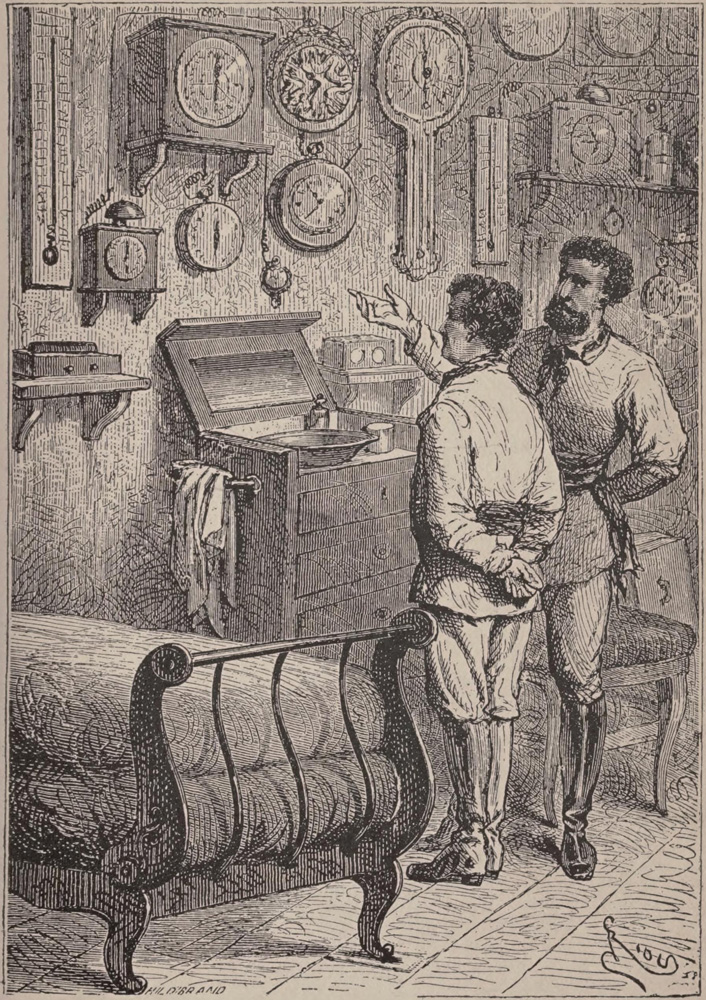
“I can understand, Captain, the delight of wandering about in the midst of such riches. You are one of those who have collected their treasures themselves. No museum in Europe possesses such a collection of the produce of the ocean. But if I exhaust all my admiration upon it, I shall have none left for the vessel which carries it. I do not wish to pry into your secrets; but I must confess that this Nautilus, with the motive power which is confined in it, the contrivances which enable it to be worked, the powerful agent which propels it, all excite my curiosity to the highest pitch. I see suspended on the walls of this room instruments of whose use I am ignorant.”
“I can understand, Captain, the delight of wandering among such riches. You are one of those who have collected their treasures themselves. No museum in Europe has such a collection of things from the ocean. But if I use up all my admiration on the collection, I will have none left for the vessel that carries it. I do not want to pry into your secrets. But I must confess that this Nautilus arouses my curiosity to the highest degree. So do the power it contains, the devices used to operate it, and the powerful force that drives it forward. I see instruments hanging on the walls of this room, and I do not know what they are used for.”
“You will find these same instruments in my own room, Professor, where I shall have much pleasure in explaining their use to you. But first come and inspect the cabin which is set apart for your own use. You must see how you will be accommodated on board the Nautilus.”
“You will find these same instruments in my room, Professor. I’ll be happy to explain how to use them there. But first, come and see the cabin set aside for you. You should see where you’ll be staying aboard the Nautilus.”
I followed Captain Nemo, who, by one of the doors opening from each panel of the drawing-room, regained the waist. He conducted me towards the bow, and there I found, not a cabin, but an elegant room, with a bed, dressing-table, and several other pieces of furniture.
I followed Captain Nemo through one of the doors in the drawing room’s panels and back to the middle of the vessel. He led me toward the bow. There I found not a cabin, but an elegant room with a bed, a dressing table, and several other pieces of furniture.
I could only thank my host.
I could only thank my host.
“Your room adjoins mine,” said he, opening a door, “and mine opens into the drawing-room that we have just quitted.”
“Your room is next to mine,” he said, opening a door, “and mine opens into the sitting room we just left.”
I entered the Captain’s room: it had a severe, almost a monkish, aspect. A small iron bedstead, a table, some articles for the toilet; the whole lighted by a skylight. No comforts, the strictest necessaries only.
I entered the Captain’s room. It was austere, almost like a monk’s cell. It had a small iron bed, a table, and some toiletries. A skylight lit the room. There were no comforts, only the bare necessities.
Captain Nemo pointed to a seat.
Captain Nemo pointed to a seat.
“Be so good as to sit down,” he said. I seated myself, and he began thus:
“Please sit down,” he said. I sat down, and he began: