Part 2, Chapter 6
The Greek Archipelago
The next day, the 12th of February, at the dawn of day, the Nautilus rose to the surface. I hastened on to the platform. Three miles to the south the dim outline of Pelusium was to be seen. A torrent had carried us from one sea to another. About seven o’clock Ned and Conseil joined me.
The next day, February 12, the Nautilus rose to the surface at dawn. I hurried onto the platform. Three miles to the south, I could see the faint outline of Pelusium. A torrent had carried us from one sea to another. Around seven o’clock, Ned and Conseil joined me.
“Well, Sir Naturalist,” said the Canadian, in a slightly jovial tone, “and the Mediterranean?”
“Well, Mr. Naturalist,” said the Canadian, sounding slightly cheerful, “what about the Mediterranean?”
“We are floating on its surface, friend Ned.”
“We’re floating on its surface, Ned.”
“What!” said Conseil, “this very night.”
“What!” said Conseil, “tonight?”
“Yes, this very night; in a few minutes we have passed this impassable isthmus.”
“Yes, tonight. We crossed this impassable isthmus in just a few minutes.”
“I do not believe it,” replied the Canadian.
“I don’t believe it,” said the Canadian.
“Then you are wrong, Master Land,” I continued; “this low coast which rounds off to the south is the Egyptian coast. And you who have such good eyes, Ned, you can see the jetty of Port Said stretching into the sea.”
“Then you’re wrong, Master Land,” I continued. “This low coast curves south. It’s the Egyptian coast. And with your sharp eyes, Ned, you can see the Port Said jetty stretching into the sea.”
The Canadian looked attentively.
The Canadian looked carefully.
“Certainly you are right, sir, and your Captain is a first-rate man. We are in the Mediterranean. Good! Now, if you please, let us talk of our own little affair, but so that no one hears us.”
“Of course you’re right, sir, and your captain is a first-rate man. We’re in the Mediterranean. Good! Now, please, let’s talk about our own little affair, but make sure no one hears us.”
I saw what the Canadian wanted, and, in any case, I thought it better to let him talk, as he wished it; so we all three went and sat down near the lantern, where we were less exposed to the spray of the blades.
I understood what the Canadian wanted. In any case, I thought it best to let him talk, since he wanted to. So the three of us sat down near the lantern, where we were more sheltered from the spray of the blades.
“Now, Ned, we listen; what have you to tell us?”
“Now, Ned, we're listening. What do you have to tell us?”
“What I have to tell you is very simple. We are in Europe; and before Captain Nemo’s caprices drag us once more to the bottom of the Polar Seas, or lead us into Oceania, I ask to leave the Nautilus.”
“What I have to tell you is very simple. We are in Europe. I want to leave the Nautilus before Captain Nemo’s whims drag us back to the bottom of the Polar Seas or take us to Oceania.”
I wished in no way to shackle the liberty of my companions, but I certainly felt no desire to leave Captain Nemo.
I did not want to restrict my companions’ freedom in any way, but I had no desire to leave Captain Nemo.
Thanks to him, and thanks to his apparatus, I was each day nearer the completion of my submarine studies; and I was rewriting my book of submarine depths in its very element. Should I ever again have such an opportunity of observing the wonders of the ocean? No, certainly not! And I could not bring myself to the idea of abandoning the Nautilus before the cycle of investigation was accomplished.
Thanks to him and his equipment, I came closer each day to completing my underwater studies. I was rewriting my book about the ocean depths while immersed in them. Would I ever again have such a chance to observe the wonders of the ocean? No, certainly not! I could not bear the thought of leaving the Nautilus before my research was complete.
“Friend Ned, answer me frankly, are you tired of being on board? Are you sorry that destiny has thrown us into Captain Nemo’s hands?”
“Ned, tell me honestly, are you tired of being on board? Do you regret that fate put us in Captain Nemo’s hands?”
The Canadian remained some moments without answering. Then, crossing his arms, he said:
The Canadian said nothing for a few moments. Then he crossed his arms and said:
“Frankly, I do not regret this journey under the seas. I shall be glad to have made it; but, now that it is made, let us have done with it. That is my idea.”
“Honestly, I don’t regret this journey under the sea. I’ll be glad I made it. But now that it’s over, let’s be done with it. That’s how I feel.”
“It will come to an end, Ned.”
“It will end, Ned.”
“Where and when?”
“Where and when?”
“Where I do not know—when I cannot say; or, rather, I suppose it will end when these seas have nothing more to teach us.”
“I don’t know where, and I can’t say when. Or rather, I suppose it will end when these seas have nothing more to teach us.”
“Then what do you hope for?” demanded the Canadian.
“Then what are you hoping for?” the Canadian demanded.
“That circumstances may occur as well six months hence as now by which we may and ought to profit.”
“Opportunities may arise six months from now, just as they may arise now, and we can and should take advantage of them.”
“Oh!” said Ned Land, “and where shall we be in six months, if you please, Sir Naturalist?”
“Oh!” said Ned Land. “And where will we be in six months, Sir Naturalist, if you please?”
“Perhaps in China; you know the Nautilus is a rapid traveller. It goes through water as swallows through the air, or as an express on the land. It does not fear frequented seas; who can say that it may not beat the coasts of France, England, or America, on which flight may be attempted as advantageously as here.”
“Perhaps in China. You know the Nautilus travels fast. It moves through water like swallows through the air or an express train on land. It does not fear busy seas. Who can say it won't cruise along the coasts of France, England, or America? We might attempt to escape from those shores just as easily as here.”
“M. Aronnax,” replied the Canadian, “your arguments are rotten at the foundation. You speak in the future, ‘We shall be there! we shall be here!’ I speak in the present, ‘We are here, and we must profit by it.’”
“M. Aronnax,” replied the Canadian, “your arguments are rotten at their core. You talk about the future: ‘We’ll be there! We’ll be here!’ I talk about the present: ‘We’re here, and we must make the most of it.’”
Ned Land’s logic pressed me hard, and I felt myself beaten on that ground. I knew not what argument would now tell in my favour.
Ned Land’s reasoning was hard to counter, and I felt he had beaten me on that point. I didn’t know what argument I could make in my favor now.
“Sir,” continued Ned, “let us suppose an impossibility: if Captain Nemo should this day offer you your liberty; would you accept it?”
“Sir,” Ned continued, “let’s imagine something impossible. If Captain Nemo offered you your freedom today, would you accept it?”
“I do not know,” I answered.
“I don't know,” I answered.
“And if,” he added, “the offer made you this day was never to be renewed, would you accept it?”
“And if,” he added, “the offer made to you today were never repeated, would you accept it?”
“Friend Ned, this is my answer. Your reasoning is against me. We must not rely on Captain Nemo’s good-will. Common prudence forbids him to set us at liberty. On the other side, prudence bids us profit by the first opportunity to leave the Nautilus.”
“Ned, my friend, here is my answer. Your reasoning is against me. We cannot rely on Captain Nemo’s goodwill. Common sense tells him not to set us free. On the other hand, common sense tells us to leave the Nautilus at the first opportunity.”
“Well, M. Aronnax, that is wisely said.”
“Well, M. Aronnax, that's a wise thing to say.”
“Only one observation—just one. The occasion must be serious, and our first attempt must succeed; if it fails, we shall never find another, and Captain Nemo will never forgive us.”
“Just one observation. The occasion must be serious, and our first attempt must succeed. If it fails, we will never have another chance, and Captain Nemo will never forgive us.”
“All that is true,” replied the Canadian. “But your observation applies equally to all attempts at flight, whether in two years’ time, or in two days’. But the question is still this: If a favourable opportunity presents itself, it must be seized.”
“All that is true,” replied the Canadian. “But your point applies equally to all escape attempts, whether in two years or two days. The question remains: If a good opportunity comes, we must seize it.”
“Agreed! And now, Ned, will you tell me what you mean by a favourable opportunity?”
“Agreed! Now, Ned, what do you mean by a good opportunity?”
“It will be that which, on a dark night, will bring the Nautilus a short distance from some European coast.”
“It will be whatever brings the Nautilus close to some European coast on a dark night.”
“And you will try and save yourself by swimming?”
“And will you try to save yourself by swimming?”
“Yes, if we were near enough to the bank, and if the vessel was floating at the time. Not if the bank was far away, and the boat was under the water.”
“Yes, if we were close enough to the bank and the boat was floating at the time. Not if the bank was far away and the boat was underwater.”
“And in that case?”
“And in that case?”
“In that case, I should seek to make myself master of the pinnace. I know how it is worked. We must get inside, and the bolts once drawn, we shall come to the surface of the water, without even the pilot, who is in the bows, perceiving our flight.”
“In that case, I would try to take control of the pinnace. I know how it works. We must get inside and draw the bolts. Then we will rise to the surface without even the pilot in the bow noticing our escape.”
“Well, Ned, watch for the opportunity; but do not forget that a hitch will ruin us.”
“Well, Ned, watch for a chance. But don't forget that one setback will ruin us.”
“I will not forget, sir.”
“I won’t forget, sir.”
“And now, Ned, would you like to know what I think of your project?”
“And now, Ned, would you like to know what I think of your plan?”
“Certainly, M. Aronnax.”
“Certainly, Mr. Aronnax.”
“Well, I think—I do not say I hope—I think that this favourable opportunity will never present itself.”
“Well, I think this good opportunity will never come. I don't say I hope it won't.”
“Why not?”
“Why not?”
“Because Captain Nemo cannot hide from himself that we have not given up all hope of regaining our liberty, and he will be on his guard, above all, in the seas and in the sight of European coasts.”
“Because Captain Nemo knows we have not given up all hope of regaining our freedom. He will be on guard, especially at sea and within sight of European coasts.”
“We shall see,” replied Ned Land, shaking his head determinedly.
“We’ll see,” Ned Land replied, shaking his head firmly.
“And now, Ned Land,” I added, “let us stop here. Not another word on the subject. The day that you are ready, come and let us know, and we will follow you. I rely entirely upon you.”
“And now, Ned Land,” I added, “let’s leave it there. Not another word about it. When you’re ready, come and tell us, and we’ll follow you. I’m counting entirely on you.”
Thus ended a conversation which, at no very distant time, led to such grave results. I must say here that facts seemed to confirm my foresight, to the Canadian’s great despair. Did Captain Nemo distrust us in these frequented seas? or did he only wish to hide himself from the numerous vessels, of all nations, which ploughed the Mediterranean? I could not tell; but we were oftener between waters and far from the coast. Or, if the Nautilus did emerge, nothing was to be seen but the pilot’s cage; and sometimes it went to great depths, for, between the Grecian Archipelago and Asia Minor we could not touch the bottom by more than a thousand fathoms.
That was how our conversation ended. Before long, it would lead to serious consequences. I must say that events seemed to confirm my fears, to the Canadian’s great despair. Did Captain Nemo distrust us in these busy waters? Or did he simply want to hide from the many ships of all nations sailing the Mediterranean? I could not tell. But we spent more time underwater and far from the coast. If the Nautilus did surface, only the pilot’s enclosure could be seen. Sometimes the vessel went very deep. Between the Grecian Archipelago and Asia Minor, the water was more than a thousand fathoms deep.
Thus I only knew we were near the Island of Carpathos, one of the Sporades, by Captain Nemo reciting these lines from Virgil:
So I knew we were near the Island of Carpathos, one of the Sporades, only because Captain Nemo recited these lines from Virgil:
“Est Carpathio Neptuni gurgite vates, Caeruleus Proteus,”
“In Neptune’s Carpathian sea lives a prophet, the blue Proteus,”
as he pointed to a spot on the planisphere.
as he pointed to a spot on the world map.
It was indeed the ancient abode of Proteus, the old shepherd of Neptune’s flocks, now the Island of Scarpanto, situated between Rhodes and Crete. I saw nothing but the granite base through the glass panels of the saloon.
This was indeed the ancient home of Proteus, the old shepherd of Neptune’s flocks. It is now the Island of Scarpanto, between Rhodes and Crete. Through the saloon’s glass panels, I could see only its granite base.
The next day, the 14th of February, I resolved to employ some hours in studying the fishes of the Archipelago; but for some reason or other the panels remained hermetically sealed. Upon taking the course of the Nautilus, I found that we were going towards Candia, the ancient Isle of Crete. At the time I embarked on the Abraham Lincoln, the whole of this island had risen in insurrection against the despotism of the Turks. But how the insurgents had fared since that time I was absolutely ignorant, and it was not Captain Nemo, deprived of all land communications, who could tell me.
The next day, February 14, I decided to spend a few hours studying the fish of the Archipelago. But for some reason, the panels remained sealed shut. When I checked the course of the Nautilus, I found that we were heading toward Candia, the ancient Isle of Crete. When I boarded the Abraham Lincoln, the entire island had risen in revolt against the tyranny of the Turks. But I had no idea how the rebels had fared since then. And Captain Nemo, cut off from all contact with land, could not tell me.
I made no allusion to this event when that night I found myself alone with him in the saloon. Besides, he seemed to be taciturn and preoccupied. Then, contrary to his custom, he ordered both panels to be opened, and, going from one to the other, observed the mass of waters attentively. To what end I could not guess; so, on my side, I employed my time in studying the fish passing before my eyes.
I did not mention the event when I was alone with him in the saloon that night. Besides, he seemed quiet and distracted. Then, unusually for him, he ordered both panels opened. He went from one to the other, studying the mass of water intently. I could not guess why, so I spent my time studying the fish passing before my eyes.
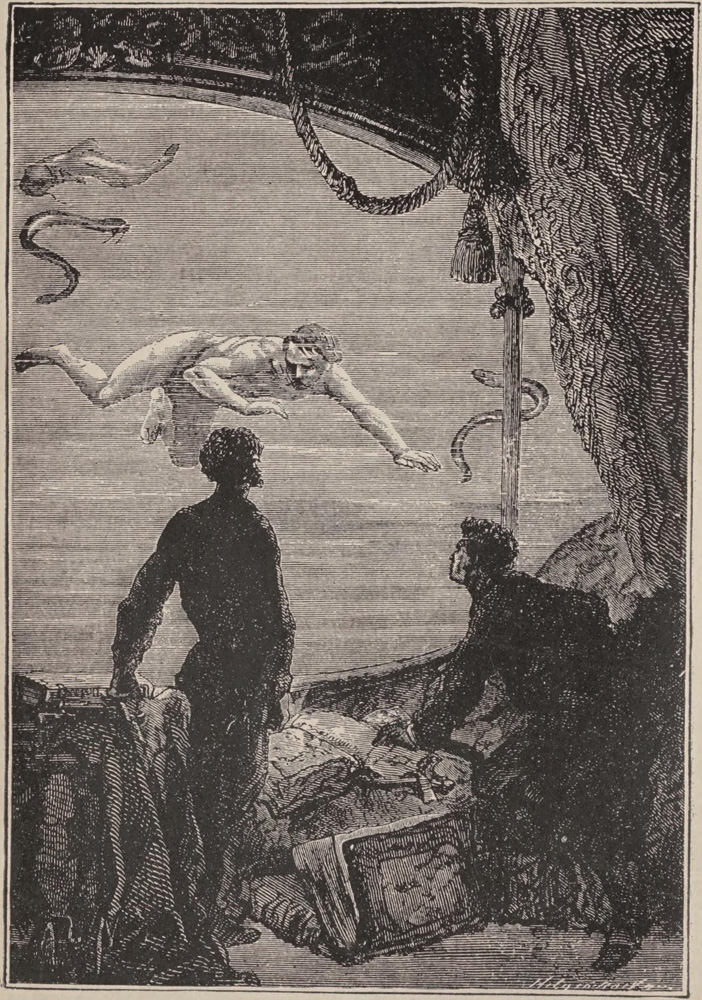
In the midst of the waters a man appeared, a diver, carrying at his belt a leathern purse. It was not a body abandoned to the waves; it was a living man, swimming with a strong hand, disappearing occasionally to take breath at the surface.
A man appeared in the water. He was a diver, with a leather pouch at his belt. He was not a body abandoned to the waves. He was alive, swimming strongly and occasionally coming up to the surface for air.
I turned towards Captain Nemo, and in an agitated voice exclaimed:
I turned to Captain Nemo and exclaimed in an agitated voice:
“A man shipwrecked! He must be saved at any price!”
“A man has been shipwrecked! We must save him at any cost!”
The Captain did not answer me, but came and leaned against the panel.
The Captain didn't answer me, but came over and leaned against the panel.
The man had approached, and, with his face flattened against the glass, was looking at us.
The man had come closer and was looking at us with his face pressed against the glass.
To my great amazement, Captain Nemo signed to him. The diver answered with his hand, mounted immediately to the surface of the water, and did not appear again.
To my great amazement, Captain Nemo signaled to him. The diver responded with a hand signal, immediately rose to the surface, and did not appear again.
“Do not be uncomfortable,” said Captain Nemo. “It is Nicholas of Cape Matapan, surnamed Pesca. He is well known in all the Cyclades. A bold diver! water is his element, and he lives more in it than on land, going continually from one island to another, even as far as Crete.”
“Don’t be uneasy,” said Captain Nemo. “That is Nicholas of Cape Matapan, nicknamed Pesca. He is well known throughout the Cyclades. What a daring diver! Water is his element, and he spends more time in it than on land. He travels constantly from one island to another, even as far as Crete.”
“You know him, Captain?”
“Do you know him, Captain?”
“Why not, M. Aronnax?”
“Why not, Mr. Aronnax?”
Saying which, Captain Nemo went towards a piece of furniture standing near the left panel of the saloon. Near this piece of furniture, I saw a chest bound with iron, on the cover of which was a copper plate, bearing the cypher of the Nautilus with its device.
After saying this, Captain Nemo went to a piece of furniture near the saloon’s left wall. Beside it, I saw an iron-bound chest. A copper plate on its lid bore the Nautilus’s monogram and motto.
At that moment, the Captain, without noticing my presence, opened the piece of furniture, a sort of strong box, which held a great many ingots.
At that moment, the Captain opened a piece of furniture without noticing me. It was a kind of strongbox that held many ingots.
They were ingots of gold. From whence came this precious metal, which represented an enormous sum? Where did the Captain gather this gold from? and what was he going to do with it?
They were gold bars. Where had this precious metal, worth an enormous sum, come from? Where had the Captain gathered the gold, and what was he going to do with it?
I did not say one word. I looked. Captain Nemo took the ingots one by one, and arranged them methodically in the chest, which he filled entirely. I estimated the contents at more than 4,000 lbs. weight of gold, that is to say, nearly £200,000.
I said nothing. I watched. Captain Nemo took the ingots one by one and carefully arranged them in the chest. He filled it completely. I estimated that the chest held more than 4,000 pounds of gold, worth nearly £200,000.
The chest was securely fastened, and the Captain wrote an address on the lid, in characters which must have belonged to Modern Greece.
The chest was securely fastened. The Captain wrote an address on the lid in what must have been modern Greek characters.
This done, Captain Nemo pressed a knob, the wire of which communicated with the quarters of the crew. Four men appeared, and, not without some trouble, pushed the chest out of the saloon. Then I heard them hoisting it up the iron staircase by means of pulleys.
Once this was done, Captain Nemo pressed a button wired to the crew’s quarters. Four men appeared and pushed the chest out of the salon, though not without some difficulty. Then I heard them using pulleys to lift it up the iron staircase.
At that moment, Captain Nemo turned to me.
At that moment, Captain Nemo turned to me.
“And you were saying, sir?” said he.
“And you were saying, sir?” he said.
“I was saying nothing, Captain.”
“I wasn't saying anything, Captain.”
“Then, sir, if you will allow me, I will wish you good night.”
“Then, sir, if you don't mind, I'll say good night.”
Whereupon he turned and left the saloon.
Then he turned and left the saloon.
I returned to my room much troubled, as one may believe. I vainly tried to sleep—I sought the connecting link between the apparition of the diver and the chest filled with gold. Soon, I felt by certain movements of pitching and tossing that the Nautilus was leaving the depths and returning to the surface.
I returned to my room deeply troubled, as you can imagine. I tried in vain to sleep. I searched for a connection between the appearance of the diver and the chest full of gold. Soon, I felt the Nautilus pitch and roll as it left the depths and returned to the surface.
Then I heard steps upon the platform; and I knew they were unfastening the pinnace and launching it upon the waves. For one instant it struck the side of the Nautilus, then all noise ceased.
Then I heard footsteps on the platform. I knew they were unfastening the small boat and launching it into the waves. The boat struck the side of the Nautilus for an instant, then all noise stopped.
Two hours after, the same noise, the same going and coming was renewed; the boat was hoisted on board, replaced in its socket, and the Nautilus again plunged under the waves.
Two hours later, the same noises and movement began again. The boat was hoisted aboard and put back in its socket. The Nautilus plunged beneath the waves again.
So these millions had been transported to their address. To what point of the continent? Who was Captain Nemo’s correspondent?
So these millions had been delivered to their destination. Where on the continent? Who was Captain Nemo’s correspondent?
The next day I related to Conseil and the Canadian the events of the night, which had excited my curiosity to the highest degree. My companions were not less surprised than myself.
The next day, I told Conseil and the Canadian about the night’s events, which had greatly aroused my curiosity. My companions were just as surprised as I was.
“But where does he take his millions to?” asked Ned Land.
“But where does he take his millions?” asked Ned Land.
To that there was no possible answer. I returned to the saloon after having breakfast and set to work. Till five o’clock in the evening I employed myself in arranging my notes. At that moment—(ought I to attribute it to some peculiar idiosyncrasy)—I felt so great a heat that I was obliged to take off my coat. It was strange, for we were under low latitudes; and even then the Nautilus, submerged as it was, ought to experience no change of temperature. I looked at the manometer; it showed a depth of sixty feet, to which atmospheric heat could never attain.
There was no possible answer to that. After breakfast, I returned to the saloon and went to work. I spent the time until five in the evening arranging my notes. Then I felt so hot that I had to take off my coat. Was this due to some peculiarity of my own? It was strange, for we were in low latitudes. Even so, the Nautilus was submerged, and its temperature should not have changed. I looked at the manometer. It showed a depth of sixty feet, far beyond the reach of heat from the air.
I continued my work, but the temperature rose to such a pitch as to be intolerable.
I continued my work, but the temperature rose until it was unbearable.
“Could there be fire on board?” I asked myself.
“Could there be a fire on board?” I wondered.
I was leaving the saloon, when Captain Nemo entered; he approached the thermometer, consulted it, and, turning to me, said:
I was leaving the saloon when Captain Nemo entered. He walked over to the thermometer, checked it, and turned to me. Then he said:
“Forty-two degrees.”
“Forty-two degrees.”
“I have noticed it, Captain,” I replied; “and if it gets much hotter we cannot bear it.”
“I’ve noticed, Captain,” I replied. “If it gets much hotter, we won’t be able to bear it.”
“Oh, sir, it will not get hotter if we do not wish it.”
“Oh, sir, it won’t get hotter if we don’t want it to.”
“You can reduce it as you please, then?”
“So you can reduce it however you like?”
“No; but I can go farther from the stove which produces it.”
“No, but I can move farther away from the stove that produces it.”
“It is outward, then!”
“So it’s going outward!”
“Certainly; we are floating in a current of boiling water.”
“Certainly. We are floating in a current of boiling water.”
“Is it possible!” I exclaimed.
“Is that possible!” I exclaimed.
“Look.”
“Look.”
The panels opened, and I saw the sea entirely white all round. A sulphurous smoke was curling amid the waves, which boiled like water in a copper. I placed my hand on one of the panes of glass, but the heat was so great that I quickly took it off again.
The panels opened, and I saw that the sea was completely white all around. Sulfurous smoke curled among the waves, which boiled like water in a kettle. I put my hand on one of the glass panes, but it was so hot that I quickly pulled it away.
“Where are we?” I asked.
“Where are we?” I asked.
“Near the Island of Santorin, sir,” replied the Captain. “I wished to give you a sight of the curious spectacle of a submarine eruption.”
“Near the Island of Santorin, sir,” replied the Captain. “I wanted to show you the curious sight of an underwater eruption.”
“I thought,” said I, “that the formation of these new islands was ended.”
“I thought,” I said, “that new islands had stopped forming.”
“Nothing is ever ended in the volcanic parts of the sea,” replied Captain Nemo; “and the globe is always being worked by subterranean fires. Already, in the nineteenth year of our era, according to Cassiodorus and Pliny, a new island, Theia (the divine), appeared in the very place where these islets have recently been formed. Then they sank under the waves, to rise again in the year 69, when they again subsided. Since that time to our days the Plutonian work has been suspended. But on the 3rd of February, 1866, a new island, which they named George Island, emerged from the midst of the sulphurous vapour near Nea Kamenni, and settled again the 6th of the same month. Seven days after, the 13th of February, the Island of Aphroessa appeared, leaving between Nea Kamenni and itself a canal ten yards broad. I was in these seas when the phenomenon occurred, and I was able therefore to observe all the different phases. The Island of Aphroessa, of round form, measured 300 feet in diameter, and 30 feet in height. It was composed of black and vitreous lava, mixed with fragments of felspar. And lately, on the 10th of March, a smaller island, called Reka, showed itself near Nea Kamenni, and since then these three have joined together, forming but one and the same island.”
“Nothing ever comes to an end in the volcanic parts of the sea,” replied Captain Nemo. “Underground fires are always at work inside the globe. According to Cassiodorus and Pliny, a new island appeared in the nineteenth year of our era. It was called Theia, meaning ‘the divine,’ and appeared where these islets have recently formed. Then the islets sank beneath the waves, only to rise again in the year 69, before sinking once more. From then until our own time, the work of Pluto was suspended. But on February 3, 1866, a new island emerged from the sulfurous vapor near Nea Kamenni. It was named George Island and sank again on February 6. Seven days later, on February 13, the Island of Aphroessa appeared. It left a channel ten yards wide between itself and Nea Kamenni. I was in these seas when this happened, so I was able to observe every stage. The Island of Aphroessa was round, 300 feet across and 30 feet high. It was made of black, glassy lava mixed with fragments of feldspar. More recently, on March 10, a smaller island called Reka appeared near Nea Kamenni. Since then, these three islands have joined together to form a single island.”
“And the canal in which we are at this moment?” I asked.
“And the canal we’re in right now?” I asked.
“Here it is,” replied Captain Nemo, showing me a map of the Archipelago. “You see, I have marked the new islands.”
“Here it is,” Captain Nemo replied, showing me a map of the Archipelago. “You can see that I’ve marked the new islands.”
I returned to the glass. The Nautilus was no longer moving, the heat was becoming unbearable. The sea, which till now had been white, was red, owing to the presence of salts of iron. In spite of the ship’s being hermetically sealed, an insupportable smell of sulphur filled the saloon, and the brilliancy of the electricity was entirely extinguished by bright scarlet flames. I was in a bath, I was choking, I was broiled.
I returned to the glass. The Nautilus had stopped moving, and the heat was becoming unbearable. Until now, the sea had been white. It was red because of iron salts. Although the ship was airtight, an unbearable smell of sulfur filled the saloon. Bright scarlet flames completely overwhelmed the electric light. I was in a bath, I was choking, I was roasting.
“We can remain no longer in this boiling water,” said I to the Captain.
“We can't stay in this boiling water any longer,” I said to the Captain.
“It would not be prudent,” replied the impassive Captain Nemo.
“That wouldn't be wise,” replied Captain Nemo without showing any emotion.
An order was given; the Nautilus tacked about and left the furnace it could not brave with impunity. A quarter of an hour after we were breathing fresh air on the surface. The thought then struck me that, if Ned Land had chosen this part of the sea for our flight, we should never have come alive out of this sea of fire.
An order was given, and the Nautilus turned away from the furnace it could not face without danger. Fifteen minutes later, we were breathing fresh air at the surface. Then it struck me that if Ned Land had chosen this part of the sea for our escape, we would never have escaped that sea of fire alive.
The next day, the 16th of February, we left the basin which, between Rhodes and Alexandria, is reckoned about 1,500 fathoms in depth, and the Nautilus, passing some distance from Cerigo, quitted the Grecian Archipelago after having doubled Cape Matapan.
The next day, February 16, we left the basin between Rhodes and Alexandria, estimated to be 1,500 fathoms deep. The Nautilus passed some distance from Cerigo, then rounded Cape Matapan and left the Grecian Archipelago.